Here are, in no particular order, the top 10 tasks for which I use Logos Bible Software. Most of these uses are for preaching and teaching preparation, or for when I’m preparing to lead a Bible study. This post is a visual tour, so if you want to see any image in more detail, you can click to enlarge it or open it in a new tab or window.
10. To look up a word in a dictionary.
Here’s a word l00k-up in the Anchor Yale Bible Dictionary, which I can do from an already-open text, or as a stand-alone, searchable dictionary. Here I move from the article on Jesus I was reading to an article on “Tax Collector”:
Looking Up a Word in Anchor Bible Dictionary
9. To annotate commentaries.
Here you can see both highlights (which sync seamlessly across devices) and a notes icon from where I have recorded my own reactions:
Commentary Reading on Logos on a PC
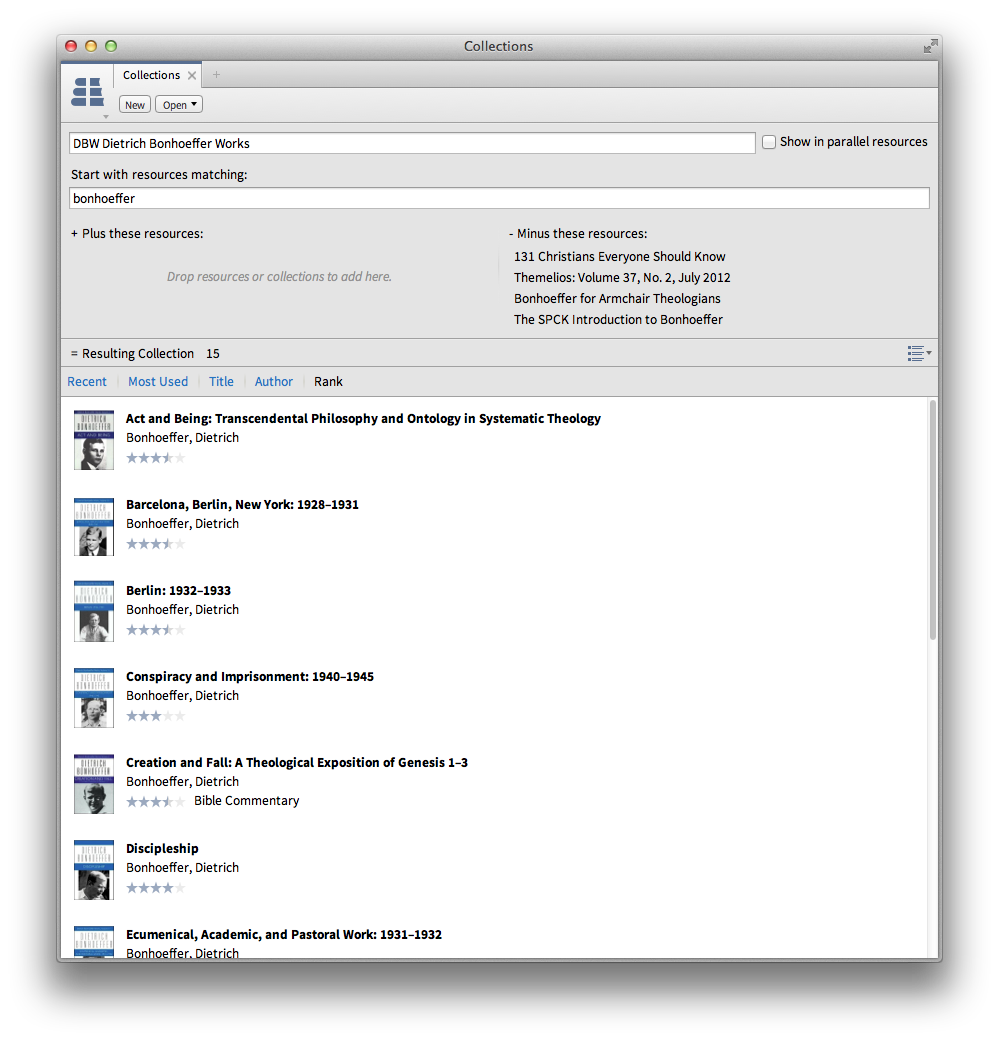
8. To create (and then search) my own defined collection of resources.
7. To navigate through a book via Table of Contents sidebar.
As at left here:
Sidebar Table of Contents
6. As a portable library.
Here’s the searchable library view in Logos in iOS, where one can access almost all of one’s library. In iOS you can access all of your resources with an Internet connection without having to download them. You can also download them, so that you don’t have to use data or a wireless connection. I like the flexibility that offers.
iOS Logos Library
5. For keyword searching a commentary.
This is particularly useful when I want to know not just what a commentary says about a passage, but how it traces a theme throughout the book.
Keyword Searching NIGTC Matthew for “Kingdom”
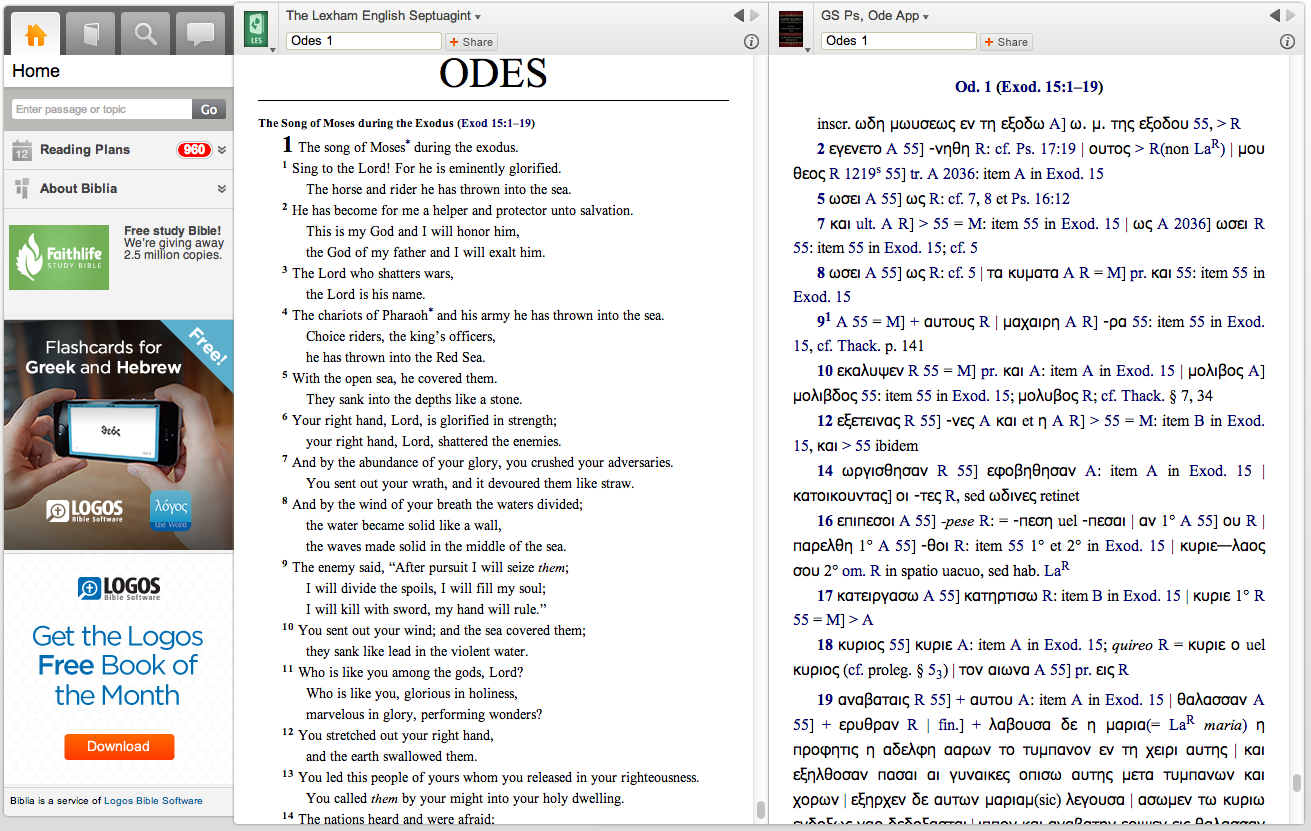
4. Via Logos’s Biblia.com, for quick reference to my Logos library from anywhere with Web access.
Here I am looking at the Odes in Greek and English translation:
Reading the Septuagint at Biblia.com
3. For pulling up at once all I have in my library on a given passage.
Logos’s Passage Guide is available on whatever device you have Logos in; here it is in iOS. Using a split screen, I can read one commentary (and highlight it), as well as see other hyperlinked options to explore:
Passage Guide in Logos iOS
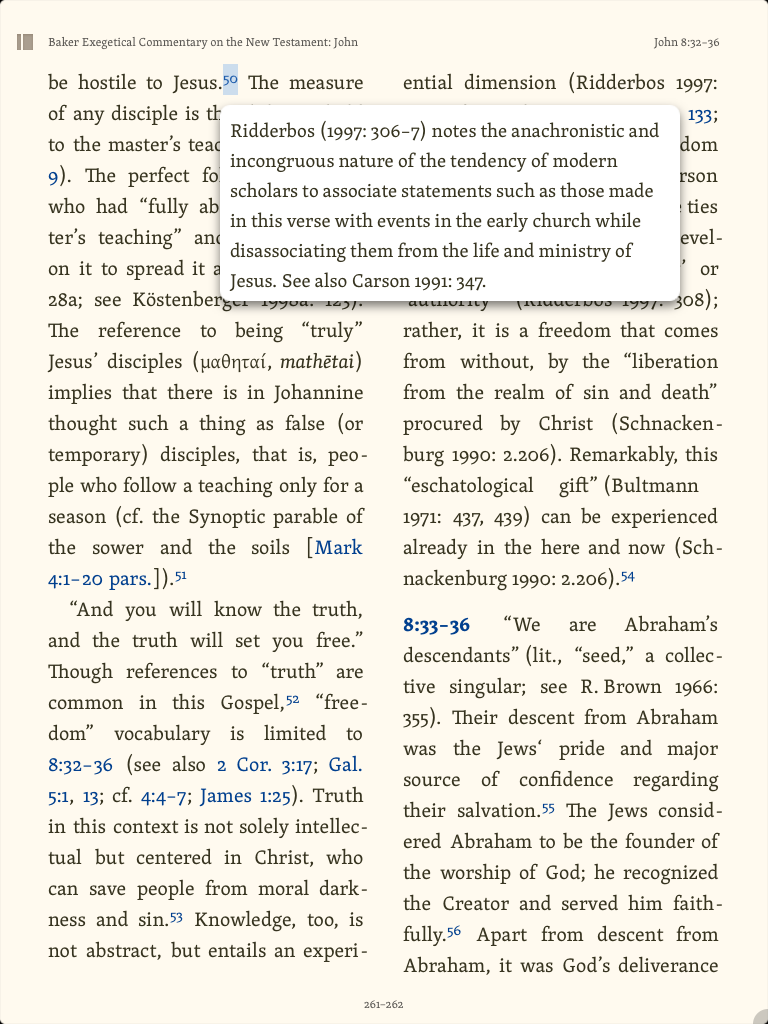
2. For touching footnotes to pull them up.
This I can do in iOS:
Tapping a Hyperlinked Footnote Brings It Up
1. For reading through a book of the Bible, with help.
Here is a layout I used often for when I read with a group of folks through Greek Isaiah in a Year. I could compare multiple Greek texts, a Hebrew text, English translations, lexicons, notes, and more:
Multi-Text and Multi-Resource Layout
The major advantages in Logos are its connections of resources to each other, system of hyperlinks, and ability to sync (notes, highlights, and where you left off reading) across devices. Not only that, but even compared to Amazon Kindle and iBooks, they have the most extensive store/library of resources for biblical studies that I know of. There’s a lot more you can do in Logos than what I’ve highlighted above. You can find all my Logos reviews gathered here.
This month’s free book in Logos Bible Software is 300 Quotations for Preachers from the Puritans. It is free as a stand-alone, and also part of a larger series I reviewed about a year ago, 1,500 Quotations for Preachers.
Here’s the link to the free 300 quotations book. Richard Baxter, John Bunyan, Jonathan Edwards, John Owen, and a number of others are included.
There is also a short commentary on James (from Logos’s Pastorum Series) available for $0.99, here.
Renate Bethge’s Dietrich Bonhoeffer: A Brief Life, is about as short a Bonhoeffer biography as there is. Renate’s husband was the late Eberhard Bethge, Bonhoeffer’s dear friend and biographer. Renate is also Bonhoeffer’s niece.
Whereas Eberhard’s bio is well over 900 pages, Renate’s Brief Life is under 90. It’s laid out nicely, with lots of photographs, wide margins, and quotations from Bonhoeffer’s writing and correspondence. Given how little text is actually on a page, it’s a quick read.
The book offers a succinct overview of Bonhoeffer’s life, yet it does not lack substance in its brevity. Highlights for me were the overview of his parents (and their character, and its effect on Bonhoeffer), a chapter called “Contacts with Jews,” and the personal touch of including some of Bonhoeffer’s correspondence. His beautiful poem “Who Am I?” is re-printed here in its entirety.
There are brief mentions of his writings: Life Together, Ethics, and Letters and Papers from Prison (but not, surprisingly, Discipleship). Page 87 offers a nice one-page summary chronology of Bonhoeffer’s life.
Someone looking for biographical detail will want to look elsewhere, but this only claims to be a “brief” biography, which has value especially for folks like me who are coming seriously to Bonhoeffer for the first time. As I continue to read through Eberhard Bethge’s biography, it was nice to put it aside for a bit to get a quick overview of all of Bonhoeffer’s life.
The above book was an unexpected but welcomed gift from somebody (not a review copy from the publisher). It’s on Amazon here. See my other Bonhoeffer posts here.
For an exegesis course in seminary, I was assigned R.T. France’s Mark in the New International Greek Testament Commentary (NIGTC) series. The assignment was to read the entire commentary that semester, and I read every one of its 700+ pages. It was that good.
Like the rest of the NIGTC series, France’s volume focuses first on the Greek text, including textual variants where they arise. France is a careful interpreter and keeps the other synoptic gospels in view throughout the commentary. This is not, however, to the exclusion of a keen awareness of and sensitivity to the literary context of Mark as its own book. Even as he unpacks the lexical range of a Greek word, he keeps the larger contour of Mark in view.
As I mentioned in another France review, despite the technical nature of Mark, France moved me deeply with his interaction with the text. He helped me to know and love Jesus more deeply, using the Greek text of Mark as a means to that end. You can find France’s commentary on Amazon (affiliate link) here. It’s in Logos here, where it is well-produced and thoroughly hyperlinked.
For as much as I’ve reviewed Logos Bible Software, I’ve barely mentioned Biblia.com. It’s a Web-based way of accessing Logos resources you own. This is especially helpful for those times when I just need to pull up a commentary (like France’s) but don’t want to wait for Logos to open, load, or index. It looks like this (click on image to enlarge):
I haven’t found a way to make the ads at lower left disappear. Nor is Biblia intended to be as full-bodied as Logos (note that it’s in Beta). Since you can access it through any Web browser, it’s fairly universally accessible. Only real downside I’ve experienced: unlike Logos on iOS, Mac, and PC, you can’t highlight or take notes in any resources. But for reading texts–two at a time, as shown above–it’s pretty handy.
You can see above how I’m reading France’s Mark on the right, with a Bible open on the left. Regarding the way that Mark introduces John the Baptist at Mark 1:9, France writes:
(ἐν ἐκείναις ταῖς ἡμέραις has an equally formal, ‘biblical’ ring; Mark stands in the tradition of the great chroniclers of the acts of God in the OT.) It introduces a new phase in the story and, in this case, a new actor in the drama.
This is one of many examples of France’s using Greek to help the reader better understand what Mark is up to in his Gospel. His command of Greek and obvious love for God make this the first commentary to reach for when reading, teaching, or preaching on Mark.
Thanks to Logos for the review copy of the NIGTC series. See also my post about NIGTC Matthew in Logos here.
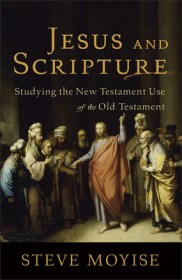
In early February I finished reading Steve Moyise’s Jesus and Scripture: Studying the New Testament Use of the Old Testament. You can read what I wrote about it here. Here is the concluding portion of that review:
Jesus and Scripture would be perfect for a seminary course on the Gospels, or on the NT use of the OT. An advanced undergrad course would also do well to adopt this book. I’d also recommend it to a serious Bible reader–no biblical languages are needed here, and I found that even with my own knowledge gaps in historical Jesus studies, Moyise explained everything I needed to know.
Though this survey is short (less than 150 pages), Moyise gives plenty of sample passages and insights that have challenged me. I know this is a book I will come back to and want to read again in the future.
This month Logos Bible Software is offering their edition of the book for free. It’s a fantastic book, and I look forward to being able to use it now electronically (with keyword searchability and hyperlinked Scripture references throughout). You can get the book here.
This month Bonhoeffer for Armchair Theologians is free in Logos Bible Software. You can find it here.
Here is part of the product description from Logos:
This volume in the ever-popular W. J. K. Armchair series turns its sights on contemporary theologian Dietrich Bonhoeffer (1906–1945). Born in Breslau, Germany, Bonhoeffer led quite an intriguing life. This book, with dozens of illustrations by artist Ron Hill, highlights Bonhoeffer’s background and theological education; his time at Union Seminary in New York City; his involvement in the resistance movement against Adolf Hitler; and his participation in the plot to assassinate Hitler.
The below is adapted from my full-length review of the print edition of NIGTC Matthew. Here I reproduce some of the content of that post, but with an eye toward the commentary’s presentation and use in Logos Bible Software.
Readers of this blog (and those with whom I worship on Sunday!) will know I’ve been preaching through Matthew this year. I have made profitable use of John Nolland’s commentary almost every week in my preparation.
This is what Nolland says about his commentary:
My central concern in this commentary is with the story Matthew has to tell and how he tells it. Though the reader will recognise that I have been influenced by some scholarly methods more than by others, my work is committedly eclectic.
Nolland comments on Matthew using redaction criticism, grammatical analysis, rhetorical criticism, and more. Though the NIGTC series does not seek to be devotional, per se, and though Nolland’s Matthew is not an application commentary, the author is consistently sensitive to the broader context of Matthew and his aims. (Nolland says he cares about “a close reading of the inner logic of the unfolding text.”)
Nolland’s Introduction to Matthew
The introduction includes the following sections (the bullet points below are all the author’s words):
authorship of the Gospel
the sources for the Gospel
the prehistory of the sources
the date and provenance of the Gospel
the kind of document the Gospel intends to be
the state of the Greek text of the Gospel
aspects of the author’s narrative technique
the Gospel’s use of the OT and of other Jewish tradition
and the theology of the Gospel of Matthew.
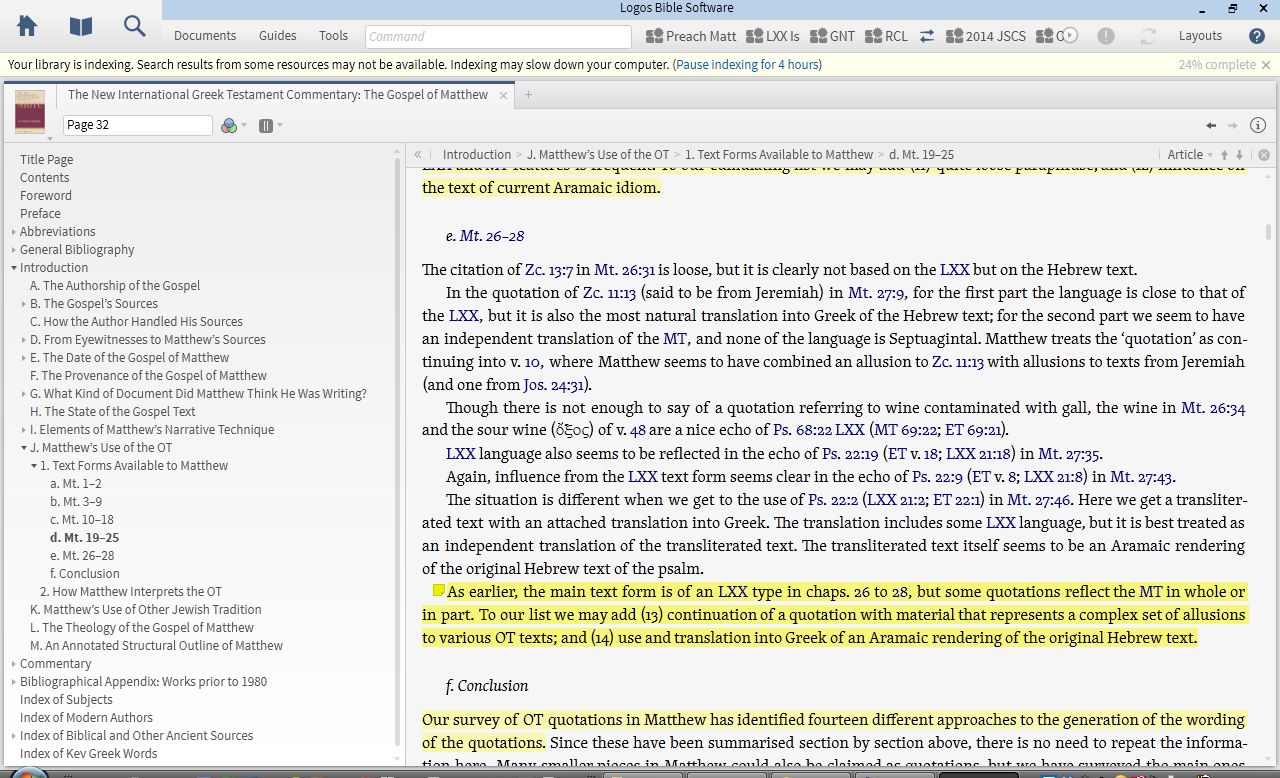
Here’s what it looks like in Logos on a PC. You can hide or show the table of contents at the left, and many of its sections have expand/collapse triangles (click or open in a new tab to enlarge the image below):
Introduction to Matthew
Any highlights or notes I add (which you can see above) automatically sync with any other devices that run the Logos app.
Like R.T. France, Nolland would rather elaborate on certain points in the body of the commentary itself, which makes the introduction accordingly shorter. I experienced this as a relief, because (a) I could get into the commentary proper more quickly and (b) when primarily coming to the commentary with a specific passage in mind, I found quite a bit of substance in the commentary proper, without having to go back to the introduction. Getting to a given passage via Logos is almost instantaneous.
Nolland on Matthew’s Use of the OT
There is more of note in the introduction, but “Matthew’s Use of the OT” is probably the most exceptional section (pictured above). It details both (a) what text forms Matthew might have had and (b) how he used them. Nolland lists 14 (!)“different approaches to the generation of the wording of the quotations.” And yet, amid the detail, he can conclude:
Though some of Matthew’s text forms come to him straight from the Gospel tradition, the overall impression is of a man who freshly scrutinises, at least on many occasions, the OT texts to which he appeals, and is able to do so in Greek, Hebrew (not always the Hebrew of the preserved MT), and occasionally in Aramaic. When it suits him to do so, he produces translations that reflect influence along more than one track of tradition.
Nolland then identifies eight different ways in which Matthew uses the OT. This section of the commentary alone is worth half the price of the commentary. A nearly 20-page “Annotated Structural Outline of Matthew” at the end of the introduction is quite impressive (and maybe even worth the other half of the price of the commentary).
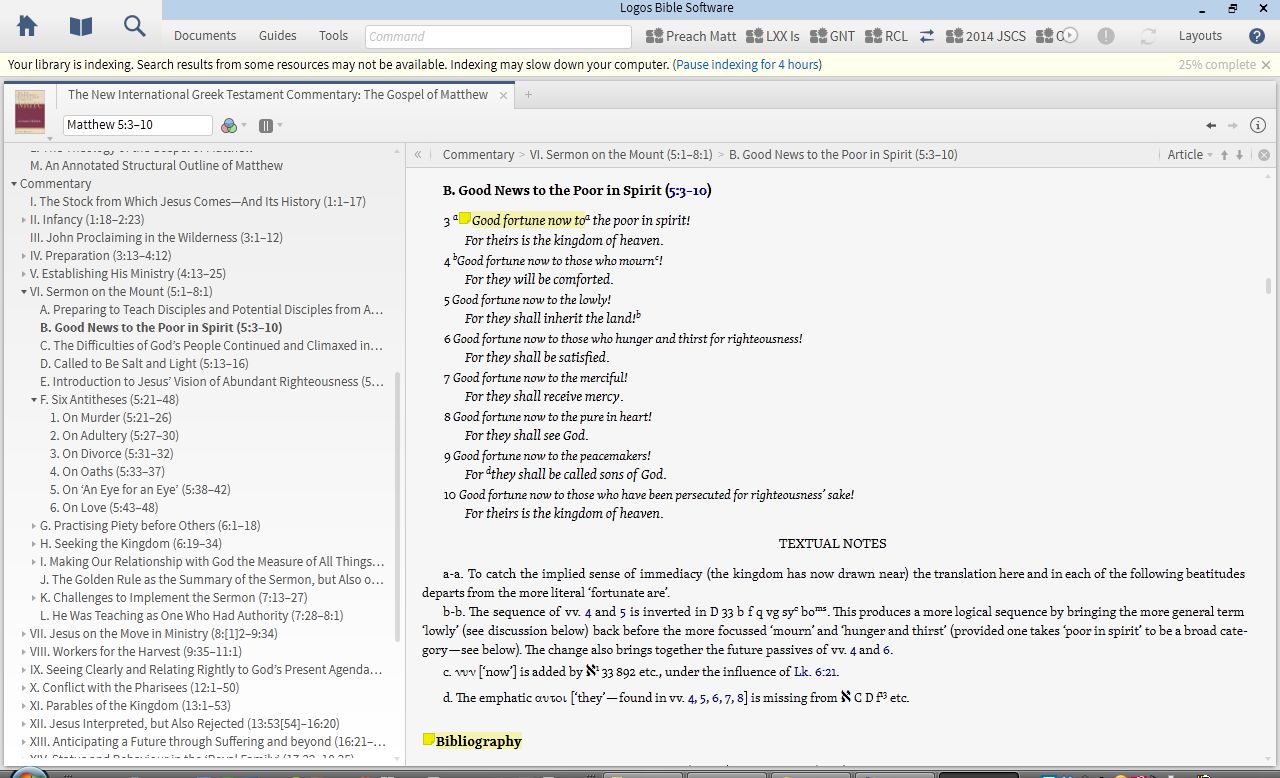
The Author’s Translation of Matthew
Nolland admits that his translation of Matthew (located at the beginning of each section) “may at times be wooden,” and this woodenness is noticeable in a number passages. For example, the genealogy reads: “Abraham produced Isaac; Isaac produced Jacob….” Nolland acknowledges the “unfortunately impersonal and nonbiological” implications of that translation. Indeed, a better word is needed.
And for the Beatitudes (where the Greek μακάριος is admittedly difficult to translate), he has, “Good fortune now to….” I liked the “now” part of this (it carries an “implied sense of immediacy”), but the more traditional “blessed” still seems to leave room in English for the divine blesser, who should be kept in view here. “Good fortune now” seems to miss that.
The commentary (with original translation)
A more readable translation would not have compromised Nolland’s aims in producing a fairly literal rendering of the Greek. It wasn’t an enormous distraction from a well-written commentary, but it stood out, nonetheless.
The Commentary Proper
It would be impossible for Nolland to be comprehensive at every turn. There were some Greek words or passages of Matthew where I had hoped for more detail, but on the whole, Nolland is thorough.
For instance, in the narrative of the devil’s temptation of Jesus in Matthew 4, Nolland writes of verse 1:
The opening ‘then’, the role of the Spirit, and the Son of God language to come in vv. 2 and 6 create a strong link between 4:1–11 and 3:13–17.
and:
Because of the agency of the devil (and the specific temptations to come) πειρασθῆναι has been translated ‘to be tempted’, but there is in fact a play on the two senses of the πειραζ- root: ‘test’ or ‘tempt’.
This commentary matches literary sensitivity and Greek analysis with conclusions that can easily lead the reader to application. In the same passage: “[T]he devil suggests that sonship is a privilege to be exploited, that Jesus should use his opportunities to see to his own needs.”
Nolland often presents multiple scholarly interpretations of a given passage before offering his own–and even then, he does it humbly (though not unconvincingly). In the Beatitudes, for instance, he notes 11 different understandings of “poor” and four different understandings of “in spirit” for Matthew 5:3. One gets the sense that the author is just as interested in historical interpretation of given passages as he is with his own. This is a good thing.
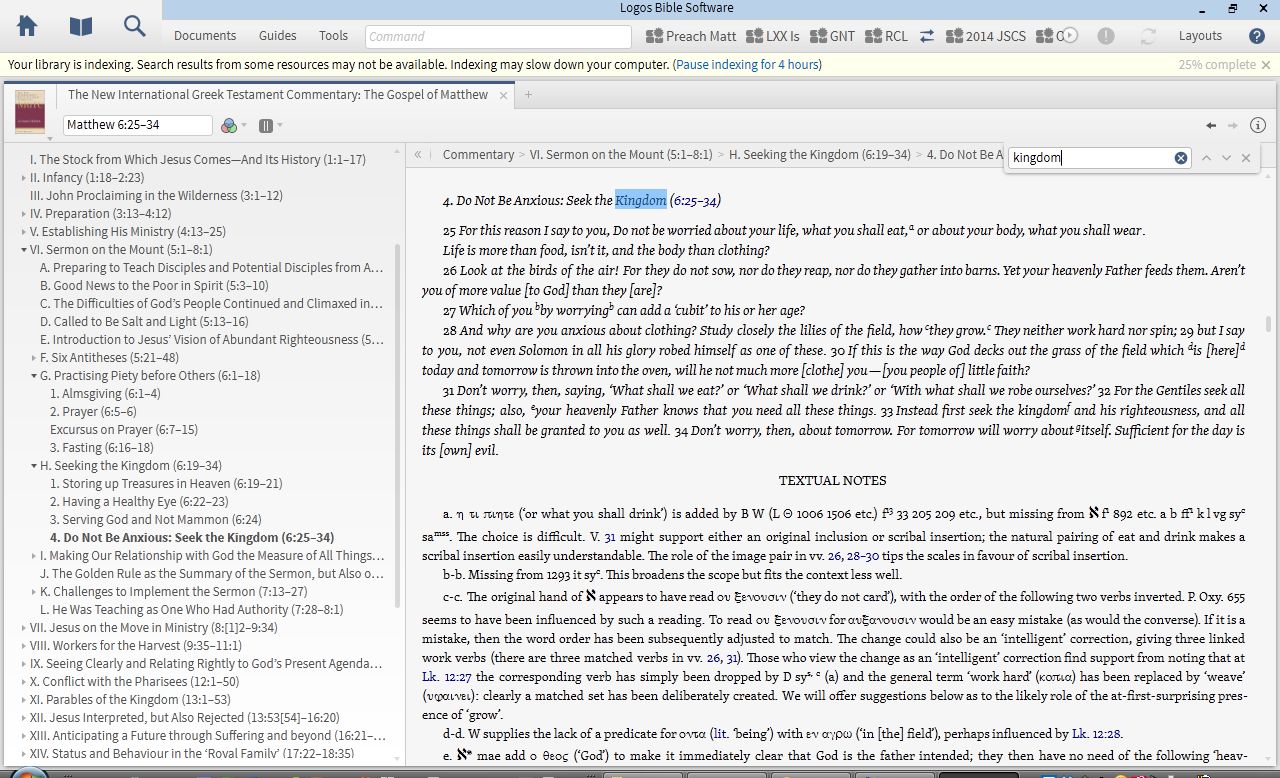
In Logos, one can search the commentary using control+F (PC) or command+F (Mac):
Keyword searching NIGTC for “kingdom”
One cool thing about this is that if you are already in Matthew 6:25 of the commentary (as above), the search results start right where you are (instead of going back to the beginning of the commentary). This way one can research a given word or theme as it unfolds in Nolland’s writing.
Concluding Evaluation
Despite the technical nature of the commentary (which I appreciated), the writing style is engaging and accessible, even inspiring in places. I loved this:
Jesus proclaims the imminent arrival of the kingdom of heaven. God now intends to establish afresh his rule among his people. If people are to be ready for this development, then repentance is urgent. Only a fundamental change of life direction will match the needs of the moment.
The bibliographies are a gold mine. One wonders if there’s any journal article or monograph on Matthew that Nolland hasn’t examined. Even so, he says in his preface that he had to trim his listing to accommodate the requirements of the editors!
My critique of the author’s translation notwithstanding, Nolland’s Matthew is a magnificent work, probably even one of the very first places one should go when doing in-depth study of Matthew’s text. Nolland does not disappoint in his technical analysis of words and passages, and yet he somehow is able to keep the Gospel as a whole before him and the reader as he expounds on its component parts. The reader cannot help but be impressed throughout the commentary, both with Nolland, and with Matthew’s Gospel which he describes.
Thanks to Logos for the review copy of the NIGTC series. I will post more in the future about the series and its use in Logos.
I have been benefiting lately from the wisdom of N.T. Wright. His For Everyone series now covers every book of the New Testament, with each passage being preceded by Wright’s own translation of Scripture.
I describe the series here. And here I review the Luke volume in further detail. In this post I’ll review the usefulness of the series in Logos Bible Software, both on an iPad and on a computer.
Logos syncs automatically across multiple devices and platforms. Its iOS app for iPad is one of the apps I use the most. It’s just recently received a nice makeover. It looks like this:
Library view
Here’s how I set up Wright in the app. You can sync the two windows of the app so that they move together, passage-by-passage. I.e., if I advance the Bible text in the top window, the commentary at the bottom follows.
Reading Wright on iOS
You’ll also note that you can highlight as needed, which then shows up in Logos on any other device, almost instantaneously. The pop-up is a note I took (“Even if we know what’s coming, we’re surprised”) on this section of Wright’s commentary. Notes also sync automatically.
You could also view the Passage Guide for a given portion of Scripture and see all of your commentaries and resources (which would include Wright, in this case) with information on the passage to be studied. The Passage Guide stays open at the top while the bottom window cycles through various commentaries as you tap the selection in the Passage Guide.
The desktop/laptop version of Logos offers even more options for using Wright side-by-side with other resources:
(click image to enlarge)
The little “C” at the bottom left of each of the book images shows that I’ve linked resources together, so that they scroll in tandem. In the above, I can work through English and Greek texts, with Logos’s clausal outlines and Wright’s commentary all open. The other tabs to the left and right of Matthew for Everyone are other commentaries to consult. I have all of the above saved as a workspace called “Preach Matt,” to which I can come back at any time.
One feature I appreciate is that if I type “John 1:1” into the search window of one of the Bible texts, the N.T. Wright window automatically goes to Wright’s commentary on John, even though it’s a different book in the set. And you can see that my highlight and note from iOS automatically came over to this version.
In general I find Accordance commentaries a little easier and quicker to search with their specific content fields (where you can search by reference, by English content, by Greek content, etc.). But the command (or control) + F search box gets the job done just fine in these commentaries. (For more on searches and content fields, see the discussion on the Logos forums here.)
I write more in depth about using Logos for a commentary series here. I’ve found Logos to be more responsive on a PC laptop (and it seems to index less) than on a Mac laptop.
Whether it’s through iOS or at a computer, I recommend N.T. Wright’s companionship through the Bible. The print volumes, of course, do just fine, but the Logos edition of Wright’s commentary set has some nice features that enhance study of the New Testament and use of the For Everyone series.
Thanks to Logos Bible Software for the review copy of New Testament for Everyone (16 vols. here; 2 vols. upgrade here). You can find my other Logos reviews here.
I’ve been seeing too much Upworthy in my Facebook news feed lately! Apologies for the sensational blog post headline.
But I really did meet N.T. Wright once. And you might actually guess what he told me, when I tell you what I asked him. I introduced myself to him briefly after a message he delivered a Calvin Collegeworship symposium, and asked him how to improve my Greek. He said, “Read the text, read the text, read the text.”
He told me to really get the feel of the language. I shouldn’t think of Greek just as a one-to-one code for English; I should get into the Greek itself. I asked him what he thought about reading with a diglot, but he encouraged me to check the English translation only after reading an entire Greek paragraph, and then, only as necessary.
It’s challenging, but I’ve benefited from that advice multiple times.
The For Everyone Series
Over the years I’ve made occasional use of his For Everyone Bible commentary series. Written under the name Tom Wright, the series brings Wright’s extensive knowledge of the biblical text and history to a general audience. Anyone wanting to know more about a passage–whether they are preaching from it or reading it in their personal devotions–would benefit from the series. It’s decidedly non-scholarly, but even scholars will find useful information here (if a bit simplified at times). Here is how Wright introduces the series:
But the point of it all is that the message can get out to everyone, especially to people who wouldn’t normally read a book with footnotes and Greek words in it. That’s the sort of person for whom these books are written.
Though Wright is a prolific writer of scholarly works, he writes well for a general audience–a rare combination. Throughout the series Wright puts key terms in bold, which the reader can then look up in a corresponding glossary (e.g., Gehenna/Hell, Covenant, Age to Come, Law, Faith, Son of Man, and more).
Between this package and this upgrade, Logos Bible Software offers the entire 18 vol. set. In a future post I will review Logos’s presentation of the series. Here I post about its content.
A Refreshing (One-Man) Translation
Wright splits each biblical book up into manageable passages. His original translation does a good job of striking the balance he seeks of faithfulness to the original and readability. Here is a passage in Wright’s translation:
Romans 4:18-25
Abraham’s Faith—and Ours
18 Against all hope, but still in hope, Abraham believed that he would become the father of many nations, in line with what had been said to him, ‘That’s what your family will be like.’ 19 He didn’t become weak in faith as he considered his own body (which was already as good as dead, since he was about a hundred years old), and the lifelessness of Sarah’s womb. 20 He didn’t waver in unbelief when faced with God’s promise. Instead, he grew strong in faith and gave glory to God, 21 being fully convinced that God had the power to accomplish what he had promised. 22 That is why ‘it was calculated to him in terms of covenant justice’.
23 But it wasn’t written for him alone that ‘it was calculated to him’.24 It was written for us as well! It will be calculated to us, too, when we believe in the one who raised our Lord Jesus from the dead, 25 the one who was handed over because of our trespasses and raised because of our justification.
Wright explains, “The older language, ‘it was reckoned to him as righteousness’, gives off so many different messages now that it’s hard for us, hearing it, to think the thoughts Paul had in his head.” His translation is fresh, yet is not a paraphrase (like Eugene Peterson’s Message, for example).
“Come to Him, by Whatever Route You Can”
The For Everyone series, though divided into discrete passages, shows a literary sensitivity so that the reader can see how a given section connects to the larger flow of the book. For example, of the above passage, Wright writes:
The last verse of the chapter anticipates something Paul is going to do throughout chapters 5-8. He rounds off every stage of the argument in this long section with a reference to Jesus. This isn’t a mere pious gesture, smuggling in a mention of Jesus in case we thought he’d forgotten about him. It shows, rather, what the whole argument is all about. It brings us back home to the source and power of Paul’s thought.
Though preachers are not the target audience, the series is a good one for preachers to have on their shelves. There is not the same sort of explicit homiletical guidance that Feasting on the Word offers on every passage under consideration, but Wright is not short on practical application. For the Romans passage above, he concludes:
Do we share Abraham’s faith? Do we look in love, gratitude and trust to the creator God who promises impossible things and brings them to pass? Have we learned to celebrate this God, and to live as one family with all those who share this faith and hope?
Similarly, in Matthew’s account of the Magi’s visit to Jesus, Wright notes that the inclusion of the Gentile Magi already in chapter 2 shows one of Matthew’s themes–that Jesus is king of the Jews, and of all people. He concludes:
Listen to the whole story, Matthew is saying. Think about what it meant for Jesus to be the true king of the Jews. And then—come to him, by whatever route you can, and with the best gifts you can find.
This application comes after Wright succinctly answers who the Magi were, what the “star” they saw might have been, and what Old Testament passages are at play in the Epiphany narrative.
In Conclusion (So Far): One of the Best Reading Guides
Wright’s style is conversational, engaging, highly readable, and stimulating on both an intellectual and devotional level. As I make my way through more of the series, I’ll post more about it (with screenshots of how it looks in Logos for computer and iOS). But so far I’m a big fan of what I’ve seen. The Luke volume was a frequent reference as I preached through parts of Luke this fall.
If you’re reading through the Bible, and want to have a substantive yet concise reading guide for the journey, Wright’s For Everyone series is hard to top.
Thanks to Logos Bible Software for the review copy of New Testament for Everyone (16 vols. here; 2 vols. upgrade here). You can find my other Logos reviews here.
Among preachers, there are books known as “Monday books” because they need to be read thoughtfully at least a week ahead of time. There are also “Saturday books,” so called because they supply sermon ideas on short notice. The books in this series are not Saturday books. Our aim is to help preachers go deeper, not faster, in a world that is in need of saving words.
–Feasting on the Word
I continue to utilize the 12-volume Feasting on the Word commentary series most weeks in my sermon preparation. As I described at greater length here, the 12 volumes cover the three-year lectionary cycle (A, B, and C), split into four volumes per year. Each week offers four different “perspectives” (theological, pastoral, exegetical, and homiletical) for each lectionary passage in the Revised Common Lectionary.
As far as its layout and usability in Logos, I covered that here. My favorite part about having Feasting on the Word in Logos is that I find Logos to be the most robust e-reader currently on the market. It syncs seamlessly across devices and platforms, and easily allows for highlights and notes to be made directly within the text.
In this final post, I want to interact a bit more with some of the content of the series.
The diversity of the contributors is a strong point. They come from different vocations (preachers, professors, Bishops), and reflect diversity in race, sex, and denominational affiliation, as well. I’ve found this refreshing.
There is a general evenness in style, tone, and substance across the volumes I’ve used. As one might expect with a commentary series with this many contributors, some entries end up being more helpful than others.
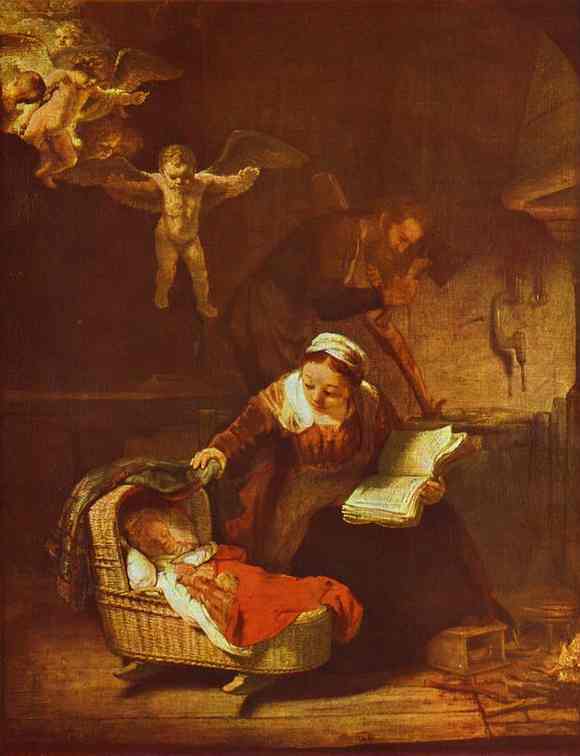
While I have found the “Exegetical Perspective” and “Homiletical Perspective” sections to be of some value, the “Homiletical Perspective” and “Preaching Perspective” are the ones I use most often. Each of these help the preacher imagine how she or he might orient herself/himself and the congregation to a given text. For example, the “Homiletical Perspective” on John 1 begins with a description of Rembrandt’s “Holy Family” painting, then goes on:
I can imagine a sermon that would begin with a description of Rembrandt’s painting and that would develop the idea of the necessary dialogue between Mary’s studying the Bible and studying the child, the Word made flesh. Like Mary, we come to understand the Word more and more fully as we oscillate between the book and the child, between the Word through words and the Word made flesh.
Few commentaries offer homiletical suggestions this practical. The “Pastoral Perspective” for the same passage is worth quoting at length. After quoting Eugene Peterson’s rendering of John 1:14, preacher Frank Thomas writes:
I love this rendering of this text because of the choice of the word “neighborhood.” The Word was made flesh and blood and moved into the neighborhood. Neighborhood reminds me of the place where I grew up and the people with whom I grew up. I remember the street corner where we played baseball that had four sewer covers; one sewer cover was first base, another second, another third, and the final one home. I ran around those bases thousands of times, dreaming that I was a professional baseball player. I remember the playground, where what seemed like millions of kids played basketball, Ping-Pong, pool, volleyball, dodgeball, and tons of games. I remember block parties, where all the neighbors would sit out on the front lawns with the streets blocked off, and all day we would just have food, games, and fun together. I remember the girl across the street. That’s what I think of when I hear, “The Word was made flesh and moved into the neighborhood.” The Word was made flesh and moved into my south-side neighborhood.
He concludes, “When Peterson says that the Word was made flesh and moved into the neighborhood, I hear that the Word moved into my neighborhood.”
There is much for the preacher to mine and adapt and re-contextualize in the above, in a way that fits one’s own setting. Reading Pastor Thomas’s writing above makes it easy to think about Jesus moving into our neighborhoods, too. (Which immediately raises interesting questions for congregations–would we be a good neighbor to him? Would we need to change anything about our community life? Would we recognize him?) I find that Feasting on the Word is constantly suggesting good questions for reflection and stimulating even more.
There is a claim in the series introduction that, “Wherever they begin, preachers will find what they need in a single volume….” While the exegesis and theological analysis in these volumes is substantive, I still find myself turning to more in-depth commentaries for exegesis, before using Feasting on the Word to think through how to move from passage to sermon. That has been how I’ve most benefitted from the commentary.
I’ll continue to use the commentary series on a regular basis. While I love print books, there are advantages to the electronic version, and Logos integrates Feasting on the Word with any other Logos resources you may have. For those who preach regularly, this set is well worth checking out.
Thanks to Logos Bible Software for the review copy of Feasting on the Word (12 vols.). Find it here. The publisher’s page for the series is here. You can find my other Logos reviews here.









 Words on the Word

