The Westminster Dictionary of Theological Terms, Reviewed

Westminster Dictionary of Theological Terms


The Westminster Dictionary of Theological Terms (Westminster John Knox Press, 2014) is a succinct compendium of key theological words and concepts.

One obvious advantage to the book is its portability. It’s less than 400 pages and easy to carry around in a satchel… though since receiving it, I’ve kept it on my desk with a few other works I reference a lot.

What sorts of “theological terms” does this dictionary cover? The publisher’s product page notes:

This second edition of The Westminster Dictionary of Theological Terms provides a comprehensive guide to nearly 7,000 theological terms—1,000 more terms than the first edition. McKim’s succinct definitions cover a broad range of theological studies and related disciplines: contemporary theologies, biblical studies, church history, ethics, feminist theology, global theologies, hermeneutics, liberation theology, liturgy, ministry, philosophy, philosophy of religion, postcolonial theology, social sciences, spiritually, worship, and Protestant, Reformed, and Roman Catholic theologies.

There is also a short annotated bibliography, list of works consulted, and set of abbreviations at the back of the book. The “Major Topics and Distinctive Terms and Concepts” section at the beginning gives the reader a framework of overarching topics into which the dictionary’s terms will fit. (E.g., “Bible,” “theology,” “worship,” “ethics and moral theology,” and so on.)

McKim himself has overseen much larger dictionaries. An initial point of skepticism for me was whether a theological dictionary this small and short could still be substantive. Definitions are somewhere in the 15-75 word range, depending on the term.

Yet as a quick-reference guide, it does well. Consider McKim’s definition of feminist criticism:

A critical approach to reading the Bible that focuses on the political, social, and economic rights of women. Diverse goals and methods are employed, with a common recognition that all texts are gendered. This implies not only that they reflect sexual differences between males and females, but also that they involve power. Feminist criticism seeks to make clear culturally based presuppositions found in texts.

Here’s another example, the entry for “agrapha,” a term one finds shortly after delving into studies of the Gospels:

(Gr. “unwritten sayings”) Sayings attributed to Jesus that circulated as traditions during the period of the early church. Also those sayings attributed to Jesus found outside the canonical Gospels.

The reader will also find terms like “Griesbach hypothesis,” “haggadah,” “Muratorian Canon,” perspectivalism,” “cuneiform,” “body-soul dualism,” “Trisagion,” “interiority,” “rechte Lehre” (German for “right teaching on doctrine”), and many more.

McKim’s goal was to provide a “wider, synthetic work that gives short, identifying definitions over a more comprehensive range of theological disciplines,” as opposed to something more “specialized” and “extensive.” The beginning theological students that McKim seeks to reach will find such a dictionary an especially useful entry point into the large and growing world of biblical and theological studies. McKim seeks to be more “broad” than “deep”; in this he succeeds, but the definitions are still plenty substantive to be useful to students at various stages.

The annotated bibliography is just five pages and glosses over important works (e.g., the commentaries section lists Anchor but omits Hermeneia). It does include a good page on Web-based resources for theological studies. The abbreviations include a couple pages of textual criticism abbreviations (including Latin), which will save the new reader of the Hebrew Bible from having to look most terms up elsewhere.

One feature I felt to be missing was a lengthier set of introductory essays on the nature and methods of theological study. I’m assuming Dr. McKim didn’t include this because it might exceed the intended scope of the work, but perhaps future editions could include–as many dictionaries do–at least two or three introductory essays to further orient the reader to theological study.

I’ve had the dictionary at my desk all summer, and each time I’ve looked up a word or phrase, I’ve found what I was looking for (with the exception of dereliction or “cry of dereliction”).

Especially for its price and accessibility, The Westminster Dictionary of Theological Terms is an excellent starting point for seminary students or for pastors who want to stay up-to-date on theological terminology.

Many thanks to WJK Press for the review copy, given to me with no expectation as to the content of my review. You can find the dictionary here on Amazon (affiliate link), or here at WJK Press.

Bonhoeffer’s Life Together: A Review

A scroll through some of my recent Facebook statuses shows the quotability of Bonhoeffer’s Life Together and its impact on me:

And:

Also, this one:

And, just for fun, here’s some Bonhoeffer from a letter quoted in Eberhard Bethge’s biography of him:

Bonhoeffer’s Life Together is substantial evidence that this servant of God saw himself as belonging to the church. The short, powerful book is both a gift and a challenge to any Christian who will take the time to study it.

I have just finished reading it through all the way for the first time. Though it’s true that there is a focus on how one can be a faithful member of a Christian community, the application to the Christian-as-individual is rich, as well.
 

How Life Together is Structured

 
There are five main sections of Life Together:

  1. Community
  2. The Day Together
  3. The Day Alone
  4. Service
  5. Confession and the Lord’s Supper

Bonhoeffer was, in fact, writing with his own seminary community in mind (see “Benefits of the DBWE Critical Edition,” below), but he also intended with Life Together something more universal:

We are not dealing with a concern of some private circles but with a mission entrusted to the church. Because of this, we are not searching for more or less haphazard individual solutions to a problem. This is, rather, a responsibility to be undertaken by the church as a whole.

Throughout each of the sections, the focus of the book is “life together under the Word” (my emphasis, but also an ongoing emphasis of Bonhoeffer). An editor’s footnote explains that “life together” can also be translated from German as “common life.”

Christians in community are a sort of sacrament to each other, a theme throughout Life Together:

The prisoner, the sick person, the Christian living in the diaspora recognizes in the nearness of a fellow Christian a physical sign of the gracious presence of the triune God. In their loneliness, both the visitor and the one visited recognize in each other the Christ who is present in the body.

Through prayer and worship together, intentional solitude, service to each other, hearing confession of sins and–ultimately–through participation in the Lord’s Supper, the purpose and aim of Christian communities is “to encounter one another as bringers of the message of salvation.”
 

Bonhoeffer’s Dialectic of Solitude and Community

 
Throughout the book Bonhoeffer explores the dialectic between living in community (“The Day Together”) and the individual’s time alone (“The Day Alone”). He suggests that the ones who will do best living in community are those who already do well alone. Those who cannot already live at peace with themselves will not do well in community:

Those who take refuge in community while fleeing from themselves are misusing it to indulge in empty talk and distraction, no matter how spiritual this idle talk and distraction may appear.

On the other hand, “the reverse is also true.” Discipleship is best when not received, experienced, and lived just as a solitary endeavor. Bonhoeffer says, “Whoever cannot stand being in community should beware of being alone” (emphasis in original).

Both solitude and the company of others, then, are needed:

We recognize, then, that only as we stand within the community can we be alone, and only those who are alone can live in the community. … It is not as if the one preceded the other; rather both begin at the same time, namely, with the call of Jesus Christ.

Bonhoeffer’s characteristic and refreshing forthrightness brings the point to a head:

Those who want community without solitude [Alleinsein] plunge into the void of words and feelings, and those who seek solitude without community perish in the bottomless pit of vanity, self-infatuation, and despair.

Whoever cannot be alone should beware of community. Whoever cannot stand being in community should beware of being alone.


Benefits of the DBWE Critical Edition

 
Bonhoeffer Life TogetherLife Together is Volume 5 of Fortress Press’s Dietrich Bonhoeffer Works (English Edition); it’s also the first one published (1995) in the series.

In addition to its being a new translation from Bonhoeffer’s German, there is an Editor’s Introduction to the English Edition, Editors’ Afterword to the German Edition [abridged], and an extensive (though not distractingly so) set of footnotes as part of an explanatory critical apparatus.

Though one could certainly read Life Together in its own right, editor Geffrey B. Kelly’s introduction is a great set-up. From the very beginning he highlights the fascinating history of the book:

It was because [the Gestapo] had shut down the preachers’ seminary at Finkenwalde that Dietrich Bonhoeffer was finally persuaded to compose his thoughts on the nature and sustaining structures of Christian community, based on the “life together” that he and his seminarians had sustained both at the seminary and in the Brothers’ House at Finkenwalde. … With the closing of the seminary at Finkenwalde and the dispersal of the seminarians, however, Bonhoeffer felt compelled not only to record for posterity the daily regimen and its rationale, but also to voice his conviction that the worldwide church itself needed to promote a sense of community like this if it was to have new life breathed into it.

Kelly brings to light more about the historical situation leading to Life Together (including the Finkenwalde seminary), as well as ties it in with some of Bonhoeffer’s earlier writing that undergirds the book. Kelly notes that Life Together is ultimately a highly Christocentric work. Indeed, Bonhoeffer writes:

Christian community means community through Jesus Christ and in Jesus Christ. There is no Christian community that is more than this, and none that is less than this. Whether it be a brief, single encounter or the daily community of many years, Christian community is solely this. We belong to one another only through and in Jesus Christ.

The critical footnotes are excellent and seem to be placed at just the right spots. They include biblical references, historical background, explanations of German-to-English translations, and descriptions, where needed, of the larger body of Bonhoeffer’s thought that informs a given passage.

For those wanting to read Life Together, there’s a nice bonus with the Fortress Press DBWE edition: it includes also Bonhoeffer’s Prayerbook of the Bible: An Introduction to the Psalms. Given his emphasis already in Life Together on the importance of the Psalms for the prayer life of the community (“The Psalter is the great school of prayer”), its inclusion in this volume is perfectly fitting. The text itself is just above 20 pages, with the addition of an English editor’s introduction and German editors’ afterword.
 

One More Bonhoeffer Quote,
and How to Get the Book

 
The last word of this review goes to Bonhoeffer. Here it is:

The fact that Jesus Christ died is more important than the fact that I will die. And the fact that Jesus Christ was raised from the dead is the sole ground of my hope that I, too, will be raised on the day of judgment. Our salvation is “from outside ourselves” (extra nos). I find salvation not in my life story, but only in the story of Jesus Christ. Only those who allow themselves to be found in Jesus Christ—in the incarnation, cross, and resurrection—are with God and God with them.

If you don’t already own Life Together, you should. If you do own it in an old paperback edition, you should get the Fortress Press Dietrich Bonhoeffer Works edition, if possible, whether through purchase or library check-out.

If you really want to go in depth, Geffrey B. Kelly (lead English editor of DBWE 5) wrote Reading Bonhoeffer, which includes a reading companion to Life Together.

Many thanks to Fortress Press for the review copy, given to me with no expectation as to the content of my review. You can find Life Together and Prayerbook of the Bible here on Amazon (affiliate link), or here at Fortress Press.

Got a Theology of Justice?

Justice ScaleI had a seminary professor who rightly noted the lack of ministers and churchgoers with a fully developed theology of justice.

“What’s your theology of justice?” he asked at the beginning of the class, which was met with blank but curious stares.

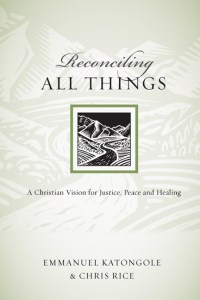
Reconciling All Things: A Christian Vision for Justice, Peace and Healing, more than any other book besides the Bible, has shaped my theological understanding of justice. Authors Emmanuel Katongole and Chris Rice develop a Christ-centered, Scripture-shaped, journey-oriented theology of justice reconciliation.

The authors urge that we slow down and take the time that is needed for true reconciliation—as a journey—to take hold. A question that permeates the book is, “Reconciliation toward what?” Katongole and Rice are aware that “reconciliation” calls to mind various “prevailing visions,” many of which lack theological rootedness in the Biblical story of God saving his people.

Reconciliation is, they suggest, a God-given gift to the world and the ultimate goal of the “journey with God from old toward new.” They write,

The journey of reconciliation hangs or falls on seeing Jesus. …For Christians, the compass for the journey of reconciliation is always pointing toward Jesus Christ.

Katongole and Rice make heavy use of Paul’s words to the Corinthians:

All this is from God, who reconciled us to himself through Christ and gave us the ministry of reconciliation: that God was reconciling the world to himself in Christ, not counting people’s sins against them. And he has committed to us the message of reconciliation. We are therefore Christ’s ambassadors, as though God were making his appeal through us. We implore you on Christ’s behalf: Be reconciled to God.  (II Corinthians 5:18-20, TNIV)

Seen as a gift, then, reconciliation becomes something that is “not for experts only,” but something that God calls all his children to. To equip us for the journey God gives us gifts: a cloud of witnesses, communion, peace and harmony, Sabbath, and the gift of Scripture, which is to shape us as God’s story in the world.

Midway through the book the authors arrive at a biblically understood definition of justice:

Justice is an aspect of God’s shalom, a notion that carries with it the idea of completeness, soundness, well-being and prosperity, and includes every aspect of life—personal, relational and national.

Justice, they say, is to include the interpersonal, relational aspect; yet it must also attend to structural considerations. To speak about justice so holistically, against dichotomies that might otherwise render our work ineffective, is wise and instructive for our journey toward reconciliation.

Reconciling All ThingsAlthough written by a black, Catholic, African academician and a white, Protestant, American practitioner, the book does not specify what issues in reconciliation may occur between any two specific groups and how those groups (or individuals) might think about moving forward. The authors do give helpful anecdotal evidence of reconciliation that bridges and heals divides of race, class, and ethnicity. But the reader wanting, for example, to mend and redress the brokenness in black-white relations in the United States may have to look to supplemental reading for more practical hints.

However, in its development of a fairly robust theology of reconciliation and justice, Reconciling All Things lays the important groundwork on top of which such future work can be built. Its chapters on lament (“The Discipline of Lament”) and leadership (“The Heart, Spirit, and Life of Leadership”) are profound in their call for Christians to slow down, locate themselves (emotionally and physically) among the broken places of the world, and to mourn and lament in those places, together with those who mourn and lament.

The one who would lead, then, is less concerned with specific techniques, tools, and strategies, and more concerned with seeing a gap, being deeply moved in response, and belonging to the gap, long before she or he would make proposals to initiate change and issue directives. In laying this groundwork, Katongole and Rice actually leave the work of developing techniques and specific reconciliation “skills” to the reader.

In the end, “You find that God has surprised you and your companions over and over with all that you needed to go on….” The assurance of this ongoing gift of God’s provision gives the Christian who would practice reconciliation all she needs to begin discerning her role in practicing reconciliation in everyday life.

I bought this book. You should, too, or check it out from your local library. Here at Amazon; here at IVP.

Accept the Incompleteness of Your Work

28102-Sabbath in the City_pYesterday I preached on Sabbath-keeping and what I think is the real reason it’s so hard for us to engage such a life-giving practice. As I’m reflecting further this week on cultivating a Sabbath-oriented mindset throughout my days, I remembered a book I read a few years ago that nourished me. It’s called Sabbath in the City: Sustaining Urban Pastoral Excellence.

Bryan P. Stone and Claire E. Wolfteich wrote this short yet compelling book on “what constitutes pastoral excellence in the urban context” and “what sustains it.” The authors use results from their project, “Sustaining Urban Pastoral Excellence,” which piloted a program of rest and renewal for 96 urban pastors across the country. According to Stone and Wolfteich, there are four primary activities or modes of being that make up pastoral excellence (which they also refer to as “virtue”):

  1. The cultivation of holy, life-giving friendships, particularly with other pastors;
  2. Regular Sabbath practices of rest that allow for acts of both creation and liberation;
  3. A renewal of the spirit through disciplines like prayer, reading Scripture, and silence;
  4. Study and reflection on the theology and practice of ministry (the authors tie this in with the above activity, renewal of the spirit).

While the authors note that pastoral excellence thus constituted is applicable to other, non-urban settings, they emphasize the uniqueness of the urban context and how it can challenge and fatigue urban pastors. They describe the city as “a place of distractions, busyness, and frenzied activity.” In contradistinction to more affluent suburban parishes, the urban church is likely to function as a full-service institution that addresses the variegated needs of the city in which it resides. The authors follow the group of 96 participants and show how the four practices listed above helped them to cultivate and sustain pastoral excellence.

Reading the book was itself an act of refreshment. Two aspects were most helpful to me:

First, the authors highlight the importance to pastors of cultivating holy, God-focused friendships. They write, “Friendships, then, are not simply a means of supporting a more healthy spiritual life. As some of the pastors in our project put it, ‘They are our spiritual life.’” The old African proverb is apropos here:

If you want to travel fast, travel alone. If you want to travel far, travel together.

Second, Sabbath-keeping is easier idealized than practiced. Stone and Wolfteich write,

[The] advice to accept the incompleteness of our work may be difficult to enact.

Though I didn’t have Sabbath in the City in mind at the time, the sermon I’ll post later this week interacts at length with this idea, i.e., why it is that we don’t take the Sabbath we know we want to take.

The book is intended for pastors in an urban setting, but even a suburban-dweller who is not involved in pastoral ministry will find rest and hope in Sabbath in the City.

You can find it on Amazon here and at Westminster John Knox Books here.

Getting Pre-Pub Books in Logos Bible Software

Especially since Eerdmans has a large number of resources in production right now at Logos Bible Software, I’ve started paying more attention to Logos’s Pre-Publication program.

Logos puts titles into “Pre-Pub” to help gauge user interest in various resources. When users pre-order a resource, that helps to cover the cost of production. If/when enough users pre-order, the title goes into development and the user gets it at the discounted pre-pub price when it “ships” (i.e., when it is completed).

Here is a short description from Logos’s Pre-Pub About page:

Prices start low and increase over time so the sooner you pre-order, the less you pay. We don’t charge you until your pre-order is ready, and we’ll send you a reminder email a few weeks before. If you decide you don’t want the resource anymore, you can cancel your pre-order at any time.

Here is a compilation of the newest Pre-Pub titles. (This one from Oxford University Press is pricey but looks good; here is When God Spoke Greek, which had enough pre-pub orders that it’s already under development and will probably ship within a month.)

Here is the Pre-Pub list sorted by Progress or “ship date,” so you can see which ones are almost ready to go–with the pre-order discount still applying, at least for now. There’s a bunch of Eerdmans stuff that will go out on August 6, including this collection that looks especially useful to pastors, including the book that is pictured above.

Here’s a short overview video of how Pre-Pub in Logos works:

An Interculturally Aware Read of Psalm 46 (Location, Location, Location)

Psalms of Summer

As I have read and preached on some Psalms this summer, I’ve appreciated the importance of trying to practice intercultural sensitivity in reading the Bible (and in all of life).

I am working on a course on intercultural counseling this summer, one purpose of which has been to help build intercultural competence and sensitivity.

The readings, lectures, and class discussions have reminded me of the important truth that reading and interpreting the Bible is an exercise–whether we realize it or not–in intercultural relations.

Intercultural Sensitivity=Better Bible Reading

The culture, values, and practices, for instance, of ancient Israel differ from those of 21st century North America in a number of ways. If I read a passage with only an awareness of the cultural values I carry with me, I very well may miss an important truth or robust reading of a text. Or I may map a “truth” or value judgment onto the text that the author didn’t necessarily intend to be there. (I’m not discounting the potential value of so-called reader-response criticism, but I am suggesting we seek to avoid a monocultural or culturally hegemonic interpretation of a text, if possible.)

In a 2008 article for Journal of Spiritual Formation & Soul Care (“Relational Spirituality and Transformation: Risking Intimacy and Alterity”), Steven J. Sandage, Mary L. Jensen, and Daniel Jass write:

Since hermeneutical understanding is always intercultural and contextual, cultural self-awareness is a prerequisite to responsibly interpreting Scripture and spiritual experience.

I mentioned here how the idea of intercultural sensitivity helped me read Psalm 23 in a fuller way. The same thing happened as I prepared to preach on Psalm 46 this week. I got a little extra help this time from a Bible atlas I’ve been reading.

Psalm 46: God Is Our Refuge

Psalm 46 begins:

 1 God is our refuge and strength,
an ever-present help in trouble.
2 Therefore we will not fear, though the earth give way
and the mountains fall into the heart of the sea,
3 though its waters roar and foam
and the mountains quake with their surging.

How should we understand the scenario the Sons of Korah (writers of this Psalm) describe?

Mountain and WaterThe sons of Korah don’t just paint a picture of tragic events befalling God’s people—it’s the complete disintegration of all of life that is the dominant metaphor in these verses. A number of commentators point out here that the effective merging of the land (mountains) and waters (sea) harken back to the pre-creation state of chaos that existed before God separated the land from the waters, bringing order to life. The sons of Korah, then, describe a sort of uncreation.

But even in the midst of an envisioned chaos and uncreation of the world (!), “God is our refuge and strength.”

Verse 2 says, “though the earth give way,” or, though the land give way. Here is where an interculturally aware read of the Psalm helps it to come alive even more profoundly. (The below was inspired, in part, by Paul H. Wright’s Rose Then And Now Bible Map Atlas® With Biblical Background And Culture.)

Life for Israel: Location, Location, Location

Before there was such a thing as real estate, life for Israel already was location, location, location.

The topography or shape of the land had a lot to do with whether a given area would be suitable for habitation. Mountains, in particular, provided a sort of natural buffer of protection against enemies… a hiding place to run to, if need be. Water, of course, was necessary for life and the production of crops.

Mountains in Edom (photo: Garo Nalbandian, from Carta's Sacred Bridge atlas)
Mountains in Edom (photo: Garo Nalbandian, from Carta’s Sacred Bridge atlas)

The congregation of Israelites who would sing this Psalm understood their identity as intricately tied to the land. The land—which God had given them—was part and parcel of his covenant relationship with them. It was part of his blessing, a sign of his love. If we don’t have this land, how can we really call ourselves God’s people? This is still a live question for many.

Yet even if we were to lose this fundamental aspect of our identity, the Psalm declares, even if the world were to be uncreated and fall back into chaos, “we will not fear.”

The congregation can still say—can still sing, “God is our refuge and strength, an ever-present help in trouble.”

Given how important land was to the people of Israel and the construction of their collectivistic identity, this is an amazing affirmation of trust in God.

Intercultural Insight from a Bible Atlas

Paul Wright AtlasPaul H. Wright’s cultural awareness and sensitivity is present from the very first chapter (“The Landed Context of the Biblical Story”) of his biographically-arranged atlas:

To start, it is perhaps appropriate to define a few aspects of location that have impacted living conditions in the lands of the Bible over time. The building blocks of biblical geography include the following….

He lists topography, climate, and available resources. He goes on:

The particular mix of elements such as these plays a significant role in determining whether any given plot of ground can support permanent settlements and how large and well-established these might have become, or if the land is better suited for herding or desert lifestyles.

Here’s the intercultural piece, which I so appreciated:

Specific geographical realities have also helped to shape cultural values and norms that defined individual societies. For instance, protocols of cooperation, hospitality and defense that functioned well in arid, shepherding societies in biblical times developed differently than did those that attained to urban centers located in fertile areas, or to sailors who frequented foreign ports-of-call. And aspects of geography gave rise to specific images that biblical writers used to describe God and the people of ancient Israel.

Understanding the value of land to the people singing Psalm 46–it was an essential component of their identity and experience of God’s love for them!–makes the affirmation of trust in this Psalm even more remarkable.

Though the sons of Korah envision a scenario in which their land is gone–having slipped into the ocean–they call on the congregation to praise God still.

The above is adapted from a portion of a sermon I preached yesterday. Rose Publishing has sent me the Wright atlas for review purposes. A full review is forthcoming. You can find the atlas in the following places: Rose Publishing, Amazon (affiliate link), Carta (as Greatness, Grace, and Glory: Carta’s Atlas of Biblical Biography), and Eisenbrauns (same title as Carta).

A Peaceable Psychology: Christian Therapy in a World of Many Cultures

Peaceable PsychologyThis summer I’ve been taking a course on multicultural counseling. Here I offer some interaction with and reflection on A Peaceable Psychology, pictured at left.

Key Points of Learning: Agreements and Concerns

Before reading A Peaceable Psychology, I hadn’t really thought about counseling and therapy as “political” acts. And yet Alvin Dueck and Kevin Reimer warn well against the illusion that the therapist can somehow counsel apolitically, aculturally, amorally, and areligiously. One of the key, unifying ideas of the book is: “Civility includes learning and validating the language of the ethno-religious client. It is polite to defer to the meaning framework of a client.”

I found this to be a helpful way of framing the quest for diversity competence among therapists and pastors. Dueck and Reimer do go even farther than saying this kind of psychotherapy is polite; they suggest that to counsel in this way is to be like Jesus, especially when therapist and client can inhabit the same place of suffering together.

Although Dueck and Reimer have a healthy (and hearty!) reluctance toward philosophical foundationalism as such, they see the work and life and love of Jesus as foundational to a peaceable psychology. This is especially evident in their view of the importance of the atonement.

I found myself in agreement with Dueck and Reimer when they wrote:

The reconciling atonement of Christ is not spiritual alone but contains physical, psychological, and social dimensions of human brokenness. The suffering God is a beckoning God, who in Christ offers the potential of a new beginning. Consequently, a peaceable psychology is an incarnational event whereupon the invisible spiritual reality of God’s grace is attached to and bound up in the visible life of both the victim and the offender.

They go on, “Atonement is God’s welcoming of the enemy, of the other. It is an invitation to new life, to freedom from sin. This is the basis of a peaceable psychology.”

When considering various theological theories of the atonement, I find myself convinced by an all-of-the-above approach. (How could we limit the efficacy of the atonement by proffering just one theory as to what it was and how it happened?) The work and suffering of Jesus, they suggest, is to transform the therapist-client relationship. “If Juanita were our client,” they ask, “would her suffering fully impact us?”

This, however, also was a potential point of disagreement I had with the authors. Or at least I had questions and wanted to add qualifications. To be sure, the idea of the “kenotic therapist” makes sense to me—especially as a pastor. But the following expression of kenotic therapy was too much, at least for me: “Indeed, I am held hostage by my clients’ suffering. Their face places an ethical claim on me because as a fellow human I am systemically responsible for their suffering.”

While I can agree about “an ethical claim,” I’m not sure being “held hostage” is the most useful metaphor. How many clients will—or can—a therapist allow to hold him hostage before he feels imprisoned in an unhealthy and stultifying way? I wish the authors had spoken more to the point with some practical suggestions and caveats.

Implications for Pastoral Care

Dueck and Reimer say, “We fear that the American psychologist who assumes a level playing field for the linguistic comprehension of ‘self’ has already begun a subtle process of imposition upon the client.”

This is a valuable reminder to me as a minister. I simply cannot make assumptions about the cultural backgrounds of congregants. Further, there is value in this approach (of not assuming “a level playing field for the linguistic comprehension of ‘self’”) that has already—just this last week—had practical import and payoff in my biblical hermeneutics for preaching.

Yesterday I preached on Psalm 23. Due in large part to the idea Dueck and Reimer articulate above, namely, that constructions of self are culturally conditioned and informed, I was able to observe the following about Psalm 23.

David uses the first person singular pronoun throughout the Psalm. God is the shepherd of each individual who would follow him.

This may seem slightly unremarkable to us. We live in a North American society that already tends toward individualism. Our cultural construction of the self tends to be individually-focused.

The culture in which David found himself was much more communally-oriented. …A person’s sense of self was constructed and informed and shaped in a communal context.

So it’s at least a little remarkable, in the larger context of Hebrew worshiping society, that David begins–the Lord is MY shepherd.

This really drove home the point in another article we read in class: “Since hermeneutical understanding is always intercultural and contextual, cultural self-awareness is a prerequisite to responsibly interpreting Scripture and spiritual experience” (Sandage, Jensen, and Jass).

I also do and will find it useful for my own pastoring to consider that “a peaceable therapist recognizes that healing is best conducted ethnically, in the client’s mother tongue and in his or her local culture.”

Of course no therapist can be already conversant in the mother tongue of every cultural or religious tradition. But Dueck and Reimer realize that, and are suggesting more of an “ad hoc” approach anyway: “A peaceable therapist is a linguist; he or she recognizes differences between languages and honors them by learning them.”

May God help us–therapists and ministers alike–so to do!

Find A Peaceable Pscyhology at Amazon here. Baker/Brazos has its product page here, with an excerpt (including Table of Contents) here. No review copy–I bought this one!

Zondervan Theology Collection (Logos Software) Giveaway

Logos Zondervan TheologyWant to enter for a chance to get some free theology books? These ones won’t even take up shelf space. I’m joining with a few other bloggers and Logos Bible Software for a giveaway of Logos’s Zondervan Theology Collection.

What’s Up for Grabs

The collection can be found here. It includes these books:

How to Enter the Giveaway

Logos will choose the winner at random on August 1, with the collection sent to that person’s Logos account. If you don’t have a Logos account, you can register for free here. An iOS app for Logos (and other mobile apps can be found here, also free.

To enter, log in below using either your email address or Facebook account, and the Punchtab widget walks you through the rest. You can choose which methods of entry to use. Each prompted action is its own entry.

Logos has this disclaimer: By entering this giveaway you consent to being signed up to Logos’ “Product Reviews” email list.  (This just means you’d get emails with Logos-related content written by bloggers such as yours truly.)

UPDATE: WordPress doesn’t want to show the Punchtab widget for some reason. For now you can enter here.

Eusebius’s Onomasticon in Greek, Free (and Where to Find it in English)

One of many cool things about Carta’s Sacred Bridge atlas is its use of original/source languages.

For example, when The Sacred Bridge (TSB) cites Eusebius’s Onomasticon (a 4th century list of Bible place names), it does so both in its original Greek and in English translation.

OnomasticonThis, of course, got me to wondering about Eusebius in Greek. Using The Sacred Bridge in Accordance, I can easily pull up all the times TSB cites Eusebius (more on this later).

Then I wanted to know where to find more Onomasticon in Greek.

After a short hunt, I found this digital edition of the Onomasticon in Greek. I thought I would pass it on in case anyone else using the atlas in English wanted to be able to access the Greek.

Brill has an expensive triglot edition, and De Gruyter has one with Greek and Syriac, but the above is free and online.

Eusebius’s Onomasticon (in English translation, and with English translation of Jerome’s Latin translation/expansion of Eusebius) is here in Accordance, here on Carta’s site, and here at Eisenbrauns, Carta’s North American distributor.

Titus For You, Reviewed

Tim Keller’s For You series now includes contributions from other authors. I reviewed Keller’s Romans 1-7 For You here. In this post I review Tim Chester’s Titus For You.

But allow me to allow Chester to introduce the book. Here he is:


The books in the For You series claim to not be commentaries. Instead, the Titus For You product page describes what kind of book it is:

Written for people of every age and stage, from new believers to pastors and teachers, this flexible resource is for you to:

• READ: As a guide to this wonderful letter, exciting and equipping you to live out the truth in your life.
• FEED: As a daily devotional to help you grow in Christ as you read and meditate on this portion of God’s word.
• LEAD: As notes to aid you in explaining, illustrating and applying Titus as you preach or lead a Bible study.

Titus For YouThe book is short and its tone conversational. Chester begins with a short introduction to the book, then divides Titus into seven units (each of them split again into two parts) for comment. Reflection questions throughout help the reader digest the book, and could also be used in small group settings. At the close is a short glossary and six-book bibliography of sorts.

What folks will find most beneficial about Chester’s book is his ability to re-state Paul in easy-to-understand terms. For example, when discussing Titus 1:7-11 Chester says:

There are two common dangers in pastoral ministry and Paul is alert to both of them. They are what we might call over-pastoring and under-pastoring.

He elaborates on each kind of pastoring to help explain Paul’s exhortations to Titus in this first chapter.

Similarly helpful was Chester’s description in the section on Titus 2 (especially verse 14) of the Christian’s identity:

In Christ, we are members of the royal family of the universe. That is our status, and we cannot lose it. And our behaviour should match who we are. Royal children have royal manners.

One can easily see Chester’s concern with practical application of Paul’s letter in broader contexts. This makes it suitable as a go-to for devotional reading.

The introduction to Titus was not as substantive as I’d have liked. Or, at least, I wouldn’t feel prepared to lead a small group through the book from just having read this short introduction. (There was hardly anything about Crete, Titus’s setting.) Even the introduction in a good Study Bible (of similar or shorter length) could be more elucidating as to how to understand and read Titus.

I appreciated Chester’s interpretation of Titus as having to do with church “succession planning.” He (rightly, in my opinion) distinguishes between instructions for church structures that are “context-specific” and those that are “for ministry in every time and place.”

Nonetheless, I disagree with Chester’s interpretation that eldership in the church is to be male-only. This is a piece of Paul’s letter that I take to be context-specific and not universally binding–though I’m not sure Paul even intended in Titus to be talking about an elder’s sex, as such. Even as I tried to have an open mind on the issue, I didn’t think that the author made much of a case for his interpretation of Titus. And the idea of men as “good leaders in their home” does not really appear in Titus at all–not even in a context-specific instance.

UPDATE, 6/30/14: I glossed over this before, but wanted to mention (along similar lines as the above) that I found his application of Titus 2 to be offensive. I’m sure he didn’t intend it to be, but nonetheless: “It is not that younger women cannot have a career. But if they are wives and mothers, home is the primary place where they are to serve.” On the contrary, this is not a biblical mandate, and God calls plenty of “wives and mothers” to serve outside of the home, even to have robust careers… just as God calls “husbands and fathers” to the same!

There are some typos scattered throughout the book (including erroneously spelled Greek, as was also true in the Keller Romans volume) that the reader will have to try to ignore.

I did find Titus For You a largely worthwhile read (in spite of interpretive disagreements I had at other spots, too), but I think that for background and Bible study and teaching preparation, readers might want to start elsewhere. Then, perhaps, one could turn to Titus For You for some helpful suggestions as to how to understand and teach the application of the passages–theological caveat above notwithstanding.

Thanks to Cross-Focused Reviews and The Good Book Company for the review copy. You can find Titus For You on Amazon here.