Magnificent Monograph Monday: How to Read a Book

There’s a good plug over at Near Emmaus blog for How to Read a Bookwhich my friend Ian recommended to me, and which just came in the mail today. Especially any of you going back to school, see what Near Emmaus has to say about the book. I haven’t read it yet, but I’ve heard multiple times now in recent weeks that it’s a good one.

Review of Biblical Hebrew: A Compact Guide

At long last, a compact reference guide to Biblical Hebrew!  Not long ago Zondervan released Biblical Greek: A Compact Guide, a helpful and portable distillation of Mounce’s oft-used grammar. Many such little books already exist for easily reviewing Koine Greek: Dale Russell Bowne’s Paradigms and Principal Parts for the Greek New Testament, Paul Fullmer and Robert H. Smith’s Greek at a Glance, and even the back of Kubo’s Reader’s Lexicon has a good summary of Greek grammar with paradigm charts.

There seem to be more resources available to students of Biblical Greek than to students of Biblical Hebrew.  For example, while there is just one (excellent!) “Reader’s” Hebrew Bible (uncommon vocabulary is glossed at the bottom of the page), I am aware of at least three Reader’s Bibles that exist for the Greek New Testament.  So Miles Van Pelt’s Compact Guide, based on his and Gary Pratico’s Basics of Biblical Hebrew, is a welcome addition as far as this eager Hebrew student is concerned.

The book is not terribly dissimilar from Pratico/Van Pelt’s Charts of Biblical Hebrew, but unlike that work, A Compact Guide is more than just a collection of charts and paradigms.  Each section includes a distillation of what is in the larger grammar textbook, followed by paradigms and charts for quick reference. Seeing Van Pelt’s world-famous color-coded verbal diagnostics is a highlight.

Oddly enough, at times there seems to be more precision and detail in this little book than in the larger grammar.  Or perhaps it’s just more nuance or smoother grouping of material that has come about with the passage of time since the publishing of the grammar’s second edition. For example, there is a section in the Compact Guide on “particles” that is a unique and clearer grouping than what is in the larger grammar. And whereas the grammar lists three kinds of Hebrew prepositions (independent, Maqqef, and inseparable), the Compact Guide adds a fourth: compound prepositions, where “two different prepositions, or a preposition and a noun” (28) combine to make a new preposition. (This fourth category appeared in the larger textbook later in its chapter as “Advanced Information”; having everything grouped together in the Compact Guide was easier.)

The primary focus of the guide is morphology (how words are formed, including paradigm charts) and syntax (how words are used in sentences, i.e., grammar).  Unlike Basics of Biblical Hebrew there is not much in the Compact Guide by way of vocabulary, save for a Hebrew-English mini-lexicon at the back of the book.  Unfortunately, there was no explanatory note as to what constituted inclusion on the lexicon.  (In Mounce’s Greek Compact Guide, the lexicon notes that it includes words that occur in the New Testament 10 times or more.)

From what I can tell, though, the Hebrew Compact Guide reproduces exactly the Hebrew-English lexicon in its larger textbook counterpart. In this case, the lexicon covers Hebrew words that occur 50 times or more in the biblical text. The Basics of Biblical Hebrew lexicon notes that it also adds “less frequently occurring words that appear in the grammar and workbook.”

In addition to a thorough listing of paradigms (the 11-page section on pronominal suffixes is particularly helpful), the book is filled with examples from the Hebrew Bible (with English translation).  The Hebrew font used, while not quite as easy to read as that of the grammar, is readable enough. (And that may just be a matter of personal preference anyway.)

The section on verbs is a particular strength of this work–in addition to examining all the forms and stems (both strong and weak), there are extensive listings of paradigms for easy review.

All in all, I give a hearty two thumbs up to this work–and express my gratitude that it is now on the scene for those who want to keep their Biblical Hebrew fresh!  For a beginner in Biblical Hebrew I would recommend the full-length grammar textbook, but for those with even a semester or two of Hebrew (and beyond), this small reference guide will be a valuable and inexpensive addition to their library. As Van Pelt notes in his preface, even “veterans” of Hebrew will be able to utlize the guide to “keep fit” in their language use.

Icing on the cake: the pocket-sized paperback comes encased in a sturdy, translucent plastic cover.

You can preview the book here.

Note: I received a review copy from Zondervan for the purposes of this review. I had initially reviewed a digital galley version of this book through Net Galley. The above reproduces my galley review, checked now against the hard copy for accuracy.

Review of Malachi (Baylor Handbook on the Hebrew Text), part 2

In this post I both explain the jarring Malachi 2:3-4 as well as offer part 2 of my review of Malachi: A Handbook on the Hebrew Text by Terry W. Eddigner (Baylor University Press, 2012). Part 1 of the review is here.

Eddinger begins each passage with his own English translation, then analyzes the Hebrew text verse by verse. Any reader will appreciate that Eddinger prints the full Hebrew text of a given verse, then reprints the various clauses and words when commenting on them. (This eliminates the need to constantly refer to another book when using Malachi.) The Hebrew font is large, clear, and easy to read. It’s fully pointed and includes the Masoretic markings that one would find in the BHS. Though at first I had wished to see the English translation verse-by-verse alongside the Hebrew, Eddinger’s decision to have English translations primarly at the beginning of a passage does force the reader more into the Hebrew itself. For the intended audience of “a second-year Biblical Hebrew student” whose focus is translation, grammar, and syntax, this is a good thing.

I was pleasantly surprised to see that Eddinger discusses textual variants throughout the handbook. He especially focuses on LXX/Septuagint variants that receive attention from the BHS editors. His conclusions regarding variants often end with something like, “X makes sense in context and so should be retained.” Thoroughgoing text critics may be left wanting more evaluation or interaction with variants than this (as I was at times)–but this is a short handbook. The fact that the author highlighted such variants at all was an added bonus, as far as I’m concerned.

Eddinger gives excellent attention to grammatical and syntactical detail–down to an assimilated dagesh lene (1:13)! He treats clauses as wholes–for example, highlighting word order and fronting for emphasis. And he treats individual words and parts of speech. He never loses the forest for the trees, and he gives the trees their due attention, too. In conjunction with the “key words” chart at the beginning of a section and the appendix of all Hebrew words in Malachi, Eddinger often notes rare Hebrew words as such, giving something of their context in the rest of the Hebrew Bible. He seems to have HALOT, TDOT, BDB, and other technical commentaries readily at hand as he comments on the text. On 1:14 he writes,

נוֹכֵל is a rare word in the Masoretic Text, occurring only four times (only here in Malachi) and means “one who acts cleverly” or “deceitfully” thus, “a cheat.”

That is the sort of insight I could come to expect on a regular basis by the end of the handbook. I loved it for that.

In terms of grammar, his discussion of individual words includes syntax and morphology, with every single word parsed / morphologically analyzed and often more detail than that. Eddinger uses the qatal and yiqtol verb classification system. This may not line up with what every Hebrew student has read regarding tense/aspect in their first-year Hebrew class, but it does (at least according to some) carry significant advantages over “perfect” and “imperfect.” (See a mini-primer on the Hebrew verbal system here.)

Regarding the verses from Malachi with which I led off part 1 of this review, Eddinger explains them well:

פֶרֶשׁ refers to the contents of the bowels of sacrificed animals, which the priests were to burn as refuse at a location away from the altar (Exod 29:14; Lev 4:11; 8:17). The phrase [feces upon your faces] is a double entendre in meaning as the act is an act of humiliation and contact with the ‘unclean’ matter makes the priests ‘unclean’ for their priestly duties.

(I allude more to Malachi 2:3 here.)

I’ve found Malachi to be an indispensable companion for reading through Malachi in Hebrew. I do have one minor critique and one larger one, though.

First, the English Bible versification at the end of Malachi gives the book four chapters; it is just three in the Hebrew text. Malachi nowhere notes this (although it does note regarding the last three verses that “some LXX texts have these verses reordered.” Again, this is a handbook on the Hebrew text, but a simple explanatory note here as to why English Bibles have four chapters in Malachi and Hebrew Bibles three would have been beneficial.

Second, I found myself often distracted (though I didn’t want to be) by the presence of typographical errors or comma splices or run-on sentences. I hope future printings can correct these, since they take away from an otherwise great book. There would be no benefit in listing typos here, but there were some 20 or more spots where either a word was misspelled, there was disagreement of number between verb and subject, punctuation was missing, and so on. Fortunately the vast majority of these are in English and so easy enough to spot. (I.e., the reader can trust the Hebrew here.) But the author’s English translation sections especially seemed to be in want of a closer edit. I do hope future printings or editions can make adjustments here; I imagine students of Malachi will want to make use of this book for years to come.

Eddinger in the end is a worthy guide through the Hebrew of Malachi. The prophets often (suddenly!) shifted pronouns or speakers or subjects in their writing. Who is talking now: God, the prophet, both, or the people? Eddinger coolly walks the reader through such grammatical challenges, and others besides.

While the obvious use of Malachi is as a reference work in which to look up a given passage, it reads well as a whole, too. I eagerly await future books in the Baylor Handbook on the Hebrew Bible series.

Thank you to Baylor University Press for providing me a free copy, in exchange for an unbiased review (which ends up being a two-part review in this case–by my choice). You can find the Baylor product page for Malachi: A Handbook on the Hebrew Text here. It’s on Amazon here.

Forsaken: Did God the Father kill Jesus on the cross?

“My God, my God, why have you forsaken me?”

“Never will I leave you; never will I forsake you.”

“I and the Father are one.”

Wondering how these three verses of Scripture fit together? I often have. Cognitive dissonance finally got the better of me, and I decided I should try to think through this one a little more deeply. To that end I read Thomas H. McCall’s Forsaken: The Trinity and the Cross, and Why It Matters (InterVarsity Press, 2012). Here, on Magnificent Monograph Monday, I offer a review of the book. (Thanks to IVP for the free review copy, in exchange for an unbiased review.)

First, the very short summary of my review, if you want to cut to the chase and head off and do something else after this next paragraph.

McCall tackles some difficult questions: “Did God forsake Jesus [on the cross]? Did the Father turn his back on the Son in rage? Was the Trinity ruptured or broken on that day?” His answers and arguments are rooted in Scripture, the history of interpretation of that Scripture, and are consistently compelling. McCall really helped me through my own struggles to grasp some of these questions, leading me to a fuller understanding of the life of the Trinity and the relationship between its persons, particularly in terms of what happened on the cross. And he spells out the implications of his assertions beautifully. God is not divided, he concludes, but God–all of God–is for us. So we can rejoice and rest secure in that. Five stars, no doubt.

McCall writes “not for other scholars…but for pastors, students and friends–indeed, for anyone genuinely interested in moving toward a deeper understanding of God’s being and actions.” Forsaken is heavy theological lifting for a non-scholar (and not lightweight for a scholar, either), but the effort is well worth it. McCall answers some very common questions people ask (or are scared to ask and should ask) about the Trinity, also showing ramifications for our relationship to God.

Forsaken has four chapters. Each asks a theological question, addresses it, then concludes with some theological assertions to avoid, some to affirm, and why it matters.

The first chapter asks, “Was the Trinity Broken?” Here McCall discusses the theological concept of “dereliction,” or the idea that Jesus was abandoned by God on the cross. Recent theology notwithstanding, McCall makes a strong Scriptural case that God the Father did not forsake the Son on the Cross. Understanding Psalm 22 as an “interpretive key” to Jesus’ death, McCall writes:

No, the only text of Scripture that we can understand to address this question directly, Psalm 22:24, says that the Father did not hide his face from his Son. To the contrary, he has “listened to his cry for help.”

Not only that, the author argues, but if God truly had forsaken Jesus, why would Jesus bother–after his cry–to say, “Father, into your hands I commit my spirit”? Jesus “prefaces his last words with a sense of deep relational intimacy: Jesus addresses his ‘Father.'”

In chapter two McCall asks, “Just what are we to make of the biblical witness to the wrath of God? Is it opposed to his love? Is it a ‘dark side’ to God that is inconsistent with his holiness or with his mercy?” He makes a pretty hard-to-argue-with case that “the biblical witness does not set love and wrath in opposition to one another.” McCall, I thought, was at his best in this chapter when he highlighted multiple New Testament references to wrath–not only the wrath of God generally, but Jesus’ wrath specifically. So there’s no Old Testament God=wrath, New Testament God=mercy conclusion to be drawn from the Bible. The author utilizes the theological categories of divine impassibility and simplicity to show that “wrath” as God exhibits it is not what we might envision in human anger; rather, it is an expression of holy love.

McCall’s third chapter asks whether God’s divine foreknowledge means that God killed Jesus, since he knew it was going to happen, could have stopped it, but didn’t. “God’s plan was to use the death of Jesus for his purposes and for our good,” but God himself did not cause the death. As Acts so often makes clear, McCall points out, “The apostolic proclamation of the gospel places the fault and blame on the sinners who are responsible for the death of Jesus.”

Chapter four articulates a robust theology of justification (forensic; instantaneous; by which I enter into the life of God) and sanctification (separation unto God; progressive; by which I grow in communion with God). Page 145 and following has a brilliant interpretation of Paul’s famous Romans 7:14-25 passage where he (seemingly) wrestles with sin.

One difficult implication of this book for me as a worship leader (and coach of worship leaders) is that, if McCall is right, we may be singing some not-quite-right theology in two well-known songs. “How Deep the Father’s Love for Us” has a line that says, “The Father turns his face away.” And the song “In Christ Alone” says, “…till on that cross, as Jesus died, the wrath of God was satisfied.” McCall addresses these two claims head on and (in my opinion, successfully) refutes them. The Father did not turn his face away (see the block quote above). And to say that God the Son mollified the wrath of God the Father is to bifurcate the Trinity in some unorthodox ways. (!)

I’m not sure if it’s generally accepted for a book reviewer to admit to shedding tears when reading a review copy. (Objectivity! Right?) No matter. McCall’s concluding postscript (“A Personal Theological Testimony”) moved me to tears, as he recounted the difference “the trinitarian gospel” made for him and his family as they processed the death of his father.

Getting the theological details of the Trinity right (as best we can!) matters. It matters for our understanding of God, our relationship with him, and for all of life. In the life and truths of the Trinity–properly understood, and I think McCall a good guide here–there is great comfort. We see a God who, as McCall says, is for us. We find a God who has granted us victory over sin and death, making it possible for us to enter into communion with the triune God of love.

You can find Forsaken here at the IVP product page or on Amazon.

Systems Thinking and Gentrification: Review of The New Urban Renewal

How do neighborhoods change? How does a forgotten ghetto become an urban hotspot?

Derek S. Hyra answers these questions in The New Urban Renewal: The Economic Transformation of Harlem and Bronzeville (published by University of Chicago Press, 2008).

Hyra presents a careful comparative study between two economically gentrifying communities: Harlem (New York) and Bronzeville (Chicago). He takes a “systems thinking” approach (though he does not call it that) to see how global and national forces interact with municipal political structures, which interact with community organizational structures, which all work together to affect local conditions. These are the lenses through which he views gentrification in those two communities.

He notes that while Bronzeville and Harlem are gentrifying economically, their racial composition is not changing–they both remain primarily African American neighborhoods. So Hyra also analyzes intraracial, cross-class conflict.

Hyra’s interest is especially in displaced, non-home-owning residents of each community. He keeps this population in mind throughout the book and makes recommendations at the end for how to minimize resident displacement in gentrifying communities.

The New Urban Renewal is not very concise–typographical errors and run-on sentences are surprisingly common for a University of Chicago Press Book. But this can be overlooked. The concepts in Hyra’s book are well worth understanding and exploring.

“How do I get more out of my Bible reading?”

“How do I get more out of my Bible reading? What was going on during the gap between the Old and New Testaments? How do all the books of the Bible fit together as a whole?”

It is the aim of Understanding the Picture of the Bible: A Guide to Reading the Bible Well to answer those questions and put “clear, readable Bible study aids at your fingertips.” (All quotes from back cover and also found here.) Here I review the book for another installment of Magnificent Monograph Mondays.

The book begins with “An Overview of the Bible’s Storyline,” then continues with three parts, one for the Old Testament (subdivided into OT Theology, Pentateuch, Historical Books, Poetry/Wisdom Literature, and Prophets), one for New Testament background (intertestamental history and literature), and one for the New Testament (NT Theology, Gospels/Acts, Epistles, and Revelation). Each author gives a thorough yet concise overview of the section of the Bible he (all authors are male) treats. Each also discusses themes within a given section of the Bible and how they connect with the larger Biblical narrative.

What first stands out in Understanding the Big Picture of the Bible is that almost every author has a knack for simply explaining important concepts and terms. The summary overviews of sections of the Bible provide the reader with a firm foundation for better understanding the purpose and scope of that section. For example, Paul House’s excellent chapter on the prophetic books has an excursus on “pronouns in the prophets.” He begins: “As prepositions are to the letters of Paul, so pronouns are to the oracles of the prophets: crucial for meaning, but often puzzling” (72). In the five following pages he does much for the reader to make prophetic pronouns (and how they often shift person and gender) easier to understand. Other highlights are Gordon Wenham’s chapter on the Pentateuch and Dennis Johnson’s essay on Revelation.

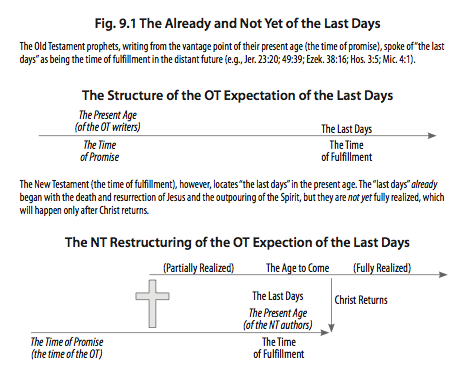
Timelines and charts throughout are a great feature. In addition to timelines in the back of the book covering all of Biblical history (including intertestamental times), there are charts throughout the book that aid the reader. Thomas Schreiner lists all the Epistles, their authors, dates, place of writing, and recipients. Johnson uses nine separate figures to visually (and clearly) display the differences in how Christians interpret Revelation. And House has a table that lines up the prophets with the kings during whose time they prophesied. (A couple of similarly simple and clear maps could be a great addition to future editions of this book.) Here’s an example (taken from a pdf sample of the book):

And then there’s the middle section, part two of Understanding the Big Picture of the Bible. That section alone makes this book worth more than its purchase price. It contains the following:

  • “The Time between the Testaments,” by J. Julius Scott Jr.
  • “The Roman Empire and the Greco-Roman World at the Time of the New Testament,” by David Chapman
  • “Jewish Groups at the Time of the New Testament,” by John Delhousaye

Take just this short quotation from Chapman as an example:

Amid this history, Jesus Christ launched his ministry in a Galilee governed by a Roman client king, a Judea under Roman procurators, and a Judaism tinged with Hellenism. After his crucifixion by the Romans and his resurrection, his gospel was carried by the apostles directly into the heart of Greek culture and Roman power. (94)

Having this background in mind when approaching the New Testament will greatly advance the efforts of any Bible reader. Most Bible overview guides that I’ve seen go right from Old Testament to New Testament. But what about all that time in between? I’ve written more here about why that time period is essential to NT understanding. This book really gets that, and covers that period well. Someone with no knowledge of NT background would find this section easy to follow, and even a budding scholar would appreciate the clarity of the historical overview.

While it’s hard to discern what is the work of the editors (this book has three: Wayne Grudem, C. John Collins, and Schreiner) and what is the work of the writers, this book could have benefitted from a little more careful editorial oversight. There are a few little typos scattered throughout the book (tehillah instead of tefillah for Hebrew prayer, e.g.). I found the use of the sex-specific “man” to refer to all of humanity–even when not quoting the ESV–distracting (although this may not bother other readers).

But there is a bigger editorial oversight. While the book excellently helps the reader to better understand the “big picture” of the Bible, it never directly answers the question it seeks to answer of “How do I get more out of my Bible reading?” The authors present all the necessary information to better understand the background (context) and foreground (content) of the Bible, yes. But understanding context and content is only necessary and not sufficient for “reading the Bible well.” I wish the editors would have made sure the book gave more attention to how one can read the Bible, for example, devotionally… or for transformation rather than just the receiving of information. In other words, I wanted this book, based on its title, to answer: How can I grow closer to God as I read the Bible? How can I allow the Bible to convict me of my sin? What about the importance of reading Scripture in community and corporate worship? David Reimer’s essay gets closest to this when he says, “[T]he art and craft of the Bible’s poems offers an invitation to read slowly, to have one’s vision broadened, once’s perception deepened… to see literary reflection in the service of worship and godly living” (54). I wanted to hear more about this. The key question for me is: Is overview knowledge of the Bible’s context and content sufficient to read the Bible well? Necessary, yes. Sufficient, no.

However, even if the book doesn’t execute its aim listed in the subtitle, it is still a valuable work to have in hand while reading through the Bible. Its unique contribution to works of this kind is in the middle section. I’d imagine this book sitting well on someone’s shelf next to his/her Bible and notebook. (It has on mine these last few weeks!) It would benefit a serious Bible reader to read, say, Darrell Bock’s essay on the Gospels and Acts before reading those Biblical books through.

Thank you to Crossway who provided me with a review copy of this book in exchange for an unbiased review. You can find Understanding the Bible Picture of the Bible at Amazon here.

Good Grief (a review of A Liturgy of Grief)

There is a Yiddish proverb that calls tears the soap of the soul. The release, rather than the bottling up, of inarticulate emotion is a valuable first aid to be applied over and over again to the raw wounds of grief.

A Liturgy of Grief, p. 2

My boss and I have recently lamented together the lack of good lament liturgies for the Church. Worshiping communities seem to be good at celebration and constant in intercession–maybe even at times confession–but lament? We’re too scared or too complacent to adopt that difficult posture. We may think that even if we wanted to lament, we don’t have the words with which to do it. “Contemporary Western culture,” Leslie C. Allen says in his Liturgy of Grief, “provides little space for grief.”

And yet we do have resources, scripts to help us unbottle the anguish and woe we inevitably experience. Allen, whose book is aptly subtitled A Pastoral Commentary on Lamentations, writes, “The book of Lamentations is best understood as the script of a liturgy intended as a therapeutic ritual.”

A Liturgy of Grief is a unique kind of commentary. Though Allen has written technical commentaries and contributed to commentary sets (a few are here), this book is a monograph, a singular contribution to Lamentations commentaries. Baker Academic publishes it, but it is not so academic or technical so as to exclude readers who have only a passing familiarity with Lamentations or the Old Testament.

The book includes the full English text of Lamentations, in Allen’s own translation. Though he often references the Hebrew he translates, he rarely lists the Hebrew words themselves. Language and translation buffs, however, will be happy to see nine pages of translation notes in an appendix. (This language buff appreciated that Allen saved his longest translation note for the single English word “but” in the last verse of Lamentations.)

Allen has written lengthy technical commentaries, yet this is not that, nor is it intended to be. However, Allen does not neglect to thoroughly elucidate the text. He understands the five chapters of Lamentations as “five poems,” each with their own distinctive theme and contribution to the larger book. The climax of the book comes in the fifth poem. Here the grieving community, having heard the model prayers of a pastoral mentor/liturgist (Allen calls him “the reporter”), at last can pray to God in their grief.

Allen weaves together narratives past and present, from the 6th century B.C. to today, in order to guide the reader section-by-section through the book of Lamentations. In addition to being Senior Professor of Old Testament at Fuller Theological Seminary, he is a hospital chaplain. Nicholas Wolterstorff comments in the foreword, “[Allen] brings to his commentary an understanding of grief that was already deeply informed both by the contemporary literature on grief, all of which he seems to have read, and by his own activities as a hospital chaplain.” In reference to the repeated expressions of grief in the first poem (chapter 1 of Lamentations), Allen writes:

For those who grieve, but not for their regular hearers, the old story is ever new, always filling their consciousness and needing to be told once more, as intensely as it was the first time. Patience is the prime virtue that empathy requires.

Any preacher, liturgist, or worship leader will appreciate Allen’s commentary. He gives attention to the approach and words of “the reporter”/liturgist in Lamentations, drawing important conclusions that can guide today’s liturgist in helping a community deal with grief:

In this [third] poem a wounded healer offers his knowledge of God’s ways and his experience of them in a context of suffering. At beginning and end he ministers out of his own suffering and presents himself as an object lesson. A fellow sufferer, he points the congregation forward to a new wholeness that both he and they yearn to attain. In turn, we readers who are wounded have the potential to be wounded healers.

A Liturgy of Grief is a special book and a gift to the Church, both its leaders and its members. Contrary to lament-free churches or a Western culture which knows not how to grieve, Allen opens up a space for readers to recall and feel their hurt and the hurt of others. The commentary is “pastoral,” just as it promises, with Allen a pastor to any who will receive the ministry he has to offer through this book. “When believers find themselves in such a fearfully dark valley,” Allen concludes, “the biblical tradition is there, providing challenging words for souls in pain to use.” In addition to Lamentations, Allen evokes the biblical traditions of Isaiah, Jeremiah, Joel, and makes reference to numerous lament Psalms.

Allen illuminates all these “challenging words” of Scripture beautifully. His final chapter perfectly matches the surprising ending of Lamentations. (No spoilers here, but I will say that all I could write in the margins was, “This is real, true, holy.”) I finally realized hours after finishing the book that, all along, Allen as author plays the same role to reader as “the reporter”/liturgist in Lamentations did to his 6th century B.C. worshiping community:

He mentors members of the community by giving expression to the grief he and they have in common, turning incoherent feelings into words and explaining the experiences they have all been through. …He is also interpreter of their loss…. and finally involves them in a creative response of their own that they are ready to make in the final poem…

…that of prayer to God. As a result, A Liturgy of Grief serves as its own sort of book of Lamentations for the 21st century, with Allen “giving expression to the grief” of his readers, interpreting their loss and–finally–guiding them into a response of prayer.

I offer my thanks to Baker Academic for providing me with a free review copy in exchange for an unbiased review. A Liturgy of Grief is available at Amazon.

UPDATE: I interview the author here.

Should I get a PhD?

Should I get a PhD? If you’ve asked yourself this question, especially about a PhD in Biblical Studies, you should read Nijay K. Gupta’s book. In Prepare, Succeed, Advance: A Guidebook for Getting a PhD in Biblical Studies and Beyond (Wipf and Stock), Gupta walks through the stages of applying for a PhD (prepare), working on a PhD (succeed), and using one’s PhD to find work (advance).

In Prepare, Succeed, Advance, Gupta seeks to “provide a series of responses to a host of questions that one may encounter when travelling down the path towards a PhD in biblical studies and beyond.” The book is right on the money in this sense. While it reads through nicely, it is also the sort of work that one will want to refer to time and again–especially someone who is trying to advance through the stages of the PhD process.

In the Prepare section, Gupta guides the reader through how to select a program, including what factors to consider, such as cost, location, school prestige, and so on. Perhaps the most useful section of the book is the second chapter, in which he counsels PhD applicants in how to prepare for a PhD–what languages they’ll need to know, what reference works with which to familiarize themselves, and so on. The bibliography he provides (with comments) is a time-saver to many. He concludes the section with nuts-and-bolts advice for how to fill out a PhD program application.

The second part of the book, Succeed, is all about how to do well in a PhD program, once accepted. Gupta goes in depth with regard to how to work with one’s supervisor, how to write and plan for the dissertation, and how to prepare for the oral dissertation defense. He writes:

The point of a dissertation is not that your argumentation and evidence will convince everyone, but rather that you have made a sufficiently plausible argument using methods and evidence that are appropriate to your field and generally accepted.

(He coaches to reader on how to do this, too.)

Finally, for the one who has earned her or his PhD, the final section of Advance covers everything from how to interview for a job, how and where to get teaching experience, conference involvement and article publishing (with helpful lists of journal series to shoot for), and dissertation publishing.

There is much to appreciate about this book. As a book reviewer, I particularly appreciated his section on how (and where) to write book reviews. He covered the basics well. (Key point: measure a book against its own standard; that is, does it advance its thesis successfully?)

If I have any criticism of the book (and this is hard to come by), it’s that Gupta’s section on writing the actual body of the dissertation could have included more. He gives advice like, “Individual chapters should be relatively freestanding and stand as an independent contribution to the overall argument,” but doesn’t spend much time on how to go about writing each individual chapter in the dissertation’s body. Perhaps Gupta assumes that other books on the market adequately cover how to write a dissertation, or that it varies so much from topic to topic that no general advice can be given. But something more about how to organize the argument of the dissertation and make sure its logical flow is clear and cogent would have been a good addition to the book. But this is a minor quibble. There is not much that Gupta does not cover thoroughly and winsomely.

Gupta blogs at Crux Sola. Portions of his book (PhD advice) can be found on his blog here. He writes about his book here. More (PhD Survival Guide) here. Even with all that is available on his blog, this guide is indispensable to anyone thinking about a PhD. Should that day ever come for me, I plan to have this within reach on my bookshelf.

I am grateful to Wipf and Stock for the free review copy, provided in exchange for an unbiased review.

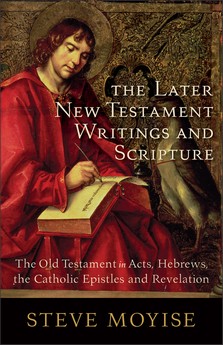
Magnificent Monograph Monday: The Later New Testament Writings and Scripture, Reviewed

Eisegesis. Not a label most evangelical Biblical interpreters want to wear. If exegesis is drawing the meaning out of a text–with a careful eye toward its original context and authorial intention–eisegesis is taking one’s own set of meanings and intentions into the text. Evangelical scholars aim to practice the former and avoid the latter, although of course everyone comes to any text with some presuppositions. (And new hermeneutics like reader response criticism may see this as a good thing anyway.)

My seminary teaches an exegetical method that majors on reading a text in its original context and understanding its original purpose. I’ve often thought that if New Testament writers submitted any of their works as exegesis papers, they’d fail because of the various “hermeneutical fallacies” they commit! It seems that New Testament writers freely appropriate or proof-text Old Testament passages for their own purposes, no matter the original context or intention of the passage at hand. They might even be accused of eisegesis, were they employing their methods today.

Baker Academic has just published the third volume of Steve Moyises’s de facto trilogy, in which he examines how Jesus, Paul, and the later New Testament writers use Scripture. He seeks to “give an account of” and “consider the use of Scripture” in the later NT writings. This is a “study” of “important engagements with Scripture.”

Just picking up the book before reading it was a pleasure–the layout is great, the paper quality is high, the font is clear and easy to read, and the cover design is appealing. Especially for a paperback, it’s an attractive volume to have on a bookshelf. (I note here that I received a free copy from Baker in exchange for an unbiased review.)

Moyise treats Acts, 1 Peter, Jude/2 Peter, James, Hebrews, Revelation, and includes a brief excursus on 1-3 John. He is thorough in the Scriptures he treats, which is especially aided by a UBS index in the back that serves as an index of all the quotations of the Old Testament in the above books. (There are full Scripture and author/subject indeces, too.)

The author groups the Scriptures thematically or by Old Testament book, rather than going verse by verse through each of the New Testament writings under consideration. In Acts, for example, he considers how the author Luke uses Old Testament Scripture to address themes like “Salvation for Jews and Gentiles,” “Christ’s death, resurrection, and exaltation,” “Judgement,” and so on. In 1 Peter Moyise has sections devoted to I Peter’s use of the Psalms, of Isaiah, etc. Moyise does this so as not to “miss the wood for the trees,” and he is successful. The reader, then, can conclude each portion of the book with a solid overview of how each NT writer uses the OT.

The text is accessible to a non-scholar or non-specialist in this field. For example, Moyise explains on p. 4:

[I]n some cases the New Testament authors appear to know a version of the text that differs from the majority of manuscripts that have come down to us. The discovery of the Dead Sea Scrolls (1948–) has shown that the biblical text existed in several forms in the first century and it is not always clear which form is being quoted.

He uses gray shaded boxes at various points to succinctly explain key concepts such as “typological interpretation” or to address things like 2 Peter’s use of the largely unknown 1 Enoch. The endnotes include more textual details and point the reader in the direction of the scholarly writings about each book. One does not need knowledge of the original language to read Moyise, but he does at times use transliteration of various Greek words if it helps his explanation.

The potential reader might be concerned that a book about intertextuality could end up as just a dry list of references. Moyise does thoroughly catalog the quoted OT passages, yet he draws conclusions from such use, as well:

Although James’s use of Scripture is not christological in a doctrinal sense, it bears comparison with Jesus’ own interpretation of the law, particularly his emphasis on seeing the law in the light of the twin commands to love God and neighbour. (63)

Moyise presents various interpretations in an even-handed, balanced way. I felt more than once like I was reading R.T. France, a favorite commentator of mine. He includes, too, the full text of many of the verses he cites, eliminating the need to flip back and forth through other reference works while reading this one. Jude and 2 Peter have a helpful table of comparisons where the two are lined up side-by-side, and this feature is present for other passages also.

There were a couple times where I thought Moyise might be guilty of the fallacy of post hoc ergo propter hoc (inferring causation just because one thing chronologically follows the other). In Revelation, for example (which he notes quotes no Scripture explicitly but is full of allusions), he speaks in terms of the “source” of (129, 137) or “inspiration behind” (130) John’s descriptions of his visions. My response to this was–just because John’s language has much in common with the Scriptures that came before him, do they therefore have to be his source? What if his source was, in fact, the vision he had, and he just used Scriptural language to express it?

Finally in the conclusion to his section on Revelation, Moyise addresses this very question. In fact, he is quite aware of questions like mine, and in the end treats it thoroughly and fairly, citing those who advocate a “scribal model” (where John is said to have basically just compiled Scriptures into a new presentation) and those who advocate a “rhetorical model” (where John uses OT language to express something new that he actually saw).

My question about whether or not NT writers are in some sense eisegetes is not an uncommon one. Students often ask: If we’re not supposed to handle Scripture that way, how can they? Though Moyise doesn’t necessarily set out to answer that question in this volume, he answers it beautifully:

The important point in all this is that the Scriptures did not exist in a vacuum. They were part of a living tradition where text and interpretation were transmitted together. (148)

In describing Revelation’s use of Daniel, for example, he says it is “not necessarily an ‘improper’ use of Scripture but hardly what Daniel had in mind” (140).

Moyise (87) quotes Susan E. Docherty from her book The Use of the Old Testament in Hebrews:

The author of Hebrews as much as any ancient Jewish exegete…regarded it as legitimate interpretation to seek out what scriptural texts imply as much as what they actually say, presumably believing that the new meaning he gave them was inherent in the original revelation, which he regarded as having endless depths of meaning and real contemporary relevance.

That Moyise’s trilogy of books on NT use of Scripture exists is a testament to the depth of Scripture. Moyise is a fantastic guide for exploring what can be confusing and difficult territory.

(Here’s the book at Amazon.)

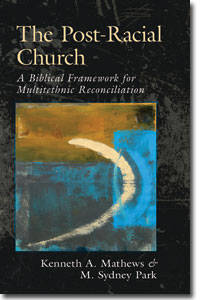
Magnificent Monograph Monday: Review of The Post-Racial Church

Kenneth A. Mathews (Old Testament) and M. Sydney Park (New Testament), professors at Beeson Divinity School, attempt in The Post-Racial Church to “better equip the church in answering why Christians claim that the gospel and the Christian church are the first and last best hope for peace in a racially diverse world” (25).

To help readers understand how churches can more faithfully reflect “the wonder of God’s human kaleidoscope,” they work their way through the arc of the Old and New Testaments to reveal God’s plan for reconciliation. Reconciliation, they believe, “can only be fully and finally achieved by a Savior who redeems and transforms the human state” (57). Their call to racial/ethnic unity in the church is an unabashedly Biblical program. They write, “Genuine unity must be predicated upon a commitment to the Lord God, not based on anything or anyone else. Otherwise, the unity is circumstantial, which means that it is superficial and fragile” (72-73). They ground their call for ethnic unity in the Church firmly in Scripture.

Mathews writes the introduction and chapters 1-4 on the Old Testament, addressing God’s design in creation, his covenant with Noah and then with Abram to bless all nations, as well as God’s heart and provision for the immigrant among the people of Israel. Park traces the New Testament development of the theme of the inclusion of all people in God’s covenant. She explores Jesus’ stories concerning reconciliation, as well as how Biblical characters like James, Peter, and Paul came to grips with a deeper understanding of God’s desire for trans-ethnic unity in the Church.  (Park’s interpretation and application of the Prodigal Son parable opened up new understandings of that story that I had never considered—despite having already heard and read it many times.)

The Post-Racial Church is excellent in the thoroughness with which it treats Biblical texts that have to do with multiethnic reconciliation (and reconciliation more generally). In this sense, it greatly succeeds in being what the book’s subtitle claims it will be: A Biblical Framework for Multiethnic Reconciliation. Even though the introductory chapter clarifies what the authors mean by various terms they use, the phrase “post-racial church” as such is not really explored in the book itself. “Kaleidoscopic Church” or “The Post-Racist Church” would have been more fitting titles for the book. (So if you, like me, express skepticism at a Church or any institution being “post-racial,” don’t let that stop you from checking out this book. The authors don’t actually advance that we be “color-blind” or “ignore race” as part of their thesis.)

On the one hand the book at times felt a bit over-dense (especially the first half). But on the other hand, other books I’ve read about multiethnic church-building or racial reconciliation often give what feels like too short a treatment of Biblical texts on the topic. Mathews’ and Park’s detailed exegesis was in the end refreshing in this sense, and makes a unique contribution to the genre of book into which The Post-Racial Church fits. I also appreciated that they drew on the original Hebrew and Greek to further illuminate the texts they expounded. This made their work even more compelling.

Each chapter concludes with “Thought Provoker” questions, a high point of the book. For example, one question (p. 171) asks,

If loving our neighbors is a critical factor in our discipleship, and if loving our neighbors self-sacrificially serves as the litmus test for our discipleship, does the test prove positive for you and your church?

One could easily use this book in a small group discussion to great effect.

The reader who takes the time to work carefully through the authors’ guided exegetical tour through the Scriptures will be greatly rewarded. If indeed, as Park claims, “the proper understanding of racial reconciliation is possible only in light of God’s saving activity throughout human history,” then those who desire to join God in drawing all people to himself will want to avail themselves to the solid Biblical exposition that the authors provide.

(Per FTC guidelines, I note that I received a complimentary copy of this book from Kregel in exchange for an unbiased review.)