One of the most promising new commentary projects continues to add new volumes: the Zondervan Exegetical Commentary series, covering both Old and New Testament books.
Accordance Bible Software has a huge sale on the OT and NT volumes, both as collections and individual volumes. Check out the details here.
Want to read more about individual volumes in the series?
I reviewed Daniel I. Block’s Obadiah volume here. And Kevin J. Youngblood’s Jonah volume might just be the best commentary I’ve worked through on Jonah. (A remarkable feat, as there is no dearth of Jonah commentaries!) I have not yet reviewed Block’s Ruth volume, but noted it here.
And I’ve reviewed these NT volumes: Matthew, Colossians and Philemon, James, and Luke… with a book note on Mark here. (Fun fact: the Luke ZECNT volume was the very first commentary reviewed at Words on the Word.)
If you haven’t gotten lost in the above hyperlinks, here is the link again to the sale at Accordance. Overall this is a series I’ve been impressed with, and have made good use of in preaching.
Last week I posted the mind map I made to help me visualize the letter to Ephesus in Revelation 2:1-7.
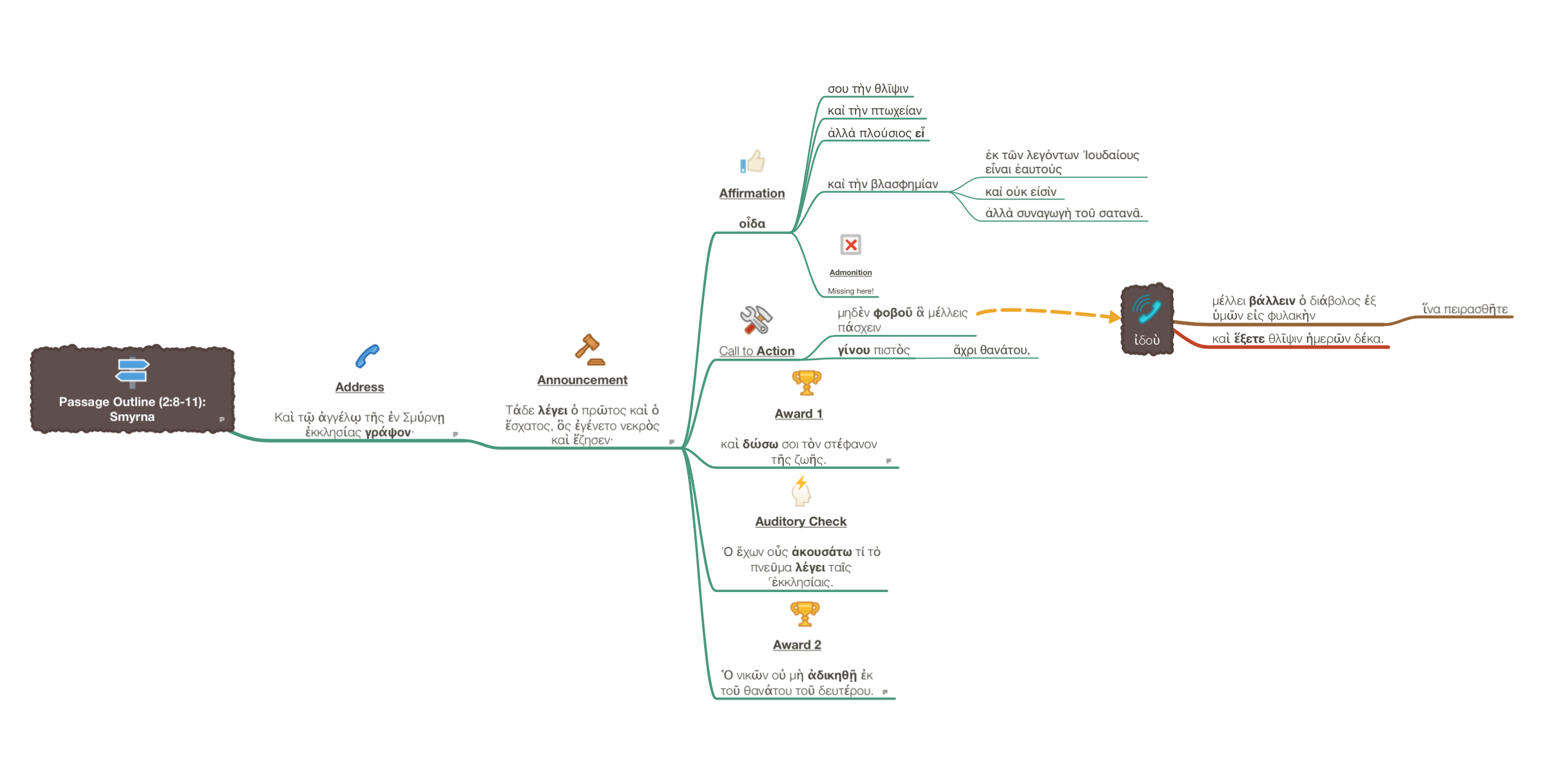
Here is my mind map of Greek Revelation 2:8-11, the letter to Smyrna. Interesting to see how the structure of this “oracle” is both similar to and different from the letter to Ephesus.
As with last time, this passage outline definitely informed my sermon outline, but the latter differs quite a bit from the former. If you want to hear these sermons, by the way, you can subscribe or listen to the podcast here.
I haven’t posted about it since, but I mentioned a while ago that I’m preaching through the first three chapters in Revelation, calling the series, “The 7 Last Words to the Church.” God still speaks to the church today, I believe, but these are the 7 last “words” (or messages) as recorded in Scripture.
This Sunday I’m preaching on the message to Ephesus, the first of seven churches to be addressed (Revelation 2:1-7).
If you are reading this post, it is at least possible that you read Words on the Word because of its nerdery and not in spite of it.
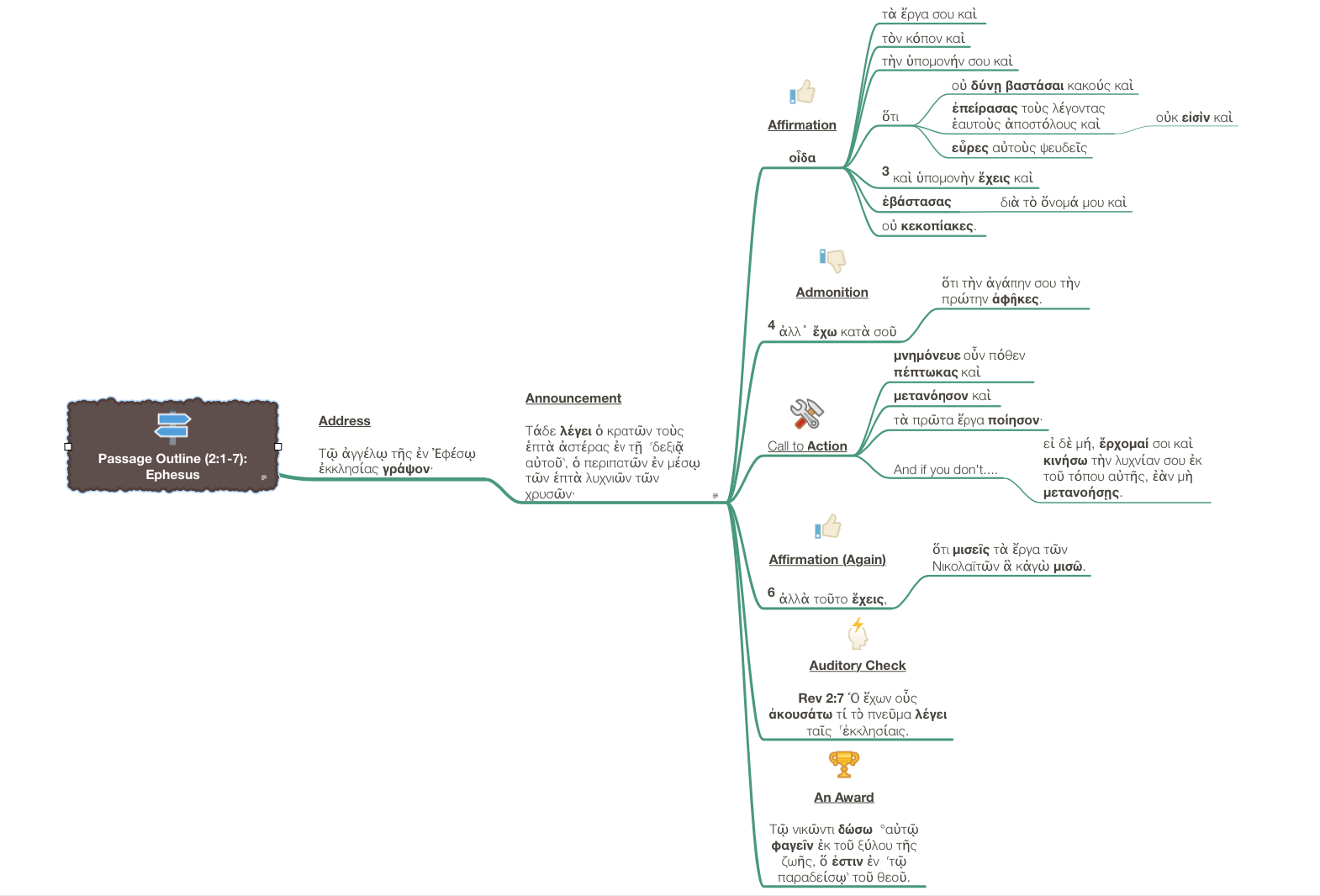
So I wanted to share how much fun I had this morning working through the Greek text (via Accordance) and making a mind map outline of the passage (with MindNode). This is my passage outline, which is not always the same as the sermon outline itself (generally I think of this much alliteration as verboden). Seeing the verses visually like this has helped me get a good grasp on the flow of Revelation 2:1-7. (Click or tap the image to enlarge it.)
I’ve just begun a preaching series on the first three chapters in Revelation, called, “The 7 Last Words to the Church.”
Just as Jesus uttered “7 last words” (or 7 series of words) on the cross, the Bible’s final book has 7 words (or passages) directed to individual churches in John’s day. Just about every interpreter that I can see, including yours truly, understands those passages as having significant universal application to today’s church.
The words to the 7 churches come in Revelation 2 and 3. Before that is one of the most remarkable chapters in all of Scripture. (I know… you can’t really rank these things.) Revelation 1 is rich and powerful and worthy of deep reflection in this season of Easter, soon to give way to Pentecost. In my church we’ll spend a number of weeks in Revelation 1 before moving to the 7 last words to the church in chapters 2 and 3.
The first week I offered our congregation the simple encouragement to read Revelation 1:3 and take it at face value. It says:
Blessed is the one who reads the words of this prophecy, and blessed are those who hear it and take to heart what is written in it, because the time is near.
Okay, I’ll admit: “face value” when it comes to Revelation’s “the time is near” is anything but agreed upon by those who read Revelation! That’s fine. John’s vision and words to the church still have a sense of urgency regardless of when “the time” is and how “near” it may be.
The book–this revelation from, by, and about Jesus Christ–begins with an apocalyptic beatitude. Maybe we’re right to be skeptical any time a preacher asks, “DO YOU WANT TO BE BLESSED?” But John begins his letter with an ironclad promise, endorsed by Jesus himself. Namely, if you read these words of Scripture, if you hear them, and if you take them to heart, you will be blessed, fulfilled, content.
It’s a great way to start this apocalyptic and prophetic letter-Gospel.
González notes that Luke’s story in Luke-Acts doesn’t really end per se: “Paul has suffered countless vicissitudes. He has been shipwrecked. He has finally made it to Rome. He is awaiting trial before Caesar. And then—nothing!”
(If you can never remember how Acts ends, rest assured! This may be why.)
Gonzalez goes on:
In telling his story and leaving it unfinished, Luke is inviting his readers to be part of it, to join the throng. ….But since the story is unfinished, it is more appropriate to conclude it with “RSVP,” like an invitation that awaits a response. This is what Luke demand from us: not satisfied curiosity about the past, but a response here and now. RSVP!
It’s neat to think about the church today as being a new sequel to Luke-Acts. Or, more accurately, the threequel to those two stories: Luke, Acts, the Church Today.
May God continue to empower with his Holy Spirit those of us who would RSVP faithfully to his invitation!
Head over to appealtochristians.com to see “Appeal to Christians Regarding President-Elect Donald Trump.” I’m honored to be joined by more than 30 Christian faith leaders who have signed the letter. The appeal culminates in this five-point commitment and call to action:
1. We will pray for President-elect Trump, elected officials, our nation, our churches, and each other.
2. Rooted in the teachings of Jesus and the prophets, we will tell the truth about the world around us, and we will speak up for those who have been marginalized and taken advantage of.
3. We will actively resist the temptation to overlook or normalize values, speech, and behavior that are in conflict with what Scripture calls us to.
4. In the name of Jesus, we call President-elect Trump to repentance for dishonoring the image of God in others.
5. We will fix our eyes on Jesus and, by the power of the Holy Spirit, redouble our efforts to honor the image of God in all people and to love all our neighbors as ourselves.
Read the whole thing here, add your name if you are so inclined (you’ll see a link), and share freely.
I’ve really been enjoying the Monday Morning Preacher podcast from PreachingToday.com.
The length is perfect (I listen while I do the dishes)
The focus on a single concept (introductions, ladder of abstraction, finding your voice) makes it memorable and easy to apply
The specificity of the content (e.g., come down the ladder of abstraction every 3-4 minutes) means that without a ton of effort I can put the stuff to use right away the next Sunday
I also enjoy hearing real, live preachers with the analysis after a sermon clip
Check out the Monday Morning Preacher podcast here.
John the Baptist arrives on the scene today, the second Sunday of Advent. Here’s how Luke describes it:
The voice of one crying out in the wilderness: “Prepare the way of the Lord, make his paths straight. Every valley shall be filled, and every mountain and hill shall be made low, and the crooked shall be made straight, and the rough ways made smooth; and all flesh shall see the salvation of God.”
Through the Incarnation of Jesus, God exalts the humbled, humbles the exalted, brings light into darkness, and reverses the fortunes of the rich and poor alike, of those who are ahead and those who feel left behind. What a wonderful promise that we would see the salvation of God in this way!
Even as God himself lowers mountains and straightens crooked paths and makes rough ways smooth, we can look inward to our own hearts and ask, “What crooked ways are here? What mountains have I tried to build so I can climb them and exalt myself above others? Where are my own rough ways?”
This is the sermon I preached to my congregation last Sunday, after the U.S. Presidential Election. If you prefer audio, that is here, with a downloadable podcast version here. (It’s the sermon at the top, “The Long View.”) The text follows.
“Not by might, nor by power, but by my spirit, says the LORD of hosts. What are you, O great mountain? Before Zerubbabel you shall become a plain….”
In the name of God: Father, Son, and Holy Spirit. Amen.
What I share this morning comes from one of about four possible outlines I struggled through this week. I’m still not sure if this is the right one. You may find it too weak, you may find it too strong, but I hope you will at least find it to be true… that these words will bear witness faithfully to the truth and love of God that is in Jesus Christ our Lord. That has been my prayer.
If you’ve been on social media or tuned in to the news this week you’ve had no shortage of people telling you how to feel and what to do.
How can there be so many words, so many possible responses, so many angles to consider… and yet a feeling of uncertainty remains? Who are we? How did we get here? What will the next four years look like? What should we do now?
I’ve found myself seeking to console and encourage and maybe even challenge this congregation, even as I’ve been consoled and encouraged and challenged by members of this congregation. I’ve watched YouTube clips of preachers uttering “Jesus is Lord” and, though I fully agree, have told them to go preach to somebody else right now.
I’ve found myself troubled by the new access to power of someone I’m deeply concerned may not stand up for the dignity and needs of all citizens, someone who has bragged about sexual assault and unapologetically mocked his female accusers, and who has repeatedly spoken disparagingly about African Americans and other minority groups.
I’ve wished for a direct hotline to the President-elect—even just one phone call—to implore him to speak out against the anti-Semitic and race-related attacks committed already after the election in his name. That Donald Trump and that we would condemn such hatred–both in the name of America and in the name of Jesus–should be a given. Ours is the message of Christ’s love and hope, fellowship across lines of difference. We followers of Jesus in our prophetic voice need to hold even the leaders of a secular state to certain standards, and hope and pray they will measure up.
I acknowledge and bless the political diversity in this sanctuary. I affirm that we are a church and not a political party. You came to a worship service, not a rally. Mapping Christian virtues onto political candidates and platforms is difficult and messy, and can be—at least for me—deeply unsatisfying. We know that some in the Church in the U.S. are rejoicing that their candidate won (or that the other candidate lost), some are reluctantly at ease with the results, others voted third party or didn’t vote, and still others remain in a state of shock and anger and mourning at the election results. We need to own this reality.
I have not always felt like my best self this week. Maybe you haven’t, either. I think that’s okay.
We were getting out of the van to go into a friend’s house this week, and my four-year-old said, “Carry me.” I didn’t have that good of a grip on her, so she said, “Carry me harder!” I said, that’s a good prayer.
Lament takes time, and we’ve had our eyes opened this election to places where there is no shalom, hurt that calls for lament. It is not true that everything is okay. We need Jesus to carry us harder. Like the prophet Jeremiah, we cannot and should not say “Shalom, shalom” where there is no shalom. Our God is a God of truth, of bringing deeds of darkness out of hiding, and into the light of Christ. What we see may need transforming.
Since Tuesday I’ve second-guessed myself for not being charitable toward our President-Elect, and then the next second I’ve third-guessed myself for second-guessing myself, and wished I had more courage to be a strongly prophetic voice. At least my ongoing uncertainty in how to move forward has led to a renewed impulse to pray fervently for our country’s President-Elect, and for other elected officials.
After today we have plenty more worship services and Scripture readings and hymns and Bible studies… lots of chances to gather in small groups and prayer times and conversations over coffee, where we can keep exploring what it means to be faithful to Jesus in a time of national tension.
This week in the midst of my exasperation and uncertainty about how we best move ahead, in the midst of the divisions in our country and in the Church, in the midst of the cries of people who fear for their safety in what should be a secure home for them… in the midst of it all, I am certain of a few things. Even if we woke up to a new world on Wednesday, some things have not changed since then. I offer four such convictions this morning.
1. “The Church is the Conscience of the State”
One conviction is that the church is the conscience of the state. Martin Luther King gave us this. I know Israel was a theocracy and we live in a non-theocratic democracy, but I think we’ve inherited something of the prophetic task we see in the Hebrew Bible. Isaiah and Jeremiah and Micah and all the other prophets came alongside kings and people, and said, “Exhibit A: how things are. Exhibit B: how things should be.” They held before the people visions of shalom, the world as God would re-create it one day, and a world in-between the times that could move more faithfully toward wholeness.
As prophets challenged kings, as Jesus pushed the local ruling religious establishment of his day, so we Christians have the responsibility to speak the truth even to positions of power. It’s a scary task, but it’s our task.
We just can’t normalize race-based dismissiveness, the devaluing of women’s bodies, xenophobia, inflammatory rhetoric, nor any other sinful behavior. We must not explain it away or look past it as if it’s not there, or as if we could somehow just “make the best of it,” leaving it as it is.
And we ought to have a sincere desire for the repentance of any perpetrator. We’re called to speak the truth, not spitefully but in love, not vindictively but with the hope for repentance. We hold ourselves to Gospel standards, too, looking for ways we need to repent. As ones who have received the outpouring of Holy Spirit, as the prophet Joel says, we all–men and women, young and old–have a prophetic task. We can be a conscience for power brokers and systems that are so easily corrupted by power.
We tell the truth about who we know God to be, and what we see in the world–for better or for worse. Having drunk deeply of the well of the Scriptures, which any prophet must do, we speak up for ones who have been marginalized, taken advantage of, for the fatherless and the widow that Scripture speaks so frequently about. We say, “These are God’s dearly loved children. Let justice for them and for everyone roll down like waters, and righteousness like an ever-flowing stream.” And we proclaim that “Christ has died, Christ is risen, Christ will come again” to bring a vision of shalom to reality.
There’s freedom in knowing that the church is not the state, and this country is not all we have. It’s not that the two should never be integrated in how we think about positive social action. But there is freedom in remembering that our ability to effect change is not limited by what we can do through the power structures of an election, legislation, and the Supreme Court. We can discharge our duty as citizens of the United States by being active as citizens of the Kingdom of God, who bring conscience to bear on politics.
“The church is the conscience of the state.” Among those who call Jesus Christ Lord, there should be no bystanders.
2. “The Local Church is the Hope of the World”
Bill Hybels, long-time pastor at Willow Creek in Illinois, loves to say that “the local church is the hope of the world.” “The local church is the hope of the world.” That’s been a second bedrock certainty for me this week.
Why? He says:
There’s only one power on planet earth that can turn a hate-filled heart to a loving heart, a greedy heart to a generous heart, a selfish heart to a selfless or serving heart. There is only one power in the universe that can do that. It’s the power of the transforming love of Jesus Christ, which has been given to the church to steward.
“The local church is the hope of the world.” Not just “the Church.” But the local church. Bill Hybels’s church: Willow Creek Community Church. Our church: Union Congregational Church in Magnolia. Other local churches in and beyond the North Shore.
We need to pray that we would steward well the “transforming love of Jesus Christ,” and even look inward and repent for ways in which we have not taken that role seriously. I hold fast to that truth: “the local church is the hope of the world,” because we have the message of Jesus.
3. Come What May, Jesus is Stronger
A third truth I cling to: come what may, Jesus is stronger.
Some months ago we were in Ephesians. Paul prays in the first chapter that his churches would have the “eyes of [their] heart enlightened” so that they would know God’s “incomparably great power for us who believe.”
Nothing compares to this power, the power that raised Jesus from the dead and is at work in us now–as a local church and as individuals, as contemplatives and as Christian activists.
Paul says, Jesus is “far above every ruler and authority and power and dominion and every name that is named”, not only in this age, but also in the age to come! (1:21)
Come what may, Jesus is stronger! Come who may, Jesus rules over them! In a world giving ground to idolatry and fear-mongering and greed and apathy and hatred and a distaste for holiness… Jesus will still prevail. Every “rule and authority, power and dominion” must submit to the name of Jesus.
Christ is in a position of authority that cannot be breached by any other power. All other names, all other titles, all governors and Senators and Representatives and Supreme Court Justices and President and Cabinet—these God has placed at the feet of Jesus.
Every authority that would dare to set itself up against the ways of God finds its proper place as a footstool where Jesus Christ stretches out his feet from his throne.
This is what we pastors mean when we say, “Jesus is still Lord.” I know it may sound like a platitude in a time of distress, but boy do I believe it with every inch and every pound of my body. And the truth that “Jesus is Lord” matters for how we live our lives, for how we work as ambassadors for shalom, for how we share with others the great news of the love of Jesus.
Come what may, Jesus is stronger.
4. All Things Made New
Finally, I am quite certain that we will one morning wake up into another new world:
Behold, I will create
new heavens and a new earth.
The former things will not be remembered,
nor will they come to mind.
But be glad and rejoice forever
in what I will create,
for I will create Jerusalem to be a delight and its people a joy.
I will rejoice over Jerusalem
and take delight in my people;
the sound of weeping and of crying
will be heard in it no more.
Can you see this vision, even now? “Never again,” Isaiah says, “will there be in [this world] an infant who lives but a few days, or an old man who does not live out his years.” Doesn’t your heart burn within you? “They will not toil in vain or bear children doomed to misfortune.” Don’t you want to live there now? “Before they call I will answer; while they are still speaking I will heart.”
I’m not always so convinced that “the moral arc of the universe bends toward justice.” Maybe it scatters toward entropy. But we at least can look ahead to justice, a day of total shalom, where God will be perfectly present to his people. There will be no more injury and pain and animosity. Jesus himself will be our light, and we will bask in his love.
The Best Campaign
We live for those times when this vision of tomorrow breaks in to today.
If God can create a new heavens and a new earth, can he not also, create a new United States?
If God can create a new heavens and a new earth, can he not also, renew his church? Can he not embolden us to co-create a more just and peaceable world with him?
If God can create a new heavens and a new earth, if God can raise Jesus Christ from the dead, can he not also, raise your heart to new life?
The road ahead might be long. So we need to take the long view, and Isaiah 65 is it.
So, my good friends, you who are some of my favorite people on earth: may we be renewed, deep in our souls, by God’s vision of a perfect future. May we be faithful in our prophetic call to be both conscience and hope of the world in this present moment. May we remember that at all times, come what may, Jesus is stronger.
May we walk freely and joyfully in the truth that tomorrow will be another sunrise. And more than that–may we affirm that with every sunrise comes the ruling Son of God: “Jesus shall reign where’er the sun // does its successive journeys run, // his kingdom stretch from shore to shore, // till moons shall wax and wane no more.”










 Words on the Word