Donald Trump, the Church, and Jesus: The Long View

This is the sermon I preached to my congregation last Sunday, after the U.S. Presidential Election. If you prefer audio, that is here, with a downloadable podcast version here. (It’s the sermon at the top, “The Long View.”) The text follows.


“Not by might, nor by power, but by my spirit, says the LORD of hosts. What are you, O great mountain? Before Zerubbabel you shall become a plain….”

In the name of God: Father, Son, and Holy Spirit. Amen.


What I share this morning comes from one of about four possible outlines I struggled through this week. I’m still not sure if this is the right one. You may find it too weak, you may find it too strong, but I hope you will at least find it to be true… that these words will bear witness faithfully to the truth and love of God that is in Jesus Christ our Lord. That has been my prayer.

If you’ve been on social media or tuned in to the news this week you’ve had no shortage of people telling you how to feel and what to do.

How can there be so many words, so many possible responses, so many angles to consider… and yet a feeling of uncertainty remains? Who are we? How did we get here? What will the next four years look like? What should we do now?

I’ve found myself seeking to console and encourage and maybe even challenge this congregation, even as I’ve been consoled and encouraged and challenged by members of this congregation. I’ve watched YouTube clips of preachers uttering “Jesus is Lord” and, though I fully agree, have told them to go preach to somebody else right now.

I’ve found myself troubled by the new access to power of someone I’m deeply concerned may not stand up for the dignity and needs of all citizens, someone who has bragged about sexual assault and unapologetically mocked his female accusers, and who has repeatedly spoken disparagingly about African Americans and other minority groups.

I’ve wished for a direct hotline to the President-elect—even just one phone call—to implore him to speak out against the anti-Semitic and race-related attacks committed already after the election in his name. That Donald Trump and that we would condemn such hatred–both in the name of America and in the name of Jesus–should be a given. Ours is the message of Christ’s love and hope, fellowship across lines of difference. We followers of Jesus in our prophetic voice need to hold even the leaders of a secular state to certain standards, and hope and pray they will measure up.

I acknowledge and bless the political diversity in this sanctuary. I affirm that we are a church and not a political party. You came to a worship service, not a rally. Mapping Christian virtues onto political candidates and platforms is difficult and messy, and can be—at least for me—deeply unsatisfying. We know that some in the Church in the U.S. are rejoicing that their candidate won (or that the other candidate lost), some are reluctantly at ease with the results, others voted third party or didn’t vote, and still others remain in a state of shock and anger and mourning at the election results. We need to own this reality.

I have not always felt like my best self this week. Maybe you haven’t, either. I think that’s okay.

We were getting out of the van to go into a friend’s house this week, and my four-year-old said, “Carry me.” I didn’t have that good of a grip on her, so she said, “Carry me harder!” I said, that’s a good prayer.

Lament takes time, and we’ve had our eyes opened this election to places where there is no shalom, hurt that calls for lament. It is not true that everything is okay. We need Jesus to carry us harder. Like the prophet Jeremiah, we cannot and should not say “Shalom, shalom” where there is no shalom. Our God is a God of truth, of bringing deeds of darkness out of hiding, and into the light of Christ. What we see may need transforming.

Since Tuesday I’ve second-guessed myself for not being charitable toward our President-Elect, and then the next second I’ve third-guessed myself for second-guessing myself, and wished I had more courage to be a strongly prophetic voice. At least my ongoing uncertainty in how to move forward has led to a renewed impulse to pray fervently for our country’s President-Elect, and for other elected officials.

After today we have plenty more worship services and Scripture readings and hymns and Bible studies… lots of chances to gather in small groups and prayer times and conversations over coffee, where we can keep exploring what it means to be faithful to Jesus in a time of national tension.

This week in the midst of my exasperation and uncertainty about how we best move ahead, in the midst of the divisions in our country and in the Church, in the midst of the cries of people who fear for their safety in what should be a secure home for them… in the midst of it all, I am certain of a few things. Even if we woke up to a new world on Wednesday, some things have not changed since then. I offer four such convictions this morning.


1. “The Church is the Conscience of the State”


One conviction is that the church is the conscience of the state. Martin Luther King gave us this. I know Israel was a theocracy and we live in a non-theocratic democracy, but I think we’ve inherited something of the prophetic task we see in the Hebrew Bible. Isaiah and Jeremiah and Micah and all the other prophets came alongside kings and people, and said, “Exhibit A: how things are. Exhibit B: how things should be.” They held before the people visions of shalom, the world as God would re-create it one day, and a world in-between the times that could move more faithfully toward wholeness.

As prophets challenged kings, as Jesus pushed the local ruling religious establishment of his day, so we Christians have the responsibility to speak the truth even to positions of power. It’s a scary task, but it’s our task.

We just can’t normalize race-based dismissiveness, the devaluing of women’s bodies, xenophobia, inflammatory rhetoric, nor any other sinful behavior. We must not explain it away or look past it as if it’s not there, or as if we could somehow just “make the best of it,” leaving it as it is.

And we ought to have a sincere desire for the repentance of any perpetrator. We’re called to speak the truth, not spitefully but in love, not vindictively but with the hope for repentance. We hold ourselves to Gospel standards, too, looking for ways we need to repent. As ones who have received the outpouring of Holy Spirit, as the prophet Joel says, we all–men and women, young and old–have a prophetic task. We can be a conscience for power brokers and systems that are so easily corrupted by power.

We tell the truth about who we know God to be, and what we see in the world–for better or for worse. Having drunk deeply of the well of the Scriptures, which any prophet must do, we speak up for ones who have been marginalized, taken advantage of, for the fatherless and the widow that Scripture speaks so frequently about. We say, “These are God’s dearly loved children. Let justice for them and for everyone roll down like waters, and righteousness like an ever-flowing stream.” And we proclaim that “Christ has died, Christ is risen, Christ will come again” to bring a vision of shalom to reality.

There’s freedom in knowing that the church is not the state, and this country is not all we have. It’s not that the two should never be integrated in how we think about positive social action. But there is freedom in remembering that our ability to effect change is not limited by what we can do through the power structures of an election, legislation, and the Supreme Court. We can discharge our duty as citizens of the United States by being active as citizens of the Kingdom of God, who bring conscience to bear on politics.

“The church is the conscience of the state.” Among those who call Jesus Christ Lord, there should be no bystanders.


2. “The Local Church is the Hope of the World”


Bill Hybels, long-time pastor at Willow Creek in Illinois, loves to say that “the local church is the hope of the world.” “The local church is the hope of the world.” That’s been a second bedrock certainty for me this week.

Why? He says:

There’s only one power on planet earth that can turn a hate-filled heart to a loving heart, a greedy heart to a generous heart, a selfish heart to a selfless or serving heart. There is only one power in the universe that can do that. It’s the power of the transforming love of Jesus Christ, which has been given to the church to steward.

“The local church is the hope of the world.” Not just “the Church.” But the local church. Bill Hybels’s church: Willow Creek Community Church. Our church: Union Congregational Church in Magnolia. Other local churches in and beyond the North Shore.

We need to pray that we would steward well the “transforming love of Jesus Christ,” and even look inward and repent for ways in which we have not taken that role seriously. I hold fast to that truth: “the local church is the hope of the world,” because we have the message of Jesus.


3. Come What May, Jesus is Stronger


A third truth I cling to: come what may, Jesus is stronger.

Some months ago we were in Ephesians. Paul prays in the first chapter that his churches would have the “eyes of [their] heart enlightened” so that they would know God’s “incomparably great power for us who believe.”

Nothing compares to this power, the power that raised Jesus from the dead and is at work in us now–as a local church and as individuals, as contemplatives and as Christian activists.

Paul says, Jesus is “far above every ruler and authority and power and dominion and every name that is named”, not only in this age, but also in the age to come! (1:21)

Come what may, Jesus is stronger! Come who may, Jesus rules over them! In a world giving ground to idolatry and fear-mongering and greed and apathy and hatred and a distaste for holiness… Jesus will still prevail. Every “rule and authority, power and dominion” must submit to the name of Jesus.

Christ is in a position of authority that cannot be breached by any other power. All other names, all other titles, all governors and Senators and Representatives and Supreme Court Justices and President and Cabinet—these God has placed at the feet of Jesus.

Every authority that would dare to set itself up against the ways of God finds its proper place as a footstool where Jesus Christ stretches out his feet from his throne.

 

trump-bumpersticker
CREDIT: Micah Jones (www.micahharrisjones.com)


This is what we pastors mean when we say, “Jesus is still Lord.” I know it may sound like a platitude in a time of distress, but boy do I believe it with every inch and every pound of my body. And the truth that “Jesus is Lord” matters for how we live our lives, for how we work as ambassadors for shalom, for how we share with others the great news of the love of Jesus.

Come what may, Jesus is stronger.


4. All Things Made New


Finally, I am quite certain that we will one morning wake up into another new world:

Behold, I will create

new heavens and a new earth.

The former things will not be remembered,

nor will they come to mind.

But be glad and rejoice forever

in what I will create,

for I will create Jerusalem to be a delight and its people a joy.

I will rejoice over Jerusalem

and take delight in my people;

the sound of weeping and of crying

will be heard in it no more.

Can you see this vision, even now? “Never again,” Isaiah says, “will there be in [this world] an infant who lives but a few days, or an old man who does not live out his years.” Doesn’t your heart burn within you? “They will not toil in vain or bear children doomed to misfortune.” Don’t you want to live there now? “Before they call I will answer; while they are still speaking I will heart.”

I’m not always so convinced that “the moral arc of the universe bends toward justice.” Maybe it scatters toward entropy. But we at least can look ahead to justice, a day of total shalom, where God will be perfectly present to his people. There will be no more injury and pain and animosity. Jesus himself will be our light, and we will bask in his love.


The Best Campaign


We live for those times when this vision of tomorrow breaks in to today.

If God can create a new heavens and a new earth, can he not also, create a new United States?

If God can create a new heavens and a new earth, can he not also, renew his church? Can he not embolden us to co-create a more just and peaceable world with him?

If God can create a new heavens and a new earth, if God can raise Jesus Christ from the dead, can he not also, raise your heart to new life?

The road ahead might be long. So we need to take the long view, and Isaiah 65 is it.

So, my good friends, you who are some of my favorite people on earth: may we be renewed, deep in our souls, by God’s vision of a perfect future. May we be faithful in our prophetic call to be both conscience and hope of the world in this present moment. May we remember that at all times, come what may, Jesus is stronger.

May we walk freely and joyfully in the truth that tomorrow will be another sunrise. And more than that–may we affirm that with every sunrise comes the ruling Son of God: “Jesus shall reign where’er the sun // does its successive journeys run, // his kingdom stretch from shore to shore, // till moons shall wax and wane no more.”

In the meantime…

God give us courage

to suit up and work together

on that perfect campaign,

the campaign that will one day end

with no ruler but Jesus.

NIV Application Commentaries, $4.99 Each

NIVAC sale


Zondervan’s NIV Application Commentary series is on sale again (today is the last day), with each of the ebooks selling at $4.99.

I really liked Psalms vol. 1 in this series. There are a lot of really good volumes in NIVAC, including some e-bundles available now.

All the Table of Contents now are hyperlinked, so navigating via Kindle or iBooks should be relatively manageable. You won’t get the same sort of search power you’d get in Accordance or Logos, but the price is tough to beat.

See everything here on Amazon or here at Zondervan’s page.

After the Election

I wrote this letter to my congregation yesterday with only them in mind, but then thought I’d post here in case any others wanted to read.

Dear church,

There’s a scene in Hoosiers (maybe a future pastor will quote different movies) where the team from tiny, rural Hickory High scopes out the giant and intimidating basketball stadium where they’ll play the state championship game:

Coach Dale: Buddy, hold this [tape measure] under the backboard. [They measure from free throw line to underneath backboard.] What is it?
Buddy: 15 feet.
Coach: 15 feet!

Coach: Strap, put Ollie on your shoulders. Measure this from the rim [hands them tape measure; they measure from rim to floor]. Buddy… how far?
Buddy: 10 feet.
Coach: 10 feet!

Coach: I think you’ll find it’s the exact same measurements as our gym back at Hickory.
Team: [laughs]
Coach: Okay, let’s get dressed for practice.

I was happy this morning at home to see our coffeemaker had reliably brewed the coffee. The sun had risen. Another day was here.

Sufficiently wired from yet more coffee and a breakfast at Friendly’s with a friend and mentor, I went to the church with that Hoosiers clip in mind. The office was still there. The sanctuary is just as we left it Sunday: fresh candles at the altar, a cross, pews where God has been praised for over 100 years, a stack of chord charts for the band in the first pew. All the measurements and implements were the same.

Today I know that even while some rejoice, or reluctantly greet the election results as the best available option, many in our country are mourning, confused, and frustrated.

However you feel, this is a good day to take care of yourself, and for us to take care of our loved ones and each other. Be liberal with hugs!

I stand by what I preached Sunday, which I preach again now to myself, if you’d like to listen in:

Whatever happens on Tuesday, whatever rebuilding is ahead of us, our country right now needs more of God’s presence. We little temples need to get to work in bringing the holiness of God, the power of God, the joy of God, and the goodness of God to would-be worshipers. I truly believe we can hear the same words spoken to Esther that we cannot remain silent “at such a time as this.” Maybe also like Esther, we have come to our position—as bearers of God’s presence—for such a time as this.

“Do not fear,” God says, “for I am with you.”

Might this be a kairos moment for the church? We have much soul-searching, rebuilding and national identity negotiation ahead of us. What would it look like if the church somehow took up the mantle and led the way? What if we re-doubled our efforts to do justice, love mercy, and walk humbly with our God? (Micah 6:8) What if we re-committed ourselves to the spiritual disciplines of prayer, Scripture reading, corporate repentance, and social action?

If that kind of talk feels overly moralizing or too soon for you, I hope you feel free to take your time and feel what you need to feel right now.

If you would find it helpful, I’m available to talk and to pray these next few days—just text or call ahead to make sure I haven’t stepped out of the office for a bit. Not claiming to have any answers or great political insights—but I would love to listen and pray with anyone who wants to. (To blog readers: you can contact me here.)

If the full vision of God’s shalom “seems to tarry,” Habakkuk said, “wait for it.” And, empowered by the Lord, he would also have us work for it: “The Sovereign LORD is my strength; he makes my feet like the feet of a deer, he enables me to go on the heights.”

Peace and hope,
Abram

A Letter to My Congregation on Election Day

shalom


Dear friends,

Perhaps none of us needs a reminder of the importance of today’s Election Day–not to mention the accompanying issues, conversations, and implications around our vote. Allow me, then, to hold before us the importance of prayer in this national moment.

In our worship services we’ve been mining our Old Testament lectionary readings for “Glimpses of Shalom.” Jeremiah 29 encourages ones in exile to “Seek the shalom” of their city, which includes praying for the shalom of the city:

Also, seek the peace (shalom) and prosperity of the city to which I have carried you into exile. Pray to the LORD for it, because if it prospers, you too will prosper.

I wanted to suggest some features of shalom that could become prayer points to guide our intercessions for our cities and country, today and in the coming days and weeks. This is what the Hebrew Bible calls the people and land to when it speaks of shalom:

  • love
  • relational wholeness
  • reconciliation
  • completeness
  • selfless giving
  • “the totality of human flourishing” (Eldin Villafañe)
  • humility
  • truth-seeking and truth-telling
  • peace, especially in a community setting
  • “the state of flourishing in all dimensions of one’s existence” (Nicholas Wolterstorff)
  • well-being
  • justice: God’s will done on earth as in heaven
  • connectedness across lines of difference
  • righteousness (Isaiah 32:17 says, “The product of righteousness will be shalom“)
  • “universal flourishing, wholeness, and delight” (Cornelius Plantinga)
  • the Lord’s favor
  • grace for ourselves and others

Let’s pray that where shalom exists, it would deepen. Let’s pray that where there is no shalom, God would bring it into being–even through our prayers and efforts!

“To clasp the hands in prayer is the beginning of an uprising against the disorder of the world” (Karl Barth).

Praying with you for God’s shalom,

Abram

The Joy of Analogue: Outlining the Book of Joel for Preaching

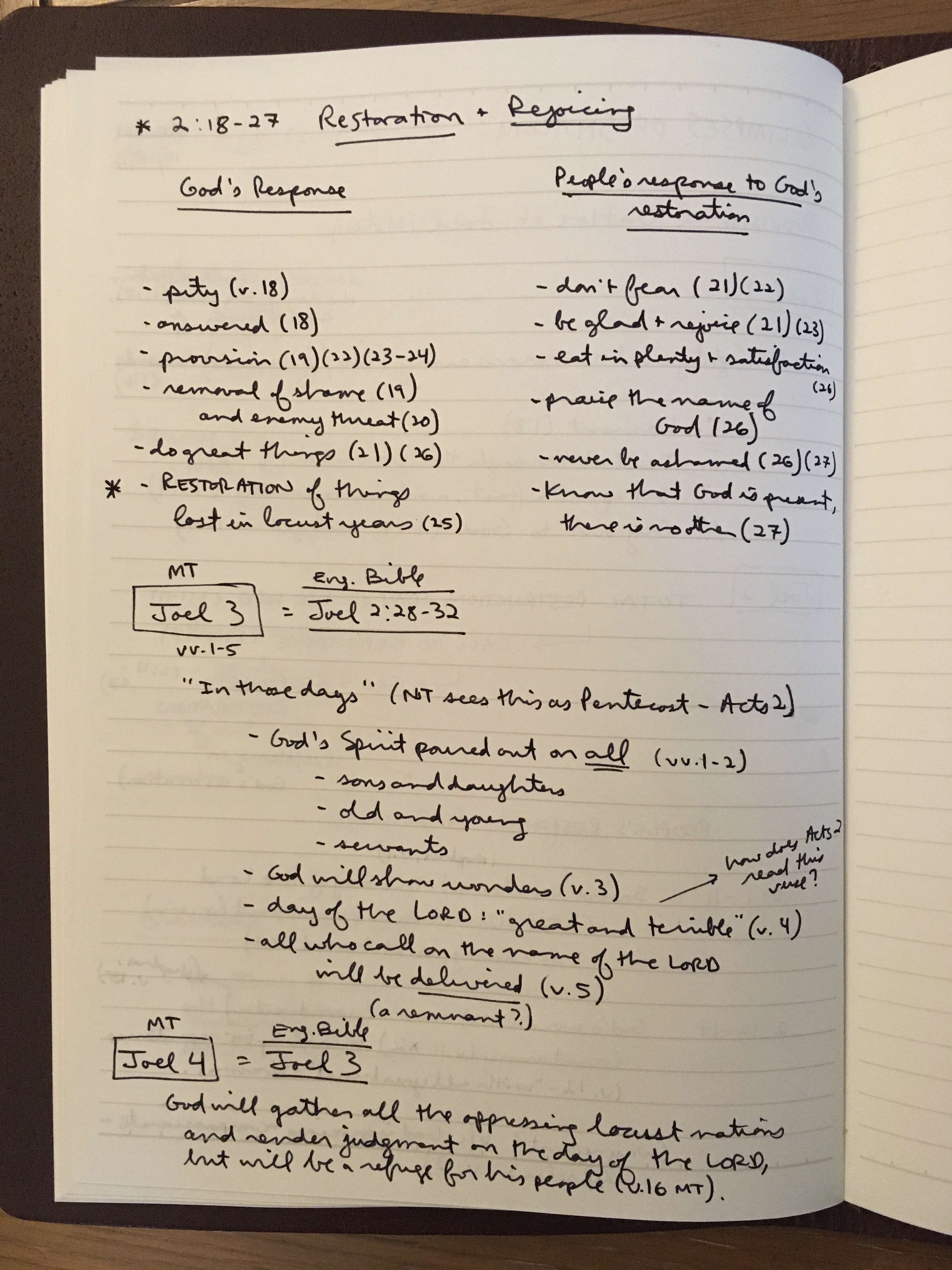
One essential step in my sermon preparation process is reading the book of which the preaching passage is a part. I find it a discipline to hold off on reading commentaries and sit with the text itself. This is easier with a short book like Joel, from which this Sunday’s Old Testament lectionary reading comes.

I find myself more focused to read through and outline the book in analogue fashion. Here’s what it looked like for me yesterday morning:


img_8646


(Having fine writing implements like a fountain pen and nice paper helps!) I have since transferred my book outline to MindNode, from which I’ll continue my sermon planning. Starting device-free is important (and really enjoyable) for me.

Here’s my two-page provisional outline of the book of Joel, complete with a misspelling of “devastation”:


img_8647


img_8648

How I’m Keeping Greek and Hebrew Fresh

I’ve been practicing reading Greek fairly regularly all year. Hebrew had fallen a bit by the wayside until recently. As of the last two weeks, however, I think I’ve got a good rhythm now for keeping both fresh.

I know I’m not the only pastor who finds it a challenge to not lose the heard-earned results of semesters and years of Greek and Hebrew in the classroom.

Here’s what I’ve been doing:


1. Reading through the Greek New Testament, roughly a chapter a day.


To become more fluent in reading, there’s no substitute for… you know… reading. I just got through 2 Corinthians, which I think might be the most difficult book in the New Testament—in both Greek and English!


2. Working through the Baylor Handbooks.


Baylor’s got two solid series in progress: Baylor Handbook on the Greek New Testament (BHGNT) and Baylor Handbook on the Hebrew Bible (BHHB).


These are books to read cover to cover, especially when you want to move from “rapid reading” to more detailed analysis of the text. I just finished Jonah and have started in on †Rod Decker’s Mark. You can see more about the series in my reviews of Luke and Malachi (here and here).


3. Reading my preaching passage in the original language, maybe even making my own translation.


Mark 1 in GreekI just preached through Ephesians. I translated much of it as I studied the text—either typing it out or doing it in my head. Especially with Paul’s longer sentences and more involved lines of thought in the first three chapters, this was challenging, but also essential in my grasping the text.

Now with the Old Testament lectionary readings in view (hello, prophets!), I’ll have a chance to reactivate my Hebrew reading.

If you (a) preach somewhat regularly and (b) want to make use of your Greek and Hebrew, why not combine the two endeavors? Both your preaching and your languages will be the better for it.

(NB: I teach a Webinar on this very topic, with more dates TBA. Here’s the handout.)

There’s also an invaluable chapter in Baker Academic’s Preaching the Old Testament called “Keeping Your Hebrew Healthy.”


4. Reading Greek with another person.


I’m really fortunate to have a reading partner for #1 above, reading through the GNT. This is an immense help and likely deserves its own post. Just remember that skill-building often happens best in community.


5. Learning to enjoy reading Greek and Hebrew.


Lack of proficiency for me is a great way to not enjoy a task; conversely, the more I read, the more comfortable I am with the text (Galatians was almost easy after 2 Corinthians!). Reading the Bible in its first languages also forces me to slow down and carefully consider what I’m reading. Greek and Hebrew reading fit well into devotional practices. (Great book on this, by the way, here: Using and Enjoying Biblical Greek: Reading the New Testament with Fluency and Devotion).


How about you? If you’ve been keeping your Greek and Hebrew active, what’s been helpful? What pitfalls are you facing? What other resources should I and others like me be using?

Review and Reflection: Greek for Preachers

Greek for Preachers (Chalice Press, 2002) divides into three primary parts. Part 1 is “The Preliminaries,” where authors Joseph M. Webb and Robert Kysar suggest initial tools for preachers who want to use Greek. Part 2 offers “Ten Principles for Uncovering Greek Meaning,” which makes up the majority of the book. Part 3 focuses on “Using the Greek Text in Sermon Preparation,” and is a hands-on application of the principles the authors have taught in the second part. The book’s aim is simple: “to bring the Greek text of the New Testament within reach of anyone who wishes to explore its riches” (x). The authors want preachers who have lost their Greek (or not had any) to find the language “both usable and exciting” for use in sermon preparation (7).


Part 1: “The Preliminaries”


I worried a bit when I saw “uncovering Greek meaning” as the title for Part 2. Somewhere along the way I learned that Greek is not just a language to decode, as if there could be one-to-one equivalents for everything, with “hidden gems” available to ones with secret inside knowledge. But the authors are balanced here. In the Preface they say, “We do not believe there is anything intrinsically magic or even necessarily sacred about the original language of the New Testament, even though we both assert the importance of biblical languages for the Christian tradition” (ix). This approach resonates with me, especially as they go on to affirm, “But, judiciously and frugally handled, the joys of the Greek language of our New Testament are as bright as newly cut diamonds sitting in a store window waiting for someone to pick them up and share them with others” (7).

The first part focuses primarily on introducing the preacher to two tools: a Greek-English interlinear and an analytical lexicon. From there the authors go over the Greek alphabet, syllabification, pronunciation, and helpful immersion in a few practice texts. (The Greek font in this book looks good and is readable.) It is also in this first part that the authors introduce their approach to words and meaning, one that I am fully on board with: “[W]e should never assume that a word is used in the exact same way in different passages. The context in which a word is used is more important than how another writer in a different document might use the same word…” (5). This, in fact, has preaching implications for me, because I can make points like this in my sermons without even bringing “the underlying Greek” into the picture.


Part 2: “Ten Principles for Uncovering Greek Meaning”


Part 2 is the heart of the book. The authors give ten principles around specific grammatical features. Concepts they explore include: articles (and how their presence or absence adjusts meaning), verbs, participles, infinitives, cases, and more. There are lots of examples from the Greek New Testament, including possible sermon angles to derive from interpreting the Greek grammar. There’s a wealth of interaction with the Greek text for the reader to work through. There are charts, glosses, and plenty of material that any Greek reader will benefit from reviewing.

A highlight of the second part for me was the authors’ good distinction between grammatical gender and what they call human gender (also called social gender). They would support, for example, not using the generic “man” in English translations where the Greek has ἄνθρωπος. I am similarly deliberate in reading from the pulpit gender-accurate translations whenever I can.

While most of the instruction in this section is consistent with what I’ve learned from various grammars and exegesis courses at Gordon-Conwell (and reading Greek regularly since), there are a couple of surprising hermeneutical moves that I didn’t think were on firm footing.

For example, here is John 1:1:

Ἐν ἀρχῇ ἦν ὁ λόγος, καὶ ὁ λόγος ἦν πρὸς τὸν θεόν, καὶ θεὸς ἦν ὁ λόγος.

The authors say, “Look for the articles, especially the ones associated with God” (39). With the last part of the verse (θεὸς ἦν ὁ λόγος), the authors rightly point out that ὁ λόγος becomes the subject because of the article. So, “the Word was God.” However, they go on to explore “the nature of the articular nouns as they differ from the anarthrous nouns “(39), considering that the anarthrous θεὸς could simply mean something less specific like “God-like.” They approach the translation with humility, but unfortunately conclude, “Theologically, it raises the issue of whether or not the text means that God and the ‘word’ are identical” (39). Though it’s tempting to criticize this interpretation on account of what sounds like heterodoxy, Greek grammar alone (at least I thought!) settles the issue, that, “the Word was God” (and not just God-like). I can recall at least two Greek professors at GCTS making a similar point that the anarthrous θεὸς should not be interpreted in the way the authors explore.

greek-for-preachersAlso a curious was the interpretation of participles in the Great Commission of Matthew 28:19-20. The authors point out the three participles in those two verses, the first of which is aorist. “But the aorist participle,” they say, “that begins the sentence gives the idea of ‘going’ before it mentions the command to ‘make learners.’ Those who are addressed in this passage are already going” (65). As Roy Ciampa (from a 2008 Every Thought Captive blog post called, “As You Go, Make Disciples?“) and others have argued, that aorist participle is actually a participle of attendance circumstance, and it simply has the force of an imperative: nothing more, nothing less.

How does this interaction impact my own preaching, beyond my desire to critically engage with anything I read for my ministry development?

The authors model humility in how they approach the Greek, even when I disagree with them. I want to follow suit here.

On the other hand, some of their Greek-based hermeneutical moves seem like classic anecdotes of “what not to do” when moving from Greek New Testament to interpretation to pulpit. One wants to be careful not to make too much of subtle grammatical points that may reflect merely on what wording the author felt like using at the time of writing. As with the John 21 example where John and Peter dance between two different Greek words for love, a given author could simply be using a rhetorical flourish, and not intending us to derive any meaning more than that the author writes with creative style. (John 21 seems less clear-cut to me, though, than the examples above.)


Part 3: “Using the Greek Text in Sermon Preparation”


In the third part, “Using the Greek Text in Sermon Preparation,” the authors move the process into the pulpit. They list seven steps, each of which is easy enough to implement. And they have a stance on commentaries that I really appreciate, even as I’m aware of the discipline required: “We suggest that you use commentaries to learn what others have said about the passage but not necessarily to learn what you should say” (172). Great advice. I also resonated with their explanation of a topical sermon, where “the text gives you entry into an extensive issue that reaches beyond the text itself” (163).

The book closes with two full sample sermons using Greek, the first of which was a really interesting (and helpful) take on “submission” (as mutual) in Ephesians 5.


Concluding Assessment


Greek beginners will want to turn to Part 1 right away, although I’ve had it drilled into me that interlinears are bad. I think they have their place, but a preacher who really wants to learn Greek might better avoid them and use a footnoted Reader’s Greek New Testament instead. The authors suggest that pastors actively using Greek can profitably skim Part 2 as a refresher–it can be consulted later as a reference–and cut right to Part 3 for the meat of using Greek in preaching.

I appreciate the desire of this book. On the one hand, the authors are right on when they say,

“A little learning is a dangerous thing.” Novices in the Greek New Testament are in danger of slipping into the same mold. Greek is not a cure-all for biblical interpretation nor the key that unlocks truth. It is only one more tool to help us (176).

On the other hand, I really like the idea of teaching pastors the basics of Greek so that they can begin to get their feet wet with word studies.

Again, the drawback to using this book is that readers need enough Greek already to be able to discern what the authors are doing with John 1:1 and Matthew 28:19-20. The humility they model is admirable, though, and the majority of the other examples don’t make the same kind of questionable (in my opinion) conclusions those ones do.

For me, I try to use Greek as much as possible in my study. I’m reading through the Greek New Testament this year with a friend, and we’re taking (and sharing) notes as we go. I often find that insights from our conversations about the Greek text make their way into my sermons. So I wholeheartedly affirm with the authors that the integration of Greek reading and sermon preparation is a beautiful thing. Reading Greek for Preachers compels me to re-double my efforts in turning over the Greek (or Hebrew) text as an essential part of sermon preparation.

Greek for Preachers is at Amazon here, and at Chalice Press here.


Thanks to Chalice Press for sending me a review copy, which—I trust will be evident—did not influence my attempts at objectivity in assessing the book.

MindNode is Free on iOS This Week


MindNode


One of my favorite and most-used apps–MindNode–is free in the iOS App Store this week. After thinking mind mapping wasn’t for me, I tried it just over a year ago and loved it. Now it’s a regular part of my brainstorming and writing workflow.

Here‘s the link–download it while you can, for iPhone and iPad. (Regular price is something like $10.)


The Winner Is…

Mark ZECNT


Congrats to Brian Davidson, the winner of Mark in the Zondervan Exegetical Commentary on the NT! Enjoy the book, Brian!

I used Random Number Generator to pick the winner–tried and true. If you’d like to read my book note on the Mark commentary, it’s here.

Thanks for all who entered the giveaway! Subscribe via the right sidebar to get updated every time I post here.

Free Copy of Mark (ZECNT) in Print, and 80% Off Ebook Gospel Commentaries from Zondervan

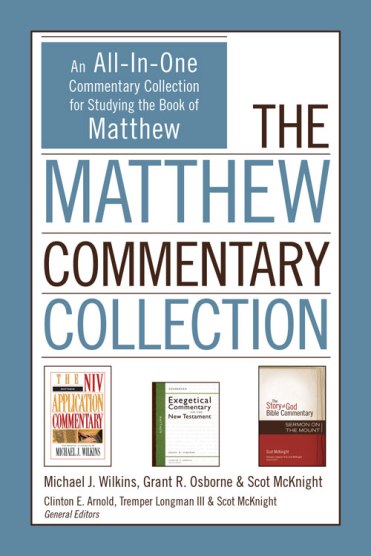
Zondervan Matthew Collection


Starting August 8 and going until 11:59 (EST) on August 11, Zondervan is offering a host of commentaries on the Gospels at a steep discount. Almost all of them are ones I use regularly in preaching preparation.

Some highlights:

  • Matthew, Zondervan Exegetical Commentary on the NT, $7.99 (reviewed here)
  • Scot McKnight’s Commentary on the Sermon on the Mount (The Story of God Bible Commentary, reviewed here)
  • Mark, Zondervan Exegetical Commentary on the NT, $7.99 (book note here)
  • NIVAC volumes, including Gary Burge’s volume on John
  • Luke, Zondervan Exegetical Commentary on the NT, $7.99 (reviewed here, and I think the first commentary I reviewed for Words on the Word)

Find all the books on sale here.

Mark ZECNT
Up for grabs!

As part of the promotion, Zondervan has given me a print copy of Mark Strauss’s Mark commentary (ZECNT) to give away. It retails at $44.99.

If you’d like to enter for a chance to win the Mark commentary, leave a comment saying which Gospel you find yourself most drawn to and why. If you share a link to this post on Facebook and/or Twitter, you get a second entry. (Make sure you let me know you shared, and leave the link in the comments.)

I’ll announce the winner Friday evening. Check out the whole sale here.