Reader’s Edition of the UBS5 Greek New Testament: An Illustrated Review

Typesetting is somewhat subjective, but the German Bible Society’s UBS5 has some of the best-looking Greek text you’ll find in any New Testament.

The UBS5 itself is about three years old. (Hendrickson, which distributes GBS items in the U.S., put together this excellent infographic.) Known for its full-bodied text-critical apparatus, translators and students alike benefit from its footnoted listing of variant manuscript readings. (So do NA28-loving scholars; don’t let them fool you!)

The UBS5 Reader’s Edition significantly pares down the textual apparatus and in its place provides a running list of infrequently occurring Greek vocabulary. As the name implies, the Reader’s Edition is a one-stop shop that facilitates fluid reading of the Greek text, even for those who have had just a year or so of Greek studies.

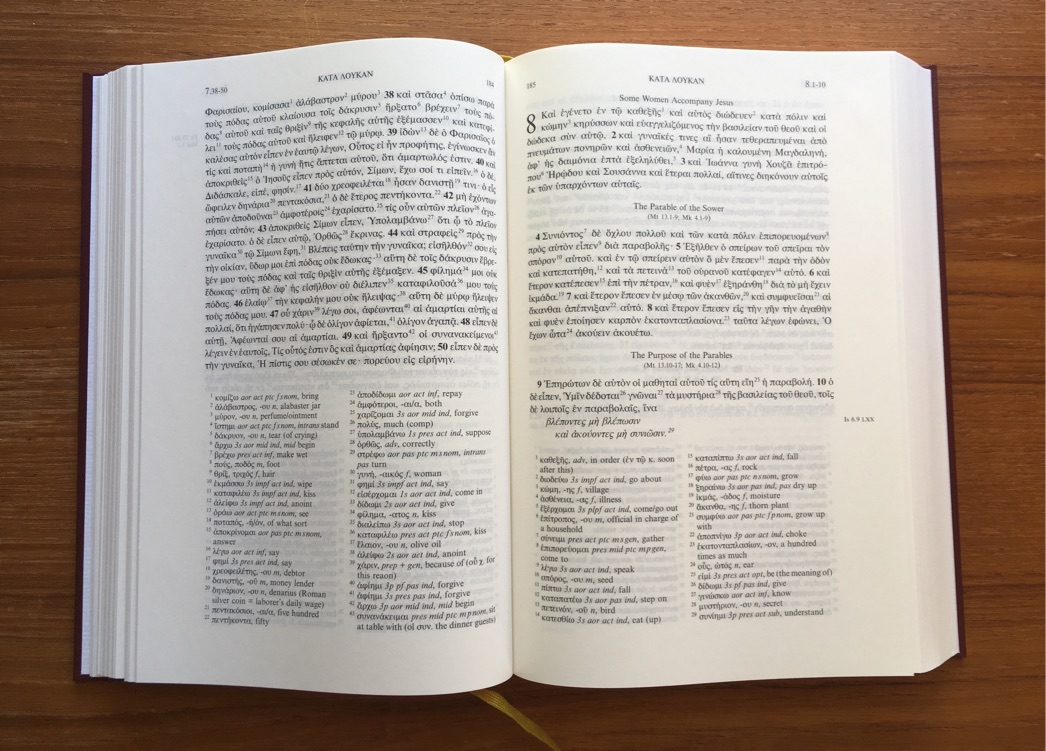
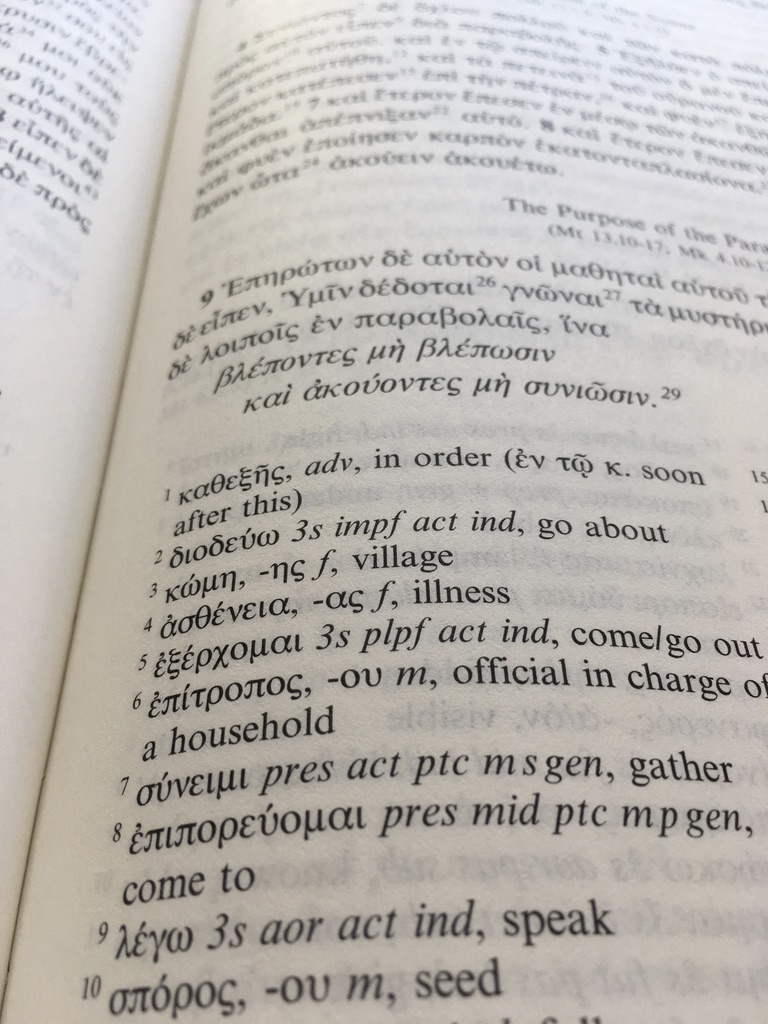
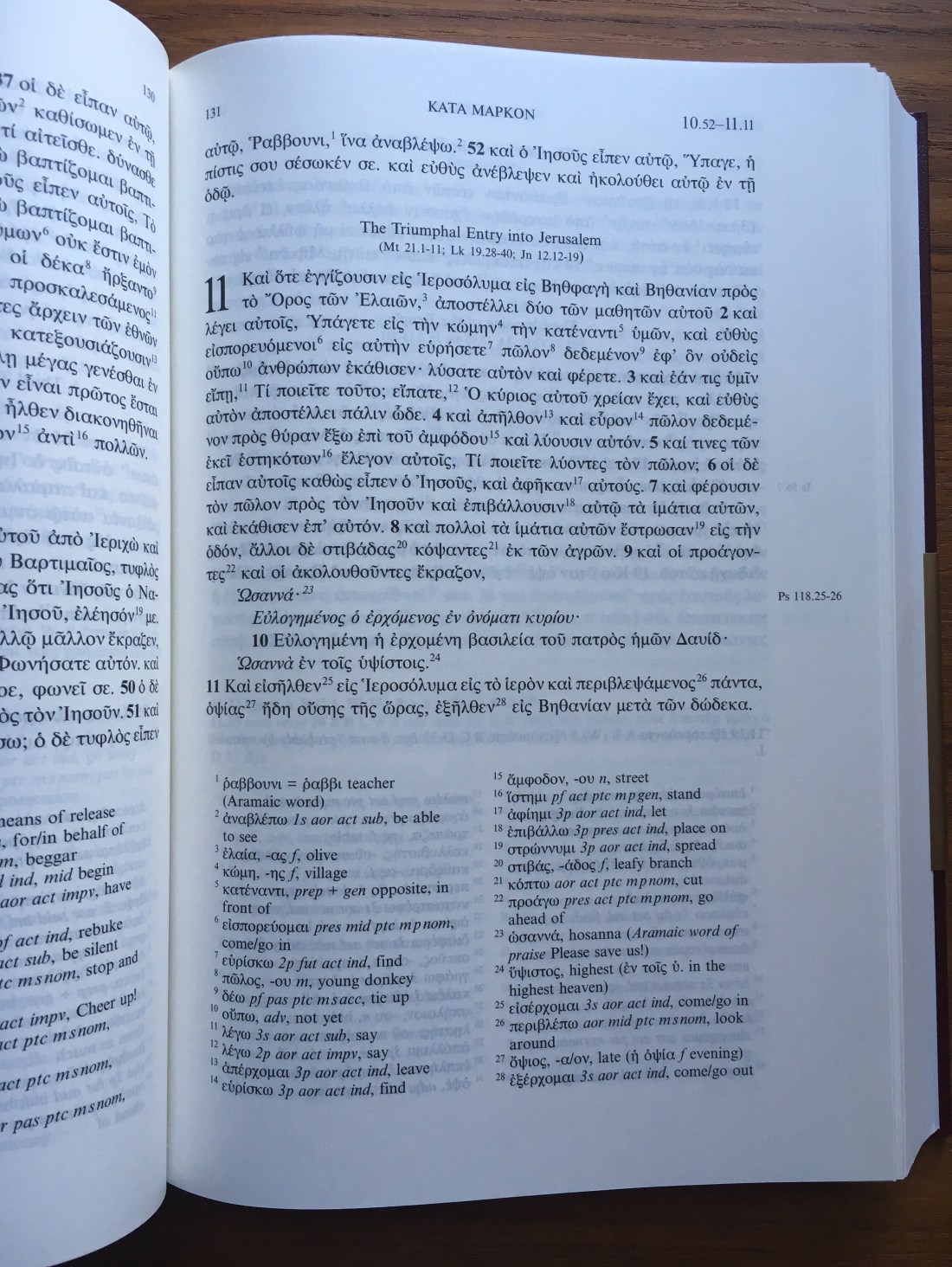
Here’s what it looks like:


The “textual notes” here just “highlight the most important differences between major Greek manuscripts and identify Old Testament references in the margins,” the latter of which I have found really useful.

As for the footnoted vocabulary, any word that occurs 30 times or less in the Greek New Testament has a “contextual” gloss (short translation equivalent) next to it. What I really like about this volume in contrast to the Zondervan Reader’s Edition is that there are verb parsings and noun genders listed with the vocabulary. This helps me not just to know what a word means in its context, but provides occasion to review verbal forms—something that can slip surprisingly quickly without review! Everything on the bottom of the page is easy to scan, too, as it is in two columns, not all jumbled together as some other reader’s editions have it.


img_6961-e1497842648504.jpeg


Between the aesthetically pleasing font and the vocabulary and parsings, this is the best reader’s edition on the market.

I’ve found parsing errors in the previous UBS Reader’s Edition. No doubt there have been corrections in this one. I cannot recall coming across any errors so far, and I’ve been using it off and on for at least a year of reading.

If a vocabulary word is not glossed at the bottom (i.e., you don’t know your vocabulary down to 30 occurrences), there is a concise Greek-English dictionary in the back of the Bible. Yes! Just about everything you need for Greek reading is here.

The only potential annoyance I can think of is that sometimes if a word is glossed already on page (n), when it occurs again on page (n+1) it is not always listed on that page—you have to flip back a page. Sometimes it’s not even footnoted when repeated, but then you recall that you just saw it (hopefully).

The inclusion of a high-quality ribbon marker is icing on the cake.

Finally, I have to say I was a little saddened that a beautiful typo (found in the UBS5 stand-alone and UBS5-NIV11 diglot and even previous UBS Reader’s Edition) is corrected in this edition! For the better, I suppose.

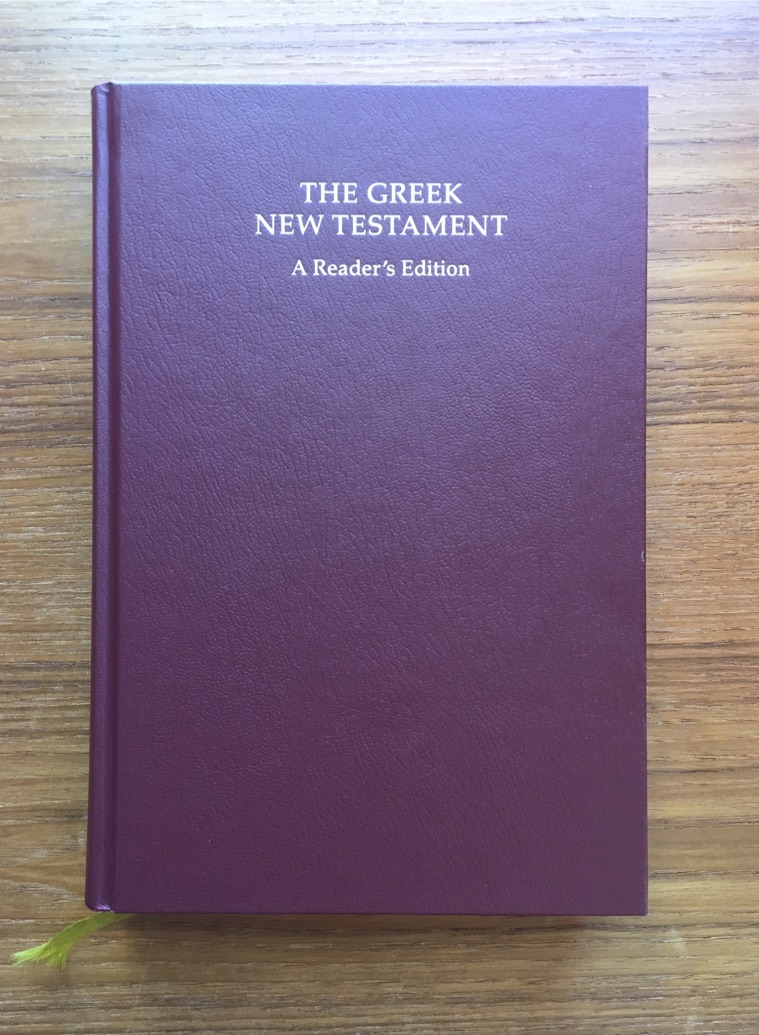
You can find the UBS5 Reader’s Edition here at Whole Foo—I mean, Amazon, here at Hendrickson, here at GBS, and here at CBD. There is both a hardcover edition (what is pictured in this post) and a slightly more expensive imitation leather edition.


Thanks to Hendrickson for the review copy, given for the purposes of this write-up, but with no expectation as to the content of my review.

Phoenix Finally Has a New Album: I Listen So You Don’t Have To


From Ti Amo’s beginning track and first single “J-Boy,” Phoenix delivers an album much more like United (2000) or Alphabetical (2004) than the catchy four-piece scarf rock of It’s Never Been Like That (2006) and Wolfgang Amadeus Phoenix (2009). Ti Amo is, however, a stronger offering than the last record, the aptly titled Bankrupt!

The guitars come to the fore in the second and title track, “Ti Amo.” The groove is catchy, but the listening world could have done without the vapid and irresponsible lines, “Open up your legs,” and, “Don’t tell me no” (?!), however else those were meant. Have we learned nothing about making light of or enabling rape culture? Those lyrics should have never left the cutting room floor.

After the Tame Impala-like and somewhat uninspired “Tuttifrutti,” the introspective and guitar-driven “Fior Di Latte” offers sonic beauty, tempered only by another throw-away lyric, “We’re meant to get it on.”

From there the album seems like it will take a turn for the better, with one of its best songs, “Lovelife,” introduced by synthesizer octaves and a catchy drum beat. The ascending scale synthesizer riff is one of the album’s best moments. Tracks six through nine, unfortunately, are navel-gazing and uninteresting.

In the end, Phoenix delivers a good closing track, “Telefono,” a fitting blend of guitars and synths that one wished had better pervaded the album. Nine additional songs more like the last one would have made this a strong album.

I really do like this band—they’re talented and have written two of my favorite indie rock albums. I hope their next album will be more focused and introspective.

You can listen to samples of the album here (Amazon) or here (iTunes). It’s on Spotify, too, if you want to check it out in its entirety there.


Thanks to the kind folks at Glassnote for giving me access to the album so I could write the review.

In Which I (Finally!) Play Guitar with Kyser’s Partial Capo


For more than twenty years I have been writing and playing guitar music with a partial capo. It’s always been the Kyser full six-string capo, just commandeered for my 4/6 capoing purposes. I’ll put the capo on strings 3-6, leaving the high E and B strings open—nice and ringy! It’s a great way to approximate an alternate tuning without having to majorly re-tune the strings.

The approach has generally worked well, even though that’s not the intent of the six-string capo. Still, I’ve long wondered how one of Kyser’s actual partial capos would work. One of their partial capos is the Short-Cut. I recently reached out to Kyser and they were kind enough to send me a black Short-Cut capo to review.

This is one of the funnest products I’ve gotten to review, and I’m a big fan of the Short-Cut.

The immediate effect is that you can approximate DADGAD tuning with a simple putting on of the capo.

But there’s actually a new world of sonics and chord voicing opened up with this little guy, too.

I want to show you some pictures and say a few more things, but first, the best I can do to describe the capo is to offer you this snippet, with the Kyser (full) capo on the second fret and the Short-Cut on the fourth.


Any time you put a capo (of any kind) on, you’ll have to tweak the strings a bit to make sure they’re in tune. This is especially (but expectedly) true of the Short-Cut capo, since it pulls up (toward the player, that is) just a bit on the third string, making it a touch sharper than it would otherwise be. This is easy enough to adjust, of course. It just means that the Short-Cut capo does not allow you to actually avoid re-tuning altogether. Not a surprise, and not really a strike against it.

(UPDATE: The Kyser team tells me you can adjust the tension on the capo.)

I’ve had my store-bought Kyser capo for ages, and it’s held up really well, so I expect the Short-Cut will, too.

I’m still having fun with the novelty of capoing three and not four strings. though I would love it if Kyser made a 4/6 partial capo. There still is not (that I’m aware of) a good capo on the market that covers the third, fourth, fifth, and six strings only—a tuning I’ve written and recorded a number of songs in. The Short-Cut covers just the third, fourth, and fifth strings.

But the great benefit to the Short-Cut over adapting the six-string capo is that it doesn’t look like it’s about to snap off at any moment. It’s totally secure.

Here’s what it looks like:


And with both capos on:


The Short-Cut is a great product, well-made, and will bring a new level of energy and creativity to anyone’s guitar playing.

One last thing—the folks at Kyser included in my package one of the cleverest and (I hope they don’t mind my saying) adorable lapel pins I’ve ever seen:


On point!


You can get the Short-Cut capo at Amazon, probably, but Kyser is a family-run business, so if you’re going to get it, you can support their good work by ordering directly here.

Released Today: Stubborn Persistent Illusions by Do Make Say Think

Today marks the release of a new full-length album by Do Make Say Think: Stubborn Persistent Illusions.

The band wastes no time in piling up layers of guitars, effects, and energetic drums on the first track, “War on Torpor.” The opener is reminiscent of some of Godspeed You! Black Emperor’s best builds, minus the waiting. The song does, indeed, slay the listener’s torpor. You’ll feel your blood pressure rise a bit as you listen, and the song never settles into much of a repetitive groove. No matter–it’s aurally stimulating, and the band finally comes back to the song’s opening motif in the last part of the track.

Do Make Say Think

From there, Do Make Say Think tones it down a bit with a 10-minute track two, “Horripilation.” Yes, I had to look up the word, too: “the erection of hairs on the skin due to cold, fear, or excitement.” AKA goose bumps.

It’s at this point in the record–and for its remainder–that the band tests the listener’s allegiance to whatever people mean when they say “post-rock.” To be fair, Do Make Say Think are more creative, tighter, and experimental than many other bands in this genre–think Don Caballero rather than This Will Destroy You. But if you’re looking for hooks, they seem in short supply here. By track three, “A Murder of Thoughts,” only the most patient of non-fans won’t be reaching for the fast-forward button.

Even so, there are some real bright spots on the album: a couple minutes into “Boundless,” the band locks into a groove you’ll be glad goes on for minutes, even as textures build and change on top of the steady drums. And all eight minutes of “As Far as the Eye Can See” are interesting. The musicianship on the album is really good–a trait that made up for this reviewer’s not infrequent sense of torpor when listening, propelling me to want to continue experiencing the album as a whole.

In contrast to instrumental rock bands like Caspian and Mogwai, there is nary a vocal line to be found on the album. But there are enough riffs, layers, lines, changes, motifs, and grooves that you’ll probably want to listen to this album at least two times through before you feel confident making up your mind about it.

At nine tracks and an hour long, Do Make Say Think have given their patient listeners much to digest in their first record in eight years. Your mileage may vary. I don’t think this will compete for Album of the Year (I give the edge so far to the new Slowdive… so good). But I also suspect this album will live up to its name and stubbornly, persistently grow on me and all who take the time to carefully listen.

Check out Stubborn Persistent Illusions here at Constellation Records.


Thanks to the kind folks at Constellation Records for giving me early access to the album so I could write the review.


How to Read a Book in Accordance (Screencast)

I’ve recorded a 12-minute screencast on how to read a book in Accordance Bible Software.

I highlight four features:

  1. Hyperlinks, hyperlinks, hyperlinks!
  2. The expandable/collapsible Table of Contents sidebar
  3. Search Fields to better focus your search
  4. Advanced: Amplify/Research to get from the book you’re reading to the rest of your library

You’ll never read or study a work of theology or biblical studies the same way again. Accordance makes Kindle look like a codex.

Here’s the video:


I mention these resources:

And there are Interpretation Bible studies. More about these exciting new additions to Accordance can be found here.

Thanks for watching!


Thanks to Accordance for access to the Interpretation modules shown in this screencast review. See my other Accordance posts (there are many) gathered here. I recorded the tutorial using the app Capto.

February 8: Happy International Septuagint Day!

International Septuagint Day


Today is February 8, which can only mean one thing: International Septuagint Day. Happy LXX Day! Take some time to read part of the Septuagint today, in Greek or English.

Here are few more links to explore:

From the Creator of Captain Underpants: Dog Man

Our children don’t need any encouragement in the area of scatalogical humor, but here we all have been anyway, laughing through the pages of Dav Pilkey’s new Dog Man. (Pilkey of Captain Underpants fame.) That is to say–this book would not be something to read to your four-year-old daughter. Unless, uh, she had two older brothers and was already unfazed by such humor.

Case in point:


one-day-this-happened


in-my-office-now


Dog Man, as Pilkey tells it, is the creation of George Beard and Harold Hutchins, two comic-writing friends whose teacher, Ms. Construde, clearly does not appreciate their “disruptive activity in my classroom.” All my kids love it, of course.

The premise itself is a little more violent than I would have liked for my (or any) kids: Dog Man is born when the evil cat Petey blows up Officer Knight and his dog Greg:

Doctor: I’m sorry Greg, but your body is dying. and your head is dying too, cop.

Officer: Rats! I sure hate my dying head!

But just when all seemed lost…

Nurse Lady: Hey! Why don’t we sew Greg’s head onto cop’s body?

Doctor: Good idea, nurse lady! You’re a genius!

Here “a brand-new crime-fighting sensation was unleashed.”

Dog Man the character is about what you would expect from somebody who is half man, half dog. He battles Petey, then Robo Chief, and then a giant, walking Philly cheesesteak mascot in chapter 4, “Weenie Wars: The Franks Awaken.” This last chapter was probably the funniest and best part of the book. Sample lines:

OH look! Little baby hot dogs are starting a revolution!!!!

We’re not little babies! we’re regular sized!

(Their subsequent claim to be “gangsta” will go over kids’ heads and seems to unfortunately engage in cultural appropriation.)

A fun feature that comes up at several points is the “Flip-O-Rama,” where you can create a little bit of animation by quickly flipping between pages. At this moment I’m looking at the book’s warning: “Remember—Flip it, Don’t Rip it!!!!!!”, which happens to be right next to a newly made rip in our edition. Oh, well.

The section in the back of the book with “How 2 Draw” different characters is icing on the cake.

For how inexpensive the book is, I was pleasantly surprised to see a sewn binding. The colors are vibrant and the lettering is what you would expect from Dav-Pilkey-as-two-kids-writing-a-comic. It inspired my own kids to write their own. (Details forthcoming, or maybe we’ll just try for a book deal.)

If you’re trying to avoid scatological humor, don’t get this book. If you’ve maybe slacked a little with your standards for your kids in that regard, they’ll probably love Dog Man.

You can find the book at Scholastic’s page here. It’s also available at Amazon here. Dav Pilkey’s got his own site, too.


Thanks to Scholastic for the review copy, given with no expectation as to the content of the review.

Mamoko: A World Where Kids Read to the Grown-Ups

mamoko-3000


Some of the best book gifts our oldest child has received have been Maps and Animalium from Big Picture Press, an imprint of Candlewick.

Our kids have also spent many collective minutes and hours poring over two books from The World of Mamoko series: The World of Mamoko in the Year 3000 and The World of Mamoko in the Time of Dragons.

The premise of Mamoko is simple: “Use your eyes!” to “follow the adventures” of more than two dozen different characters through seven detailed spreads that span two pages each. The books are hardback, like giant board books, so they’ll last us a long time. The target age range is 5-8 years old, but my four-year-old (who can’t yet read) really enjoys looking at the pictures, too.

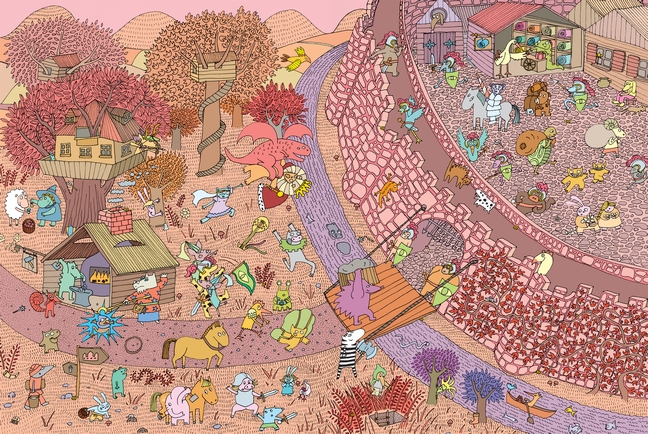
Here’s a spread from World of Mamoko in the Time of Dragons:


mamoko-in-the-time-of-dragons


It’s lots of fun. There are short descriptions of each character that help in knowing what to look for. For example, a pink elephant (holding a hammer?) is Othello Smith:

OTHELLO SMITH is feeling bummed out. What is the cause of his distress?

The book is pretty funny. And it’s big enough that, like the Where’s Waldo? books, two people can easily look for characters and their antics at the same time.

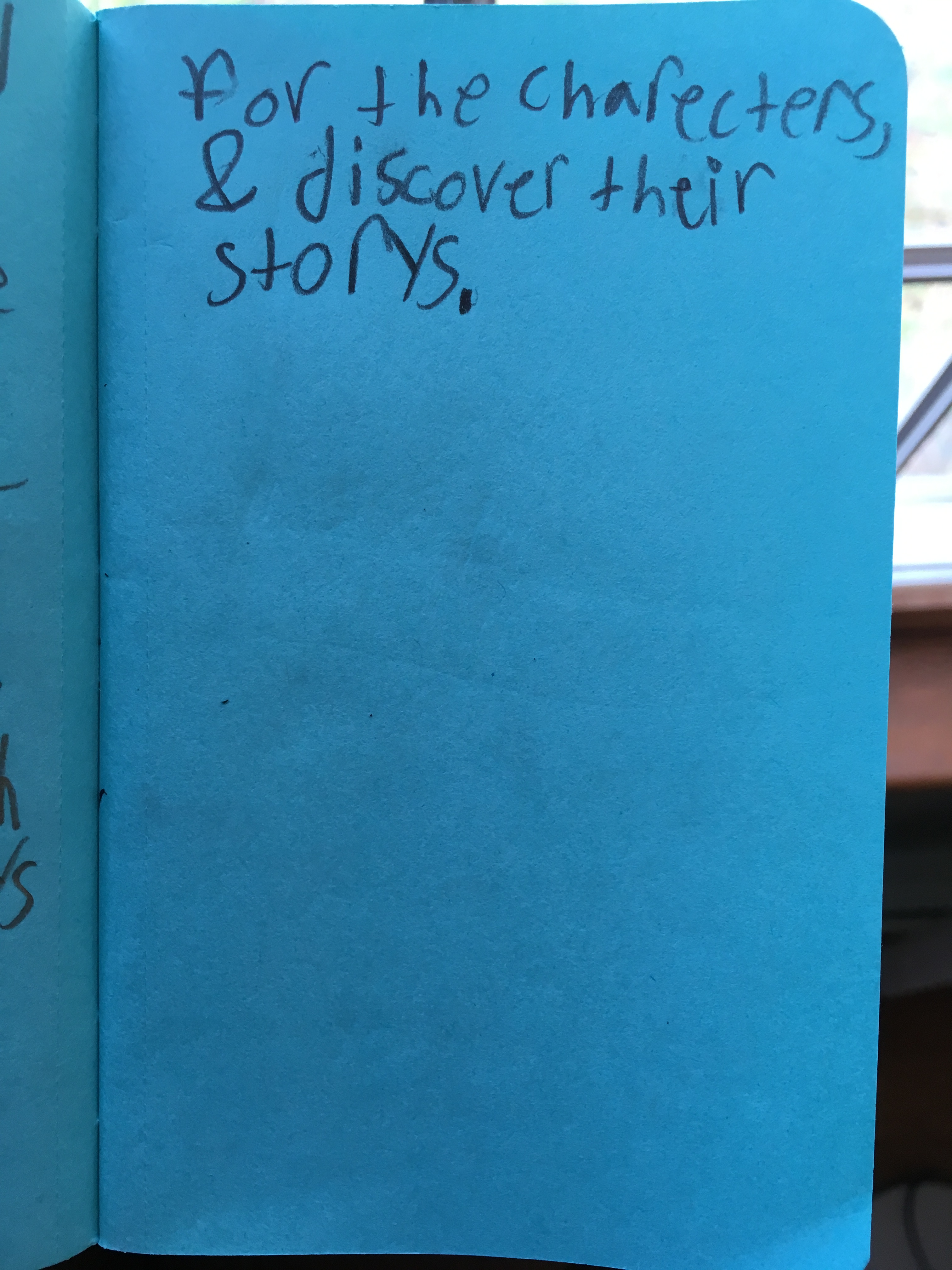
But I told Candlewick my kids would help me review these two books, and a promise is a promise, so… here are my nine-year-old’s review notes from The World of Mamoko in the Year 3000:


mamoko-3000-1


mamoko-3000-2


mamoko-3000-3


And here’s his short take on The World of Mamoko in the Time of Dragons:


mamoko-dragons


You can find all three Mamoko titles at Candlewick’s page here. They’re also available at Amazon here.


Thanks to Candlewick Press for the review copies, given with no expectation as to the content of the review.