T. Michael Law posted two more installments of his Septuagint Sessions podcast, here and here.
BLT blog wrote about God’s first Greek puns (brought to you largely by the letters γ and ν).
William Ross promises upcoming LXX Resource Reviews. You can see a resource page he has up now, here. Also, in the last soiree I missed his February review of Abi T. Ngunga’s Messianism in the Old Greek of Isaiah. (It’s on my shelf, too, and I’ve worked with it a little.) Here it is, in excerpted form.
Daniel Streett uses the LXX to venture an answer to the question: Did Enoch Die? He also mentions a couple options for a bound LXX-Greek NT combo.
Mosissimus Mose continues a review of T. Michael Law’s When God Spoke Greekin dialogic form. The fourth part posted in March.
Here’s a post on “ditching flashcards” (via here).
Jacob Cerone has been posting his way through LXX Jonah. See here, here, and here.
Did I miss anything? Feel free to post an LXX-related link in the comments.
Prof. Rodney Decker is the creator of Koine Greek Reader, one of my favorite resources for learning and practicing Greek. The book includes grammar review, vocabulary lists, and Greek readings with helps. The Reader covers the New Testament, the Septuagint, the Apostolic Fathers, and a few early church creeds (which are really fun to look at in Greek).
His resources page has some very helpful Septuagint vocabulary lists. This one (PDF) has all words that occur more than 100 times in the Septuagint. This list (PDF) includes words occurring more than 100 times in the Septuagint but less than 25 times in the New Testament. This second list is a good starting point for those who are (somewhat) proficient reading the New Testament in Greek, but who want to expand their reading into the more difficult (and larger) vocabulary pool of the Septuagint.
You can read an excerpt (PDF) from the Reader here, and much more about it is here at Prof. Decker’s NT Resources blog.
In English it reads, “And God said, ‘Let there be light.’ And there was light.”
The Septuagint straightforwardly translates the Hebrew, which is:
ויאמר אלהים יהי אור ויהי־אור
The Greek καὶ is versatile. The first καὶ in Genesis 1:3 is connected to what precedes it in 1:2 (darkness over the deep), but not necessarily inextricably so. In other words, one could leave it untranslated when going into English, with 1:3 beginning just, “God said….” The second καὶ in 1:3, however, seems to be more closely related to what precedes it. “And there was light” follows immediately upon God’s calling for light. God said it, and it happened.
God’s first words bring light into being in order to counter the darkness that was over the earth. In the first words attributed to God, LXX-G establishes a formulaic speech pattern that continues throughout the chapter, namely, a verb in the third person imperative (let x be), followed by ‘and,’ and concludes with a verb in the aorist (and x was). The pattern, similar to that in the MT noticed by Westermann and others, not only represents God as an orderly creator, but more importantly, as a powerful creator whose very words accomplish actions.
Dietrich Bonhoeffer has much to say about this in his Creation and Fall lectures on Genesis 1-3. On Tuesday I’ll post about his take on the link between God’s speech and the resulting creation.
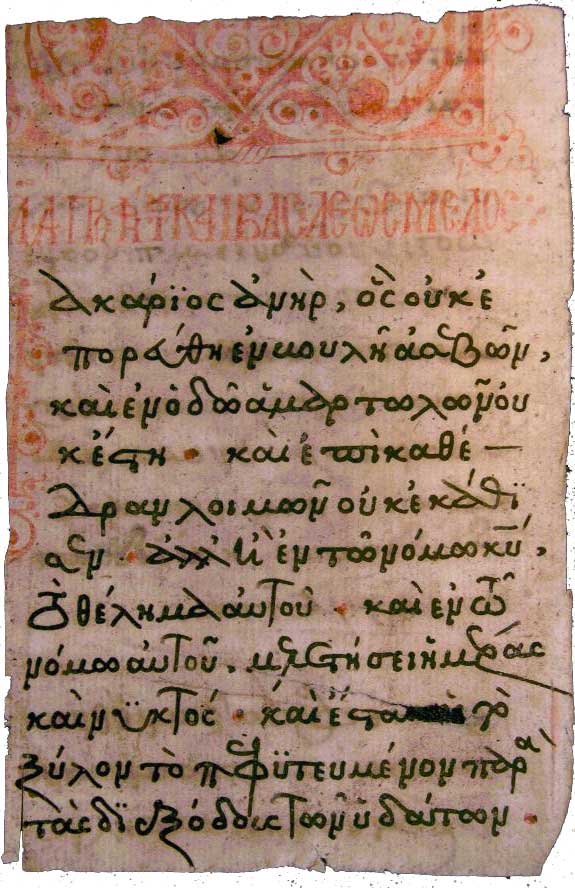
A book that I desire to delve into more deeply is Conybeare and Stock’s Grammar of Septuagint Greek. The grammar itself is short, and still leaves to be desired a fuller grammar of Septuagint Greek. But the selected readings have Septuagint text with reading helps at the bottom of each page, and make for a nice bridge into reading Old Testament Greek. The readings section looks like this (click to enlarge):
From the reading on Joseph
You can access the whole book for free (and legally) here. The format there is a little unwieldy, so you might also consider checking it out in print (affiliate link).
The grammar is pretty dense, and feels sparse in places, but I haven’t had a chance to examine the book thoroughly yet. The selected readings have helped me in improving my Greek, though. It’s recommended reading on this Septuagint Sunday.
Welcome to the Septuagint Studies Soirée #7, covering February in the Septuagintablogosphere.
There is now a Septuagint podcast. Check it out here.
Via Jim West: There will be a Historical and Theological Lexicon of the Septuagint (HTLS), which you can read more about here and here. You can even read a sample article (pdf)!
Do you want to contribute to a Septuagint Dictionary? Then check this one out.
This is a review of the Joshua volume of the Septuagint Commentary Series (Brill).
Here’s Lawrence Shiffman on Isaiah and the Greek Septuagint.
Brian Davidson posted a rockin’ interview with the editors of the Lexham English Septuagint.
It’s the International Septuaginta Summer School 2014. It sounds incredible, and it’s on Greek Isaiah. If you have a benefactor, go (and then introduce him or her to me, and I’ll meet you there).
Into prizes? Submit an LXX paper here for a prize of $350.
UPDATE 3/3/14: Wayne Coppins writes about Dietrich-Alex Koch’s analysis of Paul’s use of the Septuagint.
Finally, here and here you can find more interaction with T. Michael Law’s When God Spoke Greek.
Did I miss anything? Feel free to leave more February 2014 LXX links of interest in the comments.
One good monograph to read on the Septuagint is First Bible of the Church. And if you want to get in-depth with the critical edition of the LXX, I have offered reviews of the Göttingen Septuagint in Logos and Accordance softwares. And, perhaps as important, I suggest how one might actually make sense of that critical edition, noted here and here, with an ever-elusive third part of the primer still to come.
But right now, I’m going to go play outside in the snow with my kids. Happy LXX Day!
Suzanne at BLT has been writing about childshippe. I haven’t been able to fully digest it all, but given the preponderance of the word “son”/υἱός in the New Testament, I want to spend more time thinking through why so many translations opt for “son” when both male and female “children” seem to be in view. She writes more here and here.
Jim promises a review of de Gruyter’s Die Göttinger Septuaginta. And check out the Dust blog for a post called, “How much we take for granted, the publishing process and the Septuagint,” here.
Also, it wasn’t updated in January, but I just found out about what looks like a good LXX-related blog.
Did I miss anything? Feel free to leave more January 2014 LXX links of interest in the comments. And Happy (almost) International Septuagint Day!
It’s the first day of a new month (and new year), which means that the Septuagint Studies Soirée has arrived. Here is a collection of what the LXX-blogosphere had to offer in December 2013.
Old School Script has an interesting post (with some good questions to think about) regarding lexicography and instincts. (E.g., “How much do we trust our (next-to-nothing?) intuitive powers?”)
J.K. Gayle asks the provocative question, “Was David a virgin when his soul was pregnant?” to “bring some attention to the way in Bible reading and translation we highlight gender and sex and motherliness so dogmatically.” Gayle seems to “know” a bit about the Bible’s “sex verbs,” as he discusses ἐγίνωσκεν in Matthew 1 here. One other post of his worth reading (all his posts are worth reading) says, “The Greek / Hebrew names here for the baby Jesus are rather political in contrast to the Empire of Alexander and the Empire of the Caesar.”
T. Michael Law’s book about the Septuagint made #2 on Near Emmaus’s year-end books list.
Though it wasn’t on a blog, per se, James K. Aitken posted a chapter on LXX neologisms (thanks, Jim, for the tip). He writes, “There is a need for more descriptors of so-called new words, identifying them as semantic extensions, unattested compounds, morphological extensions, foreign loans, and so on.” One other non-blog, LXX-related url, if you want a daily LXX fix via the Twitter, is here.
Brian Davidson at LXXI made a couple of short videos about using Logos for a sort of MT-LXX Two-way Index.
Speaking of Brian, he’s taking over Greek Isaiah in a Year (which just finished) and leading a group through Isaiah again in 2014! Join them here.
Did I miss anything? As prevalent as women are in Septuagint studies, I didn’t find any LXX blog posts by women in December, but I might have missed one! Feel free to leave more December 2013 LXX links of interest in the comments. And in case you didn’t see it, the first Septuagint Studies Soirée is here; the second one is here; the third one is here; the fourth one is here.
On November 30 the group Greek Isaiah in a Year read the last verses of Isaiah 66. And what a rewarding experience it was to read slowly–over the course of a (church) calendar year–through Isaiah.
Blogger Brian Davidson wants to do it again. I’m going to be following the Facebook group (here, where all the action will be), but am not sure I can do the whole thing again in a year. We’ll see.
But if you started last time and didn’t finish, or are looking for a way to sharpen your Greek this coming calendar year, check it out.
For the New Testament authors, the original text, that is, the text they drew on, was primarily the Septuagint. To make up the first part of the Bible which has the New Testament as the other part, the Old Testament in the shape it has in the Septuagint would therefore seem the obvious choice.
—First Bible of the Church: A Plea for the Septuagint, by Mogens Müller (p. 144)
Mogens Müller provocatively asks, “What caused the displacement of the Septuagint? …Today it is an open question whether the Septuagint should be reinstalled as the Old Testament of the Church” (p. 7). First Bible of the Church is part reception history, part biblical theology, and part apologetic work that suggests the Greek translation of the Hebrew Bible should be brought (back) into canonical status. It should be “at least part of a canon” (p. 122), if not the better choice than Biblia Hebraica for today’s “original text” of the Old Testament/Hebrew Bible.
What follows is a brief summary of the book’s contents, followed by some evaluative comments.
Müller’s Plea
Chapter 1 is the introduction to the book. In it Müller raises the question of just what should qualify as “the original text” of the Old Testament. If we see “what the early church regarded as its Bible” (p. 23), already one has to take the Septuagint seriously. This is not a question Müller addresses exclusively on textual grounds; for him the issue is also a theological one. To wit: In Isaiah 7:14/Matthew 1:23, “the ‘wrong’ text gains a significance of its own by being used” (p. 23).
Chapter 2, “The Jewish Bible at the Time of the New Testament,” looks at the canonization and textual history of the Jewish Bible, including various Greek recensions. Müller makes a key (and helpful) distinction in canonization between “the recognition of a writing as sacred” and “the final fixing of its wording” (p. 32). Evaluating various source materials, and dismissing the idea of an Urtext, the author notes the (accepted) fluidity of the process of textual transmission, where the actual wording in the sacred books only became important some centuries after the books themselves had become part of a canon. The implications of this, of course, are that New Testament writers may not have cared–in the way modernists do–about making sure they were using “the original” Hebrew text when quoting Scripture–if such a thing even ever existed as such.
Nonetheless, as chapter 3 points out, there was a very early historical concern about the authority of the Greek translation of the Hebrew Scriptures. Would the former be on par with the latter? Müller examines various defenses of the Septuagint (the Law books, specifically): Aristeas, Aristobulus, Philo, and Josephus. Chapter 4, “The Reception of the Septuagint Legend into the Church up to and Including Augustine” continues the historical inquiry into attitudes toward the Septuagint, especially when compared to the Hebrew text it was said to have translated. Justin and Irenaeus (among others) are given as examples of early interpreters who saw the Septuagint translation as inspired. Jerome, Müller suggests:
saw the Biblia Hebraica as the basic text as far as the Old Testament was concerned, and thus he contributed, at least for the Latin-speaking part of Christianity, to bring about the final abandonment of the Septuagint, which had very early come to be acknowledged as the Bible of the Gentile, Christian Church. (p. 86)
Biblia Graeca
Chapters 5 (“Hebraica sive Graeca Veritas?“) calls the Septuagint “a witness to the process of transmitting tradition” (p. 99), a process which Müller sees in ancient Judaism as having “a very creative character” (p. 104). Translation in antiquity included a measure of interpretation. The author’s foray into translation theory gives refreshing context to a world that valued lexical equivalency in translation less than many do today.
Chapter 6 (“Vetus Testamentum in Novo Receptum“) provides a short biblical theology, in which the New Testament is seen primarily as the story of Jesus, who himself fulfills what is written in the Old Testament. Müller notes that it is for this reason that the Hebrew Bible became the Old Testament, and yet its use by New Testament writers solidified its importance and sacredness for Christians. The Old Testament is necessary–“it remains the Holy Writ of the Christian community.” But it is not sufficient–“the Old Testament per se represents a limited epoch in salvation history” (p. 135).
The conclusion calls for the Septuagint to (re-)take its canonical place alongside the New Testament.
Is Müller’s Plea Worth Paying Heed To?
Yes. Readers of this blog and its Septuagint posts will not be surprised by my saying so. Müller makes a good case and generally succeeds in making a compelling plea for the LXX. If readers don’t accept his call to (re-)canonize the Greek OT, they will at least take seriously his petition to take it more seriously (as the NT writers did).
The book is short (some 150 pages) but dense. There is untranslated German and Latin in the footnotes, as one would expect in a scholarly monograph, but the writing is no less engaging for its density. The Greek font used throughout is easy to read, and the Greek is often translated into English.
Müller’s brief biblical theology at the end of the book is excellent. It left me wanting to read more. His notion of fulfillment as a motif that links together the OT and NT was convincing and well-articulated.
I found some typographical errors, as well as a number of sentences that just seemed to have wanted closer editing. This could be in part due to the book’s translation from a Danish manuscript. I was distracted in a few places as a result, but not consistently.
Evangelicals will find a few things they disagree with. For example, Müller cites Wellhausen approvingly to note that “the prophets were not reformers anxious to lead the people back to an original Mosaic religion.” The Law, then, “is not the starting-point but the result of Israel’s spiritual development” (p. 102). This line of reasoning is not essential to following the rest of Müller’s arguments, but his “redactional-critical attitude” (p. 100) does lead to a few assertions that some (including myself) don’t agree with.
Müller’s logic and historical inquiry is generally careful and robust, not to mention more readable than one might expect from a work of this nature. Perhaps it is due to the short length of the book, but there are still some unanswered questions. If “the Septuagint” is to comprise the Old Testament in Christian Bibles (as Müller suggests on p. 144, among other places), which Septuagint should we use? On which codex or codices should we base it? And given that Septuagint manuscripts vary on which books are included, how would we decide which books to place in a reconstituted OT? Simply those books that are now in the Hebrew OT, but in their Greek iterations? What about the Apocrypha?
And yet it appears that Müller’s aim is more to address “whether the Septuagint should be reinstalled as the Old Testament of the Church” (p. 7, my emphasis), not how and by what methodology such a reinstallation would take place. With this aim in mind, Müller’s short yet substantive book offers a compelling plea that deserves the reader’s careful consideration.
You can find First Bible of the Church: A Plea for the Septuaginthere at Amazon. Its publisher’s product page is here. Thanks to Bloomsbury for the review copy, given with no expectation as to the content of the review.








 Words on the Word