One essential step in my sermon preparation process is reading the book of which the preaching passage is a part. I find it a discipline to hold off on reading commentaries and sit with the text itself. This is easier with a short book like Joel, from which this Sunday’s Old Testament lectionary reading comes.
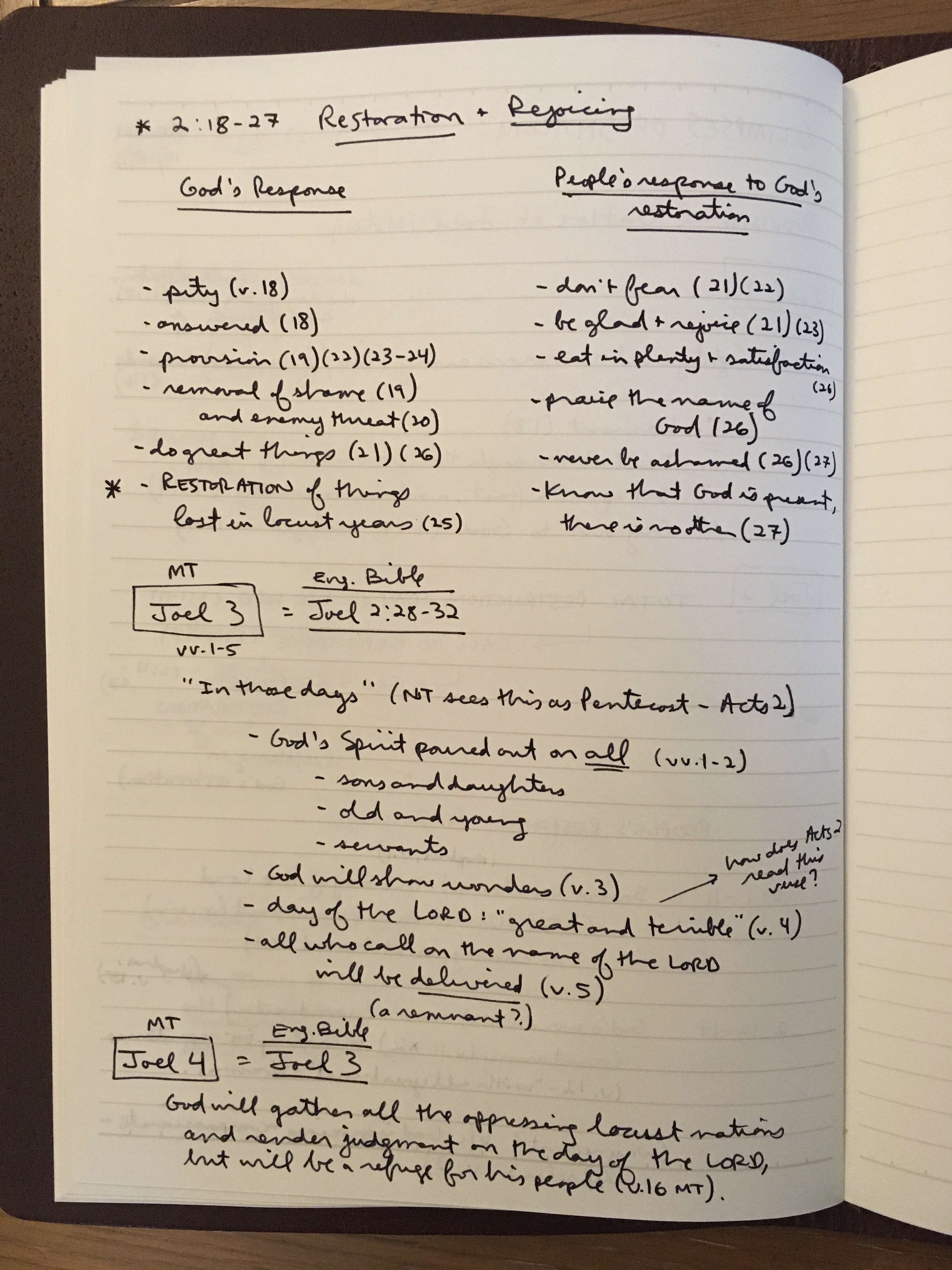
I find myself more focused to read through and outline the book in analogue fashion. Here’s what it looked like for me yesterday morning:
(Having fine writing implements like a fountain pen and nice paper helps!) I have since transferred my book outline to MindNode, from which I’ll continue my sermon planning. Starting device-free is important (and really enjoyable) for me.
Here’s my two-page provisional outline of the book of Joel, complete with a misspelling of “devastation”:
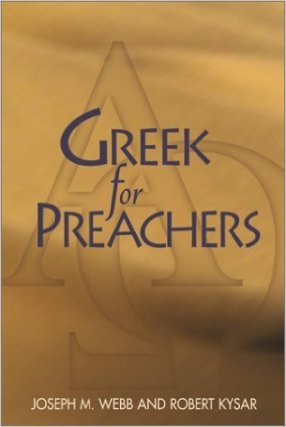
Greek for Preachers (Chalice Press, 2002) divides into three primary parts. Part 1 is “The Preliminaries,” where authors Joseph M. Webb and Robert Kysar suggest initial tools for preachers who want to use Greek. Part 2 offers “Ten Principles for Uncovering Greek Meaning,” which makes up the majority of the book. Part 3 focuses on “Using the Greek Text in Sermon Preparation,” and is a hands-on application of the principles the authors have taught in the second part. The book’s aim is simple: “to bring the Greek text of the New Testament within reach of anyone who wishes to explore its riches” (x). The authors want preachers who have lost their Greek (or not had any) to find the language “both usable and exciting” for use in sermon preparation (7).
Part 1: “The Preliminaries”
I worried a bit when I saw “uncovering Greek meaning” as the title for Part 2. Somewhere along the way I learned that Greek is not just a language to decode, as if there could be one-to-one equivalents for everything, with “hidden gems” available to ones with secret inside knowledge. But the authors are balanced here. In the Preface they say, “We do not believe there is anything intrinsically magic or even necessarily sacred about the original language of the New Testament, even though we both assert the importance of biblical languages for the Christian tradition” (ix). This approach resonates with me, especially as they go on to affirm, “But, judiciously and frugally handled, the joys of the Greek language of our New Testament are as bright as newly cut diamonds sitting in a store window waiting for someone to pick them up and share them with others” (7).
The first part focuses primarily on introducing the preacher to two tools: a Greek-English interlinear and an analytical lexicon. From there the authors go over the Greek alphabet, syllabification, pronunciation, and helpful immersion in a few practice texts. (The Greek font in this book looks good and is readable.) It is also in this first part that the authors introduce their approach to words and meaning, one that I am fully on board with: “[W]e should never assume that a word is used in the exact same way in different passages. The context in which a word is used is more important than how another writer in a different document might use the same word…” (5). This, in fact, has preaching implications for me, because I can make points like this in my sermons without even bringing “the underlying Greek” into the picture.
Part 2: “Ten Principles for Uncovering Greek Meaning”
Part 2 is the heart of the book. The authors give ten principles around specific grammatical features. Concepts they explore include: articles (and how their presence or absence adjusts meaning), verbs, participles, infinitives, cases, and more. There are lots of examples from the Greek New Testament, including possible sermon angles to derive from interpreting the Greek grammar. There’s a wealth of interaction with the Greek text for the reader to work through. There are charts, glosses, and plenty of material that any Greek reader will benefit from reviewing.
A highlight of the second part for me was the authors’ good distinction between grammatical gender and what they call human gender (also called social gender). They would support, for example, not using the generic “man” in English translations where the Greek has ἄνθρωπος. I am similarly deliberate in reading from the pulpit gender-accurate translations whenever I can.
While most of the instruction in this section is consistent with what I’ve learned from various grammars and exegesis courses at Gordon-Conwell (and reading Greek regularly since), there are a couple of surprising hermeneutical moves that I didn’t think were on firm footing.
The authors say, “Look for the articles, especially the ones associated with God” (39). With the last part of the verse (θεὸς ἦν ὁ λόγος), the authors rightly point out that ὁ λόγος becomes the subject because of the article. So, “the Word was God.” However, they go on to explore “the nature of the articular nouns as they differ from the anarthrous nouns “(39), considering that the anarthrous θεὸς could simply mean something less specific like “God-like.” They approach the translation with humility, but unfortunately conclude, “Theologically, it raises the issue of whether or not the text means that God and the ‘word’ are identical” (39). Though it’s tempting to criticize this interpretation on account of what sounds like heterodoxy, Greek grammar alone (at least I thought!) settles the issue, that, “the Word was God” (and not just God-like). I can recall at least two Greek professors at GCTS making a similar point that the anarthrous θεὸς should not be interpreted in the way the authors explore.
Also a curious was the interpretation of participles in the Great Commission of Matthew 28:19-20. The authors point out the three participles in those two verses, the first of which is aorist. “But the aorist participle,” they say, “that begins the sentence gives the idea of ‘going’ before it mentions the command to ‘make learners.’ Those who are addressed in this passage are already going” (65). As Roy Ciampa (from a 2008 Every Thought Captive blog post called, “As You Go, Make Disciples?“) and others have argued, that aorist participle is actually a participle of attendance circumstance, and it simply has the force of an imperative: nothing more, nothing less.
How does this interaction impact my own preaching, beyond my desire to critically engage with anything I read for my ministry development?
The authors model humility in how they approach the Greek, even when I disagree with them. I want to follow suit here.
On the other hand, some of their Greek-based hermeneutical moves seem like classic anecdotes of “what not to do” when moving from Greek New Testament to interpretation to pulpit. One wants to be careful not to make too much of subtle grammatical points that may reflect merely on what wording the author felt like using at the time of writing. As with the John 21 example where John and Peter dance between two different Greek words for love, a given author could simply be using a rhetorical flourish, and not intending us to derive any meaning more than that the author writes with creative style. (John 21 seems less clear-cut to me, though, than the examples above.)
Part 3: “Using the Greek Text in Sermon Preparation”
In the third part, “Using the Greek Text in Sermon Preparation,” the authors move the process into the pulpit. They list seven steps, each of which is easy enough to implement. And they have a stance on commentaries that I really appreciate, even as I’m aware of the discipline required: “We suggest that you use commentaries to learn what others have said about the passage but not necessarily to learn what you should say” (172). Great advice. I also resonated with their explanation of a topical sermon, where “the text gives you entry into an extensive issue that reaches beyond the text itself” (163).
The book closes with two full sample sermons using Greek, the first of which was a really interesting (and helpful) take on “submission” (as mutual) in Ephesians 5.
Concluding Assessment
Greek beginners will want to turn to Part 1 right away, although I’ve had it drilled into me that interlinears are bad. I think they have their place, but a preacher who really wants to learn Greek might better avoid them and use a footnoted Reader’s Greek New Testament instead. The authors suggest that pastors actively using Greek can profitably skim Part 2 as a refresher–it can be consulted later as a reference–and cut right to Part 3 for the meat of using Greek in preaching.
I appreciate the desire of this book. On the one hand, the authors are right on when they say,
“A little learning is a dangerous thing.” Novices in the Greek New Testament are in danger of slipping into the same mold. Greek is not a cure-all for biblical interpretation nor the key that unlocks truth. It is only one more tool to help us (176).
On the other hand, I really like the idea of teaching pastors the basics of Greek so that they can begin to get their feet wet with word studies.
Again, the drawback to using this book is that readers need enough Greek already to be able to discern what the authors are doing with John 1:1 and Matthew 28:19-20. The humility they model is admirable, though, and the majority of the other examples don’t make the same kind of questionable (in my opinion) conclusions those ones do.
For me, I try to use Greek as much as possible in my study. I’m reading through the Greek New Testament this year with a friend, and we’re taking (and sharing) notes as we go. I often find that insights from our conversations about the Greek text make their way into my sermons. So I wholeheartedly affirm with the authors that the integration of Greek reading and sermon preparation is a beautiful thing. Reading Greek for Preachers compels me to re-double my efforts in turning over the Greek (or Hebrew) text as an essential part of sermon preparation.
Greek for Preachers is at Amazon here, and at Chalice Press here.
Thanks to Chalice Press for sending me a review copy, which—I trust will be evident—did not influence my attempts at objectivity in assessing the book.
Michael Brown’s homicide in Ferguson, Missouri was almost two years ago. His encounter with a police officer set off a wave of protests and brought a conversation about institutionalized racism once again into the public square.
This week Michael Brown’s mother expressed the numbness and wordlessness that often comes after unjust killing:
When their children are killed, mothers are expected to say something. To help keep the peace. To help make change. But what can I possibly say? I just know we need to do something. We are taught to be peaceful, but we aren’t at peace. I have to wake up and go to sleep with this pain everyday. Ain’t no peace. If we mothers can’t change where this is heading for these families — to public hearings, protests, un-asked-for martyrdom, or worse, to nothing at all — what can we do?
We can at least remember the names of the deceased as we are gathered in the presence of God.
37-year-old Alton Sterling of Baton Rouge, Louisiana.
32-year-old Philando Castile of Saint Paul, Minnesota.
And then five police officers killed while they were protecting the people’s right to protest police brutality: Patrick Zamarripa, Lorne Ahrens, Michael Smith, Michael Krol, and Brent Thompson.
Let us remember their names and their faces and their families. They were and are loved deeply by God. May the Lord receive them into his loving arms, into his eternal care.
In one sense it would be missing the point for white folks to dwell on our cluelessness in what to say after another spate of gun violence. Though the thought keeps crossing my mind, I would be selfish to complain about having to find words for this pulpit after yet another week of killing in the United States.
Because as much as we may struggle in figuring out what to think and how to pray, there is an entire segment of our population that is worrying about how—worrying about if—they can live under these conditions.
Ty Burr, a writer for the Boston Globe, expressed it this way:
I understand; it’s exhausting. Social change asks a lot of us, but most of all our attention. To process all that incoming outrage, we have to become stronger in heart and clearer of head, and we have to decide when it’s time to stop watching the slipstream and dive into it instead.
If you hadn’t already, a week like this one all but demands that we followers of Christ dive in.
But… “what can [we] possibly say?” And “what can we do?”
Well, I don’t know. But I sure have read Ephesians 4 in a different light. And, so help me, God, may I not be shaken in my faith that Scripture always—always—will have something to say to us, even in our darkest hours.
With that conviction, hear again the first three verses of Ephesians 4:
As a prisoner for the Lord, then, I urge you to live a life worthy of the calling you have received. Be completely humble and gentle; be patient, bearing with one another in love. Make every effort to keep the unity of the Spirit through the bond of peace.
Ephesians 4:1 is the pivot point of the whole letter. Paul moves from the theologically rich prayers and beautiful expression of Christian identity—chapters 1 through 3—to what we should do about it—in chapters 4 through 6.
“Therefore,” he says, “I—a prisoner of the Lord!—urge you strongly to live worthily of the calling with which you have been called.”
Paul lays a nice guilt trip on his listeners: Look, I’m in chains here! I’m a prisoner! The least you could do is live up to your calling as a Christian, like your poor Paul is urging you to do.
If you’ve been thinking about memorizing part or all of Ephesians recently, you could at least memorize 4:1, since it summarizes the whole book. Paul’s told them what their calling is in the first half of the letter.
He’s said: you Christians have been chosen by God, God delights in you, and you are sealed with the promise of the Holy Spirit. He’s encouraged the church by saying: we are a people called to hope. We are God’s riches. And God’s power for us who believe—even for those who feel powerless—God’s power for us is immense. Nothing compares to it, and we who believe have the power of God.
Paul has also written: we were dead in sin, but God was rich in mercy, and God intervened. He made as alive with Christ, he raised us with Christ, and he seated us with Christ in the heavenly realms.
When he says, “Therefore,” or “Live a life, then,”—he’s got all of that in mind, everything in the first three chapters.
From here on out he’s going to get specific about how to live a life worthy of that calling. You are this, this, and this… so here’s how you can live like it.
“Live a life”—or as Paul first put it in his letter: “walk” in a worthy way.
It was a Jewish metaphor to talk about life as a walk. A sort of ongoing journey: active, with movement. “Walk the walk,” your “Christian walk”—that didn’t come from your evangelical youth pastor, it came from the Hebrew Bible!
Paul starts in right away with some of the ways Christians should walk.
Humility
He says in verse 2, “Be completely humble and gentle; be patient, bearing with one another in love.”
Completely humble. Gentle. Patient.
As I studied the passage this week, I was surprised to learn that the particular word for humility in this verse was not really in Greek literature before the Bible. And then finally there was a Greek writer outside of the New Testament, Epictetus, who mentioned “humility” in the first century. He said it was the first character trait to avoid.
That could help explain why a humble and even humiliated Jesus was mocked on the cross. God had said, through Isaiah, “This is the one I esteem: he who is humble and contrite in spirit, and trembles at my word” (66:2). But humility is a counter-cultural value; it always has been.
Gentleness
“Be completely humble,” Paul says, “and gentle.” Be gentle.
Jesus told Peter to put away his sword in the garden. Those who live by the sword, he said, will die by the sword. Or as I’ve heard it paraphrased, “When you fight fire with fire, the whole world burns down.”
Micah prophesies about a day when “they will beat their swords into plowshares and their spears into pruning hooks. Nation will not take up sword against nation, nor will they train for war anymore.”
There will be a day, when what happened this last week, and all the evils leading up to it (that still exist!)—will not happen anymore. Nations will not go to war with other nations. Nations will not even feel like they are engaging civil war within their own borders.
This is what it means to be gentle. Loretta Lynch said, “After the events of this week, Americans across our country are feeling a sense of helplessness, uncertainty and fear … but the answer must not be violence.” Paul would agree: the answer must not be violence, but the answer must be gentleness.
Yeah, gentleness.
I know… I almost picked another passage and didn’t preach on this one today because after Alton and Philando and five officers died, a gentle response felt like a cop-out.
I might as well have been reading, “Be tepid. Let it go. Don’t do anything about it. Just watch.”
Turns out, that’s not what Paul is saying. Harold Hoehner, who taught at Dallas Seminary for many years, says, “The word [gentleness] never connotes the idea of weakness. Rather, it implies the conscious exercise of self-control, exhibiting a conscious choice of gentleness as opposed to the use of power for the purpose of retaliation.” Self-control, not retaliation.
Aristotle talks about gentleness as coming between two extremes: “never being angry with anything” on the one hand and “excessive anger against everyone and on all occasions” on the other. Gentleness is somewhere in the middle. As another interpreter put it, if you’re gentle as Paul urges, you are “always angry at the right time and never angry at the wrong time.”
Our model again is Jesus, the one who said, “Take my yoke upon you and learn from me, for I am gentle and humble in heart, and you will find rest for your souls.” Jesus was “always angry at the right time and never angry at the wrong time.”
When Jesus saw oppression, hatred, and racial injustice—he got angry. But that didn’t mean he wasn’t gentle.
“Be completely humble,” Paul says, “and gentle.” That gentleness is a fruit of the Spirit, a piece of evidence that we Christians are living lives worthy of the calling we have received.
Patience
Then to humility and gentleness, Paul adds this one more: patience.
The Old Testament talks about patience as long-suffering. Being patient doesn’t mean letting injustice go unprotested, but it does mean persistence… holding out hope… slowing down to wait and listen to the voice of another.
Those of us who have not been racially profiled and probably never will be, would do well to slow down and listen to our brothers and sisters who have. We need to exercise patience to hear the stories and pain of others… even to let it transform our own view of the world.
And now Paul gets into church territory—he says one mark of patience is “bearing with one another in love.”
“Be completely humble and gentle; be patient, bearing with one another in love.”
“Put up with each other,” he’s saying! This is the same word Jesus uses when he is exasperated by his faithless disciples: “How long shall I put up with you?”
Well… how long did Jesus put up with his disciples? He’s still doing it, right? He is still, even right now, interceding for us while we worship.
Patience—putting up with each other’s differences and even annoying habits—is required if the church is going to be a bastion of unity… a witness of one love to a divided world.
Eager to Keep Peace
Paul says, then, ”Make every effort to keep the unity of the Spirit through the bond of peace.” He tells them to be eager to keep the peace.
But here’s a nice twist—he’s calling on them to be peacekeepers. The peace has already been made. Paul had said earlier, Jesus himself is peace. Jesus is the one who made peace—it’s the work he did when he broke down the dividing wall between so-called races—Jew and Gentile in the first century, a work that extends to black and white America in the 21st century.
“Keep the unity of the Spirit through the bond of peace.”
Paul calls for Christians to be humble, gentle, patience, and eager to keep the peace that Christ himself established. Even as Jesus made peace, others try to snuff it out. But we’ve got to guard and protect the peace of unity—and for Paul that starts in the church and then emanates outward.
Paul reminds the church that the reason we can be practice a peaceful witness of unity is that God is not divided. God is one. And God is everywhere. God is, Paul says, “Over all and through all and in all.”
In other words, he’s still on this throne, though evil powers try unsuccessfully to unseat him. He’s still working through his church and his followers. And he’s still making his home with us. He walks alongside us, even as Paul calls us to walk faithfully in the world. It’s because of the strength of the God who is over all, through all, and in all that we can be faithful to our calling. God is with us. He walks with us to enable us to walk strong in our call.
God Speaks in Falcon Heights
I heard an echo of this promise in the horrific video of the Falcon Heights shooting.
A four-year-old girl saw what no child should ever have to see. Afterwards she says to her grieving mother, “It’s okay, Mommy. It’s okay. I’m right here with you.” That little girl had to have been full of the power of the Holy Spirit to be able to say that.
She was the mouthpiece of God: “It’s okay. I’m right here with you.”
There’s a scene in Hoosiers, the greatest basketball movie, greatest sports movie, and—yea, verily—greatest movie in human history. The assistant coach, Shooter, stumbles out onto the court in the middle of a game, totally inebriated.
One of the players is Shooter’s son, who’s utterly embarrassed by his dad.
Coach Norman Dale pulls his player aside and says, “Hey, you keep your head in the game. I need you out there.”
Brothers and sisters in Christ, friends: we’ve got to keep our heads in the game. God chooses to need us. God calls us to witness with humility to a world filled with the arrogant who are still getting their way. God urges us to witness with gentleness to a world where violence continues to make headlines. God needs us to show patience with each other, to work together as one body to witness to a hurting world.
So let’s keep our head in the game. As a classic lament Psalm says, “none of us knows how long this will be.” But as best as I can tell, God encourages us to wait it out anyway, to walk out our call every day.
And we don’t walk alone. Our generous God gives us each other, and even himself. He’s like that precious little girl telling us, “It’s okay. I’m right here with you.”
The one who calls us is faithful—he will freely give us his power so we can live out the humility, gentleness, and patience that seem at first blush too weak to us. But those virtues are, in fact, our strong and powerful witness. Humility, gentleness, patience, and peacekeeping—they’re all an expression of the calling we’ve received.
And we need to live it out now more than ever before.
In the past when I’ve preached on Ephesians 2:1-10, I’ve gone straight for the gold of Ephesians 2:8-10:
For it is by grace you have been saved, through faith—and this not from yourselves, it is the gift of God—not by works, so that no one can boast. For we are God’s workmanship, created in Christ Jesus to do good works, which God prepared in advance for us to do.
The first seven verses have just felt like an opening band that–while good–wasn’t necessarily what I had come to see.
I see the passage differently now, having spent a good deal of time trying to understand Paul’s flow.
Here’s the passage from the 1984 NIV, followed by the passage in Greek:
Eph 2:1 As for you, you were dead in your transgressions and sins, 2 in which you used to live when you followed the ways of this world and of the ruler of the kingdom of the air, the spirit who is now at work in those who are disobedient. 3 All of us also lived among them at one time, gratifying the cravings of our sinful nature and following its desires and thoughts. Like the rest, we were by nature objects of wrath. 4 But because of his great love for us, God, who is rich in mercy, 5 made us alive with Christ even when we were dead in transgressions—it is by grace you have been saved. 6 And God raised us up with Christ and seated us with him in the heavenly realms in Christ Jesus, 7 in order that in the coming ages he might show the incomparable riches of his grace, expressed in his kindness to us in Christ Jesus. 8 For it is by grace you have been saved, through faith—and this not from yourselves, it is the gift of God— 9 not by works, so that no one can boast. 10 For we are God’s workmanship, created in Christ Jesus to do good works, which God prepared in advance for us to do.
Assuming 2:1 is the beginning of a new sentence (Καὶ ὑμᾶς ὄντας νεκροὺς τοῖς παραπτώμασιν καὶ ταῖς ἁμαρτίαις ὑμῶν), there is not a clear indicative verb in a non-subordinate clause really anywhere in sight, at least not until an indicative verb of ἤμεθα (“we were”) in 2:3 (και ἤμεθα τέκνα φύσει ὀργῆς ὡς καὶ οἱ λοιποί). (Though I confess I’m not sure why this is preceded by καὶ if it’s not a participle.)
So 2:3’s ἤμεθα is the first indicative verb in the whole passage not in a subordinate clause. 2:1 (“You, being dead…”=participle) leads to 2:3b’s “we were children of wrath” (and notice Paul’s subtle shift in 2:3a from “you” as sinner to “we” as sinners). This wrath is the outcome one would anticipate.
Then there is a construction with a participle in 2:4a, similar to how the chapter began: ὁ δὲ θεὸς πλούσιος ὢν ἐν ἐλέει–“God, being rich in mercy”=participle. This is a grammatical (and theological) balance to “you, being dead.”
Paul is about to expand on this nice contrast, but first he interrupts with this recapitulation in Ephesians 2:5a: καὶ ὄντας ἡμᾶς νεκροὺς τοῖς παραπτώμασιν (and you, being dead in transgressions). It is nearly identical wording to how the passage started, forming an inclusio with 2:1. (Just in case we missed it the first time, that we were dead in sin!)
Now there is the continuation of θεὸς ὢν–completed with a main verb to grammatically match but theologically and narratively replace the “we were children of wrath.” It is the high point of the passage, the phrase that holds the whole passage together. It has the three main verbs the listener/reader will have been waiting for since the participle of 2:1.
συνεζωοποίησεν τῷ Χριστῷ
God made us alive in Christ!
Then the rest of the passage is the unfolding (2:6 gives two more main verbs: he raised us and seated us with Christ) and purpose (2:7) and reiteration with implications (2:8-9) of συνεζωοποίησεν τῷ Χριστῷ.
I take 2:10 and its ἐν Χριστῷ Ἰησοῦ, then, to be the “application” section of this passage.
Interestingly enough, read this way, the ever-popular 2:8-9 are not the main point of the passage, at least not on their own. They need to be understood in light of God’s specific actions of making us alive in Christ (συνεζωοποίησεν τῷ Χριστῷ), raising us (συνήγειρεν) and seating us in the heavenly realms in Christ (συνεκάθισεν ἐν τοῖς ἐπουρανίοις ἐν Χριστῷ Ἰησοῦ).
The technical commentaries confirm this way of reading the passage, namely, that the structural and grammatical center is 2:5-6, describing the three-fold action of God in making us alive, raising us, and seating us.
It’s a nuance, to be sure, and it doesn’t take away from the power of 2:8-10. But it does mean my preaching focus tomorrow will be on the three-fold action of God, and how we understand that as his saving grace, to be received by faith.
Just when I thought my sermon preparation was moving away from loooong Pauline sentences, Ephesians 1:15-23 offers another–a single sentence stretches across those nine verses. (See here on Ephesians 1:3-14 as one sentence and where I started my exegesis.)
This week I thought I’d see if I could wed my need to visually outline the text with my deep appreciation for mind mapping.
The result was that I got a significant step closer to understanding the focus of Paul’s prayer for Ephesian Christians. This is in rough form (and will be revised still), but here’s how I used the app MindNode to lay out the passage (click/tap to enlarge):
Ephesians 1:3-14 is a single sentence in Greek. It has more than 200 words. How does a preacher even begin!
Well, to start, I isolated the indicative verbs, which is as simple as typing
[VERB Indicative]
into the search entry bar in Accordance software. I wanted to start there because I thought indicative verbs (as opposed to the participles) would be the best place to begin breaking down the flow of Paul’s argument.
Then I cross-highlighted the verbs in an English translation in parallel (though I had done my own translation, too) so I could see them in both languages. The result was this (click/tap to enlarge):
From there, you guessed it, a three-point outline emerged, which shaped my sermon on this beautiful passage. I found that the indicative verbs themselves coalesce pretty nicely into three main points.
I’m preaching on the passage tomorrow–great stuff, and much more to share, but just this simple search (with, of course, instantaneous results) has been essential in guiding my exegesis and preparation.
At my church we’ve spent the Easter season looking for and finding signs of Christ’s resurrection power all around us.
We see the power of the risen Jesus through mundane interactions in our worlds, just as the risen Jesus appeared on the shore to the disciples and ate breakfast with them.
We find rhythms of resurrection—death and rebirth—in creation.
We see signs of it in our daily lives: our work, family life, and friendships.
We find the power of the resurrection at work within us when we Christians show love to each other—both in word and action.
And we experience the power of the resurrection of Jesus when we affirm with his disciple John, “Perfect love drives out fear.”
I’ve grown these last couple months in my appreciation of how Christ’s resurrection is still shaping everything today.
So I sort of don’t want the Easter season to end. It feels like a little bit of a letdown. I’ll still be on the lookout for signs of the resurrection—I’ll still try to “practice resurrection,” as Wendell Berry wisely tells us to do. But we’re moving now into that long period in the church calendar creatively called, “Ordinary Time.”
I was doing some long-range preaching planning the other day with a week-by-week calendar in front of me. This coming Sunday is the First Sunday after Pentecost. And then, not surprisingly, it will be the Second Sunday after Pentecost. And then the Third, and Fourth, and Fifth, and 13th, and 19th, and 23rd Sunday after Pentecost… all the way up to the 27th Sunday after Pentecost on November 20. Then it’s Advent.
Those “after Pentecost” Sundays for us are “Ordinary Time.”
But moving from what has been a meaningful Easter season for me into this 27-week long “Ordinary Time,” I feel a little like the disciples must’ve felt on Pentecost Sunday: “What now?” “Where do we go from here?”
We need the Holy Spirit for the “ordinary” days ahead. Jesus unleashes the power and energy and life and breath that is the Holy Spirit, so that the disciples can have the Holy Spirit now that Easter has come and gone.
* * * * * *
If I could live through any period of history, it would be those post-resurrection days with the disciples and Jesus. They had lost him to death once, and now he’s gone from them again through his ascension to heaven.
But he doesn’t leave them stranded. He gives to the Church and to every believer the Holy Spirit for all our days to come. The Holy Spirit is for ordinary time.
A number of years ago, when Newsweek was still a print magazine, the editors asked Garrison Keillor what five books were most important to him. #1 on his list was “The Acts of the Apostles.” His one-sentence summary of it was: “The flames lit on their little heads and bravely and dangerously went they onward.” (HT)
And that’s how we go: onward, into differently structured summer days and adjusted schedules. We go onward, even into Ordinary Time, into seasons of waiting and tedium and unmet expectations—we go forward anyway because the promised Holy Spirit has come.
When we love with the love of Jesus, we go “dangerously” but willingly into places of darkness and loneliness and despair, ready to share God’s Spirit far beyond our gathered Sunday morning assemblies. Through the Holy Spirit’s power we can declare with the prophet Joel and the apostle Peter that God’s Holy Spirit is for all people, and that “everyone who calls on the name of the Lord will be saved.”
The Holy Spirit, having come in power at Pentecost, has filled each of us—all of us—to speak words of praise and comfort and love. And we can move with those first disciples from praying, “Come, Holy Spirit,” to now praying, “Thank you, Jesus, for giving us your Holy Spirit. Come afresh to me.”
And we can know that the Holy Spirit is a promise, a guarantee of Jesus Christ himself, given to us now. The Holy Spirit is for Ordinary Time!
The above is adapted from my Pentecost Sunday sermon to my congregation yesterday.
The Art & Craft of Biblical Preaching (Zondervan, 2005) is a massive and indispensable reference work for preachers. It is true to its sub-title: A Comprehensive Resource for Today’s Communicators. When it comes to the process of preaching–start to finish–there is very little the book does not cover. Virtually all aspects of sermon preparation and delivery are here, such as the call of the preacher (chapter 1), careful consideration of the listeners (chapter 3), sermon structure (chapter 5), delivery (chapter 8), and seeking sermon feedback (chapter 11).
The book’s 201 (!) chapters vary in length. A handful of the articles are barely a page, while others approach ten pages. Not that length correlates with quality. One of the most beneficial articles is the one-page set of self-evaluation questions by Haddon Robinson (“A Comprehensive Check-Up,” 701).
The quality of article is high, with just a few exceptions along the way–perhaps inevitable among over 100 contributors. (A handful of articles feel more vague than I would have hoped.) There is also an overwhelmingly disproportionate inclusion of male contributors, while there are just a few articles from female contributors, and no women on the book’s accompanying 14-track sermon audio CD. The CD is otherwise a great inclusion, since you get to hear great preaching examples in action. My five-year-old loved the first few stories on the disc.
The Art & Craft is a joy to read and a goldmine of a resource. Following are three highlights of the rich book, as well as some reflections on how they have informed my preaching.
1. Preaching with Intensity
“Preaching with Intensity” (596), by my friend Kevin A. Miller, is one of the best essays in the book. I first read the article two years ago, and only realized when re-reading it recently how much of Miller’s advice I’ve internalized. It’s that good.
He leads off by asking, “Why is it that sometimes we as preachers feel a message so deeply, yet our listeners don’t feel that? Why is something that’s so intensely meaningful to us not always communicated in a way that grips the congregation as intensely?” (596) He suggests four factors as to “why intensity doesn’t transfer.” One of these is “the time factor,” and Miller’s point hit me so hard the first time that I’ve never forgotten it. (That’s a rare occurrence for me.)
By the time I step into the pulpit, I have studied for this message all week. I meditated on the text. I read commentaries. I prayed about the message. I gave this sermon from eight to twenty hours of my best thought, prayer and energy.
Amen! say the preachers! But here’s the blunt truth:
But the people listening to me are hearing the sermon cold. What’s become so meaningful to me has had no time to sink in to them. I can’t expect the truths that have gripped me during hours of study to automatically grip a congregation–unless I practice the skills I describe below.
Once you pick up this book, turn to page 597 to pick it up from here. Miller will walk you through what to do next.
Because of “the time factor,” one of my first steps in preaching prep (on my better weeks!) is reading through the text out loud in English, since that is what will happen immediately before the sermon in the actual church service. With note-taking capability ready at hand, I try to anticipate what questions and reactions might come up when the congregation hears it Sunday–that is what will be top of mind for them (not my hours of study!) as soon as I begin the sermon. It’s not that I need to try to come up with FAQ For Sunday-Morning Hearers of This Passage to start off every sermon, but keeping the congregation in mind like this has become an essential part of my process.
One more takeaway from Kevin Miller, since it’s stuck with me: don’t over-nuance your points. I was a philosophy major, and I have an educated congregation, so this is difficult for me. Miller doesn’t mean don’t be nuanced–our faith requires it at times. He just means:
Every nuance and qualifier, though it may add technical accuracy, also blunts the force of the statement we’re trying to make. Even if we believe something intensely, we can drain the energy out of our statement so that the congregation doesn’t sense that. It’s good to be accurate, to use nuance, to balance. But we must never let those good practices dull the share edge of the Bible’s two-edged sword. (598)
I’ve kept this advice close during my sermon editing process in recent months. Almost every draft revision includes taking out an overly (and probably unnecessarily) nuanced sentence or two.
2. Manuscript, Outline, or No Notes?
After my first 60 or so weekly sermons in the church I pastor, I remember moving from a 10-page manuscript to a 2-page outline. That entire fall I thoroughly enjoyed the flexibility of an outline, and found it enhanced my preaching, not made it worse (which I had feared). I swore off manuscripts forever.
The next spring, and ever since, I’ve been preaching from word-for-word manuscripts. (Ha!) Of course I add and delete and rephrase on the fly, once I look at the congregation and make connection with them. But I’m also thinking it’s time again for me to go back to using a more minimal outline.
Whether a preacher should write out her or his sermon, whether she should preach from an outline, or whether he should go into the pulpit with nothing but a Bible is a matter for the preacher to decide. It is, after all, a matter of style and personal preference.
In “No Notes, Lots of Notes, Brief Notes” (600), Jeffery Arthurs explores the benefits and drawbacks of each approach. I was pleasantly surprised by the nuance and balance offered, since Arthurs teaches at Gordon-Conwell Theological Seminary, where the modus operandi is to require preaching with virtually no pulpit notes. Arthurs explores “no notes, lots of notes, and brief notes” (600). For each he asks, “Why Use This Method?”, “Why Avoid This Method?”, and, “How to Use This Method.”
The point I found most useful was under the “Lots of Notes” section. Two of the drawbacks to such an approach (as in my current practice of preaching from a manuscript) are, “Most readers cannot read with skill” (604) and, “Eye contact is difficult or impossible” (604). Those two points have not been challenges for me, but the third drawback has been an area of growth: “Most writers write in a written style” (604). Arthurs suggests preachers should write for the ear, and specifically gives tips to that end. “Your writing will seem redundant and choppy,” he says, “But that is how we talk” (605). So I’ve made efforts this year to preach with orality in mind.
3. The Value of Sermon Feedback
Since I’ve been soliciting preaching feedback from a few members recently, I was especially eager to read Part 11, Evaluation. Bill Hybels leads off with “Well-Focused Preaching” (687), one of the longer essays in the book. Hybels shares in detail how he looks for sermon evaluation, especially from his church’s elders. It’s a refreshingly honest essay. Hybels also helped me see again the connection between what the sermon is trying to do in relation to larger church goals and vision. This is a link that is too easy to forget when yet another Sunday message seems to be just around the corner.
William Willimon includes a questionnaire for sermon evaluation: “Getting the Feedback You Need” (698). I’m not sure I would use his numbers for rating a preacher’s sermon, though. To my mind there’s a subtle but important difference between sermon feedback and sermon evaluation. The book speaks in terms of sermon evaluation, but I prefer to use feedback when soliciting input from congregants. The sermon is not a performance to be graded or an initiative to be voted on by the congregation. Using the language of evaluation could easily put a congregant in a mindset of grading a sermon, which feels like a category mistake for something that is supposed to be formative. There may already exist among churchgoers the evaluation of, “I liked it” or, “I didn’t like it,” and asking for “evaluation” could unintentionally encourage that. Of course, preachers need feedback to know what’s connecting and not, and we can always improve in our proclamation of God’s Word. Either way I found benefit in the section on evaluation.
Haddon Robinson’s “Comprehensive Check-Up” (701) is short but sweet. He gives the preacher a host of good questions to ask herself or himself. There are questions especially for the introduction of the sermon (“Does the message get attention?”) and its conclusion (“Are there effective closing appeals or suggestions?”). There is a sense in which some of these questions read as common-sense measurements, but in the press of weekly ministry and preaching, it’s really to forget them. Robinson does preachers (and has done me) a great service by putting so many good self-evaluation questions in one place.
Barbara Brown Taylor offers a refreshing perspective in her “My Worst and Best Sermons Ever” (710). Her account of a sermon at the death of a baby girl is moving:
When it came time for the service, I walked into a full church with nothing but a half page of notes. I stood plucking the words out of thin air as they appeared before my eyes. Somehow, they worked. God consented to be present in them. (710)
She concludes–in a subtle corrective to the use of sermon “evaluation”–that there is value in being “reluctant to talk about ‘best’ and ‘worst’ sermons” (710). Indeed, “Something happens between the preacher’s lips and congregation’s ears that is beyond prediction or explanation” (710). The reader finishes her short piece wishing her writing had been featured more than in this and one other article.
Finally, “Lessons from Preaching Today Screeners” (704), features 10 questions “by which we evaluate all the sermons received by Preaching Today, and some of the lessons we’ve learned from listening” (704). It’s a fascinating read, and a set of questions to use in sharpening one’s own preaching. I was especially convicted by, “Is the sermon fresh?” There Lee Eclov cautions against preaching to the congregation “things they surely already know and believe, and doing so in terms the congregation would probably find overly familiar” (705). This one is a big challenge for me.
Conclusion
The Art & Craft of Biblical Preaching easily lends itself to both quick and sustained study. Whether you just pick it up and read what you need to give you a boost one week, or whether you spend hours poring over its advice, it’s an outstanding resource to keep at the desk or quick-access bookshelf. In “How to Use This Book,” the editors wisely say, “A manual like this–overflowing with helpful information–must be managed. …You will consciously focus on one important principle from a chapter for weeks or months. Eventually it will become second nature, and you will be ready to focus deliberate attention on another principle” (15).
As a production note, the book’s glued binding is an unfortunate choice for a rich reference book like this.
The editors are right in their expectation: “We expect this manual is one you will grow with for years to come” (15). I’m looking forward to my own continued growth as a preacher, and grateful to have this resource to help me to that end.
Here are all the main sections in the book, with the questions they set out to answer:
Part 1: The High Call of Preaching (“How can I be faithful to what God intends preaching to be and do?”)
Part 2: The Spiritual Life of the Preacher (“How should I attend to my soul so that I am spiritually prepared to preach?”)
Part 3: Considering Hearers (“How should my approach change depending on who is listening?”)
Part 4: Interpretation and Application (“How do I grasp the correct meaning of Scripture and show its relevance to my unique hearers?”)
Part 5: Structure (“How do I generate, organize, and support ideas in a way that is clear?”)
Part 6: Part and Style (“How can I use my personal strengths and various message types to their full biblical potential?”)
Part 7: Stories and Illustrations (“How do I find examples that are illuminating, credible, and compelling?”)
Part 8: Preparation (“How should I invest my limited study time so that I am ready to preach?”)
Part 9: Delivery (“How do I speak in a way that arrests hearers?”)
Part 10: Special Topics (“How do I speak on holidays and about tough topics in a way that is fresh and trustworthy?”)
Part 11: Evaluation (“How do I get the constructive feedback I need to keep growing?”)
Thanks to Zondervan for the review copy, given to me with no expectation as to the review’s content, and certainly not with the expectation of a 2,000 word review essay!









 Words on the Word