The massive LSJ Greek-English Lexicon for Logos (9th ed. with revised supplement) is an invaluable resource for Greek lexicography, covering the classical and New Testament eras. I wrote more about the lexicon in Logos here. How does it look and work on an iPad?
As much as I still look back nostalgically on my early days of Greek and Hebrew reading–where I used only a paper lexicon to look up words I didn’t know–I don’t miss how time-consuming it was. I’m able to do more reading now, not just because of (hopefully!) increased language proficiency, but also because of computerized versions of the same lexicons.
The Liddell and Scott Greek–English Lexicon (LSJ) covers Greek of the classical variety (Homer, Plato, Aristotle, etc.) and of the Septuagint, New Testament, and early church variety. I’ve had the pleasure recently of accessing LSJ via Logos Bible Software.
Something I immediately appreciated about the Baker Exegetical Commentary set is its clear statement of purpose in the Series Preface, found in each of the 15 volumes published so far:
The chief concern of the Baker Exegetical Commentary on the New Testament (BECNT) is to provide, within the framework of informed evangelical thought, commentaries that blend scholarly depth with readability, exegetical detail with sensitivity to the whole, and attention to critical problems with theological awareness. We hope thereby to attract the interest of a fairly wide audience, from the scholar who is looking for a thoughtful and independent examination of the text to the motivated lay Christian who craves a solid but accessible exposition.
Which Bible software program should I buy? My answer to that question continues to be the most-visited post at Words on the Word. In it I offer a comparative review of BibleWorks (9), Logos (4 and 5), and Accordance (10).
A fourth popular Bible study software is by Olive Tree. Their “Bible Study App” works in the following platforms:
iPad
iPhone
Mac on Lion
Windows 8
Windows Desktop
Android
I’ve installed the app on a Mac and an iPad, and have received the NA28 Greek New Testament to review. In a short series of posts, I’ll report on the Bible Study App, and how it allows users to interact with the NA28 text and critical apparatus. Here I review the Mac version, using a MacBook laptop.
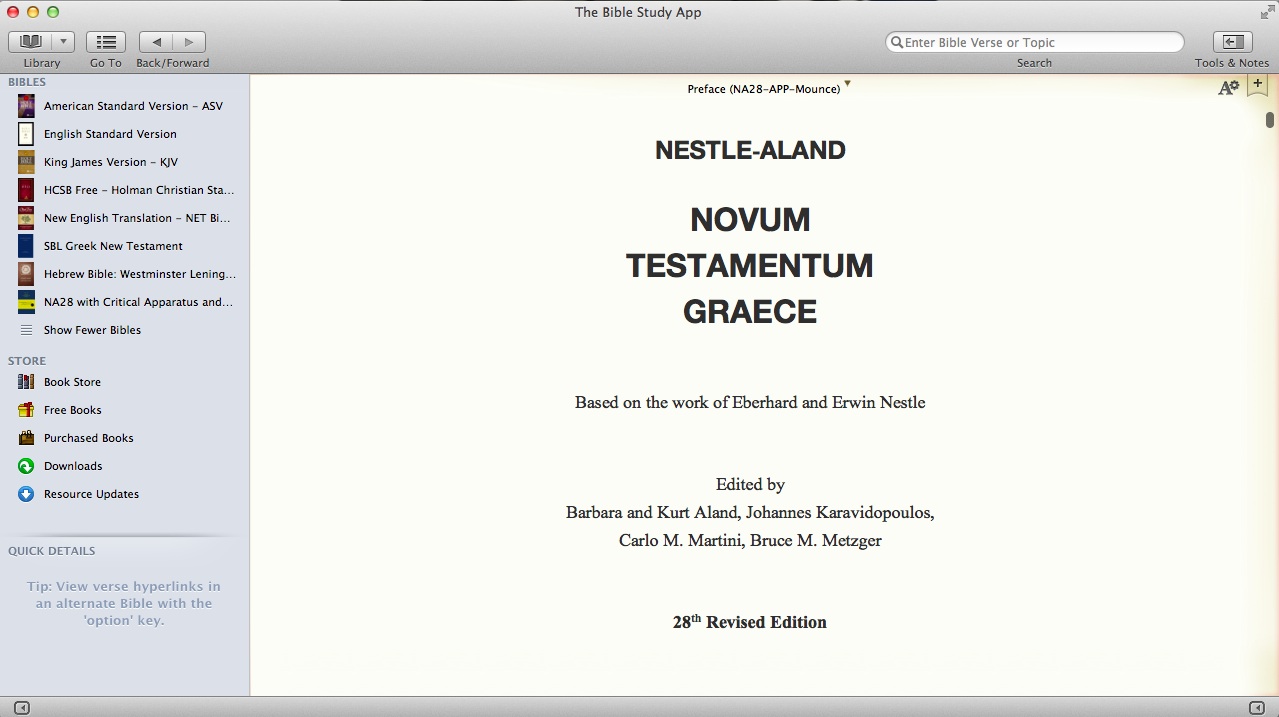
My opening screen, when I open the NA28 from my Library, looks like this (click to enlarge):
The interface of the left sidebar resembles that of the Mac Finder windows. In addition the sidebar affords immediate (in-app) access to the Olive Tree store. Once you click on “Book Store,” you see a screen that slightly resembles the iTunes store:
You can hide the sidebar and hide or customize the toolbar on top.
By clicking on the “Tools & Notes” icon on the top right (from the first screen shot above), I can open a second window (Olive Tree calls this “the split window”):
I have several options at the top of the split window: Resource Guide, Notes, etc.
With the NA28 open, I quickly found four ways to navigate to a given verse–each of the three shown below, as well as a right-click option to select a verse.
For the NA28 with apparatus, I open the text in the left window and the apparatus in the right. Clicking on a word or hovering over it will show its morphological information (i.e., parsing and gloss) either through a pop-up menu (when clicking) or through the “Quick Details” at bottom left in the shot below (when hovering):
Getting right to work within the program (with just the occasional reference to help files and a quick start guide) was easy enough. I didn’t find getting the two windows side-by-side to be as quickly intuitive as I would have liked, but I don’t know yet whether that’s a weakness in the program or just my newness to it. The interface is clean and visually appealing. I’ve already been impressed with all that’s available in the Olive Tree store.
More to come. In the meantime, Olive Tree has a blog post of their own on using the NA28 here.
Thanks to Olive Tree for the NA28 with Critical Apparatus, Mounce Parsings, and Concise Dictionary for the purposes of this blog review.You can find that product here.
The one who is serious about getting at the earliest attainable text of the Hebrew Bible will eventually find herself or himself face-to-face with a page like this:
Genesis 1 in the Göttingen Septuagint
The Göttingen Septuagint is the largest scholarly edition of the Greek translation of the Hebrew Bible. Its full title is Septuaginta: Vetus Testamentum Graecum Auctoritate Academiae Scientiarum Gottingensis editum. Vandenhoeck & Ruprecht in Göttingen,
Germany publishes the series, which includes more than 20 volumes covering some 40 biblical books (counting the minor prophets as 12). Various editors are working toward the publication of additional volumes.
But if good coffee, fine wine, or well-aged cheese requires work on the part of the one taking it in, the Göttingen LXX makes its own demands of the reader who would use it. The critical apparatuses on each page have Greek, abbreviated Greek, abbreviated Latin, and other potentially unfamiliar sigla. The introductions in each volume are in German.
How to read and understand the Göttingen Septuagint, then? To begin, here is the sample page from above:
Genesis 1:4-9, reprinted with publisher’s permission
There are four main parts to the page, marked in the image above by the numbers 1 through 4.
The reconstructed Greek critical text (“Der kritische Text”)
The Source List (“Kopfleiste”) (note: not every Göttingen volume has this)
The First Critical Apparatus (“Apparat I”)
The Second Critical Apparatus (“Apparat II”)
In part 1 of my primer, I covered numbers 1 and 2 above. To summarize a bit:
1. With verse references in both the margin and in the body of the text, the top portion of each page of the Göttingen Septuagint is the editorially reconstructed text of each biblical book.
2. The Kopfleiste comes just below the text and above the apparatuses. Wevers notes it as a list of all manuscripts and versions used, listed in the order that they appear in the apparatus on that page. A fragmentary textual witness is enclosed in parenthesis.
Next are the two critical apparatuses. In his introduction to Genesis (conveniently translated into English here, from which I quote), editor John William Wevers speaks of the critically reconstructed text as an “approximation of the original” and “hopefully the best which could be reconstructed.” I previously noted:
[Göttingen] editors have viewed and listed the readings of many manuscripts and versions. The critical apparatuses are where they list those readings, so the user of Göttingen can see other readings as they compare with the critically reconstructed text. (Because the Göttingen editions are critical/eclectic texts, no single manuscript will match the text of the Göttingen Septuagint.)
The International Organization for Septuagint and Cognate Studies (IOSCS) notes (from here):
The Göttingen Septuagint features two apparatuses (as does the Larger Cambridge Septuagint), the first for LXX/OG textual evidence proper and the second for so-called hexaplaric evidence, i.e. “rival” translations/revisions of the translated LXX/OG (such as circulated under the labels “Theodotion,” “Aquila,” and “Symmachus”), preserved largely through the influence of Origen’s Hexapla. For LXX/OG research the importance of both apparatuses is second only to the critical text itself.
The challenge, of course, is that to make sense of the apparatuses and their abbreviations.
3. The First Critical Apparatus (“Apparat I”)
The “textual evidence proper” consists of any readings that the editor deems as variant to the reconstructed text. The editors follow a consistent order in the witnesses they cite. (There is minor variation, volume to volume.) In Genesis Wevers writes:
The witnesses for a variant are always arranged in a set order: a) the uncial texts in alphabetic order; b) the papyri in numerical order; c) the witnesses of the O‘ mss [AKJ: the “hexaplaric group”]; d) the witnesses of the C‘’ mss [AKJ: the “Catena group”]; e) the remaining text families (comp Section B I above) in alphabetical order; f) the rest of the Greek evidence in the following order: N.T. witnesses, Ios [AKJ: Josephus], Phil [AKJ: Philo], followed by the rest of the Greek writers in alphabetic order; g) La (or the sub-groups, for ex. LaI Las, etc.) [AKJ: Old Latin versions], followed by the other versions in alphabetic order; h) citations of the Latin Fathers, introduced by the sign Lat (these witnesses always stand in opposition to La or a sub-group of La); i) other witnesses or commentaries.
To look at an example of the first critical apparatus, Deuteronomy 6:5 in the Göttingen edition reads:
(And you shall love the Lord your God with all your mind and with all your soul and with all your strength.)
The apparatus for that verse, in part, has:
om καί 1° Arab Sa17 | αγαπησης 30; αγαπη σε 527 | κύριον τόν] bisscr 120* | om σου 1° Tht Dtap | ἐξ 1°—διανοίας] εν ολη τη καρδια Matth 22:37 |
With each unit broken up by line here, the apparatus gives this information about its manuscripts:
Arab and Sa17 omit (om) the first (1°) use of καί
30 has αγαπησης; 527 has αγαπη σε
120* has κύριον τόν written (scr) twice (bis)
Tht Dtap omits (om) the first (1°) use of σου
From the first use (1°) of ἐξ through (—) the word διανοίας, Matthew 22:37 has rather (]) εν ολη τη καρδια
One has to go to the introduction for information about the manuscripts “Arab” (Arabic version), ” Sa17” (from the Sahidic version), “30” and “527” (minuscule manuscripts), “120*” (also a minuscule manuscript, where the asterisk * refers to “the original reading of a ms,” as opposed to a “correction”), and “Tht Dtap” (Tht=Theodoretus (“Cyrensis=Cyrrhensis”); Dt=his Quaestiones in Deuteronomium;ap refers, Wevers notes, “to readings (variants) in the apparatus of editions”).
Miles Van Pelt has produced a concise two-page summary of sigla and abbreviations. I offer appreciation and gratitude to Miles that I can link to that pdf here. That offers further instruction as to deciphering the apparatuses (both the first and second) in the Göttingen volumes. The introductions to given volumes contain the signs/symbols and abbreviations (“Zeichen und Abkürzungen”), as well.
Boromir had it right:
So I’ll write about the Second Critical Apparatus (“Apparat II”) in a future post. Until then….
Thanks to Brian Davidson of LXXI for his helpful suggestions on an earlier draft of this post and the part 1 that preceded it. He is not to be blamed for the inclusion of Boromir in this post.
Most students of the Hebrew Bible who read Hebrew know of the premier scholarly edition, the Biblia Hebraica Stuttgartensia (BHS, here on Amazon). The BHS is now being updated by the BHQ (Q=Quinta), about which you can read more here. Both the BHS and BHQ are “diplomatic” editions of the text, which means that they reproduce a single “best” manuscript, the Leningrad Codex, in their cases. The footer in each page contains a critical apparatus, which lists variant readings from other manuscripts and versions that the editors have deemed to be of importance for getting even closer to the “original” (now often being called the “earliest attainable text”). In some cases, the editors may wish to show where another manuscript or version differs from the Leningrad Codex; the critical apparatus is where they do it.
There are two other similar projects underway for the Hebrew Bible. One is the Hebrew University Bible Project, also a diplomatic edition, but unlike BHS and BHQ, based on the Aleppo Codex. The HUB includes a more extensive critical apparatus than BHS, so that readers can see more textual variants.
The other scholarly edition of the Hebrew Bible is the Oxford Hebrew Bible Project, “a new critical edition of the Hebrew Bible featuring a critical text and extensive text-critical introduction and commentary.” Though the BHQ contains commentary, too, the OHB differs in being an “eclectic” text, meaning that, as R.S. Hendel says (quoted in Tov),
The practical goal for the OHB is to approximate in its critical text the textual “archetype,” by which I mean the earliest inferable textual state.
Though the textual apparatuses of the BHS/BHQ and HUB can theoretically aid the reader in approximating the textual “archetype,” the text of the OHB offers that approximation rather than reproducing an actual manuscript (as the diplomatic editions do). Hence, the OHB is an “eclectic” edition. (So, too, are the two major scholarly editions of the Greek New Testament, the NA27 and UBS4.)
The Septuagint–the Greek translation of these Jewish Scriptures–has various scholarly editions, too.
On its Website the International Organization for Septuagint and Cognate Studies (IOSCS) has a great primer on the various editions of the Septuagint. Below, “OG” stands for “Old Greek.” They write:
The creation and propagation of a critical text of the LXX/OG has been a basic concern in modern scholarship. The two great text editions begun in the early 20th century are the Cambridge Septuagint and the Göttingen Septuagint, each with a “minor edition” (editio minor) and a “major edition” (editio maior). For Cambridge this means respectively H. B. Swete, The Old Testament in Greek (1909-1922) and the so-called “Larger Cambridge Septuagint” by A. E. Brooke, N. McLean, (and H. St. John Thackeray) (1906-). For Göttingen it denotes respectively Alfred Rahlfs’s Handausgabe (1935) and the “Larger Göttingen Septuagint” (1931-). Though Rahlfs (editio minor) can be called a semi-critical edition, the Göttingen Septuaginta (editio maior) presents a fully critical text, as described below.
Beginning Septuagint students are likely to own just “Rahlfs” (the Handausgabe mentioned above). But those who want to do more detailed text work with the Septuagint want more than the mini-apparatus in that edition.
There is more here about the scholarly versions of the Septuagint, including a volume-by-volume listing of both the Cambridge and Göttingen projects.
I have been fortunate to receive a review copy of BHS and BHQ Hebrew Bible editions from Accordance, as well as the existing volumes of the Göttingen Septuagint from Logos. I’ll be reviewing each in the coming weeks.
UPDATE: My review of BHS in Accordance is here. My BHQ review is here. Part 1 of a short primer on using the Göttingen Septuagint is here.








 Words on the Word