A wife for Jesus?

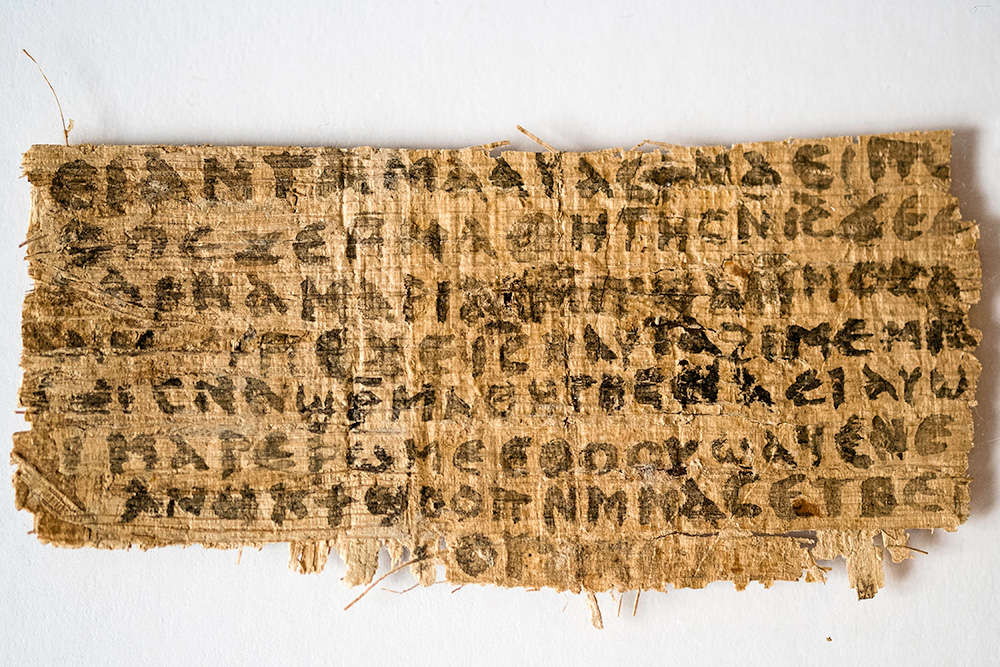
Front of papyrus fragment, Karen L. King, 2012

Did Jesus have a wife? Does it matter?

In the last two days I’ve seen about 50 Facebook status updates from friends and groups I follow, each with their own take on the “Gospel of Jesus’s Wife” papyrus that Harvard Professor Karen L. King recently announced. (Nerdy grammatical excursus: King has titled the papyrus with Jesus’s, but I follow Strunk and White and prefer Jesus’.)

The Harvard Divinity School press release is here. It begins,

Four words on a previously unknown papyrus fragment provide the first evidence that some early Christians believed Jesus had been married, Harvard Professor Karen King told the 10th International Congress of Coptic Studies today.

The papyrus has been dated to the 4th century and is written in Coptic, the alphabet of which has overlap with the Greek alphabet. King has postulated, in fact, that the Coptic in this little fragment may have translated a Greek original.

The key quote from the papyrus is translated, “Jesus said to them, ‘My wife….'” It then gets cut off. Go here for a full translation, as well as helpful Q&A with Professor King.

It seems to me there are two primary questions on folks’ minds right now. First, is this thing real or a fake? Second, did Jesus have a wife, or could he have?

In pursuit of these questions, I spoke with two Professors of Biblical Studies at Gordon College, a top Christian liberal arts school, located just north of Boston. Was Jesus married?

“Is there anything in the Gospels that would give us a hint he was married? I don’t think so,” noted Professor Marvin R. Wilson. “If he was married, how come he says to his beloved disciple at the cross, ‘Take my mother,’ not ‘Take my wife’?”

The significant woman in Jesus’ life, for whom he is looking out in his final hours, is his mother Mary, not a wife.

All the same, Wilson said, “It’s a good question. One who had no marriage would certainly have been the exception. We have an exception in Jeremiah, but that was a divinely commanded celibacy.”

Wilson noted, however, that the assertion that Jesus had a wife is still an argument from silence. “Certainly he had a wonderful ministry with women. We know the 4th century was a time of theological clarification (Council of Nicea) as well as turbulence. This Coptic text may have represented a small sect of aberrant Christians that had broken away from the larger–yet still emerging–traditional community.”

Is there much at stake in the question of whether or not Jesus had a wife?

“Certainly I don’t think any key issues of the Christian faith are at stake here. If Jesus had a self-imposed celibacy because of the work he was called to accomplish, that would make him unusual, but not unique.”

Professor Steven Hunt noted, “There’s so much we don’t know about it yet. It’s apparently a very small fragment.”

Regarding the authenticity of the papyrus, he added, “I’m perfectly willing to go with [Professor King] and say that it’s an authentic fragment of some document that’s now lost, but it’s probably speaking more to the nature of debates in the 3rd and 4th century about sex and marriage… it’s almost certainly not giving us accurate information about the historical Jesus.”

More interesting than the fragment itself, Hunt noted, is the question, “Would Christians be troubled to find out Jesus was married? The fact that many would, may really be quite suggestive, especially if their reaction was rooted in a negative attitude toward bodily existence in general and sexuality in particular.

“So, while there’s no good historical evidence that he was [married], from my perspective,” Hunt said, “it’s not really theologically problematic to suggest that he could have been. Since the Bible affirms the essential goodness of marriage and sexuality, what would be the problem with that?”

And God planted a garden…

[R]econciliation has too often been discussed in Christian circles as if it took place in a vacuum, as if only people and not trees, rivers, mountains and farms are swept up in God’s redemptive drama. Our aim, then, is to point our attention back to the land, to say what a faithful life on it might look like, and to show that the land–indeed, the entire cosmos–is inextricably bound up in God’s salvation through Jesus Christ (see Col 1:20).

–Fred Bahnson & Norman Wirzba in Making Peace with the Land

The newest offering from IVP Books’ Resources for Reconciliation series is Making Peace with the Land: God’s Call to Reconcile with CreationThe Resources for Reconciliation series pairs a practitioner with an academician, who then together address the theology and practice of reconciliation in a given sphere of life. The first book in the series, Reconciling All Things, profoundly influenced my development of a Biblical theology of justice and reconciliation.

Practitioner Fred Bahnson is an agriculturalist and writer (and excellent theologian); academician Norman Wirzba is a theology professor at Duke Divinity School (and grounded practitioner). Making Peace with the Land makes the Biblical case that “redemption is cosmic,” and so extends to the whole created order, not just humanity. God wants all creatures (“human and nonhuman”) to be “reconciled with each other and with God.” In other words, our Biblical theology of reconciliation is anemic if it does not extend to a loving stewardship of the whole of God’s creation. The authors warn against “ecological amnesia.”

Our “ecological amnesia” is at its core a theological issue. God is God of the soil, a gardener who loves the soil and brings forth life through it (as noted in Genesis). But we have worked against the land in developing systems and structures for farming that draw heavily on “our own agricultural scheme” and “monocultures of annual crops.” Instead we need to “look to nature as a model for how to practice agriculture,” engaging in what Bahnson calls regenerative agriculture, founded on the truth that “the ecosystems in which we find ourselves–created by God and deemed ‘very good’–are far more adept at growing things than we are.” The profile in chapter 6 of the work of ECHO (Educational Concerns for Hunger Organization) both astounded and inspired me. (Check out ECHO here.)

Bahnson and Wirzba are compelling: “Surely it is a contradiction to profess belief in the Creator while showing disregard or disdain for the works of the Creator’s hands.” After reading a lengthy description of how Chicken McNuggets are made, I was about ready to become a vegetarian. Regardless of how the phrase “animal rights” makes you feel, animal torture is not possibly justifiable by those who have been called to co-steward the creation with God.

At times I desired more exegetical nuance when the authors dealt with Scripture. For example, though the prologue is convincing enough that we ought to view God as gardener, to accept that God’s gardening work is “the most fundamental and indispensable expression of the divine love that creates, sustains, and reconciles the world” is difficult for me to… well… reconcile with the expression of divine love on the cross. In the end, it’s all of the above. That said, Bahnson’s note on the acacia tree in Isaiah 41:18-19 as a nitrogen-fixing tree and thus “divine agroforestry advice” was awesome. And the authors do affirm elsewhere that reconciliation begins with the person and work of Jesus–it is in Jesus that all things hold together, as they point out from Colossians 1.

Many of us practice “a sort of gnostic disdain for manual labor, soil husbandry, caring for physical places and living within our ecological limits.” If I make enough money to simply buy food, I don’t need to get close to that food except to pick it up at the store (or restaurant!). Then I eat it and keep going with my work, however disconnected I may be from the source of that food. However,

Reconciliation with the land means learning to see the land as part of God’s redemptive plan and acknowledge God’s ongoing presence there. That will require putting ourselves in proximity to the land and staying there long enough to be changed.

After reading this book, I’m unsettled. I’m a lot farther from “the land” than I perhaps should be. I’m not sure what to do with that. And my theology of reconciliation has often not been robust enough. But I’ve been thinking more about my food, its sources, and my connection to God’s land now that I’ve read Making Peace with the Land. I’m not suggesting that we engage carbon offsets as a solution. (Slight detour: does this not look eerily like indulgences?)

But if I’m unsettled, I’m also inspired. What if I allowed my having been reconciled with Christ to inform a ministry of reconciliation not limited to other people? What if we followed Wirzba’s advice to allow our weekly “Eucharistic eating” to “not only transform the eating we do with people,” but to also transform “the entire act of eating, which means [changing] the way we go about growing, harvesting, processing, distributing, preparing and then sharing the food we daily eat”?

That would be an abundant life.

Thank you to IVP for the free review copy, in exchange for an unbiased review, and–as it turns out–a re-examined life. Find more about Making Peace with the Land here (IVP) or here (Amazon). Highly recommended.

Prayer in the liturgy: Is it worth it?

Today’s post comes from Timothy Dean Roth, author of The Week That Changed the World: The Complete Easter Story (amzn). There are few people whose words inspire, challenge, and fill me with a sense of God’s presence more than Tim’s. His book has been an excellent aid to my experience of Holy Week these last two years. He’s given me some of my best sermon ideas. Etc., etc. He’s a great dialogue partner and friend. As Words on the Word addresses themes of worship and liturgy on Wednesdays, Tim asks today: “Prayer in the liturgy: Is it worth it?”

If you go to a Church that has a time when a lector reads prayers and the congregation responds after each one-sentence prayer, “Lord, hear our prayer,” you may wonder sometimes whether the Lord really does hear our prayer, especially if you were spacing out and can’t even remember what the prayer was. The answer is that God does indeed hear these prayers, and he responds to them.

Here’s why. These prayers are themselves written by liturgists in a spirit of prayer in response to the needs of the times we live in. The Holy Spirit himself prompts liturgists who are attuned to his voice to write down these prayers. I have never heard a prayer read to the congregation that could be considered outside God’s will (and hopefully you haven’t either), and we know that God favorably answers prayers that are in accordance with his will. We also know that God the Father answers the prayers of the righteous, just like he answered the prayers of his own Son, though only if prayed in a spirit of steadfast faith and without doubt, which is the hard part.

Fortunately for those of us with weak faith, there are some crazy people out there who do believe that when we pray outlandish things like, “That you may increase peace in the Middle East” or, “That you may help all politicians recognize the value of life,” these things are actually going to happen. God hears these people, even if we can’t quite figure out how. What if a suicide bomber changes his mind the day before blowing up a mosque because enough people like the one right next to you sincerely said, “Lord, hear our prayer”? We can’t know how these prayers are answered, but they are. God’s word promises us that. Every little prayer counts, every little prayer brings a little more good into the world and a little less evil, and even the tiniest difference in the chaotic, unpredictable daily stock market fluctuations of good versus evil is worth the effort.

God is going to answer these prayers with or without your participation, so why not participate, why not fully abandon yourself to these prayers? Through these prayers, he’s inviting every one of us, from greatest to least, to join the battle, to actively participate in his work of transforming this world.

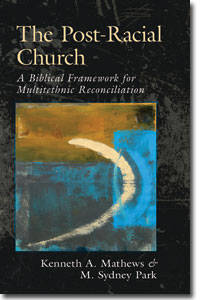
Magnificent Monograph Monday: Review of The Post-Racial Church

Kenneth A. Mathews (Old Testament) and M. Sydney Park (New Testament), professors at Beeson Divinity School, attempt in The Post-Racial Church to “better equip the church in answering why Christians claim that the gospel and the Christian church are the first and last best hope for peace in a racially diverse world” (25).

To help readers understand how churches can more faithfully reflect “the wonder of God’s human kaleidoscope,” they work their way through the arc of the Old and New Testaments to reveal God’s plan for reconciliation. Reconciliation, they believe, “can only be fully and finally achieved by a Savior who redeems and transforms the human state” (57). Their call to racial/ethnic unity in the church is an unabashedly Biblical program. They write, “Genuine unity must be predicated upon a commitment to the Lord God, not based on anything or anyone else. Otherwise, the unity is circumstantial, which means that it is superficial and fragile” (72-73). They ground their call for ethnic unity in the Church firmly in Scripture.

Mathews writes the introduction and chapters 1-4 on the Old Testament, addressing God’s design in creation, his covenant with Noah and then with Abram to bless all nations, as well as God’s heart and provision for the immigrant among the people of Israel. Park traces the New Testament development of the theme of the inclusion of all people in God’s covenant. She explores Jesus’ stories concerning reconciliation, as well as how Biblical characters like James, Peter, and Paul came to grips with a deeper understanding of God’s desire for trans-ethnic unity in the Church.  (Park’s interpretation and application of the Prodigal Son parable opened up new understandings of that story that I had never considered—despite having already heard and read it many times.)

The Post-Racial Church is excellent in the thoroughness with which it treats Biblical texts that have to do with multiethnic reconciliation (and reconciliation more generally). In this sense, it greatly succeeds in being what the book’s subtitle claims it will be: A Biblical Framework for Multiethnic Reconciliation. Even though the introductory chapter clarifies what the authors mean by various terms they use, the phrase “post-racial church” as such is not really explored in the book itself. “Kaleidoscopic Church” or “The Post-Racist Church” would have been more fitting titles for the book. (So if you, like me, express skepticism at a Church or any institution being “post-racial,” don’t let that stop you from checking out this book. The authors don’t actually advance that we be “color-blind” or “ignore race” as part of their thesis.)

On the one hand the book at times felt a bit over-dense (especially the first half). But on the other hand, other books I’ve read about multiethnic church-building or racial reconciliation often give what feels like too short a treatment of Biblical texts on the topic. Mathews’ and Park’s detailed exegesis was in the end refreshing in this sense, and makes a unique contribution to the genre of book into which The Post-Racial Church fits. I also appreciated that they drew on the original Hebrew and Greek to further illuminate the texts they expounded. This made their work even more compelling.

Each chapter concludes with “Thought Provoker” questions, a high point of the book. For example, one question (p. 171) asks,

If loving our neighbors is a critical factor in our discipleship, and if loving our neighbors self-sacrificially serves as the litmus test for our discipleship, does the test prove positive for you and your church?

One could easily use this book in a small group discussion to great effect.

The reader who takes the time to work carefully through the authors’ guided exegetical tour through the Scriptures will be greatly rewarded. If indeed, as Park claims, “the proper understanding of racial reconciliation is possible only in light of God’s saving activity throughout human history,” then those who desire to join God in drawing all people to himself will want to avail themselves to the solid Biblical exposition that the authors provide.

(Per FTC guidelines, I note that I received a complimentary copy of this book from Kregel in exchange for an unbiased review.)

Book Review: The Next Evangelicalism, by Soong-Chan Rah

Soong-Chan Rah writes, “As many lament the decline of Christianity in the United States in the early stages of the twenty-first century, very few have recognized that American Christianity may actually be growing, but in unexpected and surprising ways.”

In The Next Evangelicalism: Freeing the Church from Western Cultural Captivity, Rah posits that mainstream evangelicalism in the United States has been too monocultural in its worldview–“white” and “Western,” he says. It has been “taken captive” by individualism, consumerism and materialism, and racism. This captivity is pervasive, he writes, as seen in the megachurch movement, the emerging church movement (which Rah rightly argues pays too much attention to just white voices), and through cultural imperialism. Looking at Native American, African American, immigrant, and multicultural communities, Rah offers hopeful alternatives for evangelicalism’s future.

Every evangelical Christian should read this book. Rah has the courage to say hard things the church needs to hear. His excellent treatment of racism, especially, should be preached from the pulpits and studied in small groups.

However, there are at least two key points where I take issue with Rah.

First, a distraction is Rah’s equating “white” with “Western” as he discusses the church’s captivity. But these two are not always synonymous words, and sometimes when the author uses “white” he really means (or should mean) “Western” instead. Rah mentions T.D. Jakes as a megachurch pastor who is emblematic of the church’s captivity to (“white”) numerical pragmatism. But Jakes is “Western” and not “white.”  And there are non-white sectors of the Western church deserving of Rah’s critique (for example, Creflo Dollar and other “health and wealth gospel” African American pastors should be included in Rah’s critique of Western consumerism and materialism). Rah’s arguments would have more force (and been more accurate) if he simply had referred to “Western cultural captivity.”

Second, I struggled to accept some final remarks: “The shift in American evangelicalism is well under way. The white churches are in significant decline.” I will grant the first assertion. But as to the second, Rah does not define further what he means by “decline” and provides barely any evidence of it that I could see. In fact, if he means numerical decline, he is using a standard previously rejected in his book. (Church health ought to be measured not by buildings built or number of attendees alone, he notes, but by taking the spiritual pulse of the congregation.) Is a Church feeding the poor?  Welcoming visitors?  Caring for the sick? (Etc.?) If so, Rah would say, it is a healthy church. By this standard, the predominantly “white” church at which I recently served as youth minister, for example, is very healthy. Members of that church, and of many others I know that are like it, might read lines like this and ask, “What decline?”

Even so, I don’t want to overly fault Rah for those objections. As a reader I do not demand that Rah say everything perfectly before I accept the force and truth of his overarching claims. All in all, The Next Evangelicalism issues a clarion call to the church to end racism, embrace the growing ethnic diversity of the body of Christ, hear voices that have been overlooked and marginalized, and more accurately reflect the church the Bible calls us to be.