Scot McKnight’s Sermon on the Mount Commentary

SGBC SMount

Scot McKnight just released a commentary on the Sermon on the Mount. I’ll post a review in due time, but as I prepare my sermon for our church’s last Sunday in the Sermon on the Mount, I wanted to give props here to what is a really good commentary! McKnight blends careful exegesis with relevant application, and isn’t afraid to really wrestle with some of the challenges Jesus issues in the S.Mount. Highly recommended.


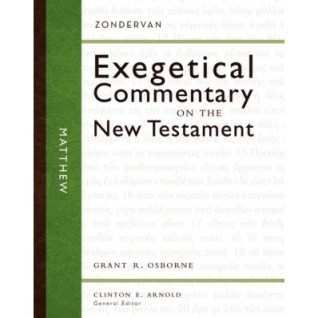
Matthew (Zondervan ECNT), reviewed

Matthew ZECNT

Now that I’ve been preaching through the early sections of Matthew for 10 weeks, I’ve had a chance to make regular use of a number of commentaries. I continue to value Zondervan’s Exegetical Commentary on the New Testament. Its Matthew volume is very much on par with the rest of the series (which I’ve reviewed here, here, and here). Author Grant R. Osborne primarily intends it for preachers, but I’ve seen it assigned as a seminary textbook, as well.

ZECNT Layout

Matthew, like the rest of the ZECNT series, includes:

  • The full Greek text of Matthew, verse by verse, or often split up phrase by phrase
  • The author’s English translation
    • First, appearing in the graphical layout for the entire passage
    • Second, verse by verse or phrase by phrase, next to the Greek
  • Matthew’s broader Literary Context for each passage
  • An outline of the passage in its immediately surrounding context
  • The Main Idea (probably the first place preachers would want to look)
  • Structure and Literary Form (with focus on source criticism)
  • A more detailed Exegetical Outline of the passage under consideration
  • Explanation of the Text, which includes the Greek and English mentioned above, as well as the commentary proper
  • A concluding Theology in Application section

This sounds like a lot, but the result is not a cluttered commentary. Rather, as one gets accustomed to the series format, it becomes easy to quickly find specific information about a passage. The section headings are in large, bold font.

The Greek font is aesthetically pleasing and readable. Here’s a picture:

ZECNT font

Osborne’s Introduction to Matthew

For a commentary of more than 1,000 pages, the introduction is surprisingly short (27 pages). Seven of those pages are a section called, “How to Study and Preach the Gospel of Matthew.” Osborne acknowledges,

[T]he details I chose to include in this commentary, both exegetical and theological, were chosen on the basis of one major question: What would I want to know as a pastor preparing a sermon on this passage?

So it’s fitting that he speaks directly to preachers at the very beginning of his introduction. He suggests understanding the Gospels as “history seen through theological eyes” and encourages the preacher to try to grasp the distinct “theological purposes of each [Gospel] author.”

Though the introduction is short, and someone doing extended work on Matthew will need to also look elsewhere for introductory concerns, Osborne is able to give an informative enough overview of dating, authorship, genre, purpose, audience (the thinnest subject in the introduction), sources, history, Matthew’s use of the Old Testament, and structure.

There are also more than 20 pages at the end of the commentary that cover the theology of Matthew. Although that section is tucked away, it’s not to be missed, especially Osborne’s coverage of Christology and of discipleship.

The Commentary Proper: Highlights and Observations

There is just enough Greek (grammar and word studies) to keep one’s Greek sharp. There’s not the level of detail found in the Baylor Handbook on the Greek Text series, which does not yet have a Matthew volume.

Matthew 13:54 begins, “He came into his hometown and began teaching (ἐδίδασκεν) them in their synagogue.” In the commentary you’ll find comments like this one:

The imperfect ἐδίδασκεν could refer to an ongoing practice but is probably ingressive, “began teaching” on this occasion (as in v. 8).

Osborne is sensitive to larger biblical context and theology–even in explaining individual words–so that one gets, for example, a fairly robust explanation of the “righteousness” Jesus talks about fulfilling in Matthew 3:15. And here is Osborne’s take on the “peacemakers” that Jesus calls blessed in 5:9:

The term “peacemaker” only appears elsewhere in verb form in Col 1:20, where Jesus made peace by his blood on the cross, but the concept is found often (Ps 34:14; Isa 52:7; Rom 12:18; 14:19; Jas 3:18; Heb 12:14; cf. 1 En. 52:11). This connotes both peace with God and peace between people—the latter flows out of the former. Jesus is the supreme peacemaker, who reconciles human beings with God through the cross (Col 1:20), so the supreme peacemaking is the proclamation of the gospel.

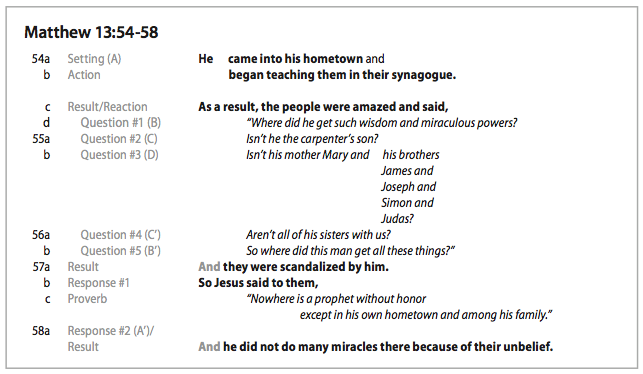
The graphical layout remains one of my favorite parts of the series. Look at Matthew 13:54-58 (from which the comment above is taken):

ZECNT passage flow

It’s readily apparent how Osborne sees the parts of a passage working together and relating to one another.

By way of critique, even with the commentary’s length there were times when I wanted more coverage. The “Explanation of the Text” section for Matthew 5:38-42, for example, barely covered two pages. The single paragraph on “turn the other cheek” addressed the main points that most other commentaries do, but given how many Christians have wrestled through this important passage (both on paper and in action), more could have been said.

Conclusion

Osborne succeeds in keeping the preacher in view throughout the commentary. I’ll give one last example, since this typifies Osborne’s blend of research and presentation in a way that will both assist and inspire preachers and teachers. In Matthew (and Luke) the Lord’s Prayer that Jesus gives his disciples to pray does not have the ending it does when prayed in liturgical settings (“for thine is the kingdom…”). Whether this should make it into a sermon or not is another question, but Osborne anticipates that readers and preachers will at least be wondering about it. He writes:

The traditional doxology (“for yours is the kingdom and the power and the glory forever. Amen”) appears in only a few late manuscripts (L W Θ 0233 et al.), and several of the best manuscripts end here (א B D Z et al.), with a variety of endings in others. This makes it almost certain that it is not original. It is possible that churches added their own doxology when praying this prayer, and this one emerged as the best summary of the contents of the prayer. However, it (and the other endings) is based on 1 Chr 29:11 – 13 and is meaningful, so it is not wrong to utter the ending as a personal prayer.

Where does the Matthew ZECNT volume rate among Matthew commentaries for preachers? Definitely toward the top. I still go to R.T. France’s NICNT volume first. And for Greek and history of interpretation, John Nolland (NIGTC) covers more territory. But Osborne’s constant eye on the larger literary context, the detailed structural outlines, the inclusion of Greek and English texts, the Theology in Application sections, and the graphical layout make his commentary a welcome guide for preaching and teaching through the First Gospel.

Thanks to Zondervan for the review copy. You can find the book’s product page here. It is on Amazon here. Amazon links above are affiliate links that help further the work of this blog, described here.

Zondervan Atlas of the Bible

Zondervan Atlas

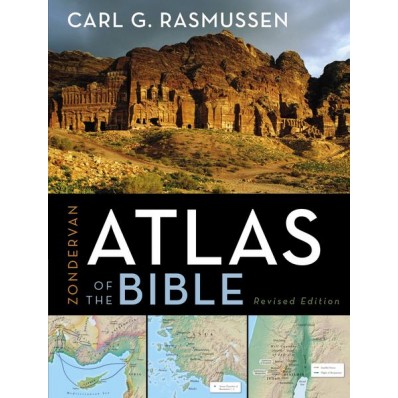
Carl G. Rasmussen has recently released a Revised Edition of Zondervan Atlas of the Bible. Below I offer a description of its contents with some evaluative remarks.

What’s in the Atlas

After the Preface and Introduction the atlas consists of a Geographical Section and a Historical Section, followed by Appendices.

The Geographical Section is first, because:

This atlas has been written in the belief that once one has a basic understanding of the geography of the Middle East, one has a much better chance of coming to grips with the flow of historical events that occurred there.

After “Introduction to the Middle East as a Whole” there are these sub-sections:

  1. The Geography of Israel and Jordan (the longest section, covering “the Five Zones,” weather, routes, and individual regions)
  2. The Geography of Egypt
  3. The Geography of Syria and Lebanon
  4. The Geography of Mesopotamia

The Historical Section covers the Bible’s history in canonical order, from the pre-patriarchal period to the churches in Revelation. It concludes with a special section on Jerusalem (“Of all the cities in the Bible, this is the most prominent one: it is mentioned 667 times in the Old Testament and 139 times in the New”) and an essay:  “The Disciplines of Historical Geography.” I appreciated being able to compare the layout of Jerusalem in the Old Testament, during the time of Nehemiah, and in the New Testament.

Rasmussen covers even the so-called intertestamental period, with sections on the Greeks (4th century B.C. onward), the Maccabees, and the Hasmonean dynasty.

The Appendices are also impressive. What really makes this atlas user-friendly is the 31-page Geographical Dictionary and Index. Any place name in the atlas (whether it has appeared on a map or in the descriptive text) is in the dictionary/index. There are also identifications with modern places, so one finds out, for example, that the biblical Bethany is the current-day El-Azariya. More specifically, here is the entry for Bethany at the back of the atlas:

Bethany (near Jerusalem)—Village on road to Jericho (Mark 11:1; Luke 19:29) less than 2 mi. from Jerusalem (John 11:18). Mary, Martha, and Lazarus lived there (John 11) and it seems that Jesus spent the evenings of the week before his crucifixion there. Mentioned 11 times in NT.–El-Azariya (174131), 1.5 mi. E of Jerusalem, on E side of Mount of Olives. 212, 214, 217, 251, 252

There’s quite a lot of text in the atlas, too. (It’s far more than just maps and photos.) In the section covering Jesus’ life, for example, Rasmussen offers an almost narrative overview of the locations of Jesus’ ministry, interspersed with graphics.

The Graphics

As with other Zondervan books along similar lines, there are striking full-color images and well-drawn maps throughout the book. Photographs like this will have to suffice until I can visit the lands described in this book:

Full-color photograph from the Atlas
Full-color photograph from the atlas

The atlas contains both two-dimensional and three-dimensional maps:

One of many maps from the Atlas

Between the maps, photographs, and timelines throughout the book, you can easily get your bearings in any era or biblical passage of study.

Evaluation

I’ve not been able to take full advantage of all that the atlas has to offer–there is a lot here–but it is my current go-to atlas. I look forward to making further use of it. Perhaps the proof is in the pudding: even though I was given a gratis copy for review by Zondervan, I purchased an electronic version of it in Accordance Bible software so I could have access to it there, too (I rarely purchase a book in two formats). Accordance’s production of the module, from what I’ve seen so far, enhances what is already an excellent book, with the added advantages of hyperlinks and advanced searching capabilities.

My two points of critique are fairly minor ones. First, the timelines throughout the book are easy enough to follow, but they are stylized in such a way that they feel a bit cluttered. You can see examples using the Search Inside feature on Amazon here (affiliate link). Second, the font is narrow and looks crammed on a page, especially pages that have a good amount of text. The flip-side to this is that in a book that is still fairly portable (just under 300 pages), you’re getting a lot of great information, but it’s not always easy to read for long stretches of time.

Any serious reader, no matter their level of prior knowledge of biblical geography and history, could make profitable use of the atlas. It’s not highly technical or scholarly, though students and professors should still consider it, especially in a classroom or Sunday school setting.

You can view a sample pdf of the atlas (including a detailed Table of Contents) here. Its product page at Zondervan is here. Accordance has it on sale for the rest of today (Monday) here.

New OT Commentary Series: Hearing the Message of Scripture

HMS Obadiah by BlockZondervan has just published the first two volumes of a new Old Testament commentary series, Hearing the Message of Scripture. Here’s part of a brief description of its approach:

[W]hen dealing with specific texts, the authors of the commentaries in this series are concerned with three principal questions:

  1. What are the principal theological points the biblical writers are making?
  2. How do biblical writers make those points?
  3. What significance does the message of the present text have for understanding the message of the biblical book within which it is embedded and the message of the Scriptures as a whole?

The achievement of these goals requires careful attention to the way ideas are expressed in the OT, including the selection and arrangement of materials and the syntactical shaping of the text.

Zondervan introduces the series more fully here, with a listing of contributors here. Or, if you prefer a video introduction, here is Series Editor Daniel I. Block on the series:

You can see PDF samples from Obadiah (by Daniel I. Block) here and from Jonah (by Kevin J. Youngblood) here. Zondervan’s book pages for each title are here and here. I’ve read half of the Obadiah volume so far and will post a review shortly.

Where Cultural Anthropology, Geography, History, and Praise All Meet

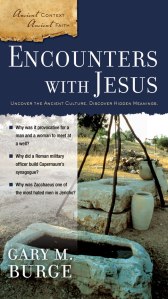
Encounters with JesusI learned my very first bit of Hebrew–the Sh’ma–from Gary Burge at Wheaton. His knowledge of cultural backgrounds of the Bible–and ability to communicate about it–is impressive. In Encounters with Jesus he explores the connections between “the ancient landscape,” encounters people in the first century had with Jesus, and how that can draw us into a deeper faith in Jesus today.

The short book consists of six chapters:

  1. Encountering Jesus
  2. The Woman with the Hemorrhage (from Matthew 9:18 – 26 and Mark 5:21 – 43)
  3. Zacchaeus of Jericho (from Luke 19:1 – 10)
  4. The Centurion of Capernaum (from Luke 7:1 – 10)
  5. A Woman in Samaria (from John 4:4 – 26)
  6. A Greek Woman in Tyre (from Matthew 15:21 – 28 and Mark 7:24 – 30)

In the series preface Burge writes:

We have forgotten that we read the Bible as foreigners, as visitors who have traveled not only to a new geography but a new century. We are literary tourists who are deeply in need of a guide.

The goal of this series is to be such a guide….

Burge asks, “Have you ever wondered what it would be like to encounter Jesus personally?” In chapter 1 he sketches a picture of a teacher who “took time for people who generally assumed that they were invisible.” And yet as accustomed as we are to thinking of Jesus as present with the poor, the sick, the outcast, and the powerless, Burge notes that Jesus does not deliberately avoid the powerful, either. Case in point: the centurion in Capernaum (chapter 4).

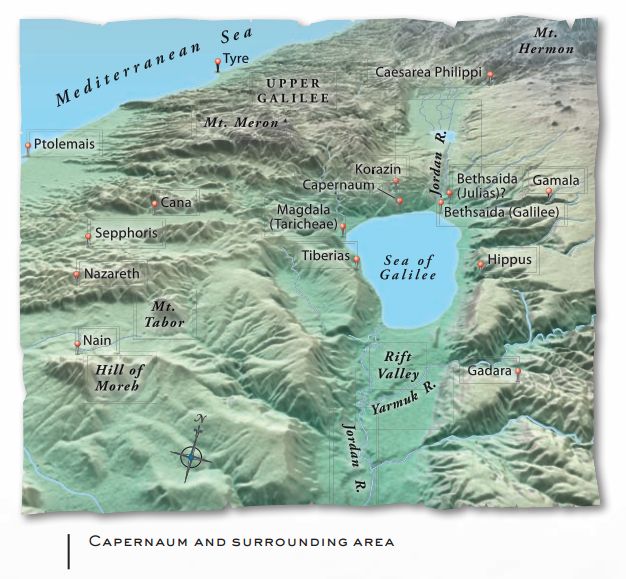
A map from the book
A map from the book

You can read the story of the centurion’s encounter with Jesus and find much to appreciate and marvel at already. But as Burge unpacked what was behind that encounter, the improbability of such an interaction became increasingly clear. That chapter begins with important geographical information on Capernaum, and then notes that it was Jesus’ home, as well as the site of the Sermon on the Mount and the Feeding of the 5,000. (No wonder, Burge notes, that Jesus says woe to Capernaum in Matthew 11, when they won’t believe.)

Capernaum was an economically strategic trade center, and so the Roman occupiers had made a home there–hence the presence of the centurion. Burge explains the organization of the Roman army, a “highly disciplined, professional fighting force.” An easy-to-understand diagram shows the division of the army into legions, cohorts, and centuries (which consisted of one centurion overseeing 80 men).

It is against this backdrop that Burge then tells the story of Jesus’ encounter with the centurion, a man who “understands that Jesus is similarly empowered by God in a way that others are not.” Jesus takes “social risks” in responding to him. Burge similarly unpacks the four more encounters with Jesus in the Gospels.

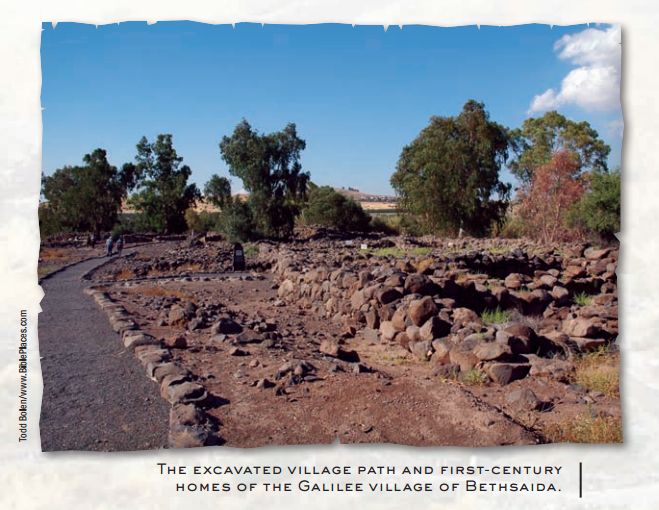
Like the other books in the Ancient Context, Ancient Faith series, Encounters with Jesus is printed on thick, glossy paper (which you can still easily mark in pencil) and is full of high-quality, color photographs and maps. Both the selection and placement of the visuals is perfect. (This truly is the guidebook the author seeks to produce.) Here’s one photograph from the book:

A photograph from the book

There are endnotes at the back of the book, but as with another book in the series, there is no Subject or Place Names or Scripture index, which I experienced as a lack. That’s about the extent of what I found to critique, though.

Encounters with Jesus is something I love: a book of biblical studies that also draws the reader into the presence and praise of God. I began reading it because I wanted to learn more about the cultural and historical background of some of the Gospel stories, but by the time I had finished the first chapter, I moved to reading it deliberately as part of my personal devotions.

I highly recommend Encounters with Jesus. As I read I had a better sense of what was happening in the Gospel stories Burge recounts, and–more important–I found myself growing in admiration and awe of Jesus.

Thanks to Zondervan for the review copy. Encounters with Jesus is on Amazon here. Its product page is at Zondervan’s site here. A sample pdf is here.

Isaiah (Zondervan Illustrated Bible Backgrounds Commentary)

Isaiah ZIBBCOTWhen I read through Isaiah last year, one resource I consulted whenever I could was the Isaiah section in the Zondervan Illustrated Bible Backgrounds Commentary. Zondervan has recently published it as a stand-alone book.

The sort of “backgrounds” that Isaiah describes are history, geography, culture, archaeology, and comparison to other Ancient Near Eastern texts and traditions. The introduction is quite short, but with its timelines of kings and map and historical overview, it provides a solid orientation to Isaiah.

David W. Baker’s comments on the first two words of Isaiah give a good sense of the approach of his commentary:

The vision (1:1). Most prophecies begin with a self-identification that can contain elements such as the type of literature, the identity of the prophet, and the time period. These indicate that they contain actual messages to a real audience addressing real-life issues they were facing. “Vision” is a form of divine revelation that did not necessarily involve the physical eyes, since here it involves primarily words rather than images (cf. 2:1). Prophets of Yahweh and pagan prophets experienced them. In Mesopotamia, even laypeople, both men and women, received visions or dreams from their gods.

The commentary does not reproduce the entire biblical text, but the words and verse to be commented on are marked in bold.

Isaiah 22:16 (NIV) reads:

What are you doing here and who gave you permission
to cut out a grave for yourself here,
hewing your grave on the height
and chiseling your resting place in the rock?

The verse makes some sense in its context already, but Baker’s concise comment adds more:

Hewing your grave (22:16). In Jerusalem, tombs were often hewn from the limestone rock, especially by people with means (e.g., Gen. 50:5; 2 Chr. 16:14; Matt. 27:60).

Baker has excursuses throughout the book that further illuminate themes like “Names and Naming” (Isaiah 9), “Assyrian Siege Tactics” (Isaiah 23), and “Divine Mercy” (Isaiah 54-55).

Swords shall be beaten into this (image from the book)

The ZIBBC series does not offer much by way of grammatical analysis or rhetorical criticism, but neither does it seek to. It ably accomplishes its purpose of giving the reader background information on the text, as well as sources for further reading.

To that end more than 1,700 (!) endnotes supply citations and bibliographic information that one can follow. (Note: I much prefer footnotes to endnotes, but with all of the sidebars and charts and photographs already in the body of the text, I think I see why the series uses endnotes.)

As the commentary progressed, I occasionally grew tired of the constant comparison of Isaiah to other Ancient Near Eastern parallels. On the one hand, it wouldn’t be entirely fair to criticize a “Bible Backgrounds” commentary for this, but the parallels sometimes felt a little strained.

Yet at other times the connections to ANE texts are illuminating, and downright fascinating. For instance, in a section called “Year of the Lord’s Favor,” covering Isaiah 61:1-11, Baker writes

Happiness and plenty are the goal of an ideal reign. A letter containing a prophecy addressed to Ashurbanipal foretells blessings from Shamash and Adad. These gods establish

a happy reign: days of justice, years of equity, heavy rains, water in full flood, a thriving commerce … Old men dance, young men sing, women and maidens are glad and make merry … Whom his crime has condemned to death, the king my lord has let live; who has been held prisoner many years, is set free; who were sick many days have recovered. The hungry have been sated; the lice-infested have been anointed; the naked have been clad in garments.

Many of these same elements characterize the anticipated messianic reign in Israel….

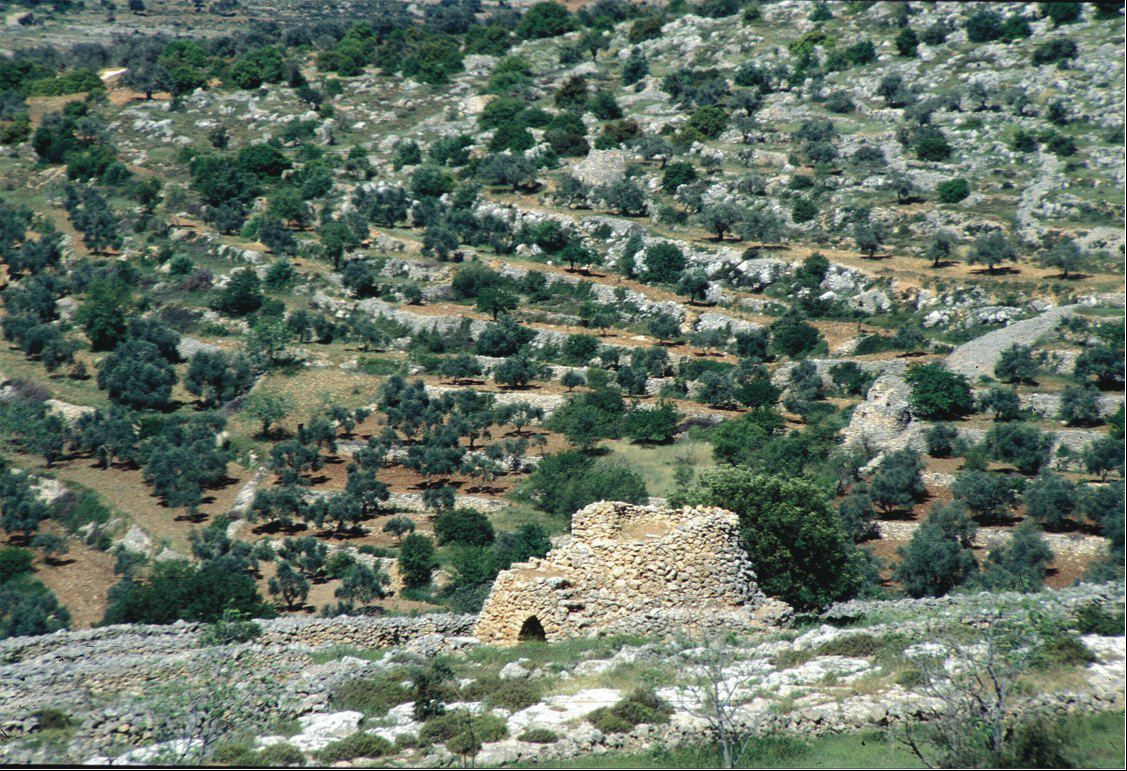
"He built a watchtower..." (Isa. 5:2/book image)
“He built a watchtower…” (Isa. 5:2/book image)

One can deduce, then, that the elements of this reign fulfill universally human desires (since they show up in other religious texts) for well-being and freedom. Understanding this enhances one’s read of Isaiah 61. The Messiah, one could say, fulfills a human longing that many cultures and religions have sought to express.

One missing piece in this single volume is the “Methodology: An Introductory Essay” by series editor John H. Walton, that can be found in the multi-book volumes. I would hope that future single volumes in this series include it.

The book is surprisingly well-constructed for a paperback that retails at $19.99. The glossy paper is of high quality, as are the full-color photographs, maps, and charts. The cover and binding are built to last. Regardless of your level of knowledge about the Old Testament or biblical background in general, Baker’s Isaiah is a good second book to have on hand when reading through the biblical book of Isaiah.

Thanks to Zondervan for the review copy. Find it here on Amazon, or at the publisher’s page here.

One Way to Improve Your Biblical Hebrew Is…

…to beef up your knowledge of vocabulary in the Hebrew Bible. But reading through the detailed instructions on building the tabernacle (Exodus 26 and following) can feel like too much of a vocab stretch. It seems like every other word is a rare one. Using an alphabetically organized lexicon for such passages really slows down the reading. Also, readers who have a way to gauge how common a word is can decide if they should know it or not.

Back in Print

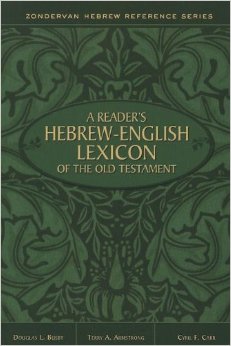
Readers Hebrew English LexiconA resource that has been out of print for some time is now back and available in a (cheaper) paperback edition. Zondervan’s Reader’s Hebrew-English Lexicon of the Old Testament offers verse-by-verse glosses (short translation equivalents) for rarely occurring words in the Hebrew Bible. The glosses are based on the Brown/Driver/Briggs (BDB) lexicon, with the context of each verse also taken into account. Organized in canonical order and covering the whole Old Testament, the lexicon lists each word that occurs 50 times or less in the Old Testament. Next to the word is the gloss and how many times that word appears in (a) a given book and (b) the whole Hebrew Bible. Each entry also has the page number in BDB, if you want to consult that additional work for a longer definition of a word. For verbs, the number of occurrences of that particular stem is also noted.

The lexicon follows the order of books that the Hebrew Bible does (i.e., the ordering differs from English Bibles). Only numbers and proper nouns are not included. The lexicon clocks in at 720 pages. It’s not as portable as when this single work was split into four volumes, but those are as hard to find as the four-volumes-in-one hardback had been. A Reader’s Hebrew-English Lexicon is intended to be a sort of counterpart to Kubo’s Greek lexicon by Zondervan. Here’s what it looks like:

HebrewI often struggle to remember Hebrew words that occur between 50 and 100 times in the OT, so the additional appendix is especially useful–it has Hebrew words that occur more than 50 times. There is also an Aramaic appendix.

How I Use It, Why I Like It

I’ve used this reader’s lexicon in tandem with Zondervan’s nicely laid out  “reader’s” edition of the Hebrew Bible. Though that Bible already footnotes rarely occurring words, the frequency counts in this lexicon help me know if it’s a word I should have known (e.g., one that occurs 45 times) or one I shouldn’t be surprised to not know (e.g., one that occurs three times).

The glosses are sufficient for rapid reading of the text. And the frequency counts add a nice orienting element not found in the reader’s Bible.

This edition is a reprint, so nothing has been re-formatted or changed in terms of the font. The font, while not always crisp on every page, is readable, both in Hebrew and English.

Yes, there are good Bible software options for reading the text, but I still like to read through the Hebrew Bible in print, and this reader’s lexicon makes for a convenient and trustworthy guide. For bettering one’s Hebrew vocabulary and reading, I heartily recommend it.

Thanks to Zondervan for the review copy of the lexicon. Its product page is here. It’s here on Amazon.

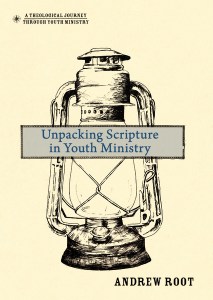
Unpacking Scripture in Youth Ministry, reviewed

Unpacking Scripture in YMWhen I was a vocational youth minister, I tried to help young people (and myself) read the Bible not just for information, but for transformation. I had a number of zealous starts in my own teenage years with an overly ambitious Bible-reading plan, only to find by January 22 that no, I can’t actually read and absorb three chapters a day. This is not to disparage Bible-reading plans, even ones that have you reading through the whole Bible in a year, but it is to say that it’s all too easy to just read the Book for the sake of being able to say, “I’ve read it.”

Andrew Root, author and professor of family and youth ministry at Luther Seminary, makes a similar suggestion. In Unpacking Scripture in Youth Ministry, he offers a short volume of “dogmatic theology written through youth ministry.” The book is part narrative, part theological mini-treatise, and follows the story of a fictional youth worker named Nadia. Throughout the book Nadia wrestles with her own views on Scripture, how to engage youth in Bible reading, and how to respond to the parents, pastors, and facilities committee members with whom she is in community.

The book is just over 100 pages and part of a larger series called A Theological Journey Through Youth Ministry. (See the other three volumes here.) A blend of fictional narrative and theology is hard to pull off in any book, but the transitions here between the two are smooth. From the very beginning scene (Nadia is called at 7 a.m. by a not-entirely-happy facilities coordinator at the church), Root’s storytelling is compelling, funny, and sometimes painfully relatable. Nadia is not the only youth minister, I’m sure, to have been grilled on her biblical theology by the building and grounds committee.

There are discussion questions for each chapter at the back of the book, which would make it easy for a youth minister to lead a team of volunteer leaders or staff through it. Unpacking Scripture and its series fill a gap in youth ministry literature–it’s great to see serious theological reflection coupled with practical application (and done creatively with Nadia’s narrative throughout).

Insatiable Interpreters

Root makes a fascinating point (that I’m still mulling over): “Today, access is more important than memory; we surrender our memory over to gigabytes.” Youth, then, and youth ministers should not see the Bible as a source of knowledge, Root suggests, but as a locus for the construction of meaning. Young people are insatiable “hermeneutical animals,” so Root warns against “frozen biblical knowledge,” since “adolescents interpret everything” in life anyway. He calls for youth ministers to ask:

What does this text mean in the midst of my life? And what does it mean in relation to my existence between possibility and nothingness? What does it say to this struggle I know in the world and in my bones? And…What does this text mean in relation to how God is moving and acting?

Root uses the story in Acts 8 of Philip and the eunuch to unpack his own vision of how to read and interpret the Bible. Philip, he writes, “is not only concerned with helping the eunuch understand the text, he wants to help the man experience it next to his own existence.” Right on.

100% Human, and…?

Root, in his chapter, “The Authority of Scripture,” leads off by talking about the paradox of Christ’s two natures–fully human and fully divine. He uses that as a springboard to look at “the Bible’s two natures,” which I expected to be an articulation of its having been written by human people (who were all too human) who were yet divinely inspired to write. However, Root goes farther than I’m comfortable accepting by saying that the “contradiction of the Bible is that the story of the divine action comes to us in a book that is simply, and profoundly human.” The Bible “contains all the shortcomings and fallibilities of any written text.” And, “The Bible is a 100 percent human book.”

Eunuch and PhilipI would have been on board, had he followed up with the ways in which the Bible is also “100 percent divinely inspired” or “breathed-into,” etc., but the emphasis seems to be largely on its human production. To be fair, this “human book,” Root notes, “is essential for encountering the living God,” but other than Acts 8, there wasn’t much discussion about what the Bible says about itself (with due respect to all the footnoted Barth). If this Word is “living and active,” and capable of transforming us (because it is God’s Word/words), doesn’t its inspiration go beyond just the fact that it is a “witness,” the purpose of which “was to reveal God’s action by articulating what God has done”? In other words, could there also be something about these very words that can transform? (Darrell W. Johnson, in his book The Glory of Preaching, notes, “[T]he word of the living God is a performative word” (my italics).)

Maybe I’m splitting hairs here, and I don’t know Root personally–I suspect that given more pages, or over a cup of coffee, he might say more about the divine inspiration of the Bible, or about its performative power. But I thought at least this book may have put too much emphasis on the human element, as it described “what the Bible is not” and “what the Bible is.”

What is the Goal in Youth Ministry?

Where I find myself agreeing with Root is in his articulation of the goal of youth ministry in relation to Scripture:

So our goal in youth ministry is not to get kids to know the Bible, but for them to use the Bible–to become familiar with its function–so they might encounter the living God, participating in God’s own action through its story.

Of course, the goal in youth ministry could/should be both of those things. We want young people to know the Bible and know how to use it, just as Root describes the eunuch’s both understanding and experiencing Scripture. Youth ministers will still need to help young people differentiate between genres (just as English teachers do) and help them know how to dig into the historical background of a text, which often helps to explain it more than just a surface read.

So we need to get both “behind the text” (“boring” or not) and “in front of the text” to be faithful interpreters. To say, as Root does, that the Bible “only can live, then, by being drawn into our world, into the world in front of the text” has the potential to turn into a me-centric way of reading.

Perhaps the length of this review is an indication that Root has succeeded in getting ministers to think about their own views of Scripture, and how they would engage others in reading the Bible. That is a good thing! I’m not sure I would use this book for youth minister training, since there’s a good deal I’d feel compelled to qualify or further nuance. (Though it’s hard to think of an alternative book along similar lines to suggest.) Unpacking Scripture in Youth Ministry has, however, very much provoked me to a great deal of reflection. I hope that Root continues to write more about theology, Scripture, and youth ministry, and that others follow suit.

Thanks to Zondervan for the review copy, given without expectation as to the nature and content of this review. The publisher’s product page is here. You can find it on Amazon here. A sample .pdf is here.

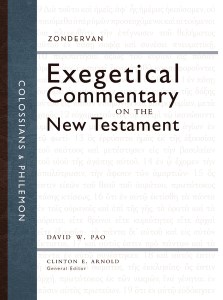
Colossians and Philemon (Zondervan ECNT), reviewed

col phil zecntI got an ad in the mail the other day for a new commentary series that claimed to avoid all the weaknesses of previous commentary series while building on their strengths. (!)

With how many good “old” commentaries there are, I think commentary users should critically examine new series, and certainly not take claims like the above too seriously. (Every commentary set has weaknesses.)

That said–Zondervan’s new Exegetical Commentary on the New Testament series is a real winner. It adds important elements to the mix that are not present in previously published commentaries. As a preacher with a scholarly interest in Scripture, I find this series to cover many bases well. It would be good for a student, professor, preacher, or even someone who didn’t know Greek and wanted to go more deeply into a given book.

I’ve (favorably) reviewed James and Luke in the same ZECNT series. Like the rest of the series, Colossians and Philemon includes the following for each passage of Scripture:

  • The full Greek text of Colossians and Philemon, verse by verse
  • The author’s English translation
    • First, passage by passage in the graphical layout
    • Second, verse by verse next to the Greek
  • The broader “Literary Context” of each passage (within the larger book)
  • An outline of the passage in its surrounding context
  • The Main Idea (this is a great focus point for preachers)
  • Structure
  • A more detailed “Exegetical Outline”
  • “Explanation of the Text,” which includes the Greek and English mentioned above, as well as the commentary proper
  • “Theology in Application” concludes each passage

The fact that the commentary has within it all the Greek and English of the two books under examination means you can take the single book (and no other) with you for thorough study of Colossians and Philemon.

Author David W. Pao makes frequent use of Greek throughout the commentary, but a non-Greek reader would also make profitable use of his comments.

Colossians has a 16-page introduction and 8-page bibliography; Philemon’s introduction is 13 pages, its bibliography 4. A “theology” section of 13 and 9 pages, respectively, concludes each book.

Regarding authorship of Colossians, Pao writes, “Among the various possibilities, to consider Paul as the author of Colossians is still the best hypothesis on which our reading can be constructed.” Like Murray J. Harris, Pao deduces this due to the various parallels (e.g., the opening greeting sections) between Colossians and Philemon, which is almost universally accepted as Pauline. He dates both letters to 60-62 AD, being written by Paul during his Roman imprisonment.

Pao is a good writer, too. This is from the introduction to Colossians, on its significance:

This letter that addresses a congregation challenged by a form of syncretism has significant contemporary application in a society in which the “virtues” of pluralism and tolerance are exalted as most important. Instead of simply pointing out the errors of the various practices and beliefs promoted by the false teachers, Paul begins and ends with an intense focus on Christ as the foundation of the believers’ existence. As a result, one finds powerful theoretical and practical outworkings of a robust Christology. In this letter, the readers encounter a detailed portrayal of the unique identity and final authority of Christ, and this portrayal enriches the high Christology found elsewhere in Paul’s letters.

This  slightly longer excerpt on Col. 3:3 shows how adeptly Pao blends lexical study with historical background in a way that incorporates today’s Christian settings… all from an appreciated doxological posture:

That this life “is hidden with Christ” is significant in a number of ways. First, the verb “to hide” (κρύπτω) can signify close association (cf. Luke 13:21), and this meaning is certainly present in light of Paul’s identification of Christ as “your life” (ἡ ζωὴ ὑμῶν). To be “hidden with Christ” reaffirms the believers’ participation in Christ’s death and resurrection as they anticipate the final consummation of God’s salvific act at the end of time.

Second, to be “hidden with Christ” necessarily implies the security that one finds in Christ. The following verse explains the purpose of this hiddenness as it guarantees the final participation of believers in the revelation of God’s glory. This security from the evil powers is also implied in the reference to their dying with Christ, an act that points to the freedom of the threats posed by the opposing spiritual powers (2:20).

Third, in light of 2:3, where Paul asserts that in Christ “all the treasures of wisdom and knowledge are hidden,” Paul is here affirming that the lives of believers are also contained in Christ. This may serve a polemical purpose as Paul argues against those who continuously seek to get access to the heavenly mysteries. Paul’s response is that believers are already hidden with all the treasures in Christ. The sufficiency of Christ cannot be challenged, and to seek for these treasures elsewhere is to betray the true gospel. 

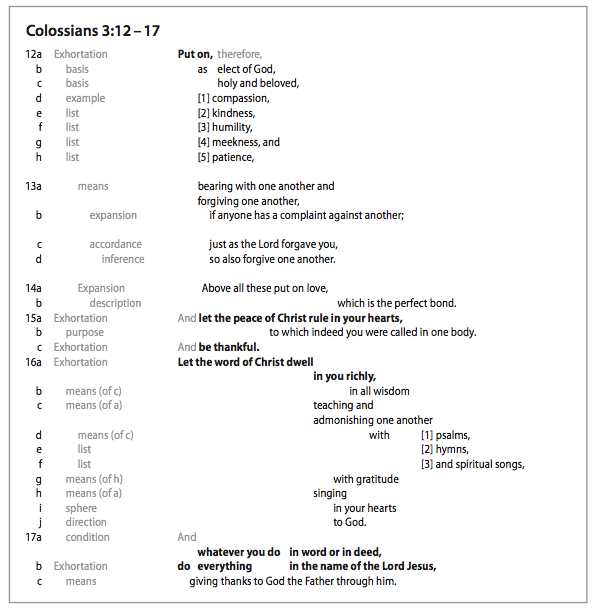
Out of all of the above features, the graphical layout is my favorite in this series and in this volume. It’s what makes the ZECNT something I’ll always reach for when preaching on a given passage–and early on in the process, too. Here’s what it looks like:

Col. 3:12-17
Col. 3:12-17

The main clauses are in bold, and subordinate clauses are indented under them. It’s easy to see, at a glance, how all the parts of a sentence and paragraph relate. The words in gray at left describe the function of each line (exhortation, expansion, etc.).

Pao is a refreshingly enjoyable writer who knows this terrain very well. Preaching or teaching from Colossians/Philemon (or even studying in depth on one’s own or with others) would be greatly enhanced by use of his commentary.

I am grateful to Zondervan for the gratis review copy of this commentary, which was offered to me in exchange for an unbiased review. You can find the book on Amazon here. The Zondervan product page is here. See a pdf sample of the book here.

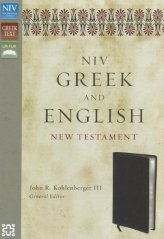
Zondervan’s NIV Greek and English New Testament, reviewed

Zondervan GNTZondervan continues to publish great resources for learning and using Biblical Greek and Hebrew. I reviewed their Greek and Hebrew Reader’s Bible here. Now they have published a “diglot,” a Bible with two languages side-by-side, on facing pages, for the New Testament.

This is also known as a “parallel Bible,” so that the reader can easily see both the Greek and English side-by-side. It’s not an interlinear Bible, though (English interspersed line-by-line with Greek), so you can easily just read all English or all Greek any time you want to. Both the Greek and English section headings are the same (in English), which makes it easy to stay on track when reading through. Each page is single column format.

The Greek text is not the scholarly NA27 or NA28 critical edition. Rather, it is the Greek text that the NIV translators agreed on as the textual basis for translation. The few times (and there aren’t a ton of instances) when this Greek text differs from the NA27, footnotes provide additional information.

Greek font preference can be subjective, but I find this one pleasing and easy to read:

Greek English

The italics are for an Old Testament quotation.

The leather/Italian Duo-Tone version has a single ribbon for marking one’s place. Its feel is pleasant and flexible, yet durable. It’s a well-made Bible.

I wondered when reading whether not having the critical Nestle-Aland Greek in front of me would be a problem, but (a) the differences are minor and (b) if one’s goal is just to read Greek (not do textual criticism), whether or not one has Nestle-Aland is not hugely important. Besides that, there are possibly places where the NIV translators have made a better textual choice than the NA folks! (We’ll find out when we get to see all the original “autographs” in heaven, I suppose.)

There is also a 146-page Greek to English dictionary included at the back (Mounce Concise) which has word frequency information, a short gloss/definition, and verse references where words are used. It’s basic, but a good dictionary, especially for quick look-ups when doing daily reading.

One advantage to this diglot over other diglots (RSV and NET versions) is that the Greek is always on the left-hand page and the English is always on the right-hand page. In these other two diglots (perhaps for ease of printing?) it changes every two pages, so that this left-hand page is Greek, this other left-hand page is English. It’s a small thing, but it makes it easier to use.

As for the English version employed, this is the 2011 NIV, the update to both the 1984 NIV (New International Version) and the 2001/2005 TNIV (Today’s New International Version). Much ink (and many bytes) have been spilled over the differences between these three and the controversy surrounding the TNIV. (Much ado about not-much, in my opinion.) The TNIV opted to be more gender-inclusive than the 1984 NIV in how it translated masculine Greek words, so “brothers” would be “brothers and sisters.” If Paul clearly has men and women in view (he often does), “brothers and sisters” is the best way to translate the masculine Greek noun. But this gender inclusivity (I prefer “gender accuracy”) displeased some, and so now the TNIV is off the shelf (as is the old NIV) with the NIV (2011) in its stead.

The 2011 NIV seems to either lean more toward the TNIV or to split the difference on gender. For example, take Galatians 1:11 in the three versions:

NIV (1984): “I want you to know, brothers, that the gospel I preached is not something that man made up.”
TNIV: “I want you to know, brothers and sisters, that the gospel I preached is not of human origin.”
NIV (2011): “I want you to know, brothers and sisters, that the gospel I preached is not of human origin.”

Here are Galatians 1:1-2. Note how the new NIV matches neither of its predecessors.

NIV (1984): “Paul, an apostle—sent not from men nor by man, but by Jesus Christ and God the Father, who raised him from the dead—and all the brothers with me….”
TNIV: “Paul, an apostle—sent not with a human commission nor by human authority, but by Jesus Christ and God the Father, who raised him from the dead—and all the brothers and sisters with me….”
NIV (2011): “Paul, an apostle—sent not from men nor by a man, but by Jesus Christ and God the Father, who raised him from the dead—and all the brothers and sisters with me….”

Rodney Decker has a thorough (and I mean thoroughreview of the new NIV here.

Although I never had the pleasure of seeing a TNIV-Greek diglot (I don’t think Zondervan published one?), this one is the next best thing. Especially for preachers and students and Greek-learners who want to stay close to the NIV, this diglot is yet another great language resource from Zondervan.

Thanks to Zondervan for the review copy. See a sample file here (pdf). You can find purchasing information about the book at Amazon or at its Zondervan product page.