
Which Bible software program should I buy? It’s an important question for the student of the Bible, especially if she or he is on a limited budget. Having now reviewed BibleWorks 9 (here), Accordance 10 (here) and Logos 4 (here) and now 5 (here), I want to compare the three programs and offer some suggestions for moving forward with Bible software.
There are some free programs available for download (E-Sword, for example), but my sense has been that if you want to have something in-depth, you’ll probably want to consider BibleWorks, Accordance, and Logos.
If you’re in the market to buy Bible software, then, here’s how I recommend proceeding.
1. Think through why you want the Bible software.
I don’t mean in an existential sense; I mean: for what do you want to use Bible software? Personal Bible study? As a means to access electronic commentaries for sermon preparation? To do in-depth word studies in the original languages? To compare the Greek and the Hebrew texts of the Old Testament? For complex syntactical searches? To help generate graphics and handouts for a Sunday School class you teach? Some or all of the above?
Similarly, are there things you know you don’t need? Are you interested only in studying the Bible in English (or Spanish, or French…) but not necessarily in Greek and Hebrew? Are maps and graphics something you can easily access elsewhere? Is having a large library of electronic commentaries not a value?
I highlight these considerations because the answer to the question, “Which Bible software program should I buy?” is: It depends. It depends on why and for what you want Bible software. More on that below.
2. Explore BibleWorks, Accordance, and Logos on their own merits.
Get a sense of what each can do by visiting their respective Websites (BibleWorks here, Accordance here, and Logos here). Look through those sites for videos which will let you see the programs in action. You can also look through the full reviews I’ve done of BibleWorks here, Accordance here, and Logos here (v.4) and here (just-released v. 5). In these reviews I look at multiple features and resources in each program.
BibleWorks is a PC program. You can run it on a Mac, though. This either requires a separate Windows license (= more $$), where it runs nicely in Parallels, etc., or you can use a “native” Mac version of it. The former option is costly and requires a lot of your Mac machine (though you get a fully-functinoing BibleWorks on a Mac that way). I can’t yet recommend the latter option, where it is in “Public Preview,” since the “native” Mac version looks only native to about two Mac operating systems ago… I expect BibleWorks will make improvements here, but I haven’t found BibleWorks on my Mac to be as functional as I’d like. It’s excellent on a PC, though.
Accordance is a Mac program. They have announced that they’ll introduce Accordance for Windows in 2013, and they have said that they are previewing that at SBL/AAR this week. (I understand that you can run Accordance on Windows now via an emulator, per the above link, but that it’s not 100% functional in the same way Accordance on Mac is.) Accordance is silky smooth–if I may call a Bible software program that. It is very Mac-like, which is a goal and priority of Accordance. Using it is truly enjoyable. Accordance also has an iOS app, which I haven’t used, as I do not own an iPhone, iPad, iOverbrain, etc. It looks like a stripped-down version of Accordance, but it’s free. If I had an iPhone, that would definitely be on there.
Logos works on PC and Macs. It’s also cloud-based, so that you can sync your work in Logos across computers, platforms, mobile devices, on the Internet using Biblia, and so on. Logos for the Mac feels fairly Mac-like, but not to the extent that Accordance does. However, being able to switch between a PC and a Mac in Logos and have everything sync via the cloud is a great feature. I noted in a Logos review recently how I was working in Logos 5 on a PC, then the next day opened Logos on my Mac to the exact same window I had just closed on a PC the day before.
3. Think about what your budget is.
You should actually probably do this before you check out the individual programs a whole lot–just to make sure you don’t end up spending money you don’t really have! Sometimes you’ll see a price tag associated with how much a base package would cost you if you bought all the resources in print. But this really doesn’t matter if you wouldn’t buy many of those resources in the first place (per point #1 above).
BibleWorks does not have packages, per se–it’s just the program and all its contents for $359. You can also purchase add-on modules in BibleWorks. Accordance has various collections (beginning with the basic Starter Collection at $49.99), which you can compare here. They sell various other products, as well. These base packages had been a little difficult to wade through and make sense of in Accordance 9, but the August release of Accordance 10 greatly simplified things. Logos also sells various base packages, starting at $294.95 retail price for their Starter package, and many other products. Note also that Accordance and Logos both offer discounts to academicians, ministers, etc.
4. Compare.
 Keep firmly in mind the purposes for which you want Bible software as you read the below. But I will offer some general insights.
Speed
BibleWorks (PC) and Accordance (Mac) take the cake here. I wrote here about the sluggishness of Logos 4 for searching. That’s improved somewhat in Logos 5. Where BibleWorks stands out is in its Use tab, new in BibleWorks 9. Via the Use tab, you can instantaneously see all the uses of a given word in an open version just by hovering over that word. I’m not aware of anything comparable in Accordance or Logos, and it’s a mind-blowing feature. Accordance, however, returns search results as quickly as BibleWorks, and starts up faster. I continue to be impressed with the speed of both BibleWorks and Accordance. I’m glad for the improvements in Logos, but hope they’ll continue to improve search speed.
Package for the Price
Had I written this post six months ago, the no-brainer answer would be that BibleWorks is best. For $359 you get everything listed here.
Comparable in Accordance is the Original Languages Collection for $299 (full contents compared here). This collection six months ago was not really comparable to BibleWorks, but with the release of Accordance 10, Accordance significantly improved on and expanded what’s available in its Original Languages Collection. Someone wanting Bible software for detailed original languages work could get a lot of what they need in Accordance for under $300. However, it remains true that you get more in BibleWorks that you have to pay extra for in Accordance (like the Center for NT Textual Studies apparatus and images, Philo, Josephus, Church Fathers, the Tov-Polak MT-LXX Parallel, etc.). That’s true compared with Logos, too.
Logos 5 is a little more difficult for me to size up here. In Logos 4 there was an Original Languages Library for $400 or so that was at least comparable to BibleWorks and Accordance (and included the 10-volume Theological Dictionary of the New Testament). Based just on package for the price, I still would have picked BibleWorks over Logos, but the release of Logos 5 has seen a restructuring of base packages that seems less than ideal for something like original language study. They do now have the Theological Lexicon of the OT and of the NT in the “Bronze” package, but the nearly $300 Logos Starter package doesn’t include the necessary and basic lexica for studying the Hebrew Bible, the Septuagint, and the Greek New Testament.
This is where what you want out of a Bible software program should dictate which way you go. Are you a seminarian with a primary interest in original language exegesis, with a preference for commentaries in print? If so, I recommend Accordance on Mac or BibleWorks on PC. Accordance also has good commentaries as add-ons (not much here for BibleWorks), but Logos has a large amount of digitized books, and tends on the balance (though not always) to run cheaper than Accordance for the same modules. (The cheapest BDAG/HALOT lexicon bundle is in BibleWorks.) But the larger library in Logos is perhaps at the expense of program speed, so you’ll want to weigh options here. If you preach weekly and don’t make much reference to Greek and Hebrew, wanting extensive commentaries instead, Logos could be the way to go for you.
Customizability and Usability
Here I favor Accordance of the three. BibleWorks is probably the least configurable. There are four columns in BibleWorks 9, but you can’t move things around much, whereas in Accordance and Logos you can put tabs/zones/resources more or less where you want them. Logos is plenty customizable, but the Workspaces feature in Accordance sets it apart from Logos. In Accordance you can save distinct Workspaces and have multiple ones open at a time. You can save “Layouts” in Logos, but from all I can see, you can only have one layout open at once. This has often slowed my study. You can detach tabs into separate windows with Logos, but for working on multiple projects at once (e.g., an NT use of the OT Workspace, an LXX Workspace, a Hebrew OT Workspace, an English Bible Study workspace, etc.), Accordance is tops.
For the record, both for my graduate studies and message preparation, Accordance is the first program I have open. Part of this is due to the fact that I prefer to use a Mac. (Within the last year I bought a cheap PC laptop just so I could keep using BibleWorks, which is still excellent.) But the multiple Workspaces option makes Accordance great for easy day-to-day use across multiple kinds of tasks. It’s been interesting to watch myself mouse over to the Accordance icon in my dock on my Mac before either Logos or BibleWorks.
Support
This is probably a toss-up. I’ve had positive interactions with everyone I’ve contacted in BibleWorks, Accordance, and Logos. All have active and helpful user forums. All offer help files and how-to videos. (BibleWorks has the most extensive set of videos.) I was surprised to see how many how-to videos and manuals you could buy from Logos, but many of these have been produced by approved third-parties. I don’t think you should have to pay more money to learn how to use a program you already paid for.
Note-taking
One thing I haven’t extensively reviewed is the note-taking features, which are available in BibleWorks, Accordance, and Logos. I particularly appreciate being able to highlight passages (which then stay highlighted every time I open that resource) in resources in both Accordance and Logos. Logos has an easier one-keystroke shortcut to highlight selected text, but there’s a delay in doing so; Accordance is faster here. But back when I was using only BibleWorks, I was concerned about saving notes in a file format that wouldn’t be accessible across computers and platforms, so all my notes were always just in Word or TextEdit (.rtf). I’ve continued this practice as I’ve begun using Accordance and Logos, so that any writing I generate is not confined within a given program.
In sum…
So, which Bible software program should you buy? It depends on why you want Bible software and the uses you’ll have for it. If you’re looking to build and access a large digital library, no one denies that Logos is the leader in that regard. It is also only Logos that connects to the cloud to sync across multiple devices. If you’re looking to really delve into the original languages, though, and do complex and fast searches, Accordance for Mac and BibleWorks for PC are preferable. (Logos 5 has offered significant improvement from Logos 4 in working closely with original language texts, but the search speed still needs to be improved.) BibleWorks gets you the most bang for your buck by including as many resources, versions, lexica, grammars, etc. as it does, but the interface and customizability of Accordance makes the latter more enjoyable and a little easier to use.
When it comes to the BibleWorks vs. Accordance vs. Logos question, I think at bottom each is a solid software program and good decision. You can’t go badly wrong with any of them. In fact, I now use all three on an almost daily basis. (Thanks again to each software company for the review copies.) But insofar as potential users may not want to have to purchase or learn how to use all three programs, I hope the above reflections are of use.
Next time…
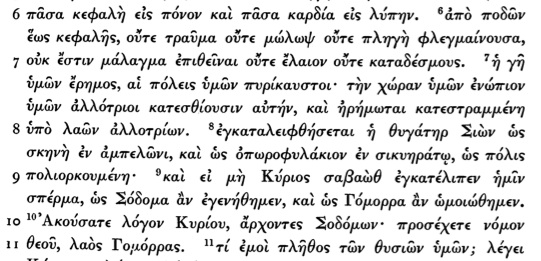
I will post one more time in the near future along these same lines. In particular I plan to compare Septuagint study across BibleWorks, Accordance, and Logos. I’ve covered this in each of my individual reviews already, but I’ll look at the Tov-Polak MT-LXX Parallel database in particular in each of the three, so you can see in more detail how each software program handles the same basic resource. In that post I will also write about more complex search features in BibleWorks, Accordance, and Logos, assessing how they compare.
(2015 UPDATE: That would-be blog post ended up as a published article in a journal of Septuagint studies. See more here.)
If you’ve made it this far (more than 2,000 words later), congratulations! Please feel free to leave me a comment or contact me if you are seriously considering Bible software and want to ask any questions about anything I’ve reviewed… or haven’t covered in my reviews.
January 2014 UPDATE: I have begun reviewing the Bible Study app from Olive Tree. You can see those reviews gathered here.




 R.R. Ottley’s Book of Isaiah According to the Septuagint (based on Codex Alexandrinus). See the archive.org site with description










 Words on the Word