The beginning of Greek Isaiah in a Year is nigh upon us. There are more than 100 people participating via Facebook, and others besides. This post compiles the reading plan, some texts of Greek Isaiah, and other resources. I’ll be adding to this post as often as I can.
The reading plan
Here it is. 5 verses a day (give or take), 5 days a week (Monday through Friday). 12/20/13 update: Here is the reading plan for the 2014 Greek Isaiah in a Year, the Sequel.
Texts of Greek Isaiah
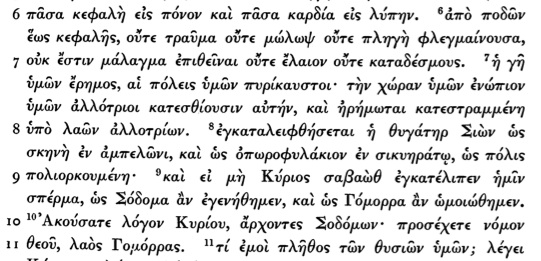
Folks in the group will be reading whatever Greek texts they have available. My initial foray into Greek Isaiah has suggested that Codex Alexandrinus (A) is a better text than Codex Vaticanus (B) for this particular book. Moisés Silva writes, “While this important manuscript [Vaticanus=B] preserves an excellent text for most books of the LXX, it is less trustworthy in the case of Esaias [Isaiah].” R.R. Ottley and Ken M. Penner, both linked below, agree. Ottley bases his work on Alexandrinus, writing, “In the Book of Isaiah… it is thus quite allowable to suggest that B falls below its usual standard, relative or absolute.”
Without further ado, then, some texts to consider, and where to find them:
 Isaiah in Rahlfs LXX (German Bible Society, eclectic/critical text). Find it free, legal, and online here. Note that due to copyright restrictions I cannot post the Rahlfs text myself publicly, but you can access the whole thing from the site above. The Rahlfs edition has been called “semi-critical,” so that the textual notes in his apparatus are not extensive. But he does not base his text only on one manuscript.
 R.R. Ottley’s Book of Isaiah According to the Septuagint (based on Codex Alexandrinus). See the archive.org site with description here. Or download a compressed pdf (17 MB instead of 57 MB) here from my site. (Thanks to Jim Darlack for combining both volumes 1 and 2 into a single pdf!) Volume 2 has the full Greek text with Ottley’s notes in an apparatus. This commentary is a gold mine of information about the Greek text, the Hebrew it translated, and more.
Isaiah in Swete’s edition (based on Codex Vaticanus). That’s here.
Isaiah in the NETS (New English Translation of the Septuagint), with an introduction by Moisés Silva. This is the leading English translation of the Septuagint. Find the pdf of Isaiah with intro here.
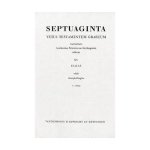 The Göttingen edition of Isaiah. Whereas everything above is available for free online, Göttingen is not. It’s here on Amazon (affiliate link) and here at the publisher’s site. It’s not cheap, but you may be able to find a used edition somewhere. This edition, edited by Joseph Ziegler, is also available from Accordance Bible Software as a single volume here, and from Logos Bible Software as part of a larger collection here. (If it’s Göttingen you’re using, I’ve begun a short primer on how to read and understand the Göttingen editions, their apparatuses, etc.)
More resources for Greek Isaiah
Ken M. Penner, who is writing the Isaiah volume for the Brill Septuagint Commentary series, graciously shared some of his notes with the Biblical Greek Forum last year. See here and here for detailed notes and discussion.
Do you like vocabulary? Like it or not, Septuagint vocabulary is more expansive than New Testament vocabulary. Here is a list (pdf) of all the words in Isaiah that occur 100 times or less in the Septuagint, sorted by frequency. Here is that same list sorted alphabetically. My friend, co-worker, and fellow churchgoer M. Ryan has put the vocabulary list into Quizlet.
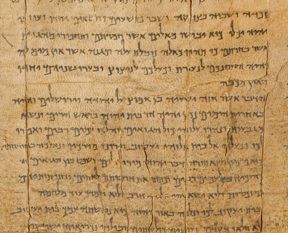
The Great Isaiah Scroll (1QIsaa) from the Dead Sea Scrolls is available online for viewing. When you hover over a part of the scroll, an English translation pops up. The scroll is in Hebrew, and is close to the Masoretic Text (MT) of Isaiah, which you can access here, if you want to look at the Hebrew of Isaiah at any point.
Did I miss anything? Please let me know in the comments, and I’ll keep this page updated. Happy reading! Before Monday I will post again with the coming week’s schedule and text.

 If you’re looking for a Bible reading plan for 2013, here’s a simple one (pdf) that takes you through the New Testament six days a week, at the rate of about a chapter a day. Logos 5 generated the reading plan for me.