Basics of Biblical Aramaic

This textbook is a great one. I’m amazed at how much Aramaic it helped me pick up in just a long afternoon and evening. What follows is my review of Miles V. Van Pelt’s stellar text, Basics of Biblical Aramaic. It’s a winner!

Basics of Biblical Aramaic (BBA hereafter) is a “Complete Grammar, Lexicon, and Annotated Text.” I’ll review each of these components in turn.

Scope, Aim and Audience

BBA seeks to include “everything you need to learn biblical Aramaic” and is “designed for those who already have a working knowledge of biblical Hebrew.” This is a fair expectation, since most students of Aramaic only come to Aramaic having already had Hebrew (and often Greek, too). This allows Van Pelt to use Hebrew as a springboard for Aramaic throughout the book, which he does to great effect. He writes “for those students who desire to study, teach, and preach faithfully from those portions of the Bible that appear in Aramaic.”

I write as a member of Van Pelt’s target audience. I’ve had (more than) a year of Hebrew but no Aramaic to date.

Grammar

Van Pelt divides the grammar into the following sections:

  • Phonology, in which he introduces the Aramaic alphabet, vowels, and syllabification
  • The Nominal System, in which he covers nouns (absolute, determined, and construct states), conjunctions, prepositions, pronouns and pronominal suffixes, adjectives, numerals, adverbs, and particles
  • The Verbal system, in which he covers the simple Peal stem in all its conjugations (perfect, imperfect, imperative, etc.), followed by the derived stems in their multiple conjugations
  • Six pages of quick-reference Charts and Paradigms

Here is a sample pdf of the Table of Contents and first few chapters. In the book’s layout and in many other ways, BBA is like Van Pelt’s Basics of Biblical Hebrew (BBH), which he co-authored with Gary D. Pratico.

As with BBH the typical chapter layout of BBA is grammar followed by vocabulary. And in this case, since the workbook is essentially included in the text, chapters close with exercises. There is no answer key included, but the book lists the site from which it can be downloaded.

Van Pelt classifies verbs according to the “Peal” stem and its derived stems–also explaining alternate verbal terminology (G-stem, etc.). As he explains the various conjugations, he keeps aspect firmly in mind:

The incomplete (or imperfective) aspect of the Imperfect conjugation is well suited for describing present and future actions and so a present or future tense English translation is common with this verbal form. However, it is important to remember that that imperfective aspect of the imperfect conjugation may refer to actions in the past, present, or future….

One of Van Pelt’s aims in this textbook is “pedagogical sensitivity,” which he notes has not always appeared in Aramaic grammars. (He may have this one by Alger F. Johns in mind, which, good as it is, is not as user-friendly.) He succeeds immensely in this regard. That Van Pelt is a professor in an actual classroom is on display throughout the text; his tone is warm and even encouraging in many places. Each chapter concludes with a “Before You Move On” section, which helps the reader distinguish between things he or she needs to commit to memory and what he or she can leave for future reference.

Van Pelt’s grouping of vocabulary also exhibits “pedagogical sensitivity.” Initial lists have vocabulary that is similar or identical to Hebrew, so that an Aramaic student can get a quick jump on vocabulary acquisition. Van Pelt groups several lists according to semantic domain and also parts of speech. This is merciful to the students who will work their way through BBA (and good pedagogy). He includes all Aramaic words occurring four times or more in the OT, which constitute 91% of the text.

Lexicon

The lexicon is a comprehensive one that includes every Aramaic word occurring in the OT. Van Pelt bases the definitions/glosses on HALOT. There are definitions for different stems of each verb, too. There are no word frequency counts, either here or in the vocabulary lists. (Basics of Biblical Hebrew has frequencies in the vocab lists at the end of each chapter, one of its great features.) However, this may not be as essential as in Hebrew, since the Aramaic corpus in the OT is smaller. Van Pelt does include frequency statistics for many prepositions, conjunctions, adverbs, particles, and stems as he introduces them throughout the text.

Annotated Text

This is the best feature of an already great textbook. In the same way that Van Pelt and Pratico’s Graded Reader of Biblical Hebrew helps the student to really dig into the text, the Annotated Text in the back of BBA allows the student to put his or her new knowledge of Aramaic into practice. Every OT verse and passage in Aramaic is included: Genesis 31:47, Jeremiah 10:11, Daniel 2:4b-7:28, Ezra 4:8-6:18, and Ezra 7:12-26. The footnotes link back to specific chapters and sections of the text, and Van Pelt includes detailed morphological and lexical analysis of various words.

Further reflections

I have only two (minor) critiques of this textbook, which are as much as anything hopes for small adjustments that might be made in a future printing or edition of this book.

First, there is little about Aramaic in its Northwest Semitic context. This isn’t an oversight; Van Pelt says his grammar is not “written for Aramaic scholars or for students interested in comparative Semitic grammar.” Instead he wants to help produce a “working knowledge” for those who will “study, teach, and preach faithfully” from the Aramaic portions of the Bible. Fair enough. And he does allude to further discussions of Aramaic as a language in his footnotes. But as I imagine myself teaching and preaching Aramaic portions of the Bible, I think it would be helpful to know something of Aramaic’s context and development, to explain to my congregation. This could simply be a few paragraphs in a future edition.

Second, the verbal diagnostics Van Pelt highlights (using “the identification of distinctive verbal features unique to a group of related verbal forms”) are explained in the individual chapters, but not color-coded in the paradigm charts. They are given in red in the Hebrew textbook Van Pelt co-authored, and this was one of the most useful parts of that book–it really aided in learning the paradigms. Van Pelt does explain what diagnostics to look for, but I’d love if a future edition or printing could color-code the vowels/consonants that constitute the various verbal diagnostics. (UPDATE: I had thought that perhaps the lack of color in verbal diagnostics was a print cost issue. I’ve now been able to confirm that there will eventually be an electronic release of the grammar with color.)

Also, though this might be asking a lot of a single text, I found the English to Hebrew composition exercises in the BBH workbook to be a great way to improve my Hebrew. Perhaps supplemental composition exercises could find their way onto Van Pelt’s site in the future?

I initially thought a $45 retail price was steep for a paperback. But considering that this includes a grammar text, workbook exercises, a comprehensive Aramaic lexicon, and an annotated text of all the Aramaic in the Old Testament… it’s actually reasonable. In the Hebrew and Greek equivalents to this textbook, the text, workbook, and set of annotated readings are all separate volumes. This was a good move on the book’s part, I thought, and makes it easy to refer to it time and again as a one-stop shop for Aramaic acquisition and development.

What stands out most to me about Basics of Biblical Aramaic is the very-nice-to-have Annotated Text at the back with all the Aramaic OT passages. And another standout feature of this text is that Van Pelt truly does display “pedagogical sensitivity” throughout the text. Who would have thought an Aramaic textbook could have such a conversational tone without sacrificing thoroughness and good pedagogy?

Five stars. I imagine this textbook will become the standard in seminary and upper-level college courses where students learn biblical Aramaic.

My thanks to Zondervan for the review copy of this textbook. Find it here on Powell’s or here at Zondervan’s product page.

James (Zondervan ECNT), reviewed

James is no “epistle of straw,” as Martin Luther once (in)famously said of the book. But many–with Luther–find it difficult to reconcile Paul and James on faith and works.

Paul: “A person is justified by faith apart from works of the law.”

James: “A person is considered righteous [i.e., justified] by what they do and not by faith alone.”

Here I review James by Craig L. Blomberg and Mariam J. Kamell, from Zondervan’s Exegetical Commentary on the New Testament (ZECNT) series. (Click here to find my review of Luke in that same series; below I use some of my same wording from that post to introduce the ZECNT series more generally.)

Like the rest of the ZECNT series, James is “designed for the pastor and Bible teacher.” The authors assume a basic knowledge of Greek, but Greek is not required to understand the commentary. For each passage the commentary gives the broader literary context, the main idea (great for preachers!), an original translation of the Greek and its graphical layout, the structure, an outline, explanation, and “theology in application” section.

The introduction covers an outline and structure of James, the circumstances surrounding its writing, authorship and date, and significance of the book. It is shorter and less detailed than the introductions in Douglas Moo’s James commentary and that of Peter Davids. Immediately I looked for how the authors would resolve the Paul/James (alleged) discrepancy, but they note in the introduction that they discuss James’s theology after “the commentary proper.” (The ZECNT series has a separate “Theology” section at the back of the book that most other commentaries include as part of the introduction.)

They give just two paragraphs in their theology section–with a bit more in the body of the commentary–to “Faith and Works” (compare Moo’s lengthier discussion in his introduction), but they have their reasons for this:

Contrary to what the extent of the discussion of the topic might suggest, faith and works is not the main focus of James’s letter. It is a subordinate point that grows out of his concern for the poor and the dispossessed (2:14-26; cf. 2:1-13).

I’m a little embarrassed to admit that this idea of faith and works as a subordinate point in James had not really occurred to me prior to working with this commentary. (A good trait in a commentary to produce such thoughts!) But if you click on the references above or look through James 2 (and the rest of James) in your Bible, it’s easy to see where the authors are coming from.

In fact, the “three key topics” in James, according to Blomberg and Kamell, are “trials in the Christian life,” “wisdom,” and “riches and poverty.” They follow Davids here, and note that James 1:2-11 lays out each of the major themes, which James then restates in 1:12-27. 2:1-5:18 then consist of “the three themes expanded,” in reverse order, followed by a closing in 5:19-20.

Blomberg and Kamell are “the first to grant that we may still be imposing more structure on the text than James had in mind.” All the same, their outline of James makes it easier to work through the book, and then finally does, I think, justify their claim in the theology section that “faith and works” is not the central theme of the letter and should be considered in its broader context. Still, they do have a good way forward in understanding Paul and James together: “But this action, these deeds or works, are not put forward in any attempt to merit God’s favor but as the natural, spiritual outgrowth of one’s faith.”

As with Luke, the graphical layout of each passage (in original English translation) is a unique contribution in James. Being able to see main clauses in bold with subordinate clauses indented under them (plus how they relate back to the main clause) gives the reader a quick, visual grasp of the entire passage at hand. See page 45 of the commentary in this sample pdf to see how it looks. This is a highlight of the ZECNT series, and the fact that it’s in English makes it all the more accessible. The translation is smooth and readable, doing great justice to both the Greek it translates and the English language.

James has the full Greek text of James, verse by verse, and the full English translation (passage by passage in the graphical layout, then again verse by verse next to the Greek). As I’ve said before, a value for me in using reference works is not having to pull five more reference works off the shelf to use the first reference work! The authors make comments like this one in 1:5 throughout the work, wedding grammatical and lexical analysis to exegetical application:

We are told to ask of the “giving God” (διδόντος θεοῦ). Here the present participle suggests that “giving” represents a continuous characteristic of God.

To take another example, on James 2:20, which they translate, “Do you want to know, O empty person, that faith without works is workless?” they write:

James incorporates a pun on the word “work” (ἔργον), using the negative adjective from the same root–“workless” (ἀργή). The term can also mean idle or useless. Faith that lacks works does not work! In other words, it is entirely ineffective to save.

Teachers and preachers especially will appreciate the “Theology in Application” section that concludes each passage. James may already strike the preacher as a book that just preaches itself, but the authors do well in helping the preacher connect the text with today’s concerns. For example, for 2:14-17 they note that although James

provides no treatise on the most effective ways to help the poor…, true believers will take some kind of action. At the very least, they must cultivate generous, even sacrificial giving to help the poor as part of their ongoing personal and corporate stewardship of their possessions. But in light of systemic injustice, we probably need to do much more.

Amen. The authors go on, “James certainly would share the concern of liberation theologians to do far more for the poor, individually and systemically, than many branches of recent Christianity have attempted” (my italics). Moo agrees–though he wants to distance himself “from an extreme ‘liberation’ perspective,” he says “we must be careful not to rob his denunciation of the rich of its power.” And James 5:1-6 are pretty damning of the powerful rich who use their power to oppress the poor.

The authors write,

[These oppressors] are the financially wealthy in a world where the rich occupied a miniscule percentage of the population. James does not call them to change their behavior. Instead, he warns them of impending disaster in their lives by commanding them to mourn their coming fate. …”Wail” [ὀλολύζοντες] appears in the LXX of the Prophets in contexts of judgment and can refer to inarticulate shrieks of terror. …James makes it clear that these rich people are going to undergo a terrible ordeal.

There were a few times in the “Theology in Application” section that I wondered (as other reviewers have) whether the authors weren’t getting a bit off-topic from the text. For example, on 3:9-12 they say,

Abortion and euthanasia offend God deeply because they take lives made in his image. But abuse or neglect of the poor and outcast (including the homosexual) proves equally offensive because such treatments likewise demean individuals God made to reflect himself.

They say this to argue against the “stereotypical agendas of both the political and religious ‘right’ and ‘left,'” but it was hard for me to decide whether this was a case of applying an ancient text well to a contemporary set of issues, or if it was an anachronistic stretch. Nothing they say here is incongruent with James, but I did wonder here (and in another place) whether those verses in James really speak to issues like abortion and homosexuality. A minor critique, though.

Those working their way through the Greek of James may still want to have Davids on hand. But as with the Luke volume in this series, the combination of close attention to the Greek text with contemporary application makes James a commentary very much worth using. I know I will want to go back to this commentary right away when I am doing work with the book of James in the future.

(I am grateful to Zondervan for the free review copy of this commentary, which was sent to me with the understanding that I would then write an unbiased review. You can find the book on Amazon or at Zondervan.)

And God planted a garden…

[R]econciliation has too often been discussed in Christian circles as if it took place in a vacuum, as if only people and not trees, rivers, mountains and farms are swept up in God’s redemptive drama. Our aim, then, is to point our attention back to the land, to say what a faithful life on it might look like, and to show that the land–indeed, the entire cosmos–is inextricably bound up in God’s salvation through Jesus Christ (see Col 1:20).

–Fred Bahnson & Norman Wirzba in Making Peace with the Land

The newest offering from IVP Books’ Resources for Reconciliation series is Making Peace with the Land: God’s Call to Reconcile with CreationThe Resources for Reconciliation series pairs a practitioner with an academician, who then together address the theology and practice of reconciliation in a given sphere of life. The first book in the series, Reconciling All Things, profoundly influenced my development of a Biblical theology of justice and reconciliation.

Practitioner Fred Bahnson is an agriculturalist and writer (and excellent theologian); academician Norman Wirzba is a theology professor at Duke Divinity School (and grounded practitioner). Making Peace with the Land makes the Biblical case that “redemption is cosmic,” and so extends to the whole created order, not just humanity. God wants all creatures (“human and nonhuman”) to be “reconciled with each other and with God.” In other words, our Biblical theology of reconciliation is anemic if it does not extend to a loving stewardship of the whole of God’s creation. The authors warn against “ecological amnesia.”

Our “ecological amnesia” is at its core a theological issue. God is God of the soil, a gardener who loves the soil and brings forth life through it (as noted in Genesis). But we have worked against the land in developing systems and structures for farming that draw heavily on “our own agricultural scheme” and “monocultures of annual crops.” Instead we need to “look to nature as a model for how to practice agriculture,” engaging in what Bahnson calls regenerative agriculture, founded on the truth that “the ecosystems in which we find ourselves–created by God and deemed ‘very good’–are far more adept at growing things than we are.” The profile in chapter 6 of the work of ECHO (Educational Concerns for Hunger Organization) both astounded and inspired me. (Check out ECHO here.)

Bahnson and Wirzba are compelling: “Surely it is a contradiction to profess belief in the Creator while showing disregard or disdain for the works of the Creator’s hands.” After reading a lengthy description of how Chicken McNuggets are made, I was about ready to become a vegetarian. Regardless of how the phrase “animal rights” makes you feel, animal torture is not possibly justifiable by those who have been called to co-steward the creation with God.

At times I desired more exegetical nuance when the authors dealt with Scripture. For example, though the prologue is convincing enough that we ought to view God as gardener, to accept that God’s gardening work is “the most fundamental and indispensable expression of the divine love that creates, sustains, and reconciles the world” is difficult for me to… well… reconcile with the expression of divine love on the cross. In the end, it’s all of the above. That said, Bahnson’s note on the acacia tree in Isaiah 41:18-19 as a nitrogen-fixing tree and thus “divine agroforestry advice” was awesome. And the authors do affirm elsewhere that reconciliation begins with the person and work of Jesus–it is in Jesus that all things hold together, as they point out from Colossians 1.

Many of us practice “a sort of gnostic disdain for manual labor, soil husbandry, caring for physical places and living within our ecological limits.” If I make enough money to simply buy food, I don’t need to get close to that food except to pick it up at the store (or restaurant!). Then I eat it and keep going with my work, however disconnected I may be from the source of that food. However,

Reconciliation with the land means learning to see the land as part of God’s redemptive plan and acknowledge God’s ongoing presence there. That will require putting ourselves in proximity to the land and staying there long enough to be changed.

After reading this book, I’m unsettled. I’m a lot farther from “the land” than I perhaps should be. I’m not sure what to do with that. And my theology of reconciliation has often not been robust enough. But I’ve been thinking more about my food, its sources, and my connection to God’s land now that I’ve read Making Peace with the Land. I’m not suggesting that we engage carbon offsets as a solution. (Slight detour: does this not look eerily like indulgences?)

But if I’m unsettled, I’m also inspired. What if I allowed my having been reconciled with Christ to inform a ministry of reconciliation not limited to other people? What if we followed Wirzba’s advice to allow our weekly “Eucharistic eating” to “not only transform the eating we do with people,” but to also transform “the entire act of eating, which means [changing] the way we go about growing, harvesting, processing, distributing, preparing and then sharing the food we daily eat”?

That would be an abundant life.

Thank you to IVP for the free review copy, in exchange for an unbiased review, and–as it turns out–a re-examined life. Find more about Making Peace with the Land here (IVP) or here (Amazon). Highly recommended.

Review of Malachi (Baylor Handbook on the Hebrew Text), part 2

In this post I both explain the jarring Malachi 2:3-4 as well as offer part 2 of my review of Malachi: A Handbook on the Hebrew Text by Terry W. Eddigner (Baylor University Press, 2012). Part 1 of the review is here.

Eddinger begins each passage with his own English translation, then analyzes the Hebrew text verse by verse. Any reader will appreciate that Eddinger prints the full Hebrew text of a given verse, then reprints the various clauses and words when commenting on them. (This eliminates the need to constantly refer to another book when using Malachi.) The Hebrew font is large, clear, and easy to read. It’s fully pointed and includes the Masoretic markings that one would find in the BHS. Though at first I had wished to see the English translation verse-by-verse alongside the Hebrew, Eddinger’s decision to have English translations primarly at the beginning of a passage does force the reader more into the Hebrew itself. For the intended audience of “a second-year Biblical Hebrew student” whose focus is translation, grammar, and syntax, this is a good thing.

I was pleasantly surprised to see that Eddinger discusses textual variants throughout the handbook. He especially focuses on LXX/Septuagint variants that receive attention from the BHS editors. His conclusions regarding variants often end with something like, “X makes sense in context and so should be retained.” Thoroughgoing text critics may be left wanting more evaluation or interaction with variants than this (as I was at times)–but this is a short handbook. The fact that the author highlighted such variants at all was an added bonus, as far as I’m concerned.

Eddinger gives excellent attention to grammatical and syntactical detail–down to an assimilated dagesh lene (1:13)! He treats clauses as wholes–for example, highlighting word order and fronting for emphasis. And he treats individual words and parts of speech. He never loses the forest for the trees, and he gives the trees their due attention, too. In conjunction with the “key words” chart at the beginning of a section and the appendix of all Hebrew words in Malachi, Eddinger often notes rare Hebrew words as such, giving something of their context in the rest of the Hebrew Bible. He seems to have HALOT, TDOT, BDB, and other technical commentaries readily at hand as he comments on the text. On 1:14 he writes,

נוֹכֵל is a rare word in the Masoretic Text, occurring only four times (only here in Malachi) and means “one who acts cleverly” or “deceitfully” thus, “a cheat.”

That is the sort of insight I could come to expect on a regular basis by the end of the handbook. I loved it for that.

In terms of grammar, his discussion of individual words includes syntax and morphology, with every single word parsed / morphologically analyzed and often more detail than that. Eddinger uses the qatal and yiqtol verb classification system. This may not line up with what every Hebrew student has read regarding tense/aspect in their first-year Hebrew class, but it does (at least according to some) carry significant advantages over “perfect” and “imperfect.” (See a mini-primer on the Hebrew verbal system here.)

Regarding the verses from Malachi with which I led off part 1 of this review, Eddinger explains them well:

פֶרֶשׁ refers to the contents of the bowels of sacrificed animals, which the priests were to burn as refuse at a location away from the altar (Exod 29:14; Lev 4:11; 8:17). The phrase [feces upon your faces] is a double entendre in meaning as the act is an act of humiliation and contact with the ‘unclean’ matter makes the priests ‘unclean’ for their priestly duties.

(I allude more to Malachi 2:3 here.)

I’ve found Malachi to be an indispensable companion for reading through Malachi in Hebrew. I do have one minor critique and one larger one, though.

First, the English Bible versification at the end of Malachi gives the book four chapters; it is just three in the Hebrew text. Malachi nowhere notes this (although it does note regarding the last three verses that “some LXX texts have these verses reordered.” Again, this is a handbook on the Hebrew text, but a simple explanatory note here as to why English Bibles have four chapters in Malachi and Hebrew Bibles three would have been beneficial.

Second, I found myself often distracted (though I didn’t want to be) by the presence of typographical errors or comma splices or run-on sentences. I hope future printings can correct these, since they take away from an otherwise great book. There would be no benefit in listing typos here, but there were some 20 or more spots where either a word was misspelled, there was disagreement of number between verb and subject, punctuation was missing, and so on. Fortunately the vast majority of these are in English and so easy enough to spot. (I.e., the reader can trust the Hebrew here.) But the author’s English translation sections especially seemed to be in want of a closer edit. I do hope future printings or editions can make adjustments here; I imagine students of Malachi will want to make use of this book for years to come.

Eddinger in the end is a worthy guide through the Hebrew of Malachi. The prophets often (suddenly!) shifted pronouns or speakers or subjects in their writing. Who is talking now: God, the prophet, both, or the people? Eddinger coolly walks the reader through such grammatical challenges, and others besides.

While the obvious use of Malachi is as a reference work in which to look up a given passage, it reads well as a whole, too. I eagerly await future books in the Baylor Handbook on the Hebrew Bible series.

Thank you to Baylor University Press for providing me a free copy, in exchange for an unbiased review (which ends up being a two-part review in this case–by my choice). You can find the Baylor product page for Malachi: A Handbook on the Hebrew Text here. It’s on Amazon here.

Review of Malachi (Baylor Handbook on the Hebrew Text), part 1

“Because of you I will rebuke your descendants; I will smear on your faces the dung from your festival sacrifices, and you will be carried off with it. And you will know that I have sent you this warning so that my covenant with Levi may continue,” says the Lord Almighty.

–Malachi 2:3-4 (NIV)

Although Words on the Word has since taken fuller shape, two primary motivations in my beginning this blog were (a) to read and review good books and commentaries and (b) to interact with the original Biblical languages. This post offers a good opportunity to do both. Here I review Malachi: A Handbook on the Hebrew Text by Terry W. Eddigner (Baylor University Press, 2012).

The Hebrew prophet Malachi holds a significant place in the Hebrew Bible. Malachi is the last prophet of the Book of the Twelve (minor prophets) and the last book in the Hebrew Bible/Old Testament. The last two verses of Malachi are Yahweh’s promise to send the prophet Elijah–a promise fulfilled, Christians believe, by John the Baptist. It sets up the beginning of the Gospels well.

The Baylor Handbook on the Hebrew Bible series is a deliberately unique contribution to the field of commentaries on the Hebrew Bible. Okay, I suppose all commentary series intend to make unique contributions, but this one really does. It fills a void. Although the student of the Hebrew of the minor prophets is fortunate to perhaps be able to access Baker’s fine exegetical commentary (Malachi is in this volume), there is still a dearth in general of OT commentaries that comment extensively on the Hebrew text and grammar. In that sense I’ve been happy to see the careful attention this series gives to the Hebrew text. (Bonus: this book and some the others in the series that I’ve briefly glanced through give good treatment of discourse analysis.)

It’s important to note from the outset that Malachi (as a book in this series) is not a “full blown commentary.” It’s a “Handbook on the Hebrew Text,” which does “not attempt to replace the second step of consulting commentaries and secondary literature….” In keeping with this aim, Terry W. Eddinger gives the reader a short (five pages) introduction, yet it is plenty to be able to work well within the Hebrew text of Malachi. (And a bibliography with references throughout points readers in the direction of other Malachi-related literature.) Eddinger especially emphasizes the structure and “literary forms and devices” in Malachi. He views the structure of Malachi as consisting of a superscription, six oracles, and two appendices. Literarily, Eddinger says, Malachi is a prose and poetry hybrid, “perhaps the best example of such in the Hebrew Bible.”

There is a linguistic glossary at the back of the book, so when Eddinger says, “Hortatory style is the predominate literary form and is found in all but two verses,” the uninitiated reader can quickly determine that hortatory means “a word, clause, or sentence of direct dialogue.” This is perhaps an over-general or vague definition (the Jonah book in this series has, “Hortatory discourse is meant to exhort someone to act in a particular manner”), but I found that not to be the norm for the succinct and useful glossary.

One commendable feature is the “key words” chart at the beginning of each oracle. Malachi is the first book in this series to offer such a feature. Eddinger highlights important words that the reader will want to know as he or she makes his or her way through a pericope. Then–in what was my favorite part of this book–Eddinger has a chart at the back of the book that lists every Hebrew word in Malachi and verse references for all its occurrences. (Future printings or editions of this book could soup up this chart even more with English glosses of the Hebrew words, for the purposes of vocabulary acquisition.) Several times in making my way through Malachi and this handbook, I referred to the Hebrew word chart.  A second appendix lists all the times the “divine messenger formula” (e.g., אָמַר יְהוָה צְבָאוֹת) occurs in Malachi.

Eddinger begins each passage with his own English translation, then analyzes the Hebrew text verse by verse. In part 2 of this review (to post Monday), I’ll look at the guts of Eddinger’s handbook, that is, the verse-by-verse exposition, including his explanation of the verses that led off this post.

UPDATE: Part 2 of the review is here.

Thank you to Baylor University Press for providing me a free copy, in exchange for an unbiased review (which ends up being a two-part review in this case–by my choice). You can find the Baylor product page for Malachi: A Handbook on the Hebrew Text here. It’s on Amazon here.

My 4-year-old son reviews The Jesus Storybook Bible

A long-time family favorite has been The Jesus Storybook Bible (subtitle: Every Story Whispers His Name). Friend and fellow blogger Robbie and his wife gave us this sweet gift when our now four-year-old was born.

Following on the heels of his first book review, my four-year-old here reviews The Jesus Storybook Bible. (Cool thing: the author of the book he reviewed blogged about it here.) As before, I did the typing, but the words below are all his. For the purposes of this review, he focuses on “The terrible lie: Adam and Eve lose everything, from Genesis 3.”

This story is about a snake, and the two people that God told them not to eat the food on that tree… and they did. And a big lie–a really, really, really, really big lie–came into the world. And then it felt like everything was going to break. And I even know that story.

God had to send them out of the garden, because they were being naughty. God sent them away. God gave them a note that said that they were going to get back to their place. God said he was going to forgive them.

It’s wroten [written] good. This book has a bird on it. And bats might come into the house and might like the book, just in case if they come in the house. [Editorial note from dad: four-year-old son just saw a news story about bats.] It’s a good book. It could help somebody if they were crying, and if they were sad, and nothing could work… except only if a book could work, and only if someone said Jesus StoryBible Book and they could buy it.

Here’s a sample page of the Bible, from Zondervan’s product page (click for larger):

There’s a great accompanying website for The Jesus Storybook Bible, with sample pages, audio files from the audio version, and more. You can also find the book on Amazon.

The Verse Tab: Review of BibleWorks 9, part 2

I continue to be impressed with BibleWorks 9. The new Use Tab is likely my favorite new feature (I posted about it in part 1 of my review). The Verse Tab is another new feature. Here’s how the BibleWorks site describes it:

The Verse Tab tracks with any Bible version. For the current verse under the mouse, it displays the relevant sections in resources such as the CNTTS apparatus, the NET Bible textual notes, the Tischendorf apparatus, Metzger’s Textual Commentary (requires unlock), and the ESV Study Bible (requires unlock).

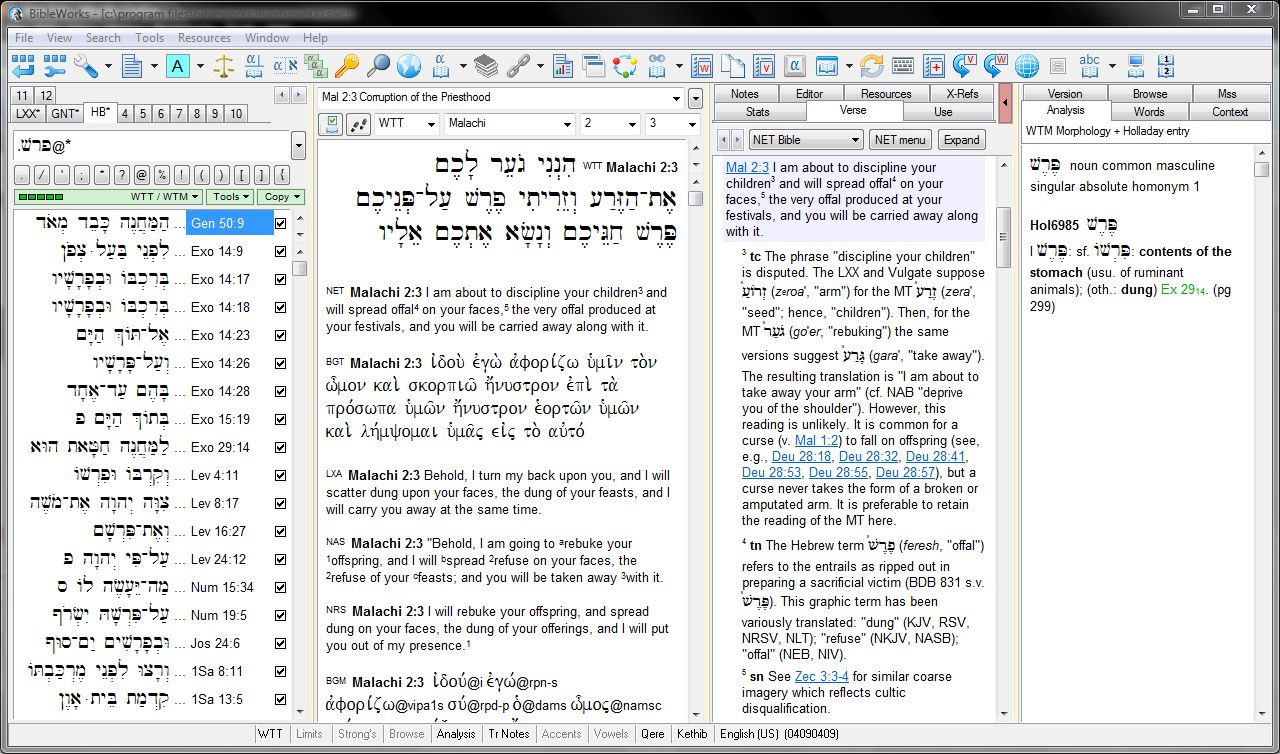
I will devote a future post to the CNTTS apparatus. Today I want to comment on and review the Verse Tab and its usefulness. Just so you can have a visual of what I’m working with, here’s a layout I’m currently using to look at the Hebrew of Malachi. (Click on the image below for larger.)

(Editorial note. File this under: can you believe that’s in the Bible? I had somehow never noticed this verse until the other day… thou shalt not trifle with the Lord, especially if you’re a priest or pastor. Take obedience to God seriously.)

Here’s the great thing about the Verse Tab. In previous versions of BibleWorks, the NET Bible study notes were only available via the Analysis Window. But this meant that if the Analysis Window were open to an NET study note, you couldn’t also at the same time easily see morphological analysis and lexical data–it was one or the other in that window. Now, however, as you can see above, you can easily access both study notes and a separate analysis window for individual word analysis. I find this new feature an immense help.

The NET study notes are fantastic. (It’s worth reading more about that translation and its notes here.) Honestly, a verse like the one I’ve chosen to highlight above might be a bit jarring to some–although in context it makes perfect sense. Yahweh was dealing with a corrupt and complacent priesthood. They were not making sacrifices in the way he had commanded (and they knew it, too). So his response in context really ought not to be a surprise. The NET note (see superscript number 4 and “tn” in the image above) clarifies that Yahweh is speaking of the entrails of to-be-sacrificed animals. The priests were supposed to dispose of these away from the sacrificial altar, but apparently were not in Malachi’s time. Bad idea. Clicking on Lev. 4:11 in the BibleWorks Search column (far left column) immediately takes me to the verse that explains this requirement.

One other neat thing about the Verse Tab: if you click on the “Expand” button, you can get a free-floating window that shows you all the NET notes for the whole Bible. This is easy to navigate through, as you can imagine:

I welcome the Verse Tab as an addition to the BibleWorks program. I’ve already made heavy use of it and will continue to in the future. For a mere $20 you can buy a module that gives you the notes and maps from the ESV Study Bible in that same tab. The program comes with the NET Bible notes already loaded.

See all that’s new in BibleWorks 9 here.

I received a free upgrade to BibleWorks 9 in exchange for an unbiased review. See my prolegomenon to a review here and part 1 (setup and layout) here. You can order the full program here or upgrade here. It’s on Amazon, too.

What language did Jesus speak?

In my top 10 reasons why you need the Septuagint I conclude with the #1 reason being that the Gospel writers record Jesus’ words as occasionally matching the Old Greek of the Hebrew Bible against the Hebrew. This has become a new research interest of mine, and there is no lack of scholarly opinion on the issue! It’s hard to tell if there’s scholarly consensus. The conventional wisdom seems to be that Jesus spoke Aramaic and read from and recited Hebrew scrolls, but that’s certainly not a universal view, from what I can tell. For example, Stanley E. Porter suggests:

… Jesus not only had sufficient linguistic competence to converse with others in Greek but also even to teach in Greek during his ministry. 

I believe that, first, it can be firmly established that Jesus did speak Greek and that we do indeed have some of his actual words. 

Porter explores the question “Did Jesus Ever Teach in Greek?” here (pdf). Thanks to the LXX Yahoo! group for the link.

Septuagint Sunday: I Heart Maccabees


I’d give away half a bookshelf worth of books to see Mark Wahlberg or Matt Damon star in a film adaptation of 1 Maccabees. Judas Maccabeus (“Hammer” will be his nom de film) and his Hasmonean family drive out imperial powers and call the Jewish people back to faithful observance of the Torah. They do it with great violence, against all odds. (This would be an action movie, and not for small children.)

Here’s how Jonathan A. Goldstein, in his 1 Maccabees Anchor Bible commentary, begins his introduction. Try to call to mind that deep male voice that does movie trailer voice-overs:

The faithful Israelite living in Judaea under the rule of the Ptolemies and the Seleucids in the third and second centuries B.C.E. learned from childhood that the LORD’s chosen people had nothing to fear if they kept the LORD’s commandments. Subjection to the great empires of Persia and the Hellenistic kings had brought stability and security over long periods, which in part compensated for galling exploitation and servitude and for episodes of devastating warfare. Then, under the Seleucid Antiochus IV from 167 to 164 B.C.E., obedience to the LORD’s commandments became a crime punished with extreme severity. No harsher trial ever tested the monotheistic faith of the Jews.

[Cue music swell.] Goldstein/our movie trailer goes on:

The outcome was entirely unexpected: the desperate resistance of the Jews prevailed, and for a time the “yoke of foreign empires” was lifted from the Jews as they became independent under the Hasmonaean dynasty. After the centuries of heartbreaking delay, were the glorious predictions of the prophets of a mighty restored Israel being fulfilled?

That’s got to be good watching, folks. It’s certainly making for great reading! (I’m focusing on the first four chapters for a directed study for one of my seminary classes.) Here is a “Quick and Dirty Summary” of 1 Maccabees from Gordon College professor Ted Hildebrandt.

As I wrote in an earlier post about the Septuagint:

Books like 1 Maccabees, especially, fill out the intertestamental gap between Malachi and Matthew. I’ve been working my way through 1 Maccabees lately, and it’s really helping me better understand Jewish expectation of a conquering Messiah who would expel oppressive Roman rule.

Good book. Would make an awesome movie. The Maccabean Identity? Or, perhaps, simply: I Heart Maccabees.