Guest post: Robbie Pruitt on A.W. Tozer

Magnificent Monograph Monday this week features a guest blogger, Robbie Pruitt. I have guest posted on his blog (My Two Mites) before, and today he posts here. It’s a review of Knowledge of the Holy by A.W. Tozer. Robbie is a gifted youth minister, teacher, poet, reader, writer, and friend.
Nothing is more important than a right understanding of God, or “thinking rightly about God.”  In Knowledge of the HolyA.W. Tozer states, “The Church has surrendered her once lofty concept of God and has substituted for it one so low, so ignoble, as to be utterly unworthy of thinking, worshipping men.”  Tozer is addressing idol worship that many fall into by thinking wrongly about God.

It is into this reality that Tozer speaks in Knowledge of the Holy, which is an excellent study of the attributes of God. (See pdf of book here.)  Tozer describes in detail the importance of thinking rightly about God, going so far as asserting, “What comes into our minds when we think about God is the most important thing about us.”  When it comes to our thinking about God, everything is at stake.  We must think deeply and accurately about God if we are to know Him and worship Him rightly and truthfully.

According to Tozer, when we think about God, we are using the language and the concepts that our finite minds can grapple with.  Our understanding of God is limited, as God is infinite and we are finite.  We are also unaware of the fullness of God as there are attributes we have not had revealed to us yet, and which we do not currently have the capacity to comprehend.  Tozer says, “We learn by using what we already know as a bridge, over which we pass to the unknown. It is not possible for the mind to crash suddenly past the familiar into the totally unfamiliar.”

While Tozer is acutely aware of the magnitude of his subject, God, he is not deterred from writing a most excellent reflection on the attributes of God that we can understand and contemplate.  An attribute, simply stated by Tozer, is “whatever may be correctly ascribed to God.”  While there is ample evidence to conclude that what we do not know about God is vast, there is so much about God’s character and nature that we can accurately know.  To begin with, we can know His attributes, and we can ascribe these attributes to Him with confidence.

In thinking about the enormity of God, Tozer is quick to warn against idolatry and thinking wrongly about God.  He says, “To think of creature and Creator as alike in essential being is to rob God of most of His attributes and reduce Him to the status of a creature.”  We must not think of God in “human” terms, though we are using human brains and creation and are reasoning, to contemplate the essence of God.  In thinking of God we must proceed cautiously, reverently and prayerfully, in faith and in love, as we rest in God’s divine revelation to us.

If we are not cautious, the dangers are clear.  We can think of something less than God and find ourselves in idolatry, worshipping something less than God.  Tozer says, “If we insist upon trying to imagine Him, we end with an idol, made not with hands but with thoughts; and an idol of the mind is as offensive to God as an idol of the hand.”  The other danger in thinking about God is attempting to manipulate, control, or manage God, which essentially places us above God as “god.”  Tozer describes this phenomenon this way: “Left to ourselves we tend immediately to reduce God to manageable terms.  We want to get Him where we can use Him, or at least know where He is when we need Him.”

We must look to God with great anticipation and appreciation of God’s revelation to us.  It is adequate.  God has revealed Himself to us and God is knowable.  God, in His great love and mercy, has revealed Himself to us in His son Jesus and we can know Him in faith and in love.  Tozer asserts, “In Christ and by Christ, God effects complete self-disclosure, although He shows Himself not to reason but to faith and love. Faith is an organ of knowledge, and love an organ of experience.”   We can know God and we can experience God.  This revelation of God is a great mercy to us and is a gift to us in Jesus Christ, through His Holy Spirit, which leads us into all truth.

As Tozer says so eloquently, “For while the name of God is secret and His essential nature incomprehensible, He in condescending love has by revelation declared certain things to be true of Himself.”  These truths of God are, indeed, His attributes, and we can know them and study them.  Knowledge of the Holy is a great tool for this study as we seek to come to know the eternal, magnificent, and indescribable God that we seek to worship rightly.

An attribute study is a great way to come to know God more deeply and is a great way to explore the richness of the Scriptures in a more non-linear approach.  Knowledge of the Holy covers some essential thoughts and attributes of God, as well as doctrines, that every Christian should think about.  As Tozer rightly points out, “The study of the attributes of God, far from being dull and heavy, may for the enlightened Christian be a sweet and absorbing spiritual exercise. To the soul that is athirst for God, nothing could be more delightful.”  As we seek God and seek to have our thirsts for Him quenched, this book, in addition to Scripture, prayer, and community, is a great place to start.

A thorough reading of Knowledge of the Holy highlights so many truths about God.  We are plunged into the depths of God’s character and nature and are left in a state of awe and worship in the presence of an awesome God.  While we will spend a lifetime and an eternity seeking to know God completely and to worship Him rightly, we can know God and worship Him now.  To quote Tozer one last time, “To our questions God has provided answers; not all the answers, certainly, but enough to satisfy our intellects and ravish our hearts. These answers He has provided in nature, in the Scriptures, and in the person of His Son.”  How marvelous it is to wonder at His greatness and to think rightly about our God!

One of my reviews to be published in Bible Study Magazine

I have written a book review that is slated to be published in an upcoming issue of Bible Study Magazine.

You can see what Bible Study Magazine looks like by flipping through this past issue.

The book I review is Lamentations and the Song of Songs, by Harvey Cox and Stephanie Paulsell. It’s the newest edition of Westminster John Knox Press’s Belief theological commentary series. (More about the book is here.)

Both authors suggest reading their respective biblical books in a “participatory mood.” Cox and Paulsell each highlight the timelessness of Lamentations and Song of Songs, surveying well their history of interpretation to help readers today apply them and enter in to the texts. A good commentary to have at hand, especially when preaching through either Lamentations or Song of Songs–something that probably doesn’t happen as often as it should.

Review: Accordance 10’s Commentary on the New Testament Use of the Old Testament, by Beale and Carson (part 2 of 2: the content)

Commentary on the New Testament Use of the Old Testament, edited by G.K. Beale and D.A. Carson, is available as an add-on module in Accordance 10. In the first part of my review of the module, I focused on Accordance’s presentation of the commentary. Here I review the content of the commentary itself, but still with a close eye on how I’ve experienced it in Accordance.

I mentioned in my last post that for reading this commentary straight through (e.g., if I want to spend some time absorbing the introduction to any given book), I can easily detach it from a given workspace where it has shown up as a “Reference Tool.” I also noted that navigating through the various headings and sub-headings of the commentary is very easy, as Accordance lays it out.

To quickly view hyperlinks you can do a “Popover” for Instant Details by holding a click on a hyperlink or by pressing option-click. Or, as I’ve begun doing since my last post, you can just have the Instant Details always open. This way I can quickly read the text of a verse that is merely referenced in the commentary, and not lose my place in the body of the commentary.

Highlighting is also mercifully easy, so that my commentary currently looks like this:

One thing to appreciate about the content of the commentary right off the bat is that it succeeds in its hope that

Readers will be helped to think through how a particular NT book or writer habitually uses the OT; they will be stimulated to see how certain OT passages and themes keep recurring in the various NT corpora.

Take D.A. Carson’s introduction to 1 Peter, for example:

The OT is cited or alluded to in 1 Peter in rich profusion. In a handful of instances quotations are introduced by formulae: dioti gegraptai, “wherefore it is written” (1:16, citing Lev. 19:2), dioti periechei en graphē, “wherefore it stands in Scripture” (2:6–8, citing Isa. 28:16; Ps. 118:22; Isa. 8:14), or, more simply, by dioti, “wherefore” (1:24–25a, citing Isa. 40:6–8) or by gar, “for” (3:10–12, citing Ps. 34:13–17). About twenty quotations are sufficiently lengthy and specific that there is little doubt regarding their specific OT provenance. For a book of only five short chapters, there is a remarkable record of quotation. Yet the quotations tell only a small part of the story, for 1 Peter is also laced with allusions to the OT.

Andreas J. Köstenberger’s introduction to John is remarkably thorough in this regard, containing (among other things!) a table of introductory formulas John used for OT quotations, a comparison between how John uses a given OT text and how other NT writers use it, how John’s quotations relate to potentially underlying Hebrew and Greek texts, and so on.

As noted above, there are several ways I can easily use Instant Details to look up each of the verses mentioned in the commentary, without losing my place in the main body. Note that the commentary uses transliteration for Greek and Hebrew throughout. For those who are not huge fans of transliteration (myself included), this is offset by the ease with which I can look up any of those verses in Accordance in the original texts, right alongside the commentary.

In the below screen shot I have the GNT-T text at bottom left tied to the Beale-Carson Commentary. This is simple to set up with a right click on the tab, then going to “Tab Ties.” This means that as I advance through 1 Peter, for example, the GNT-T text follows me. In the instance below, I have the parallel NET open, so that a Greek-English diglot follows me through the commentary. In the “Context” zone at the right I have the Hebrew Masoretic Text and the Old Greek (LXX) open with my favorite corresponding English translations (NET and NETS) below.

One thing I sort of stumbled on that is really neat. Besides clicking on a hyperlinked verse in the text (to show me that single verse in the Context zone), command-clikcing on a hyperlinked verse gives me all the verses in my commentary’s paragraph that are hyperlinked. Note the “Verse 1 of 12” below, and how Isaiah 8:14 is right below Leviticus 19:2 in my LXX. What a nice feature!

Okay. Back to the content of the commentary itself. The introductions to each NT book, then, do well to orient the reader to trends in how that particular writer interacts with the OT text. The list of contributors is impressive–see it here. The commentary seeks to analyze not only instances where the NT quotes the OT, but also “all probable allusions” as well.

Generally speaking, each citation or allusion in question is organized around these facets:

  • The New Testament context: “the topic of discussion, the flow of thought, and, where relevant, the literary structure, genre, and rhetoric of the passage”
  • The Old Testament context of the source of the quotation or allusion–already things get interesting here, because NT writers do seem to feel free to recontextualize or resituate OT passages…
  • How early Judaism literature understood the given OT text. Even when there is little evidence of citation in early Judaism, there is still explanation. Köstenberger, for example, on John 2:17 briefly discusses the Jewish valuing of zeal, drawing on Phinehas, the Maccabees, and the Qumran community.
  • Textual issues, e.g., changes in verb tense from the LXX to the NT, and explorations of what text (proto-MT, LXX, etc.) or texts might inform the NT author’s quotation, including good discussion of textual variants (in the MT, LXX, and GNT!)
  • “How the NT is using or appealing to the OT,” i.e., are they so steeped in the OT that its language comes out naturally and not as a deliberate quotation? Does the NT writer have fulfilled prophecy in view? Etc.
  • The “theological use” of the OT by the NT writer

This last category ties much of the other content together. For example, on the theological use of Mark 1:2-3, Rick E. Watts says, “As such, eschatologically, in Jesus Isaiah’s long-delayed new-exodus deliverance of Israel has begun in Malachi’s great and terrible day of the Lord (Mal. 4:5).” Watts is dense here, but delightfully so, in my opinion. He develops these themes further–especially that of the new exodus–throughout his analysis on Mark.

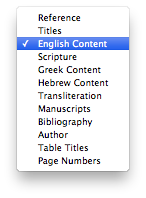
I mentioned in my last post that you can search this module in a dozen different ways. The search bar is similar to Google, in that you can search English content by a single word, but also by a phrase in quotation marks, so that that exact phrase comes up in your search. Unfortunately the “Greek Content” and “Hebrew Content” searches (which search using Greek and Hebrew letters) are not available in this module, but that’s no fault of Accordance’s, since the commentary uses transliteration.

Fortunately, “Transliteration” is a search option, so you can easily look up how the commentary treats a given Greek or Hebrew word. Searching hilastērion, I see that all seven of its uses in the commentary are at Romans 3:25.

There were a few times when I wanted to go deeper into a passage than the commentary allowed. For example, Paul’s citation of Malachi in Romans 9:13 has, “Jacob I loved, but Esau I hated.” It’s hard to imagine anyone using a commentary who doesn’t want at least a little explanation of “hated” here. The commentary, to be fair, does have, “This choice of Jacob meant the rejection of Esau,” but doesn’t connect this rejection with the verb “hate.”

This just means that Beale and Carson’s commentary won’t be the only place I turn for in-depth study of a passage, but all my seminary professors say don’t use just one commentary anyway! Not a major loss here. The book is already huge (though not on a computer, thankfully), and attempts to be only “reasonably comprehensive” (which it very much is), not exhaustively so.

Besides that, it took me about three seconds to find in Accordance the NET Bible note on Malachi 1:3:

The context indicates this is technical covenant vocabulary in which “love” and “hate” are synonymous with “choose” and “reject” respectively (see Deut 7:8; Jer 31:3; Hos 3:1; 9:15; 11:1).

This commentary is what we book reviewers like to call a monumental achievement. It sits in the carrel of many a student in my seminary’s library. For good reason. And Accordance has done a magnificent job if seamlessly integrating a rich and multi-facted commentary into its software. This is a five star commentary with five star integration into Accordance 10.

Beale and Carson say in their introduction:

If this volume helps some scholars and preachers to think more coherently about the Bible and teach “the whole counsel of God” with greater understanding, depth, reverence, and edification for fellow believers, contributors and editors alike will happily conclude that the thousands of hours invested in this book were a very small price to pay.

After consulting the original biblical texts, this commentary will always be the first place I turn when I am looking to better understand (and share with others) how the New Testament uses the Old. I am grateful for those “thousands of hours invested in this book.”

Thank you to Accordance for providing me with a copy of the Beale/Carson commentary module for review. Scroll through for all six parts of my Accordance 10 review here.

The Gospel According to Isaiah 53, reviewed

Isaiah 53 is one of the clearest prophecies of Jesus the Messiah in the Hebrew Scriptures. This chapter has changed the lives of thousands of people–both Jews and Gentiles–who have read the text and believed in the One who fulfilled these prophecies in glorious detail.

Thus begins Mitch Glaser’s Introduction in The Gospel According to Isaiah 53: Encountering the Suffering Servant in Jewish and Christian Theology (affiliate link). In three parts the book expounds how the prophecies of Isaiah 53 relate to and are ultimately fulfilled in the person of Jesus. (The full passage the book treats is Isaiah 52:13-Isaiah 53.)

The first section, a sort of exegetical prelude, discusses “Christian interpretations” and “Jewish interpretations” of Isaiah 53. The second section is a biblical theology of Isaiah 53 (with particular attention to its use throughout Scripture). The third and concluding section speaks to “Isaiah 53 and Practical Theology,” with an emphasis on how to preach the passage, both from the pulpit and in conversation.

The book is “designed to enable pastors and lay leaders to deepen their understanding of Isaiah 53 and to better equip the saints for ministry among the Jewish people.”

The first thing I noticed about the book is that it’s just as much an apologetic for Jesus-as-suffering-servant as it is an academic study of Isaiah 53. It’s not that it lacks academic substance, though. This is a meaty book, and pleasingly so.

Regarding the book’s explicitly evangelistic intent–there may be some who are uncomfortable with the description of Chosen People Ministries’ “Isaiah 53 Campaign” (including 75,000 postcards to Jewish homes and 40,000 voice blasts=robo-calls?). I’ll admit that I question the potential efficacy of pre-recorded phone messages for reaching anyone with the Gospel (though God can use anything!). But see blogger Joel Watts for his helpful (refreshing!) take on the blending of the academic and evangelistic enterprises, especially in the context of this book.

You can find a full list of contributors in the table of contents here (pdf). A few names to highlight are Walter C. Kaiser Jr., Darrell L. Bock (one of the co-editors), Craig A. Evans, and Donald R. Sunukjian. I particularly appreciated the book’s treatment of the New Testament use of Isaiah 53. The chapter by Michael J. Wilkins lists the quotations of Isaiah 53 in the NT and additional allusions to it in the Gospels. (He makes a key point, that Jesus himself understood “his mission and death in the light of Isaiah 53.”) Darrell Bock goes in depth with a comparison of the Greek and Hebrew texts of Isaiah 53:7-8, highlighting its use in Acts 8 where Philip explains the passage to the Ethiopian eunuch.

Something to critique in this book is that there were a few generalizations of Jews that I found to be unfair, particularly in the chapter “Using Isaiah 53 in Jewish Evangelism.” Mitch Glaser writes:

I think I can safely say that, in the United States, most Jewish people would recognize Isaiah as the first name of a professional athlete sooner than they would recognize the prophet of biblical literature.

Granted, he is operating from the assumption that “most Jewish people are not Lubavitch, Hasidic, or Orthodox,” but still…. What was more surprising to me: “Most Jewish people do not understand or believe in biblical prophecy” and, “Most Jewish people do not believe in sin.” Glaser does (only later) qualify these with, “We must note that all of the above does not apply to those who hold to traditional Jewish theological positions,” but he would have been better off saying something like “many secular or ethnic but non-religious Jews…” or at least supporting his statements with statistics from surveys rather than anecdotal evidence. Glaser himself is a converted Jew who has a compelling conversion story, but I still found those characterizations to be frustrating. I wonder how helpful such statements could be in advancing an evangelistic cause in conversation with another Jew.

This next thing to highlight may seem a small point to some, but as someone seeking to keep my Hebrew and Greek going, I appreciated the actual Hebrew and Greek fonts throughout the book (i.e., not just transliteration), which are clear and easy to read. I did think, however, about an intended audience of “pastors and lay leaders” who may have desired transliteration, too. (All Hebrew and Greek is translated into English.)

Darrell Bock’s conclusion summarizes all the essays of the book, with key quotations. Having this there was a big help in piecing everything together again. The Gospel According to Isaiah 53 will not be far from my reach in coming months and years. I expect I will often reference this compendium of biblical scholarship on a vital text. My hesitations about the characterizations of Jews above notwithstanding, there is a good deal here that can be useful for Christian-Jewish conversations about the Suffering Servant.

I received a free copy of The Gospel According to Isaiah 53 with the only expectations of providing an (unbiased and honest) review on this blog. Its publisher’s product page is here. It’s on Amazon here (affiliate link).

Magnificent Monograph Monday: How to Read a Book

There’s a good plug over at Near Emmaus blog for How to Read a Bookwhich my friend Ian recommended to me, and which just came in the mail today. Especially any of you going back to school, see what Near Emmaus has to say about the book. I haven’t read it yet, but I’ve heard multiple times now in recent weeks that it’s a good one.

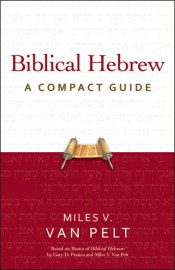
Review of Biblical Hebrew: A Compact Guide

At long last, a compact reference guide to Biblical Hebrew!  Not long ago Zondervan released Biblical Greek: A Compact Guide, a helpful and portable distillation of Mounce’s oft-used grammar. Many such little books already exist for easily reviewing Koine Greek: Dale Russell Bowne’s Paradigms and Principal Parts for the Greek New Testament, Paul Fullmer and Robert H. Smith’s Greek at a Glance, and even the back of Kubo’s Reader’s Lexicon has a good summary of Greek grammar with paradigm charts.

There seem to be more resources available to students of Biblical Greek than to students of Biblical Hebrew.  For example, while there is just one (excellent!) “Reader’s” Hebrew Bible (uncommon vocabulary is glossed at the bottom of the page), I am aware of at least three Reader’s Bibles that exist for the Greek New Testament.  So Miles Van Pelt’s Compact Guide, based on his and Gary Pratico’s Basics of Biblical Hebrew, is a welcome addition as far as this eager Hebrew student is concerned.

The book is not terribly dissimilar from Pratico/Van Pelt’s Charts of Biblical Hebrew, but unlike that work, A Compact Guide is more than just a collection of charts and paradigms.  Each section includes a distillation of what is in the larger grammar textbook, followed by paradigms and charts for quick reference. Seeing Van Pelt’s world-famous color-coded verbal diagnostics is a highlight.

Oddly enough, at times there seems to be more precision and detail in this little book than in the larger grammar.  Or perhaps it’s just more nuance or smoother grouping of material that has come about with the passage of time since the publishing of the grammar’s second edition. For example, there is a section in the Compact Guide on “particles” that is a unique and clearer grouping than what is in the larger grammar. And whereas the grammar lists three kinds of Hebrew prepositions (independent, Maqqef, and inseparable), the Compact Guide adds a fourth: compound prepositions, where “two different prepositions, or a preposition and a noun” (28) combine to make a new preposition. (This fourth category appeared in the larger textbook later in its chapter as “Advanced Information”; having everything grouped together in the Compact Guide was easier.)

The primary focus of the guide is morphology (how words are formed, including paradigm charts) and syntax (how words are used in sentences, i.e., grammar).  Unlike Basics of Biblical Hebrew there is not much in the Compact Guide by way of vocabulary, save for a Hebrew-English mini-lexicon at the back of the book.  Unfortunately, there was no explanatory note as to what constituted inclusion on the lexicon.  (In Mounce’s Greek Compact Guide, the lexicon notes that it includes words that occur in the New Testament 10 times or more.)

From what I can tell, though, the Hebrew Compact Guide reproduces exactly the Hebrew-English lexicon in its larger textbook counterpart. In this case, the lexicon covers Hebrew words that occur 50 times or more in the biblical text. The Basics of Biblical Hebrew lexicon notes that it also adds “less frequently occurring words that appear in the grammar and workbook.”

In addition to a thorough listing of paradigms (the 11-page section on pronominal suffixes is particularly helpful), the book is filled with examples from the Hebrew Bible (with English translation).  The Hebrew font used, while not quite as easy to read as that of the grammar, is readable enough. (And that may just be a matter of personal preference anyway.)

The section on verbs is a particular strength of this work–in addition to examining all the forms and stems (both strong and weak), there are extensive listings of paradigms for easy review.

All in all, I give a hearty two thumbs up to this work–and express my gratitude that it is now on the scene for those who want to keep their Biblical Hebrew fresh!  For a beginner in Biblical Hebrew I would recommend the full-length grammar textbook, but for those with even a semester or two of Hebrew (and beyond), this small reference guide will be a valuable and inexpensive addition to their library. As Van Pelt notes in his preface, even “veterans” of Hebrew will be able to utlize the guide to “keep fit” in their language use.

Icing on the cake: the pocket-sized paperback comes encased in a sturdy, translucent plastic cover.

You can preview the book here.

Note: I received a review copy from Zondervan for the purposes of this review. I had initially reviewed a digital galley version of this book through Net Galley. The above reproduces my galley review, checked now against the hard copy for accuracy.

Review of Malachi (Baylor Handbook on the Hebrew Text), part 2

In this post I both explain the jarring Malachi 2:3-4 as well as offer part 2 of my review of Malachi: A Handbook on the Hebrew Text by Terry W. Eddigner (Baylor University Press, 2012). Part 1 of the review is here.

Eddinger begins each passage with his own English translation, then analyzes the Hebrew text verse by verse. Any reader will appreciate that Eddinger prints the full Hebrew text of a given verse, then reprints the various clauses and words when commenting on them. (This eliminates the need to constantly refer to another book when using Malachi.) The Hebrew font is large, clear, and easy to read. It’s fully pointed and includes the Masoretic markings that one would find in the BHS. Though at first I had wished to see the English translation verse-by-verse alongside the Hebrew, Eddinger’s decision to have English translations primarly at the beginning of a passage does force the reader more into the Hebrew itself. For the intended audience of “a second-year Biblical Hebrew student” whose focus is translation, grammar, and syntax, this is a good thing.

I was pleasantly surprised to see that Eddinger discusses textual variants throughout the handbook. He especially focuses on LXX/Septuagint variants that receive attention from the BHS editors. His conclusions regarding variants often end with something like, “X makes sense in context and so should be retained.” Thoroughgoing text critics may be left wanting more evaluation or interaction with variants than this (as I was at times)–but this is a short handbook. The fact that the author highlighted such variants at all was an added bonus, as far as I’m concerned.

Eddinger gives excellent attention to grammatical and syntactical detail–down to an assimilated dagesh lene (1:13)! He treats clauses as wholes–for example, highlighting word order and fronting for emphasis. And he treats individual words and parts of speech. He never loses the forest for the trees, and he gives the trees their due attention, too. In conjunction with the “key words” chart at the beginning of a section and the appendix of all Hebrew words in Malachi, Eddinger often notes rare Hebrew words as such, giving something of their context in the rest of the Hebrew Bible. He seems to have HALOT, TDOT, BDB, and other technical commentaries readily at hand as he comments on the text. On 1:14 he writes,

נוֹכֵל is a rare word in the Masoretic Text, occurring only four times (only here in Malachi) and means “one who acts cleverly” or “deceitfully” thus, “a cheat.”

That is the sort of insight I could come to expect on a regular basis by the end of the handbook. I loved it for that.

In terms of grammar, his discussion of individual words includes syntax and morphology, with every single word parsed / morphologically analyzed and often more detail than that. Eddinger uses the qatal and yiqtol verb classification system. This may not line up with what every Hebrew student has read regarding tense/aspect in their first-year Hebrew class, but it does (at least according to some) carry significant advantages over “perfect” and “imperfect.” (See a mini-primer on the Hebrew verbal system here.)

Regarding the verses from Malachi with which I led off part 1 of this review, Eddinger explains them well:

פֶרֶשׁ refers to the contents of the bowels of sacrificed animals, which the priests were to burn as refuse at a location away from the altar (Exod 29:14; Lev 4:11; 8:17). The phrase [feces upon your faces] is a double entendre in meaning as the act is an act of humiliation and contact with the ‘unclean’ matter makes the priests ‘unclean’ for their priestly duties.

(I allude more to Malachi 2:3 here.)

I’ve found Malachi to be an indispensable companion for reading through Malachi in Hebrew. I do have one minor critique and one larger one, though.

First, the English Bible versification at the end of Malachi gives the book four chapters; it is just three in the Hebrew text. Malachi nowhere notes this (although it does note regarding the last three verses that “some LXX texts have these verses reordered.” Again, this is a handbook on the Hebrew text, but a simple explanatory note here as to why English Bibles have four chapters in Malachi and Hebrew Bibles three would have been beneficial.

Second, I found myself often distracted (though I didn’t want to be) by the presence of typographical errors or comma splices or run-on sentences. I hope future printings can correct these, since they take away from an otherwise great book. There would be no benefit in listing typos here, but there were some 20 or more spots where either a word was misspelled, there was disagreement of number between verb and subject, punctuation was missing, and so on. Fortunately the vast majority of these are in English and so easy enough to spot. (I.e., the reader can trust the Hebrew here.) But the author’s English translation sections especially seemed to be in want of a closer edit. I do hope future printings or editions can make adjustments here; I imagine students of Malachi will want to make use of this book for years to come.

Eddinger in the end is a worthy guide through the Hebrew of Malachi. The prophets often (suddenly!) shifted pronouns or speakers or subjects in their writing. Who is talking now: God, the prophet, both, or the people? Eddinger coolly walks the reader through such grammatical challenges, and others besides.

While the obvious use of Malachi is as a reference work in which to look up a given passage, it reads well as a whole, too. I eagerly await future books in the Baylor Handbook on the Hebrew Bible series.

Thank you to Baylor University Press for providing me a free copy, in exchange for an unbiased review (which ends up being a two-part review in this case–by my choice). You can find the Baylor product page for Malachi: A Handbook on the Hebrew Text here. It’s on Amazon here.

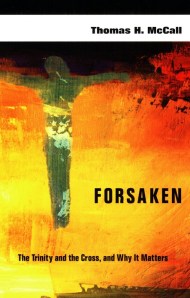
Forsaken: Did God the Father kill Jesus on the cross?

“My God, my God, why have you forsaken me?”

“Never will I leave you; never will I forsake you.”

“I and the Father are one.”

Wondering how these three verses of Scripture fit together? I often have. Cognitive dissonance finally got the better of me, and I decided I should try to think through this one a little more deeply. To that end I read Thomas H. McCall’s Forsaken: The Trinity and the Cross, and Why It Matters (InterVarsity Press, 2012). Here, on Magnificent Monograph Monday, I offer a review of the book. (Thanks to IVP for the free review copy, in exchange for an unbiased review.)

First, the very short summary of my review, if you want to cut to the chase and head off and do something else after this next paragraph.

McCall tackles some difficult questions: “Did God forsake Jesus [on the cross]? Did the Father turn his back on the Son in rage? Was the Trinity ruptured or broken on that day?” His answers and arguments are rooted in Scripture, the history of interpretation of that Scripture, and are consistently compelling. McCall really helped me through my own struggles to grasp some of these questions, leading me to a fuller understanding of the life of the Trinity and the relationship between its persons, particularly in terms of what happened on the cross. And he spells out the implications of his assertions beautifully. God is not divided, he concludes, but God–all of God–is for us. So we can rejoice and rest secure in that. Five stars, no doubt.

McCall writes “not for other scholars…but for pastors, students and friends–indeed, for anyone genuinely interested in moving toward a deeper understanding of God’s being and actions.” Forsaken is heavy theological lifting for a non-scholar (and not lightweight for a scholar, either), but the effort is well worth it. McCall answers some very common questions people ask (or are scared to ask and should ask) about the Trinity, also showing ramifications for our relationship to God.

Forsaken has four chapters. Each asks a theological question, addresses it, then concludes with some theological assertions to avoid, some to affirm, and why it matters.

The first chapter asks, “Was the Trinity Broken?” Here McCall discusses the theological concept of “dereliction,” or the idea that Jesus was abandoned by God on the cross. Recent theology notwithstanding, McCall makes a strong Scriptural case that God the Father did not forsake the Son on the Cross. Understanding Psalm 22 as an “interpretive key” to Jesus’ death, McCall writes:

No, the only text of Scripture that we can understand to address this question directly, Psalm 22:24, says that the Father did not hide his face from his Son. To the contrary, he has “listened to his cry for help.”

Not only that, the author argues, but if God truly had forsaken Jesus, why would Jesus bother–after his cry–to say, “Father, into your hands I commit my spirit”? Jesus “prefaces his last words with a sense of deep relational intimacy: Jesus addresses his ‘Father.'”

In chapter two McCall asks, “Just what are we to make of the biblical witness to the wrath of God? Is it opposed to his love? Is it a ‘dark side’ to God that is inconsistent with his holiness or with his mercy?” He makes a pretty hard-to-argue-with case that “the biblical witness does not set love and wrath in opposition to one another.” McCall, I thought, was at his best in this chapter when he highlighted multiple New Testament references to wrath–not only the wrath of God generally, but Jesus’ wrath specifically. So there’s no Old Testament God=wrath, New Testament God=mercy conclusion to be drawn from the Bible. The author utilizes the theological categories of divine impassibility and simplicity to show that “wrath” as God exhibits it is not what we might envision in human anger; rather, it is an expression of holy love.

McCall’s third chapter asks whether God’s divine foreknowledge means that God killed Jesus, since he knew it was going to happen, could have stopped it, but didn’t. “God’s plan was to use the death of Jesus for his purposes and for our good,” but God himself did not cause the death. As Acts so often makes clear, McCall points out, “The apostolic proclamation of the gospel places the fault and blame on the sinners who are responsible for the death of Jesus.”

Chapter four articulates a robust theology of justification (forensic; instantaneous; by which I enter into the life of God) and sanctification (separation unto God; progressive; by which I grow in communion with God). Page 145 and following has a brilliant interpretation of Paul’s famous Romans 7:14-25 passage where he (seemingly) wrestles with sin.

One difficult implication of this book for me as a worship leader (and coach of worship leaders) is that, if McCall is right, we may be singing some not-quite-right theology in two well-known songs. “How Deep the Father’s Love for Us” has a line that says, “The Father turns his face away.” And the song “In Christ Alone” says, “…till on that cross, as Jesus died, the wrath of God was satisfied.” McCall addresses these two claims head on and (in my opinion, successfully) refutes them. The Father did not turn his face away (see the block quote above). And to say that God the Son mollified the wrath of God the Father is to bifurcate the Trinity in some unorthodox ways. (!)

I’m not sure if it’s generally accepted for a book reviewer to admit to shedding tears when reading a review copy. (Objectivity! Right?) No matter. McCall’s concluding postscript (“A Personal Theological Testimony”) moved me to tears, as he recounted the difference “the trinitarian gospel” made for him and his family as they processed the death of his father.

Getting the theological details of the Trinity right (as best we can!) matters. It matters for our understanding of God, our relationship with him, and for all of life. In the life and truths of the Trinity–properly understood, and I think McCall a good guide here–there is great comfort. We see a God who, as McCall says, is for us. We find a God who has granted us victory over sin and death, making it possible for us to enter into communion with the triune God of love.

You can find Forsaken here at the IVP product page or on Amazon.

Systems Thinking and Gentrification: Review of The New Urban Renewal

How do neighborhoods change? How does a forgotten ghetto become an urban hotspot?

Derek S. Hyra answers these questions in The New Urban Renewal: The Economic Transformation of Harlem and Bronzeville (published by University of Chicago Press, 2008).

Hyra presents a careful comparative study between two economically gentrifying communities: Harlem (New York) and Bronzeville (Chicago). He takes a “systems thinking” approach (though he does not call it that) to see how global and national forces interact with municipal political structures, which interact with community organizational structures, which all work together to affect local conditions. These are the lenses through which he views gentrification in those two communities.

He notes that while Bronzeville and Harlem are gentrifying economically, their racial composition is not changing–they both remain primarily African American neighborhoods. So Hyra also analyzes intraracial, cross-class conflict.

Hyra’s interest is especially in displaced, non-home-owning residents of each community. He keeps this population in mind throughout the book and makes recommendations at the end for how to minimize resident displacement in gentrifying communities.

The New Urban Renewal is not very concise–typographical errors and run-on sentences are surprisingly common for a University of Chicago Press Book. But this can be overlooked. The concepts in Hyra’s book are well worth understanding and exploring.

“How do I get more out of my Bible reading?”

“How do I get more out of my Bible reading? What was going on during the gap between the Old and New Testaments? How do all the books of the Bible fit together as a whole?”

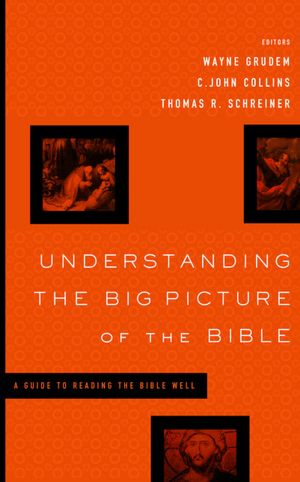
It is the aim of Understanding the Picture of the Bible: A Guide to Reading the Bible Well to answer those questions and put “clear, readable Bible study aids at your fingertips.” (All quotes from back cover and also found here.) Here I review the book for another installment of Magnificent Monograph Mondays.

The book begins with “An Overview of the Bible’s Storyline,” then continues with three parts, one for the Old Testament (subdivided into OT Theology, Pentateuch, Historical Books, Poetry/Wisdom Literature, and Prophets), one for New Testament background (intertestamental history and literature), and one for the New Testament (NT Theology, Gospels/Acts, Epistles, and Revelation). Each author gives a thorough yet concise overview of the section of the Bible he (all authors are male) treats. Each also discusses themes within a given section of the Bible and how they connect with the larger Biblical narrative.

What first stands out in Understanding the Big Picture of the Bible is that almost every author has a knack for simply explaining important concepts and terms. The summary overviews of sections of the Bible provide the reader with a firm foundation for better understanding the purpose and scope of that section. For example, Paul House’s excellent chapter on the prophetic books has an excursus on “pronouns in the prophets.” He begins: “As prepositions are to the letters of Paul, so pronouns are to the oracles of the prophets: crucial for meaning, but often puzzling” (72). In the five following pages he does much for the reader to make prophetic pronouns (and how they often shift person and gender) easier to understand. Other highlights are Gordon Wenham’s chapter on the Pentateuch and Dennis Johnson’s essay on Revelation.

Timelines and charts throughout are a great feature. In addition to timelines in the back of the book covering all of Biblical history (including intertestamental times), there are charts throughout the book that aid the reader. Thomas Schreiner lists all the Epistles, their authors, dates, place of writing, and recipients. Johnson uses nine separate figures to visually (and clearly) display the differences in how Christians interpret Revelation. And House has a table that lines up the prophets with the kings during whose time they prophesied. (A couple of similarly simple and clear maps could be a great addition to future editions of this book.) Here’s an example (taken from a pdf sample of the book):

And then there’s the middle section, part two of Understanding the Big Picture of the Bible. That section alone makes this book worth more than its purchase price. It contains the following:

  • “The Time between the Testaments,” by J. Julius Scott Jr.
  • “The Roman Empire and the Greco-Roman World at the Time of the New Testament,” by David Chapman
  • “Jewish Groups at the Time of the New Testament,” by John Delhousaye

Take just this short quotation from Chapman as an example:

Amid this history, Jesus Christ launched his ministry in a Galilee governed by a Roman client king, a Judea under Roman procurators, and a Judaism tinged with Hellenism. After his crucifixion by the Romans and his resurrection, his gospel was carried by the apostles directly into the heart of Greek culture and Roman power. (94)

Having this background in mind when approaching the New Testament will greatly advance the efforts of any Bible reader. Most Bible overview guides that I’ve seen go right from Old Testament to New Testament. But what about all that time in between? I’ve written more here about why that time period is essential to NT understanding. This book really gets that, and covers that period well. Someone with no knowledge of NT background would find this section easy to follow, and even a budding scholar would appreciate the clarity of the historical overview.

While it’s hard to discern what is the work of the editors (this book has three: Wayne Grudem, C. John Collins, and Schreiner) and what is the work of the writers, this book could have benefitted from a little more careful editorial oversight. There are a few little typos scattered throughout the book (tehillah instead of tefillah for Hebrew prayer, e.g.). I found the use of the sex-specific “man” to refer to all of humanity–even when not quoting the ESV–distracting (although this may not bother other readers).

But there is a bigger editorial oversight. While the book excellently helps the reader to better understand the “big picture” of the Bible, it never directly answers the question it seeks to answer of “How do I get more out of my Bible reading?” The authors present all the necessary information to better understand the background (context) and foreground (content) of the Bible, yes. But understanding context and content is only necessary and not sufficient for “reading the Bible well.” I wish the editors would have made sure the book gave more attention to how one can read the Bible, for example, devotionally… or for transformation rather than just the receiving of information. In other words, I wanted this book, based on its title, to answer: How can I grow closer to God as I read the Bible? How can I allow the Bible to convict me of my sin? What about the importance of reading Scripture in community and corporate worship? David Reimer’s essay gets closest to this when he says, “[T]he art and craft of the Bible’s poems offers an invitation to read slowly, to have one’s vision broadened, once’s perception deepened… to see literary reflection in the service of worship and godly living” (54). I wanted to hear more about this. The key question for me is: Is overview knowledge of the Bible’s context and content sufficient to read the Bible well? Necessary, yes. Sufficient, no.

However, even if the book doesn’t execute its aim listed in the subtitle, it is still a valuable work to have in hand while reading through the Bible. Its unique contribution to works of this kind is in the middle section. I’d imagine this book sitting well on someone’s shelf next to his/her Bible and notebook. (It has on mine these last few weeks!) It would benefit a serious Bible reader to read, say, Darrell Bock’s essay on the Gospels and Acts before reading those Biblical books through.

Thank you to Crossway who provided me with a review copy of this book in exchange for an unbiased review. You can find Understanding the Bible Picture of the Bible at Amazon here.