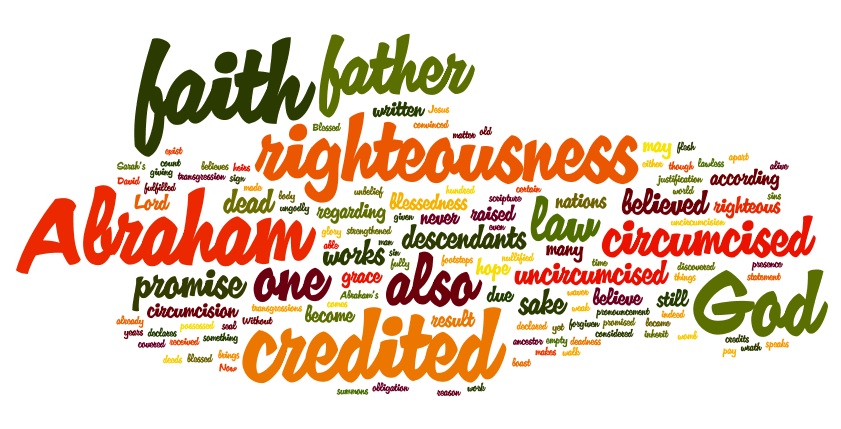
Over the past couple of months I’ve spent a good deal of time in Romans 4. The more I study Paul’s magnum opus, the more amazed I am by all that he packed in and the way he did it.
In my reading and writing on Romans, I’ve come across some great monographs. Here are three, with a sample quote from each. I’ll do three more tomorrow.
In sum, Christians in the Church, stemming from Jewish and Gentile origins, can rejoice together in the salvation available by faith in Christ to all without distinction. “Rejoice, O nations, with his people!” (Rom 15:10). With humility, they can marvel at God’s plan for Israel, of which the Gentile-Christians in particular are beneficiaries. “O the depth of the riches and wisdom and knowledge of God! How inscrutable are his judgments and how unsearchable his ways!” (Rom 11:33) (p. 328)
In Romans 4, Paul elevates Abraham as an ancestor of a new Israel, which includes Jews and Gentiles. …In this new situation, Paul gives a new meaning to the Torah as an integrator of all nations of the world. (p. 98)
Philip Francis Esler, Conflict and Identity in Romans. (Minneapolis: Fortress, 2009.) I love this assessment. Before reading Esler, this is just how I had begun to understood Paul’s use of Abraham in Romans 4. Though he expresses it more eloquently than I could:
Above all, [the account of Abraham in Romans 4] carries forward Paul’s aim of recategorizing Judean and non-Judean Christ-followers in Rome into the new ingroup identity and does so by mobilizing collective memories to explain how both subgroups claim ancestry from Abraham in the same way—righteousness credited to them through faith. Abraham thus becomes the prototype of the new identity, portrayed by Paul in a manner peculiar to the needs of this communication and in the face of many rival construals of this patriarch that were possible in the ongoing processing of the past to serve the needs of the present. (p. 194)
The one who is serious about getting at the earliest attainable text of the Hebrew Bible will eventually find herself or himself face-to-face with a page like this:
Genesis 1 in the Göttingen Septuagint
The Göttingen Septuagint is the largest scholarly edition of the Greek translation of the Hebrew Bible. Its full title is Septuaginta: Vetus Testamentum Graecum Auctoritate Academiae Scientiarum Gottingensis editum. Vandenhoeck & Ruprecht in Göttingen,
Germany publishes the series, which includes more than 20 volumes covering some 40 biblical books (counting the minor prophets as 12). Various editors are working toward the publication of additional volumes.
But if good coffee, fine wine, or well-aged cheese requires work on the part of the one taking it in, the Göttingen LXX makes its own demands of the reader who would use it. The critical apparatuses on each page have Greek, abbreviated Greek, abbreviated Latin, and other potentially unfamiliar sigla. The introductions in each volume are in German.
How to read and understand the Göttingen Septuagint, then? To begin, here is the sample page from above:
Genesis 1:4-9, reprinted with publisher’s permission
There are four main parts to the page, marked in the image above by the numbers 1 through 4.
The reconstructed Greek critical text (“Der kritische Text”)
The Source List (“Kopfleiste”) (note: not every Göttingen volume has this)
The First Critical Apparatus (“Apparat I”)
The Second Critical Apparatus (“Apparat II”)
In part 1 of my primer, I covered numbers 1 and 2 above. To summarize a bit:
1. With verse references in both the margin and in the body of the text, the top portion of each page of the Göttingen Septuagint is the editorially reconstructed text of each biblical book.
2. The Kopfleiste comes just below the text and above the apparatuses. Wevers notes it as a list of all manuscripts and versions used, listed in the order that they appear in the apparatus on that page. A fragmentary textual witness is enclosed in parenthesis.
Next are the two critical apparatuses. In his introduction to Genesis (conveniently translated into English here, from which I quote), editor John William Wevers speaks of the critically reconstructed text as an “approximation of the original” and “hopefully the best which could be reconstructed.” I previously noted:
[Göttingen] editors have viewed and listed the readings of many manuscripts and versions. The critical apparatuses are where they list those readings, so the user of Göttingen can see other readings as they compare with the critically reconstructed text. (Because the Göttingen editions are critical/eclectic texts, no single manuscript will match the text of the Göttingen Septuagint.)
The International Organization for Septuagint and Cognate Studies (IOSCS) notes (from here):
The Göttingen Septuagint features two apparatuses (as does the Larger Cambridge Septuagint), the first for LXX/OG textual evidence proper and the second for so-called hexaplaric evidence, i.e. “rival” translations/revisions of the translated LXX/OG (such as circulated under the labels “Theodotion,” “Aquila,” and “Symmachus”), preserved largely through the influence of Origen’s Hexapla. For LXX/OG research the importance of both apparatuses is second only to the critical text itself.
The challenge, of course, is that to make sense of the apparatuses and their abbreviations.
3. The First Critical Apparatus (“Apparat I”)
The “textual evidence proper” consists of any readings that the editor deems as variant to the reconstructed text. The editors follow a consistent order in the witnesses they cite. (There is minor variation, volume to volume.) In Genesis Wevers writes:
The witnesses for a variant are always arranged in a set order: a) the uncial texts in alphabetic order; b) the papyri in numerical order; c) the witnesses of the O‘ mss [AKJ: the “hexaplaric group”]; d) the witnesses of the C‘’ mss [AKJ: the “Catena group”]; e) the remaining text families (comp Section B I above) in alphabetical order; f) the rest of the Greek evidence in the following order: N.T. witnesses, Ios [AKJ: Josephus], Phil [AKJ: Philo], followed by the rest of the Greek writers in alphabetic order; g) La (or the sub-groups, for ex. LaI Las, etc.) [AKJ: Old Latin versions], followed by the other versions in alphabetic order; h) citations of the Latin Fathers, introduced by the sign Lat (these witnesses always stand in opposition to La or a sub-group of La); i) other witnesses or commentaries.
To look at an example of the first critical apparatus, Deuteronomy 6:5 in the Göttingen edition reads:
(And you shall love the Lord your God with all your mind and with all your soul and with all your strength.)
The apparatus for that verse, in part, has:
om καί 1° Arab Sa17 | αγαπησης 30; αγαπη σε 527 | κύριον τόν] bisscr 120* | om σου 1° Tht Dtap | ἐξ 1°—διανοίας] εν ολη τη καρδια Matth 22:37 |
With each unit broken up by line here, the apparatus gives this information about its manuscripts:
Arab and Sa17 omit (om) the first (1°) use of καί
30 has αγαπησης; 527 has αγαπη σε
120* has κύριον τόν written (scr) twice (bis)
Tht Dtap omits (om) the first (1°) use of σου
From the first use (1°) of ἐξ through (—) the word διανοίας, Matthew 22:37 has rather (]) εν ολη τη καρδια
One has to go to the introduction for information about the manuscripts “Arab” (Arabic version), ” Sa17” (from the Sahidic version), “30” and “527” (minuscule manuscripts), “120*” (also a minuscule manuscript, where the asterisk * refers to “the original reading of a ms,” as opposed to a “correction”), and “Tht Dtap” (Tht=Theodoretus (“Cyrensis=Cyrrhensis”); Dt=his Quaestiones in Deuteronomium;ap refers, Wevers notes, “to readings (variants) in the apparatus of editions”).
Miles Van Pelt has produced a concise two-page summary of sigla and abbreviations. I offer appreciation and gratitude to Miles that I can link to that pdf here. That offers further instruction as to deciphering the apparatuses (both the first and second) in the Göttingen volumes. The introductions to given volumes contain the signs/symbols and abbreviations (“Zeichen und Abkürzungen”), as well.
Boromir had it right:
So I’ll write about the Second Critical Apparatus (“Apparat II”) in a future post. Until then….
Thanks to Brian Davidson of LXXI for his helpful suggestions on an earlier draft of this post and the part 1 that preceded it. He is not to be blamed for the inclusion of Boromir in this post.
I’ve just recently learned about The Blog of the Twelve. Based on what I’ve seen so far, it’s recommended reading, especially for folks with an interest in the Minor Prophets.
The usefulness of this book can hardly be stated for those seeking to rightly handle the Scripture, whether student, pastor, or laity. Beale’s clear writing style, in addition to the uncharacteristic conciseness of the book, makes the method accessible to a wide audience. Furthermore, Beale, while emphasizing the indispensable value of learning the biblical languages, formats the book in such a way that those not familiar with Hebrew and Greek are able to profit just as well from the work.
We’re here; we blog about the Bible; get used to it.
Charles Spurgeon is reported to have said, “If you have to give a carnival to get people to come to church, then you will have to keep giving carnivals to keep them coming back.”
And so we who blog in the fields of academic biblical studies and theology keep giving carnivals.
So let Words on the Word be among the first to wish you and yours a Happy New Year! Let’s welcome the year ahead with a recap of what went on in the so-called biblioblogosphere in December 2012.
Newtown, Connecticut, December 14
On December 14 there was the horrible news of a shooter who killed 26 other people at an elementary school in Newtown, CT, 20 of them young children. Peter Enns shared some thoughts from an unsettled state. Jim West wrote about it quite a bit and excoriated the NRA.
With the generous lead support of the Leon Levy Foundation and additional generous support of the Arcadia Fund, the Israel Antiquities Authority and Google joined forces to develop the most advanced imaging and web technologies to bring to the web hundreds of Dead Sea Scrolls images as well as specially developed supporting resources in a user-friendly platform intended for the public, students and scholars alike.
A number of bloggers wrote about this, not a few of whom Jim McGrath links to.
That wasn’t all that went online in December. Evangelical Textual Criticism notes quiteafewothermanuscriptsthatare now online. (As proven by the fact that every word of that last phrase is its own hyperlink.) Charles Halton of awilum.com highlights the availability of A. Leo Oppenheim’s Ancient Mesopotamia as a free pdf. Readers of this carnival may also like to take some time with ASOR’s weekly archaeology roundups in December, here, here, and here.
Septuagint
December saw a plethora of posts about παρθένος/עלמה in Isaiah 7:14, and Matthew’s use of that verse. Here is T.M. Law, saying that Greek Isaiah’s use of παρθένος for עלמה is not without precedent in the LXX (“The Greek translator of Isaiah used a perfectly acceptable rendering for עלמה.”). Here’s the Jesus Creed on the virgin birth. Krista Dalton notes, “[T]he author of Matthew is not saying that Isaiah was envisioning the birth of Jesus.” Kevin Brown of Diglotting posts here about it. And, looking at hermeneutics more generally, Brian LePort suggested three paradigms to use in studying the virgin birth.
J.K. Gayle at The WOMBman’s Bible (“An Outsider’s Perspective on the Hebrew Males’ Hellene Book”) posted reflections from Greek Isaiah not 1, not 2, not 3, not 4, not 5, not 6, but 7 times in December. Set aside some time and read them all.
Codex Sinaiticus dropped in price to just under $200 at CBD this month–a facsimile edition, that is. Theophrastus of BLT notes it here. He will later lament (which I, too, lament) that Oxford University Press no longer prints their wonderful Comparative Psalter. And while we’re on those Ψαλμοὶ, did their Greek translator(s) have Aristotle and Greek rhetoric in mind?
Anthony Le Donne is taking on the Wikipedia entry on “Historical Jesus” (best biblioblog comment of the month: here). James Tabor asked how December 25 got to be the day we observe Jesus’ birthday (with more thoughts here). Mark Goodacre produced a Christmas NT Pod in which he “explores the differences between the Birth Narratives in Matt. 1-2 and Luke 1-2 and asks how this can be the case if Luke is familiar with Matthew.” The Sacred Page produced a podcast on “the first Christmas.” For a fresh translation of Luke 1:34-38 (with the Greek reproduced beneath the English), see “She spoke yet-Miriam did.” Daniel Street even gave us some Christmas songs in Greek!
Anglican minister Rach Marszalek calls for nuance in discussions on the Trinity, as well as an appreciation of “the perichoretic beauty” of the Same. Read her “Eternal functional subordination and ontological equality?” here. While we’re on Anglicans, Brian LePort asks whether he needs a Bishop?
Gaudete Theology offers a feminist reading of “the bride of Christ” language. (“The image of the Bride of Christ needn’t be viewed only through the patriarchal perception of woman’s nature as inherently passive, docile, compliant, and receptive.”) Alice C. Linsley at Just Genesis would, I think, agree that the image and office of priest should also not be viewed through a patriarchal lens. She says, “Luther Was Wrong About the Priesthood.”
And, finally, may I offer thanks to Amanda at Cheesewearing Theology for this excellent December 2012 theology roundup? She covers yet more territory in theology than I have already covered here. If you’re disappointed that this carnival is about over, spend time reading the posts she collects.
Ευχαριστω/תודה/Thank you
Thanks for coming, and keep coming back! I blog regularly, so feel free to follow/subscribe by going back up to the right sidebar of the blog.
The full text of the new NA28 Greek New Testament is available online for free. No critical apparatus (that will probably be for-pay only), but it’s nice to be able to easily access the text now. You can go here to do that.
I am hosting the next Biblical Studies Carnival. (See here for the last one, by Bob MacDonald.)
The carnival is basically a long list of links, and anthology of analyses, a précis of posts, etc., etc., on all things biblical and theological in the blogosphere.
If you know of good links I should include (anything that has been or will be posted in December), please let me know.
I have an extra copy to give away (not my review copy). I recommend this volume, for either you or the Greek language-lover in your life.
To enter the giveaway, simply comment on this blog post and say why it is you would want to win a copy. I will accept entries through next Monday afternoon, December 17, with 3pm EST being the cutoff.
Then if you link to this post on your Facebook, Twitter, blog, etc., come back here to tell me in the comments section that you did, and you’ll receive a second entry. I will announce the winner just before 5pm EST Monday.
If you want to check out the book before you decide to enter, my review of it is here.
I used to think it was just a scare tactic when professors of biblical languages said, “Use your Greek! Don’t let your Hebrew get rusty, or it will be gone forever!”
They were, of course, right. For various reasons I had to have a bit of lag time between Hebrew I and Hebrew II, and quite a bit fell by the wayside then. I find myself highly motivated now to keep reading Greek and Hebrew, several years in to each language.
The key question is–when? How do I find time to do that? I’m a husband, father of three kids age five and under, work full-time, take classes, and try to have some semblance of a social life.
So I try to work smarter, not harder. I take my Hebrew and Greek Bible to church with me and follow along in it–and let me here publicly apologize to my wife for asking her to carry it in her purse for me. (Bible software in church still seems a bit tacky to me.) And I try to do my personal Bible reading/devotions in another language whenever possible. For example, I’m having a blast with Greek Isaiah in a Year.
For people like me who want to keep and improve their languages, I think that sort of integration is vital. Learning Greek and Hebrew can’t be just rote study time with piles of vocabulary cards and pages of sentence diagrams. Especially for those who want to improve them, languages need to become, I think, part of life, and part of one’s regular reading and worshiping patterns.
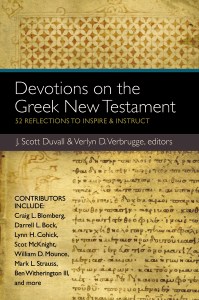
EnterZondervan’s Devotions on the Greek New Testament. The book fills a gap for ongoing language study that not many other resources meet, at least not in this way. It contains “52 reflections to inspire and instruct,” offered by scholars like Scot McKnight, Lynn H. Cohick, Roy E. Ciampa, Linda Belleville, Constantine R. Campbell, and more.
Readers of this blog will not be shocked that I agree with the doxological focus this volume has:
The need to know why you are studying Greek, particularly in relation to the ultimate purpose of strengthening your walk with the Lord, never fades into the background.
Each devotion is a couple of pages long, beginning with a block of untranslated Greek text and followed by English commentary on the text. The 52 reflections could be spread out over the course of a year for one a week. (Those who want to do regular Greek devotions, however, might go through the book more quickly.)
There are 28 male authors and 3 female authors, which as out-of-balance as that may sound, is actually more diverse (sadly) than many resources like this. The variety of authors, perspectives, and approaches makes Devotions on the GNT rich. The reflections are listed in canonical order, with every NT book represented except for 2 and 3 John.
The book succeeds in its effort to “instruct.” Some devotions focus on single words or phrases from the Greek text (Ciampa has a great clarifying devotion on Joseph’s righteousness in Matthew 1:19, teasing out δίκαιος ὢν in the text). Dean Deppe unpacks participles and main verbs (or shall we say, parses participles and primary predicates?) in Mark 5:25-27 to unearth more of what Mark and Jesus are up to. J.R. Dodson offers a fantastic literary analysis and sentence flow (which is presented well on the page) to ask how well the reader is doing embracing the freedom the Gospel brings.
Devotions on the GNT does “inspire,” too, and I’m encouraged that this resource exists for students of the Greek Bible like myself. However, at times I found the application sections to be a bit shorter than I’d have hoped (sometimes just a sentence or two). The reader may be perfectly capable of making the application herself or himself, but more could have been offered here.
The only other similar resource of which I’m aware is More Light on the Path (Baker, 1999). That devotional has both Hebrew and Greek, with uncommon vocabulary and parsings footnoted. But Devotions on the GNT goes more in-depth with the passage it treats, making it suitable as a true “devotional.”
After reading a given reflection, I do generally feel instructed and inspired: I feel that I’ve worked at my Greek for the day and have something to take with me. And it takes less than five minutes to work carefully through a reflection.
You can find Devotions on the Greek New Testament at Amazon or at Zondervan. In both places you can look inside the book.
I hope Zondervan publishes a corresponding Hebrew volume, and it would be a dream to see a Septuagint Greek devotional, too! Devotions on the Greek New Testament constitutes yet another step forward for language-learning students.
And keep an eye on this here blog. Within the next couple days, I’ll have a giveaway contest with an additional copy I’ve received of this book. (Update: go here for the giveaway.)
(I am thankful to Zondervan for the free review copy of this book, which was sent to me with the understanding that I would then write an unbiased review.)
Tomorrow (Tuesday) I have the final exam in my class, Use of the Old Testament in the New. That can only mean one thing, and that is that it’s time for this:

 Over the past couple of months I’ve spent a good deal of time in Romans 4. The more I study Paul’s magnum opus, the more amazed I am by all that he packed in and the way he did it.



 Scot McKnight lists the “Jesus Creed Books of the Year”
 Speaking of Greek Isaiah… more than 150 of us are reading through






 Words on the Word