A New Reader’s Lexicon of the Greek New Testament, Reviewed

Unfamiliar vocabulary proves to be an enduring challenge for students of New Testament Greek. Even students who understand the rules of the language get bogged down having to look up uncommon words while translating. Nevertheless the correct interpretation of many passages of Scripture hinges on the meaning of its rare words.

–Michael H. Burer and Jeffrey E. Miller, Preface

Vocabulary acquisition is key to being able to read any language, but so is just reading a text straight through. A “reader’s lexicon” or “reader’s Bible” seeks to bridge the gap so students can both improve their vocabulary and engage in a continuous reading of the text. To that end, Kregel Academic and Professional has published A New Reader’s Lexicon of the Greek New Testament by Michael H. Burer and Jeffrey E. Miller.

But why a new reader’s lexicon when the old one (by Kubo) has been useful to students of the Greek New Testament for so long? That’s been the primary question before me as I’ve reviewed the New Reader’s Lexicon (NRL). Daniel B. Wallace in the preface gives the reasons for this new lexicon:

But as helpful as Kubo was, there were weaknesses. First, it was not updated to the glosses found in the third edition of the Bauer Lexicon (BDAG). Second, there were numerous errors (involving word frequency numbers, omissions of words, inappropriate glosses, etc.) that went uncorrected. Third, the special vocabulary section at the beginning of each book, involving all the words that occurred more than five times in that book but less than fifty times in the New Testament, created its own problems: designed for efficiency of space, it did not prove helpful for efficiency in learning.

While I think Wallace has it right on the first two points, I (sort of) disagree with the third–that list that Kubo offers at the beginning has actually been helpful to me for learning a given book’s vocabulary, since it groups some of that book’s common words together. However, it does mean that words in that beginning list don’t then appear in Kubo’s lexicon throughout the rest of the book. To overcome this, I would make a copy of the list and use it as a bookmark, referring to it often so I didn’t have to keep flipping pages.

Herein lies one area of strength for the New Reader’s Lexicon. There is no common vocabulary list at the beginning of each book (users now can generate those easily enough through Bible software), but it means that every word that occurs less than 50 times in the New Testament is in this lexicon… in the verse in which it appears. So as I’m beginning my way through Mark 6, I can look in the NRL to quickly see that ἐκεῖθεν in verse 1 means “from there.”

To Wallace’s first two points, that the NRL uses the updated BDAG is a great relief–readers now don’t have to guess whether recent advances in lexicography or discoveries of new papyri mean that the word in front of them actually has a slightly different nuance. The NRL updates Kubo here well.

In addition to “concisely defin[ing] in context” each word, the NRL gives statistics for how many times that word appears. (Names and proper nouns are included.) There are up to three numbers listed:

  • How many times the word appears in that given book of the New Testament
  • How many times that word appears “in all canonical works by the traditional author of the book at hand”
  • How many times the word appears in the whole NT

Kubo had the first and third numbers. This second statistic now allows me to see not only how many times ἀνάθεμα appears in 1 Corinthians (twice) and in the NT (six times), but it tells me that five of the six uses of this word in the NT are with Paul.

And here’s where the lexicon is unique and really stands out–in the instance of such a rarely occurring word, it lists cross references, so I can quickly see that the other use of ἀνάθεμα in I Corinthians is at 16:22and that Paul also uses the word in Romans 9:3, Galatians 1:8,9, and that the only non-Pauline NT occurrence of the word is at Acts 23:14.

The NRL truly does improve upon Kubo’s lexicon. It accomplishes its mission quite well.

But don’t take my word for it. I’ve found that what original language resources to own and invest in is often a matter of personal preference and what works best for an individual. If you’re still on the fence about this resource, download a free sample of the lexicon for Colossians here (pdf). Read through Colossians with it in hand and see how it goes. Personally I’ve found this to be an indispensable resource for making my way through the Greek New Testament.

One huge bonus: the book is designed well. The pages are smooth and thick and bright. The font is clear and easy to read. And the binding is sewn! This means it will stand the test of time well, which you’d hope a reference work like this would.

My thanks to Kregel Academic for providing me with a review copy of this book. Find out more about the book at Kregel’s site or look inside on Amazon.

James (Zondervan ECNT), reviewed

James is no “epistle of straw,” as Martin Luther once (in)famously said of the book. But many–with Luther–find it difficult to reconcile Paul and James on faith and works.

Paul: “A person is justified by faith apart from works of the law.”

James: “A person is considered righteous [i.e., justified] by what they do and not by faith alone.”

Here I review James by Craig L. Blomberg and Mariam J. Kamell, from Zondervan’s Exegetical Commentary on the New Testament (ZECNT) series. (Click here to find my review of Luke in that same series; below I use some of my same wording from that post to introduce the ZECNT series more generally.)

Like the rest of the ZECNT series, James is “designed for the pastor and Bible teacher.” The authors assume a basic knowledge of Greek, but Greek is not required to understand the commentary. For each passage the commentary gives the broader literary context, the main idea (great for preachers!), an original translation of the Greek and its graphical layout, the structure, an outline, explanation, and “theology in application” section.

The introduction covers an outline and structure of James, the circumstances surrounding its writing, authorship and date, and significance of the book. It is shorter and less detailed than the introductions in Douglas Moo’s James commentary and that of Peter Davids. Immediately I looked for how the authors would resolve the Paul/James (alleged) discrepancy, but they note in the introduction that they discuss James’s theology after “the commentary proper.” (The ZECNT series has a separate “Theology” section at the back of the book that most other commentaries include as part of the introduction.)

They give just two paragraphs in their theology section–with a bit more in the body of the commentary–to “Faith and Works” (compare Moo’s lengthier discussion in his introduction), but they have their reasons for this:

Contrary to what the extent of the discussion of the topic might suggest, faith and works is not the main focus of James’s letter. It is a subordinate point that grows out of his concern for the poor and the dispossessed (2:14-26; cf. 2:1-13).

I’m a little embarrassed to admit that this idea of faith and works as a subordinate point in James had not really occurred to me prior to working with this commentary. (A good trait in a commentary to produce such thoughts!) But if you click on the references above or look through James 2 (and the rest of James) in your Bible, it’s easy to see where the authors are coming from.

In fact, the “three key topics” in James, according to Blomberg and Kamell, are “trials in the Christian life,” “wisdom,” and “riches and poverty.” They follow Davids here, and note that James 1:2-11 lays out each of the major themes, which James then restates in 1:12-27. 2:1-5:18 then consist of “the three themes expanded,” in reverse order, followed by a closing in 5:19-20.

Blomberg and Kamell are “the first to grant that we may still be imposing more structure on the text than James had in mind.” All the same, their outline of James makes it easier to work through the book, and then finally does, I think, justify their claim in the theology section that “faith and works” is not the central theme of the letter and should be considered in its broader context. Still, they do have a good way forward in understanding Paul and James together: “But this action, these deeds or works, are not put forward in any attempt to merit God’s favor but as the natural, spiritual outgrowth of one’s faith.”

As with Luke, the graphical layout of each passage (in original English translation) is a unique contribution in James. Being able to see main clauses in bold with subordinate clauses indented under them (plus how they relate back to the main clause) gives the reader a quick, visual grasp of the entire passage at hand. See page 45 of the commentary in this sample pdf to see how it looks. This is a highlight of the ZECNT series, and the fact that it’s in English makes it all the more accessible. The translation is smooth and readable, doing great justice to both the Greek it translates and the English language.

James has the full Greek text of James, verse by verse, and the full English translation (passage by passage in the graphical layout, then again verse by verse next to the Greek). As I’ve said before, a value for me in using reference works is not having to pull five more reference works off the shelf to use the first reference work! The authors make comments like this one in 1:5 throughout the work, wedding grammatical and lexical analysis to exegetical application:

We are told to ask of the “giving God” (διδόντος θεοῦ). Here the present participle suggests that “giving” represents a continuous characteristic of God.

To take another example, on James 2:20, which they translate, “Do you want to know, O empty person, that faith without works is workless?” they write:

James incorporates a pun on the word “work” (ἔργον), using the negative adjective from the same root–“workless” (ἀργή). The term can also mean idle or useless. Faith that lacks works does not work! In other words, it is entirely ineffective to save.

Teachers and preachers especially will appreciate the “Theology in Application” section that concludes each passage. James may already strike the preacher as a book that just preaches itself, but the authors do well in helping the preacher connect the text with today’s concerns. For example, for 2:14-17 they note that although James

provides no treatise on the most effective ways to help the poor…, true believers will take some kind of action. At the very least, they must cultivate generous, even sacrificial giving to help the poor as part of their ongoing personal and corporate stewardship of their possessions. But in light of systemic injustice, we probably need to do much more.

Amen. The authors go on, “James certainly would share the concern of liberation theologians to do far more for the poor, individually and systemically, than many branches of recent Christianity have attempted” (my italics). Moo agrees–though he wants to distance himself “from an extreme ‘liberation’ perspective,” he says “we must be careful not to rob his denunciation of the rich of its power.” And James 5:1-6 are pretty damning of the powerful rich who use their power to oppress the poor.

The authors write,

[These oppressors] are the financially wealthy in a world where the rich occupied a miniscule percentage of the population. James does not call them to change their behavior. Instead, he warns them of impending disaster in their lives by commanding them to mourn their coming fate. …”Wail” [ὀλολύζοντες] appears in the LXX of the Prophets in contexts of judgment and can refer to inarticulate shrieks of terror. …James makes it clear that these rich people are going to undergo a terrible ordeal.

There were a few times in the “Theology in Application” section that I wondered (as other reviewers have) whether the authors weren’t getting a bit off-topic from the text. For example, on 3:9-12 they say,

Abortion and euthanasia offend God deeply because they take lives made in his image. But abuse or neglect of the poor and outcast (including the homosexual) proves equally offensive because such treatments likewise demean individuals God made to reflect himself.

They say this to argue against the “stereotypical agendas of both the political and religious ‘right’ and ‘left,'” but it was hard for me to decide whether this was a case of applying an ancient text well to a contemporary set of issues, or if it was an anachronistic stretch. Nothing they say here is incongruent with James, but I did wonder here (and in another place) whether those verses in James really speak to issues like abortion and homosexuality. A minor critique, though.

Those working their way through the Greek of James may still want to have Davids on hand. But as with the Luke volume in this series, the combination of close attention to the Greek text with contemporary application makes James a commentary very much worth using. I know I will want to go back to this commentary right away when I am doing work with the book of James in the future.

(I am grateful to Zondervan for the free review copy of this commentary, which was sent to me with the understanding that I would then write an unbiased review. You can find the book on Amazon or at Zondervan.)

My 4-year-old son reviews The Jesus Storybook Bible

A long-time family favorite has been The Jesus Storybook Bible (subtitle: Every Story Whispers His Name). Friend and fellow blogger Robbie and his wife gave us this sweet gift when our now four-year-old was born.

Following on the heels of his first book review, my four-year-old here reviews The Jesus Storybook Bible. (Cool thing: the author of the book he reviewed blogged about it here.) As before, I did the typing, but the words below are all his. For the purposes of this review, he focuses on “The terrible lie: Adam and Eve lose everything, from Genesis 3.”

This story is about a snake, and the two people that God told them not to eat the food on that tree… and they did. And a big lie–a really, really, really, really big lie–came into the world. And then it felt like everything was going to break. And I even know that story.

God had to send them out of the garden, because they were being naughty. God sent them away. God gave them a note that said that they were going to get back to their place. God said he was going to forgive them.

It’s wroten [written] good. This book has a bird on it. And bats might come into the house and might like the book, just in case if they come in the house. [Editorial note from dad: four-year-old son just saw a news story about bats.] It’s a good book. It could help somebody if they were crying, and if they were sad, and nothing could work… except only if a book could work, and only if someone said Jesus StoryBible Book and they could buy it.

Here’s a sample page of the Bible, from Zondervan’s product page (click for larger):

There’s a great accompanying website for The Jesus Storybook Bible, with sample pages, audio files from the audio version, and more. You can also find the book on Amazon.

The Verse Tab: Review of BibleWorks 9, part 2

I continue to be impressed with BibleWorks 9. The new Use Tab is likely my favorite new feature (I posted about it in part 1 of my review). The Verse Tab is another new feature. Here’s how the BibleWorks site describes it:

The Verse Tab tracks with any Bible version. For the current verse under the mouse, it displays the relevant sections in resources such as the CNTTS apparatus, the NET Bible textual notes, the Tischendorf apparatus, Metzger’s Textual Commentary (requires unlock), and the ESV Study Bible (requires unlock).

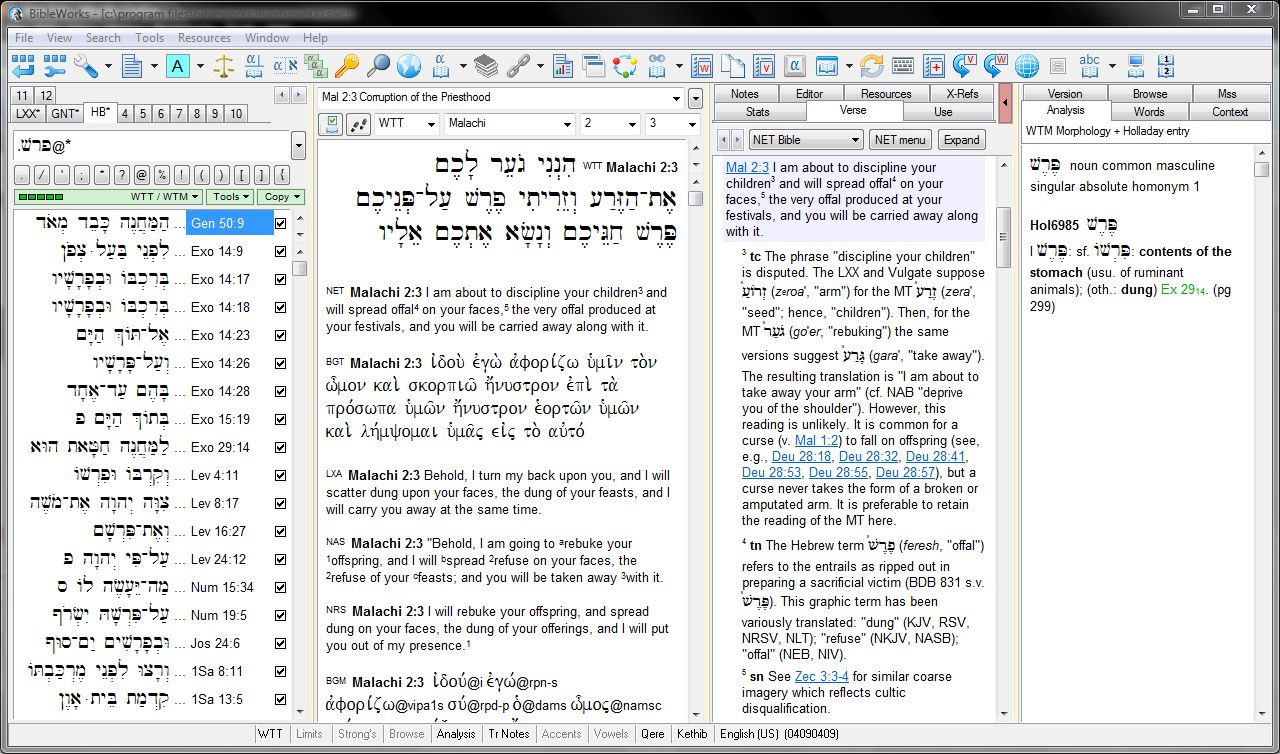
I will devote a future post to the CNTTS apparatus. Today I want to comment on and review the Verse Tab and its usefulness. Just so you can have a visual of what I’m working with, here’s a layout I’m currently using to look at the Hebrew of Malachi. (Click on the image below for larger.)

(Editorial note. File this under: can you believe that’s in the Bible? I had somehow never noticed this verse until the other day… thou shalt not trifle with the Lord, especially if you’re a priest or pastor. Take obedience to God seriously.)

Here’s the great thing about the Verse Tab. In previous versions of BibleWorks, the NET Bible study notes were only available via the Analysis Window. But this meant that if the Analysis Window were open to an NET study note, you couldn’t also at the same time easily see morphological analysis and lexical data–it was one or the other in that window. Now, however, as you can see above, you can easily access both study notes and a separate analysis window for individual word analysis. I find this new feature an immense help.

The NET study notes are fantastic. (It’s worth reading more about that translation and its notes here.) Honestly, a verse like the one I’ve chosen to highlight above might be a bit jarring to some–although in context it makes perfect sense. Yahweh was dealing with a corrupt and complacent priesthood. They were not making sacrifices in the way he had commanded (and they knew it, too). So his response in context really ought not to be a surprise. The NET note (see superscript number 4 and “tn” in the image above) clarifies that Yahweh is speaking of the entrails of to-be-sacrificed animals. The priests were supposed to dispose of these away from the sacrificial altar, but apparently were not in Malachi’s time. Bad idea. Clicking on Lev. 4:11 in the BibleWorks Search column (far left column) immediately takes me to the verse that explains this requirement.

One other neat thing about the Verse Tab: if you click on the “Expand” button, you can get a free-floating window that shows you all the NET notes for the whole Bible. This is easy to navigate through, as you can imagine:

I welcome the Verse Tab as an addition to the BibleWorks program. I’ve already made heavy use of it and will continue to in the future. For a mere $20 you can buy a module that gives you the notes and maps from the ESV Study Bible in that same tab. The program comes with the NET Bible notes already loaded.

See all that’s new in BibleWorks 9 here.

I received a free upgrade to BibleWorks 9 in exchange for an unbiased review. See my prolegomenon to a review here and part 1 (setup and layout) here. You can order the full program here or upgrade here. It’s on Amazon, too.

What language did Jesus speak?

In my top 10 reasons why you need the Septuagint I conclude with the #1 reason being that the Gospel writers record Jesus’ words as occasionally matching the Old Greek of the Hebrew Bible against the Hebrew. This has become a new research interest of mine, and there is no lack of scholarly opinion on the issue! It’s hard to tell if there’s scholarly consensus. The conventional wisdom seems to be that Jesus spoke Aramaic and read from and recited Hebrew scrolls, but that’s certainly not a universal view, from what I can tell. For example, Stanley E. Porter suggests:

… Jesus not only had sufficient linguistic competence to converse with others in Greek but also even to teach in Greek during his ministry. 

I believe that, first, it can be firmly established that Jesus did speak Greek and that we do indeed have some of his actual words. 

Porter explores the question “Did Jesus Ever Teach in Greek?” here (pdf). Thanks to the LXX Yahoo! group for the link.

Forsaken: Did God the Father kill Jesus on the cross?

“My God, my God, why have you forsaken me?”

“Never will I leave you; never will I forsake you.”

“I and the Father are one.”

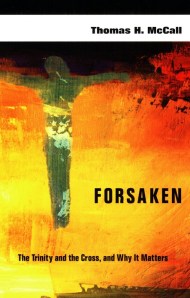
Wondering how these three verses of Scripture fit together? I often have. Cognitive dissonance finally got the better of me, and I decided I should try to think through this one a little more deeply. To that end I read Thomas H. McCall’s Forsaken: The Trinity and the Cross, and Why It Matters (InterVarsity Press, 2012). Here, on Magnificent Monograph Monday, I offer a review of the book. (Thanks to IVP for the free review copy, in exchange for an unbiased review.)

First, the very short summary of my review, if you want to cut to the chase and head off and do something else after this next paragraph.

McCall tackles some difficult questions: “Did God forsake Jesus [on the cross]? Did the Father turn his back on the Son in rage? Was the Trinity ruptured or broken on that day?” His answers and arguments are rooted in Scripture, the history of interpretation of that Scripture, and are consistently compelling. McCall really helped me through my own struggles to grasp some of these questions, leading me to a fuller understanding of the life of the Trinity and the relationship between its persons, particularly in terms of what happened on the cross. And he spells out the implications of his assertions beautifully. God is not divided, he concludes, but God–all of God–is for us. So we can rejoice and rest secure in that. Five stars, no doubt.

McCall writes “not for other scholars…but for pastors, students and friends–indeed, for anyone genuinely interested in moving toward a deeper understanding of God’s being and actions.” Forsaken is heavy theological lifting for a non-scholar (and not lightweight for a scholar, either), but the effort is well worth it. McCall answers some very common questions people ask (or are scared to ask and should ask) about the Trinity, also showing ramifications for our relationship to God.

Forsaken has four chapters. Each asks a theological question, addresses it, then concludes with some theological assertions to avoid, some to affirm, and why it matters.

The first chapter asks, “Was the Trinity Broken?” Here McCall discusses the theological concept of “dereliction,” or the idea that Jesus was abandoned by God on the cross. Recent theology notwithstanding, McCall makes a strong Scriptural case that God the Father did not forsake the Son on the Cross. Understanding Psalm 22 as an “interpretive key” to Jesus’ death, McCall writes:

No, the only text of Scripture that we can understand to address this question directly, Psalm 22:24, says that the Father did not hide his face from his Son. To the contrary, he has “listened to his cry for help.”

Not only that, the author argues, but if God truly had forsaken Jesus, why would Jesus bother–after his cry–to say, “Father, into your hands I commit my spirit”? Jesus “prefaces his last words with a sense of deep relational intimacy: Jesus addresses his ‘Father.'”

In chapter two McCall asks, “Just what are we to make of the biblical witness to the wrath of God? Is it opposed to his love? Is it a ‘dark side’ to God that is inconsistent with his holiness or with his mercy?” He makes a pretty hard-to-argue-with case that “the biblical witness does not set love and wrath in opposition to one another.” McCall, I thought, was at his best in this chapter when he highlighted multiple New Testament references to wrath–not only the wrath of God generally, but Jesus’ wrath specifically. So there’s no Old Testament God=wrath, New Testament God=mercy conclusion to be drawn from the Bible. The author utilizes the theological categories of divine impassibility and simplicity to show that “wrath” as God exhibits it is not what we might envision in human anger; rather, it is an expression of holy love.

McCall’s third chapter asks whether God’s divine foreknowledge means that God killed Jesus, since he knew it was going to happen, could have stopped it, but didn’t. “God’s plan was to use the death of Jesus for his purposes and for our good,” but God himself did not cause the death. As Acts so often makes clear, McCall points out, “The apostolic proclamation of the gospel places the fault and blame on the sinners who are responsible for the death of Jesus.”

Chapter four articulates a robust theology of justification (forensic; instantaneous; by which I enter into the life of God) and sanctification (separation unto God; progressive; by which I grow in communion with God). Page 145 and following has a brilliant interpretation of Paul’s famous Romans 7:14-25 passage where he (seemingly) wrestles with sin.

One difficult implication of this book for me as a worship leader (and coach of worship leaders) is that, if McCall is right, we may be singing some not-quite-right theology in two well-known songs. “How Deep the Father’s Love for Us” has a line that says, “The Father turns his face away.” And the song “In Christ Alone” says, “…till on that cross, as Jesus died, the wrath of God was satisfied.” McCall addresses these two claims head on and (in my opinion, successfully) refutes them. The Father did not turn his face away (see the block quote above). And to say that God the Son mollified the wrath of God the Father is to bifurcate the Trinity in some unorthodox ways. (!)

I’m not sure if it’s generally accepted for a book reviewer to admit to shedding tears when reading a review copy. (Objectivity! Right?) No matter. McCall’s concluding postscript (“A Personal Theological Testimony”) moved me to tears, as he recounted the difference “the trinitarian gospel” made for him and his family as they processed the death of his father.

Getting the theological details of the Trinity right (as best we can!) matters. It matters for our understanding of God, our relationship with him, and for all of life. In the life and truths of the Trinity–properly understood, and I think McCall a good guide here–there is great comfort. We see a God who, as McCall says, is for us. We find a God who has granted us victory over sin and death, making it possible for us to enter into communion with the triune God of love.

You can find Forsaken here at the IVP product page or on Amazon.

BibleWorks out of the box: Review of BibleWorks 9, part 1 (setup and layout)

The perennial question: Should I upgrade my BibleWorks program? I was perfectly happy with BibleWorks 7 until I upgraded to 8. (Then I was really happy with 8.) I thought 8 was such a vast improvement that when 9 came out, I saw no need… at least until I got to know version 9 a little better. Versions 7 or 8 are certainly still powerful in their own right, but my upgrade to 9 has been a great experience so far. In this and future posts, I’ll highlight why. Today: BibleWorks 9, out of the box.

The installation is easy and quick. I consider myself somewhat proficient when it comes to computer know-how, but certainly don’t have programming expertise. No matter. BibleWorks is easy to install and keep updated. And the BibleWorks staff is constant in making updates available if and as they find bugs in the program. Better than any other computer software I’ve used, in this sense.

BibleWorks 9 comes with a “Quick-Start Guide,” which has the Installation Instructions (they are mercifully short–three pages and easy to follow) and a 12-page Orientation to BibleWorks guide. The guide focuses on the Search Window, the Browse Window, and the Analysis Window, and gives instructions and specific examples as to how to best utilize each in studying the Biblical text. My only quibble with the helpful guide is that the images contained therein seem to be from BibleWorks 8, not 9. But that doesn’t really keep it from doing what it needs to, namely, quickly and effectively orienting the new or only somewhat experienced user to using the program well. (The instructions do detail the contents of the new tabs in version 9.)

BibleWorks 9 adds a delicious fourth column (essentially, a second analysis window). It looks like this (click on the png below for a larger view, if you wish):

Already this opens more options. There are also more available tabs in the Analysis Window. For example, the new “Use” tab, in my third column above, instantaneously shows you all the uses of a word with how many occurrences it has in that book and version (here, the WTT=Hebrew Bible). You had to search on a word in previous versions to do this (using the first column above). I find this particularly useful for vocabulary acquisition. As I come across a word I don’t know in the text, I can easily see–does this occur 121 times and I should know it? Or is it just in the text two or three times, so I was okay in not knowing right away what it means?

The “Verse” tab and the “Mss” tabs are new, too–those are worthy of their own post. (Anyone familiar with BibleWorks, whether they have 9 or not, may already know that this new version allows you to look at and work with images of original manuscripts.)

And, what I find best of all, you can drag and drop the tabs between the third and fourth columns so that you can customize your setup. I had already figured out a setup so that I had my own equivalent of a “fourth column” in BibleWorks 8. Now I can do even more! Check this out (from a previous post):

It’s a thing of beauty.

BibleWorks has unbeatable customer service. The user forums are active and always helpful. (Good things to know when you’re considering getting set up with them.) And they’ve provided quite a few videos to show users their way around the program. If you don’t want to wait for the rest of my review, you can see all that’s new in BibleWorks 9 here. You can order the full program here or upgrade here. It’s even on Amazon!

I received a free upgrade to BibleWorks 9 in exchange for an unbiased review. See my prolegomenon to a review here.

William L. Lane free downloads on the Gospel of Mark

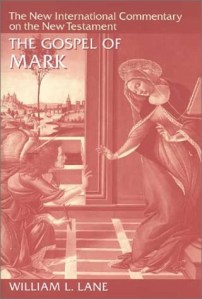
Here’s a link to a Mark teaching series that Dr. William L. Lane led at Christ Community Church in Franklin, TN in 1998. He’s the author of the commentary pictured at right, one of the best for the Gospel of Mark. (Click on the image to look inside the book at Amazon.) From the By/For site:

This Mark teaching series is led by Dr. William L. Lane, author of The Gospel According to Mark from the New International Commentary on the New Testament series. This series was the final time Dr. Lane lectured on Mark.

The study page includes a pdf file of class notes and 13 lectures by Dr. Lane. See it all here.

July 2012 Biblical Studies Carnival

Head over to Reading Acts for the July “Biblical Studies Carnival.” It’s a compilation of many, many posts on all things Biblical studies on the blogosphere in July. There is some really good stuff there, and Phil has done a great job gathering some informative links. I’m thankful to have received mention in the carnival (of my July posts here, here, and here).