NIV Application Commentaries, As Low as $4.27 Each

NIVAC sale


Zondervan’s NIV Application Commentary series is on sale, with each of the ebooks selling at $4.99–or less on Amazon.

I really liked Psalms vol. 1 in this series. There are a lot of really good volumes in NIVAC; I just picked up Genesis (now that I’m almost done preaching through it this fall-ha!), Peter Enns’s Exodus, and a few others.

All the Table of Contents now are hyperlinked, so navigating via Kindle or iBooks should be relatively manageable. You won’t get the same sort of search power you’d get in Accordance or Logos, but the price is tough to beat.

See everything here on Amazon or here at Zondervan’s page.

New Hebrew Reader’s Bible: 50% Off at ETS, SBL/AAR

BHS Reader's Edition


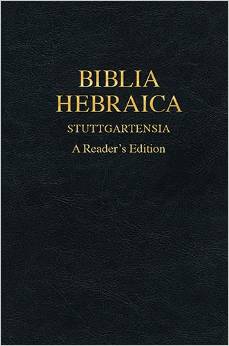
Hendrickson has published a new Hebrew Reader’s Bible. (See more here.) They’ve also posted a sample pdf online, which features the book of Obadiah (good choice!).

You order now through CBD or Amazon… OR… if you want it at 50% off, you can go to Hendrickson’s booth at the upcoming ETS (booth 222) and SBL/AAR (booth 718) conferences, and find it in its two different bindings, priced at $29.97 (from $59.95 retail) and $39.97 (from $79.95).

Conference Prices on Some Hebrew Language Gems from Eisenbrauns

This month Eisenbrauns has a sale on my favorite series of theirs: Linguistic Studies in Ancient West Semitic (LSAWS). These titles are not often on sale, and you can rarely (if ever) find a cheaper copy of anything here, even if used via Amazon.

I highlight two volumes:

Word Order in the Biblical Hebrew Finite Clause, by Adina Moshavi


Moshavi Hebrew Word OrderMany of Moshavi’s examples come from Genesis, which make them easy to understand, as she is mostly using a narrative/historical text for purposes of illustration. I’ve read 75 pages (closely) and found the book both substantive and easy to understand.

Here is the publisher’s description:

Over the last 40 years, the study of word-order variation has become a prominent and fruitful field of research. Researchers of linguistic typology have found that every language permits a variety of word-order constructions, with subject, verb, and objects occupying varying positions relative to each other. It is frequently possible to classify one of the word orders as the basic or unmarked order and the others as marked.

Moshavi’s study investigates word order in the finite nonsubordinate clause in classical Biblical Hebrew. A common marked construction in this type of clause is the preposing construction, in which a subject, object, or adverbial is placed before the verb. In this work, Moshavi formally distinguishes preposing from other marked and unmarked constructions and explores the distribution of these constructions in Biblical Hebrew. She carries out a contextual analysis of a sample (the book of Genesis) of preposed clauses in order to determine the pragmatic functions that preposing may express. Moshavi’s thesis is that the majority of preposed clauses can be classified as one of two syntactic-pragmatic constructions: focusing or topicalization.

This meticulous yet approachable study will be useful both to students of Biblical Hebrew and to persons doing general study of syntax, especially those interested in the connection between linguistic form and pragmatic meaning.


Phonology and Morphology of Biblical Hebrew, by Joshua Blau


Blau Phonology and MorphologyI haven’t read as much of this one, but is it ever detailed! It’s an excellent reference tool to look up and learn why Hebrew words are formed the way they are, and how each little part (morpheme) of a word comes into being and functions. Easily worth the $39 sale price.

From the publisher:

More than 80 years have passed since Bauer and Leander’s historical grammar of Biblical Hebrew was published, and many advances in comparative historical grammar have been made during the interim. Joshua Blau, who has for much of his life been associated with the Academy of the Hebrew Language in Jerusalem, has during the past half century studied, collected data, and written frequently on various aspects of the Hebrew language.

Phonology and Morphology of Biblical Hebrew had its origins in an introduction to Biblical Hebrew first written some 40 years ago; it has now been translated from Modern Hebrew, thoroughly revised and updated, and it distills a lifetime of knowledge of the topic. The book begins with a 60-page introduction that locates Biblical Hebrew in the Semitic family of languages. It then discusses various approaches to categorization and classification, introduces and discusses various linguistic approaches and features that are necessary to the discussion, and provides a background to the way that linguists approach a language such as Biblical Hebrew—all of which will be useful to students who have taken first-year Hebrew as well those who have studied Biblical Hebrew extensively but have not been introduced to linguistic study of the topic.

After a brief discussion of phonetics, the main portion of the book is devoted to phonology and to morphology. In the section on phonology, Blau provides complete coverage of the consonant and vowel systems of Biblical Hebrew and of the factors that have affected both systems. In the section on morphology, he discusses the parts of speech (pronouns, verbs, nouns, numerals) and includes brief comments on the prepositions and waw. The historical processes affecting each feature are explained as Blau progresses through the various sections. The book concludes with a complete set of paradigms and extensive indexes.

Blau’s recognized preeminence as a Hebraist and Arabist as well as his understanding of language change have converged in the production of this volume to provide an invaluable tool for the comparative and historical study of Biblical Hebrew phonology and morphology.


Access the sale here. The two volumes above–and some other really good titles–are available at the best discounts you’re likely to find.

Accordance 11: Now Available, and First Impressions

Acc 11_Simply Brilliant_logo


Accordance 11 is now available.

I’ve already highlighted some of the new features, as well as posted about the new Collection upgrades.

I plan to write more soon in review of the program upgrade. For now, I point you to this excellent post from Accordance, describing the “Top 11 Features of Accordance 11.”

Okay, okay–I’ll post a couple more quick looks inside now, too. The overall layout of the program hasn’t changed as much as Accordance did when going from version 9 to 10. But there are two major new features that immediately make themselves indispensable, and better aid the user in accessing resources:


1. Info Pane


With a Bible text open, click on the familiar “Add Parallel” button and select the top “Info Pane” option. You then see this (click or open in new tab to enlarge image):


Info Pane


Commentaries, cross-references, thematic topics, and critical apparatuses from your library all show up instantly. And–this is especially cool–by hovering over the book cover of a commentary or apparatus, you can see the content. The Instant Details in the image above (the pane at the bottom) shows the contents of the BHS apparatus for Exodus 20:1, just by my hovering the cursor over the apparatus image in the Info Pane.


2. Research


I thought Accordance 10’s “Search All” feature was fine–it wasn’t perfect, but it still very quickly helped you comb through all your resources at once for a given search. But the Research Tab is now faster (no idea how they did that), and the search results are (a) more clearly organized and (b) easier to work through. It looks like this when I look up Bonhoeffer:


Research 2


I’ll post more again soon. I’m already making regular use of the new features above in my weekly sermon preparation.


Thanks to OakTree Software, which allowed me to beta test Accordance 11 and has given me a review copy. More to come.


New Göttingen Septuagint Volume Just Published

Septuagint 2 ChroniclesWorking with the Göttingen Septuagint is not for the faint of heart, as I have noted before–though I have offered a couple of widely read (and hopefully helpful) posts on how to read and understand LXX-G.

New Göttingen volumes are not frequent; to publish one involves a great deal of work on the part of the editor.

Just this fall, under the editing of Robert Hanhart, publisher Vandenhoeck & Ruprecht released the 2 Chronicles Göttingen volume:

Here’s a screengrab of part of a page from a Google Book preview. The volume has the familiar font and layout of (a) critically reconstructed Greek text, (b) Kopfleiste (manuscript Source List), and (c) textual apparatus:

2 Chronicles LXX


Here is the book description:

This is the first-ever critical edition of the volume Paralipomenon II and represents a major step in the continued publication of the oldest Septuagint text available.


For this critical edition of the oldest available Septuagint text, the editor consulted Greek papyri predating the Christian era (3rd/2nd century BC), minuscule scripts from the 16th century AD as well as other Latin, Coptic, Syrian, Ethiopian and Armenic secondary translations. He also included Septuagint quotes stemming from Church authors in both Greek and Latin as well as the printed editions of the Septuagint from the 16th to the 20th century. This critical edition of the Paralipomenon II represents the continuation of the publication of the critical edition of the oldest Septuagint text available.

You can find the volume here at V & R and here at Amazon.

Free 45-Page Primer on Revised NIDNTTE

Get the New International Dictionary of New Testament Theology and Exegesis


Zondervan has just released a Revised Edition of its New International Dictionary of New Testament Theology and Exegesis (NIDNTTE).

From Zondervan:

This new revision includes:

  • Vital insights on over 3,000 Greek words — every word that ought to be in a New Testament theological dictionary
  • Scholarship on the latest debates over many word meanings
  • A wealth of background on ancient Greek and Jewish literature, shedding light on the NT’s context
  • Streamlined organization makes words easier to find and cross-reference

This thorough new revision of NIDNTTE was completed over eight years. With nearly 800 concepts (covering 3,000 Greek words) you’ll benefit from it far longer.

You can order NIDNTTE here. The free 45-page primer is available here.

TV on a Stick, from Amazon, $19

Fire TV Stick


For $19 (until 9:00 a.m. EST on Wednesday, October 29), Amazon’s Fire TV Stick is on sale:

Fire TV Stick connects your HDTV to a world of online entertainment. With a huge selection of movies and TV episodes, voice search that actually works, and exclusive features like ASAP and Prime Music, Fire TV Stick is an easy way to enjoy Netflix, Amazon Instant Video, Hulu Plus, low-cost movie rentals, live and on-demand sports, music, photos, games, and more.

According the the product page, you plug the stick in at your HDMI port, connect to the Internet, and then watch any number of shows and movies and subscription services through your TV.

Check it out here.


(Words on the Word is an Amazon affiliate, which means Amazon pays us back with a portion of any referrals. We would have posted about the Fire TV Stick anyway.)

7 New Features in Accordance 11

Acc 11_Simply Brilliant_logo


Accordance 11 has a projected release date of late October.

So far, via the Accordance Forums and their Facebook page, they have revealed 5 new features of Accordance 11 in advance of its release. (Actually 7ish, if you count a couple you can see in their podcast–see #6 and #7 below.) I use Accordance nearly every day, so expect a full review of 11 when it comes.

Everything in this post comes from something Accordance has publicly mentioned or shown; I have no insider info about new features, and if I did, I wouldn’t blog it anyway. 🙂 But, read on….


1. New categories for organizing Tools

As Accordance puts it, “23 new and useful categories for your books for better organization and easier access.”


23 Tools Categories


2. “Search All” has changed to “Research”

A forum post by a staffer cryptically says, “Search All is now Research, but the biggest difference can be found in the results!” See photo here. UPDATE: It’s no longer cryptic. Check this out.


3. Selective Easy Install (i.e., install only what you want)

This gives the user at last “the ability to selectively choose which titles to install from Collections or bundled titles.” See here for a screenshot.


4. New Collections

Here you can compare what’s in the new Collections. You can upgrade now, with the promise of a download of Accordance 11 when it’s ready.


5. Custom Upgrade pricing

An Accordance blog post explains clearly here how the new upgrade pricing system works.

And Dr. Tim Jenney shows off the new Collections in this podcast:


6. Take your own notes on Tools

It would appear from Dr. J’s setup in the podcast above that users can now take their own notes on Tools (commentaries, books, dictionaries, etc.). This has not been possible so far in Accordance. It’s a welcome addition.


7. Some kind of verse-by-verse passage guide

Logos has a Passage Guide (at least since Logos 4) that helps you quickly see all your resources that correspond to the passage or verse you are studying. It appears from Dr. J’s setup that Accordance 11 will introduce something similar. Can’t wait to see it–given how good Accordance programmers are at writing code, I’m sure it will move very quickly with the user through a passage.


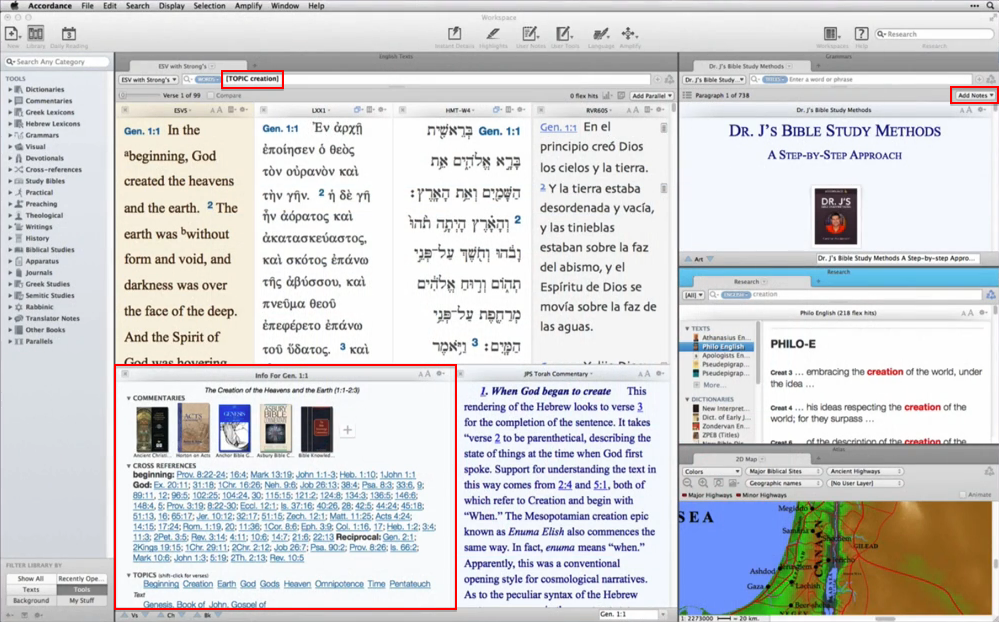
Here, by the way, is a screen grab from the podcast, highlighting some of the above–the “TOPIC” search Dr. J’s Workspace has seems keyed somehow to the passage guide (or whatever Accordance will call it). It’s low-res, so go watch the first 30 seconds of the podcast in HD, pause it, and see for yourself.


Acc 11_Dr. J Workspace_New


More to come….

You Have 10 Days to Get Yourself a Bonhoeffer Hoodie or T-Shirt

This is easily the most awesome piece of clothing I have ever seen:


Bonhoeffer Hoodie


And the Teespring “campaign” that offers it has enough pre-orders that it will go into production again! So you can order one now before the window closes.

Read details about Teespring and how it works here. You can go get the shirt ($20) or hoodie ($30) here.

New Hebrew Reader’s Bible This Fall

BHS Reader's EditionThis fall Hendrickson will publish a new Hebrew Reader’s Bible.

Hendrickson says it is:

A helpful language reference tool for students, pastors, and scholars. The BHS Reader’s Edition is for those who have a basic understanding of Biblical Hebrew and desire to read and study the Hebrew Bible. With this book alone (and a year’s study of Hebrew), students are able to read the Hebrew Bible in its entirety.

Zondervan already has such a Bible, which is the first Hebrew Bible from which I ever read (cue strings). But BHS Reader’s Edition has vocabulary helps for even more words, as well as verb parsings.

Here are the main features, in the words of the publisher:

  • Complete text of the Biblia Hebraica Stuttgartensia, checked against the Leningrad Codex
  • All words that occur fewer than 70 times are parsed and contextually defined in the apparatus
  • Glossary listing of all other words
  • Improved layout of poetic text
  • All weak verb forms are parsed
  • High quality paper does not bleed through

UPDATE: One of the authors (not Moses, though) notes that it includes full Hebrew paradigms, too. Looks like it will really be a one-stop shop for Hebrew Bible reading!

You can pre-order now through CBD or Amazon (affiliate link that helps support Words on the Word).

Once I get a look, I’ll report back!