First things first: Do we really need another commentary series? This video from Baker Publishing offers an (affirmative) answer, as it introduces the new Teach the Text Commentary Series:
I agree. As I’ve worked through the Romans volume in the Teach the Text (TTT) series, by C. Marvin Pate, I’ve appreciated the way it balances “the best of biblical scholarship” with the actual end product of the sermon in view. TTT has a fantastic accompanying Website.
Baker has summarized the layout of the commentary well here. Each text unit (or passage) is “six pages of focused commentary,” consisting of the following:
“Big Idea” at the head of each passage. This is not to be confused with “big idea” preaching, as this commentary’s “big idea” tends to stay within the world and era of the biblical text.
A “Key Themes” sidebar. This expands a bit on the “big idea” in bullet-point format to draw out key points from a given passage.
“Understanding the Text.” This is the meat of the commentary, and covers literary context, outline and structure, historical background, theology, and interpretation.
“Teaching the Text.” Here Pate offers guidance in how one could preach and/or teach the text, with an eye specifically to application. Pate suggests what sermons/sermon topics come to mind for him in a given passage. More technical or scholarly commentaries tend not to include this step.
“Illustrating the Text.” This feels like the added bonus section. Having a topic in mind is just a first step. Culling from history, literature, art, the social sciences, and more, Pate gives ideas for how the preacher or teacher could help make the sermon or lesson come alive via illustration.
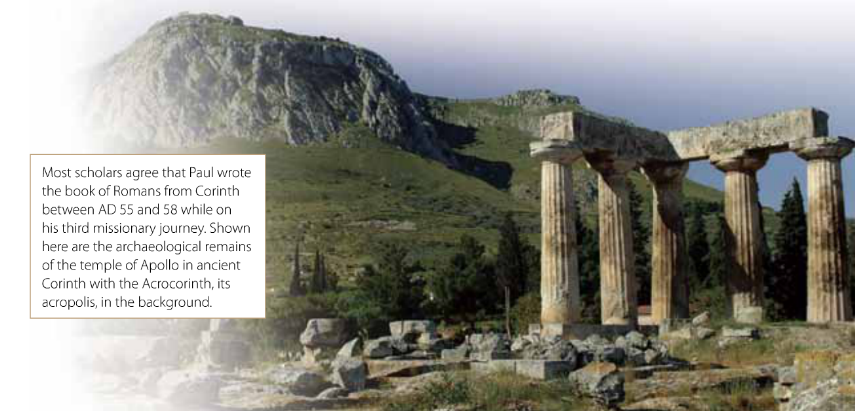
The full-color photographs throughout the text are of high quality, and help connect the reader visually to the ancient world.
From the commentary: Corinth, where Paul wrote Romans
There are also “Additional Insights” throughout the commentary, that more fully develop themes like “The Backgrounds of Christian Baptism,” “Faith and Law in Paul,” and others.
Pate’s 15-page introduction to Romans covers Paul’s world(s), letters, theology, composition, Romans in history, date and place of writing, recipients, theme, purpose, and genre. He writes:
Paul therefore writes Romans to defend his gospel of the grace of God through Christ by arguing that it is rooted in the Old Testament (Rom. 2-5), providing the disclaimer that it is not antinomian in ethic (God’s grace is not a license to sin [so Rom. 6-8]), and holding out a future for Israel (Rom. 9-11).
Not all will agree with Pate’s view of “Romans as Paul’s official doctrinal statement,” but, then again, many will. I was wishing the introduction had given more attention to Paul’s theme of a justification by faith that is decidedly pan-ethnic. Pate does talk about “the end-time conversion of the nations,” but there is also a sense in which Paul is interested in multiethnic justification (where all are saved by faith, whether Jew or Gentile) now. Fortunately the body of the commentary does address this theme in places (e.g., in Rom. 3:21-26–“So Paul’s point is that God offers justification equitably to all”).
From the commentary: map of the Roman Empire
Pate is able to interpret from multiple vantage points, synthesizing material across centuries that will benefit preachers in their sermon preparation. He moves from lexical analysis (Greek is transliterated) to 1st century historical background to practical theology in a fairly seamless manner. The illustrations are on point, too. He points out, for example, in Romans 13:13-14, that Augustine’s conversion story included meditation on these verses. The same unit includes an illustration involving Jean Valjean and Les Mis. Movie illustrations and hymn quotations are particularly present throughout, though preachers will also want to use their own, original illustrations, too.
The series claims to be “an essential commentary for pastors.” If and as pastoral budgets permit, I’d echo the sentiment and recommend this series as a worthy bookshelf addition.
More TTT volumes are on the way, including a posthumous Luke volume by the blessed R.T. France. Lord willing, as I continue to preach through Luke, I’ll review France’s volume in the future. A full-color pdf sample of Romans (including the introduction and first passage) is here.
Thanks to Baker Publishing for the review copy of Romans. Its Baker product page is here, and it is for sale at Amazon here.
Accordance Bible Software for Windows is officially released. I’ve reviewed Accordance for Mac at length here. It’s an excellent program, the Bible software I use the most.
Accordance writes:
For over ten years, Accordance has been available to PC users with the Basilisk II emulator. While the emulator version included most of the same features as Accordance for Mac, it was an imperfect solution. We have long desired to give Windows users the native version of Accordance they truly deserve, and now that day has finally come. We are pleased and excited to announce the release of Accordance for Windows.
There’s a free trial here. See all the details here.
I got an ad in the mail the other day for a new commentary series that claimed to avoid all the weaknesses of previous commentary series while building on their strengths. (!)
With how many good “old” commentaries there are, I think commentary users should critically examine new series, and certainly not take claims like the above too seriously. (Every commentary set has weaknesses.)
That said–Zondervan’s new Exegetical Commentary on the New Testament series is a real winner. It adds important elements to the mix that are not present in previously published commentaries. As a preacher with a scholarly interest in Scripture, I find this series to cover many bases well. It would be good for a student, professor, preacher, or even someone who didn’t know Greek and wanted to go more deeply into a given book.
I’ve (favorably) reviewed James and Luke in the same ZECNT series. Like the rest of the series, Colossians and Philemon includes the following for each passage of Scripture:
The full Greek text of Colossians and Philemon, verse by verse
The author’s English translation
First, passage by passage in the graphical layout
Second, verse by verse next to the Greek
The broader “Literary Context” of each passage (within the larger book)
An outline of the passage in its surrounding context
The Main Idea (this is a great focus point for preachers)
Structure
A more detailed “Exegetical Outline”
“Explanation of the Text,” which includes the Greek and English mentioned above, as well as the commentary proper
“Theology in Application” concludes each passage
The fact that the commentary has within it all the Greek and English of the two books under examination means you can take the single book (and no other) with you for thorough study of Colossians and Philemon.
Author David W. Pao makes frequent use of Greek throughout the commentary, but a non-Greek reader would also make profitable use of his comments.
Colossians has a 16-page introduction and 8-page bibliography; Philemon’s introduction is 13 pages, its bibliography 4. A “theology” section of 13 and 9 pages, respectively, concludes each book.
Regarding authorship of Colossians, Pao writes, “Among the various possibilities, to consider Paul as the author of Colossians is still the best hypothesis on which our reading can be constructed.” Like Murray J. Harris, Pao deduces this due to the various parallels (e.g., the opening greeting sections) between Colossians and Philemon, which is almost universally accepted as Pauline. He dates both letters to 60-62 AD, being written by Paul during his Roman imprisonment.
Pao is a good writer, too. This is from the introduction to Colossians, on its significance:
This letter that addresses a congregation challenged by a form of syncretism has significant contemporary application in a society in which the “virtues” of pluralism and tolerance are exalted as most important. Instead of simply pointing out the errors of the various practices and beliefs promoted by the false teachers, Paul begins and ends with an intense focus on Christ as the foundation of the believers’ existence. As a result, one finds powerful theoretical and practical outworkings of a robust Christology. In this letter, the readers encounter a detailed portrayal of the unique identity and final authority of Christ, and this portrayal enriches the high Christology found elsewhere in Paul’s letters.
This slightly longer excerpt on Col. 3:3 shows how adeptly Pao blends lexical study with historical background in a way that incorporates today’s Christian settings… all from an appreciated doxological posture:
That this life “is hidden with Christ” is significant in a number of ways. First, the verb “to hide” (κρύπτω) can signify close association (cf. Luke 13:21), and this meaning is certainly present in light of Paul’s identification of Christ as “your life” (ἡ ζωὴ ὑμῶν). To be “hidden with Christ” reaffirms the believers’ participation in Christ’s death and resurrection as they anticipate the final consummation of God’s salvific act at the end of time.
Second, to be “hidden with Christ” necessarily implies the security that one finds in Christ. The following verse explains the purpose of this hiddenness as it guarantees the final participation of believers in the revelation of God’s glory. This security from the evil powers is also implied in the reference to their dying with Christ, an act that points to the freedom of the threats posed by the opposing spiritual powers (2:20).
Third, in light of 2:3, where Paul asserts that in Christ “all the treasures of wisdom and knowledge are hidden,” Paul is here affirming that the lives of believers are also contained in Christ. This may serve a polemical purpose as Paul argues against those who continuously seek to get access to the heavenly mysteries. Paul’s response is that believers are already hidden with all the treasures in Christ. The sufficiency of Christ cannot be challenged, and to seek for these treasures elsewhere is to betray the true gospel.
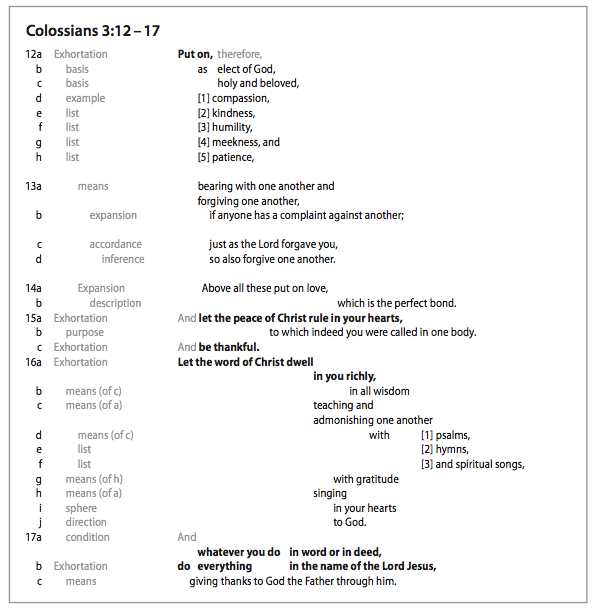
Out of all of the above features, the graphical layout is my favorite in this series and in this volume. It’s what makes the ZECNT something I’ll always reach for when preaching on a given passage–and early on in the process, too. Here’s what it looks like:
Col. 3:12-17
The main clauses are in bold, and subordinate clauses are indented under them. It’s easy to see, at a glance, how all the parts of a sentence and paragraph relate. The words in gray at left describe the function of each line (exhortation, expansion, etc.).
Pao is a refreshingly enjoyable writer who knows this terrain very well. Preaching or teaching from Colossians/Philemon (or even studying in depth on one’s own or with others) would be greatly enhanced by use of his commentary.
I am grateful to Zondervan for the gratis review copy of this commentary, which was offered to me in exchange for an unbiased review. You can find the book on Amazon here. The Zondervan product page is here. See a pdf sample of the book here.
The massive LSJ Greek-English Lexicon for Logos (9th ed. with revised supplement) is an invaluable resource for Greek lexicography, covering the classical and New Testament eras. I wrote more about the lexicon in Logos here. How does it look and work on an iPad?
As much as I still look back nostalgically on my early days of Greek and Hebrew reading–where I used only a paper lexicon to look up words I didn’t know–I don’t miss how time-consuming it was. I’m able to do more reading now, not just because of (hopefully!) increased language proficiency, but also because of computerized versions of the same lexicons.
The Liddell and Scott Greek–English Lexicon (LSJ) covers Greek of the classical variety (Homer, Plato, Aristotle, etc.) and of the Septuagint, New Testament, and early church variety. I’ve had the pleasure recently of accessing LSJ via Logos Bible Software.
Something I immediately appreciated about the Baker Exegetical Commentary set is its clear statement of purpose in the Series Preface, found in each of the 15 volumes published so far:
The chief concern of the Baker Exegetical Commentary on the New Testament (BECNT) is to provide, within the framework of informed evangelical thought, commentaries that blend scholarly depth with readability, exegetical detail with sensitivity to the whole, and attention to critical problems with theological awareness. We hope thereby to attract the interest of a fairly wide audience, from the scholar who is looking for a thoughtful and independent examination of the text to the motivated lay Christian who craves a solid but accessible exposition.
A dear friend recently remarked (wryly) that he saw a lot of “for dummies” books on my shelves. One of those books is a sort of bible of blogging: Blogging All-in-One for Dummies.
Why blog? I answered that question a year ago, shortly after starting Words on the Word, and again six months in. More than a year later, I’ve had the chance to spend some time with Susan Gunelius’s massive work.
It consists of “8 Books in 1,” or “minibooks,” as Gunelius describes them inside. Each minibook (and each chapter therein) is meant to stand alone. (It’s easy to read and use the book this way.) The minibooks range from 65 to 136 pages each. A basic glossary and carefully compiled index round out the 700+ pages in the book. It carries like a phone book, but with thicker paper, still of the newsprint variety.
The work aims to be (and is) “a complete guide to blogging, all in one place.” The author writes “primarily for a beginner audience–people who have never blogged,” but as noted below, there is plenty of advanced information for even the “skilled bloggers” she also has in mind.
Here are the eight overarching topics that Gunelius treats:
Book I: Joining the Blogosphere
Blogging 101–from the history of blogs to the types of blogs, including motivations behind different blogs and how to make them successful. This is a sort of quick start guide. Particularly helpful for beginners here are the screenshots showing the various parts of a blog (comments, trackbacks, home page, etc.). The “Blogging Rules and Ethics” section is essential reading.
Book II: Niche Blogging
Niche blogs “usually fill a void that other, larger blogs are missing but audiences want.” There are some drawbacks to niche blogging, Gunelius notes, like a smaller audience and less traffic, but there are still unique opportunities for monetization (which she treats more at length later in Book VII) and building relationships with others who have a similar area of interest.
Book III: Corporate and Business Blogging
Using examples of business blogs (“Companies That Do It Right”) like Southwest Airlines, Zappos, and Wine Library TV, the author shows how to build an online brand through blogging. She notes a “fine line… between publishing promotional content on your business blog that is useful and valued by readers and publishing so much promotional content that your blog is viewed as all marketing and no substance.” There are practical, simple pieces of advice, too: have a giveaway contest, include social media links for sharing your blog posts, responding to comments. The content here is not exceedingly advanced, but addresses appropriately the target audience of … well… dummies (i.e., beginners).
Book IV: Choosing a Blogging Application
This is one of the most useful minibooks. Even if a would-be blogger is ready with good content, topics, and publicity, knowing what medium to use can be a challenge. Here Gunelius offers a guided tour (again, complete with screenshots) of WordPress, Google Blogger, TypePad, and Tumblr. She includes both free and paid options in her analysis. I’ve been using WordPress for a year, and had no idea about all the free themes available at the WordPress Themes site she mentioned.
Book V: Blogging Tools
Once you’ve got a blog, this minibook looks at SEO (search engine optimization), measuring blog traffic, using images, blog feeds, and more. This is probably the most advanced material in the book, that even non-beginners will find useful. Her almost pastoral admonition to “try to refrain from checking your blog’s statistics every day” (i.e., “worrying about daily traffic fluctuations”) is a needed one for many bloggers.
Book VI: Promoting and Growing Your Blog
More advanced material here. She covers contests, guest blogging (whether you do it elsewhere or host it on your blog), “social bookmarking,” and other ways to increase site traffic.
Book VII: Making Money from Your Blog
Most bloggers (hopefully) realize blogging is not a terribly lucrative business, especially not in its initial stages (i.e., first couple years). But there are still ways to make money from blogging–whether that is through ad placement, merchandising, or participation in affiliate programs. Gunelius begins this minibook as she so often does, with the big picture: “[Y]ou need to determine what your blogging goals are and then decide whether publishing ads on your blog in an attempt to make some money matches those goals or runs counter to them.” Especially helpful is the short section on the Federal Trade Commission’s guidelines for any “material connection” a blogger has with a company or product they are reviewing or advertising.
Book VIII: Microblogging with Twitter
Ah, Twitter. I wrongly predicted its demise just months after its inception. “Microblogging” might be too strong a word for how some people use the site (“wordbutchering” could be more appropriate?). I’m not sure Gunelius’s “Everyone is tweeting!” assessment is completely on target, but she is right, I think, that Twitter and other “microblogging” services go beyond what just 140 characters of text can offer. And because microblogging is “convenient, far-reaching, and free,” bloggers ought to pay attention to it. Gunelius takes the reader deep into the world of tweeting, URL shorteners, hashtags, and third-party Twitter applications.
Blogging All-in-One for Dummies is engaging and easy to read. Gunelius is clearly an expert on this topic, and this encyclopedic work bears that out. Copious screenshots and diagrams give visual reinforcement to the text throughout. The index and clearly delineated chapters make it a highly useable reference work–one which I know I’ll turn to often as I continue to blog! It’s a great one-stop shop for bloggers or those who would be bloggers. Yes, even still in 2013.
You can see more about Blogging-All-in-One for Dummies at Amazon here (affiliate link) or here (Wiley’s product page, including an excerpt and the full table of contents). The book’s “cheat sheet” is available here. Many thanks to Wiley for the gratis review copy for the purposes of my writing an objective review.










 Words on the Word