Last week I posted some initial impressions of the just-released Logos 5. Having had a little more time with it now, here are some further impressions I have.
The Data Sets guide the user through resources nicely and can do some unique things.
The Logos 5 Data Sets are what most stand out to me on further use. Two in particular to note:
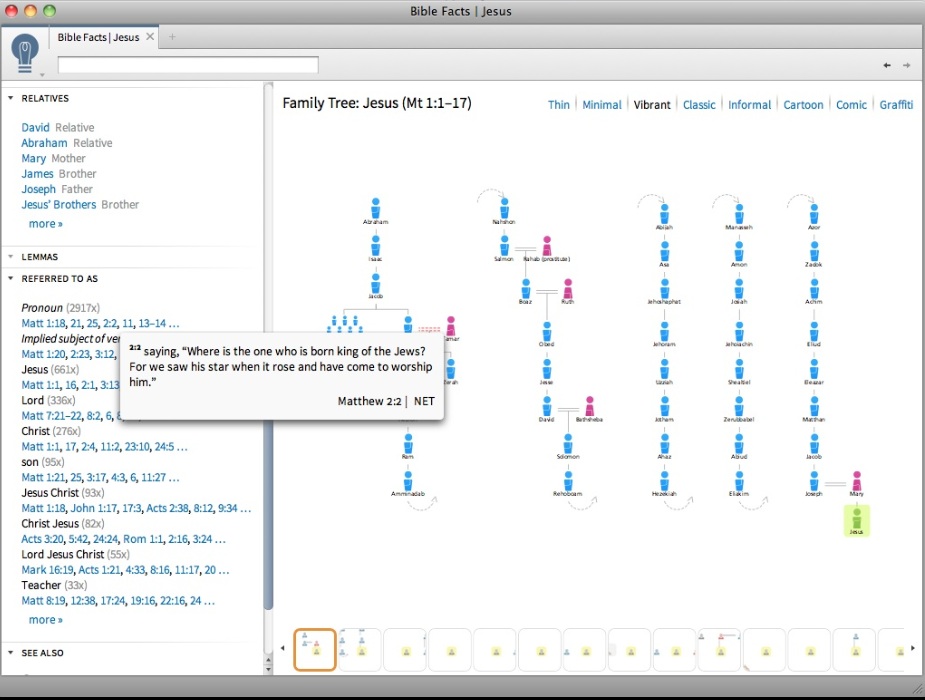
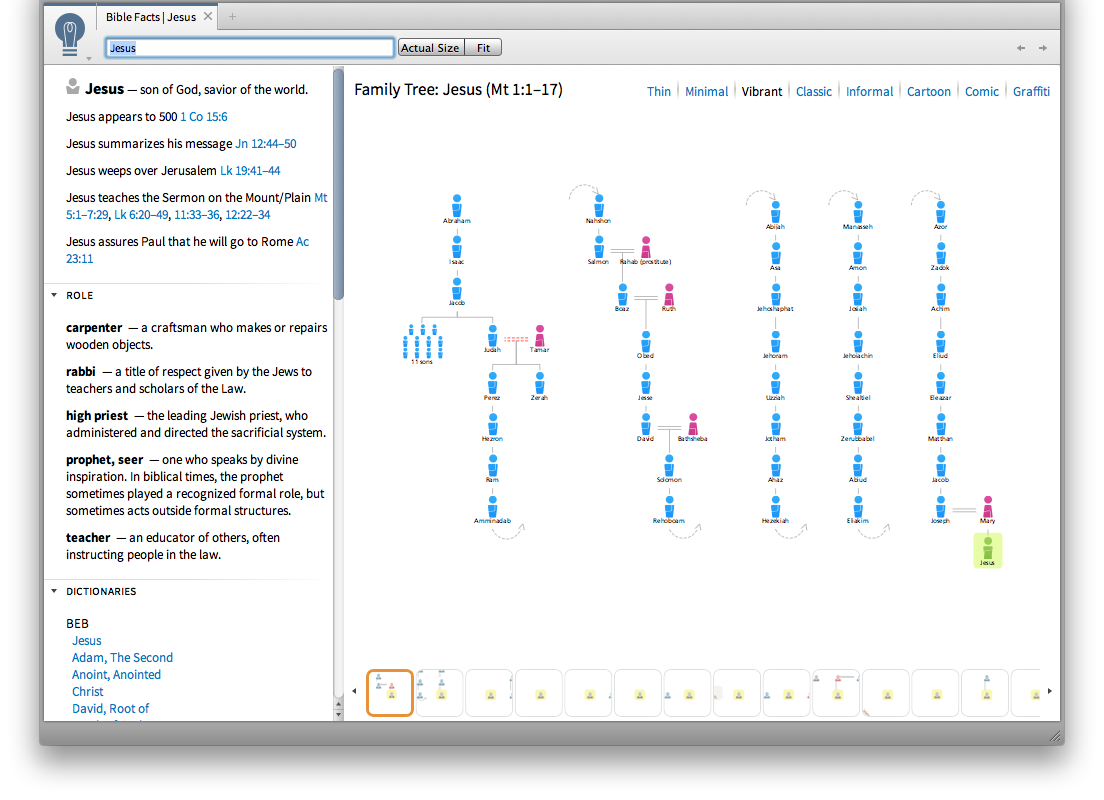
Bible Facts (People): this allows me to search by a referent and not just by the actual wording in the text. For example, by going to “Tools” from the home screen, then “Bible Facts,” I can type in “Jesus” to see not just where that word occurs in the text, but also where the text is referring to Jesus, whether by “he,” as “Christ,” “Son,” and so on. It’s a lovely and very impressive feature. Take a look, and click on the image to see larger:
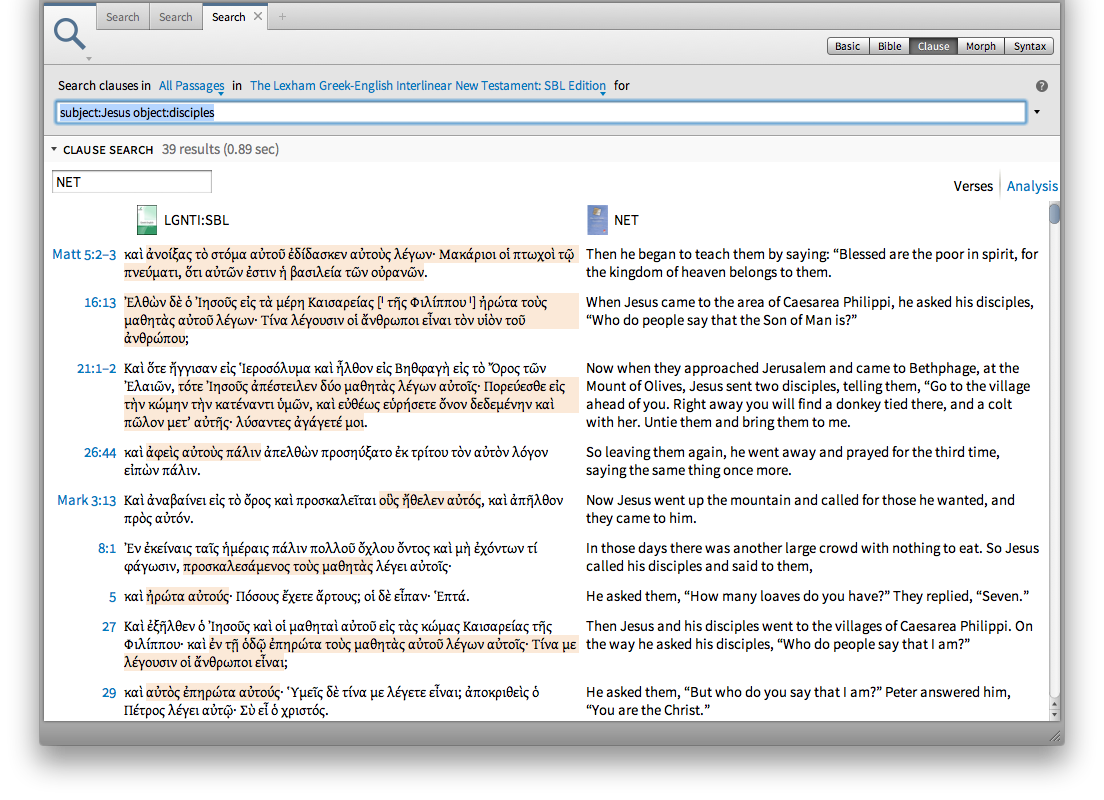
Clause Search: Another you-have-to-use-it-to-believe-it feature. Here I can find (in less than a second) every time Paul is the subject of a clause, whether “Paul” occurs in the text or not. This means I can search on Paul in Acts, but also on the things Paul says about himself (using just “I” in the text) in his epistles. Or, I can search at the clause level for times when Jesus is the subject and his disciples are the object. As here:
Note that the first result is Matthew 5:2-3, where the words “Jesus” and “disciples” don’t even appear in the text (!) but the “he” refers to “Jesus” and “them” to his disciples. Of course, there is some interpretation at play here in the results. The disciples are the closest referent to “them” in the text, but Matthew 5:1 also mentions the crowds, who could also be what “them” refers back to. But the fact that the Clause Search can, in under a second, return these kinds of results is astounding. It’s searches like this that are why Logos markets itself as “powerful.”
The search speed of the program has improved (though is still not the fastest on the market).
Logos 5 is an overall faster program than Logos 4. (I use Logos primarily on a Mac.) The clause searches I’ve done, for example, have been lightning fast. But Logos is still not quite as fast at returning results for original language word searches as BibleWorks or Accordance. I wondered with Logos 4 whether this might be because Logos has a large library of resources. Whatever the reason, the multi-second waits for search results to come up are less common in 5 than in 4. Most of my searches have been showing results in a second or less, even the clause searches that I’d expect to take longer. Accordance and BibleWorks, however, give near instantaneous search results. Logos, with v. 5, is at last in the same ballpark with regard to speed.
The contents of the base packages have changed significantly.
This does not affect previous Logos users necessarily, in that you always keep your Logos resources with you (for life). So if you upgrade to Logos 5 via a new base package, anything you had bought previously stays with you, even if it’s not in the new base package. For someone like me who primarily uses Bible software to study biblical languages, the Original Languages Library in Logos 4 was great (except, perhaps, for its lack of an English translation of the Septuagint). Even with its retail price under $500, that package still included the full 10-volume Theological Dictionary of the New Testament (TDNT), making it a good deal, and a great deal with the academic discount.
Now to have TDNT in a base package (if you don’t already own it), you have to buy the “Gold” package at a retail price of just over $1,500. The Silver package in Logos 5, that I received to review, includes the entire New American Commentary set, the full Pulpit Commentary set, the Lexham Analytical Lexicon to the Septuagint (and the same to the Greek NT), several Greek and English Apostolic Fathers texts, the Theological Lexicon of the OT (and that of the NT), as well as many more resources for a retail price of about $1,000. I was particularly excited to see a new English translation of the Septuagint, coming from the Lexham suite by Logos. Users will simply have to weigh whether the included resources in a package justify its cost. The Silver package seems to be worth the price. (Though note that the fairly standard Rahlfs Septuagint text is not included in Silver; Swete’s text is.)
This video from Logos gives a good overview of what’s new in Logos 5, with special focus on the Data Sets:
Thanks to Logos for the review copy of Logos 5 with the Silver package, provided to me simply with the expectation that I offer my honest impressions of the program.
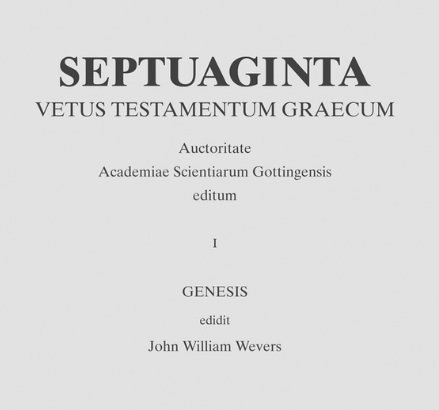
The Göttingen Septuagint is the Cadillac of Septuagint editions. It’s the largest scholarly edition of the Greek translation of the Hebrew Bible. Its full name is Septuaginta: Vetus Testamentum Graecum Auctoritate Academiae Scientiarum Gottingensis editum, published by Vandenhoeck & Ruprecht in Göttingen, Germany. The Göttingen Septuagint has published more than 20 volumes spanning some 40 biblical books (counting the minor prophets as 12), and publication of additional volumes is in progress.
But the Göttingen Septuagint is not for the faint of heart, or for the reader who is unwilling to put some serious work in to understanding the layout and import of the edition and its critical apparatuses. A challenge to using Göttingen is the paucity of material available about the project, even in books about the Septuagint. An additional challenge is that the critical apparatuses contain Greek, abbreviated Greek, and abbreviated Latin. The introductions to each volume are in German, though below I cite from English translations of the introductions to the volumes of the Pentateuch.
It is my intention with this post, and a second to follow, to give a short primer or user’s guide to the Göttingen edition. Here I offer suggestions on how to read and understand the text, the apparatuses, the sigla/abbreviations, the introductions, and point to additional resources that will be of benefit to the Göttingen user.
I recently put together a basic orientation to the scholarly editions of the Hebrew Bible and the Greek translation of the same. That is here. It is worth noting again that the International Organization for Septuagint and Cognate Studies (IOSCS) has a good, succinct article on the various editions of the Septuagint. Below, “OG” stands for “Old Greek.” They write:
The creation and propagation of a critical text of the LXX/OG has been a basic concern in modern scholarship. The two great text editions begun in the early 20th century are the Cambridge Septuagint and the Göttingen Septuagint, each with a “minor edition” (editio minor) and a “major edition” (editio maior). For Cambridge this means respectively H. B. Swete, The Old Testament in Greek (1909-1922) and the so-called “Larger Cambridge Septuagint” by A. E. Brooke, N. McLean, (and H. St. John Thackeray) (1906-). For Göttingen it denotes respectively Alfred Rahlfs’s Handausgabe (1935) and the “Larger Göttingen Septuagint” (1931-). Though Rahlfs (editio minor) can be called a semi-critical edition, the Göttingen Septuaginta (editio maior) presents a fully critical text….
In other words, rather than using a text based on an actual manuscript (as BHS, based on the Leningrad Codex, does), Göttingen utilizes a reconstructed text informed by a thorough examination of manuscript evidence. Göttingen has two critical apparatuses at the bottom of the page of most volumes. Because it is an editio maior and not an editio minor like Rahlfs, a given print page can have just a few lines of actual biblical text, with the rest being taken up by the apparatuses. Here’s a sample page from Genesis 1. Note the #s 1-4 that I’ve added to highlight the different parts of a page. Below I explain #1 and #2; the rest comes in a follow up post.
1. The reconstructed Greek critical text (“Der kritische Text”)
With verse references in both the margin and in the body of the text, the top portion of each page of the Göttingen Septuagint is the editorially reconstructed text of each biblical book. In the page from Genesis 1 above, you’ll notice that the text includes punctuation, accents, and breathing marks.
Like the NA27 (and now NA28) and UBS4 versions of the Greek New Testament, Göttingen is a critical or “eclectic” edition, which “may be described as a collection of the oldest recoverable texts, carefully restored book by book (or section by section), aiming at achieving the closest approximation to the original translations (from Hebrew or Aramaic) or compositions (in Greek), systematically reconstructed from the widest array of relevant textual data (including controlled conjecture)” (IOSCS, “Critical Editions”).
Of the critical text, John William Wevers, in his introduction to Genesis in Göttingen, writes:
Since it must be presupposed that this text will be standard for a long time, the stance taken by the editor over against the critical text was intentionally conservative. In general conjectures were avoided, even though it might be expected that future recognition would possibly confirm such conjectures.
It must be clearly evident that the critical text here offered labored under certain limitations. The mss, versions and patristic witnesses which are available to us bring us with few and small exceptions no further back than the second century of our era. Although we do know on the basis of second and third century B.C.E. papyri something about the character of every day Greek used, our knowledge of contemporary literary Greek is very limited indeed. In other words, the critical text here offered is an approximation of the original LXX text, hopefully the best which could be reconstructed on the basis of the present level of our knowledge. The editor entertains no illusion that he has restored throughout the original text of the LXX.
One cannot simply say, “The LXX says…,” because then inevitably an appropriate response is, “Which LXX? Which manuscript? Which or whose best attempt at reconstruction?” So “approximation of the original” and “hopefully the best which could be reconstructed” are key phrases here.
All the same, especially in the newer Göttingen editions, the volume editors have viewed and listed the readings of many manuscripts and versions. The critical apparatuses are where they list those readings, so the user of Göttingen can see other readings as they compare with the critically reconstructed text. (Because the Göttingen editions are critical/eclectic texts, no single manuscript will match the text of the Göttingen Septuagint.) And although scholarly editions of the Greek New Testament also present an eclectic text, neither the NA27 nor UBS 4 is an editiomaior, as Göttingen is.(The Editio Critica Maior is just recently begun for the GNT.) Serious works in Septuagint studies, then, most often use the Göttingen text, where available, as a base.
2. The Source List (“Kopfleiste”)
Not every volume has this feature, but the five Pentateuch volumes, Ruth, Esther, and others do. The Kopfleiste comes just below the text and above the apparatuses. Wevers notes it as a list of all manuscripts and versions used, listed in the order that they appear in the apparatus on that page. A fragmentary textual witness is enclosed in parenthesis.
In the above Kopfleiste, the parentheses around 912 mean that papyrus 912 is fragmentary. The “-” preceding it, Wevers notes, means that its text ends on the page in question. So although this particular Göttingen page has Genesis 1:4-9 reconstructed in the critical text (“Der kritische Text”), “(-912)” in the Kopfleiste indicates that the fragmentary papyrus 912 does not actually contain text for all the verses on the page. Looking up papyrus 912 in Wevers’s introduction to Genesis, in fact, confirms that this third to fourth century papyrus contains only Genesis 1:1-5.
By contrast, the “(D-)” here
indicates that the uncial manuscript D has its text beginning on the page in which it appears in Göttingen. The above shot is from the Göttingen page containing Genesis 1:9-13. The first time D has anything to offer (since it is fragmentary, indicated by its enclosure in parentheses) is at 1:13. This alerts the reader that D has no witness to Genesis 1:1-12. Wevers’s introduction then gives more information about the contents of that manuscript. So, too, with the minuscule manuscript 128 above–the introduction says of 128, “Init [=Latin initium=the beginning] – 1,10 is absent.”
Wevers adds:
Should a piece of text be lacking due to some external circumstance in a particular ms, this is noted in the Source-List. For example if ms 17 lacks the text this is shown as O-17. What this means is that the entire O except 17 (which belongs to O) has the text in question. The abbreviation al (for alia manuscripta) refers to the mss which belong to no particular group, i.e. the so-called codices mixti as well as mss which are too fragmentary to allow classification. The expression verss designates all the versions which have the complete text of Genesis. Versions such as Syh to (31,53) and Pal, whose texts are not complete, are listed at the end of the Source-List (Kopfleiste).
In terms of the order of citing Greek textual witnesses:
In the apparatus the citation of Greek sources appears in the following order: First place is occupied by the uncial texts in alphabetical order, and characterized by a capital letter. Then the papyri are cited in the order of 801 to 999. Then the hexaplaric group [AKJ: “O” above] is given as well as the Catena groups [AKJ: C‘’], with the mss groups following in order as: b d f n s t y z; then the codd mixti, followed by the mss without a Rahlfs number. Next come the NT citations, and finally, the rest of the patristic witnesses in alphabetic order.
In the next part of this Göttingen Septuagint primer, I’ll explore #3 and #4 above, the First Critical Apparatus (“Apparat I”) and the Second Critical Apparatus (“Apparat II”), as well as take a closer look at the contents of the Introductions in the Göttingen editions (“Die Einleitung”).
UPDATE: Part 2 of the primer is here, with still more to follow.
Thanks to Brian Davidson of LXXI for his helpful suggestions on an earlier draft of this post.
This video from Logos shows what’s new in Logos 5. It mentions some of the same features I wrote about in my early review. Of special note, though, is the explanation of the Bible Sense Lexicon, new in Logos 5, beginning at 2:23. The Silver package I received for review does not have the Bible Sense Lexicon, but the Gold package and packages above Gold do have it.
More Logos-created videos introducing version 5 are here.
Thanks to Logos for the review copy of Logos 5 with the Silver package, provided to me simply with the expectation that I offer my honest impressions of the program, which I began here.
I started using Logos 4 two months ago for a review I finished last week. Now version 5 is released today. But 4 had been out several years, so v. 5 has been in the works for some time. Having had and used Logos 5 for a few days now, I want to offer an initial set of impressions by way of review.
As I installed Logos 5, it was nice to know that I’d have access to all of my same resources, layouts, and highlights in books from Logos 4 when version 5 downloaded. This is one of my favorite things about Logos, and a feature that sets it apart from other Bible software. Logos works best with Internet enabled; you use a log-in that works across multiple computers and devices. After using Logos on a Mac, yesterday I opened it on my PC, and it opened exactly as I had left it on the Mac–all the same windows opened to all the same pages, like I had never stopped working. This is an immense time saver and a great feature.
Knowing this made the thought of installing 5 in place of 4 easier to deal with. And, sure enough, when I opened Logos 5, even though I had a new Logos engine, all was as I had left it the last time I had used 4. The installation itself took 2.5 hours (on a machine with no Logos 4 on it at the time), with a long indexing process of some 5 hours or more to follow.
The icon in my dock for Logos 5 is the same as Logos 4 (unless this is still to be updated?)–I would have expected a change here to set apart the new product even more.
Logos has also changed the structuring of their base packages, so that I am reviewing something called “Silver,” a new combination of resources. There are, in fact, seven new base packages in Logos, as noted in their table below. The sale price is offered in conjunction with the new release.
Full Title
Resource Count
Print List Prices
Retail
Sale (15% off)
1
Starter
207
$3,500
$294.95
$250.71
2
Bronze
426
$8,000
$629.95
$535.46
3
Silver
699
$13,000
$999.95
$849.96
4
Gold
1,037
$21,000
$1,549.95
$1,317.46
5
Platinum
1,327
$28,700
$2,149.95
$1,827.46
6
Diamond
1,993
$52,500
$3,449.95
$2,932.46
7
Portfolio
2,563
$78,000
$4,979.95
$4,232.96
The Silver package is certainly an upgrade from the Original Languages Library I reviewed in Logos 4. The Silver package includes Swete’s Cambridge Septuagint, the entire New American Commentary series, a ton of preaching/illustration resources, and more. My library expanded significantly upon downloading Silver.
The default font changed (across resources) to a font I found less readable. It took me all of 30 seconds, though, to figure out how to go into preferences and change it back to a font called “Default (Logos 4).”
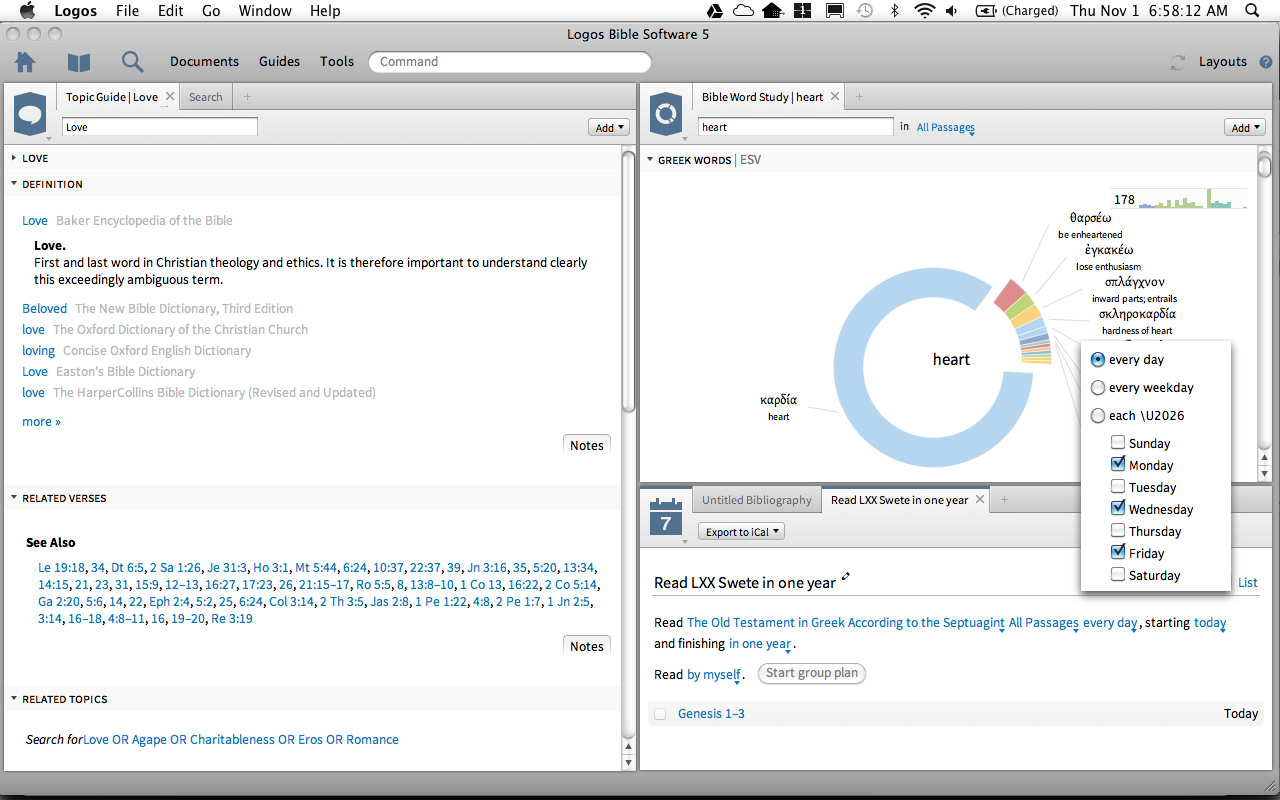
What’s new in Logos 5? The two most obvious changes are visible below (click image for larger). For one, the icons and command bar at top are joined by three additions: “Documents,” “Guides,” and “Tools.” This gives the user quicker access to more features and tasks in Logos.
The second big noticeable change is the addition of more “Guides” (it becomes obvious why it has its own place right next to the command bar). Note above the “Topic Guide,” Bibliography, and “Sermon Starter Guide.” (These join the Exegetical and Passage Guides.) The Bibliography is especially helpful to this occasional writer of academic papers, and can be adjusted to various styles.
Note also a neat customizable reading plan guide (below at bottom right, how I could read the Septuagint in a year) and a “Bible Word Study” (at top right) with graphic, among other results that come up.
I have mixed feelings about the additions of new Guides in Logos. Though my initial skepticism about the Exegetical and Passage Guides changed to appreciation the more I used them in Logos 4, it’s hard to know at this early stage of using Logos 5 whether these guides will prove helpful or just seem like clutter. The Sermon Guide holds promise, as it gathers resources in one place that would take time to compile by hand. However, the Exegetical and Passage Guides already do this, albeit with a slightly different focus.
The Bible Facts feature (new in Logos 5) is pretty cool, and could be useful in teaching settings. See here:
Whoever does graphic design at Logos is aces. Follow them on Facebook and you’ll see well-done graphics for verses each day. Bible Facts incorporates that. This is a good addition in Logos. It auto-suggests search terms and returns results quickly.
More about Logos 5, including full details of what’s new, can be found here, with some brand new videos here. I’ll provide an additional review installment once I’ve had chance to spend more time with the program.
Thanks to Logos for the review copy of Logos 5 with the Silver package, provided to me simply with the expectation that I offer my honest impressions of the program.
I have weathered the storm, several flickers of the power on and off, and have selected the winner at random. (Actually, a random number generator is to thank/blame.)
And the winner is… Matthew Hamrick! Congratulations, Matthew, and enjoy the book. Thank you to everyone who participated and spread the word.
I reviewed the book here if you’d like to learn more.
Almost every Monday at Words on the Word (and other days, too) I review new books in the field of biblical studies, original languages, and theology. I also review Bible software. Check or bookmark this link to see all my reviews.
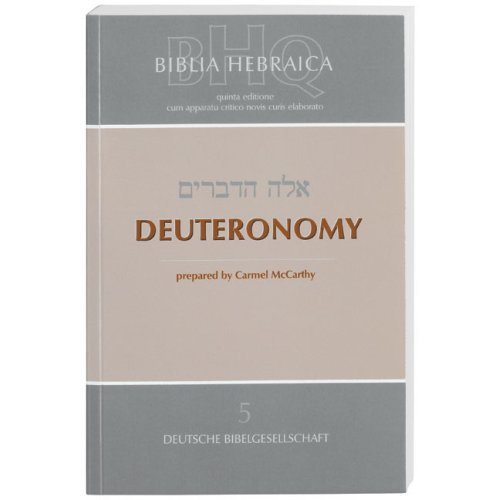
Some excellent scholarly treatments of the BHQ have already appeared. Anyone serious about learning how to use this resource discerningly (as all text critics must be discerning) will do well to avail themselves to these, probably in this order:
Emanuel Tov: “The Biblia Hebraica Quinta–An Important Step Forward” (PDF). Tov says the BHQ is “much richer in data, more mature, judicious and cautious than its predecessors. It heralds a very important step forward in the BH series.” Yet at the same time, “This advancement implies more complex notations which almost necessarily render this edition less user-friendly for the non-expert.” That said, anyone who reads Tov’s 11-page introduction will be well-equipped to begin making use of BHQ.
Richard D. Weis: “Biblia Hebraica Quinta and the Making of Critical Editions of the Hebrew Bible.” Weis has served as a member of BHQ’s editorial committee, so he is able to offer some good detail on “philosophical and pragmatic choices” made in publishing the editions. His article includes full sample pages of the print edition, too.
Blogger John F. Hobbins: “Taking Stock of Biblia Hebraica Quinta” (PDF). As I will note below, the oft-appearing, seldom-explained “prp=propositum=it has been proposed” of the BHS is replaced in BHQ with more conservatism in suggesting emendations. But Hobbins calls this “the chief drawback of BHQ” and writes “in defense of conjectural emendation” as it would appear in the apparatus. Not all text critics will agree–and many will appreciate BHQ’s approach–but his argument is compelling all the same.
Taking the BHQ for a spin alongside the BHS is perhaps the most helpful way to see how the two compare. It’s easy to have both side-by-side in Accordance. Here’s my workspace for reading the Hebrew Bible with BHS, BHQ, the apparatus for each, and the BHQ commentary. You can click or open in a new tab to enlarge.
You can see that the text of Deuteronomy 6:4-5 above is unchanged in the BHQ. Consonants, vowels, and cantillation marks are all the same. As the BHQ is based on the Leningrad Codex, just as the BHS is, the text itself is largely unchanged. (The BHQ, however, corrects the BHS to the Leningrad Codex based on new color photographs.)
Note that abbreviations in the BHQ apparatus are now abbreviations of English, not Latin. Those who have learned how to make use of the abbreviated Latin in the BHS apparatus may be somewhat disappointed to not be able to put that knowledge to use (and to have to learn a new system), but in the end this makes for a more widely accessible apparatus, in my view.
A comparison between the BHS apparatus and the BHQ apparatus at the same point is instructive. For Deuteronomy 6:4 BHS has a superscript “a” in the text after שְׁמַ֖ע, directing to footnote a, which reads: “𝔊 pr nonn vb.” I write here about the use of Accordance to quickly decipher the abbreviated Latin in the BHS critical apparatus. “𝔊 pr nonn vb” means something like, “The Old Greek/Septuagint puts before [שְׁמַ֖ע] several words.”
It’s easy enough, especially in the workspace how I have it set up above, to find out what these Greek words in question are: Καὶ ταῦτα τὰ δικαιώματα καὶ τὰ κρίματα, ὅσα ἐνετείλατο κύριος τοῖς υἱοῖς Ισραηλ ἐν τῇ ἐρήμῳ ἐξελθόντων αὐτῶν ἐκ γῆς Αἰγύπτου. But the BHS alone does not give the reader much more guidance than that.
The BHQ apparatus, however, reads: “שְׁמַ֖ע Smr V S T | prec 4:45 Nash G ✝ •” Note that instead of a superscript letter in the text with the same letter as a footnote in the apparatus, the text of the BHQ is unmarked, and the apparatus note simply preceded by the word (שְׁמַ֖ע) under consideration. Some will find this gives the text an uncluttered feel; others may find it takes extra time to match text to apparatus. Hovering over the (all in English!) abbreviations in the BHQ in Accordance shows that the note says something like, “The Samaritan Pentateuch, Vulgate, Syriac, and Targumim all begin with just שְׁמַ֖ע. In the Nash Papyrus and Old Greek שְׁמַ֖ע is preceded by the text from Deut. 4:45.” Then the ✝ notes that the BHQ commentary gives the matter more discussion. For text criticism, I have been thrilled about the addition of an included-in-the-book commentary on the text and apparatus.
The BHQ commentary at this verse reads:
The Shemaʿ in both the Nash Papyrus and G is prefaced by an introduction taken from 4:45 with the following differences: both attest a cj. before אלה; both omit העדות and the cj. attached to the following word; both read צוה for דבר, but with “the Lord” as subject in G, whereas the Nash Pappyrus and some G Mss follow M in reading “Moses”; finally, both insert במדבר after “Israel.” For further background to the combination of certain biblical passages for liturgical reading, with particular reference to this addition in G and the Nash Papyrus, see Elbogen, Jewish Liturgy, 193. The six extant phylacteries follow M.
Thumbs up here for the additional detail provided in the BHQ apparatus and commentary and for Accordance’s presentation of it. In the print edition the commentary is in a section of the fascicle that is separate from the apparatus. In Accordance you can easily lay it all out together and see it at once.
Just as BHS was, BHQ is being published in fascicles, so a bit at a time. The following six already exist in print:
Fascicle 5: Deuteronomy
Fascicle 7: Judges
Fascicle 13: The Twelve Minor Prophets
Fascicle 17: Proverbs
Fascicle 18: General Introduction and Megilloth (i.e., Ruth, Canticles, Qoheleth, Lamentations, Esther)
Fascicle 20: Ezra and Nehemiah
The BHQ module in Accordance has fascicles 5 (Deuteronomy), 18 (General Introduction and Megilloth), and 20 (Ezra and Nehemiah) so far. 13 (The Twelve Minor Prophets) and 17 (Proverbs) will be added free of charge to those who have the BHQ package. They exist in print but have not yet come from the German Bible Society to Accordance for digitization. When Judges comes to Accordance, it and future fascicles will be available as paid upgrades.
Accordance has produced a short video that shows a couple ways to use the BHQ, including a comparison with the print edition. It’s worth watching, since it explores not only the text, apparatus, and commentary that I cite above, but also the Masorah Magna (below the text in the print edition) and the Masorah Parva (at the margins of the print edition). Note especially (early in the video) how Accordance merges the Notes on the Masorah to eliminate the user’s need to go back and forth between references:
The place for the BHQ user to start is probably with the three articles at the beginning of this post. Then, the General Introduction contained in Fascicle 18 should be consulted. As with its other commentaries and books, Accordance has it presented beautifully. The English introduction tells what BHQ is, gives advice on how to use it (including full explanations of sigla and abbreviations), and tells a bit of background on the editorial processes leading to the BHQ as it is now. Click on the below for a larger image of the general introduction:
BHQ in Accordance is not morphologically tagged; Accordance does not currently have plans to tag it. But this is because the text is so similar to that of BHS already. Because I am so used to BHS and BHQ is still so new on the scene, I always have both open anyway, so I can easily get morphological tagging information from BHS. A tagged BHQ would be ideal, but it’s not a huge loss.
BHQ has less conjectural emendation than BHS. Case in point, “prp” (=”propositum”=”it has been proposed”) occurs 2,146 times in the BHS apparatus (a search that is exceedingly easy to do in Accordance). In BHQ what goes into “prp” is teased out a bit more. From the introduction to BHQ:
In cases where the editor proposes that a reading other than that of the base text is to be preferred, this is presented in the concluding portion of the entry following a double vertical stroke and the abbreviation “pref” (for “preferred reading”). The evidence supporting the preferred reading is recapitulated. If the preferred reading is not directly attested by any of the extant witnesses, but is only implied by their evidence, it is marked by the signal “(origin)”, i.e., that it is the indirectly attested origin of the extant readings. If the grammatical form of the preferred reading is not found otherwise in Hebrew of the biblical period, it is marked either as “unattest” (= “unattested”) or as “conjec-phil” (= “philological conjecture”), depending on the kind of external support for the reading. Where the proposed reading is a conjecture, it is not introduced by the abbreviation “pref” (= “preferred reading”), but by the abbreviation “conjec” (= “conjecture”). In line with the focus of the apparatus on the evidence of the text’s transmission, proposals for preferred readings will not seek to reconstruct the literary history of a text. Readings that are judged to derive from another literary tradition for a book will be characterized as “lit” (see the definitions of characterizations below).
Also,
Since the apparatus is devoted to the presentation and evaluation of the concrete evidence for the text’s transmission, a hypothetical reading (i.e., a conjecture) will have place in the apparatus of BHQ only when it is the only explanation of the extant readings in a case.
“Pref” occurs 201 times in the apparatus in the three fascicles so far published in Accordance. A primary difference in BHQ, though, is the level of textual or manuscript-based explanation given for why a certain reading is to be preferred. As someone who tries to be a cautious textual critic, I appreciate this.
Here are some additional resources for using BHQ:
A review of Fascicle 18 in Review of Biblical Literature (PDF)
A sample set of pages (print edition) of BHQ (PDF)… and note here that a .pdf of BHQ is not part of Accordance’s module
At least three things make it worth seriously considering adding BHQ in Accordance to your library. First, BHQ is a significant advance over BHS. Second, Accordance’s presentation of BHQ makes using it easier than it is in print. Third, the print editions would cost you just as much as or more than buying BHQ in Accordance. And, of course, an Accordance module is word-searchable, lighter to carry around, and so on.
All in all, BHQ in Accordance is well-produced, easy to use, and a great aid in textual criticism of the Hebrew Bible.
Thank you to Accordance for providing me with a copy of the BHS and BHQ modules for review. At the time of this writing, the sale price for that package was $149.99, an excellent deal. See all the parts of my Accordance 10 review (including the Beale/Carson commentary module) here. I reviewed BHQ’s predecessor, BHS, here.
I own a concordance, but it’s packed away in a box somewhere. Useful as a print concordance is, with sites like the NET Bible and Bible Gateway, not to mention various software programs available, I can do any word or phrase searching quickly at a computer.
This post will mark the completion of my multiple-part reviews of three major Bible software programs: BibleWorks 9, Accordance 10, and Logos 4. In this final part of my Logos review, I look at the searching features available in Logos. No print concordance necessary.
Here is the search function in action:
The above highlights four search categories: Basic, Bible, Morph, Syntax. A “Basic” search searches your library; “Bible” is just what it says it is. “Morph” can search according to a word’s inflection. “Syntax” can perform more complex grammatical searches.
There are multiple ways to search for and look up things in Logos. There’s a useful instructional video here with more information about how to do a “Basic Search” in Logos, i.e., search every resource in your library. And you can look here to watch a video that explains how to utilize the command bar on the home screen for searches.
You can also right click on a word in an open resource and search from where you are, looking it up in that resource, in all open resources, in your whole library, etc.
I was pleasantly surprised by the versatile ways one can search in Logos. The control+F search function is easy to use and remember–it’s how I search .pdfs and open Web pages already.
What was unpleasantly surprising, though, was how long some of the searches took. (Click below to enlarge.)
Nearly five seconds to return search results for a word. Granted, the above is the most frequently occurring word in the Hebrew Bible, but using different software I’ve been able to perform such a search significantly faster.
Lack of speed is perhaps the chief weakness in Logos. Part of this, I think, is because of one of its strengths, which is its massive library. Logos says, “The central metaphor Logos Bible Software is the universal digital library.” While this is a commendable project, and while the resources available in Logos are quite impressive (as I wrote here), it does seem to be at the expense of quickness of searches. Or perhaps it’s not just a library issue; it could be in the coding or some other.
Either way I hope future editions of Logos will improve upon search speed. This seems to be a vital need. I’ve had searches that turned up results faster than 5 seconds (a couple in under a second), but I also did a Bible search today that took more than 20 seconds to return results.
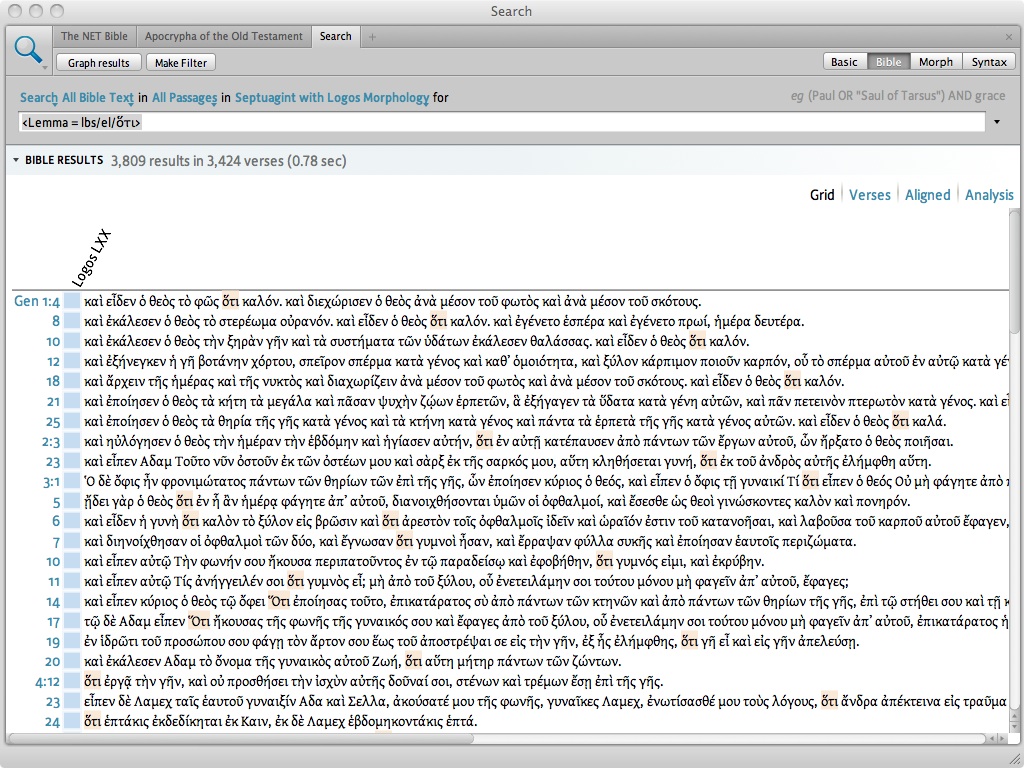
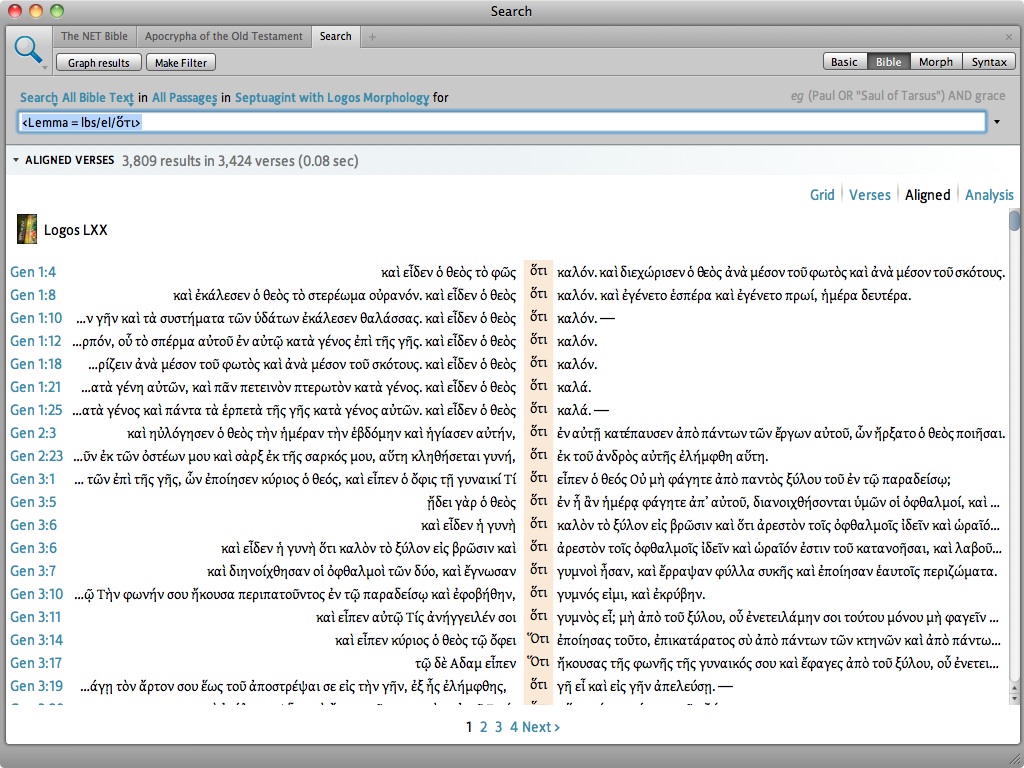
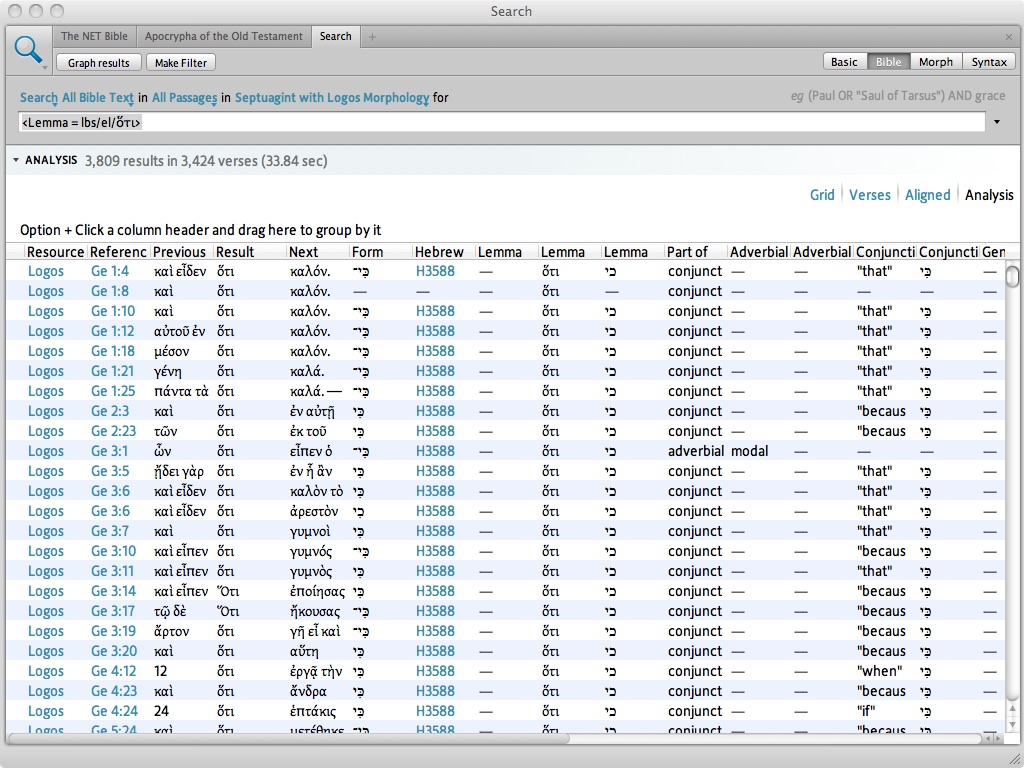
Once you have your search results, there are some fun ways to be able to manipulate and view the data. With a Septuagint search for ὅτι, I can view the results as a “Grid”:
as “Verses”:
as “Aligned”:
or as “Analysis”:
I have found the “Analysis” sorting the most helpful, since you can click on any of the column headers above and it re-sorts in the same way an Excel spreadsheet would.
Your library, notes, highlighting, etc. all travel with you and update automatically wherever you use Logos, whether that’s on a Mac, a PC, an iPhone, or online
Great library–lots of resources (including some unique ones) available
The slowness at times of searches or just general moving around in the program is not great and can hinder productivity
It’s highly customizable with its tabs and resources; makes working on multiple things at once easy
One other thing to note is that Logos offers a good discount program.
Thanks to Logos for the review copy of Logos 4 with the Original Languages Library included. For the review copy I have been giving my honest impressions of the program in a multi-part review (here, here, here, here, and here), which this installment concludes. Look in coming weeks to this blog for a comparison of Logos, BibleWorks, and Accordance.
I have an extra copy to give away (not my review copy). It’s a good resource to have on the shelf, and I know I’ll be turning to it in the future for the work and ministry I do in a college setting.
I will choose a winner at random. To enter the drawing, simply comment on this blog post with your greetings, thoughts about apologetics, favorite philosopher/theologian, etc. I will accept entries through Monday afternoon, with 3pm EST being the cutoff.
Then if you link to this post on your Facebook, Twitter, blog, etc., come back here to tell me in the comments section that you did, and you’ll receive a second entry. I will announce the winner just before 5pm EST Monday.
I still remember, as a 16-year-old, sitting down at my parents’ computer, hearing the dial tone, and logging on to AOL. I would do this often, not just to check the new technological miracle known as e-mail, but also to go into chat rooms (remember those?) and seek to share my faith with others online.
I made similar efforts at my high school, starting conversations when appropriate and generally just trying to be ready to speak intelligently and compellingly about my Christian faith.
This handbook by Peter Kreeft was a constant reference guide for me. I went on to major in philosophy at a Christian undergraduate school, where I took, among others, classes on the philosophy of religion, St. Augustine, and more. Readings in the Philosophy of Religion became a new resource to which I often turned. I had begun having philosophical and existential questions of my own by that point, ones that I experienced on a profound and at times troubling level.
I’ve always had an interest in the intellectual underpinnings of my Christian faith. And I’ve often been aware that what appear to be intellectual questions or questions of “the head,” are sometimes–when one digs deeper–questions of “the heart,” as well. Since college days, then, I’ve been a bit more cautious than I was as a 16-year-old in an AOL chat room about just how effective “apologetics” can be.
There are 54 selections divided into 11 parts, which you can see listed here (PDF) in the table of contents. Christian Apologetics begins with some methodological considerations in part 1, then moves right into various arguments for the existence of God–cosmological, teleological, ontological, moral, the argument from religious experience, and so on. From there the book narrows to more specific topics like the Trinity, the incarnation, miracles, the resurrection, the problem of evil, and more.
Christian Apologetics claims to be “a sampling of some of the best works written by Christian apologists throughout the centuries,” offering “a snapshot of Christian apologetics at its best across the spectrum of time and culture.”
The essays in this volume certainly are some of the best in apologetics. There is Paul at the Areopagus in Acts 17, Aquinas on the cosmological argument for God’s existence, Anselm and Plantinga with the ontological argument for God, Pascal’s wager, Teresa of Avila on experiencing God, Anselm on the incarnation, Swinburne on miracles, John Hick’s “Soul Making Theodicy,” Augustine on free will, and Marilyn McCord Adams on horrendous evil and the goodness of God. Each of these essays is a classic and makes a valuable contribution to the area of apologetics.
The book spans “the spectrum of time” fairly well, with a higher concentration of 20th century writers. Just a couple of the contributors are women, and the overwhelming majority hail from Western contexts–this latter an admission of the book, but a weakness all the same.
A particularly pleasant surprise to me was the inclusion of an an article by R.T. France, in which he makes the case for the historical reliability of the Gospels, which must, he argues, be understood in their proper literary context as “highly selective” records of Jesus’ life with “only a loose chronological framework.” This is not due to deficiency of the Gospels; rather, it is how the Gospel writers intended to write:
The four canonical gospels will not answer all the questions we would like to ask about the founder of Christianity; but, sensitively interpreted, they do give us a rounded portrait of a Jesus who is sufficiently integrated into what we know of first-century Jewish culture to carry historical conviction, but at the same time sufficiently remarkable and distinctive to account for the growth of a new and potentially world-wide religious movement out of his life and teaching.
As I read I appreciated a statement in the book’s general introduction:
But arguments and evidences do not of themselves bring someone into new life in Christ. Here the work of the Holy Spirit is central, and we must be willing to surrender to his leading and his truth and his goodness if we are to truly dwell with the Lord.
I hadn’t yet learned this in the AOL chat rooms, but I’ve long since been convinced of it. So I had hoped to hear more in this book about the role of the Holy Spirit in apologetics. There is a short (one paragraph) treatment by James K. Beilby in chapter 3 that asks, “What is the role of the Holy Spirit in apologetics?” He rightly (in my view) sees it as “not a zero-sum game.” The apologist should be “significantly involved” yet “still hold that the Holy Spirit will determine the effectiveness of our efforts.”
Though the Holy Spirit receives treatment in the section on the Trinity (by Origen, Aquinas, the Creeds, and Thomas V. Morris) and on the Bible (Calvin and canonization), there is never more than Beilby’s paragraph treatment about the role of the Holy Spirit in the project of apologetics. Cogent though Beilby is, I would think “a snapshot of Christian apologetics at its best” should make more mention of something like the Wesleyan view of prevenient grace or even the notion that the Holy Spirit witnesses to a person’s heart before an apologist does. Only the former can enable the latter. Christian Apologetics is not without the exploration of other methodological considerations; I just would have liked to have seen more of this one.
Several other possible areas for improvement in a future edition could be more on faith and reason and how the two interrelate, as well as arguments for the existence of God that take into account and respond to the varous assertions made by the “new atheism” (anemic though it is).
All in all, though, this is a strong work, and I’m happy for it to sit alongside my old college text, Readings in the Philosophy of Religion. Zondervan’s Christian Apologetics is a worthy, if basic, reference guide. I expect it will serve apologists well.
Thanks to Zondervan for the review copy, which I was given for the purposes of review, though without any expectations as to the nature of my review. Find the book at Amazon here (affiliate link) or at Zondervan’s product page for the book.
















 Words on the Word