Reading through the Greek of Isaiah in a year

Here is a well put together reading plan for going through the Greek (“Septuagint”) of Isaiah in a year. I like that, as blog author John Meade writes, “The key is working a little each day for many days.”

So this (PDF) is the plan I want to start using, beginning with the new year. (UPDATEThis is the plan we’ll use (PDF download), with slightly different versification than Meade’s plan.) And by “new year,” of course I mean when Advent begins (the start of the church calendar year), December 2.

If anyone wants to join me… let me know in the comments or by emailing me through this form.

UPDATE: Go here for a vocabulary list to aid reading in the LXX of Isaiah.

UPDATE 2: If you want to join along, here’s the central place on Facebook for discussion, helpful files, questions, companions, etc.

Review of T. Muraoka’s Hebrew/Aramaic Index to the Septuagint

In studying the Septuagint, I’m regularly curious about how often the LXX translators used the same Greek word to translate a given Hebrew word. How often, for example, does καρδία translate the Hebrew לבב? And what other Greek words are used to translate it? Similarly, I wonder, for occurences in the Greek text of καρδία, what other Hebrew words might it be translating?

Takamitsu Muraoka has made such questions an emphasis of his scholarly writing and publishing throughout his career. His Greek-English Lexicon of the Septuagint is one of the standard lexicons in the field, and his Greek-Hebrew/Aramaic Two-way Index to the Septuagint is the best thing I’ve seen in print for Hebrew-Greek lexical studies in the Septuagint.

Preceding that latter work was Muraoka’s Hebrew/Aramaic Index to the Septuagint: Keyed to the Hatch-Redpath Concordance. I’ve had a chance to use the work in Logos Bible software; this post contains my review.

Muraoka notes the impetus for the work in the Introduction. The Hatch-Redpath Concordance (hereafter HR), published around the turn of the 20th century, listed all Greek words used in the Septuagint with the Hebrew they were thought to have translated. At the back of the concordance was a list that basically noted the reverse, showing Hebrew words alphabetically with the Greek words used to translate them… or, rather, a key to the Greek words in question. As Muraoka notes, you would have this entry in HR:

אָמַר qal 37 c, 74 a, 109 c, 113 c, 120 a, 133 a, 222 a, 267 a, 299 b, 306 b, 313 a, 329 c, 339 b, 365 a, 384 a, 460 c, 477 a, 503 c, 505 c, 520 b, 534 c, 537 b, 538 b, 553 b, 628 b, 757 b, 841 c, 863 c, 881 c, 991 b, 1056 b, 1060 a, 1061 a, 1139 a, 1213 b, 1220 c, 1231 b, c, 1310 b, 1318 b, 1423 c, 1425 b, 69 b, 72 b, 173 a, 183 b, c, 200 a (2), 207 c, 211 b.

Whereas the Greek to Hebrew portion of HR lists the Hebrew words underlying the Greek of the LXX, the Hebrew to Greek portion at the back just has page and column reference numbers, as above. So the user of HR would have to turn to page 37, column c, page 74, column a, etc., etc., in order to see what Greek words were in those locations. Only in that tedious way could the user of HR see all the Greek words used to translate the Hebrew אָמַר.

Muraoka’s wife (who is a true co-author of this work) tediously wrote out (yes, by hand) each Hebrew to Greek entry so that instead of page and column numbers, it contained actual Greek words. The above, then, would look more like this:

אָמַר qal αἰτεῖν (37c), ἀναγγέλλειν (74a)…

…and so on. The HR page and column numbers are retained, but now the user doesn’t have to flip back and forth, since the Greek words are all in one place.

T. Muraoka then took his wife’s data and critically examined HR’s assessments in as many places as he could, drawing on advances in the past century in textual criticism, manuscript availability (like the Dead Sea Scrolls), and adding in analysis of “apocryphal” books, which HR had not fully included. The resulting revision updates both HR’s work and his wife’s manual collation.

What results, then, is an eminently helpful work where one can look up any Hebrew word and see all the Greek words used to translate it across the Septuagint. To be able to do this is valuable, and Muraoka makes it easy.

There are two things that lack here, though neither one of them is really the goal of the work, so I don’t actually criticize it for these omissions. First, there are not frequency numbers. It could be especially helpful to know not only what Greek words translate a given Hebrew word, but how many times each does, so that the user can get a sense of the distribution of each. Muraoka doesn’t have this. Second, he doesn’t have glosses or translation equivalents for words, so there is no English in this index.

But this is an index, and marked as one, so neither of those is a flaw in Muraoka’s book. In fact, here is where using Muraoka in Logos is especially helpful: you can tie tabs together so that a simple click from Greek or Hebrew in his index takes you to a corresponding Greek or Hebrew lexicon in Logos, where you can see that word’s meaning. Logos in this way really enhances Muraoka’s tool. And, of course, frequency statistics are easy to come by in Logos.

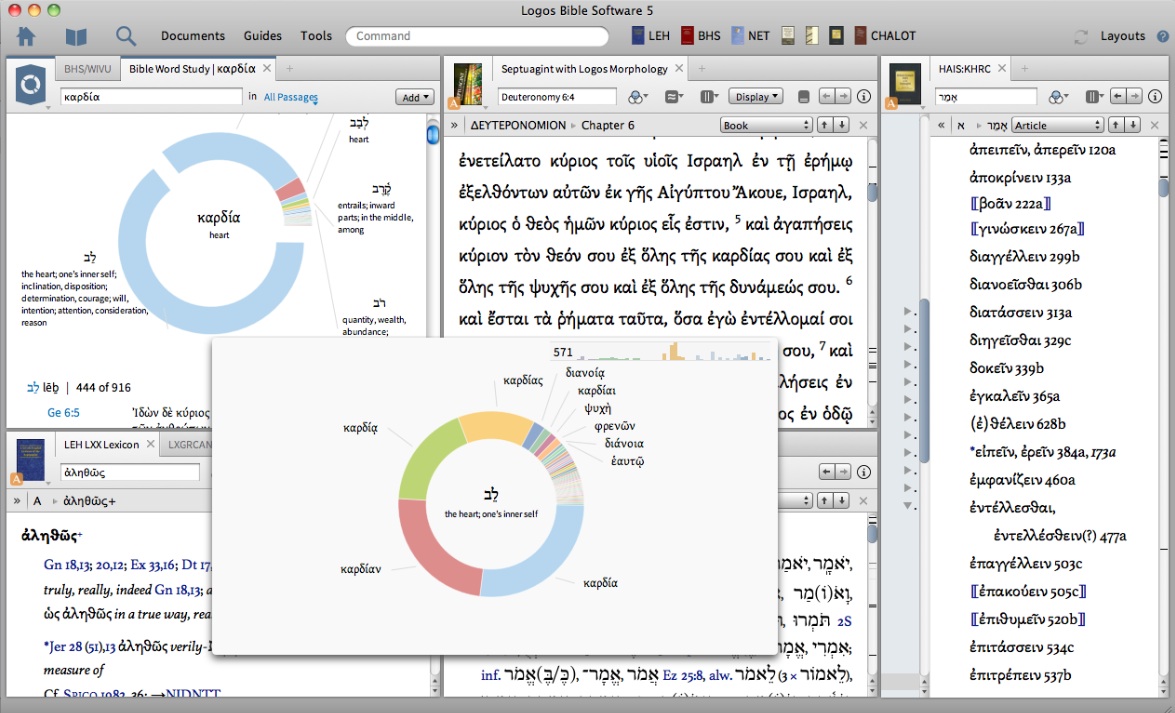
This is a good resource, and worth owning for students and professors of the Septuagint. A question remains: with all that Logos can already do, is it superfluous to purchase Muraoka’s index? Using the Bible Word Study feature in Logos, for example, I can see all of the Hebrew words that a given Greek word is used to translate, as well as all of the Greek words used to translate a given Hebrew word, as here (click to enlarge):

This may be sufficient for what many people need, especially since you can also search for a Hebrew lemma from within the Greek Septuagint text in Logos and receive results in Greek, so that you have before you all the verses with all the various Greek words that translate that Hebrew lemma. (I just learned this today from the user forums-very cool.)

But if you’ve got the money (especially if you qualify for an academic discount), and are sitting on the fence about Muraoka’s resource, I recommend it. It’s nice to have easily at hand a listing of all Greek words used to translate a Hebrew word in the Septuagint, even if there are other ways to get that information in Logos. Here it’s consolidated.

One other nice feature is that all the abbreviations throughout the index are hyperlinked to what they stand for, which you can bring up just by mousing over them:

You can see there are no verse references given, which are useful for in-depth study of Greek translations. Muraoka’s more thorough Greek-Hebrew/Aramaic Two-way Index to the Septuagint offers more depth in this regard than this 1998 Hebrew/Aramaic (one-way) index. No Bible software currently offers the two-way index, but it would be great if Logos were able to make it available in the future.

All in all Muraoka’s Hebrew/Aramaic Index to the Septuagint is a solid resource. And its digitization in Logos has been well done, too. Logos can already accomplish much of what’s in this index, but the one serious about the Septuagint may want to have any and all tools at her or his disposal. In that case, this is a worthy addition to one’s library.

Thanks to Logos for the free review copy of this work, offered without any expectation as to the positive or critical nature of my review. Muraoka’s Hebrew/Aramaic Index to the Septuagint is available in Logos here.

How to Read and Understand the Göttingen Septuagint: A Short Primer, part 1

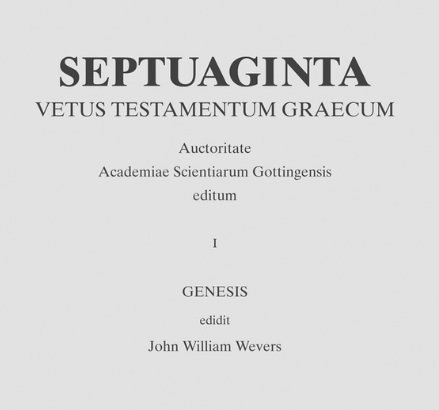
The Göttingen Septuagint is the Cadillac of Septuagint editions. It’s the largest scholarly edition of the Greek translation of the Hebrew Bible. Its full name is Septuaginta: Vetus Testamentum Graecum Auctoritate Academiae Scientiarum Gottingensis editum, published by Vandenhoeck & Ruprecht in Göttingen, Germany. The Göttingen Septuagint has published more than 20 volumes spanning some 40 biblical books (counting the minor prophets as 12), and publication of additional volumes is in progress.

But the Göttingen Septuagint is not for the faint of heart, or for the reader who is unwilling to put some serious work in to understanding the layout and import of the edition and its critical apparatuses. A challenge to using Göttingen is the paucity of material available about the project, even in books about the Septuagint. An additional challenge is that the critical apparatuses contain Greek, abbreviated Greek, and abbreviated Latin. The introductions to each volume are in German, though below I cite from English translations of the introductions to the volumes of the Pentateuch.

It is my intention with this post, and a second to follow, to give a short primer or user’s guide to the Göttingen edition. Here I offer suggestions on how to read and understand the text, the apparatuses, the sigla/abbreviations, the introductions, and point to additional resources that will be of benefit to the Göttingen user.

I recently put together a basic orientation to the scholarly editions of the Hebrew Bible and the Greek translation of the same. That is here. It is worth noting again that the International Organization for Septuagint and Cognate Studies (IOSCS) has a good, succinct article on the various editions of the Septuagint. Below, “OG” stands for “Old Greek.” They write:

The creation and propagation of a critical text of the LXX/OG has been a basic concern in modern scholarship. The two great text editions begun in the early 20th century are the Cambridge Septuagint and the Göttingen Septuagint, each with a “minor edition” (editio minor) and a “major edition” (editio maior). For Cambridge this means respectively H. B. Swete, The Old Testament in Greek (1909-1922) and the so-called “Larger Cambridge Septuagint” by A. E. Brooke, N. McLean, (and H. St. John Thackeray) (1906-). For Göttingen it denotes respectively Alfred Rahlfs’s Handausgabe (1935) and the “Larger Göttingen Septuagint” (1931-). Though Rahlfs (editio minor) can be called a semi-critical edition, the Göttingen Septuaginta (editio maior) presents a fully critical text….

In other words, rather than using a text based on an actual manuscript (as BHS, based on the Leningrad Codex, does), Göttingen utilizes a reconstructed text informed by a thorough examination of manuscript evidence. Göttingen has two critical apparatuses at the bottom of the page of most volumes. Because it is an editio maior and not an editio minor like Rahlfs, a given print page can have just a few lines of actual biblical text, with the rest being taken up by the apparatuses. Here’s a sample page from Genesis 1. Note the #s 1-4 that I’ve added to highlight the different parts of a page. Below I explain #1 and #2; the rest comes in a follow up post.
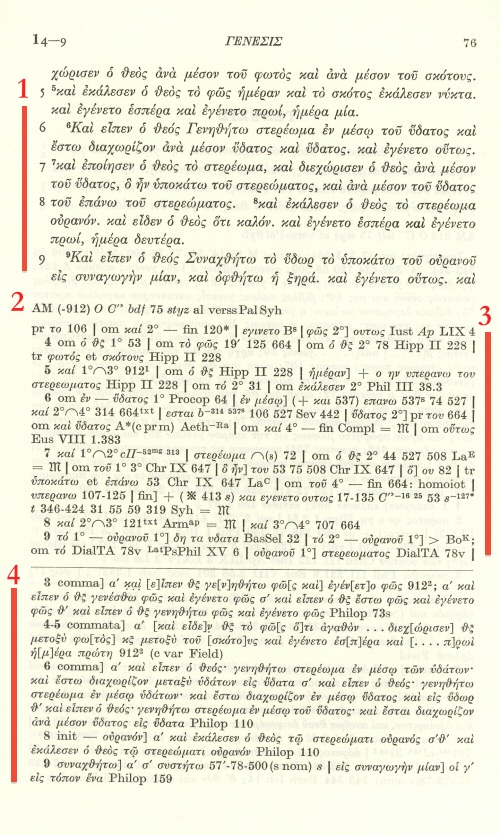
1. The reconstructed Greek critical text (“Der kritische Text”)

With verse references in both the margin and in the body of the text, the top portion of each page of the Göttingen Septuagint is the editorially reconstructed text of each biblical book. In the page from Genesis 1 above, you’ll notice that the text includes punctuation, accents, and breathing marks.

Like the NA27 (and now NA28) and UBS4 versions of the Greek New Testament, Göttingen is a critical or “eclectic” edition, which “may be described as a collection of the oldest recoverable texts, carefully restored book by book (or section by section), aiming at achieving the closest approximation to the original translations (from Hebrew or Aramaic) or compositions (in Greek), systematically reconstructed from the widest array of relevant textual data (including controlled conjecture)” (IOSCS, “Critical Editions”).

Of the critical text, John William Wevers, in his introduction to Genesis in Göttingen, writes:

Since it must be presupposed that this text will be standard for a long time, the stance taken by the editor over against the critical text was intentionally conservative. In general conjectures were avoided, even though it might be expected that future recognition would possibly confirm such conjectures.

It must be clearly evident that the critical text here offered labored under certain limitations. The mss, versions and patristic witnesses which are available to us bring us with few and small exceptions no further back than the second century of our era. Although we do know on the basis of second and third century B.C.E. papyri something about the character of every day Greek used, our knowledge of contemporary literary Greek is very limited indeed. In other words, the critical text here offered is an approximation of the original LXX text, hopefully the best which could be reconstructed on the basis of the present level of our knowledge. The editor entertains no illusion that he has restored throughout the original text of the LXX.

One cannot simply say, “The LXX says…,” because then inevitably an appropriate response is, “Which LXX? Which manuscript? Which or whose best attempt at reconstruction?” So “approximation of the original” and “hopefully the best which could be reconstructed” are key phrases here.

All the same, especially in the newer Göttingen editions, the volume editors have viewed and listed the readings of many manuscripts and versions. The critical apparatuses are where they list those readings, so the user of Göttingen can see other readings as they compare with the critically reconstructed text. (Because the Göttingen editions are critical/eclectic texts, no single manuscript will match the text of the Göttingen Septuagint.) And although scholarly editions of the Greek New Testament also present an eclectic text, neither the NA27 nor UBS 4 is an editio maior, as Göttingen is. (The Editio Critica Maior is just recently begun for the GNT.) Serious works in Septuagint studies, then, most often use the Göttingen text, where available, as a base.

2. The Source List (“Kopfleiste”)

Not every volume has this feature, but the five Pentateuch volumes, Ruth, Esther, and others do. The Kopfleiste comes just below the text and above the apparatuses. Wevers notes it as a list of all manuscripts and versions used, listed in the order that they appear in the apparatus on that page. A fragmentary textual witness is enclosed in parenthesis.

In the above Kopfleiste, the parentheses around 912 mean that papyrus 912 is fragmentary. The “-” preceding it, Wevers notes, means that its text ends on the page in question. So although this particular Göttingen page has Genesis 1:4-9 reconstructed in the critical text (“Der kritische Text”), “(-912)” in the Kopfleiste indicates that the fragmentary papyrus 912 does not actually contain text for all the verses on the page. Looking up papyrus 912 in Wevers’s introduction to Genesis, in fact, confirms that this third to fourth century papyrus contains only Genesis 1:1-5.

By contrast, the “(D-)” here

indicates that the uncial manuscript D has its text beginning on the page in which it appears in Göttingen. The above shot is from the Göttingen page containing Genesis 1:9-13. The first time D has anything to offer (since it is fragmentary, indicated by its enclosure in parentheses) is at 1:13. This alerts the reader that D has no witness to Genesis 1:1-12. Wevers’s introduction then gives more information about the contents of that manuscript. So, too, with the minuscule manuscript 128 above–the introduction says of 128, “Init [=Latin initium=the beginning] – 1,10 is absent.”

Wevers adds:

Should a piece of text be lacking due to some external circumstance in a particular ms, this is noted in the Source-List. For example if ms 17 lacks the text this is shown as O-17. What this means is that the entire O except 17 (which belongs to O) has the text in question. The abbreviation al (for alia manuscripta) refers to the mss which belong to no particular group, i.e. the so-called codices mixti as well as mss which are too fragmentary to allow classification. The expression verss designates all the versions which have the complete text of Genesis. Versions such as Syh to (31,53) and Pal, whose texts are not complete, are listed at the end of the Source-List (Kopfleiste).

In terms of the order of citing Greek textual witnesses:

In the apparatus the citation of Greek sources appears in the following order: First place is occupied by the uncial texts in alphabetical order, and characterized by a capital letter. Then the papyri are cited in the order of 801 to 999. Then the hexaplaric group [AKJ: “O” above] is given as well as the Catena groups [AKJ: C‘’], with the mss groups following in order as: b d f n s t y z; then the codd mixti, followed by the mss without a Rahlfs number. Next come the NT citations, and finally, the rest of the patristic witnesses in alphabetic order.

In the next part of this Göttingen Septuagint primer, I’ll explore #3 and #4 above, the First Critical Apparatus (“Apparat I”) and the Second Critical Apparatus (“Apparat II”), as well as take a closer look at the contents of the Introductions in the Göttingen editions (“Die Einleitung”).

UPDATE: Part 2 of the primer is here, with still more to follow.

Thanks to Brian Davidson of LXXI for his helpful suggestions on an earlier draft of this post.

Septuagint Sunday: Congratulations to…

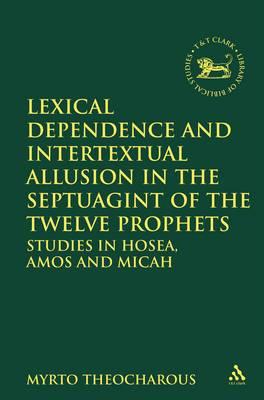
This past week I’ve received some 50 entries in a giveaway contest for a study by Myrto Theocharous called Lexical Dependence and Intertextual Allusion in the Septuagint of the Twelve Prophets: Studies in Hosea, Amos and Micah.

You can read more about the book here. I’ve made some progress in reading the book myself this week, and will be offering a review in the near future.

To choose a winner, I assigned a number to every entry (both a comment on this blog and a share of any kind qualified), then used a random number generator to select the winner.

The winner is…William Varner!

Congratulations, William, and enjoy the new book.

Thanks very much to all who entered and spread the word. I write about the Septuagint at Words on the Word at least once a week. You can bookmark this tag for my Septuagint posts; it updates as I add new posts. If you like what you see here, you can subscribe/follow this blog using the button on the right sidebar.

While you’re here, here are some highlights of what I’ve written about the Septuagint:

And coming soon:

  • My own review of Lexical Dependence and Intertextual Allusion
  • A short primer on how to read and understand the Göttingen Septuagint

Thanks for reading, and congratulations again to William Varner!

Book Giveaway Reminder

This is a reminder that Sunday night I’ll be announcing the winner of a study by Myrto Theocharous called Lexical Dependence and Intertextual Allusion in the Septuagint of the Twelve Prophets: Studies in Hosea, Amos and Micah.

If you haven’t already entered the giveaway, there’s still time. Go here to read more and enter.

Free Book! Septuagint Sunday Giveaway: Lexical Dependence and Intertextual Allusion in the LXX 12 Prophets

I am giving away a book at Words on the Word this week. It’s a study by Myrto Theocharous called Lexical Dependence and Intertextual Allusion in the Septuagint of the Twelve Prophets: Studies in Hosea, Amos and Micah. This author had me at the title. (Seriously.) It’s part of the Library of Hebrew Bible/Old Testament Studies series from Continuum/T&T Clark. (Thanks to the publisher for making the giveaway possible.) It’s got nice library binding, good quality paper, clear and easy-to-read Greek and Hebrew fonts.

I’ve been enjoying working my way through it, and in coming weeks will offer a review of the book. You can browse inside by clicking here (Amazon affiliate link). Here’s an excerpt from the publisher’s description of the book:

This book explores various aspects of intertextuality in the LXX Twelve Prophets, with a special emphasis on Hosea, Amos and Micah.

Divided into five parts, the first introduces the topic of intertextuality, discusses issues relating to the Twelve Prophets and their translator and concludes with various methodological considerations. Chapter two deals initially with the lexical sourcing of the prophets in their Hellenistic milieu and tests proposed theories of influence from the Pentateuch.

The rest of the book examines specific cases from the books of Hosea, Amos and Micah.

Theocharous summarizes her book in this short pdf. From what I’ve read so far, I can already recommend it.

I will choose a winner at random this time next week. To enter the drawing, simply comment on this blog post with your greetings, thoughts about the Septuagint or prophets, World Series predictions, etc.

Then if you link to this post on your Facebook, Twitter, blog, etc., come back here to tell me in the comments section that you did, and you’ll receive a second entry. I will announce the winner on the blog before midnight Sunday, October 21.

And you can now like Words on the Word on Facebook.

N.T. Wright on learning Greek, and a review of A Reader’s Hebrew and Greek Bible by Zondervan

I met N.T. Wright briefly in January at a worship symposium and asked him how to improve my Greek. He said, “Read the text, read the text, read the text.”

He told me to really get the feel of the language. Don’t think of Greek just as a code for English; get into the Greek itself. I asked him about reading with a diglot, but he encouraged me to check the English translation only after reading an entire Greek paragraph, and then, only as necessary.

The same holds true with Hebrew. Read the text, read the text, read the text. Reading it out loud is even better, and better still is trying to speak it to others.

Zondervan has published what is to my knowledge the only “reader’s” edition of the Hebrew Bible. It’s a masterpiece. The font is clear, sized perfectly, and easy to read (see at right, and click to enlarge). It uses the Leningrad Codex. It has no textual apparatus (which could be a distraction in a “reader’s edition”), but instead footnotes rarely occurring vocabulary. Not counting proper nouns, editors Philip Brown and Bryan Smith footnote all words that occur less than 100 times in the Hebrew Bible. Here they give “glosses,” which give the reader the basic meaning of the word. Aramaic words that occur less than 25 times are listed in the footnotes in the page on which they occur.

For readers who blank on a word that occurs, say, 150 times in the Hebrew Bible, a glossary at the back will allow them to look up even additional words.

Brown used HALOT and BDB to write the glosses. The bottom of the page looks like this (click for larger):

Note in #s 2, 7, and 8 that there is also listed what the verb stem is for a given use. What makes this feature especially easy to use is the bolding of the words before their glosses.

The only thing to critique in the Hebrew reader’s edition is that proper nouns, which are to appear in grey font since they’re not footnoted, occasionally go missed. Brown has posted an errata list here, many of which have been fixed in recent printings.

For a preview of the Hebrew reader’s edition, see here (PDF) and here (PDF).

Zondervan’s Greek reader’s New Testament has not met with such universal acclaim. It’s a good resource to have on hand, to be sure, but in my view it’s not as well executed as the Hebrew reader’s Bible.

Rather than being based on the scholarly editions of the NA27 or UBS4, the text is “the eclectic text that underpins the Today’s New International Version.” The scholars who produced the TNIV, in other words, made different textual decisions in some instances than did the editors of the “Standard Text” of the NA27/UBS4. Where this is the case, a limited textual apparatus notes it. While this could be problematic for textual criticism, the text is not vastly different from the standard one, and is certainly fine for reading.

As with the Hebrew reader’s edition, the Greek reader’s Bible footnotes and explains words that occur less than 30 times in the Greek New Testament. One unfortunate decision is that, unlike the Hebrew, the Greek footnotes do not have the glossed word in bold. This makes navigating the footnotes more cumbersome:

Font is perhaps a personal preference. While Philip Brown did a magnificent job of typesetting the Hebrew, the Greek font leaves something to be desired. It’s not the easiest Greek font I’ve read. It’s not unreadable as fonts go, but it’s thin. I got used to it after a while, so it’s not unmanageable, but the font in the UBS Greek Reader’s New Testament is easier to read. The latter also puts the footnoted glosses into two columns, which makes referencing them quicker.

Not long ago Zondervan combined the Hebrew and the Greek into one mammoth, leather-bound Reader’s Hebrew and Greek Bible. The volume is large (but how could it not be?) and impressive. It’s constructed well. The binding is sewn (rejoice!), so it will last for a while.

This combination carries with it the great advantage that its user has both the Hebrew and the Greek Bibles under one cover. Now I just have to carry one geeky Bible to church rather than two! Huge benefit.

Another nice thing about this edition is that with Hebrew going from right to left and Greek from left to right, the Greek New Testament starts at the “front” and the Hebrew Bible starts at the “back,” just as both would be in their separate volumes.

The introduction to each half explains well how the text is laid out, the footnoting of the vocabulary, and so on. All the glory of Brown’s Hebrew edition is there, and the less-than-ideal Greek font is there in the Greek portion. One thing to add in appreciation of the Greek part, however, is that Old Testament quotations appear in bold, with their references listed at the bottom of the page. The eight pages of color maps between the two sections are a nice bonus, too.

The construction of the two Bibles combined is executed quite well. I’m happy to only have to take one original language Bible with me to church now.

Thanks to Zondervan for the review copy of A Reader’s Hebrew and Greek Bible. They provided me with one in the hopes of my reviewing it on my blog, but with no expectation as to the content of the review. Find Zondervan’s product page here.

Of texts, translations, and readers

From A Greek-English Lexicon of the Septuagint (Lust/Eynikel/Hauspie):

When preparing a lexicon of the LXX, one is faced with several basic questions related to the fact that most of the books of the LXX are translations. This lexicon is supposed to give the meaning, i.e. the English translation equivalents, of the words used in the LXX. However, which meaning should be given, the one intended by the translator or the one understood by the readers for whom it was intended? Is reference to be made to the underlying Hebrew or Aramaic, or is the search for meaning to be confined to the Greek? These questions are interrelated and connected with the special character of “Septuagint Greek.”

This made me think of something I just read in Roy E. Ciampa’s chapter, “Approaching Paul’s Use of Scripture in Light of Translation Studies,” in Paul and Scripture: Extending the Conversation, edited by Christopher D. Stanley.

The point is that translations need to be analyzed not only in terms of their relationship with the source text but also in terms of (a) how the target text’s place within its adoptive literary system (as well as the social, religious, and other systems of which it is a part) relates to the source text’s place within its adoptive literary and other systems, and (b) how the place of the author of the source text within his culture and context relates to his place within the target text’s culture and context, and so forth.

Readers and how they understand texts are an issue, too.

Ciampa says in another place:

Paul’s interpretative method is closer to the idea of an indirect translation—one that that only partially resembles the original text and its meaning, retaining only those parts that are relevant to those to whom his interpretation is being transmitted. He may be aspiring not to complete interpretive resemblance with the original but only to partial resemblance, making alterations in order to adapt the text and its message in ways that optimize its relevance for his congregations.

The questions raised by each of the three above quotations are all reasons I am interested in studying the Septuagint, and now the use of the Old Testament in the New Testament. I’m learning that it’s so much more than just, what text did the NT writers have at hand, but also: how did NT writers use a text (whether Greek or Hebrew) to fit the needs of their writing and their audience? It’s a lot to unpack, and some of it is near impossible to know. But exploring questions like these strikes me as time well spent, even if I’ve unearthed more questions than answers for the time being.

What kind of Messiah was Jesus?

What kind of Messiah was Jesus?

Recently for a seminary class I had to describe the difference between “the Maccabean hope in a Messiah and Jesus’ fulfillment of that hope.”

Maccabean hope on first glance would appear to be a hope in military power. This poem at the beginning of 1 Maccabees 3, for example, extols Judas for his might (NETS translation):

And he spread glory to his people and put on a breastplate like a giant and strapped on his war instruments.

And he conducted battles, protecting the camp by the sword.

And he resembled a lion in his works and was like a whelp roaring in the hunt.

And seeking out the lawless, he persecuted them and burned up those who disturbed his people.

And the lawless drew back for fear of him, and all the workers of lawlessness were disturbed, and salvation was successful by his hand.

1 Maccabees closes similarly, in 16:23-24:

The rest of the acts of John and his wars and the brave deeds that he did, and the building of the walls that he completed, and his achievements, are written in the annals of his high priesthood, from the time that he became high priest after his father.

It is difficult not to read Maccabees as, in some sense, a narrative of one war after another. There was a Maccabean respect for leaders/priests who would lead them in battle. Certainly, then, the expectation of a Messiah would have been affected by this. “Maccabean hope” would have called for a Messiah to be a Jewish freedom fighter—in the militaristic sense of the word.

However, I think there is another, perhaps fuller way of understanding “Maccabean hope in a Messiah” that honors the author of 1 Maccabees and that book on its own terms. While a Maccabean hope certainly expected military might from a Messiah, Mattathias and his sons above all valued upholding the law. Their military resistance flowed from and was a result of that desire to keep the law.

1 Macc. 2:27 has, “And Mattathias cried out in the city with a loud voice, saying, Let everyone who is zealous in the law and is upholding the covenant follow me’” (my emphasis, from the NETS again). Only having established zealousness in the law did Mattathias and his family wage their series of wars. (Although these few verses are preceded in 2:24 by Mattathias killing a Judean man who was making a sacrifice that was not in accordance with the law!)

So, to try to read 1 Maccabees on its own terms, Maccabean hope in a Messiah must have been hope in a Messiah who was “zealous in the law” and who was “upholding the covenant.” Christians believe that Jesus was the perfect fulfillment of the law. But the descendants of the faithful Hasidim mentioned in Maccabees did not see it that way.

As I recently read through 1 Maccabees, I was surprised by how much anti-Gentile language and imagery there is in the book. In the institution of Hannukah at the end of 1 Macc. 4, to take just one example, there is a sense of fortifying the temple against the Gentile enemies.

I can appreciate the need for protection and purity–especially given how the temple had been profaned previously. This was truly a matter of life and death for God’s chosen people, physically and spiritually. But I wanted to say to the Maccabees’ author and the Maccabean family: With all due respect, what about all those verses in the prophets and other parts of the Hebrew Scriptures that say things like “nations will stream to your light” and “all nations will be blessed through you“?

Law-abiding Jews who were influenced by 1 Maccabees seem to have been expecting a Messiah who would clear the temple of the nations/Gentiles, as Judas Maccabeus did. Instead, Jesus reminded the Jewish people of their own Scriptures that said the temple was to be a house of prayer “for all nations” (Isaiah 56:7).

What kind of Messiah was he, then?

Jesus fulfilled his role as Messiah by being a conqueror, but not in an earthly, militaristic way. He fulfilled the law, but did not uphold it in a manner many had hoped for. And he drew all nations to himself, but in a way that angered anti-Gentile, exclusivist Jews.

A zealous Jewish freedom fighter? Yes. But not like Maccabees.

Reasons to pay attention to the Septuagint, and a few easy ways to do it

One of my most-visted posts at Words on the Word has been “Why you need the Septuagint.” I give 10 reasons.

Karen H. Jobes and Moisés Silva give some reasons in their Invitation to the Septuagint. Here Septuagint blogger Brian Davidson summarizes the reasons they give for Septuagint study.

I have a list of resources for Septuagint study here. I’ve particularly enjoyed studying the Septuagint recently with the use of Bible software programs. Here and here I blog about BibleWorks (PC) and the Septuagint. Here I write about Accordance (Mac) and the Septuagint.

Stay tuned for an additional installment in my Logos 4 review, which will explore how one can profitably use Logos for Septuagint study.

And if you want to just start reading the Septuagint, you can do it for free here!