The Gospel According to Isaiah 53, reviewed

Isaiah 53 is one of the clearest prophecies of Jesus the Messiah in the Hebrew Scriptures. This chapter has changed the lives of thousands of people–both Jews and Gentiles–who have read the text and believed in the One who fulfilled these prophecies in glorious detail.

Thus begins Mitch Glaser’s Introduction in The Gospel According to Isaiah 53: Encountering the Suffering Servant in Jewish and Christian Theology (affiliate link). In three parts the book expounds how the prophecies of Isaiah 53 relate to and are ultimately fulfilled in the person of Jesus. (The full passage the book treats is Isaiah 52:13-Isaiah 53.)

The first section, a sort of exegetical prelude, discusses “Christian interpretations” and “Jewish interpretations” of Isaiah 53. The second section is a biblical theology of Isaiah 53 (with particular attention to its use throughout Scripture). The third and concluding section speaks to “Isaiah 53 and Practical Theology,” with an emphasis on how to preach the passage, both from the pulpit and in conversation.

The book is “designed to enable pastors and lay leaders to deepen their understanding of Isaiah 53 and to better equip the saints for ministry among the Jewish people.”

The first thing I noticed about the book is that it’s just as much an apologetic for Jesus-as-suffering-servant as it is an academic study of Isaiah 53. It’s not that it lacks academic substance, though. This is a meaty book, and pleasingly so.

Regarding the book’s explicitly evangelistic intent–there may be some who are uncomfortable with the description of Chosen People Ministries’ “Isaiah 53 Campaign” (including 75,000 postcards to Jewish homes and 40,000 voice blasts=robo-calls?). I’ll admit that I question the potential efficacy of pre-recorded phone messages for reaching anyone with the Gospel (though God can use anything!). But see blogger Joel Watts for his helpful (refreshing!) take on the blending of the academic and evangelistic enterprises, especially in the context of this book.

You can find a full list of contributors in the table of contents here (pdf). A few names to highlight are Walter C. Kaiser Jr., Darrell L. Bock (one of the co-editors), Craig A. Evans, and Donald R. Sunukjian. I particularly appreciated the book’s treatment of the New Testament use of Isaiah 53. The chapter by Michael J. Wilkins lists the quotations of Isaiah 53 in the NT and additional allusions to it in the Gospels. (He makes a key point, that Jesus himself understood “his mission and death in the light of Isaiah 53.”) Darrell Bock goes in depth with a comparison of the Greek and Hebrew texts of Isaiah 53:7-8, highlighting its use in Acts 8 where Philip explains the passage to the Ethiopian eunuch.

Something to critique in this book is that there were a few generalizations of Jews that I found to be unfair, particularly in the chapter “Using Isaiah 53 in Jewish Evangelism.” Mitch Glaser writes:

I think I can safely say that, in the United States, most Jewish people would recognize Isaiah as the first name of a professional athlete sooner than they would recognize the prophet of biblical literature.

Granted, he is operating from the assumption that “most Jewish people are not Lubavitch, Hasidic, or Orthodox,” but still…. What was more surprising to me: “Most Jewish people do not understand or believe in biblical prophecy” and, “Most Jewish people do not believe in sin.” Glaser does (only later) qualify these with, “We must note that all of the above does not apply to those who hold to traditional Jewish theological positions,” but he would have been better off saying something like “many secular or ethnic but non-religious Jews…” or at least supporting his statements with statistics from surveys rather than anecdotal evidence. Glaser himself is a converted Jew who has a compelling conversion story, but I still found those characterizations to be frustrating. I wonder how helpful such statements could be in advancing an evangelistic cause in conversation with another Jew.

This next thing to highlight may seem a small point to some, but as someone seeking to keep my Hebrew and Greek going, I appreciated the actual Hebrew and Greek fonts throughout the book (i.e., not just transliteration), which are clear and easy to read. I did think, however, about an intended audience of “pastors and lay leaders” who may have desired transliteration, too. (All Hebrew and Greek is translated into English.)

Darrell Bock’s conclusion summarizes all the essays of the book, with key quotations. Having this there was a big help in piecing everything together again. The Gospel According to Isaiah 53 will not be far from my reach in coming months and years. I expect I will often reference this compendium of biblical scholarship on a vital text. My hesitations about the characterizations of Jews above notwithstanding, there is a good deal here that can be useful for Christian-Jewish conversations about the Suffering Servant.

I received a free copy of The Gospel According to Isaiah 53 with the only expectations of providing an (unbiased and honest) review on this blog. Its publisher’s product page is here. It’s on Amazon here (affiliate link).

Septuagint Sunday: What IS the Septuagint? Why “LXX”?

click on image to go to source

Of all the Septuagint bloggers in the world, Brian Davidson is perhaps my favorite. He is now also a fellow BibleWorks user, as he begins his review of it here.

For this week’s Septuagint Sunday, I send you to Brian’s brief but informative posts on Septuagint terminology:

  • Here he explains the use of the word “Septuagint” and its ambiguities
  • Here he writes about what the number 70 (“LXX”) has to do with it

Thanks for your blog, Brian!

My 4-year-old son reviews Field of Peace by Joyce Meyer

This book is about baseball. Buh-buh-buh-buh baseball!

Some of the characters’ names are Boyd, Arnold, Coach Pouch. Boyd is trying to win the baseball game.

Arnold the Armadillo turns into a big ball, because he’s hiding. That means he’s scared. He curls up. The team stops and loses, but the giraffe tries to win.

When they lose, the giraffe feels bad.

The skunk has a rake. He sprays, and then the giraffe has a hat on his nose because it’s stinky!

Boyd [the giraffe] thinks that Arnold wouldn’t win the Wilds’ championship. Then Arnold was by himself in the field because they were gone. But then everyone misses him.

Boyd feels bad because he misses Arnold. So he tries to get Arnold.

And he [Arnold] did this–he batted the ball even though he was a little ball.

At the end of the book, Boyd is feeling peaceful inside. That means you’re feeling happy!

My favorite part is when Arnold shook his hands down and up, down and up, because he was scared. This book made me feel good. I’ll show you what I really like: it has “peaceful” inside the book.

My 4-year-old son received an Advanced Review Copy of Field of Peace from Zonderkidz. Find more about Field of Peace on Amazon or at Zondervan. It’s slated to release September 4. Read the rest of my 4-year-old son’s reviews here.

My 4-year-old son reviews a Duncan Butterfly yo-yo

Not long after my 4-year-old son began doing book reviews on my blog (the best part of this blog, according to some), he had an idea.

“I know, Dad. We could review a toy! We could review a yo-yo!”

I emailed the folks at Duncan, not sure if there even is such a thing as a “review copy” of a toy, but, lo and behold, we got a yo-yo in the mail this week. Below, my 4-year-old son reviews it. Before we could profitably use it, we shortened the string, using this video to guide us, although the packaging did include instructions for that. Here’s my 4-year-old son now, in order of his observations as he played with it:

I’m not really good at using a yo-yo because I just learned.

In response to his two-year-old brother’s “Is it mine?”  “Nope, not yours. It’s mine.  So don’t play with it.”

I don’t think I can do it, Daddy. This is too hard for me. It’s good! But I don’t really know how to use it yet.

It’s a good knocker. It’s a good yo-yo.

I’ll tell you how it works. You roll it up, once you already use it first, and all we have to do is just get it up to your hands and pull it down and then bring it back up. That’s the end. That’s it.

(Later) It’s really easy to use.

(Later later) I can’t really do it! This knocker’s not very easy. I got to go to bed. Good night!

The folks who gave us a yo-yo for review (thanks!) emphasized that it’s for ages six and up. I see the wisdom in their age recommendation. Perhaps when “my 4-year-old son” becomes “my 6-year-old son,” we can have another go. For now, he’s finding other ways of having fun with the yo-yo, racing through the house and dragging it behind him.

UPDATE, three days later: See his original artwork (a yo-yo) here.

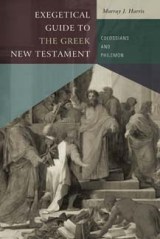
Exegetical Guide to the Greek New Testament: Colossians and Philemon, reviewed

Getting from participles to preaching, from grammar to Good News proclamation, can be a challenge to preachers and teachers when working with the biblical text. But if there is theology in those prepositions, as seminary professors have often noted, careful attention to the morphology and syntax of the text can be key in preparing to expound God’s Word with God’s people.

B&H Academic’s Exegetical Guide to the Greek New Testament “aims to close that gap between stranded student (or former student) and daunting text and to bridge that gulf between morphological analysis and exegesis.” As a volume in a projected set of 20 volumes, Murray J. Harris’s Colossians and Philemon “seeks to provide in a single volume all the necessary information for basic understanding of the Greek text and to afford suggestions for more detailed study.” Similar to the Baylor Handbook series, the Exegetical Guide is not a “full-scale” commentary. This affords the author more opportunity to comment on the original language of the biblical text.

Both Colossians and Philemon in this volume contain a brief but sufficient Introduction. It treats authorship (Harris defends Pauline authorship based on Colossians’ similarity to Philemon, which is more generally accepted as Pauline); date (he puts the two letters at 60-61); occasion and purpose; includes an outline of the letter; and makes commentary recommendations.

Each paragraph of the biblical text has the following features in the commentary:

  • A structural analysis of the Greek. This is in sentence flow style–not sentence diagramming; Harris says the former is “a simple exercise in literary physiology–showing how the grammatical and conceptual parts of a paragraph are arranged and related”
  • Commentary on each phrase in the Greek, which ranges from morphological analysis to syntax to lexical analysis (great helps for word studies in this book!) to textual variants. Much of the Greek ends up translated into English in each passage of the commentary
  • “For Further Study,” a bibliography arranged by topic, e.g., “Prayer in Paul” (1:9-12), “The Will of God” (1:9), etc.
  • “Homiletical Suggestions,” not uncommonly more than one for a given passage

In addition, at the end of each letter there is a full English translation of that letter and an “expanded paraphrase” of the Greek. Colossians 3:12-14 in Harris’s translation, for example, reads:

Therefore, as God’s chosen people, who are holy and loved by him, put on heartfelt compassion [σπλάγχνα οἰκτιρμοῦ], kindness, humility, gentleness, and patience. You are to bear with one another, and if anyone has a grievance against someone else, you are to forgive one another. Just as the Lord forgave you, so you also must forgive.

The expanded paraphrase reads, “So, then, since you are God’s chosen people, his elect, dedicated to his service and the objects of his special love….”

The structural analysis, in my view, is the best feature of this densely packed and rich commentary. For example, in his analysis of Colossians 3:1-4, Harris visually shows “Christ” (in Greek) lined up in five different instances, so that he can easily show, “Christ is a central theme of the paragraph (there are five explicit references to him in the four verses).” Just reading the Greek straight through, this may not be as obvious as it is when Harris shows it visually and comments on it.

Harris gives great attention to individual words and phrases within verses. He mentions the major Greek grammars: “Blass-Debrunner-Funk, Robertson, Turner, and Zerwick,” as well as BDAG, the Anchor Bible Dictionary, and other such standard references. Just to give one example, on 1:15 Harris writes:

The ‘firstborn’ was either the eldest child in a family or a person of preeminent rank. The use of this term to describe the Davidic king in Ps 88:28 (LXX) (=Ps 89:27 EVV), ‘I will also appoint him my firstborn (πρωτότοκον), the most exalted of the kings of the earth,’ indicates that it can denote supremacy in rank as well as priority in time.

The sermon suggestions are really just suggestions for the body of a sermon; though they are in outline form, they are not complete sermon outlines. And some of the included outlines (“Wrestling in Prayer” from 2:1-2) will preach better than others (“Introductory Greeting” from Philemon 1-3). Yet anything homiletical like this is more than some Greek-focused, exegetical series offer, and the homiletical suggestions–if not always sufficient in themselves–still make for a good point of departure for the preacher. In fact, Harris only intends “to provide some of the raw materials for sermon preparation.”

The “Glossary of Grammatical and Rhetorical Terms” is one of the best such glossaries I’ve seen in a book like this. It occasionally uses examples from Colossians and Philemon themselves, which is a nice touch.

This Exegetical Guide to the Greek New Testament is a great companion to the Greek text. Harris is sensitive yet incisive, and always thorough. It’s hard to imagine a better guide for the grammatical analysis of Colossians and Philemon in Greek. I look forward to future volumes in this series. (A James volume is coming soon.)

Thanks to B&H Academic for the free review copy of the book. I was under no obligation to provide a positive review. The book’s product page is here (B&H), or see it here (Amazon).

Review: Accordance 10’s Commentary on the New Testament Use of the Old Testament, by Beale and Carson (part 1 of 2: the module)

Baker Academic has made its way to Accordance 10 Bible Software. The first offering is Commentary on the New Testament Use of the Old Testament, edited by G.K. Beale and D.A. Carson. Here I review it, with this first part of the review covering Accordance’s version of it.

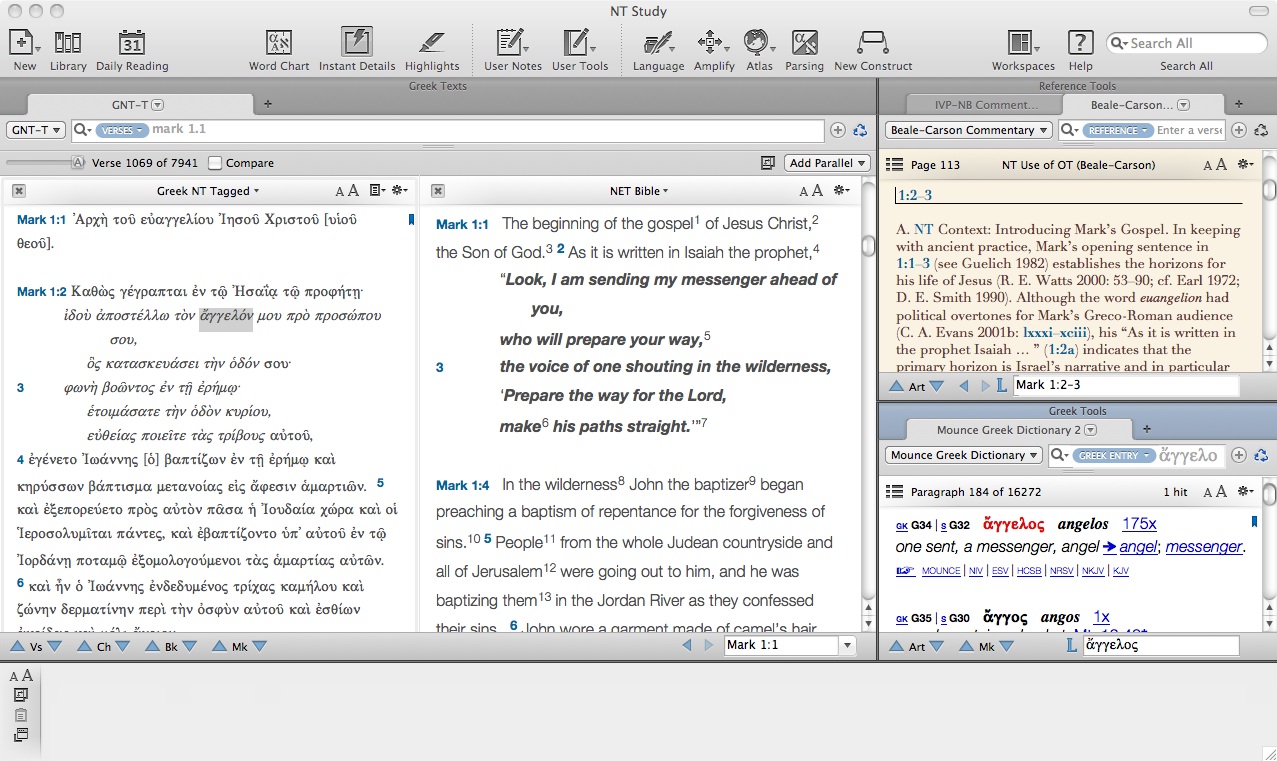
One nice thing about Accordance’s setup is that I can use Commentary on the NT Use of the OT just as any other Accordance tool (for the below and all images in this post, click or open in new tab for larger):

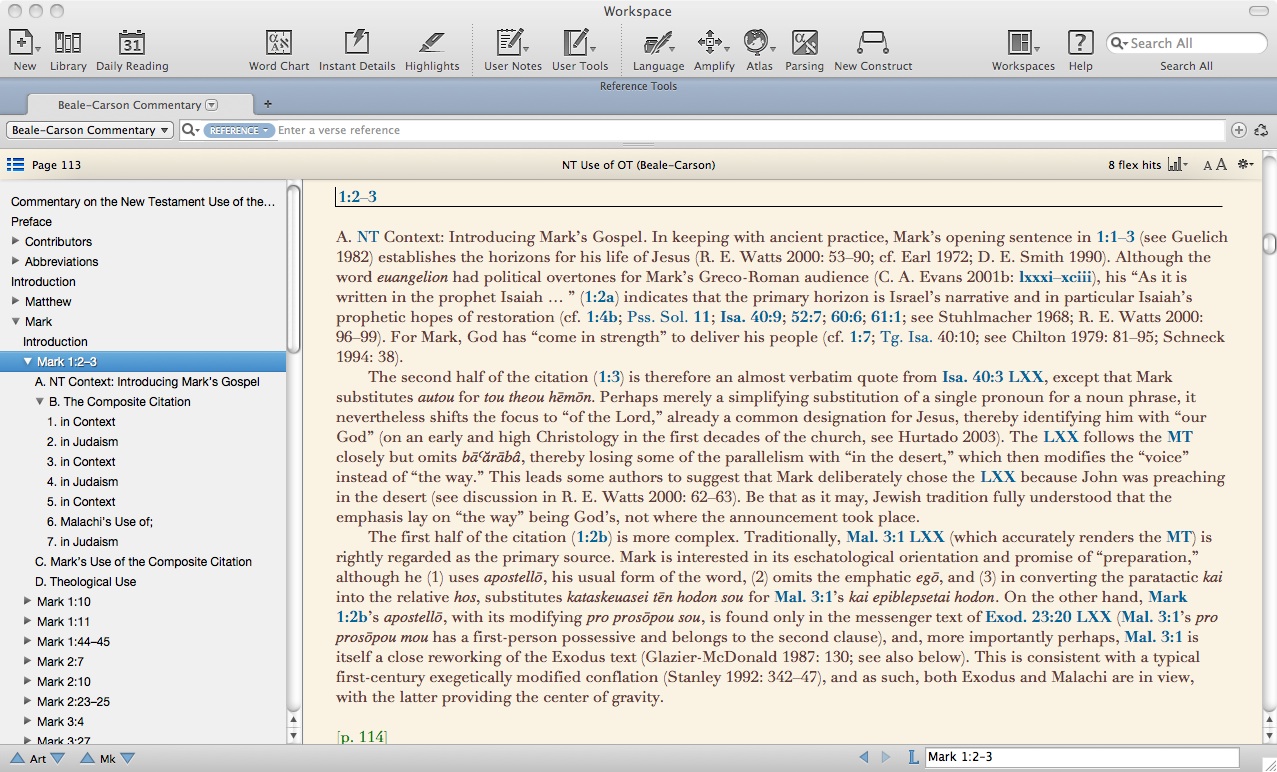
Or I can right-click on the tab to “detach it,” so that it’s its own workspace. For reading through a good deal of text at once, this is ideal. One other great feature, as you’ll see in the left sidebar below, is how easy it is to navigate through all the sections and sub-sections of the book:

But what about how I’d actually need to use this resource? To really make sense of it, I’d need the Hebrew MT, Greek LXX, possibly English translations of each, and the Greek NT all open and easy to view. Combining that kind of layout with the hyperlinking in Accordance’s version of this commentary would be sweet. Wonderfully… it’s possible. Check this out:

For a resource that can be had in print for under $40, it seems like paying nearly $60 for the Accordance module could only be justified if the electronic version could do things the print version can’t. The electronic version can, indeed, do some unique things. (See the image above.) Especially for a commentary like this with lots of cross-references and constant movement between Greek, Hebrew, and other versions, being able to see multiple versions at once–together with the commentary–is a huge benefit. It saves time and allows me to better grasp how NT writers used OT texts by seeing a quotation alongside its original context.

The Instant Details (which I happen to have closed above to maximize screen space for different versions) show whatever hyperlink you hover over–this gives you yet another window for text display, and is particularly useful for, say, quickly seeing a longer passage in English. Things did get a little buggy when I opened the Instant Details the first time, but I assume that was because of how many windows I had open (not the module itself, necessarily):

I was able to get rid of the jumbling on the top right by closing and re-opening the Instant Details. See now below:

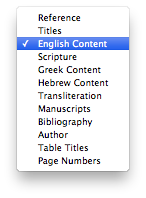
One really nice feature about Accordance’s Beale and Carson commentary module is how many ways you can search it. Accordance then tells you how many hits come up for your search, and using the “move down one mark” arrow keys, you can easily move through the results. You can even see the “real” (i.e., print) page numbers! Look again at that image at right–that’s 12 different ways you can search Beale/Carson. Pretty handy.

Most folks interested in Commentary on the New Testament Use of the Old Testament likely know of its solid reputation and are perhaps now merely trying to decide between a print and electronic version. (In a second post I’ll review the content of the commentary.) If you use Bible software regularly already, I think it is well worth the extra cost to own Accordance’s module. It’s facile to get around, hyperlinked nicely, easy to line up with original language texts, highly searchable, and quite readable as a detachable resource. I, for one, am really glad to have this module on my computer.

Thank you to Accordance for providing me with a copy of the Beale/Carson commentary module for review. Scroll through for all six parts of my Accordance 10 review here.

UPDATE: Read the rest of my review of Beale/Carson here.

Family Fridays: Why blog about family when I can go to the beach with them?

Today I took my two boys to the beach part of Lynch Park. Yesterday we went to the playground part of it. SO MUCH FUN. So… no actual blogging on this Family Friday. Just happy memories and tired bodies from time well spent outside together.

These 4 Perks are Divine in BibleWorks 9

Okay–not divine per se, but pretty indispensable for Bible study. Here are four perks in BibleWorks 9 that, the more I use the program, the more I appreciate.

1. Archer and Chirichigno’s Old Testament Quotations in the New Testament

Sure, this is perhaps an obscure thing to highlight. But it’s a major perk in my book! Archer and Chirichigno’s resource is already an invaluable one, particularly for studying the NT use of the OT. But the way it’s laid out in BibleWorks opens up possibilities unavailable to the owner of just the print version.

Because the focus is on OT Quotations, everything is listed in Old Testament canonical order. So if you’re wondering where Exodus 20 (the 10 Commandments) shows up in the New Testament, you can skip ahead to that section and find (click for larger):

Everything in Archer and Chirichigno’s book is there–their commentary at the bottom, their comparison of MT/LXX/NT. You can hide or display the English in BibleWorks (I have it shown above). Also, when you mouse over a blue hyperlinked verse, as I’ve done in the image above, you see a popup with that verse in three different versions. This seems to be an underrated part of BibleWorks, but if you’re serious about LXX or OT/NT study, having this is a great help.

2. Lots of how-to videos

Some six hours worth, according to the BibleWorks site. The videos I’ve watched have been clear, simple, and substantive.

3. Intermediate Hebrew and Greek grammars included

BibleWorks 9 comes with these three classics included:

They’re keyed to individual verses so that the appropriate information from each of these grammars will automatically show in the “Resources” window at any given verse. Using even Amazon prices, just these three grammars cost more than $150 in print. And having them lined up with the OT and NT texts as I use them in BibleWorks saves me time from flipping through indices and physical pages. (See this portion of my BibleWorks review to see Wallace in action.)

4. The Use Tab

In an earlier part of my review I wrote:

[T]he new “Use” tab … instantaneously shows you all the uses of a word with how many occurrences it has in that book and version…. You had to search on a word in previous versions to do this…. I find this particularly useful for vocabulary acquisition. As I come across a word I don’t know in the text, I can easily see–does this occur 121 times and I should know it? Or is it just in the text two or three times, so I was okay in not knowing right away what it means?

This feature was reason enough for me to pursue an upgrade from version 8 to version 9. (!) With the new fourth column (which I mention at more length at the same link above), the Use tab can be open together with an additional analysis window.

Although I still regularly use print copies of the Bible (Greek, Hebrew, and English), BibleWorks has been a useful companion in my personal Bible study and devotions for the last couple years. Especially when I want to do word studies or delve into the grammar of the text or compare multiple translations, BibleWorks has been a great program to use.

See all that’s new in BibleWorks 9 here.

I received a free upgrade to BibleWorks 9 in exchange for an unbiased review. See my prolegomenon to a review here, part 1 (setup and layout) here, part 2 (the Verse tab) here, and part 3 (text criticism 1 of 2) here, with the completion of the text criticism mini-series coming soon.  You can order the full program here or upgrade here. It’s on Amazon, too.