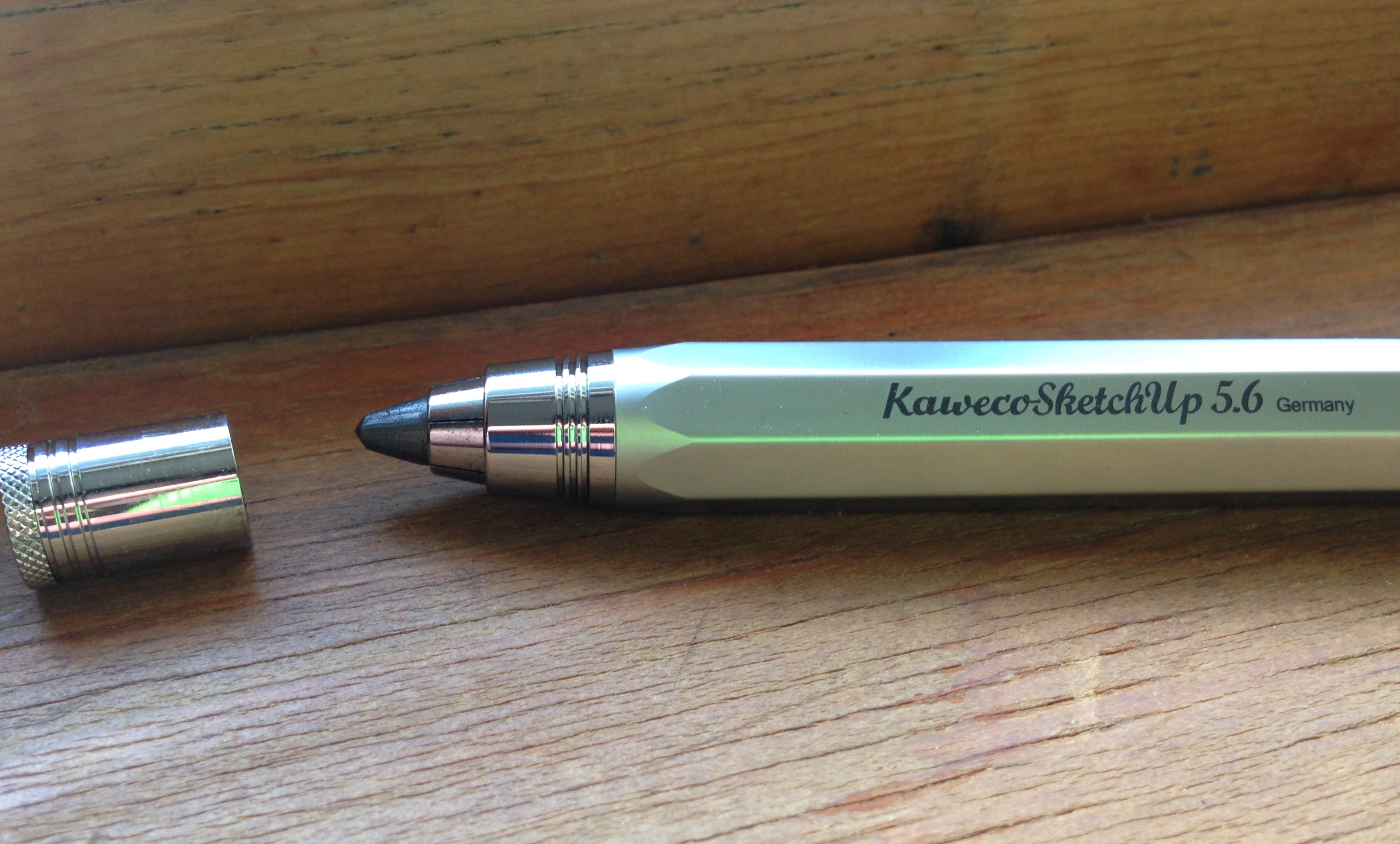
More than half my writing by hand these days happens with an implement from Kaweco in Germany. They are brand new to me, but Kaweco has been making writing instruments since 1883.
I’m especially eager to share my impressions of their outstanding LILIPUT fountain pen, but I’m saving that post for later. Here I briefly assess their SKETCH UP pencil.
The Pencil’s Construction
The SKETCH UP is a heavy beast. You will feel manly or womanly every time you pick it up to sketch. Its octagonal barrel somehow adds to its impressiveness. You simply cannot ignore its heft.
Having used pretty much only No. 2 pencils my whole life–with mechanical pencils constituting my sole upgrade–the 5.6 mm lead felt mammoth, yet also softer and smoother than any other pencil I’ve used.
The SKETCH UP is not as long as your run-of-the-mill pencil, so it will fit into any pocket.
I am only slightly embarrassed to admit it took me a few tries to figure out the mechanism that feeds the lead through.
You have to push the button at the top of the barrel with one hand (to release the lead) and use another hand to adjust the lead to the desired length, before releasing the push button again. Then you’re all set to draw.
Writing with the SKETCH UP
Writing and sketching with the SKETCH UP feels great. Shading is easy and smooth. It’s maybe heavy for writing a lot of words, but even for taking notes, it would do well. Sketching, however, is its primary intended purpose, and for that it is a workhorse.
And, get this: it’s got a built in point sharpener. The push button uncaps to sharpen your point.
You can check out Kaweco’s SKETCH UP line here. (This pencil is Item #10000946, and came with a nice tin gift box.) And if you are so inclined you can order the SKETCH UP via JetPens or Most Wanted Pens.
Many thanks to the fine folks at Kaweco for the pencil for review! Check them out here.
Dr. Aitken has a really interesting essay in this book, too
Some Sundays (though not nearly 70 or 72) have gone by without a Septuagint Sunday post, an erstwhile major focus of this blog. Today rectifies the paucity, at least for this week.
William Ross, a doctoral student at the University of Cambridge, interviewed James K. Aitken just after Christmas. Aitken is the editor of the exciting T & T Clark Companion to the Septuagint. The companion, to my knowledge, marks a first in Septuagint studies, as it presents a “handy summary of features for each of the Septuagint books.”
The interview is fascinating and enjoyable, and you get a sense of a scholar who is both rigorous in his study and writing, yet also approachable.
Aitken offers encouragement to those interested in Septuagint studies by suggesting the field still has much ground (bad pun, all mine) to till:
I do not think there is any area that is overworked in LXX studies, so that any aspect of the field is possible. Currently for most books of the LXX, there has been only one or two monographs in the past century – an enviable position in biblical studies! Some books have now received more attention (Isaiah, Psalms, Minor Prophets) but there is still plenty to do even for them. So, a student may pick any book and still have plenty to say.
Jesus says to his disciples in John, “I tell you the truth, anyone who has faith in me will do what I have been doing. He [or she] will do even greater things than these, because I am going to the Father.”
Of course our first reaction is to ask, “Greater than Jesus? How is that even possible?”
One possible meaning: Because I am going to the Father–because I am going to die and rise again–sin and death will be defeated and you will have even more power than you do now.
The Kingdom would be even more fully ushered in at the end of John. Is this what Jesus means?
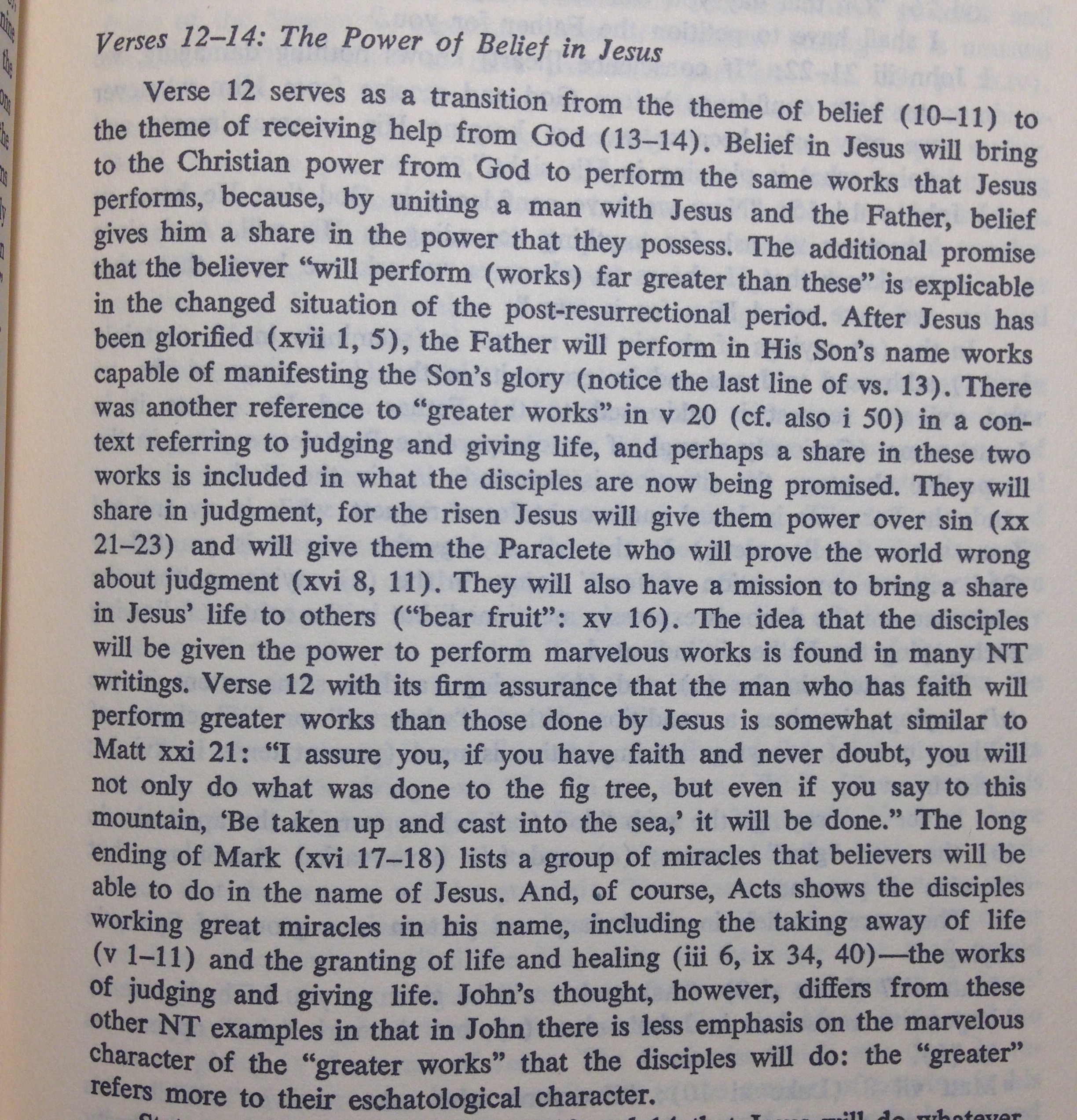
In short, the works that the disciples perform after the resurrection are greater than those done by Jesus before his death insofar as the former belong to an age of clarity and power introduced by Jesus’ sacrifice and exaltation. Both Jesus’ words and his deeds were somewhat veiled during the days of his flesh; even his closest followers, as the foregoing verses make clear, grasped only part of what he was saying. But Jesus is about to return to his Father, he is about to be glorified, and in the wake of his glorification his followers will know and make known all that Jesus is and does, and their every deed and word will belong to the new eschatological age that will then have dawned.
I think it could also be helpful to understand Jesus’ statement in light of the signs he has performed.
Jesus says the above in John 14, shortly after the conclusion of the “Book of Signs” portion of John–the first 12 chapters containing his “7 Signs.” John 13-21, then, constitute what scholars call the “Book of Glory.”
A sign, after all, is that which (while good in itself) points away from itself and to a greater, deeper, fuller reality. So if Jesus is referring to “greater things than these signs,” that is not so hard to grasp if we consider that signs always point to something greater anyway. One could read Jesus’ statement as a sort of tautology, where the “greater things” mean that somehow the deeper reality Jesus’ signs point to is more fully unearthed through the ministry of the disciples.
In other words, Jesus says to Philip, these signs are just a foretaste of the Kingdom of Heaven, and you and all the disciples after you are going to work and work and work together to keep bringing the Kingdom in.
When puzzling over John, I can think of no better place to turn than to Raymond E. Brown, to whom I give the last word. Note especially the final sentence of this paragraph.
One preacher says, “Weddings are accidents waiting to happen. Something almost always goes wrong at a service of holy matrimony.”
That doesn’t match my experience with weddings, but there is something quite wrong at the wedding in Cana, in Galilee (John 2:1-11): they’ve run out of wine.
So maybe there’s no better place for Jesus to show up, his first week of public ministry, than at a well-attended, days-long wedding.
Jesus turns water into wine—“the first of his miraculous signs,” John says.
The Seven Signs of Jesus in John
Jesus performed more than just seven signs, but John uses seven signs, or miracles, to organize the first part of his Gospel.
1. Jesus changes water into wine (John 2:1-11)
2. Jesus heals the official’s son (John 4:46-54)
3. Jesus heals the man at the pool of Bethesda (John 5:1-9)
4. Jesus feeds the 5,000 (John 6:1-13)
5. Jesus walks on water (John 6:16-21)
6. Jesus heals the man born blind (John 9:1-12)
7. Jesus raises Lazarus (John 11:1-44)
A translator’s handbook, intended especially for those who are taking to Bible into new languages for the first time, talks about it this way:
[A] “sign” is a means of revealing a greater reality to which the “sign” itself merely points. The Gospel of John speaks of seven “signs” of Jesus, and these are “signs,” not necessarily because they are miracles, but because they point to a truth beyond themselves, to a truth regarding God’s salvation.
Signs are good, even powerful, in and of themselves, but they point to a “greater reality.”
A sign is deeper than itself.
The signs of Jesus, in particular, are meant to tell us something about Jesus. The “signs” and wonders Jesus performs are witnesses to his glory. They’re each a vignette, a window into Christ’s revealing himself to anyone who would receive him.
Sign #1: Water Into Wine
Jesus, his mother, and his disciples have all gotten invitations to this wedding. It’s Jesus’ first week of public ministry, as John tells it, and it’s a huge event. It would not be unexpected for just about the whole town of Cana to be there. The local shops and businesses probably all put a “Closed for wedding” sign on their doors. Will be back in seven days. It was likely a week-long event.
But, even if not all weddings are “accidents waiting to happen,” this one was. The guests drank the wine down to the last drop.
It would be pointless (but fun) to speculate as to whether or not this was poor planning on the family’s part, or too much drinking on the guests’ part.
Either way, this family is about to go down in history as “the ones who ran out of wine at their wedding.” You sort of hope for them, at this point, that they don’t have any other kids to marry off, ‘cause no one’s coming.
Verse 3 says, “When the wine was gone, Jesus’ mother said to him, “They have no more wine.”
One early theologian said, “Perhaps his mother, as mothers do, incited him to perform a miracle, wishing that the greatness of her son would be revealed—and thinking that the lack of wine offered the right occasion for the miracle.”
The (1984) NIV gives us the reply: “Dear woman, why do you involve me?” Jesus replied. “My time has not yet come.”
There is a sense in which Jesus isn’t ready to fully reveal all his glory. But he whips into action. It’s a good way of honoring his mother.
Because… not only is the reputation of the family at stake, but the festive spirit of the wedding is in jeopardy. The Talmud, a text of Rabbinic Judaism from a couple centuries after this, bluntly says, “There is no rejoicing [without] wine.”
Jesus is on it. He performs the miracle, in kind of a subtle and smooth way. Maybe this is because his “time had not yet come,” as he said to mother Mary.
Jesus said to the servants, “Fill the jars with water”; so they filled them to the brim.
Then he told them, “Now draw some out and take it to the master of the banquet.”
They did so, and the master of the banquet tasted the water that had been turned into wine. He did not realize where it had come from, though the servants who had drawn the water knew. Then he called the bridegroom aside and said, “Everyone brings out the choice wine first and then the cheaper wine after the guests have had too much to drink; but you have saved the best till now.”
Just to be clear, we are talking about anywhere between 120 and 180 gallons of wine.
This doesn’t mean that a bunch of wedding guests are going to get toasted. If you think of a whole town of people celebrating for a week, a lot of wine is needed.
Here’s the town today that might have been 1st-century Cana:
Source: Accordance Bible Lands PhotoGuide
Imagine the effect of 180 gallons of wine!
This picture is probably 30 gallons or a little more:
So if my calculations are correct, here’s a visual on how much wine Jesus made:
The result of this sign, besides a happy wedding, is in John 2:11:
This, the first of his miraculous signs, Jesus performed at Cana in Galilee.
He thus revealed his glory,
and his disciples put their faith in him.
Or, in another translation, “There Jesus showed how wonderful he was.”
It was looking back and thinking of moments like this that John could write in his Prologue, in chapter 1: “We have seen his glory, the glory of the one and only Son, who came from the Father, full of grace and truth.” We have seen how wonderful Jesus is.
What Does the Sign Show?
N.T. Wright says, “The whole point of the ‘signs’ is that they are moments when heaven and earth intersect with each other.”
From these signs of Jesus, we on earth learn more about ultimate, heavenly realities: who Jesus really is, what sorts of things God is capable of, what kind of intervention is possible in the problems of the world today.
Especially with this first sign, when Jesus is fresh on the scene, we get a portrait of who our Savior is.
—Jesus likes to have fun—
“Eat, drink, and be merry” is not just a mindset that the Bible shoots down. Jesus wants us to eat, drink, and be merry—so long as we’re not neglecting important things.
Jesus upset the religious elite of his day by all the feasting he and his disciples did. In Luke some angry leaders say to him,
John’s disciples, like the disciples of the Pharisees, frequently fast and pray, but your disciples eat and drink. Jesus said to them, “You cannot make wedding guests fast while the bridegroom is with them, can you? The days will come when the bridegroom will be taken away from them, and then they will fast in those days. (Luke 5:33-35)
As long as you’ve got me, Jesus says, party on.
And did you catch this nice touch from John: these jars, where the chemical miracle happened, were ones “used… for ceremonial washing.” There’s nothing wrong with religious ritual, per se—I quite like it myself. But these jars for ritual cleansing—Jesus turned them into party favors. That’s kind of like co-opting the baptismal font for a punch bowl.
This family made good choice in inviting Jesus to the wedding. Maybe he already had a reputation as a fun guy—someone you wanted to celebrate with.
—Jesus is generous—
This sign also shows Jesus to be generous. Under his command, the servants “filled [the jars with water] to the brim.” There’s no skimping with Jesus.
Next chapter Jesus will say, “For the one whom God has sent speaks the words of God, for God gives the Spirit without limit.”
God does not withhold his good gifts and his love from us. He wants us coming to him with open hands, even empty cups, so he can fill us with good things.
Also, just a geographical note here: we know the stories of Jesus, so we take it for granted, but Cana was 70 miles north of Jerusalem. This is pretty far outside the city of the religious power brokers.
But being a religious insider or expert, so to speak, has never been a requirement for receiving Christ’s love.
Jesus does not withhold his presence from the ones who have never known power, wealth, or the comfort of living in the mainstream of society. Jesus is generous.
—Jesus is accommodating—
Jesus is accommodating. He says his “time has not yet come,” but then he does the miracle. He seems to be flexible on timing. You’ll see in other places in John where Jesus says “his time has not yet come.”
We know the frustration of when God’s timetable or timing in the world does not match ours. But God is not impassable. God is not unaffected by our needs and desperation.
If God has a massive planner on his desk, with dates and times and places, it’s written in pencil. God can change the future. God can even accommodate our requests when he maybe otherwise wasn’t planning to. Jesus is accommodating.
How Shall We Respond?
Having seen this intersection of the heavenly and earthly, having caught a glimpse of a God who changes reality, a Jesus who is fun, and generous, and accommodating… how shall we respond?
John models a response for us in verse 11: “He thus revealed his glory, and his disciples put their faith in him.”
We can eat, drink, be merry, trusting that our God is a God of celebration… assured that he’s generous… and confident that he’s flexible to respond in real time to our needs and intercessions.
Look at Mary’s response in verse 5 to the servants: “Do whatever he tells you.”
I think we can safely assume, 30 years in, that she’s onto the whole divinity thing. She doesn’t know what he’s going to do or how, but she expects something, when she comes to him with a need: “They have no more wine.” Her words to the servants model an admirable submission to the Son of God: “Do whatever he tells you.”
Do the good you know to do. Act in love, in the ways that you see it within your reach to do. “Do whatever he tells you.”
John, by showing Mary and the disciples’ response to Jesus’ first sign, calls us, too, to submission and faith and trust in Christ.
I think another response this passage can call forth from us is just… relief.
Jesus isn’t boring or a killjoy. He liked to celebrate, to enjoy parties and good wine and food with others.
Jesus says of his mission, “I have come that you may have life, and have it abundantly.” Jesus wants disciples to live life to the fullest, and one implication of this is that we enjoy the good things on earth.
We read in the Psalms:
How precious is your steadfast love, O God!
All people may take refuge in the shadow of your wings.
They feast on the abundance of your house,
and you give them drink from the river of your delights.
Jesus wants us to enjoy the abundance of his creation. He is not stingy. He’s not inflexible.
This passage can offer us relief because it reminds us that prayers regarding needs do affect God. We can invite him into broken and unresolved places in our life.
An Even Greater Wedding Feast
The wedding at Cana, in fact, serves as a foreshadowing of a great heavenly banquet, where Jesus is the groom. And he invites everyone, not just in one whole town, but across many nations. It’s not just a weeklong wedding celebration, but an eternal one, with Jesus as host.
The prophets saw this day and were relieved. Amos rejoiced, “New wine will drip from the mountains and flow from all the hills.” Joel saw a day when “the mountains will drip with sweet wine, and the hills will flow with milk.” (And that milk—it accounts for those who don’t drink wine… so God’s got everyone covered.)
We, like Mary and the disciples, have seen the glory of Jesus. Witnesses to this and many other signs of Jesus, may we put our trust in him. May we hope in him. May we present our needs and lacks to him, asking for his help. May we place our confidence in him. And may we give ourselves over to him, and keep our hands open for the good things he has to give us.
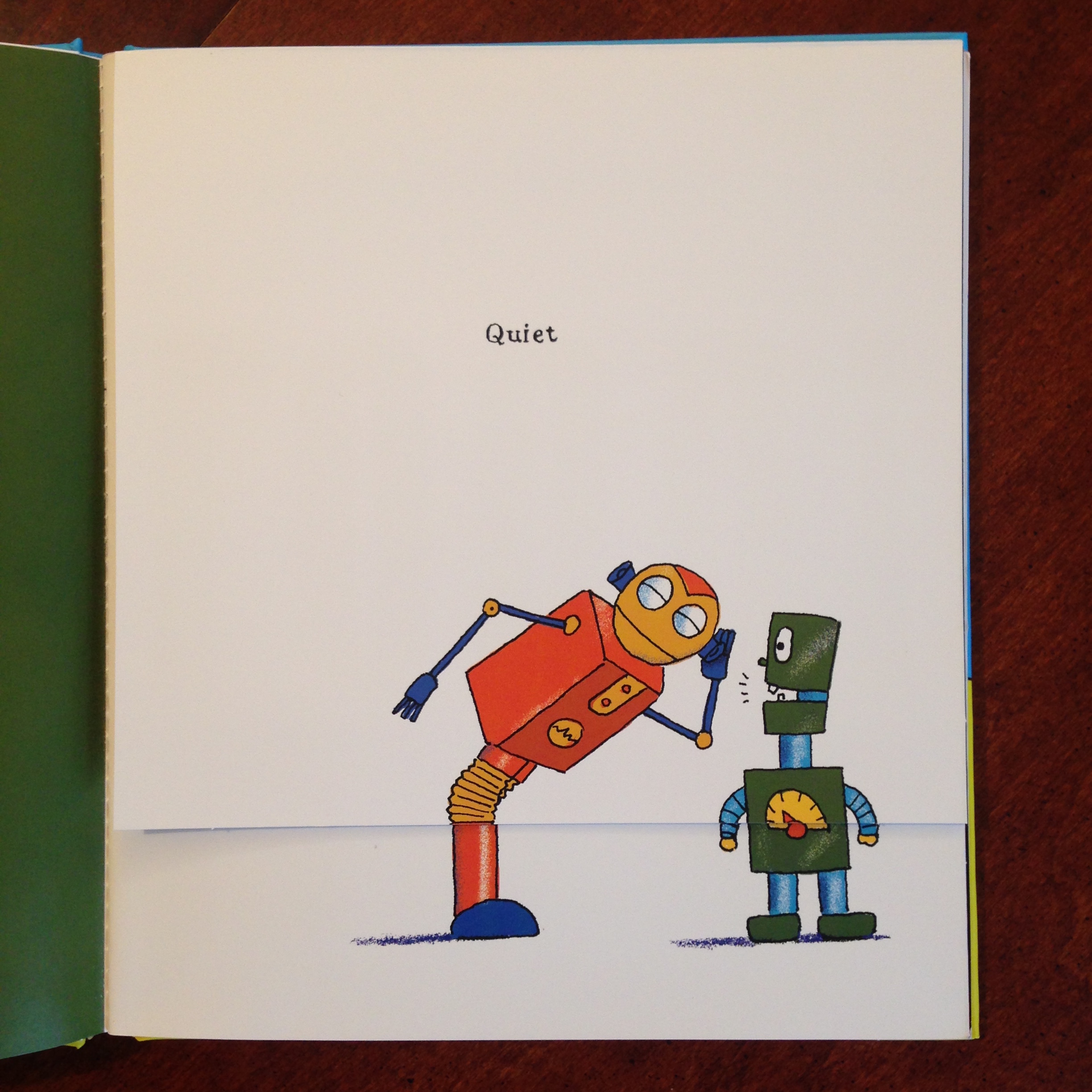
Marc Rosenthal’s Big Bot, Small Bot: A Book of Robot Opposites is short and simple, but wonderfully executed.
The book is just what it says: through colorful images and some imaginative flap-lifting, kids and parents follow some “retro-futuristic robots” through opposites like wet/dry, full/empty, and so on.
When you lift the flap, the opposite is revealed. So you start with this:
And end up with this!
I really wanted to just take a picture of every opposite and show it to you, but I will simply recommend the book, instead. The target ages are 2 to 5, which seems spot on to me. (You can see more images here, if you like.)
The book is funny, clever, and engaging. My 3-year-old was a fan from the first time she read it. The paper is nice and thick, too. That means it will give up a pretty good fight when your toddler decides–in a fit of unexplained and inexplicable rage–to rip all their books. (I’ve heard some kids do this.)
It makes for some excellent parent-child reading and interaction.
Find the book at POW! Kids here, or at Amazon here.
Thanks to the good folks at POW! Kids Books for sending the book for review, though that did not influence my opinions.
In college, when I was a prolific journaler, I filled up two or three wonderful lay-flat books with all sorts of feelings and existential insights/ramblings. My journal of choice featured semi-invisible lines, which were a guide to keep me writing straight, but subtle enough that I didn’t really notice once I looked at a filled-up page.
I noticed this fall that a Swedish company makes such a subtly-ruled notebook: Whitelines.
First, let me show you the outside of the orange A5 Hard Bound Cloth notebook:
The linen cloth gives the hardcover notebook an organic feel. The orange ribbon marker looks good, too. This is definitely a classy notebook.
What sets Whitelines apart from other notebooks is the… well… white lines it uses. Here’s what a page looks like:
The white lines look great on the colored 80g paper. You can tell from the page above that there’s a little bleed-through, though. This was using a Pilot G2 07 gel pen. An extra fine fountain pen fares better.
The branding is minimal, but I can’t think of another notebook I’ve used that had the company name on every page:
I have gotten used to this in time and don’t really notice it anymore.
Apart from the really nice experience of writing on white lines, this notebook lays flat really well, even when you’re writing on the first few pages on the left-hand side. Kudos to the makers for getting that right! The sewn binding is welcome, too. This means the notebook will last a long time.
I use the Whitelines notebook as my primary journal, since it has a classic look and feel. And because this particular book is orange, I will (probably) never lose it.
Want to give it a go? Whitelines has a variety of .pdf samples of their pages here, so you can print them out and try it.
You can see more Whitelines products here. The Hard Bound Cloth A5–available in both orange and grey–can be found here.
Many thanks to the fine folks at Whitelines for the notebook for review!
This month’s free book of the month from Logos Bible Software is the brilliant Nahum Sarna’s JPS Torah Commentary. It’s worth much more than $0.00, but you can get it for that price here. I reviewed the commentary here.
Logos is also offering the JPS Jonah Commentary (I covered it here) for $1.99–an excellent deal.
I’m increasingly finding myself drawn to the high-quality goods of manufacturers in New York (here and here) and San Francisco.
WaterField Designs is based in SF. They make an excellent keyboard slip case, which I covered here. For the last few weeks I’ve been carrying around their super-slim and stylish Spike Wallet.
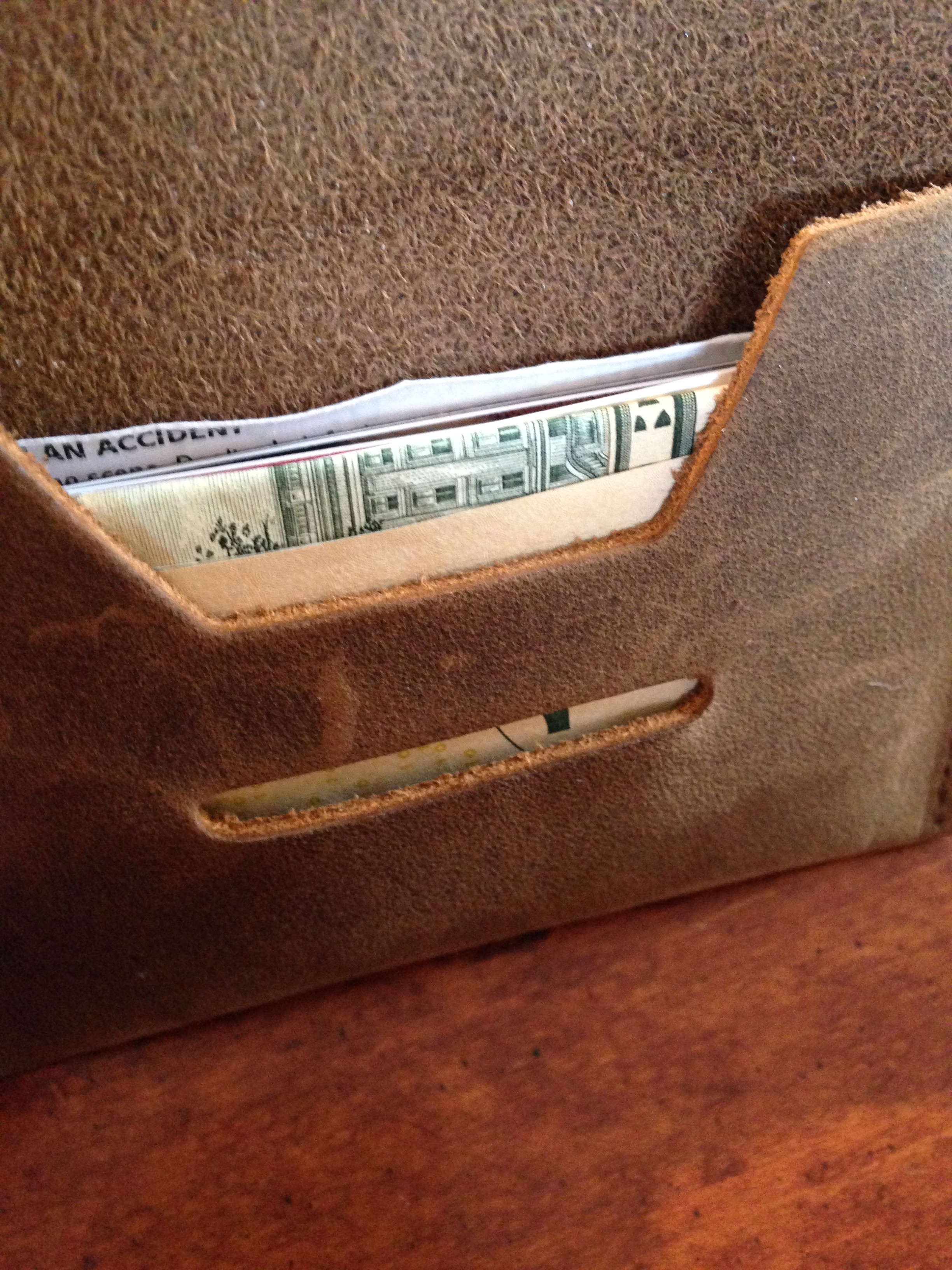
It looks like this:
The best thing about it is its size–it’s small! It’s about the size of an iPhone 5, so it actually fits really comfortably into a front pocket, right next to a phone. Actual dimensions: 4.3″ x 3″.
This can’t be your hold-everything wallet, of course. I’ve been able to easily fit into it: two debit cards, some cash, an insurance card, and my driver’s license. This is what I need most days. However, the kids’ insurance cards or any gift cards I have still have to go in another, larger wallet. (Or just in my satchel somewhere.)
Getting things in an out was a bit tough at first, but the full-grain leather continues to soften with use. Here’s what it looks like filled:
The closure mechanism is minimalist and slides right into place, easily and snugly. It’s perfectly executed.
There’s only a little bit of branding, and it’s on the back. I probably would have preferred something more subtle, like on the inside flap of the wallet, for example.
The leather feels great in the hands, the stitching is secure, and the size is right for daily use. This piece of gear has been truly enjoyable to use.
WaterField makes a lot of other great-looking gear, which you can learn more about here. Find the Spike Wallet here. Retailing at $25, it comes in “Wallet”/large size (which I’ve featured here) as well as “Business Card”/small size.
Thanks very much to WaterField for the product review sample, given to me for purposes of review, but with no expectations or influence on the review’s content.
Here, in no particular order, are some ideas for how to memorize a verse or paragraph of text. I have Bible memory specifically in mind, but this could work for any text.
There are some advantages to memorizing in a corporate context. I suggest some options here. I suppose any of those could be co-opted into an individual setting, too.
You could:
just read the verse(s) over and over until it solidifies in your memory
color code the text to enhance visual associations
do a sentence flow or diagram where you set apart subordinate clauses–this wouldn’t have to be fancy, just a way to break up the text and see the relationships spread out
start by reading one word of a given sentence, then two words, then three words, etc. So memorizing John 3:16 would go like this: “For. For God. For God so. For God so loved. For God so loved the. For God so loved the world.” And so on
write it out! Whether you make structural relationships between components of sentences and paragraphs is optional. Writing slowly helps you to turn the words and phrases over more carefully, helping you to remember them better
make flash cards. If you’re learning a Bible verse, write the verse reference on one side and the verse on the other. Or the verse reference and part of the verse on side A, with the remainder of the verse on side B
listen to the text on audio, so you have another sense engaged
for that matter, record yourself reading the text, not straight through, but with reps on each verse. So you could record yourself reading John 3:1-17 out loud, but reading verse 1 five times, then verse 2 five times, and so on
find someone to whom you can attempt to quote the passage, asking them to stop you when you don’t get it verbatim
copy the single page you’re working on, put it in a Ziploc bag, and tape it up somewhere in your house where you’ll see it (bedroom, bathroom, kitchen)
write a song or really silly rap that helps you commit the verse to memory
read the verse out loud, but backwards
do the same as above, but writing it out
give yourself some signposts–if you’re memorizing a whole chapter, start by memorizing verse 1, verse 6, verse 10, etc. Then come back and fill in the rest
brainstorm your own list of ways to memorize, keeping it handy for when you need to change it up
I’d love to hear any additional ideas in the comments below.














 Words on the Word