Two Septuagint Studies Classics from Wipf and Stock

Conybeare.Stock.Septuagint.53307Conybeare and Stock’s Selections from the Septuagint According to the Text of Swete is a classic–if somewhat dated–work in Septuagint studies. You may also know it as Grammar of Septuagint Greek.

The grammar section is short, and leaves one desiring a properly full grammar of Septuagint Greek. But it’s the best starting point there is, so the Septuagint student will still want to read it. It is chock-full of Scripture references (and quotations), which in the print edition will require a fair amount of looking things up. (The need for this is obviated if you buy the Accordance or Logos edition.)

The grammar section is dense–if selective in its treatment–but not overly obtuse. There is a 20+-page introduction on the Septuagint, its origin, the Letter of Aristeas, transmission, and so on. It offers succinct coverage of the “long process” of the “making of the Septuagint.”

After the introduction there are “Accidence” and “Syntax” sections, the former covering morphology and the latter addressing sentence structure. To get a feel for how much coverage a section has, here is part of a page on “number” in Septuagint Greek:


LXX Grammar Number
Click or open in new tab to enlarge


One oddity that appears to be a printing error is that the Table of Contents for the Grammar appears after the Grammar, on about page 100 or so.

The grammar, then, is a good enough starting point, but won’t really take one deeply into study of a particular grammatical or syntactical feature of the text. Would that T. Muraoka might give us a full Septuagint grammar! (Wait–the day after I drafted that sentence, I saw this. Awesome.)

However, Conybeare and Stock more than make up for any lack in the comprehensiveness of the grammar proper with their guided reading section. It is still the most thorough resource of its kind available for the Septuagint. (Though that looks set to change this fall.)

With the Septuagint texts there are reading helps at the bottom of each page. Especially for those who have only read New Testament Greek, this is a great next step. Here is what “The Story of Joseph” looks like (click to enlarge):


From the reading on Joseph


You’ll note the attention to grammatical detail, especially, in the notes. And the introductory mini-essays before each reading were a pleasant surprise. These selected readings have definitely helped me keep my Greek going, or ramp it back up after some delays in using it.

You can find Conybeare and Stock’s little gem at Amazon here, or at Wipf and Stock’s product page here.


6x9Cover Template


Another LXX print resource from Wipf and Stock is A Handy Concordance of the Septuagint: Giving Various Readings from Codices Vaticanus, Alexandrinus, Sinaiticus, and Ephraemi.

It’s what you’d expect: a compact, easy-to-carry-around concordance to words found in the Greek Old Testament. To boot: there is an appendix featuring words from Origen’s Hexapla that are “not found in the above manuscripts.”

Of course, a “handy” concordance cannot include every LXX word. Pronouns and prepositions and the like do not occur here. Those engaged in academic study of the Septuagint will probably cringe at this line:

All reference to the Apocrypha has been omitted; principally because it was judged that the Apocryphal books should never have a place with the Holy Scriptures.

There is the offer that if “the apocryphal parts are thought to be needed, any one so disposed can carry out that work.” (Bible software to the rescue!) But Codex Vaticanus, on which the concordance is primarily based, includes what Protestants consider “Apocrypha.” That those books should be omitted on theological grounds seems an unfortunate decision.

Otherwise the book is easy to carry and doesn’t require electricity or software updates, so Apocryphal omission aside, it could have its place in the LXX student’s library. Here’s what part of a page looks like:


LXX Concordance


You can find the LXX concordance at Amazon here, or at Wipf and Stock’s product page here.


Thanks to Wipf and Stock for the review copies of both books, given to me for the purposes of reviewing them, but with no expectation as to the content of this post.

Cool, Cool Castletown Play Mat

You may know of PlaSmart from such toys as the PlasmaCar (a.k.a., COOL COOL CAR!). Turns out they make a host of other toys, too. In this post, my kids and I assess the Castletown Play Mat.

The mat measures 78″ by 46″, which is generally big enough for three kids to play on but not so huge that it dominates your living room.


Action shot
Action shot


The mat can withstand cars, trucks, LEGOs, and probably even Teenage Mutant Ninja Turtles. It’s highly durable. And its “coated EVA foam” means that when Ms. Three-Year-Old spills milk on it or Daddy spills coffee on it or Mommy spills wine on it (just kidding, honey), it will wipe up easily. Come to think of it… maybe I should just leave the mat on the carpet all the time to act as a stain guard!

It rolls up pretty easily, too, so you can store it in a corner of the room or throw it in the car on the way to a playdate, if you’re so inclined.

Here’s a closer look at the pattern:


Castletown Smart Mat


As you can see, the pattern repeats but seamlessly links together–a fact that was not lost on my children, each of which had their own farm to focus on as they shared the mat.

Especially if you roll the mat up when you’re done and store it somewhere, bringing it out generally gets my kids’ attention, even though they are not babies anymore. I could see this mat being perfect for a one- or two-year-old, but even my eight-year-old enjoys flying his dragons over the castles and farms and breathing fire on them.

The roads are the perfect size for whatever plastic or metallic cars you’ve already got at home. DUPLOs and Playmobil also work well with the mat–really, any toy you have can find a nice home here.

The first few times we used it, it was hard to get it to lay flat without curling up a bit, but that phenomenon has gone away with additional play and use.

You can find the play mat (with some other design options) here. PlaSmart has lots of other toys, too. They are on Facebook and the Twitter.


Thanks to the good folks at PlaSmart for the review sample, provided for review but with no expectation as to the content of this post.

Rain for Roots’s Waiting Songs for Advent (and CD Giveaway)


Cover Art by A. Micah Smith


Rain for Root’s Waiting Songs releases November 10. You can pre-order it here now with a 20% off discount using code WotW.

Also, Rain for Roots is performing an online/streaming concert to celebrate the album’s release, about which you can learn more here.

Finally, there are a few more days left to enter to win a physical copy of the CD, courtesy of Rain for Roots. I’ll randomly select two winners from comments made at this link. For one entry, simply answer the question, “What is Advent to you?” For a second entry, share a link to that post on Facebook or Twitter, and come back to the comments to tell me you did. I’ll announce the two winners Thursday.

Wisdom: Inside-Out, Outside-In

Dwight


Dwite Schrute once said, “Whenever I’m about to do something, I think: would an idiot do that? And if they would, I do not do that thing.”

Dunder Mifflin’s Assistant to the Regional Manager, Dwight, picks up on a long tradition of “Stupid is as stupid does.”

This points up to the larger truth that…

…we live our lives from the inside out.

“WHO IS WISE AND UNDERSTANDING AMONG YOU?”, James will ask a diaspora group of Christians in James 3.

After a dire passage on how no one can tame the tongue, we might expect James to talk about how no one can really exercise wisdom in this world. But he comes back now to a theme he started in the first chapter, which is that wisdom comes from above, from God, and is available to all who ask.


Two Ways


It seems like God’s people are always coming up to forks in the road. You can go this way, or you can that way. There are two ways.

Wisdom, the skill and cleverness with which we live, is like that, too. There are two kinds of wisdom, James says. One from above and one from below. A different kind of fruit that each kind of wisdom produces.

Jewish Christians would have been used to this kind of language. Listen to how the prophets Isaiah and Jeremiah contrast what the people of God can be.

Isaiah 27:6:

The time is coming when Jacob will take root;
Israel will blossom and grow branches.
The produce will fill the surface of the world.

versus Jeremiah 2:21:

I planted you in the land
like a special vine of the very best stock.
Why in the world have you turned into something like a wild vine that produces rotten, foul-smelling grapes?

What you fill your heart and your head with, and how you live out who you are, has visible effects–“fruit.” Any character trait in you has accompanying actions. If you find that you struggle with being critical of others, you’ll also hear snide remarks coming out of your mouth. If you experience compassion for others often welling up in your heart, chances are good you’ll act on it and spend time giving and serving others.

What’s inside you will find its way out of you.


One Kind of Wisdom: Ungodly


James says there are two kinds of wisdom. Or, only one is really properly called wisdom. The other is in scare quotes–so-called wisdom.

This passage weaves a tale of two wisdoms… James describes godly wisdom: where it comes from, what it’s like, and what it results in. He talks about ungodly wisdom: where it comes from, what it is like, and what it results in.

First, there is the so-called “wisdom” of the world. The wisdom he calls “earthly, unspiritual,” even “demonic.”


Where does it come from?

NOT from heaven.

In other words, the ungodly man or woman has not asked God for wisdom, and is going it alone. That person has not sought to receive the good gift of wisdom from the “Father of the heavenly lights, who does not change like shifting shadows.”

It’s actually worse than just coming “not from heaven.” Note James’s progression in verse 15: “Such ‘wisdom’ does not come down from heaven but is earthly, unspiritual, demonic.” You sort of descend the depths word-by-word in that passage.


What is it like?

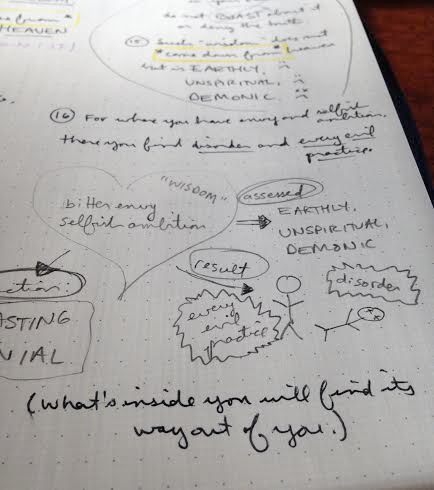
James says in verse 14, “But if you harbor bitter envy and selfish ambition in your hearts, do not boast about it or deny the truth.” There’s nothing to be proud of if you cherish “bitter envy” and “selfish ambition.” And if that does describe you, don’t deny it, James says. You’ll be better off admitting it and seeking God’s help before what’s inside you spills out onto others in a damaging way.

James talked about bitter water earlier in the chapter with regard to speech. Now he’s warning against a bitter spirit.


What are its results?

Envy and ambition, for James, lead to “disorder and every evil practice.”

As I was sketching and outlining this passage this week, with bitter envy and selfish ambition, you could end up with situations like this one…


Stick Figures


…where one stick figure knocks the other one down to the ground in a fit of disorderly rage.

I learned this week (source) about an art technique called pentimento. I am not a gifted drawer, that masterpiece above notwithstanding, so I can’t claim first-hand knowledge with this.

But pentimento is when the original base color on a canvas bleeds through. So if an artist started with a base of one color and then decided to switch that color and keep the same canvas, when that first color shows through, it’s called pentimento. What’s *really* there at bottom bleeds through whatever else is covering it.

It’s not that you can’t change the canvas. But sometimes, depending on your first color, you just can’t do anything to hide it in that same canvas. You can’t cover it up.

What’s underneath finds its way to the surface. What’s several layers inside, makes its way to the top.

That’s how James sees wisdom working. If you’re always envying others and trying to make a name for yourself, that’s going to bleed through. It leads to disorder and actually doing bad stuff.


The Other Kind of (Real) Wisdom: Godly


Then, James turns to real wisdom, the kind that God gives.


Where does true wisdom come from?

James says it’s “from heaven,” or from God. James has said this already earlier in the letter.

When he asks, “WHO IS WISE AND UNDERSTANDING AMONG YOU?”, it’s a rhetorical question, but there is an actual best answer to this question, I think, which I only came to when my eldest son was kind enough to write it down for me in my sermon notes. I had just left the question hanging there: Who is wise and understanding among you? Next to that, with a picture of a cross, he wrote, God! God is among us, is he not? And there simply is no one wiser and more understanding than God:

Oh, the depth of the riches both of the wisdom and knowledge of God! How unsearchable are His judgments and unfathomable His ways! (Romans 11:33)

Great is our Lord, and abundant in strength; His understanding is infinite (Psalms 147:5)

With Him are wisdom and might; To Him belong counsel and understanding. (Job 12:13)

This God, the Lord of infinite understanding, the God of unsearchable judgments and unfathomable ways, this God is the source of all wisdom. He freely gives of himself, of his wisdom and understanding and ability to make good judgments–he gives this to us when we ask.

And that ask, remember from James 1, is not, “If it doesn’t trouble you too much, God,” and not, “I’ve been asking around, so I figured I’d try you, too,” kind of ask. It’s a wholehearted, intense, yearning-filled, urgent request, “God, would you please grant me wisdom?!”


C.S. Lewis Quote


C.S. Lewis says, “The terrible thing, the almost impossible thing, is to hand over your whole self–all your wishes and precautions–to Christ.”

In doing so, we come to God empty-handed, ready to receive the gifts he will give. One of those is wisdom… sound judgment… better understanding… the ability to make sense of and move forward in a world that is at times just downright perplexing.


What is wisdom like?

James almost sneaks this one in. Look at verse 13: “Who is wise and understanding among you? Let them show it by their good life, by deeds done in the humility that comes from wisdom.”

Humility. True wisdom is humble. You don’t know wise people by their own claims… you know wise people by the smart and strategic and wise things they do… in humility.


What are its results?

The results of wisdom are many. Here they all are in verse 17: “But the wisdom that comes from heaven is first of all pure; then peace–loving, considerate, submissive, full of mercy and good fruit, impartial and sincere.”

Pure seems like a funny word here. When many people hear the word “purity,” the mind goes to “sexual purity.” But James is using the word to refer to an undivided spirit. A heart that is fully trained on God. This is the antithesis to the double-minded person in James 1 who asks God for wisdom, doubting all the while that God even cares enough to give it. The wisdom that God gives is pure–it’s undivided in its loyalties. It’s focused in its motives.

And then–after humility and purity–there are seven more traits of wisdom James lists: “peace–loving, considerate, submissive, full of mercy and good fruit, impartial and sincere.”

Each of these words is worthy of our measured consideration. In fact, you might take some time this week to read through this passage again, but spend a good minute or two prayerfully meditating on each of these words or phrases: “But the wisdom that comes from heaven is first of all pure; then peace–loving, considerate, submissive, full of mercy and good fruit, impartial and sincere.”


Inside-Out, Outside-In


Faith produces deeds, and wisdom bears fruit. The God-centered life is lived inside-out. What’s inside you will find its way out of you.

What’s in our hearts and minds flows out into our actions… just as is true with Okilly Dokilly, the world’s only Ned Flanders-themed metal band.


Okilly Dokilly


If you’re really into Ned Flanders, that’s going to manifest itself. They call themselves the world’s only “Nedal” band. At their shows, they’ve got a Simpsons-looking, giant inflatable donut they throw out into the crowd.

What’s inside you ought to and usually will find its way out of you in full expression.

But if our lives are lived inside out, change can only come from the outside in.

What’s inside you will find its way out of you… but perhaps the only way to change what’s inside of you is to look outside of you… to look up, to God, the source of all goodness, peace, and wisdom.

The recently deceased preacher Fred Craddock describes a trip to the eastern Kentucky mountains, where he taught classes in a poor community there. One woman, as a token of her thanks, gave him a poem:

There is the hint of quiet rain coming soon,
Not much, enough to soothe the greening needs
Of outstretched leafy arms and hidden moss,
Shy and quietly waiting for the damp.

There is the hint of quiet moments coming soon,
Not much, enough to soothe the thirsting needs
Of outstretched, anxious hearts and hidden selves,
Private and silently waiting for the peace.

Louise Davis (unpublished poem)

The poet describes the “outstretched leafy arms and hidden moss” that are “quietly waiting for the damp.”

So, too, we, with our “outstretched, anxious hearts and hidden selves” are “silently waiting for the peace” of God.

James is not the first biblical writer, you might have guessed, to connect wisdom and peace-making.

He closes out the chapter: “Peacemakers who sow in peace reap a harvest of righteousness.”
“Blessed are the peacemakers, for they will be called children of God,” The ones who do what their Father does… working (as God does) to bring peace into the world. Just a little bit more here… just a touch more there. Just a small bit of resolution over here.

That kind of work–the work of making peace, of showing mercy, of bearing good fruit, of exercising wisdom–that kind of good work can only happen when our arms are outstretched… when our eyes fixed heavenward, looking to the Giver of Peace and Wisdom to fill us with good gifts.

We long for these gifts that will enter into our hearts, transform us, and make their way out into the world.

Almost, Not Yet, Already: Rain for Roots’s New Advent Album (and a Chance to Get the CD Free)


Cover Art by A. Micah Smith


There are notoriously few tools for parents to use in engaging Advent with their kids. Rain for Roots this year offers a new and creative resource, Waiting Songs. The album is a joy to listen to, even as it draws out the difficulty of waiting, and helps the listeners to enter into the sometimes awkward liminal space of Advent.

The band explains the genesis of the album:


Here’s a brief, track-by-track overview.

1. O Come, O Come, Emmanuel

The album begins with a beautiful, stripped down version of my favorite Advent hymn. I’ve always taken this song to be the quintessential articulation of both Advents (so far!) of Christ. What better place to begin a season of waiting (“until the Son of God appear”) than with this classic prayer-hymn?


2. Come Light Our Hearts

The full band is in on track 2: guitars, piano, lots of great harmonies, bass, banjo, drums…. Sandra McCracken affirms,

For you, O Lord, our souls in stillness wait

Truly our hope is in you

It’s a compelling and reassuring waltz, giving language to those who wait.


RainForRoots94


3. Isaiah 11

Next is a twangy, string-bending, rollicking country-ish number. “A little child will lead them,” sing some wonderful mothers! Partway through there is a child reading from Isaiah 11:10, using Eugene Peterson’s Message. The song goes from, “A good, good king will lead them” to, “A good, good king will lead us.”


4. Every Valley (It’s Hard to Wait)

Have you ever wondered how to explain Advent to a child? This gentle bluesy, soulful song does a great job:

When you write a letter to a friend

And you don’t know when

You’ll hear back again

It’s hard to wait

It’s hard to wait

So hard to wait

When the one you love leaves on a plane

And you’ll know that she’ll

Come back some day

It’s hard to wait

It’s hard to wait

So hard to wait

BUT!

There is gonna to be a day

Every low valley he will raise

There is gonna to be a day

Hills and mountains gonna be made plain

There is gonna be a day

Winding roads gonna be made straight

Comfort, comfort, comfort, comfort!

I noticed it was getting awfully dusty in my room as that song played.


5. The Weight of the World

I’m not a lover of the kind of the stylized vocals that carry this track, but the song itself is—like all the others—a good one: memorable, meaningful, and singable.


6. Mary Consoles Eve

First of all, I just saw this “Mary Consoles Eve” image last Advent for the first time ever.


“Virgin Mary Consoles Eve,” Sister Grace Remington, http://www.mississippiabbey.org


And now there’s a song that accompanies it perfectly:

Almost, not yet, already

Almost, not yet, already

And

Eve, it’s Mary

Now I’m a mother, too

The child I carry

A promise coming true

This baby comes to save us from our sin

A servant King, his kingdom without end

This whole album is so catchy and well-written–even more so than their previous album on the Kingdom of God, if that were possible!–and this is perhaps the song that will stick with listeners the most.


7. Zechariah

“Zechariah” is pretty funny, because not only is the story of Zechariah’s speechlessness kind of funny (in retrospect! probably wasn’t for him), but this song gives kids and parents a chance to talk and sing in a babbling, tongue-tied manner.


8. Magnificat

“Magnificat” is another catchy—if somewhat somber—tune. This track stands out less to me than some of the others, but that doesn’t mean I’ll be hitting fast-forward when it comes to track 8 on the album. Flo Paris Oakes’s vocals and Kenny Hutson’s guitar and mandolin work call to mind Lead Me On-era Amy Grant… which is, now that I think about it, the album I am going to listen to while I work on my sermon this morning.


9. Great Rejoicing

Yet more beautiful lyrics:

The troubles of this world

Will wither up and die

That river of tears made by the lonely

Someday will be dry

There’s gonna be a great rejoicing

Also, while playing this song with my wife and three-year-old in the room, I asked my wife, “Do you like this music?” To which my three-year-old replied, “I DO like this music!” The pedal steel and Skye Peterson’s lead vocals partway through the song are icing on the cake.


Don't you want to hang out with these awesome people? Next best thing: put this album on repeat
Don’t you want to hang out with these awesome people? Next best thing: put this album on repeat


10. Come, Thou Long Expected Jesus

Waiting Songs ends much as it began: with a beautiful, stripped down version of a classic Advent hymn. (Side note to worship leaders: yes, there are Advent hymns in the hymnal! And you should sing the few of them that exist as many times as you can in the four Sundays leading up to Christmas.)

Rain for Roots’s addition to the hymn will stay with you for days, even after your first time hearing it:

We are waiting

We are waiting

We are waiting for You.

McCracken’s “Hallelujah, what a Savior!” background vocals float above the “We are waiting,” bringing the album to a satisfying close. Advent purists ought to be able to overlook the use of “the H-word” during Advent here. Or does “Hallelujah” sung on top of “We are waiting for you” deliberately point to Christ’s third Advent, when he comes again in glory?


Final Thoughts and Where to Get It (or Win It)


I really love this record, not just for myself, but for my kids, and for any other kids and families that have the privilege of hearing it! Also, I’m totally going to teach some of these songs to our congregation during our intergenerational Sunday school hour this Advent. They’re excellent.

I was a big fan of Rain for Roots’s previous album, too–it is still on regular rotation in our house, especially on road trips. But Waiting Songs even tops The Kingdom of Heaven is Like This. It’s a remarkable record.

The album releases November 10. You can (and should) pre-order it here. AND… three more cool things for you before you go:

  1. Rain for Roots is performing an online/streaming concert to celebrate the album’s release. Find out more here.
  2. If you use the discount code WotW you can get 20% off the album when you pre-order (in various formats) here. That code is good through November 9, the day before the album releases. (EDIT: Should have clarified–the code is applicable just to the digital download option.)
  3. Want to have a chance to win a physical copy of the CD, courtesy of Rain for Roots? I’ll randomly select two winners from the comments below. For one entry, simply answer the question, “What is Advent to you?” Or, you know, just say, “Yo.” For a second entry, share a link to this post on Facebook or Twitter, and come back here to the comments to tell me you did. I’ll announce the two winners in a week.


Thanks so much for the good folks at Rain for Roots for the pre-release stream of the album so I could review it.

WolframAlpha for iOS

Siri uses parts of Wolfram|Alpha when making computations. I’ve been testing out the stand-alone Wolfram|Alpha app for the last couple months. It’s sophisticated and impressive. Here’s the description from the App Store:

Remember the Star Trek computer? It’s finally happening–with Wolfram|Alpha. Building on 25 years of development led by Stephen Wolfram, Wolfram|Alpha has rapidly become the world’s definitive source for instant expert knowledge and computation.

Across thousands of domains–with more continually added–Wolfram|Alpha uses its vast collection of algorithms and data to compute answers and generate reports for you.

Parts of Wolfram|Alpha are used in the Apple Siri Assistant; this app gives you access to the full power of the Wolfram|Alpha computational knowledge engine.

These categories are included:

  • Math
  • Physics
  • Chemistry
  • Engineering
  • Astronomy
  • Music
  • Sports
  • Linguistics
  • Socioeconomics
  • And many more

Here’s what it looks like when you open the app:


1_opening sceen


That extended (and I mean, extended) keyboard tips you off as to its capabilities.

Unfortunately, my very first query did not go so well


3_fire 2


4_fire 3


2_fire 1


5_fire 4


Maybe that’s a protective measure?

Wolfram Alpha offers a ton of categories, which you can access in browse format, as well as see some display formats to get you going:


6_Categories


7_Display formats


I had much better success with the app after my initial failed foray. How do you play the impossible-to-remember Dbmin6 chord?


8_Guitar Chord


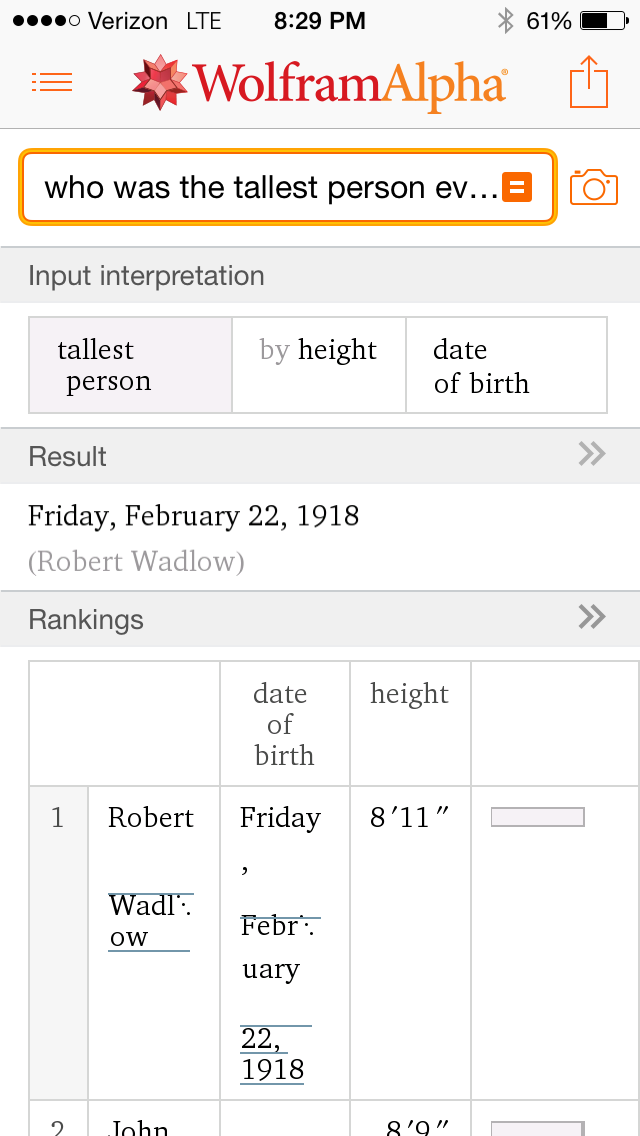
Who was the tallest person ever? (Now over to the iPhone app.)


9_Tallest Person


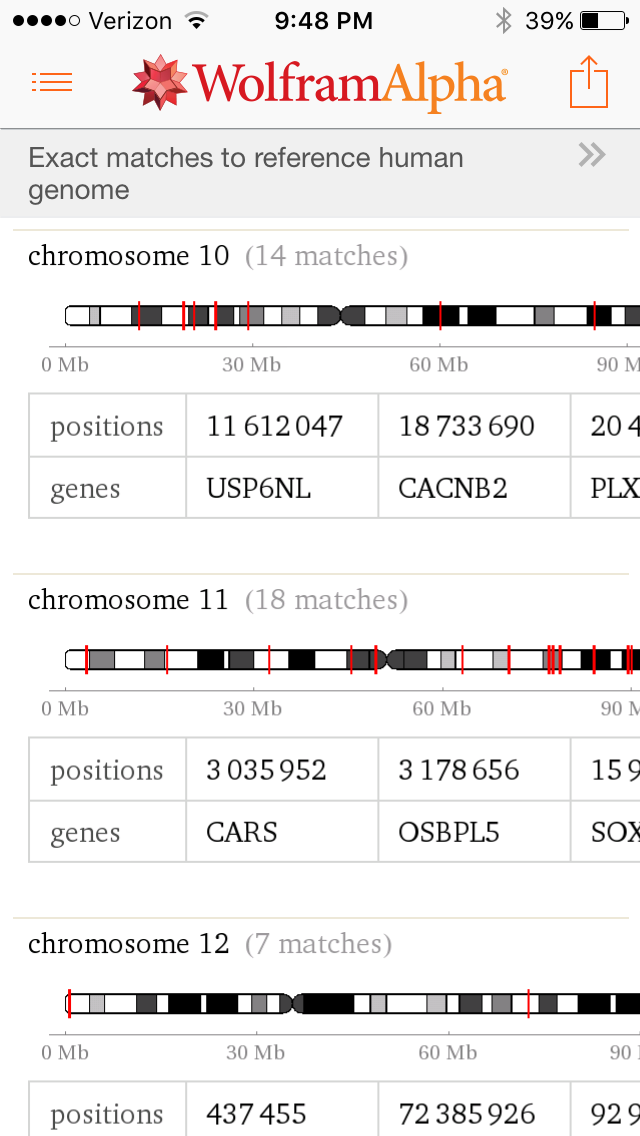
But you can do much more complicated stuff:


10_Human Genome


Per my wife’s bidding, I looked up the structure of acetone (she already knew it):


11_Acetone


That’s just scratching the surface. Wolfram|Alpha is like Google meets a super-charged calculator, plus more smarts to boot. It can generate passwords for you, give you tide information, tell you the most popular boy names, and perform lots of other search tasks I haven’t tried yet.

The app has lots of nice little touches, too. You can use the share sheet to export the url link for your query, which you can then access via a Web browser or in-app later on. The app saves your search history, and even allows you to make favorites, so you can quickly access repeated searches.

Find the app (universal for iPad and iPhone) in the App Store here.


Thanks to the makers of Wolfram|Alpha for the free download for the purposes of review.

How Accordance Can Help with Intermediate and Advanced Greek

LXX decal


Ever wonder how to do intermediate and advanced Greek searches and set up some high-octane Greek Workspaces in Accordance? Yesterday I led a Webinar on that very topic.

Here is the .pdf handout of what I covered, which includes some links to helpful resources. And Accordance allows you to share Workspaces with others, so if you want any of the Workspaces mentioned in the .pdf (notation is WS), just let me know in the comments or reach me here and I’ll set you up!

5 Years Later… A Review of The Innocence Mission’s New Album

Hello I Feel the Same album cover


The last Innocence Mission release was 2010’s My Room in the Trees. I’ve been a big fan of the band since I inquired about my youth minister’s copy of Glow on top of the youth group boombox in the mid-90s. My Room in the Trees, however, stood out to me as one of their best. It featured the amazing “God is Love”:

God is love, and love will never fail me

God is love, and love will never fail me

If I’m driving there today

And I really am this afraid

God is love, and love will never fail me.

I’ve quoted it from the pulpit before and have sung it to myself not a few times.

I listened to that song and album in the midst of some dear friends moving out of our triple-decker community house (“Some birds I know are moving on this weekend”). I needed to hear “God is Love,” because we were in the midst of a major transition: our second child was soon to be born.

Without recounting the entire birth story here, I can simply say that his safe arrival left us in tears–more than the “usual” baby-being-born kind of tears. Some last-minute delivery challenges gave us quite a scare–but then there was baby #2, safely being cuddled by his mom and me. It may seem a small thing to The Innocence Mission to sing, “Stay calm… stay calm,” but that line from North American Field Song carried me through some shared moments of difficulty. I still think that is the best song they’ve ever recorded, and one of the very few songs I would ever consider calling “perfect.”


* * * * * * *


This Friday The Innocence Mission releases Hello I Feel the Same, their first album since My Room in the Trees.

If you are still, 20 years later, longing for the killer drums of 1995’s “That Was Another Country” (my second favorite track of theirs), or the opening track to 1991’s Umbrella, you will be left waiting again till next time. (Every new Innocence Mission I harbor a secret hope that Karen and Don Peris will ply their trade with a rocking band behind them. I’m long-suffering.) Mr. Peris does, however, lay down a sweet drum groove on “Barcelona,” the album’s fourth track. It’s like a fresh-water version of recent Mark Kozelek. The drums make another cameo before the album ends.

The first two tracks are classic Innocence Mission, with just a touch of drums and subtle bass harmonica (!) coming in a minute or so into the second song. Don Peris’s high-register guitar arpeggios and pleasingly breathy background vocals complement Karen Paris’s good-as-they’ve-ever-sounded vocals.

Track 3, “Washington Field Trip,” is this album’s “North American Field Song”–at least as I listen to it. Here is the band, only “wanting to be helpful in this life,” helping–whether they mean to or not–by laying down a devastatingly beautiful song with actually perfect piano tone. Never was a three-note melody in a chorus so haunting. The Perises, again, get into soul territory:

I do not want fear to hold me

I don’t want to be kept from loving at all

The longest song on the album is 3:43. Four songs don’t even reach the three-minute mark. You want all of these songs to keep going, but therein lies the duo’s approach and artistry.
Highlights include “Blue and Yellow” (what The Truman Show might have sounded like had Karen and Don Peris scored the movie) as well as the moving (and highly singable) tribute, “Fred Rogers,” which calls to mind Lancaster, PA (and, now that I think about it, maybe also heaven):

And you know I hate to drive

Maybe I’ll see you at the station

“The Color Green” features viola and violin and closes the album in a wonderfully fitting way–ascending piano with gorgeous melody in the right hand, joined by all manner of longing-inducing string parts.

And darn it if the song doesn’t resolve to the tonic at the end! One hopes The Innocence Mission will not make their listeners wait five more years to hear what’s next.

Hello I Feel the Same is another excellent effort from some beautiful makers of art and music.


Thanks to The Innocence Mission’s publicity team for early access to the album for the review. I’m sure it’s available on Amazon and iTunes, but why not support the band more directly? Check out the album at their Bandcamp page here.

Review of Audiosharp AS1130 Earbuds


Earbuds 2
Image via Audiosharp


After I ran a 5K my sweet three-year old picked off one of my earbud covers and left it who-knows-where. So I’ve been in search of a good replacement. Audiosharp’s AS1130 earbuds (currently on sale for $25 at Amazon) have been an exceptional choice for every-day headphones.

Here are the specs from Audiosharp:


  • Perfect design: Solid all-metal construction even down to the plugs, Three size soft silicone ear buds provide a super comfortable, secure fit and One Compact rugged case for safe storage are included.
  • Accurately reproduce clear natural vocals: High intensity listening experience with crisp, clear sound and deep powerful bass, Ultra-fast,accurate speaker design delivers the full details of today’s digital music with extreme clarity and deep bass.
  • Awesome noise reduction: Sealed in-ear design reduces external noise for a better music experience. the voice is still clear over the din of the store so you can enjoy uninterrupted music on the go.
  • High Performance: High Quality Tangle Free Cable.Micro-strand wire and flux tube for clear audio with reduced interference.Innovative, cable design is ultra-flexible and tangle free.
  • Audiosharp Features: Audiosharp is the most professional headset seller, Our products are designed by high-end designers and rigorous professional inspection. All Audiosharp products come with a 1-year warranty.

Most surprising was the packaging in which the earbuds arrived. It’s impressive, if excessive:


Image via Audiosharp


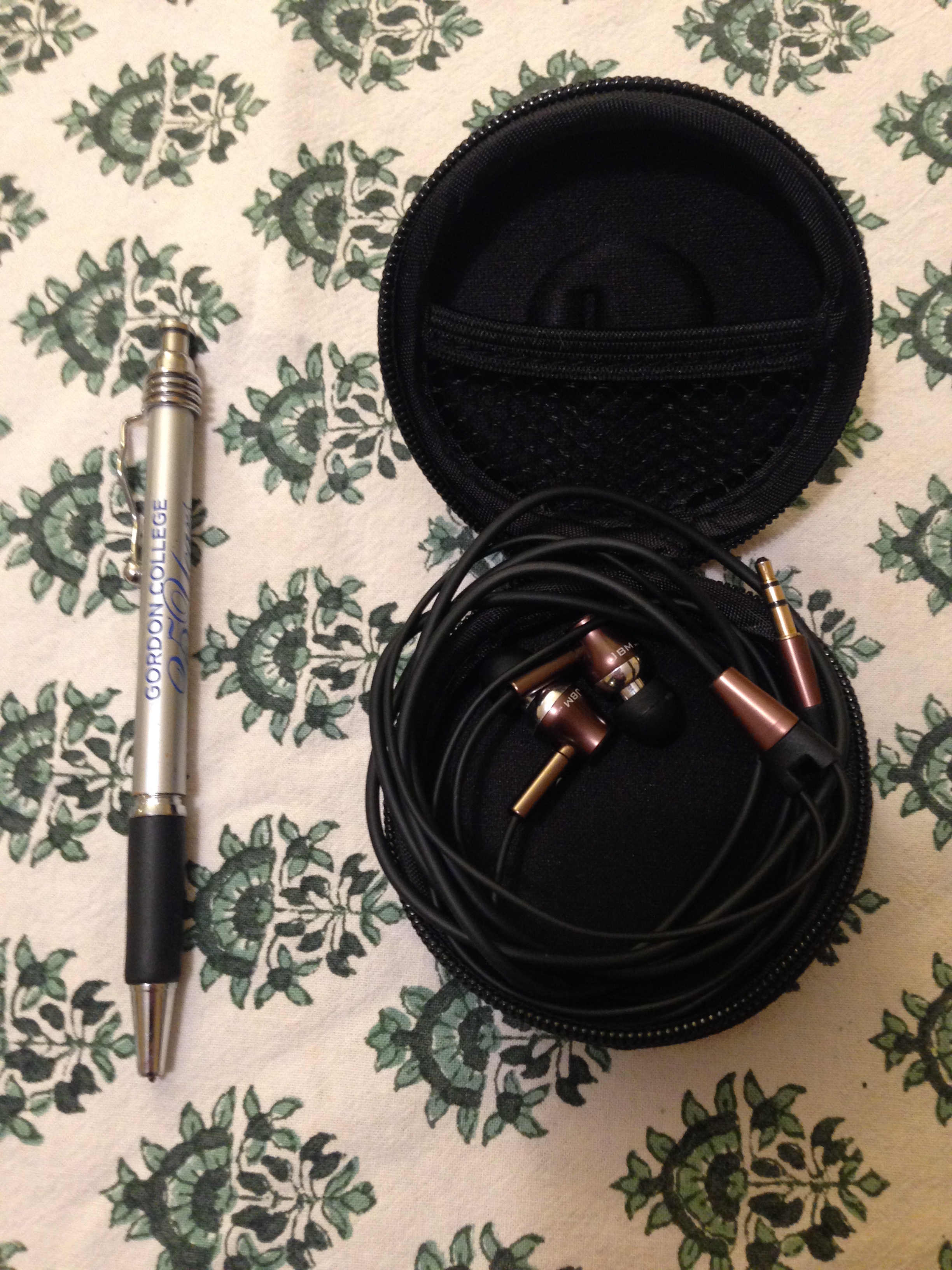
The carrying case is especially cool–and useful! It’s easy to wrap the earbuds up and store them in their protective cover:


Earbuds in case


The construction is high-grade, and these appear to be earbuds that will last a long time. The all-metal design looks cool, too:


Earbuds


Cable


As for the sound, the quality greatly exceeds what I expected for an under-$30 set of earbuds. Bass is fully present (but not overly so), and highs and mids are clear. It’s definitely an upgrade from the standard issue Apple set.

Having the earbuds in really does silence outside noise, too. They’re not noise-cancelling (nor do they claim to be), but noise-reducing, for sure.

They stay in my ears well even when I’ve got them outside on a run–a non-negotiable for me with a set of earbuds, and a feature which seems to be missing in most kinds that I’ve tried.

If you’re looking for greater sound quality than what you get with a $5 pair of earbuds, but for something that won’t break the bank and will last you a long time, Audiosharp’s AS1130 earbuds are an excellent option.


Thanks to Audiosharp for the review sample, given to me for purposes of review but with no expectation as to the content of this post. Find the earbuds here.