

Today is the last day to enter to win the Bible above. (There will be two winners.) See here for more.

Zondervan Academic (I’ve reviewed a bunch of their stuff) has some interesting new releases coming this fall. I’m particularly interested in:
I’m especially looking to the Mark volume of the ZECNT series.
The Zondervan Academic Website is here. Their Fall 2014 catalog is here.

The Westminster Dictionary of Theological Terms (Westminster John Knox Press, 2014) is a succinct compendium of key theological words and concepts.
One obvious advantage to the book is its portability. It’s less than 400 pages and easy to carry around in a satchel… though since receiving it, I’ve kept it on my desk with a few other works I reference a lot.
What sorts of “theological terms” does this dictionary cover? The publisher’s product page notes:
This second edition of The Westminster Dictionary of Theological Terms provides a comprehensive guide to nearly 7,000 theological terms—1,000 more terms than the first edition. McKim’s succinct definitions cover a broad range of theological studies and related disciplines: contemporary theologies, biblical studies, church history, ethics, feminist theology, global theologies, hermeneutics, liberation theology, liturgy, ministry, philosophy, philosophy of religion, postcolonial theology, social sciences, spiritually, worship, and Protestant, Reformed, and Roman Catholic theologies.
There is also a short annotated bibliography, list of works consulted, and set of abbreviations at the back of the book. The “Major Topics and Distinctive Terms and Concepts” section at the beginning gives the reader a framework of overarching topics into which the dictionary’s terms will fit. (E.g., “Bible,” “theology,” “worship,” “ethics and moral theology,” and so on.)
McKim himself has overseen much larger dictionaries. An initial point of skepticism for me was whether a theological dictionary this small and short could still be substantive. Definitions are somewhere in the 15-75 word range, depending on the term.
Yet as a quick-reference guide, it does well. Consider McKim’s definition of feminist criticism:
A critical approach to reading the Bible that focuses on the political, social, and economic rights of women. Diverse goals and methods are employed, with a common recognition that all texts are gendered. This implies not only that they reflect sexual differences between males and females, but also that they involve power. Feminist criticism seeks to make clear culturally based presuppositions found in texts.
Here’s another example, the entry for “agrapha,” a term one finds shortly after delving into studies of the Gospels:
(Gr. “unwritten sayings”) Sayings attributed to Jesus that circulated as traditions during the period of the early church. Also those sayings attributed to Jesus found outside the canonical Gospels.
The reader will also find terms like “Griesbach hypothesis,” “haggadah,” “Muratorian Canon,” perspectivalism,” “cuneiform,” “body-soul dualism,” “Trisagion,” “interiority,” “rechte Lehre” (German for “right teaching on doctrine”), and many more.
McKim’s goal was to provide a “wider, synthetic work that gives short, identifying definitions over a more comprehensive range of theological disciplines,” as opposed to something more “specialized” and “extensive.” The beginning theological students that McKim seeks to reach will find such a dictionary an especially useful entry point into the large and growing world of biblical and theological studies. McKim seeks to be more “broad” than “deep”; in this he succeeds, but the definitions are still plenty substantive to be useful to students at various stages.
The annotated bibliography is just five pages and glosses over important works (e.g., the commentaries section lists Anchor but omits Hermeneia). It does include a good page on Web-based resources for theological studies. The abbreviations include a couple pages of textual criticism abbreviations (including Latin), which will save the new reader of the Hebrew Bible from having to look most terms up elsewhere.
One feature I felt to be missing was a lengthier set of introductory essays on the nature and methods of theological study. I’m assuming Dr. McKim didn’t include this because it might exceed the intended scope of the work, but perhaps future editions could include–as many dictionaries do–at least two or three introductory essays to further orient the reader to theological study.
I’ve had the dictionary at my desk all summer, and each time I’ve looked up a word or phrase, I’ve found what I was looking for (with the exception of dereliction or “cry of dereliction”).
Especially for its price and accessibility, The Westminster Dictionary of Theological Terms is an excellent starting point for seminary students or for pastors who want to stay up-to-date on theological terminology.
Many thanks to WJK Press for the review copy, given to me with no expectation as to the content of my review. You can find the dictionary here on Amazon (affiliate link), or here at WJK Press.
A scroll through some of my recent Facebook statuses shows the quotability of Bonhoeffer’s Life Together and its impact on me:
And:
Also, this one:
And, just for fun, here’s some Bonhoeffer from a letter quoted in Eberhard Bethge’s biography of him:
Bonhoeffer’s Life Together is substantial evidence that this servant of God saw himself as belonging to the church. The short, powerful book is both a gift and a challenge to any Christian who will take the time to study it.
I have just finished reading it through all the way for the first time. Though it’s true that there is a focus on how one can be a faithful member of a Christian community, the application to the Christian-as-individual is rich, as well.
There are five main sections of Life Together:
Bonhoeffer was, in fact, writing with his own seminary community in mind (see “Benefits of the DBWE Critical Edition,” below), but he also intended with Life Together something more universal:
We are not dealing with a concern of some private circles but with a mission entrusted to the church. Because of this, we are not searching for more or less haphazard individual solutions to a problem. This is, rather, a responsibility to be undertaken by the church as a whole.
Throughout each of the sections, the focus of the book is “life together under the Word” (my emphasis, but also an ongoing emphasis of Bonhoeffer). An editor’s footnote explains that “life together” can also be translated from German as “common life.”
Christians in community are a sort of sacrament to each other, a theme throughout Life Together:
The prisoner, the sick person, the Christian living in the diaspora recognizes in the nearness of a fellow Christian a physical sign of the gracious presence of the triune God. In their loneliness, both the visitor and the one visited recognize in each other the Christ who is present in the body.
Through prayer and worship together, intentional solitude, service to each other, hearing confession of sins and–ultimately–through participation in the Lord’s Supper, the purpose and aim of Christian communities is “to encounter one another as bringers of the message of salvation.”
Throughout the book Bonhoeffer explores the dialectic between living in community (“The Day Together”) and the individual’s time alone (“The Day Alone”). He suggests that the ones who will do best living in community are those who already do well alone. Those who cannot already live at peace with themselves will not do well in community:
Those who take refuge in community while fleeing from themselves are misusing it to indulge in empty talk and distraction, no matter how spiritual this idle talk and distraction may appear.
On the other hand, “the reverse is also true.” Discipleship is best when not received, experienced, and lived just as a solitary endeavor. Bonhoeffer says, “Whoever cannot stand being in community should beware of being alone” (emphasis in original).
Both solitude and the company of others, then, are needed:
We recognize, then, that only as we stand within the community can we be alone, and only those who are alone can live in the community. … It is not as if the one preceded the other; rather both begin at the same time, namely, with the call of Jesus Christ.
Bonhoeffer’s characteristic and refreshing forthrightness brings the point to a head:
Those who want community without solitude [Alleinsein] plunge into the void of words and feelings, and those who seek solitude without community perish in the bottomless pit of vanity, self-infatuation, and despair.
Whoever cannot be alone should beware of community. Whoever cannot stand being in community should beware of being alone.
 Life Together is Volume 5 of Fortress Press’s Dietrich Bonhoeffer Works (English Edition); it’s also the first one published (1995) in the series.
In addition to its being a new translation from Bonhoeffer’s German, there is an Editor’s Introduction to the English Edition, Editors’ Afterword to the German Edition [abridged], and an extensive (though not distractingly so) set of footnotes as part of an explanatory critical apparatus.
Though one could certainly read Life Together in its own right, editor Geffrey B. Kelly’s introduction is a great set-up. From the very beginning he highlights the fascinating history of the book:
It was because [the Gestapo] had shut down the preachers’ seminary at Finkenwalde that Dietrich Bonhoeffer was finally persuaded to compose his thoughts on the nature and sustaining structures of Christian community, based on the “life together” that he and his seminarians had sustained both at the seminary and in the Brothers’ House at Finkenwalde. … With the closing of the seminary at Finkenwalde and the dispersal of the seminarians, however, Bonhoeffer felt compelled not only to record for posterity the daily regimen and its rationale, but also to voice his conviction that the worldwide church itself needed to promote a sense of community like this if it was to have new life breathed into it.
Kelly brings to light more about the historical situation leading to Life Together (including the Finkenwalde seminary), as well as ties it in with some of Bonhoeffer’s earlier writing that undergirds the book. Kelly notes that Life Together is ultimately a highly Christocentric work. Indeed, Bonhoeffer writes:
Christian community means community through Jesus Christ and in Jesus Christ. There is no Christian community that is more than this, and none that is less than this. Whether it be a brief, single encounter or the daily community of many years, Christian community is solely this. We belong to one another only through and in Jesus Christ.
The critical footnotes are excellent and seem to be placed at just the right spots. They include biblical references, historical background, explanations of German-to-English translations, and descriptions, where needed, of the larger body of Bonhoeffer’s thought that informs a given passage.
For those wanting to read Life Together, there’s a nice bonus with the Fortress Press DBWE edition: it includes also Bonhoeffer’s Prayerbook of the Bible: An Introduction to the Psalms. Given his emphasis already in Life Together on the importance of the Psalms for the prayer life of the community (“The Psalter is the great school of prayer”), its inclusion in this volume is perfectly fitting. The text itself is just above 20 pages, with the addition of an English editor’s introduction and German editors’ afterword.
The last word of this review goes to Bonhoeffer. Here it is:
The fact that Jesus Christ died is more important than the fact that I will die. And the fact that Jesus Christ was raised from the dead is the sole ground of my hope that I, too, will be raised on the day of judgment. Our salvation is “from outside ourselves” (extra nos). I find salvation not in my life story, but only in the story of Jesus Christ. Only those who allow themselves to be found in Jesus Christ—in the incarnation, cross, and resurrection—are with God and God with them.
If you don’t already own Life Together, you should. If you do own it in an old paperback edition, you should get the Fortress Press Dietrich Bonhoeffer Works edition, if possible, whether through purchase or library check-out.
If you really want to go in depth, Geffrey B. Kelly (lead English editor of DBWE 5) wrote Reading Bonhoeffer, which includes a reading companion to Life Together.
Many thanks to Fortress Press for the review copy, given to me with no expectation as to the content of my review. You can find Life Together and Prayerbook of the Bible here on Amazon (affiliate link), or here at Fortress Press.

This last week I visited what has to be the best bookstore in the cosmos. Loome Theological Booksellers bills itself as the world’s largest theological bookstore. It has great prices, an incredible selection (the Bonhoeffer section, for instance, had secondary literature in French and German), an easy-to-navigate layout, and a really nice owner.
Here are a few photos (click on any of them or open in a new tab/window to enlarge):


Here’s the annex. It’s enormous. The photos below just show part of it:



If you’re in the Minneapolis-St. Paul or Stillwater area, check it out! They’re having a $2 per book Labor Day sale that I was sorry to have missed by a couple of days.
By now many of you Words on the Word readers will have heard that the UBS edition of the Greek New Testament has recently been published in its fifth revised edition, the UBS5. See here for more.
Check out this smart graphic from Hendrickson Publishers announcing the edition (academia needs more good infographics):

Just as I reviewed the amazing LXX-NA28 combo, I will soon be reviewing the UBS5 Greek New Testament.
While I work my way through it, with just about a minute of your time and a few clicks, you can enter to win your own copy of the UBS5, thanks to the great people at Hendrickson Publishers.
Simply comment on this blog post with a short sentence on what interests you in the Greek New Testament. That will give you one entry.
If you share on Facebook and/or Twitter, and then come back and post the link to your share in the comments, you get two additional entries.
If you want to earn five additional entries, you can record a (however lo-fi) video of yourself answering the questions: Why does Bible translation matter? and: What does translating the Bible mean to you personally?
To receive those five additional entries, post the url to your video (whether you’ve uploaded to YouTube, Facebook, Vimeo, etc.) in the comments. Then others can see your video, too.
I’ll select two winners using a random number generator.
If you don’t want to wait for the results of the giveaway, you can find the UBS5 on sale at Amazon here (affiliate link) or through Hendrickson here.
The giveaway is open through Sunday, September 7, 11:59 p.m. EDT. On Monday I’ll notify the winner and post about it both here and in the comments below. Then Hendrickson will mail you your UBS5 GNT! (Note: Only domestic/U.S. shipping addresses are eligible for this contest, with apologies to the rest of the world!)
Make sure in when you leave a comment that you include your email address—I can use that to contact you, and the email address isn’t public.
Happy entering, and the folks at Hendrickson and I look forward to seeing your videos. Drop me a line if you have any questions.
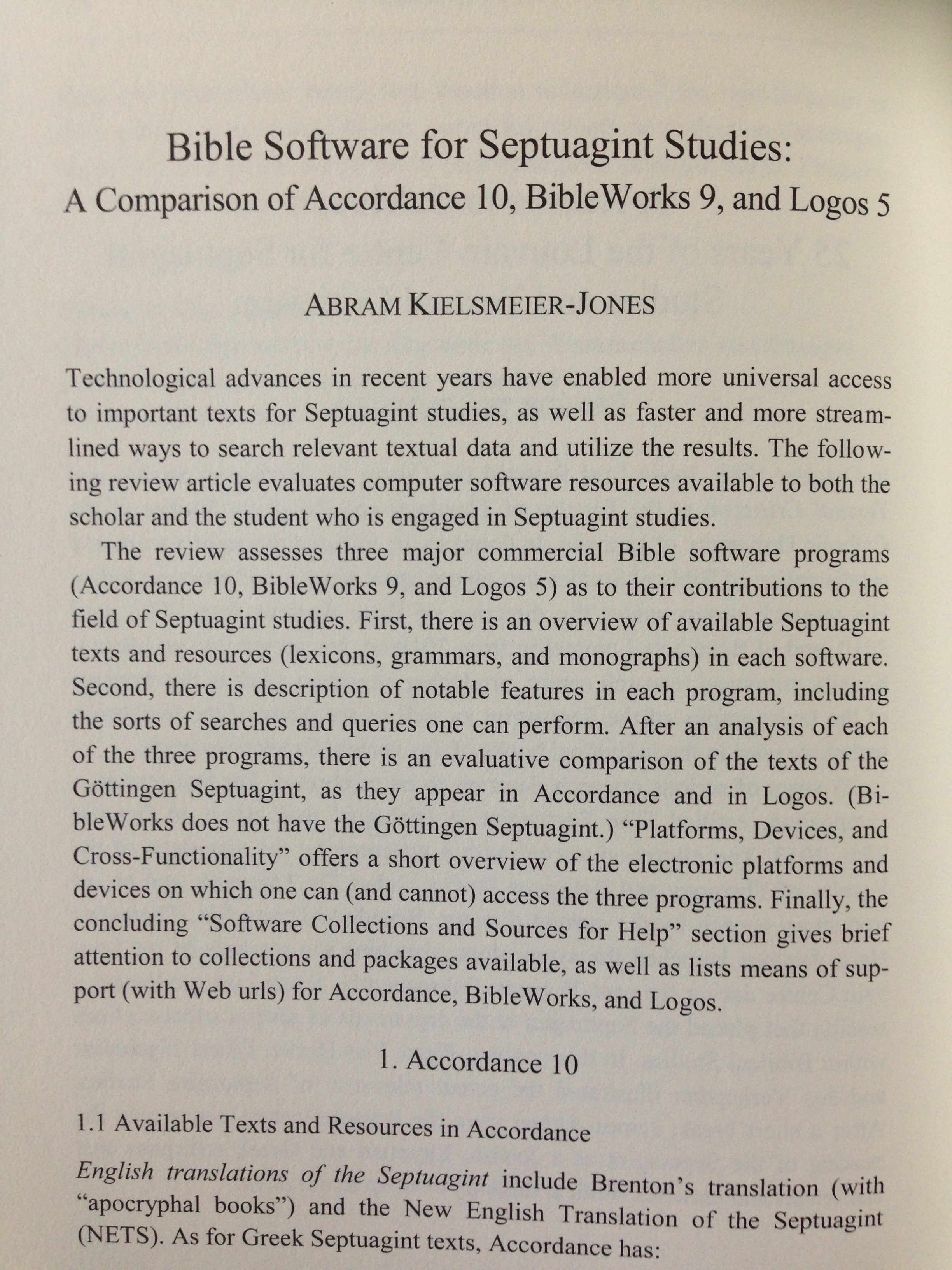
I’ve just come home to the new Journal of Septuagint and Cognate Studies (JSCS) in my mailbox. This volume (vol. 47, 2014) publishes an extensive comparative review I wrote of Bible software programs for Septuagint studies. In the review I consider and evaluate Accordance 10, BibleWorks 9, and Logos 5.
I’m excited to see it in press! Here are the journal cover, the contents, and the first page of the review. You can subscribe to JSCS at this link.


I’m reading Dietrich Bonhoeffer’s Life Together for the first time. As I near completion of the book, here is a convicting passage that jumped out at me:
But Christians who can no longer listen to one another will soon no longer be listening to God either; they will always be talking even in the presence of God. The death of the spiritual life starts here, and in the end there is nothing left but empty spiritual chatter and clerical condescension which chokes on pious words. Those who cannot listen long and patiently will always be talking past others, and finally no longer will even notice it. Those who think their time is too precious to spend listening will never really have time for God and others, but only for themselves and for their own words and plans.
You can find the book here (affiliate link) or here (they sent me a review copy). I’ll post again soon when I finish.

Congratulations to Rick Mansfield, winner of the MyWerkz foldable Bluetooth keyboard. I used a random number generator to select the winner. Way to go, Rick, and enjoy! (P.S. See his nifty blog here.)
I’ll post my review of the keyboard soon. Until then, see my gathered tech gear posts here. Thanks to all who entered and shared.


 Words on the Word