Feasting on the Word (concluding thoughts)

Feasting on the Word

Among preachers, there are books known as “Monday books” because they need to be read thoughtfully at least a week ahead of time. There are also “Saturday books,” so called because they supply sermon ideas on short notice. The books in this series are not Saturday books. Our aim is to help preachers go deeper, not faster, in a world that is in need of saving words.

–Feasting on the Word

I continue to utilize the 12-volume Feasting on the Word commentary series most weeks in my sermon preparation. As I described at greater length here, the 12 volumes cover the three-year lectionary cycle (A, B, and C), split into four volumes per year. Each week offers four different “perspectives” (theological, pastoral, exegetical, and homiletical) for each lectionary passage in the Revised Common Lectionary.

As far as its layout and usability in Logos, I covered that here. My favorite part about having Feasting on the Word in Logos is that I find Logos to be the most robust e-reader currently on the market. It syncs seamlessly across devices and platforms, and easily allows for highlights and notes to be made directly within the text.

In this final post, I want to interact a bit more with some of the content of the series.

The diversity of the contributors is a strong point. They come from different vocations (preachers, professors, Bishops), and reflect diversity in race, sex, and denominational affiliation, as well. I’ve found this refreshing.

There is a general evenness in style, tone, and substance across the volumes I’ve used. As one might expect with a commentary series with this many contributors, some entries end up being more helpful than others.
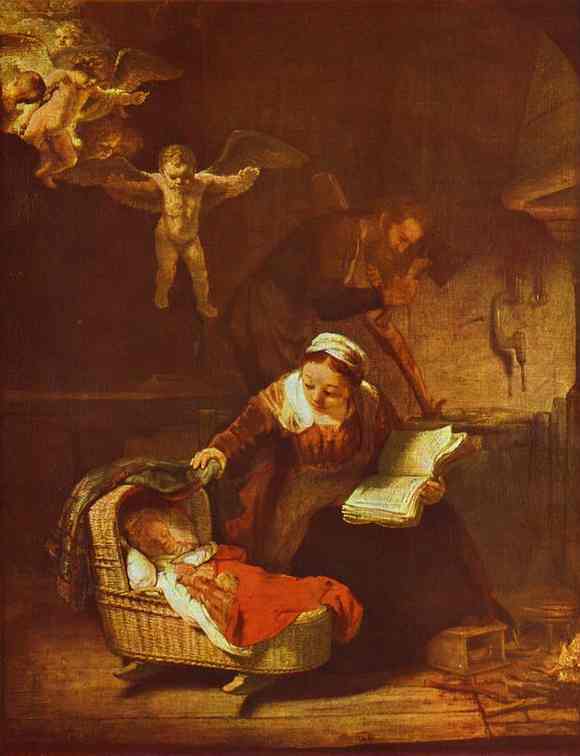
Rembrandt Holy FamilyWhile I have found the “Exegetical Perspective” and “Homiletical Perspective” sections to be of some value, the “Homiletical Perspective” and “Preaching Perspective” are the ones I use most often. Each of these help the preacher imagine how she or he might orient herself/himself and the congregation to a given text. For example, the “Homiletical Perspective” on John 1 begins with a description of Rembrandt’s “Holy Family” painting, then goes on:

I can imagine a sermon that would begin with a description of Rembrandt’s painting and that would develop the idea of the necessary dialogue between Mary’s studying the Bible and studying the child, the Word made flesh. Like Mary, we come to understand the Word more and more fully as we oscillate between the book and the child, between the Word through words and the Word made flesh.

Few commentaries offer homiletical suggestions this practical. The “Pastoral Perspective” for the same passage is worth quoting at length. After quoting Eugene Peterson’s rendering of John 1:14, preacher Frank Thomas writes:

I love this rendering of this text because of the choice of the word “neighborhood.” The Word was made flesh and blood and moved into the neighborhood. Neighborhood reminds me of the place where I grew up and the people with whom I grew up. I remember the street corner where we played baseball that had four sewer covers; one sewer cover was first base, another second, another third, and the final one home. I ran around those bases thousands of times, dreaming that I was a professional baseball player. I remember the playground, where what seemed like millions of kids played basketball, Ping-Pong, pool, volleyball, dodgeball, and tons of games. I remember block parties, where all the neighbors would sit out on the front lawns with the streets blocked off, and all day we would just have food, games, and fun together. I remember the girl across the street. That’s what I think of when I hear, “The Word was made flesh and moved into the neighborhood.” The Word was made flesh and moved into my south-side neighborhood.

He concludes, “When Peterson says that the Word was made flesh and moved into the neighborhood, I hear that the Word moved into my neighborhood.”

There is much for the preacher to mine and adapt and re-contextualize in the above, in a way that fits one’s own setting. Reading Pastor Thomas’s writing above makes it easy to think about Jesus moving into our neighborhoods, too. (Which immediately raises interesting questions for congregations–would we be a good neighbor to him? Would we need to change anything about our community life? Would we recognize him?) I find that Feasting on the Word is constantly suggesting good questions for reflection and stimulating even more.

There is a claim in the series introduction that, “Wherever they begin, preachers will find what they need in a single volume….” While the exegesis and theological analysis in these volumes is substantive, I still find myself turning to more in-depth commentaries for exegesis, before using Feasting on the Word to think through how to move from passage to sermon. That has been how I’ve most benefitted from the commentary.

I’ll continue to use the commentary series on a regular basis. While I love print books, there are advantages to the electronic version, and Logos integrates Feasting on the Word with any other Logos resources you may have. For those who preach regularly, this set is well worth checking out.

Thanks to Logos Bible Software for the review copy of Feasting on the Word (12 vols.). Find it here. The publisher’s page for the series is here. You can find my other Logos reviews here.

2013 Blog in review

The folks at WordPress prepared a 2013 “annual report” for this blog.

It notes the top five posts of the year, according to number of visits, some of which were written in 2012:

  1. Which Bible software program should I buy? Comparison of BibleWorks, Accordance, and Logos
  2. Who is the author of Honest Toddler? Identity revealed…
  3. How to Read and Understand the Göttingen Septuagint: A Short Primer, part 1
  4. How to Read and Understand the Göttingen Septuagint: A Short Primer, part 2 (Apparatus)
  5. My Accordance 10 review: all six parts (plus Beale/Carson module review)

The summary has other interesting notes about the blog, its readers, etc. You can click here to read the entire report.

Christmas at a Child’s Pace

Been spending lots of time with these

Last Christmas a day full of opening presents was overstimulating for our kids, who were at that time all five and under. This year we got a little smarter (or were just better prepared) and let the children drive the presents-opening. If they wanted to stop and play with a present, we let them. If they were ready to open a new one, we let them.

It worked out pretty well. Our two boys each opened a Lego set early in the day, with homemade Lego storage/building trays from the grandparents, and played with them for much of the morning. Then, after a while, we moved into round two of opening gifts. All in all, we opened about 90% of the presents in three different stages on Christmas Day. We’ve opened the rest since then.

Leading up to Christmas we followed our family tradition of nighttime prayer and song and candles with an Advent Wreath. Our six-year-old took the role of “leader” most nights, our three-year-old was “acolyte” (i.e., he blew out the candles), and our one-year-old was the altar guild. (And by “altar guild,” I mean she climbed up on to the table and tried to take apart the wreath and candles.) The short liturgy had the same centering effect for our kids this year as it did last year, though this year there was more fighting over who got to do what.

Two lessons learned as a dad:

#1: It’s easy, even in a Christian home, even when you’re a pastor, to let other things besides Jesus rule your consciousness during the Advent and Christmas season. This feels like it might be a yearly challenge, with due deliberateness required to keep the focus where it should be.

#2: Following the kids’ lead as much as possible leads to a more pleasant Christmas Day. There’s no need to rush through opening presents. (And children seem to receive a lot.) I think how we handle #2 has direct bearing on #1.

I’ve been thinking now about the possibility of giving gifts in each other’s names to charitable organizations as the kids get older. This could become a meaningful part of our Christmas celebrations in coming years.

Parents of kids–what about you? How do you navigate Christmas and the days leading up to it with kids? What are challenges you face? What’s rewarding about it? What helps your family keep focused on what matters most?

500 Book Sale in Logos Bible Software

500-book-mega-pack

Logos Bible Software has just announced the release of a “500 Book Mega Pack.” The bundle is up through the end of the year. More details are here. Some highlights include:

…and quite a few more. Nearly 200,000 pages (print equivalent). You probably won’t use all of it, but it’s a quick and cost-efficient way to expand a Logos library. Logos offers it at 96% off, through their Christmas sale.

As to my own personal experience using Logos, I’ve written a good deal about that here (with more reviews forthcoming). You can also see a short demo here (with a great soundtrack from Future of Forestry) on how to use Logos to research the Christmas story.

Disclosure of Material Connection: I received the 500 Book Mega Pack gratis, with the expectation that I post about it here (though with no expectation as to my evaluation of the product itself).

Greek Isaiah is… back?

The first few verses

On November 30 the group Greek Isaiah in a Year read the last verses of Isaiah 66. And what a rewarding experience it was to read slowly–over the course of a (church) calendar year–through Isaiah.

Blogger Brian Davidson wants to do it again. I’m going to be following the Facebook group (here, where all the action will be), but am not sure I can do the whole thing again in a year. We’ll see.

But if you started last time and didn’t finish, or are looking for a way to sharpen your Greek this coming calendar year, check it out.

Three Septuagint books I’m reading

There are three good (so far) books I’m reading on the Septuagint. Links and publisher’s descriptions are below.

1. LXX-Isaiah as Translation and Interpretation: The Strategies of the Translator of the Septuagint of Isaiah, by Roland L. Troxel (Brill, 2007)

LXX-Isaiah_TroxelThis book offers a fresh understanding of how Isaiah was translated into Greek, by considering the impact of the translator’s Alexandrian milieu on his work. Whereas most studies over the past fifty years have regarded the book’s free translation style as betraying the translator’s conviction that Isaiah’s oracles were being fulfilled in his day, this study argues that he was primarily interested in offering his Greek-speaking co-religionists a cohesive representation of Isaiah’s ideas. Comparison of the translator’s interpretative tacks with those employed by the grammatikoi in their study of Homer offers a convincing picture of his work as an Alexandrian Jew and clarifies how this translation should be assessed in reconstructing early textual forms of Hebrew Isaiah.

2. The Reception of the Hebrew Bible in the Septuagint and the New Testament: Essays in Memory of Aileen Guilding, edited by David J.A. Clines and J. Cheryl Exum (Sheffield Phoenix Press, 2013)

Reception of Hebrew Bible in LXXAileen Guilding was Professor of Biblical History and Literature in the University of Sheffield from 1959 to 1965, and was known especially for her monograph The Fourth Gospel and Jewish Worship: A Study of the Relation of St. John’s Gospel to the Ancient Jewish Lectionary System (Oxford, 1960), which enjoyed a succès d’estime in its day as an exceptionally fascinating and learned book. She is celebrated in Sheffield as the first female professor in the University; she was also the first woman to hold a chair in theology or religion in the United Kingdom. After her death at the age of 94 a conference on themes relevant to her special interests was held in Sheffield as part of a meeting of the Society for Old Testament Study, and the papers read there are presented in this volume, published in the 101st year after her birth.

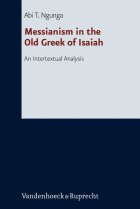
3. Messianism in the Old Greek of Isaiah: An Intertextual Analysis, by Abi T. Ngunga (Vandenhoeck & Ruprecht, 2013)

Messianism Old Greek IsaiahAbi T. Ngunga explores the theme of messianism in the entire corpus of the Old Greek of Isaiah (LXX-Isaiah). This is done through the lens of an intertextual hermeneutic employed by the Isaiah translator as a mode of reading this text.

Its introductory chapter looks at the need in scholarship to investigate the topic of messianism in the Greek Bible in general, and in the whole of the LXX-Isaiah in particular. After dealing with a few issues related to the LXX-Isaiah as a translation, Ngunga also surveys thoroughly the topic of intertextuality from its inception to its use in biblical studies including LXX research. Particular attention is given to its application in research done, to date, on the Greek text of Isaiah.

Chapter two re-examines a few arguments pertinent to the scholarly opinion that messianic hopes were not prominent among the Alexandrian Jews in comparison to their co-religionists in Palestine. It also explores the relationships between the non-Jewish citizens of the Ptolemaic kingdom and the Alexandrian Jews, with the aim to ascertain the legitimacy of investigating the theme of messianism in a piece of Jewish literature such as the LXX-Isaiah authored in the Hellenistic period. Chapter three analyses in-depth nine selected messianic passages within the LXX-Isaiah (7:10–17; 9:1–7 (8:23–9:6); 11:1–10; 16:1–5; 19:16–25; 31:9b–32:8; 42:1–4; 52:13–53:12; and 61:1–3a). The study concludes by highlighting the detected particular messianic imprints left on the LXX-Isaiah. Given the results, the study dismisses any doubt concerning the contention that there is a dynamic messianic thought running through the whole of the Greek Isaiah. It also sheds some light on the understanding of some of the messianic beliefs later echoed in early Christianity.

Reviews of each of these three will come soon.

John William Wevers LXX Text Histories… free .pdf downloads

Yes, this is free
Yes, this is free

File under: I can’t believe this is free.

From The International Organization for Septuagint and Cognate Studies (IOSCS):

The Göttingen Septuaginta-Unternehmen, home of the Göttingen editions of the Septuagint, has announced two initiatives of interest to those dealing with textual criticism of the Septuagint.

Follow the link above to the Unternehmen’s home page. There’s a lot to check out there, including what I would consider the vacation/retreat of a lifetime. (Time with family tops everything, but this school would come in second.)

Back to the “free” part:

Several of the older volumes that have appeared in the series “Mitteilungen des Septuaginta-Unternehmens” are no longer available in print. To meet the wishes of the scholarly community to maintain access to these publications (among them, Rahlfs’ Verzeichnis), the Septuaginta-Unternehmen has published a free PDF scan of the first four volumes on its website.

These resources are available in the Septuaginta-Unternehmen’s new website, which is available in both German and English.

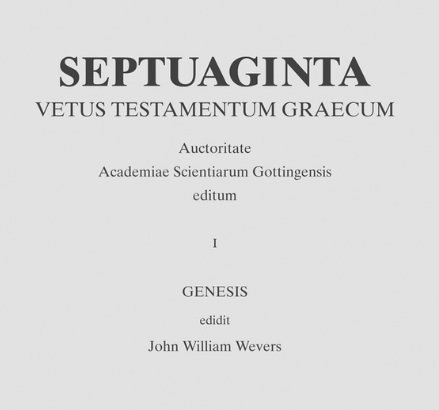
The link noted above (this one) includes, among other things, free downloads of the valuable and difficult to find Text History of the Greek… books by John William Wevers. You can download:

  • Text History of the Greek Genesis (1974)
  • Text History of the Greek Exodus (1992)
  • Text History of the Greek Leviticus (1986)
  • Text History of the Greek Numbers (1982)
  • Text History of the Greek Deuteronomy (1978)

They are large files, but I’m grateful to be able to have them.

The Göttingen Septuagint in Accordance

Septuaginta.band 1Accordance Bible has just released the Esther module in its Göttingen Septuagint. More volumes are on the way and scheduled for this month: Psalms with Odes, Jeremiah, the 12 Prophets, and Sirach. The Göttingen Septuagint is a text criticism workout. I’ve posted here and here about how to understand and use its apparatuses.

When I reviewed Göttingen in Logos earlier this year, I compared Isaiah modules between Logos and Accordance. At that time I wrote that the Logos text was more accurate to the print edition than the Accordance text, because it initially was. I was surprised, and saw this as a fluke for Accordance, whose texts–especially their original language ones–generally are the “research-grade” quality they seek to produce.

There’s been a recent update to Göttingen Isaiah in Accordance, so that it is now quite accurate in relation to the print edition. Accordance has also since dropped the price on its Isaiah module.

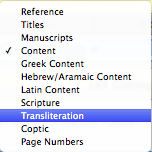
Search fields for Göttingen Isaiah Apparatus I

Where Accordance really excels in its presentation of Göttingen is the multiple ways it offers to search an apparatus. (See image at right.) The most helpful search field is “Manuscripts,” and one can also search by “Greek Content,” which greatly facilitates searching for a given text variant. Searching an apparatus in Logos doesn’t have nearly the options, and manipulating what search results one can get is more difficult.

The “List Text Differences” feature in Accordance is one I’ve used often, to see where Göttingen and Rahlfs differ on Isaiah, for example. Logos has a “Text Comparison” tool, similar to the “Compare” feature in Accordance, but “List Text Differences” is unique to Accordance.

One remaining fix in the Accordance apparatus (at least for the Isaiah module I’ve examined) is a symbol rendering issue. When the apparatus notes a case of homoioteleuton, what appears in print as 1°◠2° shows up in the apparatus as 1°  2°. (UPDATE: See Rick’s comment below; update is planned. UPDATE 12/14/13: This has now been corrected in Accordance.) This renders correctly in Logos.

Logos still doesn’t have the Kopfleiste (Source List) for the Göttingen volumes that have one in print, while Accordance does include it. On the one hand, the Kopfleiste makes most sense in a print edition, but one can imagine that serious students of the Septuagint may still want to be able to access it. Accordance’s Esther includes it, for example.

All the Göttingen volumes that have been published in print are in Logos already, but Accordance seems to be making fast progress of late in completing their own offering. Göttingen is more affordable in Logos (especially if you have their academic discount), but there are more advanced search options available in Accordance (both in the text and the apparatuses) that may make the user want to consider the latter software instead. If one wants just a single volume in Göttingen, that option is currently only available in Accordance.

Speaking of the Septuagint, I’ve just finished Greek Isaiah in a Year with a group of folks, and so will take recommendations for what to read next!

First Bible of the Church: A Plea for the Septuagint, reviewed

First Bible of the ChurchFor the New Testament authors, the original text, that is, the text they drew on, was primarily the Septuagint. To make up the first part of the Bible which has the New Testament as the other part, the Old Testament in the shape it has in the Septuagint would therefore seem the obvious choice.

First Bible of the Church: A Plea for the Septuagint, by Mogens Müller (p. 144)

Mogens Müller provocatively asks, “What caused the displacement of the Septuagint? …Today it is an open question whether the Septuagint should be reinstalled as the Old Testament of the Church” (p. 7). First Bible of the Church is part reception history, part biblical theology, and part apologetic work that suggests the Greek translation of the Hebrew Bible should be brought (back) into canonical status. It should be “at least part of a canon” (p. 122), if not the better choice than Biblia Hebraica for today’s “original text” of the Old Testament/Hebrew Bible.

What follows is a brief summary of the book’s contents, followed by some evaluative comments.

Müller’s Plea

Chapter 1 is the introduction to the book. In it Müller raises the question of just what should qualify as “the original text” of the Old Testament. If we see “what the early church regarded as its Bible” (p. 23), already one has to take the Septuagint seriously. This is not a question Müller addresses exclusively on textual grounds; for him the issue is also a theological one. To wit: In Isaiah 7:14/Matthew 1:23, “the ‘wrong’ text gains a significance of its own by being used” (p. 23).

Chapter 2, “The Jewish Bible at the Time of the New Testament,” looks at the canonization and textual history of the Jewish Bible, including various Greek recensions. Müller makes a key (and helpful) distinction in canonization between “the recognition of a writing as sacred” and “the final fixing of its wording” (p. 32). Evaluating various source materials, and dismissing the idea of an Urtext, the author notes the (accepted) fluidity of the process of textual transmission, where the actual wording in the sacred books only became important some centuries after the books themselves had become part of a canon. The implications of this, of course, are that New Testament writers may not have cared–in the way modernists do–about making sure they were using “the original” Hebrew text when quoting Scripture–if such a thing even ever existed as such.

Nonetheless, as chapter 3 points out, there was a very early historical concern about the authority of the Greek translation of the Hebrew Scriptures. Would the former be on par with the latter? Müller examines various defenses of the Septuagint (the Law books, specifically): Aristeas, Aristobulus, Philo, and Josephus. Chapter 4, “The Reception of the Septuagint Legend into the Church up to and Including Augustine” continues the historical inquiry into attitudes toward the Septuagint, especially when compared to the Hebrew text it was said to have translated. Justin and Irenaeus (among others) are given as examples of early interpreters who saw the Septuagint translation as inspired. Jerome, Müller suggests:

saw the Biblia Hebraica as the basic text as far as the Old Testament was concerned, and thus he contributed, at least for the Latin-speaking part of Christianity, to bring about the final abandonment of the Septuagint, which had very early come to be acknowledged as the Bible of the Gentile, Christian Church. (p. 86)

Biblia Graeca
Biblia Graeca

Chapters 5 (“Hebraica sive Graeca Veritas?“) calls the Septuagint “a witness to the process of transmitting tradition” (p. 99), a process which Müller sees in ancient Judaism as having “a very creative character” (p. 104). Translation in antiquity included a measure of interpretation. The author’s foray into translation theory gives refreshing context to a world that valued lexical equivalency in translation less than many do today.

Chapter 6 (“Vetus Testamentum in Novo Receptum“) provides a short biblical theology, in which the New Testament is seen primarily as the story of Jesus, who himself fulfills what is written in the Old Testament. Müller notes that it is for this reason that the Hebrew Bible became the Old Testament, and yet its use by New Testament writers solidified its importance and sacredness for Christians. The Old Testament is necessary–“it remains the Holy Writ of the Christian community.” But it is not sufficient–“the Old Testament per se represents a limited epoch in salvation history” (p. 135).

The conclusion calls for the Septuagint to (re-)take its canonical place alongside the New Testament.

Is Müller’s Plea Worth Paying Heed To?

Yes. Readers of this blog and its Septuagint posts will not be surprised by my saying so. Müller makes a good case and generally succeeds in making a compelling plea for the LXX. If readers don’t accept his call to (re-)canonize the Greek OT, they will at least take seriously his petition to take it more seriously (as the NT writers did).

The book is short (some 150 pages) but dense. There is untranslated German and Latin in the footnotes, as one would expect in a scholarly monograph, but the writing is no less engaging for its density. The Greek font used throughout is easy to read, and the Greek is often translated into English.

Müller’s brief biblical theology at the end of the book is excellent. It left me wanting to read more. His notion of fulfillment as a motif that links together the OT and NT was convincing and well-articulated.

I found some typographical errors, as well as a number of sentences that just seemed to have wanted closer editing. This could be in part due to the book’s translation from a Danish manuscript. I was distracted in a few places as a result, but not consistently.

Evangelicals will find a few things they disagree with. For example, Müller cites Wellhausen approvingly to note that “the prophets were not reformers anxious to lead the people back to an original Mosaic religion.” The Law, then, “is not the starting-point but the result of Israel’s spiritual development” (p. 102). This line of reasoning is not essential to following the rest of Müller’s arguments, but his “redactional-critical attitude” (p. 100) does lead to a few assertions that some (including myself) don’t agree with.

Müller’s logic and historical inquiry is generally careful and robust, not to mention more readable than one might expect from a work of this nature. Perhaps it is due to the short length of the book, but there are still some unanswered questions. If “the Septuagint” is to comprise the Old Testament in Christian Bibles (as Müller suggests on p. 144, among other places), which Septuagint should we use? On which codex or codices should we base it? And given that Septuagint manuscripts vary on which books are included, how would we decide which books to place in a reconstituted OT? Simply those books that are now in the Hebrew OT, but in their Greek iterations? What about the Apocrypha?

And yet it appears that Müller’s aim is more to address “whether the Septuagint should be reinstalled as the Old Testament of the Church” (p. 7, my emphasis), not how and by what methodology such a reinstallation would take place. With this aim in mind, Müller’s short yet substantive book offers a compelling plea that deserves the reader’s careful consideration.

You can find First Bible of the Church: A Plea for the Septuagint here at Amazon. Its publisher’s product page is here. Thanks to Bloomsbury for the review copy, given with no expectation as to the content of the review.

Feasting on the Word Commentary for Preachers (more thoughts)

Feasting on the Word

Whether the sermon is five minutes long or forty-five, it is the congregation’s one opportunity to hear directly from their pastor about what life in Christ means and why it matters.

–Feasting on the Word

Since getting it in Logos, I’ve been reading Feasting on the Word as a regular part of my sermon preparation each week. I describe the commentary series here.

Feasting on the Word is a lectionary-based commentary series in 12-volumes, four volumes for each of three years of the lectionary. Each Sunday has theological, pastoral, exegetical, and homiletical “perspectives” from which a variety of contributors assesses the texts. Feasting on the Word covers the OT, Psalm, Epistle, and Gospel readings each week.

As to the contributors, the publisher’s product page notes:

The editors of these resources are from a wide variety of disciplines and religious traditions. These authors teach in colleges and seminaries. They lead congregations by preaching or teaching. They write scholarly books as well as columns for newspapers and journals. They oversee denominations. In all of these capacities and more, they serve God’s Word, joining in the ongoing challenge of bringing that Word to life.

Noting a few contributors will give a sense of the diversity of perspective in the commentary:

  • Paul J. Achtemeier, Jackson Professor of Biblical Interpretation Emeritus, Union Theological Seminary, Richmond, Virginia
  • Michael B. Curry, Bishop, Diocese of North Carolina, Raleigh, North Carolina
  • Paul Simpson Duke, Co-Pastor, First Baptist Church, Ann Arbor, Michigan
  • Stacey Simpson Duke, Co-Pastor, First Baptist Church, Ann Arbor, Michigan
  • Edith M.Humphrey, William F. Orr Professor of New Testament, Pittsburgh Theological Seminary, Pittsburgh, Pennsylvania
  • Barbara Brown Taylor, Butman Professor of Religion, Piedmont College, Demorest, Georgia
  • Frank A. Thomas, Senior Servant, Mississippi Boulevard Christian Church, Memphis, Tennessee
  • David Toole, Associate Dean, Duke Divinity School, Durham, North Carolina

Here’s what a Feasting on the Word volume looks like in Logos on a laptop or desktop, next to a couple of other (not included) resources. Click to expand or open the image in new tab, and see my corresponding notes below.

Feasting on the Word in Logos with notes

(1) User annotations: Highlighting and making notes is easy–you can mark up the texts with various styles. Like Amazon’s Kindle app, the annotations made on one machine or device sync with other machines or devices. The note and highlights made above were done on an iPad and popped up automatically when I opened Logos on a computer. Logos is probably the most robust e-reader on the market in this sense.

(2) Hyperlinks: You can hover over a hyperlink for a pop-up with more info, or click on it to be taken to the biblical text (or footnote) that it references.

(3) Expandable/collapsable Table of Contents: Logos is not unique in offering this, but it does make it easy to quickly navigate between passages or “perspectives” on a given Sunday.

(4) Sync with other resources in Logos library: This is simple to set up. I can have Feasting on the Word open next to the full biblical text and other commentaries and resources.

(5) A single Sunday: on the left navigation sidebar you can see what a single Sunday looks like.

(6) Paused indexing: one challenge in using Logos is its frequent need to index. This optimizes searches, and it varies due to a user’s library size, but especially on a Mac, where Logos can already be sluggish compared to other apps, it slows the rest of the computer down. If I’m working on a sermon and using Logos, Accordance, Kindle, and Google Drive or Pages, for example, I almost always have to pause indexing to be able to keep working efficiently. I tend to resume indexing when I don’t need to use Logos.

I continue to find the “Homiletical Perspective” and “Preaching Perspective” the most useful parts of the commentary. The sections I’ve read offer a variety of vantage points and are creative and imaginative on a fairly consistent basis. In my third and final part of this review series, I’ll interact more in-depth with the content of the series.

Thanks to Logos Bible Software for the review copy of Feasting on the Word (12 vols.). Find it here. The publisher’s page for the series is here. You can find my other Logos reviews here.