NICOT in Olive Tree, reviewed

NICOT in Olive TreeAsk a group of pastors, seminarians, professors, or serious Bible readers, “What one commentary series on the Old Testament would you most recommend?” and you’re likely to hear: “NICOT.” Eerdmans’ New International Commentary on the Old Testament blends scholarship with application in a readable and engaging manner. Few, if any, commentary series are consistently this good throughout the series. And I don’t know of any other series that has such broad ecumenical appeal.

NICOT in Olive Tree has 23 volumes, spanning 26 biblical books. The bundle includes the 2010 volume on Hosea. The only volume currently in print that is not here is The Book of Judges, by Barry G. Webb (2012). (Judges is not available in any other Bible software at the moment.)

General editor Robert L. Hubbard Jr. writes of the series:

NICOT delicately balances “criticism” (i. e., the use of standard critical methodologies) with humble respect, admiration, and even affection for the biblical text. As an evangelical commentary, it pays particular attention to the textʼs literary features, theological themes, and implications for the life of faith today.

As I preached through Isaiah this past Advent, John N. Oswalt’s two volumes on that book were the first commentary I turned to after spending time with the biblical text. While it was always clear that Oswalt knew Isaiah and his milieu well, the author would find himself swept up at times in praise of the God Isaiah preached. On Isaiah 2:2, for instance, he writes:

What Isaiah was asserting was that one day it would become clear that the religion of Israel was the religion; that her God was the God. To say that his mountain would become the highest of all was a way of making that assertion in a figure which would be intelligible to people of that time.

NICOT IsaiahOn that passage’s promise of peace among nations, he concludes:

Until persons and nations have come to God to learn his ways and walk in them, peace is an illusion. This does not mean that the Church merely waits for the second coming to look for peace. But neither does it mean that the Church should promote peace talks before it seeks to bring the parties to a point where they will submit their needs to God.

Oswalt is representative of the authors in NICOT, in that he loves the text (and its grammar, history, and background) and loves the God who inspired it.

NICOT in Olive Tree has hyperlinks to biblical references and commentary footnotes, which you can easily and quickly view in the Bible Study (computer) app through the Quick Details corner (by hovering over the hyperlink), or as a pop-up window (which can then also pop out and keep your place in a separate window). It’s just as easy to tap a hyperlink in the mobile app.

There are two ways I’ve used NICOT so far.

1. I use NICOT as my starting point in the main window.

After some time in the biblical text, I have made my way through parts of NICOT by starting from the commentary. I can use hyperlinks to read the verses being commented on, as well as any other references. I can keep a Bible open in the split window and have it follow me along as I read through NICOT.

Using NICOT this way, there are quite a few ways to get around, both by looking up a verse in the commentary, and by navigating its Table of Contents. You only need to use one of these options at a time, but here they all are:
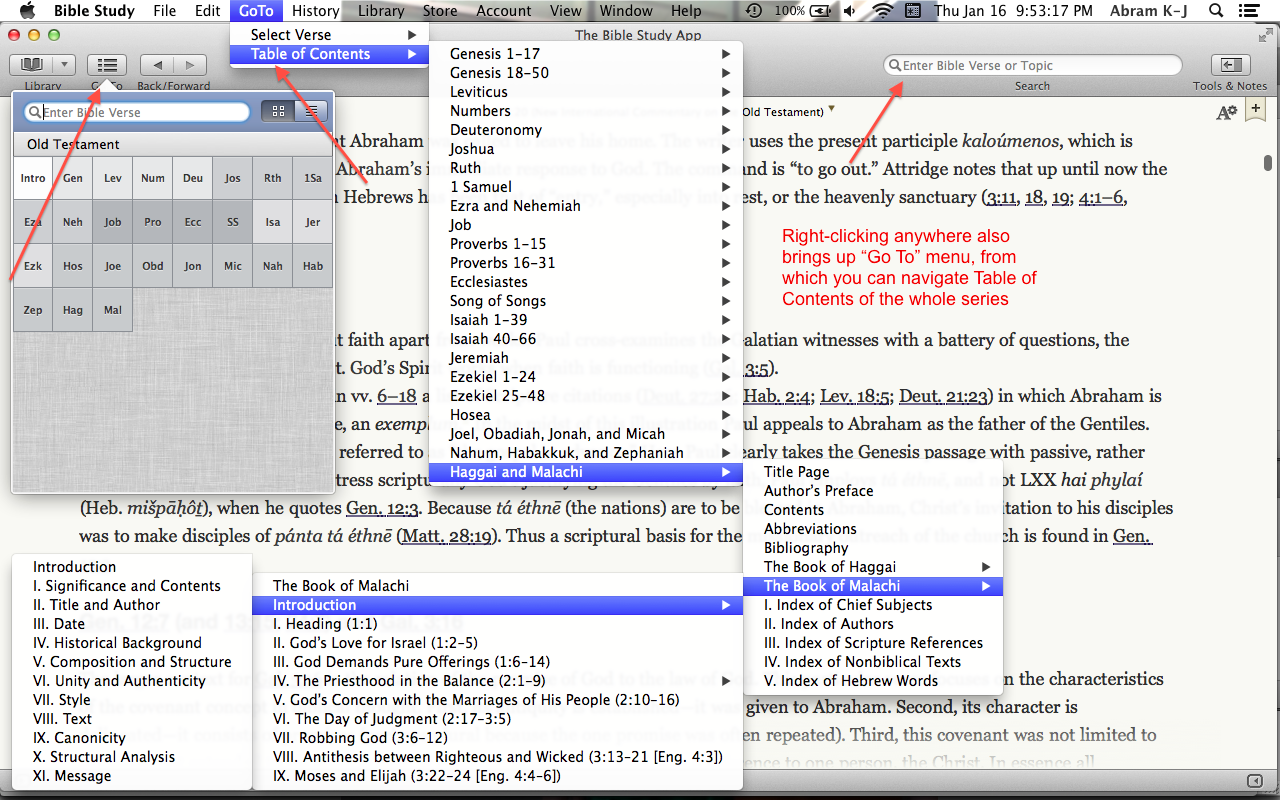
(click to enlarge image)

Note that from the Go To drop-down menu, I can keep following the sub-menus till I get to a specific place in the commentary (Introduction to Malachi in the instance above). One could also do this from the Go To item in the toolbar, which allows for both verse searching and Table of Contents navigation.

2. I use the Bible in the main window and NICOT as a supplement in the split window.

This has the advantage of letting me use NICOT as one among multiple resources in the Resource Guide, as shown (in part) here:

Resource Guide shows relevant library results (click to enlarge)

In both of the above setups you can take notes in NICOT, highlight, and bookmark your place. You can also do a search on a word or phrase in the commentary, with the results appearing almost instantaneously. One may wish, for example, to find all the times Oswalt refers to the “Suffering Servant” in Isaiah, which is an easy and fast search to run.

In reviewing Olive Tree I have found it to have the most versatile, smooth, and customizable Bible app I’ve seen on iOS. I write more about the Bible Study iOS app here. The fact that Olive Tree is cross-platform makes it appealing to many. Though the desktop app is well-designed, I would like to see a future update where you can create a saved workspace with multiple resources open in various tabs and windows. That, I think, would take the app to the next level.

But everything is here to help you work through NICOT in a way that you couldn’t in print. There are a couple of options (one free and one paid) for Hebrew Bibles, too, if you want to use NICOT in tandem with the original language. (NICOT uses transliterated Hebrew.)

NICOT volumes consistently top the charts of the Best Commentaries site. Preachers and professors, parishioners and pupils will all find much to mine here, as they seek to better understanding the Old Testament and to more faithfully love the God whose goodness its pages proclaim.

Thanks to Olive Tree for the New International Commentary on the Old Testament (NICOT), given to me for this blog review, offered without any expectations as to the content of the review. You can find the product here. For a little while longer, it’s $349.99 for the series, which is 50% off its regular price.

I Met N.T. Wright Once, and You’ll Never Guess What He Told Me

I’ve been seeing too much Upworthy in my Facebook news feed lately! Apologies for the sensational blog post headline.

NT WrightBut I really did meet N.T. Wright once. And you might actually guess what he told me, when I tell you what I asked him. I introduced myself to him briefly after a message he delivered a Calvin College worship symposium, and asked him how to improve my Greek. He said, “Read the text, read the text, read the text.”

He told me to really get the feel of the language. I shouldn’t think of Greek just as a one-to-one code for English; I should get into the Greek itself. I asked him what he thought about reading with a diglot, but he encouraged me to check the English translation only after reading an entire Greek paragraph, and then, only as necessary.

It’s challenging, but I’ve benefited from that advice multiple times.

The For Everyone Series

Wright for EveryoneOver the years I’ve made occasional use of his For Everyone Bible commentary series. Written under the name Tom Wright, the series brings Wright’s extensive knowledge of the biblical text and history to a general audience. Anyone wanting to know more about a passage–whether they are preaching from it or reading it in their personal devotions–would benefit from the series. It’s decidedly non-scholarly, but even scholars will find useful information here (if a bit simplified at times). Here is how Wright introduces the series:

But the point of it all is that the message can get out to everyone, especially to people who wouldn’t normally read a book with footnotes and Greek words in it. That’s the sort of person for whom these books are written.

Though Wright is a prolific writer of scholarly works, he writes well for a general audience–a rare combination. Throughout the series Wright puts key terms in bold, which the reader can then look up in a corresponding glossary (e.g., Gehenna/Hell, Covenant, Age to Come, Law, Faith, Son of Man, and more).

Between this package and this upgrade, Logos Bible Software offers the entire 18 vol. set. In a future post I will review Logos’s presentation of the series. Here I post about its content.

A Refreshing (One-Man) Translation

The Kingdom NTWright splits each biblical book up into manageable passages. His original translation does a good job of striking the balance he seeks of faithfulness to the original and readability. Here is a passage in Wright’s translation:

Romans 4:18-25

Abraham’s Faith—and Ours

18 Against all hope, but still in hope, Abraham believed that he would become the father of many nations, in line with what had been said to him, ‘That’s what your family will be like.’ 19 He didn’t become weak in faith as he considered his own body (which was already as good as dead, since he was about a hundred years old), and the lifelessness of Sarah’s womb. 20 He didn’t waver in unbelief when faced with God’s promise. Instead, he grew strong in faith and gave glory to God, 21 being fully convinced that God had the power to accomplish what he had promised. 22 That is why ‘it was calculated to him in terms of covenant justice’.

23 But it wasn’t written for him alone that ‘it was calculated to him’.24 It was written for us as well! It will be calculated to us, too, when we believe in the one who raised our Lord Jesus from the dead, 25 the one who was handed over because of our trespasses and raised because of our justification.

Wright explains, “The older language, ‘it was reckoned to him as righteousness’, gives off so many different messages now that it’s hard for us, hearing it, to think the thoughts Paul had in his head.” His translation is fresh, yet is not a paraphrase (like Eugene Peterson’s Message, for example).

“Come to Him, by Whatever Route You Can”

The For Everyone series, though divided into discrete passages, shows a literary sensitivity so that the reader can see how a given section connects to the larger flow of the book. For example, of the above passage, Wright writes:

The last verse of the chapter anticipates something Paul is going to do throughout chapters 5-8. He rounds off every stage of the argument in this long section with a reference to Jesus. This isn’t a mere pious gesture, smuggling in a mention of Jesus in case we thought he’d forgotten about him. It shows, rather, what the whole argument is all about. It brings us back home to the source and power of Paul’s thought.

Though preachers are not the target audience, the series is a good one for preachers to have on their shelves. There is not the same sort of explicit homiletical guidance that Feasting on the Word offers on every passage under consideration, but Wright is not short on practical application. For the Romans passage above, he concludes:

Do we share Abraham’s faith? Do we look in love, gratitude and trust to the creator God who promises impossible things and brings them to pass? Have we learned to celebrate this God, and to live as one family with all those who share this faith and hope?

Similarly, in Matthew’s account of the Magi’s visit to Jesus, Wright notes that the inclusion of the Gentile Magi already in chapter 2 shows one of Matthew’s themes–that Jesus is king of the Jews, and of all people. He concludes:

Listen to the whole story, Matthew is saying. Think about what it meant for Jesus to be the true king of the Jews. And then—come to him, by whatever route you can, and with the best gifts you can find.

This application comes after Wright succinctly answers who the Magi were, what the “star” they saw might have been, and what Old Testament passages are at play in the Epiphany narrative.

In Conclusion (So Far): One of the Best Reading Guides

Luke for EveryoneWright’s style is conversational, engaging, highly readable, and stimulating on both an intellectual and devotional level. As I make my way through more of the series, I’ll post more about it (with screenshots of how it looks in Logos for computer and iOS). But so far I’m a big fan of what I’ve seen. The Luke volume was a frequent reference as I preached through parts of Luke this fall.

If you’re reading through the Bible, and want to have a substantive yet concise reading guide for the journey, Wright’s For Everyone series is hard to top.

Thanks to Logos Bible Software for the review copy of New Testament for Everyone (16 vols. here; 2 vols. upgrade here). You can find my other Logos reviews here.

NA28 Greek New Testament in Olive Tree iOS, reviewed

Olive Tree logo

Which Bible software program should I buy? As 2014 begins, my answer to that question is still by far the most-visited post at Words on the Word.

Olive Tree is another popular Bible software option, running on just about any platform and device, whether iOS, Mac, Windows, or Android. I began to review their Bible Study App (for Mac desktop/laptop) here, with the Greek NA28 New Testament in view. In this post I look more in-depth at the NA28 in Olive Tree, with screenshots from their iPad (mini) app.

The Bible Study App for iOS

The Bible Study App is smooth, visually appealing, and easy to learn and use.

Here are a few things I especially like about the app:

You can use “flick scrolling” (as in iBooks) or “page scrolling” (as in Kindle). This accommodates just about any user. I prefer the flick scrolling, so that the books move as a Webpage on my computer would move.

You can search any resource, and view both the results-in-context and individual hits together. As in this screenshot:

Search Results

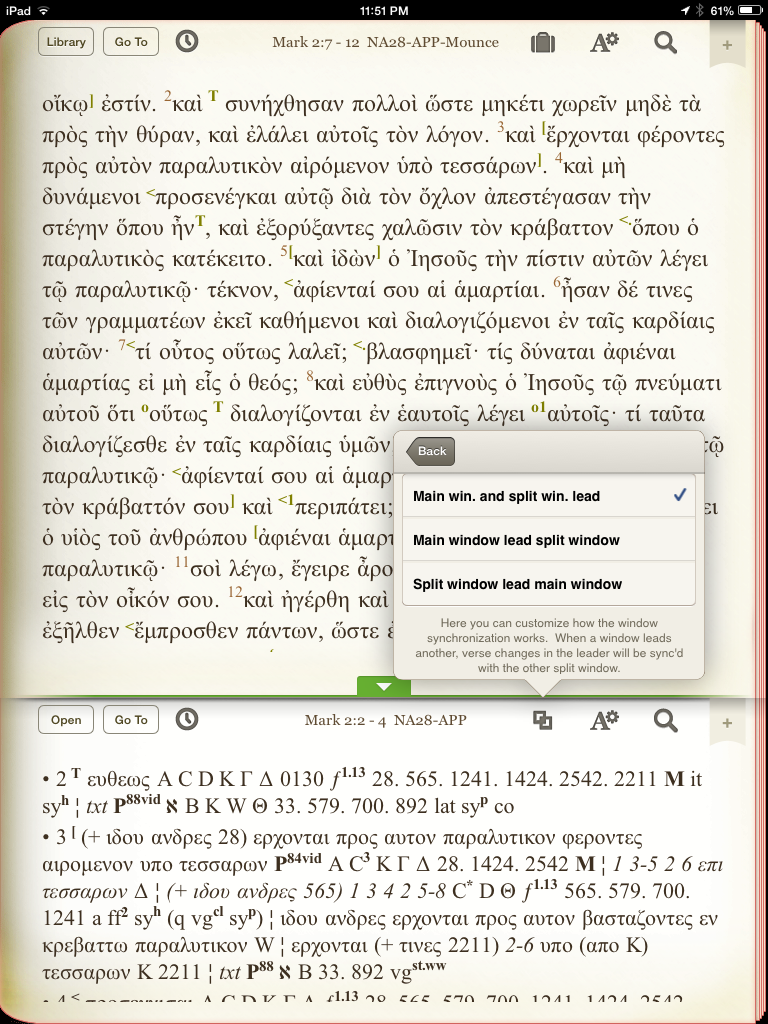
The app allows for you to view one or two resources at a time. This is the same as the iOS apps in Accordance and Logos. What I like about this app is that you can choose whether you want to sync the two windows or not. You can also choose which of the two windows “leads” the other, if you tie them together. Or you can set it up so that whichever one you move (top or bottom/left or right) causes the other to move:

Main and Split Window

There is a whole host of “Gestures/Shortcuts” preferences in the “Advanced Settings” menu. You can assign shortcuts to various gestures. I don’t know of any other iOS Bible app that is this versatile. My two favorites:

  • Two finger swipe left and right takes you through your viewing history, which makes navigation through various passages all the easier. This even works across modules, so that I can swipe between the NA28 and the iPad User Guide I might have just had open. No need to go through menus.
  • Two finger tap takes you from any screen right to your library so you can quickly get at your resources.

NA28 in Olive Tree

There are a few purchase options for the NA28 in Olive Tree. I’ll look here at the “NA28 with Critical Apparatus, Mounce Parsings, and Concise Dictionary,” which you can find hereAt the time of this blog post, it’s on sale for 50% off, so $45 instead of $90. You won’t find it cheaper elsewhere, in any format. The text and apparatus are what you’d get if you bought a print version; the parsings give morphological information, and the dictionary gives lexical detail.

There are some distinct differences between the NA28 and the NA27. If you go about halfway down this post, you can see more detail (as well as click through to some good links) as to what the changes are.

Here I have the text and apparatus open, and have simply tapped once on a Greek word to bring up a pop-up window with a gloss and parsing:

parsing popup

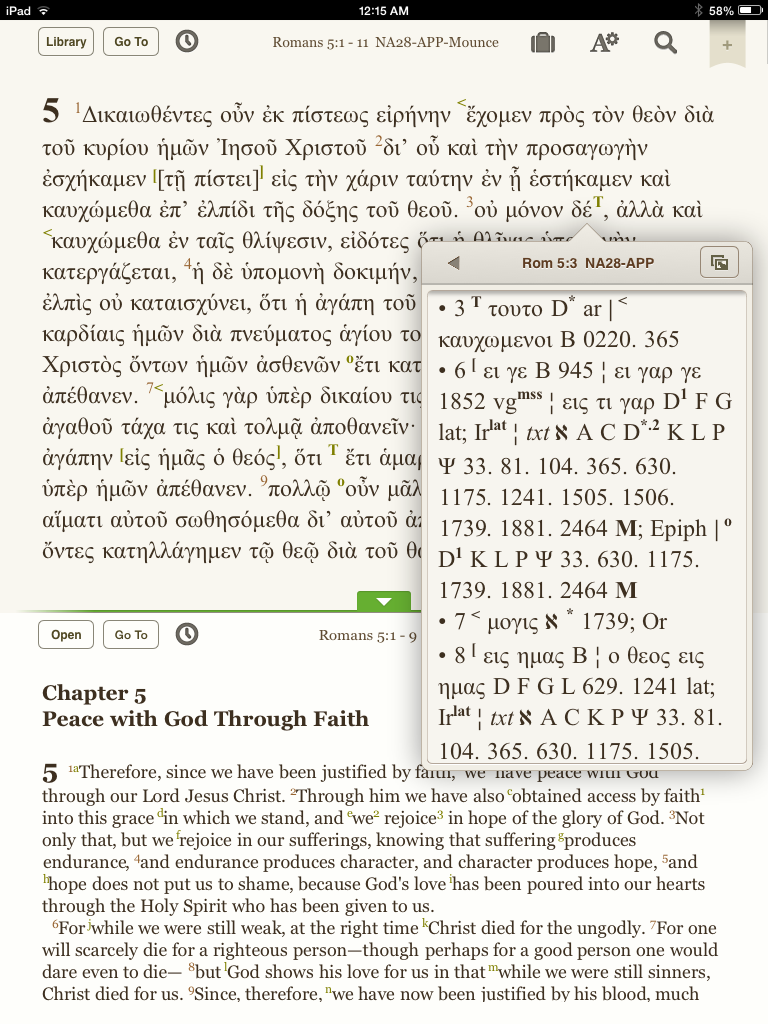
Another possible arrangement would be to use one window for the Greek text, and a second window for an English translation. In that case, one can click on the sigla in the NA28 text for a pop-up with the apparatus. (And still get parsing popups from the surface text, when needed.) This is a good way to economize space:

diglot with apparatus

I appreciate that just a short tap is all that’s required to bring up details about a word or information on a text-critical sign. I find the app overall to be quite intuitive and aesthetically pleasing.  It’s fast on word searches, too.

One critique of the NA28 apparatus is that the text-critical sigla are not hyperlinked to their meanings. In the Accordance version of NA28, for example, when you hover/click/tap on sigla and abbreviations from the apparatus, you instantaneously see (in a popup window or instant details window) what they represent or stand for. In Olive Tree, there is a workaround (described here: bookmark the relevant section of the introduction for quick reference), but this is not an improvement on what one would have to do with a print text anyway. It’s not unmanageable, but also not what one might hope for in this medium. So one will need to regularly consult the NA28 introduction, which is included with the text.

Olive Tree has one of the more active and better Bible software blogs I’ve seen. I’ve learned a good deal from it. Check it out here, especially this post that shows how to use a dictionary in the iOS app.

Since Olive Tree is new to me, and since I already use other Bible softwares, I’m still trying to figure out how it will make its way into my overall workflow. But its smooth interface, speed, and snazzy iOS app will have me coming back for further exploration.

Thanks to Olive Tree for the NA28 with Critical Apparatus, Mounce Parsings, and Concise Dictionary for the purposes of this blog review, offered without any expectations as to the content of the review. You can find the product here

Feasting on the Word (concluding thoughts)

Feasting on the Word

Among preachers, there are books known as “Monday books” because they need to be read thoughtfully at least a week ahead of time. There are also “Saturday books,” so called because they supply sermon ideas on short notice. The books in this series are not Saturday books. Our aim is to help preachers go deeper, not faster, in a world that is in need of saving words.

–Feasting on the Word

I continue to utilize the 12-volume Feasting on the Word commentary series most weeks in my sermon preparation. As I described at greater length here, the 12 volumes cover the three-year lectionary cycle (A, B, and C), split into four volumes per year. Each week offers four different “perspectives” (theological, pastoral, exegetical, and homiletical) for each lectionary passage in the Revised Common Lectionary.

As far as its layout and usability in Logos, I covered that here. My favorite part about having Feasting on the Word in Logos is that I find Logos to be the most robust e-reader currently on the market. It syncs seamlessly across devices and platforms, and easily allows for highlights and notes to be made directly within the text.

In this final post, I want to interact a bit more with some of the content of the series.

The diversity of the contributors is a strong point. They come from different vocations (preachers, professors, Bishops), and reflect diversity in race, sex, and denominational affiliation, as well. I’ve found this refreshing.

There is a general evenness in style, tone, and substance across the volumes I’ve used. As one might expect with a commentary series with this many contributors, some entries end up being more helpful than others.

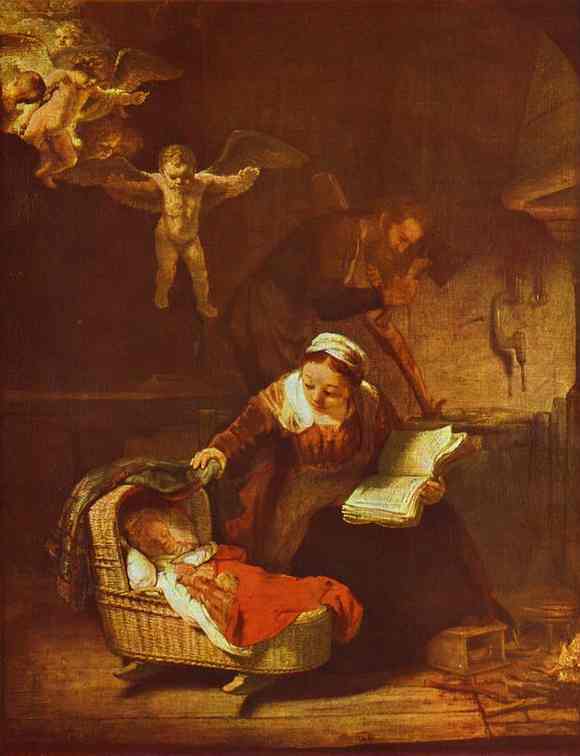
Rembrandt Holy FamilyWhile I have found the “Exegetical Perspective” and “Homiletical Perspective” sections to be of some value, the “Homiletical Perspective” and “Preaching Perspective” are the ones I use most often. Each of these help the preacher imagine how she or he might orient herself/himself and the congregation to a given text. For example, the “Homiletical Perspective” on John 1 begins with a description of Rembrandt’s “Holy Family” painting, then goes on:

I can imagine a sermon that would begin with a description of Rembrandt’s painting and that would develop the idea of the necessary dialogue between Mary’s studying the Bible and studying the child, the Word made flesh. Like Mary, we come to understand the Word more and more fully as we oscillate between the book and the child, between the Word through words and the Word made flesh.

Few commentaries offer homiletical suggestions this practical. The “Pastoral Perspective” for the same passage is worth quoting at length. After quoting Eugene Peterson’s rendering of John 1:14, preacher Frank Thomas writes:

I love this rendering of this text because of the choice of the word “neighborhood.” The Word was made flesh and blood and moved into the neighborhood. Neighborhood reminds me of the place where I grew up and the people with whom I grew up. I remember the street corner where we played baseball that had four sewer covers; one sewer cover was first base, another second, another third, and the final one home. I ran around those bases thousands of times, dreaming that I was a professional baseball player. I remember the playground, where what seemed like millions of kids played basketball, Ping-Pong, pool, volleyball, dodgeball, and tons of games. I remember block parties, where all the neighbors would sit out on the front lawns with the streets blocked off, and all day we would just have food, games, and fun together. I remember the girl across the street. That’s what I think of when I hear, “The Word was made flesh and moved into the neighborhood.” The Word was made flesh and moved into my south-side neighborhood.

He concludes, “When Peterson says that the Word was made flesh and moved into the neighborhood, I hear that the Word moved into my neighborhood.”

There is much for the preacher to mine and adapt and re-contextualize in the above, in a way that fits one’s own setting. Reading Pastor Thomas’s writing above makes it easy to think about Jesus moving into our neighborhoods, too. (Which immediately raises interesting questions for congregations–would we be a good neighbor to him? Would we need to change anything about our community life? Would we recognize him?) I find that Feasting on the Word is constantly suggesting good questions for reflection and stimulating even more.

There is a claim in the series introduction that, “Wherever they begin, preachers will find what they need in a single volume….” While the exegesis and theological analysis in these volumes is substantive, I still find myself turning to more in-depth commentaries for exegesis, before using Feasting on the Word to think through how to move from passage to sermon. That has been how I’ve most benefitted from the commentary.

I’ll continue to use the commentary series on a regular basis. While I love print books, there are advantages to the electronic version, and Logos integrates Feasting on the Word with any other Logos resources you may have. For those who preach regularly, this set is well worth checking out.

Thanks to Logos Bible Software for the review copy of Feasting on the Word (12 vols.). Find it here. The publisher’s page for the series is here. You can find my other Logos reviews here.

500 Book Sale in Logos Bible Software

500-book-mega-pack

Logos Bible Software has just announced the release of a “500 Book Mega Pack.” The bundle is up through the end of the year. More details are here. Some highlights include:

…and quite a few more. Nearly 200,000 pages (print equivalent). You probably won’t use all of it, but it’s a quick and cost-efficient way to expand a Logos library. Logos offers it at 96% off, through their Christmas sale.

As to my own personal experience using Logos, I’ve written a good deal about that here (with more reviews forthcoming). You can also see a short demo here (with a great soundtrack from Future of Forestry) on how to use Logos to research the Christmas story.

Disclosure of Material Connection: I received the 500 Book Mega Pack gratis, with the expectation that I post about it here (though with no expectation as to my evaluation of the product itself).

Feasting on the Word Commentary for Preachers (more thoughts)

Feasting on the Word

Whether the sermon is five minutes long or forty-five, it is the congregation’s one opportunity to hear directly from their pastor about what life in Christ means and why it matters.

–Feasting on the Word

Since getting it in Logos, I’ve been reading Feasting on the Word as a regular part of my sermon preparation each week. I describe the commentary series here.

Feasting on the Word is a lectionary-based commentary series in 12-volumes, four volumes for each of three years of the lectionary. Each Sunday has theological, pastoral, exegetical, and homiletical “perspectives” from which a variety of contributors assesses the texts. Feasting on the Word covers the OT, Psalm, Epistle, and Gospel readings each week.

As to the contributors, the publisher’s product page notes:

The editors of these resources are from a wide variety of disciplines and religious traditions. These authors teach in colleges and seminaries. They lead congregations by preaching or teaching. They write scholarly books as well as columns for newspapers and journals. They oversee denominations. In all of these capacities and more, they serve God’s Word, joining in the ongoing challenge of bringing that Word to life.

Noting a few contributors will give a sense of the diversity of perspective in the commentary:

  • Paul J. Achtemeier, Jackson Professor of Biblical Interpretation Emeritus, Union Theological Seminary, Richmond, Virginia
  • Michael B. Curry, Bishop, Diocese of North Carolina, Raleigh, North Carolina
  • Paul Simpson Duke, Co-Pastor, First Baptist Church, Ann Arbor, Michigan
  • Stacey Simpson Duke, Co-Pastor, First Baptist Church, Ann Arbor, Michigan
  • Edith M.Humphrey, William F. Orr Professor of New Testament, Pittsburgh Theological Seminary, Pittsburgh, Pennsylvania
  • Barbara Brown Taylor, Butman Professor of Religion, Piedmont College, Demorest, Georgia
  • Frank A. Thomas, Senior Servant, Mississippi Boulevard Christian Church, Memphis, Tennessee
  • David Toole, Associate Dean, Duke Divinity School, Durham, North Carolina

Here’s what a Feasting on the Word volume looks like in Logos on a laptop or desktop, next to a couple of other (not included) resources. Click to expand or open the image in new tab, and see my corresponding notes below.

Feasting on the Word in Logos with notes

(1) User annotations: Highlighting and making notes is easy–you can mark up the texts with various styles. Like Amazon’s Kindle app, the annotations made on one machine or device sync with other machines or devices. The note and highlights made above were done on an iPad and popped up automatically when I opened Logos on a computer. Logos is probably the most robust e-reader on the market in this sense.

(2) Hyperlinks: You can hover over a hyperlink for a pop-up with more info, or click on it to be taken to the biblical text (or footnote) that it references.

(3) Expandable/collapsable Table of Contents: Logos is not unique in offering this, but it does make it easy to quickly navigate between passages or “perspectives” on a given Sunday.

(4) Sync with other resources in Logos library: This is simple to set up. I can have Feasting on the Word open next to the full biblical text and other commentaries and resources.

(5) A single Sunday: on the left navigation sidebar you can see what a single Sunday looks like.

(6) Paused indexing: one challenge in using Logos is its frequent need to index. This optimizes searches, and it varies due to a user’s library size, but especially on a Mac, where Logos can already be sluggish compared to other apps, it slows the rest of the computer down. If I’m working on a sermon and using Logos, Accordance, Kindle, and Google Drive or Pages, for example, I almost always have to pause indexing to be able to keep working efficiently. I tend to resume indexing when I don’t need to use Logos.

I continue to find the “Homiletical Perspective” and “Preaching Perspective” the most useful parts of the commentary. The sections I’ve read offer a variety of vantage points and are creative and imaginative on a fairly consistent basis. In my third and final part of this review series, I’ll interact more in-depth with the content of the series.

Thanks to Logos Bible Software for the review copy of Feasting on the Word (12 vols.). Find it here. The publisher’s page for the series is here. You can find my other Logos reviews here.

Feasting on the Word Commentary for Preachers

Feasting on the Word

Alas, the burden and the glory of preaching consist in proclaiming things that are not yet fully realized, but the hope for them holds a powerful grip upon the faithful imagination.

–Feasting on the Word

Here is a 12-volume commentary set that covers all the lectionary readings from multiple angles. Feasting on the Word offers four different “perspectives” (theological, pastoral, exegetical, and homiletical) for each lectionary passage in the weekly Revised Common Lectionary.

The 12 volumes cover the three-year lectionary cycle (A, B, and C), split into four volumes per year:

  • Advent through Transfiguration
  • Lent through Eastertide
  • Pentecost and Season after Pentecost 1 (Propers 3-16)
  • Season after Pentecost 2 (Propers 17—Reign of Christ)

The Scripture index makes it accessible to preachers who are not following the lectionary, too. From the Logos product page:

The editors and contributors to this series are world-class scholars, pastors, and writers representing a variety of denominations and traditions. And while the twelve volumes of the series will follow the pattern of the Revised Common Lectionary, each volume will contain an index of biblical passages so that non-lectionary preachers, as well as teachers and students, may make use of its contents.

Logos Bible Software has the full set in a format that is hyperlinked, laid out well, and easy to navigate by date or Scripture reference. Here’s the Table of Contents in the Logos iOS app for the current volume:

Table of Contents
Table of Contents

Here’s how a given Sunday looks:

FotW Proper 25
Four lectionary readings of Proper 25

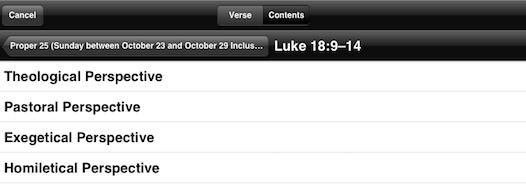
And then each of the passages splits into the four “perspective” sections.

Four perspectives on Luke 18:9-14

Since being able to access Feasting on the Word, it’s actually jumped toward the beginning of my pile (or bytes) of resources that I consult when preaching. I try to pray through my preaching ideas from the text and in conversation with others before consulting commentaries, but the “Homiletical Perspective” (and the other sections, for that matter) do a good job of helping the preacher think about how to preach a text.

The Theological Perspective and Exegetical Perspective might be the best starting points in this commentary. Perhaps by design and due to the constraints of this resource, they are not as in-depth as you would find with a commentary on a given book of the Bible. But those two sections do show a general awareness of the major interpretive issues a preacher needs to be aware of.

The Pastoral Perspective differs from the Homiletical Perspective in that the former helps the preacher be aware of pitfalls and opportunities in preaching a text. For example, Stacey Simpson Duke offers the following pastoral suggestion on Isaiah 11:1-10 (which is the OT text for the 2nd Sunday of Advent in a couple of weeks):

Our fear for children’s safety and future is especially acute. Some in our congregations may have had the tragic experience of a child’s death; they may be particularly fragile when it comes to Isaiah’s images of vulnerable children living and playing in safety. That grief may not be confined to those who have suffered the loss of near ones. We are intimately acquainted with suffering children through heartbreaking images broadcast via the electronic media. This produces its own brand of grief. Isaiah’s word is for all, but the pastor must be sensitive to the grief in the room. Isaiah promises future security; how might this be a word of hope for those from whom security has already been stolen? Answers are not easy, but the pastor who wants to care for congregants in grief will want to wrestle with the question.

This has been the section of the commentary that I most consult.

I appreciate the overall depth and thoughtfulness of the series. This portion from the series introduction is apropos:

We also recognize that this new series appears in a post-9/11, post-Katrina world. For this reason, we provide no shortcuts for those committed to the proclamation of God’s Word. Among preachers, there are books known as “Monday books” because they need to be read thoughtfully at least a week ahead of time. There are also “Saturday books,” so called because they supply sermon ideas on short notice. The books in this series are not Saturday books. Our aim is to help preachers go deeper, not faster, in a world that is in need of saving words.

So far, I not only can recommend Feasting on the Word, but have begun drawing on it as a regular part of my preaching preparation each week. I’ll write more about the series in a future post.

Thanks to Logos Bible Software for the review copy of Feasting on the Word (12 vols.). Find it here. You can find my other Logos reviews here.

A Quick Tip for Understanding Word Frequency Stats in the Dictionary of Classical Hebrew

The Concise Version
The Concise Version

Recently I’ve been paying more attention to the Dictionary of Classical Hebrew and its Concise counterpart (see here).

It took me a little while to figure out how to read the frequency stats in DCH/CDCH. So I’m posting this little tidbit here to save some folks a bit of time.

The introduction to the concise version of the lexicon reads:

2. Statistics. Next comes a notation of the number of occurrences of the word in each of the four corpora of ancient Hebrew: the Bible, Ben Sira, the Dead Sea Scrolls, and the Inscriptions. Thus the notation 334.5.13.32 means that the word occurs 334 times in the Bible, 5 times in Ben Sira, 13 times in the Dead Sea Scrolls and 32 times in the Hebrew Inscriptions. If there is only one number in the statistics, the word occurs only in the Hebrew Bible, and if the notation is, for example, 0.0.7, it means that it occurs only in the Dead Sea Scrolls, and that 7 times. In the case of verbs, occurrence statistics are also given for each of the voices (or, binyanim).

The entry for נתן has a frequency count of “2015.62.228.26.” That’s straightforward enough. But then with the entry for תרומה the frequency given is “76.2.18.” This means it occurs 76 times in the Bible, 2 in Ben Sira, 18 times in the DSS, and 0 times in the Inscriptions. Another entry that has “11.4″ means 11 times in the Bible, 4 times in Ben Sira, 0 in DSS and 0 in the Inscriptions.

What took me a little while to figure out is that some entries have counts like “376.0.1,” which means 376 occurrences in the Bible, 0 in Ben Sira, 1 in DSS, and 0 in the Inscriptions.

The 0s are not noted, then, if there is not still a number to come after it that is 1 or more. In other words, you’d have “376.0.1,” but never “376.1.0.0″ or even “376.1.0.” That would be abbreviated instead to “376.1.”

It would have been easier if all the 0s were inserted in every case, so that you were always looking at 4 actual numbers (thinking of 0 as a “number” for the moment), but I am guessing that this is because the longer DCH (at 8 volumes in print) likely couldn’t afford to be filled with 0s, where they could otherwise be deleted.

In summary, the four corpora in this lexicon are:

  1. Hebrew Bible
  2. Ben Sira
  3. Dead Sea Scrolls
  4. Hebrew Inscriptions

Committing that sequence to memory (and better understanding when a 0 is used and not used) makes use of the lexicon even easier. I appreciate DCH/CDCH’s inclusion of frequency statistics, as I use it to build my Hebrew vocabulary.

I use the Concise DCH for regular Hebrew reading in Accordance, but have just recently been really getting to know it as a lexicon. The print version of The Concise DCH is here; in Accordance it is here. The full 8-volume set from Sheffield Phoenix Press is here, found also here at Accordance.

A New Standard Lexicon for Hebrew?

HALOT has been the scholarly standard in Hebrew lexicons, but might that change?

The mammoth 8-volume Dictionary of Classical Hebrew (DCH) is another major lexical source for readers of biblical Hebrew to consult. What is unique about the DCH is that lexicons like HALOT and Brown-Driver-Briggs (BDB) cover solely the Hebrew found in the Hebrew Bible. DCH, by contrast, covers a wider corpus–“from the earliest times to 200 CE,” it says. According to its product page:

It is the first dictionary of the classical Hebrew language to cover not only the biblical texts but also Ben Sira, the Dead Sea Scrolls and the Hebrew inscriptions. It is the first dictionary to analyse the exact sense of every occurrence of every word, to follow every Hebrew word or phrase with an English equivalent, to print a frequency table of occurrences of each word, and to provide an English-Hebrew index.

Not least among its features is its addition of more than 3500 new words to the stock of the Hebrew lexicon, together with an extraordinarily rich bibliography surveying special lexicographical studies over the last century.

The Concise Version
The Concise Version

The 8-volume set in print is high-priced, as one would expect. It is much more affordable (as “affordable” goes, in these contexts) in Accordance, which is currently the only Bible software to carry it. The concise version seems to be financially within the reach of many students and pastors.

What is remarkable about the concise version of the dictionary is: “All the words in the full Dictionary of Classical Hebrew are to be found in the CDCH.” Of course, there are less instances of a given word’s occurrence listed, but that every word of the 8-volume set is treated in its 500-some-page younger sister is impressive.

The publisher notes:

The CDCH thus contains not only the c. 8400 Hebrew words found in the standard dictionaries, but also a further 3340+ words (540 from the Dead Sea Scrolls, 680 from other ancient Hebrew literature, and 2120+ proposed words for the Hebrew Bible not previously recognized by dictionaries).

By way of comparison, here is an entry for the same (rarely occurring) word in the concise and full dictionaries, respectively:

Full DCH
Full DCH
Concise DCH
Concise DCH

I use the Concise DCH for regular Hebrew reading in Accordance, but have just recently been really getting to know it as a lexicon. (UPDATE: see another post here on word frequency statistics in the lexicon.) The print version of The Concise DCH is here; in Accordance it is here. The full 8-volume set from Sheffield Phoenix Press is here, found also here at Accordance.

“Tax Collectors” in The Anchor Yale Bible Dictionary

AYBD in Logos
The Anchor Yale Bible Dictionary

Recently I’ve been spending time with The Anchor Yale Bible Dictionary in Logos Bible Software. In the coming weeks I’ll review it here, summarizing some of the articles, commenting on their content, and evaluating the dictionary’s presentation in Logos. (You can find my other Logos reviews here.)

The dictionary is massive, consisting of six volumes and somewhere in the ballpark of 7,000 total pages. Here are a few more features, taking from the dictionary’s publisher’s page:

– Includes six volumes of approximately 1,200 pages each
– More than 6,000 entries
– More than 7,000,000 words
– Nearly 1,000 contributors
– Multicultural and interdisciplinary in scope
– An unprecedented interfaith exploration of the Bible
– Illustrated throughout with easy-to-find references
– Extensively cross-referenced for comprehensive coverage of topics
– Easy-to-read article and chapter headings for speedy location of material
– Full bibliographical references following all major entries

In Logos on a computer there is the added bonus of being able to open more than one entry at a time:

Two articles open at a time
Two articles open at a time (click to enlarge)

As with the rest of Logos’s resources, all of the content in blue above is hyperlinked. So with the verse references you can hover over them for a popup of the verse text, or click on a hyperlink to open its contents in a new window. In the right half of the screen above, clicking on a section in the article takes you directly there.

I’m preaching this week on the Pharisee and the Tax Collector, so wanted to read a bit more about tax collectors. I type the entry name into the search bar to get there. Or I could navigate there via the left contents sidebar.

Tax Collector in AYBD
Looking something up

The “Tax Collector” article by John R. Donahue begins this way, with elaboration on each of the three mentioned “problems”:

Among the NT writings, only the Synoptic Gospels recount Jesus’ association with tax collectors (telōnai, KJV, “publicans”). Three problems attend this picture: (1) the identity and status of the telōnai, (2) the moral evaluation of them, and (3) the significance of Jesus as “a friend of tax collectors and sinners” (Matt 11:19; Luke 7:34).

In “Identity and Status” Donahue helpfully begins, “Etymologically telōnēs is a combination of telos in the sense of something paid for the purpose of the state, a toll, tax or duty; and ōneisthai (noun, ōnē), to buy or purchase.” I highlighted this sentence in Logos on my iPad and then moved to a computer, where the highlight had almost instantaneously synced to display there, too. Had I made a note at that sentence, it would sync, as well.

Donahue summarizes the Greco-Roman history of the term and office of the telōnēs, then moves into the details of how “Palestine was forced to pay tribute to Rome” after Pompey’s siege in 63 B.C.E. He differentiates between the different kinds of taxes (poll/census taxes, land taxes, etc.), as well as the different senses in which “tax collector” (telōnai) could be used. He concludes that the telōnai with whom Jesus interacts appear to be “toll collectors,” or, “minor functionaries fulfilling the orders of higher officials.”

In “Moral Evaluation” of the tax collectors, Donahue notes that “negative views” of this group of people occur outside the New Testament, as well (e.g., in rabbinic and secular literature). The author writes, “In Roman and Hellenistic literature they are lumped together with beggars, thieves, and robbers,” citing sources and giving examples. Knowing this helps me to better appreciate just how universally despised tax collectors were. This adds more punch to the parable in Luke. The New Testament itself (including Luke 18), as Donahue notes, mentions them in the same breath as “sinners” and “immoral people.”

“Jesus and the Tax Collectors” is the third and final section of the article. Multiple hyperlinked NT references in the article take the reader to places in the Synoptic Gospels where Jesus sits with and shows love to tax collectors. Citing Norman Perrin, Donahue notes:

Jesus’ association with them is viewed as an “acted parable” of his message of God’s mercy to sinners and “an anticipatory sitting at table in the kingdom of God” (Perrin 1967: 107).

A 15-source Biblography concludes the article.

Personally I’m not a big fan of the transliteration throughout the AYBD; I’d rather see τέλος than telos, for example. But that is the editorial decision of this dictionary. It’s not insurmountable, but does require a little extra work on the part of anyone who knows other languages but may not be used to seeing their transliterations.

Other than that quibble, Donahue’s article is indicative of what I’ve seen so far in the Anchor Dictionary: careful and top-notch scholarship that does not therefore suffer from dryness or inaccessibility. There is strength, too, in Donahue’s succinctness.

Evangelical scholars, pastors, and readers will want to be aware of and use their judgment regarding the dictionary’s “critical” approach to biblical studies. Donahue’s citation of “Q” will not be warmly accepted by all. (I and others still want to hear about manuscript evidence for Q.) But this generally does not make the dictionary any less useful or of lower quality.

Though I have other Bible dictionaries I use, when I’m studying, teaching, or preaching on a given topic, I’ll likely reach for (or, rather, click on) the Anchor Dictionary first.

Thanks to Logos Bible Software for the review copy of the Anchor Bible Dictionary. Find it here.