Accordance Bible Software for Windows is officially released. I’ve reviewed Accordance for Mac at length here. It’s an excellent program, the Bible software I use the most.
Accordance writes:
For over ten years, Accordance has been available to PC users with the Basilisk II emulator. While the emulator version included most of the same features as Accordance for Mac, it was an imperfect solution. We have long desired to give Windows users the native version of Accordance they truly deserve, and now that day has finally come. We are pleased and excited to announce the release of Accordance for Windows.
There’s a free trial here. See all the details here.
I got an ad in the mail the other day for a new commentary series that claimed to avoid all the weaknesses of previous commentary series while building on their strengths. (!)
With how many good “old” commentaries there are, I think commentary users should critically examine new series, and certainly not take claims like the above too seriously. (Every commentary set has weaknesses.)
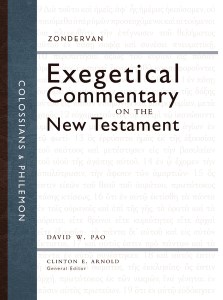
That said–Zondervan’s new Exegetical Commentary on the New Testament series is a real winner. It adds important elements to the mix that are not present in previously published commentaries. As a preacher with a scholarly interest in Scripture, I find this series to cover many bases well. It would be good for a student, professor, preacher, or even someone who didn’t know Greek and wanted to go more deeply into a given book.
I’ve (favorably) reviewed James and Luke in the same ZECNT series. Like the rest of the series, Colossians and Philemon includes the following for each passage of Scripture:
The full Greek text of Colossians and Philemon, verse by verse
The author’s English translation
First, passage by passage in the graphical layout
Second, verse by verse next to the Greek
The broader “Literary Context” of each passage (within the larger book)
An outline of the passage in its surrounding context
The Main Idea (this is a great focus point for preachers)
Structure
A more detailed “Exegetical Outline”
“Explanation of the Text,” which includes the Greek and English mentioned above, as well as the commentary proper
“Theology in Application” concludes each passage
The fact that the commentary has within it all the Greek and English of the two books under examination means you can take the single book (and no other) with you for thorough study of Colossians and Philemon.
Author David W. Pao makes frequent use of Greek throughout the commentary, but a non-Greek reader would also make profitable use of his comments.
Colossians has a 16-page introduction and 8-page bibliography; Philemon’s introduction is 13 pages, its bibliography 4. A “theology” section of 13 and 9 pages, respectively, concludes each book.
Regarding authorship of Colossians, Pao writes, “Among the various possibilities, to consider Paul as the author of Colossians is still the best hypothesis on which our reading can be constructed.” Like Murray J. Harris, Pao deduces this due to the various parallels (e.g., the opening greeting sections) between Colossians and Philemon, which is almost universally accepted as Pauline. He dates both letters to 60-62 AD, being written by Paul during his Roman imprisonment.
Pao is a good writer, too. This is from the introduction to Colossians, on its significance:
This letter that addresses a congregation challenged by a form of syncretism has significant contemporary application in a society in which the “virtues” of pluralism and tolerance are exalted as most important. Instead of simply pointing out the errors of the various practices and beliefs promoted by the false teachers, Paul begins and ends with an intense focus on Christ as the foundation of the believers’ existence. As a result, one finds powerful theoretical and practical outworkings of a robust Christology. In this letter, the readers encounter a detailed portrayal of the unique identity and final authority of Christ, and this portrayal enriches the high Christology found elsewhere in Paul’s letters.
This slightly longer excerpt on Col. 3:3 shows how adeptly Pao blends lexical study with historical background in a way that incorporates today’s Christian settings… all from an appreciated doxological posture:
That this life “is hidden with Christ” is significant in a number of ways. First, the verb “to hide” (κρύπτω) can signify close association (cf. Luke 13:21), and this meaning is certainly present in light of Paul’s identification of Christ as “your life” (ἡ ζωὴ ὑμῶν). To be “hidden with Christ” reaffirms the believers’ participation in Christ’s death and resurrection as they anticipate the final consummation of God’s salvific act at the end of time.
Second, to be “hidden with Christ” necessarily implies the security that one finds in Christ. The following verse explains the purpose of this hiddenness as it guarantees the final participation of believers in the revelation of God’s glory. This security from the evil powers is also implied in the reference to their dying with Christ, an act that points to the freedom of the threats posed by the opposing spiritual powers (2:20).
Third, in light of 2:3, where Paul asserts that in Christ “all the treasures of wisdom and knowledge are hidden,” Paul is here affirming that the lives of believers are also contained in Christ. This may serve a polemical purpose as Paul argues against those who continuously seek to get access to the heavenly mysteries. Paul’s response is that believers are already hidden with all the treasures in Christ. The sufficiency of Christ cannot be challenged, and to seek for these treasures elsewhere is to betray the true gospel.
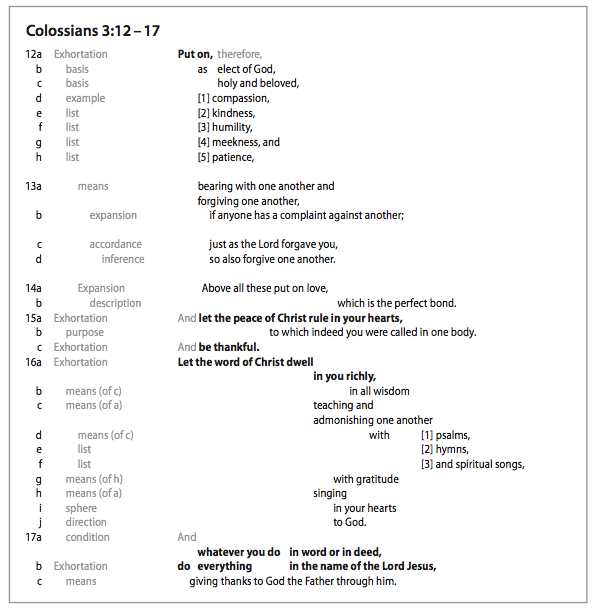
Out of all of the above features, the graphical layout is my favorite in this series and in this volume. It’s what makes the ZECNT something I’ll always reach for when preaching on a given passage–and early on in the process, too. Here’s what it looks like:
Col. 3:12-17
The main clauses are in bold, and subordinate clauses are indented under them. It’s easy to see, at a glance, how all the parts of a sentence and paragraph relate. The words in gray at left describe the function of each line (exhortation, expansion, etc.).
Pao is a refreshingly enjoyable writer who knows this terrain very well. Preaching or teaching from Colossians/Philemon (or even studying in depth on one’s own or with others) would be greatly enhanced by use of his commentary.
I am grateful to Zondervan for the gratis review copy of this commentary, which was offered to me in exchange for an unbiased review. You can find the book on Amazon here. The Zondervan product page is here. See a pdf sample of the book here.
Below is the text from R.R. Ottley’s Book of Isaiah According to the Septuagint. Ottley is also here in Logos (reviewed here) and here as a free, downloadable pdf in the public domain. The full reading plan for our group is here (pdf).
See here for more resources and links to texts for Greek Isaiah.
Yesterday we started fall Sunday School. For the first six weeks I am teaching/leading the adult class. We’ll spend those six weeks with Foster and Smith’s Devotional Classics book. Here are the writers for each session:
Week 1: St. Augustine
Week 2: François Fénelon
Week 3: Evelyn Underhill
Week 4: Apocryphal Literature
(This is not in Devotional Classics. But we’ll look at Ecclesiasticus (Sirach), Wisdom of Solomon, and the Prayer of Manasseh.)
Week 5: Catherine of Siena
Week 6: Kathleen Norris
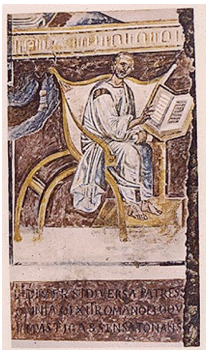
The first class covered Augustine and his Confessions. They key quote (which also serves as an (if not the) overriding theme of the book) is the best-known one, which comes from Book I, chapter 1, first paragraph:
Can any praise be worthy of the Lord’s majesty? How magnificent his strength! How inscrutable his wisdom! Man is one of your creatures, Lord, and his instinct is to praise you. He bears about him the mark of death, the sign of his own sin, to remind him that you thwart the proud. But still, since he is a part of your creation, he wishes to praise you. The thought of you stirs him so deeply that he cannot be content unless he praises you, because you made us for yourself and our hearts find no peace until they rest in you.
That’s Pine-Coffin’s translation (with the now outdated generic “he” and “man”). Italics represent Scripture quotations.
Each week we’ll do a short bio of the writer, some reading, some discussion, and some prayer.
The massive LSJ Greek-English Lexicon for Logos (9th ed. with revised supplement) is an invaluable resource for Greek lexicography, covering the classical and New Testament eras. I wrote more about the lexicon in Logos here. How does it look and work on an iPad?
As much as I still look back nostalgically on my early days of Greek and Hebrew reading–where I used only a paper lexicon to look up words I didn’t know–I don’t miss how time-consuming it was. I’m able to do more reading now, not just because of (hopefully!) increased language proficiency, but also because of computerized versions of the same lexicons.
The Liddell and Scott Greek–English Lexicon (LSJ) covers Greek of the classical variety (Homer, Plato, Aristotle, etc.) and of the Septuagint, New Testament, and early church variety. I’ve had the pleasure recently of accessing LSJ via Logos Bible Software.
Something I immediately appreciated about the Baker Exegetical Commentary set is its clear statement of purpose in the Series Preface, found in each of the 15 volumes published so far:
The chief concern of the Baker Exegetical Commentary on the New Testament (BECNT) is to provide, within the framework of informed evangelical thought, commentaries that blend scholarly depth with readability, exegetical detail with sensitivity to the whole, and attention to critical problems with theological awareness. We hope thereby to attract the interest of a fairly wide audience, from the scholar who is looking for a thoughtful and independent examination of the text to the motivated lay Christian who craves a solid but accessible exposition.