July 2012 Biblical Studies Carnival

Head over to Reading Acts for the July “Biblical Studies Carnival.” It’s a compilation of many, many posts on all things Biblical studies on the blogosphere in July. There is some really good stuff there, and Phil has done a great job gathering some informative links. I’m thankful to have received mention in the carnival (of my July posts here, here, and here).

“How do I get more out of my Bible reading?”

“How do I get more out of my Bible reading? What was going on during the gap between the Old and New Testaments? How do all the books of the Bible fit together as a whole?”

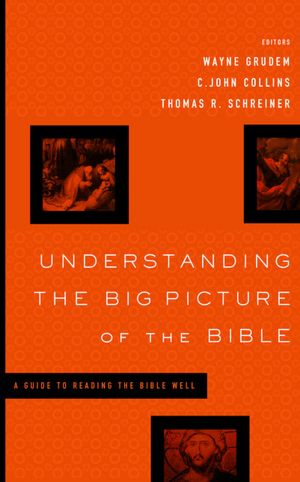
It is the aim of Understanding the Picture of the Bible: A Guide to Reading the Bible Well to answer those questions and put “clear, readable Bible study aids at your fingertips.” (All quotes from back cover and also found here.) Here I review the book for another installment of Magnificent Monograph Mondays.

The book begins with “An Overview of the Bible’s Storyline,” then continues with three parts, one for the Old Testament (subdivided into OT Theology, Pentateuch, Historical Books, Poetry/Wisdom Literature, and Prophets), one for New Testament background (intertestamental history and literature), and one for the New Testament (NT Theology, Gospels/Acts, Epistles, and Revelation). Each author gives a thorough yet concise overview of the section of the Bible he (all authors are male) treats. Each also discusses themes within a given section of the Bible and how they connect with the larger Biblical narrative.

What first stands out in Understanding the Big Picture of the Bible is that almost every author has a knack for simply explaining important concepts and terms. The summary overviews of sections of the Bible provide the reader with a firm foundation for better understanding the purpose and scope of that section. For example, Paul House’s excellent chapter on the prophetic books has an excursus on “pronouns in the prophets.” He begins: “As prepositions are to the letters of Paul, so pronouns are to the oracles of the prophets: crucial for meaning, but often puzzling” (72). In the five following pages he does much for the reader to make prophetic pronouns (and how they often shift person and gender) easier to understand. Other highlights are Gordon Wenham’s chapter on the Pentateuch and Dennis Johnson’s essay on Revelation.

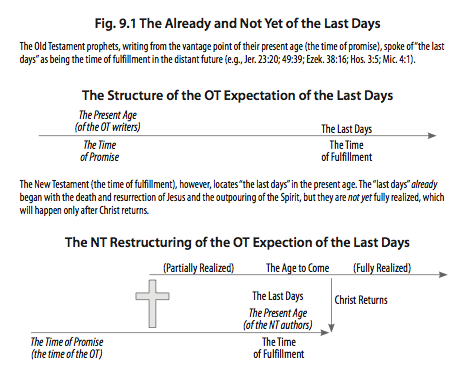
Timelines and charts throughout are a great feature. In addition to timelines in the back of the book covering all of Biblical history (including intertestamental times), there are charts throughout the book that aid the reader. Thomas Schreiner lists all the Epistles, their authors, dates, place of writing, and recipients. Johnson uses nine separate figures to visually (and clearly) display the differences in how Christians interpret Revelation. And House has a table that lines up the prophets with the kings during whose time they prophesied. (A couple of similarly simple and clear maps could be a great addition to future editions of this book.) Here’s an example (taken from a pdf sample of the book):

And then there’s the middle section, part two of Understanding the Big Picture of the Bible. That section alone makes this book worth more than its purchase price. It contains the following:

  • “The Time between the Testaments,” by J. Julius Scott Jr.
  • “The Roman Empire and the Greco-Roman World at the Time of the New Testament,” by David Chapman
  • “Jewish Groups at the Time of the New Testament,” by John Delhousaye

Take just this short quotation from Chapman as an example:

Amid this history, Jesus Christ launched his ministry in a Galilee governed by a Roman client king, a Judea under Roman procurators, and a Judaism tinged with Hellenism. After his crucifixion by the Romans and his resurrection, his gospel was carried by the apostles directly into the heart of Greek culture and Roman power. (94)

Having this background in mind when approaching the New Testament will greatly advance the efforts of any Bible reader. Most Bible overview guides that I’ve seen go right from Old Testament to New Testament. But what about all that time in between? I’ve written more here about why that time period is essential to NT understanding. This book really gets that, and covers that period well. Someone with no knowledge of NT background would find this section easy to follow, and even a budding scholar would appreciate the clarity of the historical overview.

While it’s hard to discern what is the work of the editors (this book has three: Wayne Grudem, C. John Collins, and Schreiner) and what is the work of the writers, this book could have benefitted from a little more careful editorial oversight. There are a few little typos scattered throughout the book (tehillah instead of tefillah for Hebrew prayer, e.g.). I found the use of the sex-specific “man” to refer to all of humanity–even when not quoting the ESV–distracting (although this may not bother other readers).

But there is a bigger editorial oversight. While the book excellently helps the reader to better understand the “big picture” of the Bible, it never directly answers the question it seeks to answer of “How do I get more out of my Bible reading?” The authors present all the necessary information to better understand the background (context) and foreground (content) of the Bible, yes. But understanding context and content is only necessary and not sufficient for “reading the Bible well.” I wish the editors would have made sure the book gave more attention to how one can read the Bible, for example, devotionally… or for transformation rather than just the receiving of information. In other words, I wanted this book, based on its title, to answer: How can I grow closer to God as I read the Bible? How can I allow the Bible to convict me of my sin? What about the importance of reading Scripture in community and corporate worship? David Reimer’s essay gets closest to this when he says, “[T]he art and craft of the Bible’s poems offers an invitation to read slowly, to have one’s vision broadened, once’s perception deepened… to see literary reflection in the service of worship and godly living” (54). I wanted to hear more about this. The key question for me is: Is overview knowledge of the Bible’s context and content sufficient to read the Bible well? Necessary, yes. Sufficient, no.

However, even if the book doesn’t execute its aim listed in the subtitle, it is still a valuable work to have in hand while reading through the Bible. Its unique contribution to works of this kind is in the middle section. I’d imagine this book sitting well on someone’s shelf next to his/her Bible and notebook. (It has on mine these last few weeks!) It would benefit a serious Bible reader to read, say, Darrell Bock’s essay on the Gospels and Acts before reading those Biblical books through.

Thank you to Crossway who provided me with a review copy of this book in exchange for an unbiased review. You can find Understanding the Bible Picture of the Bible at Amazon here.

Free Book! Ephesians commentary by Arnold (Zondervan)

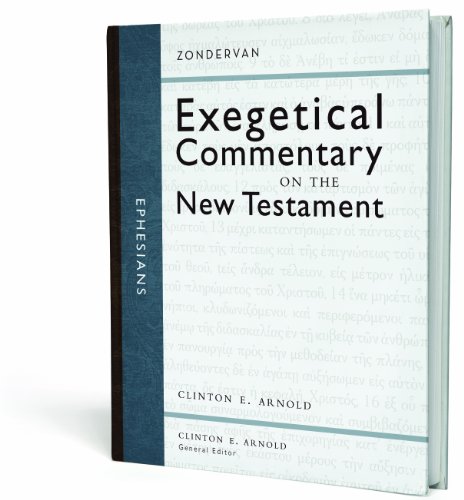
I am giving away a book at Words on the Word this weekend. It’s a commentary on Ephesians by Clinton E. Arnold, from Zondervan’s Exegetical Commentary on the New Testament series.

Last weekend I reviewed Luke from that same series. You can read that review to find out more about the structure and layout of each book in the series. Anyone who is preaching, teaching, or just studying their own way through Ephesians will find this book illuminating. Those who know even a little Greek will benefit most from this book, but Arnold translates everything, so those who know no Greek will benefit, too.

I will choose a winner at random. To enter the drawing, comment on this blog post with your answer to the question, “If you had a chance to sit down for a cup of coffee or tea with the apostle Paul today, what is the first thing you would ask him?” (I know what I would ask!)

Then if you link to this post on your Facebook, Twitter, blog, etc., come back here to tell me in the comments section that you did, and you’ll receive a second entry. I will announce the winner on the blog first thing Monday morning.

If you want to skip the giveaway contest and just buy the book for yourself, you can find it here.

Why do you blog?

Image source: http://www.winsonyeung.com/internet-marketing/blog-management-made-easy/

In the last month I’ve had at least five close friends ask me why I’m blogging so much (or at all). Two of those friends have since started their own blogs (here and here, both highly recommended!)

Shortly after the blog’s formal launch, we had our third child (Junia!). I work full-time as worship director at a fantastic Christian college. I am taking two seminary classes. All at the same time. So how and why am I blogging?

The how part is easy: although it is work to keep a blog going, I enjoy it. You know those 4 hours a day that North Americans supposedly spend watching TV?  I spend half of them blogging (and the other half with family). It’s what I do in my free time.

But why? And why now?

First, it’s a creative outlet for me. I enjoy it and it feels good to express myself and share that with others. I am receiving so much input (learning through seminary, through my job, through parenting) that I thought it was time to more deliberately contribute some output to the world.

Second, with the blog I am able to request and receive free review copies of books from various publishers. This is a win-win for everyone: free publicity for the publisher/author, and a free book for me. You get to read the review! This is also a good way for me to stay current on what’s being published in the world of Biblical studies. Hence, Magnificent Monograph Mondays.

Third, and perhaps most important, in some sense this blog is my way of holding on to my identity–particularly the part of me that is so interested in Biblical studies. With all else that is going on, especially the birth of our third child, I see potential for my identity to be overrun by other things. (If you have children, “overrun” will make perfect sense to you.) I don’t want that to happen.

Of course I will give sacrificially to my family, and three children under the age of five don’t really give me the choice–e.g., “DAD!!!  MY BROTHER IS BUGGING ME!!!!!” Or just, “WWWWAAAAAAAHHHH!!!!” (That’s Junia.) But even as the needs of the children can be all-consuming at times, I find myself saying subconsciously (and now consciously) as I blog, I… will… not… be… consumed! I need to have some “me” left over at the end.  The blog is that, in a lot of ways, for me.

(Can any other parents relate to this?)

Finally, blogging is a good way for me to test the waters with writing. I know writing is not exactly the most lucrative business in the world, but they do say the best way to get better is just to practice. I want to see how the whole writing thing might work out for me (beyond what I’ve already had published), and the blog is a small step towards that.

If you’re thinking about blogging, I recommend it! Just make sure you’ve changed all the diapers that need to be changed before you start writing.

Should I get a PhD?

Should I get a PhD? If you’ve asked yourself this question, especially about a PhD in Biblical Studies, you should read Nijay K. Gupta’s book. In Prepare, Succeed, Advance: A Guidebook for Getting a PhD in Biblical Studies and Beyond (Wipf and Stock), Gupta walks through the stages of applying for a PhD (prepare), working on a PhD (succeed), and using one’s PhD to find work (advance).

In Prepare, Succeed, Advance, Gupta seeks to “provide a series of responses to a host of questions that one may encounter when travelling down the path towards a PhD in biblical studies and beyond.” The book is right on the money in this sense. While it reads through nicely, it is also the sort of work that one will want to refer to time and again–especially someone who is trying to advance through the stages of the PhD process.

In the Prepare section, Gupta guides the reader through how to select a program, including what factors to consider, such as cost, location, school prestige, and so on. Perhaps the most useful section of the book is the second chapter, in which he counsels PhD applicants in how to prepare for a PhD–what languages they’ll need to know, what reference works with which to familiarize themselves, and so on. The bibliography he provides (with comments) is a time-saver to many. He concludes the section with nuts-and-bolts advice for how to fill out a PhD program application.

The second part of the book, Succeed, is all about how to do well in a PhD program, once accepted. Gupta goes in depth with regard to how to work with one’s supervisor, how to write and plan for the dissertation, and how to prepare for the oral dissertation defense. He writes:

The point of a dissertation is not that your argumentation and evidence will convince everyone, but rather that you have made a sufficiently plausible argument using methods and evidence that are appropriate to your field and generally accepted.

(He coaches to reader on how to do this, too.)

Finally, for the one who has earned her or his PhD, the final section of Advance covers everything from how to interview for a job, how and where to get teaching experience, conference involvement and article publishing (with helpful lists of journal series to shoot for), and dissertation publishing.

There is much to appreciate about this book. As a book reviewer, I particularly appreciated his section on how (and where) to write book reviews. He covered the basics well. (Key point: measure a book against its own standard; that is, does it advance its thesis successfully?)

If I have any criticism of the book (and this is hard to come by), it’s that Gupta’s section on writing the actual body of the dissertation could have included more. He gives advice like, “Individual chapters should be relatively freestanding and stand as an independent contribution to the overall argument,” but doesn’t spend much time on how to go about writing each individual chapter in the dissertation’s body. Perhaps Gupta assumes that other books on the market adequately cover how to write a dissertation, or that it varies so much from topic to topic that no general advice can be given. But something more about how to organize the argument of the dissertation and make sure its logical flow is clear and cogent would have been a good addition to the book. But this is a minor quibble. There is not much that Gupta does not cover thoroughly and winsomely.

Gupta blogs at Crux Sola. Portions of his book (PhD advice) can be found on his blog here. He writes about his book here. More (PhD Survival Guide) here. Even with all that is available on his blog, this guide is indispensable to anyone thinking about a PhD. Should that day ever come for me, I plan to have this within reach on my bookshelf.

I am grateful to Wipf and Stock for the free review copy, provided in exchange for an unbiased review.

How to memorize stuff better

Have you ever struggled to memorize something? Or been looking to commit text to memory, word-for-word? It can be a tedious process for some.

From the site Productivity501:

Memorizing does not have to be as hard as most people make it. The problem is that most people only know how to memorize by reading the same thing over and over again. You have to learn to memorize. In this post we are going to look at how the brain remembers and then show how to use that knowledge to come up with a method for memorizing verbatim text.  Any tip or trick that will improve your memory even slightly is well worth the effort.

In this article we are going to focus on a technique that will let you easily:

  1. Memorize a speech
  2. Memorize the Bible
  3. Memorize lines
  4. Memorize Scripture

Read the rest here.

Why you need the Septuagint

I recently had somebody ask me, in so many words, why the Septuagint?  Why bother with the Greek Septuagint when we have the Old Testament in Hebrew, in which it was first written? English translations of the Bible in most churches use the Hebrew text as a base, anyway.

Before giving my top 10 reasons why, here are a couple ways to access the Septuagint (often abbreviated LXX after the tradition of the 70(+2) who were said to have translated it). This site has the whole Septuagint in Greek with an English translation. And here‘s a good, up-to-date English translation of the whole thing. (For hard copies, the standard Greek text is the Rahlfs Septuagint, and a recent English translation is the NETS.)

Here are 10 good reasons to pay attention to the Septuagint:

10. It helps us read Scripture in new, fresh ways.

9. You get to use fun words like Septuagint, intertextuality, and urtext.

8. It’s the Bible the New Testament writers used and quoted. (See here for more about this.)

7. For students of Greek, the LXX is a good way to challenge oneself in Greek beyond the New Testament. There is a fuller and deeper vocabulary in the Septuagint that helps Greek students grow in their knowledge of the language.

6. The Septuagint was translated from a set of Hebrew texts that are centuries earlier than the Hebrew text underlying most English Old Testaments. This helps us get closer to the “original” text.

5. There are books that, while additional to the Protestant canon, still shed light on life. (I’m looking at you, Wisdom of Solomon!)

4. The Odes. This is a collection of texts appended to the end of the Psalms. It compiles some beautiful prayers found in the Old Testament (and apocryphal books). A few of these are in the Book of Common Prayer’s Morning Prayer canticles.

3. It connects us to the broad sweep of history in the Church. This was not only the Bible of the New Testament writers; it was the Bible of the Greek-speaking early church.

2. Books like 1 Maccabees, especially, fill out the intertestamental gap between Malachi and Matthew. I’ve been working my way through 1 Maccabees lately, and it’s really helping me better understand Jewish expectation of a conquering Messiah who would expel oppressive Roman rule.

1. Jesus used it. I’m intrigued by this, and want to explore it more. [UPDATE: This is a complex issue, especially since Jesus spoke Aramaic and knew and used the Hebrew Bible. I am reading this now.] But it does seem to me that his use of the Septuagint constitutes at least an implicit endorsement of it. If it was good enough for Jesus….
        [UPDATE 2: Perhaps it’s more accurate to say that the Gospel writers quote Jesus sometimes using a Septuagint text that differs from the Hebrew/proto-Masoretic Text. Many say this means only that the Gospel writers–not Jesus himself–used the Septuagint. Did Jesus himself not “use” the Septuagint, then? I will research this more and blog about it at a future date.]

More on Junia

Thanks to a blog I’ve just discovered, I keep learning more about Junia.

Here‘s a post about Junia in some ancient manuscripts of Romans. And here is a post about another Junia in ancient Corinth.

Actually, the blog (BLT) has a ton of stuff about Junia, including a multi-post series called “The Junia Evidence.” Check out more here.

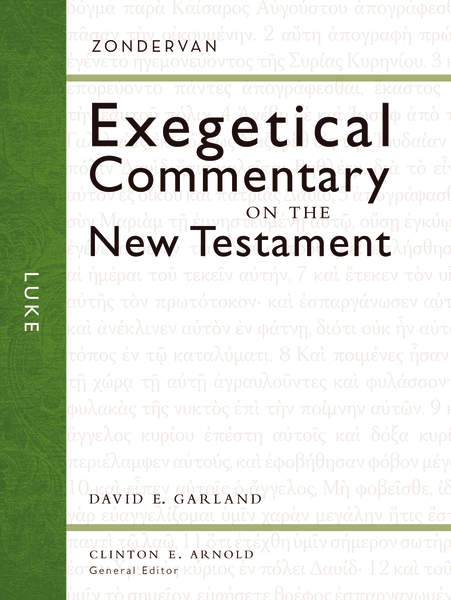
Luke (Zondervan ECNT), reviewed

The last few weeks I’ve been spending time with David Garland’s Luke volume in Zondervan’s Exegetical Commentary on the New Testament (ZECNT) series.

Garland’s commentary is more than 1,000 pages, but this should not be a surprise, since Luke is the longest Gospel. Like the rest of the ZECNT series, it is “designed for the pastor and Bible teacher.” Garland assumes a basic knowledge of Greek, but Greek is not required to understand his commentary. For each passage the commentary gives the broader literary context, the main idea (great for preachers!), an original translation of the Greek and its graphical layout, the structure, an outline, explanation, and “theology in application” section.

The graphical layout of each passage is a unique contribution that Garland’s Luke makes to Luke studies. Even though a narrative book like Luke is easier to follow than some of Paul’s detailed arguments, seeing main clauses in bold with subordinate clauses indented under them (plus how they relate back to the main clause) gives the reader a quick, visual grasp of the entire passage at hand. Garland does this well, too. Pages 50 and 62-63 of the commentary in this sample pdf give you a taste.

Luke has the full Greek text of Luke, verse by verse, and full English translation by Garland (passage by passage in the graphical layout, then again verse by verse next to the Greek). A value for me in using reference works is not having to pull five more reference works off the shelf to use the first reference work! This is about as portable as exegesis of Luke gets. Garland’s English translation is a bit wooden at times–just about every καὶ in the opening narrative of 1:5-25 receives the translation “and,” which it shouldn’t always. ὁ δὲ ἀποκριθεὶς εἶπεν in 10:27 becomes “He answered and said,” where just “He said,” would be preferred.

Garland’s intro is short, but covers what it needs to. He attributes authorship to Luke and holds to Luke-Acts unity, as many scholars do. (“[Luke] is writing not simply about the life of Jesus but what Jesus inaugurated that continued in the deeds of his followers (Acts 1:1-8)” (27).) He understands Luke-Acts as fitting into the genre of “Hellenistic historiography.” He treats Luke’s potential sources, date of writing, readers, location, purpose, and structural outline. There is an additional “theology of Luke” section at the back of the commentary that complements the introduction. It doesn’t cover all the theological themes in Luke (healing/exorcism, for example, is absent), but it doesn’t claim to, either.

Where Garland really shines in this commentary is in his treatment of the Greek words and phrases that comprise the Luke text. He attends to the lexical meaning of given words, how they function in context, and their use in other parts of Scripture. This is helpful especially for parts of Luke where the Greek vocabulary is more obscure or difficult.

Teachers and preachers especially will appreciate the “Theology in Application” section that concludes each passage. To the pastor wondering how to preach on something like Luke’s prologue, Garland writes:

The purpose of the gospel is not to give information but certainty that will change lives. Erudition about Jesus is not the same as insight into Jesus. The history of Jesus is not to be divorced from the proclamation about Jesus, as if the two were somehow incompatible. (58)

This comes after a detailed exegesis of the first four verses. As someone with preaching experience, I can say this combination of thorough attention to the Greek text with contemporary application is pure gold.

Inevitably no commentary can say everything about every word in the text, but there are parts of Luke that I thought deserved more attention. For example, in Luke 8:31 the demons known as Legion beg Jesus not to cast them into the Abyss (Greek ἄβυσσος). Garland just offers, “The Abyss is the place of punishment for evil spirits” (358). Although he infers that this verse shows the “eschatological dimension” to exorcisms, nothing more is given about ἄβυσσος. For a word that appears just once in the Gospels yet multiple times in the Old Testament and Apocrypha, more background on this term would have been useful to the reader. This could, of course, merely reflect a space limitation in the commentary.

On the other hand, Garland’s commentary on the Good Samaritan parable (“merciful” as Garland has it) leaves out just about nothing. To provide needed historical context to the passage, Garland draws on what Josephus said about priests, what Sirach said about helping those in need, and includes an excursus on the “adversarial history” of Jews and Samaritans. Garland compellingly concludes from the parable:

The original Jewish audience must enter the ditch and accept a Samaritan as a savior, helper, and healer. They must experience being touched by this unclean enemy who treats a wounded man as a compatriot. (446)

Garland seeks to prove right the series claim that “all who strive to understand and teach the New Testament will find these books beneficial,” and he succeeds in this. Preachers or students of Luke will want to supplement Garland’s work with other works on Luke (Bock’s two volume set remains the standard), but the graphical layout of each passage and the theology in application sections alone are enough to warrant careful consideration of this volume.

(I am grateful to Zondervan for the free review copy of this commentary, which was offered to me in exchange for an unbiased review. You can find the book on Amazon here.)

UPDATE: Enter to win a free book giveaway of Ephesians from this same series.