A helpful language reference tool for students, pastors, and scholars. The BHS Reader’s Edition is for those who have a basic understanding of Biblical Hebrew and desire to read and study the Hebrew Bible. With this book alone (and a year’s study of Hebrew), students are able to read the Hebrew Bible in its entirety.
Zondervan already has such a Bible, which is the first Hebrew Bible from which I ever read (cue strings). But BHS Reader’s Edition has vocabulary helps for even more words, as well as verb parsings.
Here are the main features, in the words of the publisher:
Complete text of the Biblia Hebraica Stuttgartensia, checked against the Leningrad Codex
All words that occur fewer than 70 times are parsed and contextually defined in the apparatus
Glossary listing of all other words
Improved layout of poetic text
All weak verb forms are parsed
High quality paper does not bleed through
UPDATE: One of the authors (not Moses, though) notes that it includes full Hebrew paradigms, too. Looks like it will really be a one-stop shop for Hebrew Bible reading!
You can pre-order now through CBD or Amazon (affiliate link that helps support Words on the Word).
The question was a near-refrain in my first semester of Hebrew class at seminary. After months of memorizing verbal paradigm charts and individual vocabulary words, I wondered he same thing.
I don’t mind a memorization-based or paradigm-based model for second language acquisition. I did fairly well in first learning Hebrew from the Pratico and Van Pelt Basics of Biblical Hebrew (see here and here).
But as I noted in my Pratico/Van Pelt reviews:
Some people disagree that paradigm memorization outside the context of a text or conversation is ideal pedagogy for language learning. … Even dead or ancient languages should be taught as “living languages,” proponents say. So some Hebrew textbooks encourage instead a text-based inductive approach.
The goal of the Primer is to teach students to read and understand Biblical Hebrew as quickly as possible; therefore, the lessons emphasize recognition and translation – not memorization.
It succeeds well in this aim. Indeed, as soon as chapter 10 (out of 30), the student will be excited to begin her or his guided reading of Ruth:
Congratulations! You have learned enough Hebrew to begin reading the Bible—revised for your reading level. We have chosen Ruth because it is short, simple, and beautiful. In the beginning, the Hebrew text will be simplified, but as we progress, the text will approach the original. Before we finish the Book of Ruth, you will be reading the actual biblical text.
As soon as the Primer teaches the alphabet, it offers a host of a exercises for out-loud reading practice. The “Tall Tales” (folk tales) readings give students yet another chance to put into a reading context what they have learned. All the expected charts for nouns and verbs, vocabulary lists (with occurrence of 200x or more in the Hebrew Bible), and exercise sets are present throughout the book. But I especially appreciated its emphasis on reading early.
Updates to the Third Edition
What’s different in the Third Edition? Primarily, there is more grammatical detail offered.
This revised third edition introduces several new terms and clarifies grammatical points, but will look the same to long-time Primer readers. The key change we have made is the inclusion of new explanatory endnotes. Many readers have expressed a desire to deepen their knowledge of Biblical Hebrew, but have unanimously endorsed the clear, uncomplicated tone of the Primer. We have responded by adding these optional supplementary notes. Students may read the notes to enrich their understanding of Hebrew grammar or concentrate solely on the main text. Either way, the Primer provides a sound foundation for more advanced studies in the Hebrew Bible.
One gets the feeling that in the absence of those clarifying notes, some of the grammatical concepts are oversimplified. So the additional nuances expressed in the endnotes are imperative for laying a good foundation for later Hebrew learning. EKS Publishing uses its own name for some grammatical terms (“Word Pair” instead of “construct chain” and “regular infinitive” instead of “infinitive construct”).
I can see this being something a student would need to re-learn if she or her goes further in learning Hebrew grammar; I’m not sure the level of simplification here is always helpful or necessary. (And the lack of an index makes it difficult to trace discussion throughout the book of a given concept.) All the same, page 368 provides a “Guide to Grammatical Terms” with a table of “Our Name” and the “Traditional Name” for key concepts.
The Primer for Kids?
Though the book is for “adult beginners,” my six-year-old son, whose Hebrew-learning adventures I have chronicled here, took an interest in The First Hebrew Primer once he saw it on the shelf. Chapter 3 (“The Sheva, Odd Vowels, and the Dagesh”) was particularly helpful, as the sheva had been giving him trouble. The Primer explains how to pronounce the sheva depending on where in a word it is:
Sheva at the beginning of a word: “always pronounced with a short, slurred sound”
Sheva at the end of a word: “always a silent vowel, and it is not pronounced at all”
Sheva in the middle of a word: “When a sheva appears alone in the middle of a word, it usually falls at the end of a syllable and is not pronounced.” (An endnote at this point offers additional illuminating detail.)
My son did astutely ask, “How do I correct myself if I get something wrong?” So I’ve gone through the Primer with him, rather than letting him use the Primer much on his own (even though he can read just fine). There is a companion audio CD available, which has to be purchased separately; self-guided learners will need it to be able to take full advantage of the oral exercises in the Primer.
Concluding Evaluation
The Hebrew font in The First Hebrew Primer is clear and easy to read. The exercises strike a nice balance between appropriateness for each lesson and being challenging. For example, in chapter 7 (“The Perfect Tense”), there is this:
If you prefer an interactive, digital edition, Accordance Bible Software has a Primer package available for purchase here. The Accordance edition includes the primer, the answer key (otherwise a separate purchase), and more than an hour’s worth of accompanying audio. In other words, Accordance puts everything needed in one integrated and easy-to-use place.
Would I use The First Hebrew Primer as a textbook for a first-year Hebrew student? Definitely–despite the occasional lack of nuance in the grammatical explanations, its emphasis on oral practice, its engaging exercises, its inclusions of basic paradigms, and especially its introduction of reading early on make it a solid option for a first-year Hebrew text. As an added bonus, there are plenty of English to Hebrew exercises (and even an English-Hebrew Glossary), which will go a long way to help the student solidify Hebrew comprehension.
Thanks to EKS Publishing for the review copy of the Primer and answer key, offered for the purposes of this review, but with no expectation as to my review’s content. The publisher’s book page is here (answer key here). It’s also on Amazon (affiliate link) here (answer key here).
Without accepting a so-called “theology of prepositions,” Harris’s guide is readable and illuminating. I found his exegetical guide to Colossians and Philemon quite helpful. Here is a sample of Prepositions and Theology.
Last weekend I built a sandbox; this weekend I’m cleaning up the study. I have a few books I’m trying to unload. Contact me here if you’re interested.
Simplified Guide to BHS (Hebrew Bible) (Scott, 1990 Second Edition, includes Ruger’s English Key to Latin Words, bound together), hard to find in print. One page has writing, but is helpful to understanding text. Previous owner’s name inside front cover; sticker residue on back (slight). $20
Handkonkordanz zum Griechischen Neuen Testament (English and German) Super-handy small concordance to Greek New Testament… I just don’t have use for it recently. See reviews at Amazon link here. Good to Very Good condition (sticker on back, some regular wear, but clean inside and strong binding). $22
C.L. Seow’s Grammar for Biblical Hebrew (1987)
Pencil notations throughout (one page pen), otherwise great condition. Old sticker on back. $10
The increasingly hard-to-find NIV Triglot Old Testament
Yes, English, Greek and Hebrew. It’s a big and impressive-looking hardback. Really good condition. Name inside front cover. No markings that I’m aware of. No dust cover (but you were just going to take that off as soon as you got it anyway, right?). $22
Behold, the Triglot
Spurgeon’s 3-Volume Treasury of David
Commentary on the Psalms, hardcover (green dust jackets). Hardly used, in great shape. One volume has a small coffee splash on page edges. Not a set of books I’d normally want to part with, but I have it electronically now. $29
Dietrich Bonhoeffer Works, Volume 7 (Fiction from Tegel Prison)
Hardcover. Brand new, still in shrink wrap. $14
Dietrich Bonhoeffer Works, Volume 9 (The Young Bonhoeffer, 1918-1927)
Hardcover. Still in original shrink wrap. Just a tiny bit of bumping to spine edges, one corner ever-so-slightly dinged. $20
Dietrich Bonhoeffer Works, Volume 10 (Barcelona, Berlin, New York: 1928-1931)
Hardcover. Dust jacket, page edges, and corners show some wear/bumping, but not much. Insides unmarked, never used. $25
The Biblia Hebraica Quinta (BHQ) will supercede the current scholarly edition of the Hebrew Bible, the Biblia Hebraica Stuttgartensia (BHS).
I reviewed the BHS module in Accordance Bible Software here, and posted at length about the BHQ here, if you want a primer. Short version: Emanuel Tov says it is “much richer in data, more mature, judicious and cautious than its predecessors. It heralds a very important step forward in the BH series,” though he notes that its notations are “more complex” and “less user-friendly for the non-expert.”
Here is BHQ on Amazon; here it is at Hendrickson Publishers’ site.
Hendrickson sent out an update today with the BHQ publishing schedule as it currently stands. Most volumes are “in preparation,” but the schedule (available here) notes that Ezekiel (ed. by Johan Lust) is coming in 2016 and Numbers (ed. by Martin Rösel) is coming in 2017.
At less than 400 Hebrew words, Obadiah is shorter than many Words on the Word blog posts, including this one. But its literary and rhetorical sophistication is by no means lessened by its length. Obadiah is the prophetical incarnation of the axiom, “Brevity is the soul of wit.” Or, in Obadiah’s case, “Brevity is the soul of calling out Edom and declaring God’s restoration of Jacob.”
Earlier this year Zondervan published the first two volumes of a new Old Testament commentary series, Hearing the Message of Scripture (HMS). If you want a brief overview of the series, I’ve posted about it here. Daniel I. Block is author of Obadiah: The Kingship Belongs to YHWH, as well as the general editor of HMS. I’ve had a chance to carefully work my way through the inaugural Obadiah volume, and review it in this post.
Block’s Introduction to Obadiah
The Introduction consists of three primary parts:
Historical Background to Obadiah’s Prophecies–outlining some options for dating the book’s composition, as well as describing the historical setting of Obadiah’s oracles.
Obadiah’s Rhetorical Aims and Strategy–the largest section in the introduction, with an excellent definition of “prophet,” as well as the idea that “Obadiah’s rhetorical aim was to rebuild his audience’s hope in the eternal promises of God.”
The Structure ofObadiah—here Block outlines the book, the “climax” of which is highlighted by the “marked structure” of verse 17a (“But on Mount Zion there shall be an escape…”).
Block later summarizes Obadiah’s style as “terse elevated prose, the style being chosen for maximum rhetorical effect.” After “the climax” of verse 17, the final verse 21 “brings his proclamation to a triumphant conclusion.”
Particularly useful in the introduction was this diagram of the arc of the book, to which I frequently found myself referring:
Block’s Plot Summary of Obadiah
The Commentary Proper
Hearing the Message of Scripture intends to help its readers “to hear the message of Scripture as biblical authors intended them to be heard.” Obadiah is typeset and laid out quite a lot like Zondervan’s Exegetical Commentary on the New Testament series (which I’ve reviewed–several volumes–here). Each passage of Obadiah includes this treatment:
Main Idea of the Passage–a short paragraph overview, good for getting bearings on what the prophet is trying to do.
Literary Context–Block explains the overall flow of Obadiah here and how the passage under consideration fits within the book. This might be the best section in the commentary.
Translation and Outline–the author’s original translation and spacing of the text.
Structure and Literary Form–this looks especially at the rhetorical aims of Obadiah in a given passage.
Explanation of the Text–the longest section of each passage, and the bulk of the commentary.
Block divides the commentary into five “chapters” (8-14 pages each) that follow the five sections of his structural outline.
A good example of the kind of rhetorical analysis Block does appears in his comment on the first verse of Obadiah:
Obadiah’s preference for the name Esau reflects his rhetorical concern. As noted, he is not interested in the political history of Edom or Edom’s economic standing among the nations. To him Edom is a person, the brother of Jacob (vv. 10b, 12a), who shares a common ancestry in the first two patriarchs, Abraham and Isaac, but whose history of violence against his twin brother will finally be answered.
And again, on verse 5:
Obadiah’s penchant for cutting of a thought by inserting an erratic mid-sentence is also evident in v. 5c, “How you have been destroyed!”
One thing I really appreciated about the commentary is Block’s sense of the larger literary context of Scripture. He keeps the parallel Jeremiah 49 in view throughout the commentary, as well as other prophetical literature like Ezekiel and Daniel. Block helps the reader see how Obadiah fits into the larger sweep of the Hebrew Bible. Especially noteworthy is his elaboration of what other prophets in the Hebrew Bible had to say about Edom. As I read the commentary, in other words, I was able to reflect on and learn about much more than just Obadiah.
At the end of the commentary, there is a section called “Canonical and Practical Significance,” in which Block, having worked carefully through Obadiah, draws out some theological implications of the book.
Evaluation of Block’s Obadiah
A few observations, by way of evaluation:
The footnotes serve as an excellent source of references for a given word’s use elsewhere in the Old Testament. Footnotes also keep other versions such as the Vulgate and Septuagint in view.
I found the transliterated Hebrew throughout the book to be distracting. The ZECNT, which in many ways is the NT counterpart to this HMS series, does not transliterate its Greek. It also includes the full Greek text of the New Testament book under consideration, verse-by-verse, so it would have been nice to have had the full Hebrew text of Obadiah reproduced here, as well.The Series Introduction does note that “electronic versions of this commentary series will also include the Hebrew font.”
One intangible I appreciated–the margins are nice and roomy for notes. (I made quite a few to help me process Obadiah as I read.)
In an excellent commentary that is hard to fault for much else, it has anunusually large amount of typos. Many of these occur when the same verses from Obadiah are not consistently translated when they occur in multiple spots in the commentary. I heartily recommend this volume, but would suggest that those interested perhaps wait until the second printing, when corrections can be made.
Though this series aims to focus more on the rhetorical features of Obadiah, there is a good focus throughout Obadiah on the Hebrew syntax. My grammatical knowledge of Hebrew increased just by reading this commentary.
I didn’t fully agree with Block’s interpretation at every turn, but even in such instances I generally found his arguments to be reasonable and well-argued.
Bottom line: this is a really good commentary, and I like this series a lot so far. Even with its lexical, grammatical, and rhetorical details, Hearing the Message of Scripture: Obadiah is an engaging and page-turning read. Block explains the challenging book of Obadiah well at every turn. There are other good commentaries on Obadiah already in print, but pastors especially should start here, and academicians, too, will want to make sure to pick this book up.
You can look at the volume yourself–a sample PDF of Obadiah is here.
I am grateful to Zondervan for the gratis review copy of this commentary, which was offered for an unbiased review. You can find the book on Amazon here. The Zondervan product page is here.
My now six-year-old has been asking again to learn more Hebrew. We started last spring (see here and especially here), but the Hebrew learning has been largely on hold.
We have some materials from Sarah and David’s Read Hebrew, an interactive program to help children (and others) learn Hebrew.
The other day, as you can see above, we reviewed the alphabet again and did some activities in The Aleph Bet Story Workbook.
Last year The Aleph Bet Story Audio CD was on heavy rotation on the way to school. It accompanies The Aleph Bet Story, which has creative illustrations and mnemonic devices for learning the shapes and sounds of the Hebrew letters. Even quite a few months later, the sweet boy pictured above remembered most of the letters. The system seems to be effective. And he really likes it!
The materials we’ve been using are these ones. As we pick back up again, I hope to post more in-depth about our journeys. See more of what Sarah and David offer here.
Zondervan has just published the first two volumes of a new Old Testament commentary series, Hearing the Message of Scripture. Here’s part of a brief description of its approach:
[W]hen dealing with specific texts, the authors of the commentaries in this series are concerned with three principal questions:
What are the principal theological points the biblical writers are making?
How do biblical writers make those points?
What significance does the message of the present text have for understanding the message of the biblical book within which it is embedded and the message of the Scriptures as a whole?
The achievement of these goals requires careful attention to the way ideas are expressed in the OT, including the selection and arrangement of materials and the syntactical shaping of the text.
Zondervan introduces the series more fully here, with a listing of contributors here. Or, if you prefer a video introduction, here is Series Editor Daniel I. Block on the series:
You can see PDF samples from Obadiah (by Daniel I. Block) here and from Jonah (by Kevin J. Youngblood) here. Zondervan’s book pages for each title are here and here. I’ve read half of the Obadiah volume so far and will post a review shortly.
…to beef up your knowledge of vocabulary in the Hebrew Bible. But reading through the detailed instructions on building the tabernacle (Exodus 26 and following) can feel like too much of a vocab stretch. It seems like every other word is a rare one. Using an alphabetically organized lexicon for such passages really slows down the reading. Also, readers who have a way to gauge how common a word is can decide if they should know it or not.
Back in Print
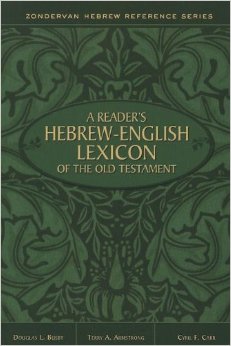
A resource that has been out of print for some time is now back and available in a (cheaper) paperback edition. Zondervan’s Reader’s Hebrew-English Lexicon of the Old Testament offers verse-by-verse glosses (short translation equivalents) for rarely occurring words in the Hebrew Bible. The glosses are based on the Brown/Driver/Briggs (BDB) lexicon, with the context of each verse also taken into account. Organized in canonical order and covering the whole Old Testament, the lexicon lists each word that occurs 50 times or less in the Old Testament. Next to the word is the gloss and how many times that word appears in (a) a given book and (b) the whole Hebrew Bible. Each entry also has the page number in BDB, if you want to consult that additional work for a longer definition of a word. For verbs, the number of occurrences of that particular stem is also noted.
The lexicon follows the order of books that the Hebrew Bible does (i.e., the ordering differs from English Bibles). Only numbers and proper nouns are not included. The lexicon clocks in at 720 pages. It’s not as portable as when this single work was split into four volumes, but those are as hard to find as the four-volumes-in-one hardback had been. A Reader’s Hebrew-English Lexicon is intended to be a sort of counterpart to Kubo’s Greek lexicon by Zondervan. Here’s what it looks like:
I often struggle to remember Hebrew words that occur between 50 and 100 times in the OT, so the additional appendix is especially useful–it has Hebrew words that occur more than 50 times. There is also an Aramaic appendix.
How I Use It, Why I Like It
I’ve used this reader’s lexicon in tandem with Zondervan’s nicely laid out “reader’s” edition of the Hebrew Bible. Though that Bible already footnotes rarely occurring words, the frequency counts in this lexicon help me know if it’s a word I should have known (e.g., one that occurs 45 times) or one I shouldn’t be surprised to not know (e.g., one that occurs three times).
The glosses are sufficient for rapid reading of the text. And the frequency counts add a nice orienting element not found in the reader’s Bible.
This edition is a reprint, so nothing has been re-formatted or changed in terms of the font. The font, while not always crisp on every page, is readable, both in Hebrew and English.
Yes, there are good Bible software options for reading the text, but I still like to read through the Hebrew Bible in print, and this reader’s lexicon makes for a convenient and trustworthy guide. For bettering one’s Hebrew vocabulary and reading, I heartily recommend it.
Thanks to Zondervan for the review copy of the lexicon. Its product page is here. It’s here on Amazon.
Ask a group of pastors, seminarians, professors, or serious Bible readers, “What one commentary series on the Old Testament would you most recommend?” and you’re likely to hear: “NICOT.” Eerdmans’ New International Commentary on the OldTestament blends scholarship with application in a readable and engaging manner. Few, if any, commentary series are consistently this good throughout the series. And I don’t know of any other series that has such broad ecumenical appeal.
NICOT in Olive Tree has 23 volumes, spanning 26 biblical books. The bundle includes the 2010 volume on Hosea. The only volume currently in print that is not here is The Book of Judges, by Barry G. Webb (2012). (Judges is not available in any other Bible software at the moment.)
General editor Robert L. Hubbard Jr. writes of the series:
NICOT delicately balances “criticism” (i. e., the use of standard critical methodologies) with humble respect, admiration, and even affection for the biblical text. As an evangelical commentary, it pays particular attention to the textʼs literary features, theological themes, and implications for the life of faith today.
As I preached through Isaiah this past Advent, John N. Oswalt’s two volumes on that book were the first commentary I turned to after spending time with the biblical text. While it was always clear that Oswalt knew Isaiah and his milieu well, the author would find himself swept up at times in praise of the God Isaiah preached. On Isaiah 2:2, for instance, he writes:
What Isaiah was asserting was that one day it would become clear that the religion of Israel was the religion; that her God was the God. To say that his mountain would become the highest of all was a way of making that assertion in a figure which would be intelligible to people of that time.
On that passage’s promise of peace among nations, he concludes:
Until persons and nations have come to God to learn his ways and walk in them, peace is an illusion. This does not mean that the Church merely waits for the second coming to look for peace. But neither does it mean that the Church should promote peace talks before it seeks to bring the parties to a point where they will submit their needs to God.
Oswalt is representative of the authors in NICOT, in that he loves the text (and its grammar, history, and background) and loves the God who inspired it.
NICOT in Olive Tree has hyperlinks to biblical references and commentary footnotes, which you can easily and quickly view in the Bible Study (computer) app through the Quick Details corner (by hovering over the hyperlink), or as a pop-up window (which can then also pop out and keep your place in a separate window). It’s just as easy to tap a hyperlink in the mobile app.
There are two ways I’ve used NICOT so far.
1. I use NICOT as my starting point in the main window.
After some time in the biblical text, I have made my way through parts of NICOT by starting from the commentary. I can use hyperlinks to read the verses being commented on, as well as any other references. I can keep a Bible open in the split window and have it follow me along as I read through NICOT.
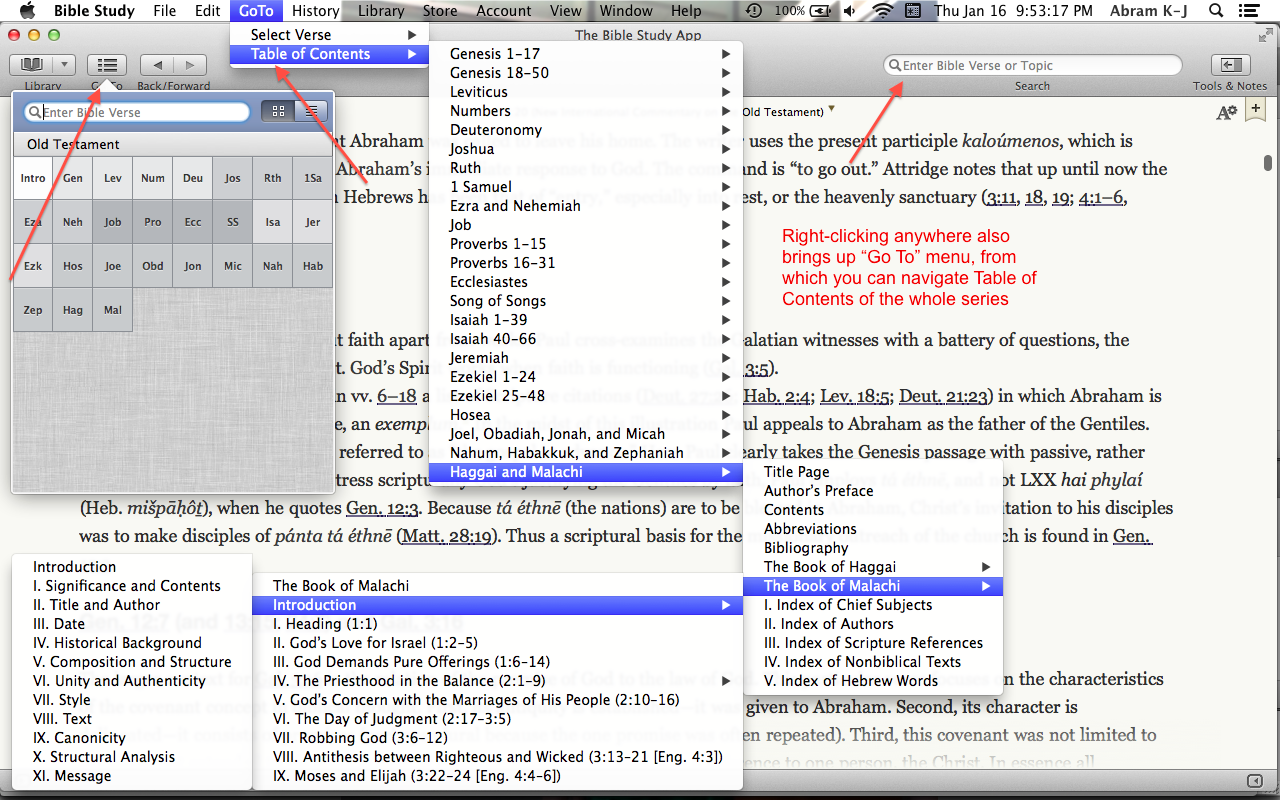
Using NICOT this way, there are quite a few ways to get around, both by looking up a verse in the commentary, and by navigating its Table of Contents. You only need to use one of these options at a time, but here they all are:
(click to enlarge image)
Note that from the Go To drop-down menu, I can keep following the sub-menus till I get to a specific place in the commentary (Introduction to Malachi in the instance above). One could also do this from the Go To item in the toolbar, which allows for both verse searching and Table of Contents navigation.
2. I use the Bible in the main window and NICOT as a supplement in the split window.
This has the advantage of letting me use NICOT as one among multiple resources in the Resource Guide, as shown (in part) here:
Resource Guide shows relevant library results (click to enlarge)
In both of the above setups you can take notes in NICOT, highlight, and bookmark your place. You can also do a search on a word or phrase in the commentary, with the results appearing almost instantaneously. One may wish, for example, to find all the times Oswalt refers to the “Suffering Servant” in Isaiah, which is an easy and fast search to run.
In reviewing Olive Tree I have found it to have the most versatile, smooth, and customizable Bible app I’ve seen on iOS. I write more about the Bible Study iOS app here. The fact that Olive Tree is cross-platform makes it appealing to many. Though the desktop app is well-designed, I would like to see a future update where you can create a saved workspace with multiple resources open in various tabs and windows. That, I think, would take the app to the next level.
But everything is here to help you work through NICOT in a way that you couldn’t in print. There are a couple of options (one free and one paid) for Hebrew Bibles, too, if you want to use NICOT in tandem with the original language. (NICOT uses transliterated Hebrew.)
NICOT volumes consistently top the charts of the Best Commentaries site. Preachers and professors, parishioners and pupils will all find much to mine here, as they seek to better understanding the Old Testament and to more faithfully love the God whose goodness its pages proclaim.
Thanks to Olive Tree for the New International Commentary on the Old Testament (NICOT), given to me for this blog review, offered without any expectations as to the content of the review.You can find the product here. For a little while longer, it’s $349.99 for the series, which is 50% off its regular price.

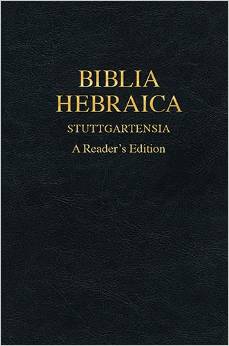 This fall Hendrickson will publish a new Hebrew Reader’s Bible.










 Words on the Word