Do You Want to Contribute to a Septuagint Dictionary?

Scholar’s Publisher is seeking contributors:

The aim of the DSEGJS [Dictionary of the Septuagint and Early Greek Jewish Scriptures] is to provide a comprehensive reference guide to the Greek Jewish Scriptures (GJS) in their Greco-Roman context as well as their subsequent influence on the early church and post Second Temple Judaism. The field as well as the general interest in matters related to the GJS has grown significantly in the past 30 years, but the discipline is lacking an informative reference tool for students and specialists, as well as scholars and students in related fields. The scope of the dictionary is to provide factual information about books, persons, places, and events, as well as define words and explain theories as they relate to the GJS. In most cases, the next step is to read an article or volume that is devoted to the topic itself, though in some cases the nature of this new endeavour means the DSEGJS is the primary source of information.

Find out more here.

From the Study… Books for Sale

Last weekend I built a sandbox; this weekend I’m cleaning up the study. I have a few books I’m trying to unload. Contact me here if you’re interested.


Simplified Guide to BHS (Hebrew Bible)
(Scott, 1990 Second Edition, includes Ruger’s English Key to Latin Words, bound together), hard to find in print. One page has writing, but is helpful to understanding text. Previous owner’s name inside front cover; sticker residue on back (slight).
$20


Hand Concordance to Greek NTHandkonkordanz zum Griechischen Neuen Testament (English and German)
Super-handy small concordance to Greek New Testament… I just don’t have use for it recently. See reviews at Amazon link here. Good to Very Good condition (sticker on back, some regular wear, but clean inside and strong binding).
$22


Seow Hebrew GrammarC.L. Seow’s Grammar for Biblical Hebrew (1987)
Pencil notations throughout (one page pen), otherwise great condition. Old sticker on back.
$10


The increasingly hard-to-find NIV Triglot Old Testament
Yes, English, Greek and Hebrew. It’s a big and impressive-looking hardback. Really good condition. Name inside front cover. No markings that I’m aware of. No dust cover (but you were just going to take that off as soon as you got it anyway, right?).
$22


Behold, the Triglot
Behold, the Triglot


Spurgeon Treasury of DavidSpurgeon’s 3-Volume Treasury of David
Commentary on the Psalms, hardcover (green dust jackets). Hardly used, in great shape. One volume has a small coffee splash on page edges. Not a set of books I’d normally want to part with, but I have it electronically now.
$29


Bonhoeffer Fiction from Tegel PrisonDietrich Bonhoeffer Works, Volume 7 (Fiction from Tegel Prison)
Hardcover. Brand new, still in shrink wrap.
$14


Dietrich Bonhoeffer Works, Volume 9 (The Young Bonhoeffer, 1918-1927)
Hardcover. Still in original shrink wrap. Just a tiny bit of bumping to spine edges, one corner ever-so-slightly dinged.
$20


Dietrich Bonhoeffer Works, Volume 10 (Barcelona, Berlin, New York: 1928-1931)
Hardcover. Dust jacket, page edges, and corners show some wear/bumping, but not much. Insides unmarked, never used.
$25


Interested? Contact me here to inquire.


And the Winners of the UBS5 Greek NT Are….

UBS5 Infographic


There were more than 50 entries into the UBS5 Greek New Testament giveaway. (Click here to read more about that new edition of the GNT.)

Using a random number generator, the two winners are:

  • spencerclark2013 (see here)
  • thanksgutenberg (see here)

Congratulations! I’ll get in touch with both of you via email in order to get the Bible shipped out to you.

And check back here, too, or subscribe to the blog at the right of the top of the page. Just as I reviewed the impressive LXX-NA28 combo, I will soon be reviewing the UBS5 Greek New Testament.

Fall 2014 New Releases from Zondervan Academic

Zondervan Academic

Zondervan Academic (I’ve reviewed a bunch of their stuff) has some interesting new releases coming this fall. I’m particularly interested in:

I’m especially looking to the Mark volume of the ZECNT series.

The Zondervan Academic Website is here. Their Fall 2014 catalog is here.

The Westminster Dictionary of Theological Terms, Reviewed

Westminster Dictionary of Theological Terms


The Westminster Dictionary of Theological Terms (Westminster John Knox Press, 2014) is a succinct compendium of key theological words and concepts.

One obvious advantage to the book is its portability. It’s less than 400 pages and easy to carry around in a satchel… though since receiving it, I’ve kept it on my desk with a few other works I reference a lot.

What sorts of “theological terms” does this dictionary cover? The publisher’s product page notes:

This second edition of The Westminster Dictionary of Theological Terms provides a comprehensive guide to nearly 7,000 theological terms—1,000 more terms than the first edition. McKim’s succinct definitions cover a broad range of theological studies and related disciplines: contemporary theologies, biblical studies, church history, ethics, feminist theology, global theologies, hermeneutics, liberation theology, liturgy, ministry, philosophy, philosophy of religion, postcolonial theology, social sciences, spiritually, worship, and Protestant, Reformed, and Roman Catholic theologies.

There is also a short annotated bibliography, list of works consulted, and set of abbreviations at the back of the book. The “Major Topics and Distinctive Terms and Concepts” section at the beginning gives the reader a framework of overarching topics into which the dictionary’s terms will fit. (E.g., “Bible,” “theology,” “worship,” “ethics and moral theology,” and so on.)

McKim himself has overseen much larger dictionaries. An initial point of skepticism for me was whether a theological dictionary this small and short could still be substantive. Definitions are somewhere in the 15-75 word range, depending on the term.

Yet as a quick-reference guide, it does well. Consider McKim’s definition of feminist criticism:

A critical approach to reading the Bible that focuses on the political, social, and economic rights of women. Diverse goals and methods are employed, with a common recognition that all texts are gendered. This implies not only that they reflect sexual differences between males and females, but also that they involve power. Feminist criticism seeks to make clear culturally based presuppositions found in texts.

Here’s another example, the entry for “agrapha,” a term one finds shortly after delving into studies of the Gospels:

(Gr. “unwritten sayings”) Sayings attributed to Jesus that circulated as traditions during the period of the early church. Also those sayings attributed to Jesus found outside the canonical Gospels.

The reader will also find terms like “Griesbach hypothesis,” “haggadah,” “Muratorian Canon,” perspectivalism,” “cuneiform,” “body-soul dualism,” “Trisagion,” “interiority,” “rechte Lehre” (German for “right teaching on doctrine”), and many more.

McKim’s goal was to provide a “wider, synthetic work that gives short, identifying definitions over a more comprehensive range of theological disciplines,” as opposed to something more “specialized” and “extensive.” The beginning theological students that McKim seeks to reach will find such a dictionary an especially useful entry point into the large and growing world of biblical and theological studies. McKim seeks to be more “broad” than “deep”; in this he succeeds, but the definitions are still plenty substantive to be useful to students at various stages.

The annotated bibliography is just five pages and glosses over important works (e.g., the commentaries section lists Anchor but omits Hermeneia). It does include a good page on Web-based resources for theological studies. The abbreviations include a couple pages of textual criticism abbreviations (including Latin), which will save the new reader of the Hebrew Bible from having to look most terms up elsewhere.

One feature I felt to be missing was a lengthier set of introductory essays on the nature and methods of theological study. I’m assuming Dr. McKim didn’t include this because it might exceed the intended scope of the work, but perhaps future editions could include–as many dictionaries do–at least two or three introductory essays to further orient the reader to theological study.

I’ve had the dictionary at my desk all summer, and each time I’ve looked up a word or phrase, I’ve found what I was looking for (with the exception of dereliction or “cry of dereliction”).

Especially for its price and accessibility, The Westminster Dictionary of Theological Terms is an excellent starting point for seminary students or for pastors who want to stay up-to-date on theological terminology.

Many thanks to WJK Press for the review copy, given to me with no expectation as to the content of my review. You can find the dictionary here on Amazon (affiliate link), or here at WJK Press.

The Best Used Bookstore in the World

Loome


This last week I visited what has to be the best bookstore in the cosmos. Loome Theological Booksellers bills itself as the world’s largest theological bookstore. It has great prices, an incredible selection (the Bonhoeffer section, for instance, had secondary literature in French and German), an easy-to-navigate layout, and a really nice owner.

Here are a few photos (click on any of them or open in a new tab/window to enlarge):


The entrance
The entrance


Two of many rooms
Two of many rooms


Here’s the annex. It’s enormous. The photos below just show part of it:


IMG_1511


IMG_1513


Annex 1


If you’re in the Minneapolis-St. Paul or Stillwater area, check it out! They’re having a $2 per book Labor Day sale that I was sorry to have missed by a couple of days.

Win a Free Copy of the New UBS5 Greek New Testament with Dictionary

UBS5
By now many of you Words on the Word readers will have heard that the UBS edition of the Greek New Testament has recently been published in its fifth revised edition, the UBS5. See here for more.

Check out this smart graphic from Hendrickson Publishers announcing the edition (academia needs more good infographics):
UBS5 Infographic

Just as I reviewed the amazing LXX-NA28 combo, I will soon be reviewing the UBS5 Greek New Testament.

While I work my way through it, with just about a minute of your time and a few clicks, you can enter to win your own copy of the UBS5, thanks to the great people at Hendrickson Publishers.

You Can Earn Up to 8 Entries: Here’s How

Simply comment on this blog post with a short sentence on what interests you in the Greek New Testament. That will give you one entry.

If you share on Facebook and/or Twitter, and then come back and post the link to your share in the comments, you get two additional entries.

If you want to earn five additional entries, you can record a (however lo-fi) video of yourself answering the questions: Why does Bible translation matter? and: What does translating the Bible mean to you personally?

To receive those five additional entries, post the url to your video (whether you’ve uploaded to YouTube, Facebook, Vimeo, etc.) in the comments. Then others can see your video, too.

I’ll select two winners using a random number generator.

If you don’t want to wait for the results of the giveaway, you can find the UBS5 on sale at Amazon here (affiliate link) or through Hendrickson here.

A Bit of Fine Print

The giveaway is open through Sunday, September 7, 11:59 p.m. EDT. On Monday I’ll notify the winner and post about it both here and in the comments below. Then Hendrickson will mail you your UBS5 GNT! (Note: Only domestic/U.S. shipping addresses are eligible for this contest, with apologies to the rest of the world!)

Make sure in when you leave a comment that you include your email address—I can use that to contact you, and the email address isn’t public.

Happy entering, and the folks at Hendrickson and I look forward to seeing your videos. Drop me a line if you have any questions.

My Comparative Review of Software for LXX Studies, Published in JSCS

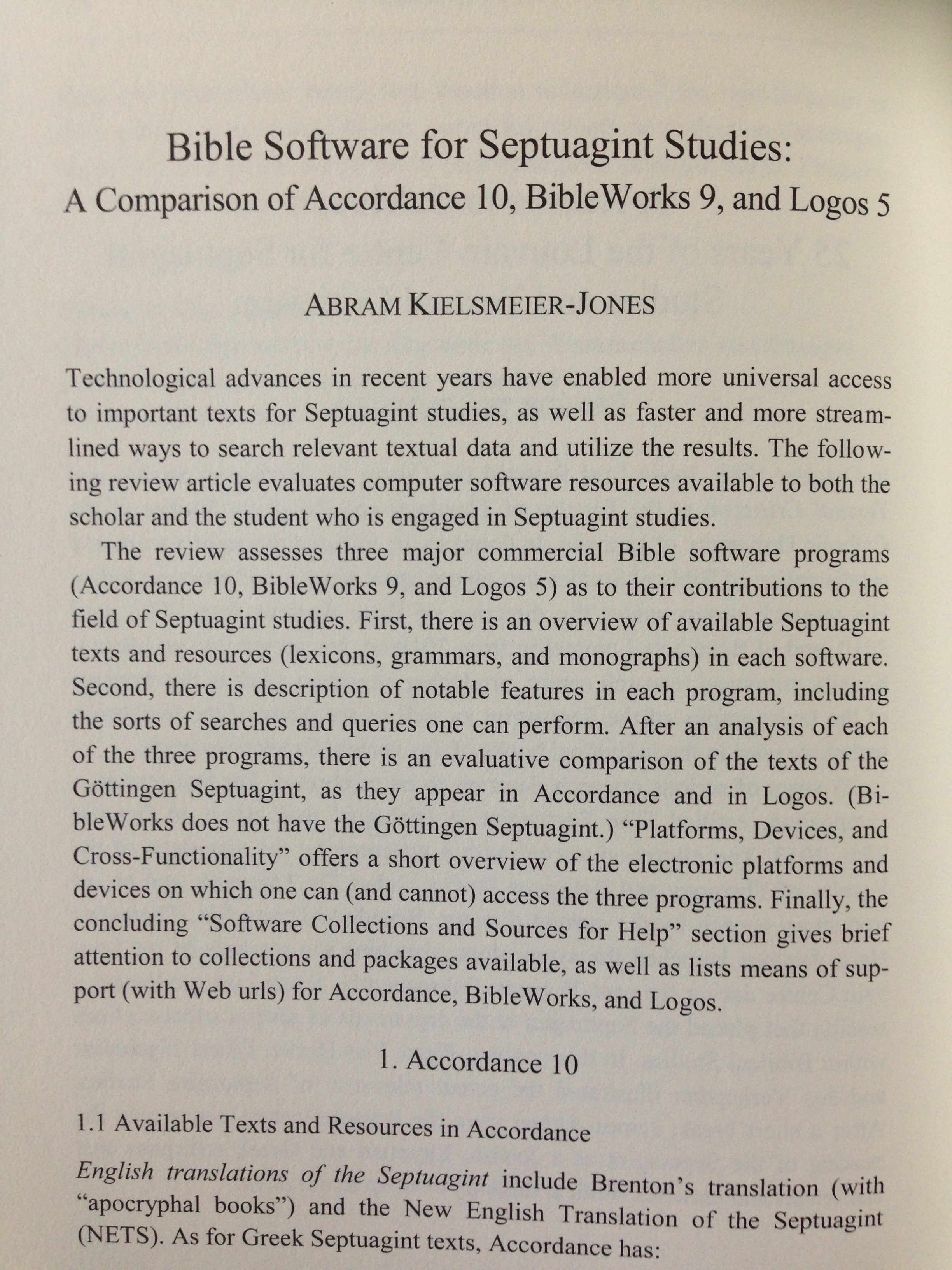
I’ve just come home to the new Journal of Septuagint and Cognate Studies (JSCS) in my mailbox. This volume (vol. 47, 2014) publishes an extensive comparative review I wrote of Bible software programs for Septuagint studies. In the review I consider and evaluate Accordance 10, BibleWorks 9, and Logos 5.

I’m excited to see it in press! Here are the journal cover, the contents, and the first page of the review. You can subscribe to JSCS at this link.

JSCS (2014) Cover
JSCS (2014) Cover


JSCS (2014) Contents


First Page of the Review