What are the best Old Testament commentaries to get?

OT Commentary Survey

This is a meta-review of sorts: a review of a book that briefly reviews commentaries for each book of the Old Testament. I.e., here are some words on some words on some words on the Word.

Here is the publisher’s book description:

Leading Old Testament scholar Tremper Longman III provides students and pastors with expert guidance on choosing a commentary for any book of the Old Testament. The fifth edition has been updated to assess the most recently published commentaries, providing evaluative comments. Longman lists a number of works available for each book of the Old Testament, gives a brief indication of their emphases and viewpoints, and evaluates them. The result is a balanced, sensible guide for those who preach and teach the Old Testament and need help in choosing the best tools.

It’s a recurring question: What are the best Old Testament commentaries to get? To help answer that question, Longman rates an impressive host of commentaries on a 1-to-5 star scale:

One or two stars indicate that the commentary is inferior or deficient, and I discourage its purchase. Four or five stars is a high mark. Three, obviously, means a commentary is good but not great. I also use half stars in order to refine the system of evaluation.

One nice touch in this book is that all of the five-star commentaries are separately listed in an appendix in the back. Students or pastors looking to build a library might start there. Before turning to commentaries on individual books of the Bible, Longman briefly reviews one-volume commentaries (though this one is absent) and “commentary sets and series.” In addition to the stars, Longman notes whether a book is better suited for a layperson (L), minister/seminary student (M), or scholar (S), or some combination of those three.

To have a rating system is good, but there are some odd ways in which it is applied. One unlucky book got “no stars” on what the 1-to-5 star scale. And the comments (a paragraph’s length) under each commentary don’t always seem to match the rating. For example, a commentary on 1 Chronicles that has “a very helpful discussion of all aspects of the book” and other positive evaluation from Longman receives only 2.5 stars. A Genesis commentary whose author “shows great exegetical skill and theological insight” then receives 1.5 stars. As does another whose author “is insightful and knowledgeable.” One series receives four stars as a whole, but one of the individual commentaries that is “definitely one of the best volumes in the series thus far” receives just three.

There are also some things that were missed in updating the 2007 fourth edition to this 2013 fifth edition. The Berit Olam series was “just under way” in the fourth edition, and is so here, too. The New American Commentary series in both 2007 and 2013 editions is “relatively new,” even though it has a number of volumes published in the early 1990s. In the Proverbs section, Fox’s Anchor commentary still only consists of volume 1 (“Hopefully, we will not have to wait too long for the rest of the commentary to appear”), even though volume 2 was published in 2009. And there is also no mention of the Baylor Handbook on the Hebrew Text series, which had five volumes published by the time of this new edition of Longman’s work. Also, especially with the proliferation of commentaries now available through Bible software, an appendix covering electronic books would have been nice.

As far as his written evaluation of the commentaries, Longman is especially favorable toward Old Testament commentaries that discuss how a given passage is used in the New Testament. It’s not clear to me that–even for a Christian–this would be a requirement for a good Old Testament commentary, but I see his point, and am disposed to at least somewhat agree. He writes:

I continue to hope that future commentaries produced for use by Christian pastors in the church would include more reflection on how the Old Testament message is appropriated by the New Testament.

But, in my opinion, this criterion is perhaps over-applied, resulting in ratings penalties for what are otherwise strong commentaries, including ones that may have never set out in the first place to discuss the NT use of the OT.

One final critique: though there are not many commentaries on the Septuagint text of the Old Testament, a few series have begun. I can’t totally fault Longman for not having any Septuagint commentaries here, but I had hoped that the few that have been published might have been noted. I think also of John William Wevers’s Notes on the Greek Text series, which covers the Pentateuch.

Longman’s aim is for “this commentary survey [to] help students of the Bible choose the commentaries that are right for them,” and in that he is mostly successful. For example, he lets the reader know which commentaries date a given prophet according to “critical” or “evangelical” interpretations (I’m oversimplifying a bit here). He has helpful comments like, “If you get only one commentary on Joel, this should be it.” I finished this book feeling like I had a general lay of the land of Old Testament commentaries.

Despite a sometimes quirky or inconsistent rating system, and despite what appears to be a not really thoroughly updated volume, Old Testament Commentary Survey is unique, and one I already consult and will continue to consult whenever considering commentaries on a given Old Testament book. I just know I’ll have to supplement it with my own research and with seeking recommendations from others. The book works especially well as an introductory checklist that one can use as she or he is building a library of commentaries.

A sample pdf of the book, including introductory material and Longman’s take on one-volume commentaries and various commentary sets, can be found here.

Many thanks to Baker Academic for the review copy of OT Commentary Survey. You can find it here (Baker Academic) and here (Amazon).

N.T. Wright on My Computer

Wright for Everyone

I have been benefiting lately from the wisdom of N.T. Wright. His For Everyone series now covers every book of the New Testament, with each passage being preceded by Wright’s own translation of Scripture.

I describe the series here. And here I review the Luke volume in further detail. In this post I’ll review the usefulness of the series in Logos Bible Software, both on an iPad and on a computer.

Logos syncs automatically across multiple devices and platforms. Its iOS app for iPad is one of the apps I use the most. It’s just recently received a nice makeover. It looks like this:

(click image to enlarge)
Library view

Here’s how I set up Wright in the app. You can sync the two windows of the app so that they move together, passage-by-passage. I.e., if I advance the Bible text in the top window, the commentary at the bottom follows.

(click image to enlarge)
Reading Wright on iOS

You’ll also note that you can highlight as needed, which then shows up in Logos on any other device, almost instantaneously. The pop-up is a note I took (“Even if we know what’s coming, we’re surprised”) on this section of Wright’s commentary. Notes also sync automatically.

You could also view the Passage Guide for a given portion of Scripture and see all of your commentaries and resources (which would include Wright, in this case) with information on the passage to be studied. The Passage Guide stays open at the top while the bottom window cycles through various commentaries as you tap the selection in the Passage Guide.

The desktop/laptop version of Logos offers even more options for using Wright side-by-side with other resources:

(click image to enlarge)

The little “C” at the bottom left of each of the book images shows that I’ve linked resources together, so that they scroll in tandem. In the above, I can work through English and Greek texts, with Logos’s clausal outlines and Wright’s commentary all open. The other tabs to the left and right of Matthew for Everyone are other commentaries to consult. I have all of the above saved as a workspace called “Preach Matt,” to which I can come back at any time.

One feature I appreciate is that if I type “John 1:1” into the search window of one of the Bible texts, the N.T. Wright window automatically goes to Wright’s commentary on John, even though it’s a different book in the set. And you can see that my highlight and note from iOS automatically came over to this version.

In general I find Accordance commentaries a little easier and quicker to search with their specific content fields (where you can search by reference, by English content, by Greek content, etc.). But the command (or control) + F search box gets the job done just fine in these commentaries. (For more on searches and content fields, see the discussion on the Logos forums here.)

I write more in depth about using Logos for a commentary series here. I’ve found Logos to be more responsive on a PC laptop (and it seems to index less) than on a Mac laptop.

Whether it’s through iOS or at a computer, I recommend N.T. Wright’s companionship through the Bible. The print volumes, of course, do just fine, but the Logos edition of Wright’s commentary set has some nice features that enhance study of the New Testament and use of the For Everyone series.

Thanks to Logos Bible Software for the review copy of New Testament for Everyone (16 vols. here; 2 vols. upgrade here). You can find my other Logos reviews here.

NICOT in Olive Tree, reviewed

NICOT in Olive TreeAsk a group of pastors, seminarians, professors, or serious Bible readers, “What one commentary series on the Old Testament would you most recommend?” and you’re likely to hear: “NICOT.” Eerdmans’ New International Commentary on the Old Testament blends scholarship with application in a readable and engaging manner. Few, if any, commentary series are consistently this good throughout the series. And I don’t know of any other series that has such broad ecumenical appeal.

NICOT in Olive Tree has 23 volumes, spanning 26 biblical books. The bundle includes the 2010 volume on Hosea. The only volume currently in print that is not here is The Book of Judges, by Barry G. Webb (2012). (Judges is not available in any other Bible software at the moment.)

General editor Robert L. Hubbard Jr. writes of the series:

NICOT delicately balances “criticism” (i. e., the use of standard critical methodologies) with humble respect, admiration, and even affection for the biblical text. As an evangelical commentary, it pays particular attention to the textʼs literary features, theological themes, and implications for the life of faith today.

As I preached through Isaiah this past Advent, John N. Oswalt’s two volumes on that book were the first commentary I turned to after spending time with the biblical text. While it was always clear that Oswalt knew Isaiah and his milieu well, the author would find himself swept up at times in praise of the God Isaiah preached. On Isaiah 2:2, for instance, he writes:

What Isaiah was asserting was that one day it would become clear that the religion of Israel was the religion; that her God was the God. To say that his mountain would become the highest of all was a way of making that assertion in a figure which would be intelligible to people of that time.

NICOT IsaiahOn that passage’s promise of peace among nations, he concludes:

Until persons and nations have come to God to learn his ways and walk in them, peace is an illusion. This does not mean that the Church merely waits for the second coming to look for peace. But neither does it mean that the Church should promote peace talks before it seeks to bring the parties to a point where they will submit their needs to God.

Oswalt is representative of the authors in NICOT, in that he loves the text (and its grammar, history, and background) and loves the God who inspired it.

NICOT in Olive Tree has hyperlinks to biblical references and commentary footnotes, which you can easily and quickly view in the Bible Study (computer) app through the Quick Details corner (by hovering over the hyperlink), or as a pop-up window (which can then also pop out and keep your place in a separate window). It’s just as easy to tap a hyperlink in the mobile app.

There are two ways I’ve used NICOT so far.

1. I use NICOT as my starting point in the main window.

After some time in the biblical text, I have made my way through parts of NICOT by starting from the commentary. I can use hyperlinks to read the verses being commented on, as well as any other references. I can keep a Bible open in the split window and have it follow me along as I read through NICOT.

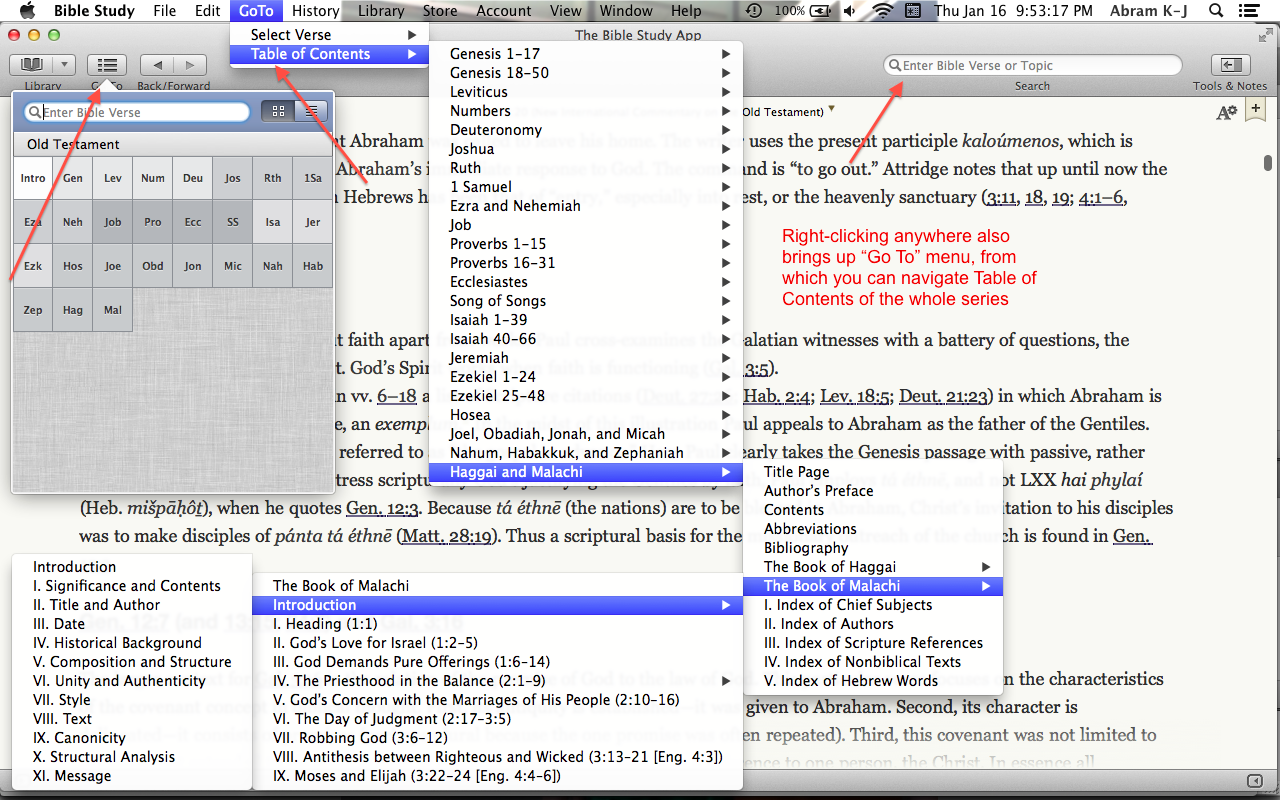
Using NICOT this way, there are quite a few ways to get around, both by looking up a verse in the commentary, and by navigating its Table of Contents. You only need to use one of these options at a time, but here they all are:

(click to enlarge image)

Note that from the Go To drop-down menu, I can keep following the sub-menus till I get to a specific place in the commentary (Introduction to Malachi in the instance above). One could also do this from the Go To item in the toolbar, which allows for both verse searching and Table of Contents navigation.

2. I use the Bible in the main window and NICOT as a supplement in the split window.

This has the advantage of letting me use NICOT as one among multiple resources in the Resource Guide, as shown (in part) here:

Resource Guide shows relevant library results (click to enlarge)

In both of the above setups you can take notes in NICOT, highlight, and bookmark your place. You can also do a search on a word or phrase in the commentary, with the results appearing almost instantaneously. One may wish, for example, to find all the times Oswalt refers to the “Suffering Servant” in Isaiah, which is an easy and fast search to run.

In reviewing Olive Tree I have found it to have the most versatile, smooth, and customizable Bible app I’ve seen on iOS. I write more about the Bible Study iOS app here. The fact that Olive Tree is cross-platform makes it appealing to many. Though the desktop app is well-designed, I would like to see a future update where you can create a saved workspace with multiple resources open in various tabs and windows. That, I think, would take the app to the next level.

But everything is here to help you work through NICOT in a way that you couldn’t in print. There are a couple of options (one free and one paid) for Hebrew Bibles, too, if you want to use NICOT in tandem with the original language. (NICOT uses transliterated Hebrew.)

NICOT volumes consistently top the charts of the Best Commentaries site. Preachers and professors, parishioners and pupils will all find much to mine here, as they seek to better understanding the Old Testament and to more faithfully love the God whose goodness its pages proclaim.

Thanks to Olive Tree for the New International Commentary on the Old Testament (NICOT), given to me for this blog review, offered without any expectations as to the content of the review. You can find the product here. For a little while longer, it’s $349.99 for the series, which is 50% off its regular price.

What is Romans Really About? (Revisited)

Romans by Jewett

When I read Romans straight through in one sitting a couple of years ago, I was surprised to see Paul’s emphasis on a community of believers. The justification by faith theme was there, to be sure, but I did not see quite the emphasis on individual and personal justification that I had expected. Of course Paul cares about individual justification, but his larger concern seems to be this: justification by faith in Jesus is available to all people. Because God’s salvation is pan-ethnic, Jew and Gentile should not fight but should celebrate instead their unity–since they both sin and are justified in the same way.

I’ve been encouraged the last couple of years to see a number of commentaries understanding the book in this same way. Robert Jewett describes his journey through Romans as a similar one.

Fortress Press is already a purveyor of some good Romans commentaries and monographs. I write here about Krister Stendahl’s Final Account: Paul’s Letter to the Romans. Fortress also published the under-noticed Conflict and Identity in Romans by Philip Francis Esler, which I briefly note here. Jewett’s Romans: A Short Commentary is an abridgment of his more than 1,000 page Hermeneia volume on Romans. Kudos to Prof. Jewett and Fortress Press for publishing a shorter, more widely accessible, more affordable version of what has already become a bit of a classic among Romans commentaries.

In the Introduction to this short(er) commentary, Jewett writes:

The most troubling of [the interpretive] challenges was the slowly emerging awareness that the dominant paradigm for interpreting justification by faith as individual forgiveness of sins was not supported by the actual wording of Romans.

He states his case more strongly than I would, but he notes that the letter instead focuses on “honor and shame” and the effort to “bring together believing Jews and non-Jews in one community” (here he cites Halvor Moxnes). “I gradually recognized,” Jewett goes on, “that the central issue was setting the world right by overcoming its perverse systems of honor and shame.” The letter is “a magnificent example of evangelical persuasion.” In order to secure support for his missionary efforts in Spain, Paul would seek

that the gospel of impartial, divine righteousness revealed in Christ be clarified to rid it of prejudicial elements that were currently dividing the congregations in Rome. …The gospel offered grace to every group in equal measure, shattering the imperial premise of exceptionalism in virtue and honor.

The bigger brother
The bigger brother (click image for details)

This understanding of Romans is evident throughout the commentary. Though the 18 chapters proceed passage-by-passage, there is a lot of verse-level detail. There isn’t the same amount of text-critical or technical detail that you’d expect from a full-blown Hermeneia volume, but that’s the point. What is still very much present here is a sense of the theological import of each passage, as well as the important historical and literary background details.

Romans: A Short Commentary, like Stendhal’s volume, includes the author’s original translation of Romans at the back of the book. Having reference to the whole text is convenient, though this there is more flipping back and forth required than in Hermeneia, where the text is at the beginning of each commentary passage.

From the very beginning phrase, Jewett is at ease with the letter and draws the reader in with both expertise and readable style. On “Paul, slave of Christ Jesus,” a phrase which “sounds rather degrading to the modern ear,” Jewett notes, “This would have made perfect sense in a letter to Rome, where influential slaves in imperial service proudly bore the title ‘slave of Caesar.'” If there is a “single theme in Romans” (which Jewett seems to accept), it is “the gospel,” with Romans 1:16 “[setting] the tone for the entire letter.” His focus on the communal component of offering “your bodies as a sacrifice” in Romans 12 was fresh and interesting, too.

One unfortunate gap in the volume is exegesis of Romans 16:1-16 and 16:21-23. Though every other verse of Romans is otherwise covered, the commentary moves from “chapter 17” (which goes through 15:33) to “chapter 18” (which begins at 16:17). I can’t imagine this was an intentional oversight, especially given the importance of Romans 16 to Jewett’s read of the letter as a whole.

There is a page or so in the introduction where Jewett talks about those Paul greets and their congregations, but this shorter work does not further comment on the early part of chapter 16. The reader never gets to read Jewett’s elaboration on “the social structure of the Roman congregations,” even though he says elsewhere in this volume that “the actual climax of Paul’s letter runs from 15:14 through 16:24.”

Is Paul writing Romans 16:25-27 here?

The lack of any comment on these key verses is all the more felt by readers as a loss, since not all will find Jewett’s read of the rest of Romans 16 compelling. He says that the “varied endings of Paul’s letter” (16:17-20, 25-27) were “inserted into  Romans” after Paul died. This itself is not so bad (even if I’m not convinced), but part of his motivation for saying so is that these two endings are “anti-Pauline.” The “exhort” and “steer away” of 16:17, he says, are “angry, authoritarian, and discriminatory.” But how? What if Paul is chastising anti-Semites here?

And despite what I think is a convincing link between “obedience of faith to/for all the Gentiles” in 1:5 and 16:26, Jewett says that 16:25-27 is not by Paul. Worse, it has “encouraged the dominance of anti-Semitism in Christian theology,” since in it only Gentiles and not Jews are mentioned. He contrasts that with the opening chapter’s “the Jew first and then to the Greek.” While he makes a good case for the semantic style of this doxology being less like the rest of Romans, I think he over-reads the anti-Jewish element, which I don’t see at all. It comes across as an argument from silence to say that lack of mention of Jewish believers in 16:25-27 means that the writer now is “excluding” them.

So I would go elsewhere for exegesis on chapter 16.

The book is otherwise fairly well-reasoned, thoroughly-researched, and a nice distillation of Jewett’s massive work in the Hermeneia series. Readers will also note that Jewett is humble enough to offer adjustments of his exegesis from Hermeneia(E.g., “What I overlooked was….”) Readers, then, get even more up-to-date thinking and research from Prof. Jewett.

If you’re studying Romans in depth, you’ll still want to try to take a gander at the larger volume. But this smaller volume will do as an initial entry point into Jewett’s copious research on Paul’s important letter.

Thanks to Fortress Press for the review copy of Romans: A Shorter Commentary. Its publisher’s product page is here, and it is for sale at Amazon here.

Flannery O’Connor and Richard Vinson Read Luke

“Have you ever been Baptized?” the preacher asked.
   “What’s that?” he murmured.
   “If I Baptize you,” the preacher said, “you’ll be able to go to the Kingdom of Christ. You’ll be washed in the river of suffering, son, and you’ll go by the deep river of life. Do you want that?”
   “Yes,” the child said, and thought, I won’t go back to the apartment then, I’ll go under the river.
   “You won’t be the same again,” the preacher said. “You’ll count.

–Flannery O’Connor, “The River,” quoted in Richard Vinson’s Luke

Luke by VinsonWhen I preached through parts of Luke this past fall, one of my favorite commentaries to consult–and the one that always felt the freshest–was Richard Vinson’s Luke in the Smyth & Helwys Bible Commentary series. Here is how the series preface describes the series:

The Smyth & Helwys Bible Commentary is a visually stimulating and user-friendly series that is as close to multimedia in print as possible. Written by accomplished scholars with all students of Scripture in mind, the primary goal of the Smyth & Helwys Bible Commentary is to make available serious, credible biblical scholarship in an accessible and less intimidating format.

What stands out to me most about Luke is that it’s not only accessible but creative in its literary read of Scripture. Vinson knows Luke and its background well; he also knows modern history, culture, literature, and art in a way that allows him to explain the biblical text in a really fresh and engaging way. His primary audience is “pastors and other Bible teachers.”

The introduction is a concise 20-some pages, covering essentials like authorship, dating, sources, structure, and themes found in Luke. (This for me was the highlight of his introduction, as he discussed gospel sources, yet with his target audience in view–“So I will content myself with the occasional ‘if Q really exists’ and worry about more important issues.”)

There are times when reading the commentary is like reading a sermon–a good sermon. To take an example, the passage on Luke 18:1-8 (about prayer, the apathetic judge, and the persistent widow) begins like this:

The title of an article in the Chronicle of Higher Education caught my attention: “Study of Prayer’s Healing Power on Surgery Patients Finds No Effect.” The article described an experiment in having people pray, by name, for persons recovering from heart bypass surgery. [Does Prayer Work? sidebar] None of the pray-ers knew the pray-ees; some of the pray- ees knew they were being prayed for, while others were told only that it might be true for them. Would the prayers have a statistically measurable effect—would the persons prayed for suffer fewer complications than those who were not prayed for? In this test, under these conditions, not so much…. I find I have mixed reactions to the finding that prayer does not always bring the desired results: (a) surely that’s not news to anyone who prays regularly; (b) at least now I know that I’m not the only one, and that God isn’t singling out my prayers to ignore; (c) maybe the experiment proves that there is no God who can be controlled by specific human behaviors, even if the desired outcome is unobjectionable.

The study itself (detailed in a sidebar) is a little silly. But it’s a nice entry into the question that such texts raise: Will God answer my prayers? And if the outcomes I’m praying for don’t obtain, what is going on?

Art from the commentary

From there it moves into exposition of the passage. Exegesis in the commentary is passage-by-passage, rather than verse-by-verse. There’s not always a lot of technical detail, but I still felt like Vinson did justice to whatever passage was under consideration. He gives the Old Testament “job description” of the judge in the passage mentioned above, as well as the larger biblical context for the importance of widows. Comparisons to other Gospel accounts, as well as the occasional word studies for important words (with reference to Greek), make this as good a starting point as any.

And yet what commentary will also reference Flannery O’Connor, Hank Williams, and Wendell Berry’s Manifesto: The Mad Farmer Liberation Front? Vinson’s creativity and honesty as he seeks to make sense of a text are refreshing, and often set me at ease when facing the prospect of preaching on a challenging passage.

The commentary comes with a CD-ROM that has a pdf of the entire book, with Table of Contents and easy navigation (as pdfs go). You can keyword search it and make annotations. This is a step in the direction of my dream that one could own both print and digital with one purchase. And the print edition is quite nicely constructed, too–sewn binding and all (so it lays flat), which seems to be increasingly rare these days.

I had not heard of this series until recently, but for any book I preach out of (there are both OT and NT volumes), I’m going to try to get a hold of the corresponding Smyth & Helwys volume from here on out.

I am grateful to Smyth & Helwys for the gratis review copy of this commentary, which was sent to me for this review. You can find the book on Amazon here. The publisher’s product page is here. All the published volumes in the series are here.

Luke for Everyone, reviewed

Luke for Everyone

“On the very first occasion when someone stood up in public to tell people about Jesus,” N.T. Wright writes, “he made it very clear: this message is for everyone.”

“N.T.” (is it coincidence that his initials also stand for “New Testament”?) wants the results of careful exegesis and historical background research (his specialties) to be accessible to the general populace–to everyone. While this is an ambitious target audience, Wright’s extensive knowledge of biblical language and history, coupled with his ability to write accessibly, make the series a success. He writes “especially to people who wouldn’t normally read a book with footnotes or Greek words in it.”

This fall I preached through parts of Luke, and had the benefit of consulting Wright’s Luke for Everyone each week as I prepared. He was often helpful, both with historical background and a better devotional understanding of the text and how to apply it. Regarding the well-known story in Luke 10 of Mary and Martha, he notes the real “problem” with Mary: “Mary was behaving as if she were a man” (Wright’s emphasis). He explains:

In the same way, to sit at the feet of a teacher was a decidedly male role. ‘Sitting at someone’s feet’ doesn’t mean (as it might sound to us) a devoted, dog-like adoring posture, as though the teacher were a rock star or a sports idol. When Saul of Tarsus ‘sat at the feet of Gamaliel’ (Acts 22:3), he wasn’t gazing up adoringly and thinking how wonderful the great rabbi was; he was listening and learning, focusing on the teaching of his master and putting it together in his mind.

“Rabbi” in the above passage is in bold, which means it corresponds to a glossary entry in the back. There are other important glossed terms throughout the book, with their entries in the Glossary.

Wright divides Luke into 89 different passages, so that each story, parable, or section can receive a good amount of treatment. This is not as long as other commentaries, so Wright doesn’t even attempt to do verse-by-verse-level detail, but the 4-5 pages per passage tend to be sufficient enough for a general orientation.

What I especially appreciated about this commentary was having someone whose knowledge of Scripture is fairly encyclopedic writing in colloquial, everyday terms. For example, he leads off his section on the parables of the lost sheep and lost coin with a story of a neighbor down the street who threw a noisy party. It led him to “thinking about how one person’s celebration can be really annoying for someone else, especially if they don’t understand the reason for the party.”

As he exposits the passage, he notes:

In the stories of the sheep and the coin, the punch line in each case depends on the Jewish belief that the two halves of God’s creation, heaven and earth, were meant to fit together and be in harmony with each other. If you discover what’s going on in heaven, you’ll discover how things were meant to be on earth. That, after all, is the point of praying that God’s kingdom will come ‘on earth as in heaven’.

He concludes:

The point of the parables is then clear. This is why there’s a party going on: all heaven is having a party, the angels are joining in, and if we don’t have one as well we’ll be out of tune with God’s reality.

The commentary itself would already be good as-is, but Wright also provides his own original translation of each passage under consideration. It’s a really good translation: highly readable and also faithful to the original. It reads as well as a modern paraphrase, but stays closer to the Greek than a paraphrase does. Here’s an example, the Lord’s Prayer:

‘When you pray,’ replied Jesus, ‘this is what to say:

‘Father, may your name be honoured; may your kingdom come; give us each day our daily bread; and forgive us our sins, as we too forgive all our debtors; and don’t put us to the test.’

Luke for Everyone would make a great devotional guide to reading through the book in one’s private Bible study, and someone taking a group through Luke would also benefit from it. Its blend of substance and accessibility is unique. Highly recommended!

Thanks to Westminster John Knox Press for the review copy of Luke for Everyone. You can find the book on Amazon here, or at the publisher’s product page here.

I Met N.T. Wright Once, and You’ll Never Guess What He Told Me

I’ve been seeing too much Upworthy in my Facebook news feed lately! Apologies for the sensational blog post headline.

NT WrightBut I really did meet N.T. Wright once. And you might actually guess what he told me, when I tell you what I asked him. I introduced myself to him briefly after a message he delivered a Calvin College worship symposium, and asked him how to improve my Greek. He said, “Read the text, read the text, read the text.”

He told me to really get the feel of the language. I shouldn’t think of Greek just as a one-to-one code for English; I should get into the Greek itself. I asked him what he thought about reading with a diglot, but he encouraged me to check the English translation only after reading an entire Greek paragraph, and then, only as necessary.

It’s challenging, but I’ve benefited from that advice multiple times.

The For Everyone Series

Wright for EveryoneOver the years I’ve made occasional use of his For Everyone Bible commentary series. Written under the name Tom Wright, the series brings Wright’s extensive knowledge of the biblical text and history to a general audience. Anyone wanting to know more about a passage–whether they are preaching from it or reading it in their personal devotions–would benefit from the series. It’s decidedly non-scholarly, but even scholars will find useful information here (if a bit simplified at times). Here is how Wright introduces the series:

But the point of it all is that the message can get out to everyone, especially to people who wouldn’t normally read a book with footnotes and Greek words in it. That’s the sort of person for whom these books are written.

Though Wright is a prolific writer of scholarly works, he writes well for a general audience–a rare combination. Throughout the series Wright puts key terms in bold, which the reader can then look up in a corresponding glossary (e.g., Gehenna/Hell, Covenant, Age to Come, Law, Faith, Son of Man, and more).

Between this package and this upgrade, Logos Bible Software offers the entire 18 vol. set. In a future post I will review Logos’s presentation of the series. Here I post about its content.

A Refreshing (One-Man) Translation

The Kingdom NTWright splits each biblical book up into manageable passages. His original translation does a good job of striking the balance he seeks of faithfulness to the original and readability. Here is a passage in Wright’s translation:

Romans 4:18-25

Abraham’s Faith—and Ours

18 Against all hope, but still in hope, Abraham believed that he would become the father of many nations, in line with what had been said to him, ‘That’s what your family will be like.’ 19 He didn’t become weak in faith as he considered his own body (which was already as good as dead, since he was about a hundred years old), and the lifelessness of Sarah’s womb. 20 He didn’t waver in unbelief when faced with God’s promise. Instead, he grew strong in faith and gave glory to God, 21 being fully convinced that God had the power to accomplish what he had promised. 22 That is why ‘it was calculated to him in terms of covenant justice’.

23 But it wasn’t written for him alone that ‘it was calculated to him’.24 It was written for us as well! It will be calculated to us, too, when we believe in the one who raised our Lord Jesus from the dead, 25 the one who was handed over because of our trespasses and raised because of our justification.

Wright explains, “The older language, ‘it was reckoned to him as righteousness’, gives off so many different messages now that it’s hard for us, hearing it, to think the thoughts Paul had in his head.” His translation is fresh, yet is not a paraphrase (like Eugene Peterson’s Message, for example).

“Come to Him, by Whatever Route You Can”

The For Everyone series, though divided into discrete passages, shows a literary sensitivity so that the reader can see how a given section connects to the larger flow of the book. For example, of the above passage, Wright writes:

The last verse of the chapter anticipates something Paul is going to do throughout chapters 5-8. He rounds off every stage of the argument in this long section with a reference to Jesus. This isn’t a mere pious gesture, smuggling in a mention of Jesus in case we thought he’d forgotten about him. It shows, rather, what the whole argument is all about. It brings us back home to the source and power of Paul’s thought.

Though preachers are not the target audience, the series is a good one for preachers to have on their shelves. There is not the same sort of explicit homiletical guidance that Feasting on the Word offers on every passage under consideration, but Wright is not short on practical application. For the Romans passage above, he concludes:

Do we share Abraham’s faith? Do we look in love, gratitude and trust to the creator God who promises impossible things and brings them to pass? Have we learned to celebrate this God, and to live as one family with all those who share this faith and hope?

Similarly, in Matthew’s account of the Magi’s visit to Jesus, Wright notes that the inclusion of the Gentile Magi already in chapter 2 shows one of Matthew’s themes–that Jesus is king of the Jews, and of all people. He concludes:

Listen to the whole story, Matthew is saying. Think about what it meant for Jesus to be the true king of the Jews. And then—come to him, by whatever route you can, and with the best gifts you can find.

This application comes after Wright succinctly answers who the Magi were, what the “star” they saw might have been, and what Old Testament passages are at play in the Epiphany narrative.

In Conclusion (So Far): One of the Best Reading Guides

Luke for EveryoneWright’s style is conversational, engaging, highly readable, and stimulating on both an intellectual and devotional level. As I make my way through more of the series, I’ll post more about it (with screenshots of how it looks in Logos for computer and iOS). But so far I’m a big fan of what I’ve seen. The Luke volume was a frequent reference as I preached through parts of Luke this fall.

If you’re reading through the Bible, and want to have a substantive yet concise reading guide for the journey, Wright’s For Everyone series is hard to top.

Thanks to Logos Bible Software for the review copy of New Testament for Everyone (16 vols. here; 2 vols. upgrade here). You can find my other Logos reviews here.

Feasting on the Word (concluding thoughts)

Feasting on the Word

Among preachers, there are books known as “Monday books” because they need to be read thoughtfully at least a week ahead of time. There are also “Saturday books,” so called because they supply sermon ideas on short notice. The books in this series are not Saturday books. Our aim is to help preachers go deeper, not faster, in a world that is in need of saving words.

–Feasting on the Word

I continue to utilize the 12-volume Feasting on the Word commentary series most weeks in my sermon preparation. As I described at greater length here, the 12 volumes cover the three-year lectionary cycle (A, B, and C), split into four volumes per year. Each week offers four different “perspectives” (theological, pastoral, exegetical, and homiletical) for each lectionary passage in the Revised Common Lectionary.

As far as its layout and usability in Logos, I covered that here. My favorite part about having Feasting on the Word in Logos is that I find Logos to be the most robust e-reader currently on the market. It syncs seamlessly across devices and platforms, and easily allows for highlights and notes to be made directly within the text.

In this final post, I want to interact a bit more with some of the content of the series.

The diversity of the contributors is a strong point. They come from different vocations (preachers, professors, Bishops), and reflect diversity in race, sex, and denominational affiliation, as well. I’ve found this refreshing.

There is a general evenness in style, tone, and substance across the volumes I’ve used. As one might expect with a commentary series with this many contributors, some entries end up being more helpful than others.

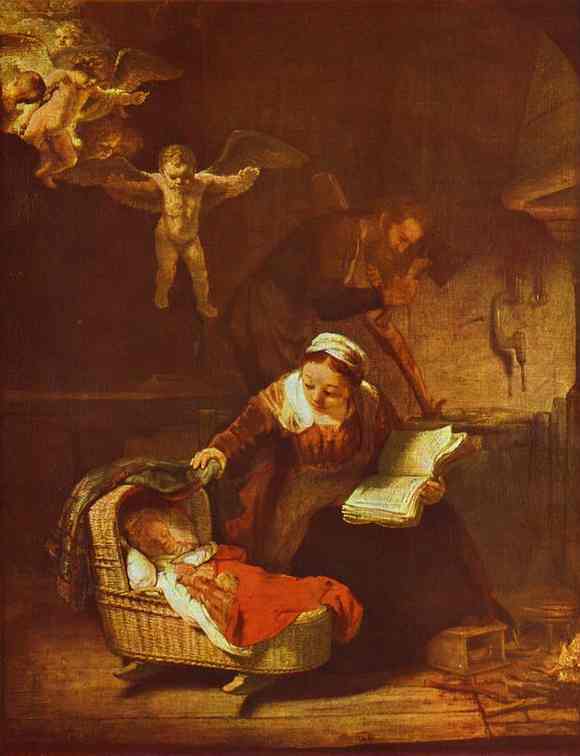
Rembrandt Holy FamilyWhile I have found the “Exegetical Perspective” and “Homiletical Perspective” sections to be of some value, the “Homiletical Perspective” and “Preaching Perspective” are the ones I use most often. Each of these help the preacher imagine how she or he might orient herself/himself and the congregation to a given text. For example, the “Homiletical Perspective” on John 1 begins with a description of Rembrandt’s “Holy Family” painting, then goes on:

I can imagine a sermon that would begin with a description of Rembrandt’s painting and that would develop the idea of the necessary dialogue between Mary’s studying the Bible and studying the child, the Word made flesh. Like Mary, we come to understand the Word more and more fully as we oscillate between the book and the child, between the Word through words and the Word made flesh.

Few commentaries offer homiletical suggestions this practical. The “Pastoral Perspective” for the same passage is worth quoting at length. After quoting Eugene Peterson’s rendering of John 1:14, preacher Frank Thomas writes:

I love this rendering of this text because of the choice of the word “neighborhood.” The Word was made flesh and blood and moved into the neighborhood. Neighborhood reminds me of the place where I grew up and the people with whom I grew up. I remember the street corner where we played baseball that had four sewer covers; one sewer cover was first base, another second, another third, and the final one home. I ran around those bases thousands of times, dreaming that I was a professional baseball player. I remember the playground, where what seemed like millions of kids played basketball, Ping-Pong, pool, volleyball, dodgeball, and tons of games. I remember block parties, where all the neighbors would sit out on the front lawns with the streets blocked off, and all day we would just have food, games, and fun together. I remember the girl across the street. That’s what I think of when I hear, “The Word was made flesh and moved into the neighborhood.” The Word was made flesh and moved into my south-side neighborhood.

He concludes, “When Peterson says that the Word was made flesh and moved into the neighborhood, I hear that the Word moved into my neighborhood.”

There is much for the preacher to mine and adapt and re-contextualize in the above, in a way that fits one’s own setting. Reading Pastor Thomas’s writing above makes it easy to think about Jesus moving into our neighborhoods, too. (Which immediately raises interesting questions for congregations–would we be a good neighbor to him? Would we need to change anything about our community life? Would we recognize him?) I find that Feasting on the Word is constantly suggesting good questions for reflection and stimulating even more.

There is a claim in the series introduction that, “Wherever they begin, preachers will find what they need in a single volume….” While the exegesis and theological analysis in these volumes is substantive, I still find myself turning to more in-depth commentaries for exegesis, before using Feasting on the Word to think through how to move from passage to sermon. That has been how I’ve most benefitted from the commentary.

I’ll continue to use the commentary series on a regular basis. While I love print books, there are advantages to the electronic version, and Logos integrates Feasting on the Word with any other Logos resources you may have. For those who preach regularly, this set is well worth checking out.

Thanks to Logos Bible Software for the review copy of Feasting on the Word (12 vols.). Find it here. The publisher’s page for the series is here. You can find my other Logos reviews here.

500 Book Sale in Logos Bible Software

500-book-mega-pack

Logos Bible Software has just announced the release of a “500 Book Mega Pack.” The bundle is up through the end of the year. More details are here. Some highlights include:

…and quite a few more. Nearly 200,000 pages (print equivalent). You probably won’t use all of it, but it’s a quick and cost-efficient way to expand a Logos library. Logos offers it at 96% off, through their Christmas sale.

As to my own personal experience using Logos, I’ve written a good deal about that here (with more reviews forthcoming). You can also see a short demo here (with a great soundtrack from Future of Forestry) on how to use Logos to research the Christmas story.

Disclosure of Material Connection: I received the 500 Book Mega Pack gratis, with the expectation that I post about it here (though with no expectation as to my evaluation of the product itself).

Feasting on the Word Commentary for Preachers (more thoughts)

Feasting on the Word

Whether the sermon is five minutes long or forty-five, it is the congregation’s one opportunity to hear directly from their pastor about what life in Christ means and why it matters.

–Feasting on the Word

Since getting it in Logos, I’ve been reading Feasting on the Word as a regular part of my sermon preparation each week. I describe the commentary series here.

Feasting on the Word is a lectionary-based commentary series in 12-volumes, four volumes for each of three years of the lectionary. Each Sunday has theological, pastoral, exegetical, and homiletical “perspectives” from which a variety of contributors assesses the texts. Feasting on the Word covers the OT, Psalm, Epistle, and Gospel readings each week.

As to the contributors, the publisher’s product page notes:

The editors of these resources are from a wide variety of disciplines and religious traditions. These authors teach in colleges and seminaries. They lead congregations by preaching or teaching. They write scholarly books as well as columns for newspapers and journals. They oversee denominations. In all of these capacities and more, they serve God’s Word, joining in the ongoing challenge of bringing that Word to life.

Noting a few contributors will give a sense of the diversity of perspective in the commentary:

  • Paul J. Achtemeier, Jackson Professor of Biblical Interpretation Emeritus, Union Theological Seminary, Richmond, Virginia
  • Michael B. Curry, Bishop, Diocese of North Carolina, Raleigh, North Carolina
  • Paul Simpson Duke, Co-Pastor, First Baptist Church, Ann Arbor, Michigan
  • Stacey Simpson Duke, Co-Pastor, First Baptist Church, Ann Arbor, Michigan
  • Edith M.Humphrey, William F. Orr Professor of New Testament, Pittsburgh Theological Seminary, Pittsburgh, Pennsylvania
  • Barbara Brown Taylor, Butman Professor of Religion, Piedmont College, Demorest, Georgia
  • Frank A. Thomas, Senior Servant, Mississippi Boulevard Christian Church, Memphis, Tennessee
  • David Toole, Associate Dean, Duke Divinity School, Durham, North Carolina

Here’s what a Feasting on the Word volume looks like in Logos on a laptop or desktop, next to a couple of other (not included) resources. Click to expand or open the image in new tab, and see my corresponding notes below.

Feasting on the Word in Logos with notes

(1) User annotations: Highlighting and making notes is easy–you can mark up the texts with various styles. Like Amazon’s Kindle app, the annotations made on one machine or device sync with other machines or devices. The note and highlights made above were done on an iPad and popped up automatically when I opened Logos on a computer. Logos is probably the most robust e-reader on the market in this sense.

(2) Hyperlinks: You can hover over a hyperlink for a pop-up with more info, or click on it to be taken to the biblical text (or footnote) that it references.

(3) Expandable/collapsable Table of Contents: Logos is not unique in offering this, but it does make it easy to quickly navigate between passages or “perspectives” on a given Sunday.

(4) Sync with other resources in Logos library: This is simple to set up. I can have Feasting on the Word open next to the full biblical text and other commentaries and resources.

(5) A single Sunday: on the left navigation sidebar you can see what a single Sunday looks like.

(6) Paused indexing: one challenge in using Logos is its frequent need to index. This optimizes searches, and it varies due to a user’s library size, but especially on a Mac, where Logos can already be sluggish compared to other apps, it slows the rest of the computer down. If I’m working on a sermon and using Logos, Accordance, Kindle, and Google Drive or Pages, for example, I almost always have to pause indexing to be able to keep working efficiently. I tend to resume indexing when I don’t need to use Logos.

I continue to find the “Homiletical Perspective” and “Preaching Perspective” the most useful parts of the commentary. The sections I’ve read offer a variety of vantage points and are creative and imaginative on a fairly consistent basis. In my third and final part of this review series, I’ll interact more in-depth with the content of the series.

Thanks to Logos Bible Software for the review copy of Feasting on the Word (12 vols.). Find it here. The publisher’s page for the series is here. You can find my other Logos reviews here.