Our family has read a lot of alphabet books in our day–now I’m working on letters with Kid #3 (!). We read through Almost an Animal Alphabet the other day, which she sincerely enjoyed. (The Yeti is my favorite–and, I think, what makes it only almost an all-animal alphabet.)
The illustrations are creative and fun, and the book is both educational (as you’d hope) and funny. Check it out via POW! Books here, or here on Amazon.
A prayer for schools and students from the Book of Common Prayer, “For Schools and Colleges”:
O Eternal God, bless all schools, colleges, and universities [and especially ______.], that they may be lively centers for sound learning, new discovery, and the pursuit of wisdom; and grant that those who teach and those who learn may find you to be the source of all truth; through Jesus Christ our Lord. Amen.
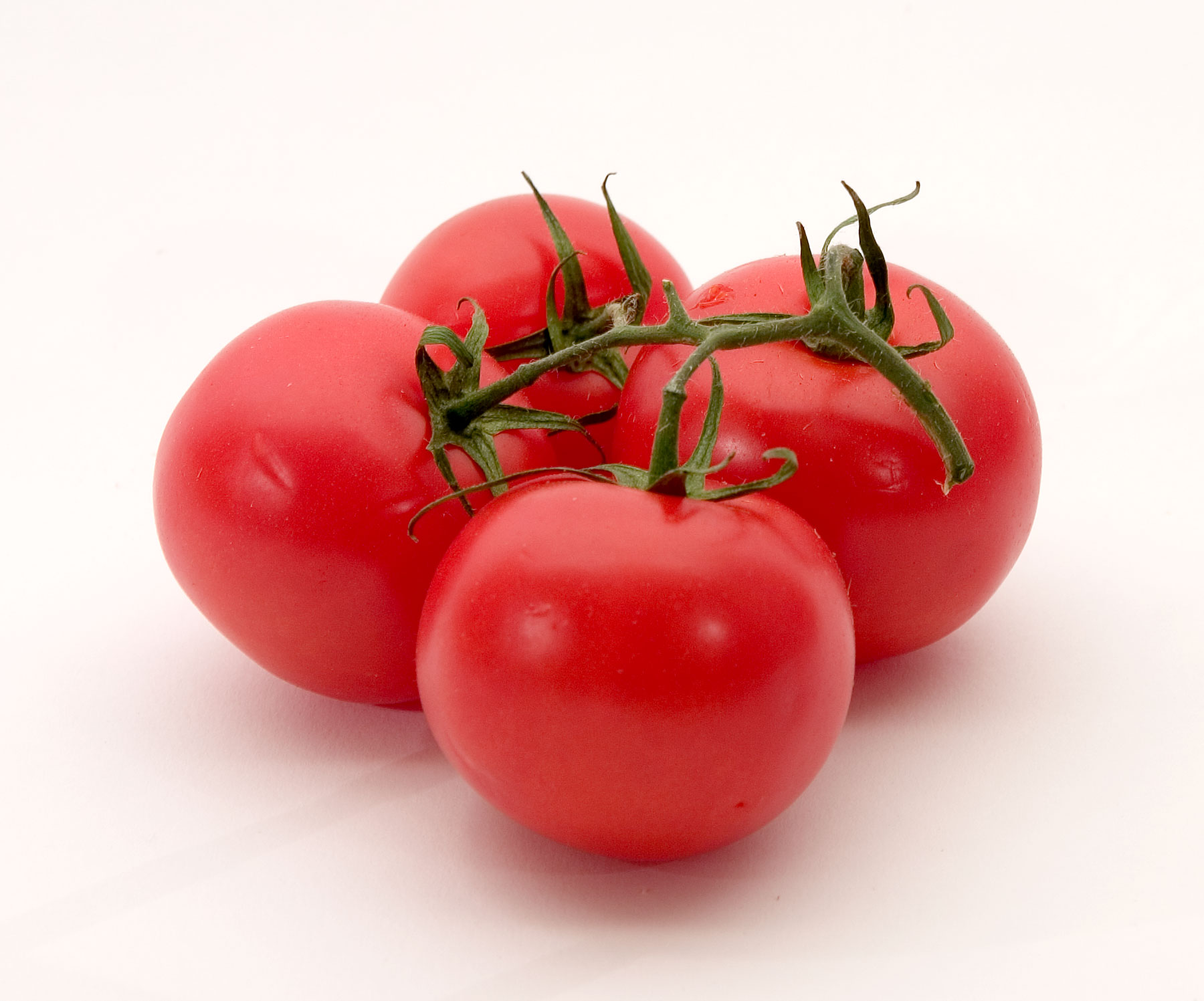
“Tomato je” by Softeis – Own work. Licensed under CC BY-SA 3.0 via Wikimedia Commons
If AC/DC was too much for you, here’s another small victory in parenting in the K-J house recently: we now call vegetables “power food.” (I.e., they make you more powerful, which of course is totally true.)
Not only that, but “power food” goes on the plate first, and the kids sit down to eat it before they eat the rest of the meal. An appetizer of sorts.
So far this lovely idea my wife had has been working like a charm. (Finally! They eat their veggies… mostly.) I raise my carrot stick to her in appreciation and celebration.
Here’s a free parenting pro tip: sing the chorus of AC/DC’s Thunderstruck antiphonally with your child to help them keep their mouth open. Then you can brush their teeth and gums the way the dentist tells you to.
You say: “Thunder!”
Your child responds: “Ah-ah-ah-ahhhh-ah-ah!”
You say: “Thunder!”
Your child responds: “Ah-ah-ah-ahhhh-ah-ah!”
Repeat ad infinitum, or until your child’s teeth are clean.
It’s been working like a charm here in the K-J house all week. Here’s the song if you need a refresher.
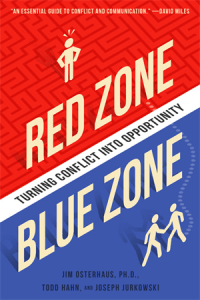
One of the people who has most influenced my understanding and practice of leadership is Dr. Jim Osterhaus. Case in point: one can survive so-called middle management by understanding a concept that Jim introduced me to (via Ron Heifetz): leading without authority.
Osterhaus’s Thriving Through Ministry Conflict, co-authored with Todd Hahn and Joe Jurkowski, offers some of the most practical advice I’ve ever read or heard on how to deal with conflict.
Most of us fear and dread conflict, at home or at work. But conflict can be your ally, not your enemy. Conflict doesn’t have to tear your family or organization apart.
Using the story of a family business leader embroiled in generational conflict, Red Zone, Blue Zone shows how to navigate conflict in a way that is healthy and leads to enhanced relationships, self-awareness, and greater leadership success. Practical response activities and personal reflection questions help the reader understand the sources of conflict, have a working command of conflict navigation principles, and be equipped to help others navigate conflict in their own lives.
You can find the book on Amazon, or at the publisher’s page linked above.
If you now find yourself or ever have found yourself in vexing conflict situations (i.e., if you are human), you should check this book out as soon as you can.
Our daughter is in the Terrific/Terrible Twos stage.
The terrible: she does things like write on the new kitchen floor in permanent marker. She leaves tons of tiny fingerprints on the MacBook and almost pushes the TV off its stand because she thinks they are both touch screens. She changes her own diaper and *tries* to flush its contents down the toilet herself. (Okay–this last one isn’t all bad–potty training, here we come!)
The terrific: sometimes, when she presses random keys on the laptop keyboard, instead of making the computer freeze, she discovers new tips. (Far more terrific than that, of course, is the fact that she is an amazing and wonderful human being.)
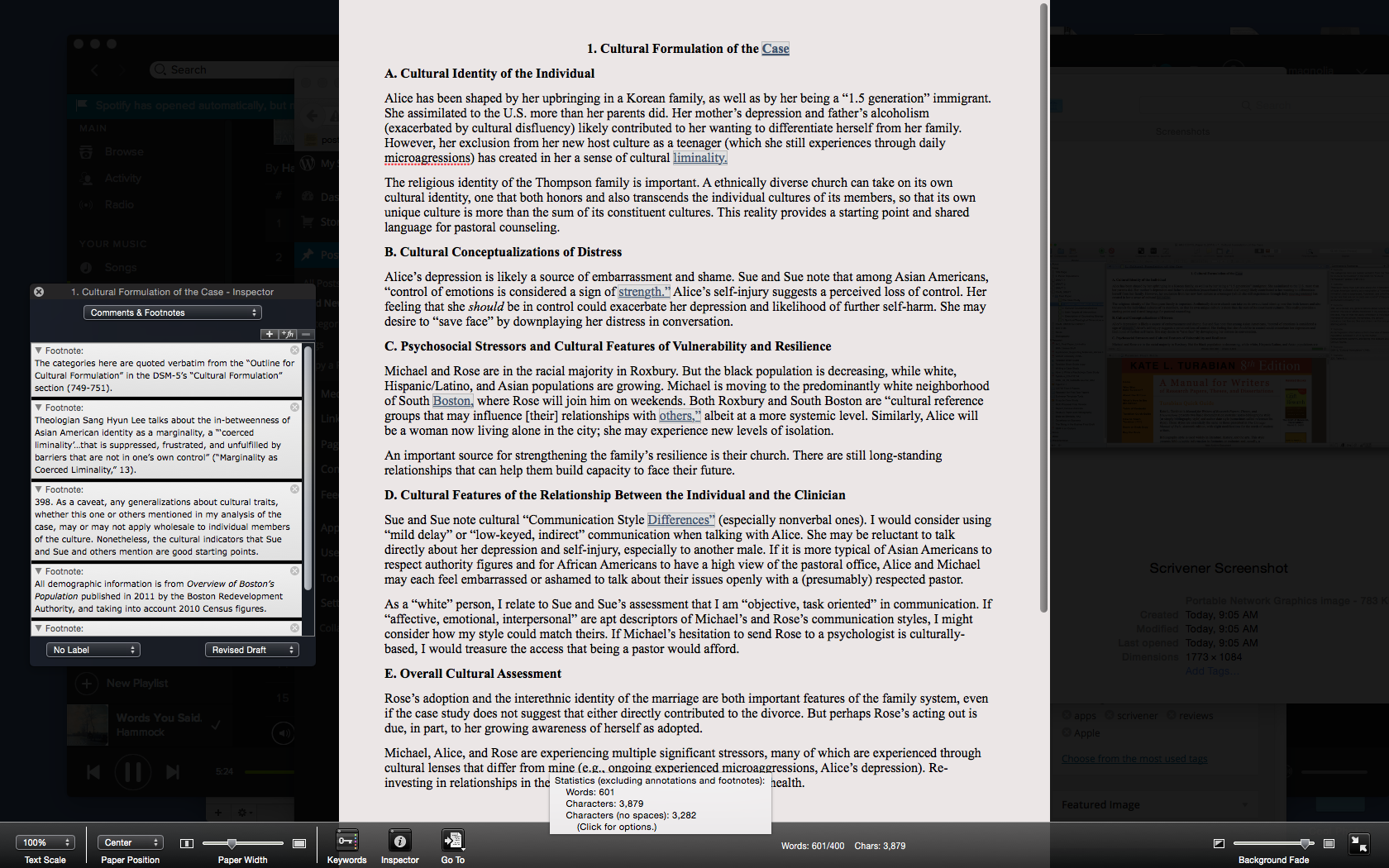
The other day she saw this little guy in the toolbar when I had Scrivener open for some work I was doing:
She tried to tap it (no Scrivener for iPad… but soon, I hear!). Then between the two of us, we clicked it and Scrivener went from this view:
Click or open in new tab to enlarge
to this one:
Click or open in new tab to enlarge
Yes, Scrivener can go into full screen, but this is something a little different–a composition mode where you can just write. You’ll see at the bottom (a toolbar which goes away if you want it to) that I can still pull up essentials like the footnote window on the left. Or I can move all that out and just focus on writing.
I’ve used Scrivener for more than a year now and don’t think I’ve ever clicked on “Compose.”
So… thank you, two-year-old daughter, for helping your dad learn more about a program he uses all week, and for simplifying my workflow!
Want to check Scrivener out? (I recommend it, and offer my thanks to the folks that make it for the review license.) Here you can download a free trial, for Mac or Windows. (It’s a generous trial period, too.) You can read more about Scrivener’s features here.
I have Honest Toddler to thank for helping me keep my wits about me as the father of three young kids. Here’s a recent Facebook status of this all-too familiar personality:
Good Morning! Wow it’s like it has been forever. …. Anyway for breakfast I’ll have 6 plain pancakes … on the red plate. Not the red one with the green trim or the brick colored one, RED. Yes, the one that shattered yesterday. I’m sure you’ll figure something out. God help you if I see a crack. Also, I would like my pancake intact but in bite-sized pieces. Don’t break my pancakes but please cut them. I want them undamaged but in small pieces so I can eat. Do you see what I’m saying? Perfect but altered. It’s not hard. Follow your heart but keep in mind that if you get it wrong I’ll make today hard. Ok I’ll be in the family room sitting in your lap while you also cook in the kitchen. Love you. (so hungry)
Toddlers can somehow seamlessly embody two (or more) mutually exclusive desires at the same time.
I want to wear that shirt, but I don’t want it covering my top half.
I want milk on my cereal, but I don’t want my Cheerios to be wet!
Nuanced Characters
I have a hard time knowing what to do when someone I’m responsible for wants me to do their top button, but at the same time leave it unbuttoned.
But when it comes to literature, film, music, and narrative TV, I love highly nuanced and complex characters.
I appreciate people like Elsa, Jimmy McNulty, Robert Duvall in The Apostle, any character by Flannery O’Connor.
Good literature, good film, and good TV all blur the line between “good guys” and “bad guys,” because those categories aren’t so clear in real life.
Jonah’s a fascinating character in that regard. We’re not really sure what to make of him. Is he a good prophet, a bad prophet, or some of both, depending on the day? His portrayal is not an even one, or an easy one to detect. He’s a bundle of contradictions and love and judgmentalism and frustration and eagerness and obedience…. He runs away from Nineveh, but then goes flying towards it, preaching repentance as he walks into the city. And then with his message successful, he flees the city again, to watch it from afar.
Jonah: Loves God’s Compassion (for him),
Hates It (for others)
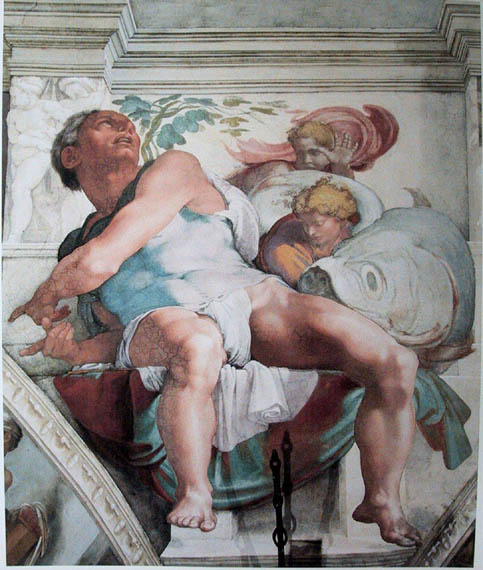
Jonah / Michelangelo / Sistine Chapel
God’s compassion is what Jonah loves most about God… when it comes to Jonah. It was God’s predisposition toward second chances, after all, that has kept Jonah alive throughout this book.
Jonah shows in Jonah 4 that he knew one of Israel’s creeds quite well: “I knew that you are a gracious and compassionate God, slow to anger and abounding in love, a God who relents from sending calamity.” And he rightly takes the shade-giving vine as God’s provision for him.
But if God’s provision and compassion toward Jonah is what keeps Jonah coming back to God, the Lord’s mercy toward despised others is what keeps Jonah running away from God.
Three times in this chapter Jonah tells God he’d rather die than watch his repentant enemies receive God’s clemency.
It almost makes you think about Peter’s three-fold denial of knowing Jesus. Jonah tries to deny God the opportunity to forgive whomever he wants to forgive.
Even the Animals
Jonah is angry enough to die. But God is concerned enough to save a clueless city…. even the animals!
Like in Jonah 4:11. Another translation follows the word order of the Hebrew a little more closely than the NIV, and punctuates the book’s ending with a mention of the animals!
“Should I not be even more concerned about Nineveh, this enormous city? There are more than one hundred twenty thousand people in it who do not know right from wrong, as well as many animals!”
A Heathen Animal of Nineveh, Pre-Repentance
Animals—there they are again! Putting on their sackcloth and mooing their repentance to the Lord.
Jonah loved the whale that saved him, but the worm that ate his shade—this animal he hated.
A vine that came up overnight, that Jonah had nothing to do with—he latched onto and cried when it withered. But a city full of hopeless people… well, he wanted them to wither like that vine… to go down into the depths and be consumed by worms.
But God loves all that he has made—evildoing humans, whales, worms, withered vines, and cursing sailors. Not one being is outside the scope of God’s loving care.
Good Theology, Bad Heart
Jonah gets a lot of things right. He’s right, I think, to be so angry at the perpetrators of injustice and oppression. He’s like every other God-inspired prophet who railed against those who tipped the scales to keep others down.
And he’s right about who God is, in verse 2 of the final chapter of the book: “a gracious and compassionate God, slow to anger and abounding in love, a God who relents from sending calamity.”
But not everything in Jonah’s head has made its way down into his heart. His theology at the beginning of this chapter sounds right, but he wants to apply the attributes of God just to himself.
It’s as if Jonah turns God’s words against him. He recites a well known formula, an articulation of who God is, but in a mocking tone of voice. In conflict resolution terminology, that’s called invalidating.
He’s like the prodigal son, who can’t stand watching lavish grace poured out on people who should have long ago forfeited the opportunity by their behavior. He’s the good guy, they’re the bad guys–why would God show them favor?
Which leads to an important question: Whom is God for? For whom exactly does God intend his salvation?
Whom is Christmas For?
And we might seasonally appropriate that question: Whom is Advent for? Whom is Christmas for?
Whose Light?
It would be easy in a season of preparation, to tend so much to our own hearts and lives, that we think only of how we receive Jesus for ourselves. We can spend so much time tending the vine, that we forget about the city we live in.
And we may be tempted to keep God’s compassion to ourselves and begrudge him when he shows mercy to those who have wronged us (and then turned to God). Well, we just wanted to see them get what was coming to them!
A Jewish commenter on this passage says, “It is not unusual for people to be so intent on the punishment of others that they lose their own way and are disappointed when people change their ways for the better.”
Jesus came into the world, offering light and life to anyone who would turn away from the darkness and turn toward him. And there are some really scummy people included in this invitation. How do we feel about that? What do we think of God’s way too liberal compassion? (I mean, he should pace himself more, right?)
Will we hide it under a bushel? Is God’s grace a proprietary character trait, only meant for the people of God? Jonah tried to hide under a vine, a divinely created shelter that he wanted only for himself.
But God sent a little worm to eat that thing up, in an effort to shake Jonah out of his self-focused slumber.
Choose Your Own Adventure
I like these stories with nuanced characters, ones whose interior lives are complex. I think this sort of storytelling is truer to the human condition.
And I resonate with Jonah. He gets it some of the time; other times, not so much. He really has a hard time just letting God be God.
One other thing that good storytellers do, besides writing full and complex characters, is to write compelling endings.
You can probably recall endings to novels that left you with goosebumps, because the last few lines of the story actually described a new beginning:
So we beat on, boats against the current, borne back ceaselessly into the past.
After all, tomorrow is another day.
Max stepped into his private boat and waved goodbye and sailed back over a year and in and out of weeks and through a day and into the night of his very own room where he found his supper waiting for him—and it was still hot.
These stories show characters with the hope of boats going on, even if into the past… they show the hope of a new day, the hope of a still-hot dinner, waiting in his room.
The narrator of Jonah is writing a new beginning into the end of the story.
But Nineveh has more than a hundred and twenty thousand people who cannot tell their right hand from their left, and many cattle as well. Should I not be concerned about that great city?
This is no tidy conclusion. It’s a question. It’s a rhetorical question, and we know the answer, just like Jonah knew the “right answer” in verse 2. But even as a rhetorical question, it invites—even demands—our response.
We have no idea how Jonah ends for Jonah. We don’t know if he’ll continue in his anger, or if he’s changed for the better.
But it really doesn’t matter… because it’s not just Jonah’s new day that the author concerned about… it’s ours. This is not The Great Gatsby or Gone with the Wind or Where the Wild Things Are. Jonah reads much more like a Choose Your Own Adventure book, where you, the reader, decide how the story ends for you.
The conclusion to Jonah requires our participation.
God has compassion on evil agents of empire when they come clean. The compassion that was always ours is now theirs—we have decide if we’re okay with sharing.
We are left with having to answer God’s question ourselves. The main character of the book of Jonah has always been God, with Jonah the most prominent supporting actor. But now we become the supporting cast, as we hear God ask:
“Should I not be concerned about that great city?”
Should I not be concerned about people who are killing each other, enslaving the innocent, beating the helpless, oppressing the poor, and destroying the environment?
Did I not come to earth to set despised evildoers free, too, should they accept my love?
Do you have any right to be angry at my gratuitous acts of incarnation, crucifixion, and resurrection for the life of the world?
Is this not the way, God asks, of my breaking in on earth, that I should have mercy on whom I will have mercy, and compassion on whomever I please?
This doesn’t mean there won’t still be justice, but do you have any right to be angry, God asks, when I decide to save the ones who should be smitten down?
The book of Jonah all boils down to that burning question: What will your response be, O reader, to the ways and work of God? Can you only accept it on your own terms, and keep God’s grace close to home? Or can you see Jesus as coming to earth for everyone, a gift of love for anyone who would believe?
Jonah ends here—but for us, the revelation of God’s concern for oppressors is not a period, but an ellipsis….
When Jesus comes, will we receive him largely for ourselves? Or can we receive him on his own terms, and open our hearts to his compassion so that we overflow with love toward even the most corrupt parts of God’s creation?
The skilled storyteller invites us now to take up the pen…
Did you know that you can get the entirety of Joy of Cooking in your iPhone or iPad?
The iconic and ever-useful cookbook would be hard to improve upon in its print edition (though some duct would help ours), but the iOS app does just that.
It’s currently on sale through New Year’s Day, $4.99 at the App Store. EDIT: They’ve changed the price twice since I posted. As of 12/22, it’s $6.99.
If I procure the app unto myself, I shall report back, but for now here’s a bit of what it claims to be able to do:
• Universal app supports both iPhone and iPad.
• Thousands of recipes and reference materials cover everything from enchiladas to lemon meringue pie.
• All materials are included in the app. No internet access is required.
• Pre-set digital timers enable you to get each recipe just right.
• Let the app speak each step aloud so you can concentrate on cooking, rather than reading.
• Navigate each recipe with simple voice commands. No need to touch the screen with sticky fingers!
• Thousands of photos and illustrations leave nothing to interpretation.
• Built-in menu-maker allows you to create a menu and use it to
navigate among recipes while you cook; you can even print it out or
email it to your guests.
• Joy of Cooking classic red bookmarks help you keep track of several recipes at once.
• The Favorites list lets you store recipes that you want to cook again and again.
• Shopping lists can be created easily from one or more recipes.
• The Sleep-Block feature prevents your iPad from sleeping when you just want to cook.
• A switch to enable metric units can adapt recipes to your preference.
• A built-in conversion calculator makes it easy to substitute just
about anything. Want to know how many teaspoons are in a half-cup? That
answer, and many others, is just a few taps away.















 Words on the Word