Zondervan has just published the first two volumes of a new Old Testament commentary series, Hearing the Message of Scripture. Here’s part of a brief description of its approach:
[W]hen dealing with specific texts, the authors of the commentaries in this series are concerned with three principal questions:
What are the principal theological points the biblical writers are making?
How do biblical writers make those points?
What significance does the message of the present text have for understanding the message of the biblical book within which it is embedded and the message of the Scriptures as a whole?
The achievement of these goals requires careful attention to the way ideas are expressed in the OT, including the selection and arrangement of materials and the syntactical shaping of the text.
Zondervan introduces the series more fully here, with a listing of contributors here. Or, if you prefer a video introduction, here is Series Editor Daniel I. Block on the series:
You can see PDF samples from Obadiah (by Daniel I. Block) here and from Jonah (by Kevin J. Youngblood) here. Zondervan’s book pages for each title are here and here. I’ve read half of the Obadiah volume so far and will post a review shortly.
…to beef up your knowledge of vocabulary in the Hebrew Bible. But reading through the detailed instructions on building the tabernacle (Exodus 26 and following) can feel like too much of a vocab stretch. It seems like every other word is a rare one. Using an alphabetically organized lexicon for such passages really slows down the reading. Also, readers who have a way to gauge how common a word is can decide if they should know it or not.
Back in Print
A resource that has been out of print for some time is now back and available in a (cheaper) paperback edition. Zondervan’s Reader’s Hebrew-English Lexicon of the Old Testament offers verse-by-verse glosses (short translation equivalents) for rarely occurring words in the Hebrew Bible. The glosses are based on the Brown/Driver/Briggs (BDB) lexicon, with the context of each verse also taken into account. Organized in canonical order and covering the whole Old Testament, the lexicon lists each word that occurs 50 times or less in the Old Testament. Next to the word is the gloss and how many times that word appears in (a) a given book and (b) the whole Hebrew Bible. Each entry also has the page number in BDB, if you want to consult that additional work for a longer definition of a word. For verbs, the number of occurrences of that particular stem is also noted.
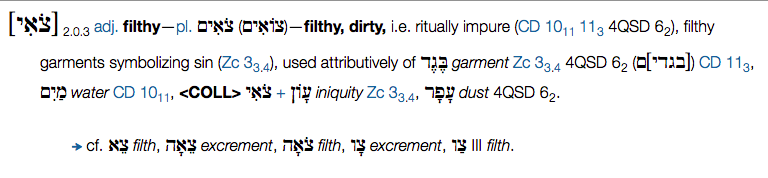
The lexicon follows the order of books that the Hebrew Bible does (i.e., the ordering differs from English Bibles). Only numbers and proper nouns are not included. The lexicon clocks in at 720 pages. It’s not as portable as when this single work was split into four volumes, but those are as hard to find as the four-volumes-in-one hardback had been. A Reader’s Hebrew-English Lexicon is intended to be a sort of counterpart to Kubo’s Greek lexicon by Zondervan. Here’s what it looks like:
I often struggle to remember Hebrew words that occur between 50 and 100 times in the OT, so the additional appendix is especially useful–it has Hebrew words that occur more than 50 times. There is also an Aramaic appendix.
How I Use It, Why I Like It
I’ve used this reader’s lexicon in tandem with Zondervan’s nicely laid out “reader’s” edition of the Hebrew Bible. Though that Bible already footnotes rarely occurring words, the frequency counts in this lexicon help me know if it’s a word I should have known (e.g., one that occurs 45 times) or one I shouldn’t be surprised to not know (e.g., one that occurs three times).
The glosses are sufficient for rapid reading of the text. And the frequency counts add a nice orienting element not found in the reader’s Bible.
This edition is a reprint, so nothing has been re-formatted or changed in terms of the font. The font, while not always crisp on every page, is readable, both in Hebrew and English.
Yes, there are good Bible software options for reading the text, but I still like to read through the Hebrew Bible in print, and this reader’s lexicon makes for a convenient and trustworthy guide. For bettering one’s Hebrew vocabulary and reading, I heartily recommend it.
Thanks to Zondervan for the review copy of the lexicon. Its product page is here. It’s here on Amazon.
This is a meta-review of sorts: a review of a book that briefly reviews commentaries for each book of the Old Testament. I.e., here are some words on some words on some words on the Word.
Leading Old Testament scholar Tremper Longman III provides students and pastors with expert guidance on choosing a commentary for any book of the Old Testament. The fifth edition has been updated to assess the most recently published commentaries, providing evaluative comments. Longman lists a number of works available for each book of the Old Testament, gives a brief indication of their emphases and viewpoints, and evaluates them. The result is a balanced, sensible guide for those who preach and teach the Old Testament and need help in choosing the best tools.
It’s a recurring question: What are the best Old Testament commentaries to get? To help answer that question, Longman rates an impressive host of commentaries on a 1-to-5 star scale:
One or two stars indicate that the commentary is inferior or deficient, and I discourage its purchase. Four or five stars is a high mark. Three, obviously, means a commentary is good but not great. I also use half stars in order to refine the system of evaluation.
One nice touch in this book is that all of the five-star commentaries are separately listed in an appendix in the back. Students or pastors looking to build a library might start there. Before turning to commentaries on individual books of the Bible, Longman briefly reviews one-volume commentaries (though this one is absent) and “commentary sets and series.” In addition to the stars, Longman notes whether a book is better suited for a layperson (L), minister/seminary student (M), or scholar (S), or some combination of those three.
To have a rating system is good, but there are some odd ways in which it is applied. One unlucky book got “no stars” on what the 1-to-5 star scale. And the comments (a paragraph’s length) under each commentary don’t always seem to match the rating. For example, a commentary on 1 Chronicles that has “a very helpful discussion of all aspects of the book” and other positive evaluation from Longman receives only 2.5 stars. A Genesis commentary whose author “shows great exegetical skill and theological insight” then receives 1.5 stars. As does another whose author “is insightful and knowledgeable.” One series receives four stars as a whole, but one of the individual commentaries that is “definitely one of the best volumes in the series thus far” receives just three.
There are also some things that were missed in updating the 2007 fourth edition to this 2013 fifth edition. The Berit Olam series was “just under way” in the fourth edition, and is so here, too. The New American Commentary series in both 2007 and 2013 editions is “relatively new,” even though it has a number of volumes published in the early 1990s. In the Proverbs section, Fox’s Anchor commentary still only consists of volume 1 (“Hopefully, we will not have to wait too long for the rest of the commentary to appear”), even though volume 2 was published in 2009. And there is also no mention of the Baylor Handbook on the Hebrew Text series, which had five volumes published by the time of this new edition of Longman’s work. Also, especially with the proliferation of commentaries now available through Bible software, an appendix covering electronic books would have been nice.
As far as his written evaluation of the commentaries, Longman is especially favorable toward Old Testament commentaries that discuss how a given passage is used in the New Testament. It’s not clear to me that–even for a Christian–this would be a requirement for a good Old Testament commentary, but I see his point, and am disposed to at least somewhat agree. He writes:
I continue to hope that future commentaries produced for use by Christian pastors in the church would include more reflection on how the Old Testament message is appropriated by the New Testament.
But, in my opinion, this criterion is perhaps over-applied, resulting in ratings penalties for what are otherwise strong commentaries, including ones that may have never set out in the first place to discuss the NT use of the OT.
One final critique: though there are not many commentaries on the Septuagint text of the Old Testament, a few series have begun. I can’t totally fault Longman for not having any Septuagint commentaries here, but I had hoped that the few that have been published might have been noted. I think also of John William Wevers’s Notes on the Greek Text series, which covers the Pentateuch.
Longman’s aim is for “this commentary survey [to] help students of the Bible choose the commentaries that are right for them,” and in that he is mostly successful. For example, he lets the reader know which commentaries date a given prophet according to “critical” or “evangelical” interpretations (I’m oversimplifying a bit here). He has helpful comments like, “If you get only one commentary on Joel, this should be it.” I finished this book feeling like I had a general lay of the land of Old Testament commentaries.
Despite a sometimes quirky or inconsistent rating system, and despite what appears to be a not really thoroughly updated volume, Old Testament Commentary Survey is unique, and one I already consult and will continue to consult whenever considering commentaries on a given Old Testament book. I just know I’ll have to supplement it with my own research and with seeking recommendations from others. The book works especially well as an introductory checklist that one can use as she or he is building a library of commentaries.
A sample pdf of the book, including introductory material and Longman’s take on one-volume commentaries and various commentary sets, can be found here.
Many thanks to Baker Academic for the review copy of OT Commentary Survey. You can find it here (Baker Academic) and here (Amazon).
Ask a group of pastors, seminarians, professors, or serious Bible readers, “What one commentary series on the Old Testament would you most recommend?” and you’re likely to hear: “NICOT.” Eerdmans’ New International Commentary on the OldTestament blends scholarship with application in a readable and engaging manner. Few, if any, commentary series are consistently this good throughout the series. And I don’t know of any other series that has such broad ecumenical appeal.
NICOT in Olive Tree has 23 volumes, spanning 26 biblical books. The bundle includes the 2010 volume on Hosea. The only volume currently in print that is not here is The Book of Judges, by Barry G. Webb (2012). (Judges is not available in any other Bible software at the moment.)
General editor Robert L. Hubbard Jr. writes of the series:
NICOT delicately balances “criticism” (i. e., the use of standard critical methodologies) with humble respect, admiration, and even affection for the biblical text. As an evangelical commentary, it pays particular attention to the textʼs literary features, theological themes, and implications for the life of faith today.
As I preached through Isaiah this past Advent, John N. Oswalt’s two volumes on that book were the first commentary I turned to after spending time with the biblical text. While it was always clear that Oswalt knew Isaiah and his milieu well, the author would find himself swept up at times in praise of the God Isaiah preached. On Isaiah 2:2, for instance, he writes:
What Isaiah was asserting was that one day it would become clear that the religion of Israel was the religion; that her God was the God. To say that his mountain would become the highest of all was a way of making that assertion in a figure which would be intelligible to people of that time.
On that passage’s promise of peace among nations, he concludes:
Until persons and nations have come to God to learn his ways and walk in them, peace is an illusion. This does not mean that the Church merely waits for the second coming to look for peace. But neither does it mean that the Church should promote peace talks before it seeks to bring the parties to a point where they will submit their needs to God.
Oswalt is representative of the authors in NICOT, in that he loves the text (and its grammar, history, and background) and loves the God who inspired it.
NICOT in Olive Tree has hyperlinks to biblical references and commentary footnotes, which you can easily and quickly view in the Bible Study (computer) app through the Quick Details corner (by hovering over the hyperlink), or as a pop-up window (which can then also pop out and keep your place in a separate window). It’s just as easy to tap a hyperlink in the mobile app.
There are two ways I’ve used NICOT so far.
1. I use NICOT as my starting point in the main window.
After some time in the biblical text, I have made my way through parts of NICOT by starting from the commentary. I can use hyperlinks to read the verses being commented on, as well as any other references. I can keep a Bible open in the split window and have it follow me along as I read through NICOT.
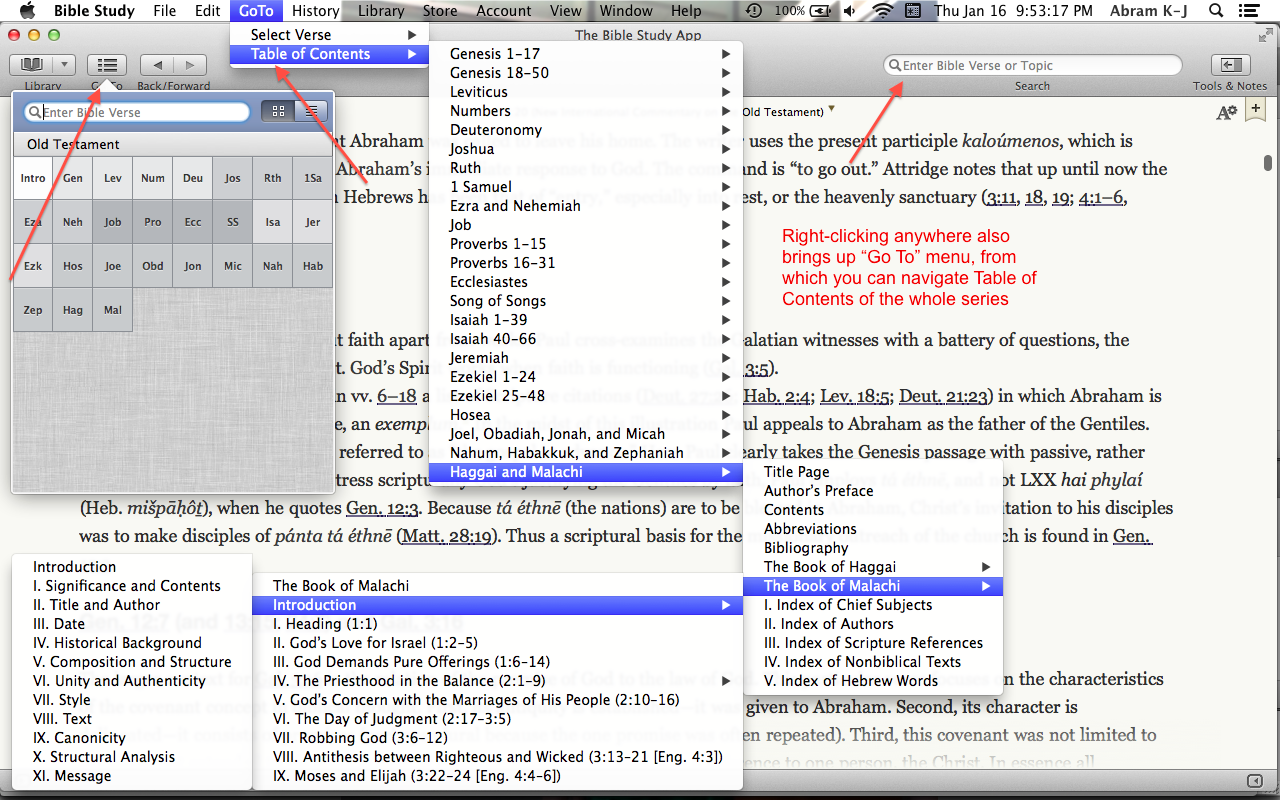
Using NICOT this way, there are quite a few ways to get around, both by looking up a verse in the commentary, and by navigating its Table of Contents. You only need to use one of these options at a time, but here they all are:
(click to enlarge image)
Note that from the Go To drop-down menu, I can keep following the sub-menus till I get to a specific place in the commentary (Introduction to Malachi in the instance above). One could also do this from the Go To item in the toolbar, which allows for both verse searching and Table of Contents navigation.
2. I use the Bible in the main window and NICOT as a supplement in the split window.
This has the advantage of letting me use NICOT as one among multiple resources in the Resource Guide, as shown (in part) here:
Resource Guide shows relevant library results (click to enlarge)
In both of the above setups you can take notes in NICOT, highlight, and bookmark your place. You can also do a search on a word or phrase in the commentary, with the results appearing almost instantaneously. One may wish, for example, to find all the times Oswalt refers to the “Suffering Servant” in Isaiah, which is an easy and fast search to run.
In reviewing Olive Tree I have found it to have the most versatile, smooth, and customizable Bible app I’ve seen on iOS. I write more about the Bible Study iOS app here. The fact that Olive Tree is cross-platform makes it appealing to many. Though the desktop app is well-designed, I would like to see a future update where you can create a saved workspace with multiple resources open in various tabs and windows. That, I think, would take the app to the next level.
But everything is here to help you work through NICOT in a way that you couldn’t in print. There are a couple of options (one free and one paid) for Hebrew Bibles, too, if you want to use NICOT in tandem with the original language. (NICOT uses transliterated Hebrew.)
NICOT volumes consistently top the charts of the Best Commentaries site. Preachers and professors, parishioners and pupils will all find much to mine here, as they seek to better understanding the Old Testament and to more faithfully love the God whose goodness its pages proclaim.
Thanks to Olive Tree for the New International Commentary on the Old Testament (NICOT), given to me for this blog review, offered without any expectations as to the content of the review.You can find the product here. For a little while longer, it’s $349.99 for the series, which is 50% off its regular price.
For the New Testament authors, the original text, that is, the text they drew on, was primarily the Septuagint. To make up the first part of the Bible which has the New Testament as the other part, the Old Testament in the shape it has in the Septuagint would therefore seem the obvious choice.
—First Bible of the Church: A Plea for the Septuagint, by Mogens Müller (p. 144)
Mogens Müller provocatively asks, “What caused the displacement of the Septuagint? …Today it is an open question whether the Septuagint should be reinstalled as the Old Testament of the Church” (p. 7). First Bible of the Church is part reception history, part biblical theology, and part apologetic work that suggests the Greek translation of the Hebrew Bible should be brought (back) into canonical status. It should be “at least part of a canon” (p. 122), if not the better choice than Biblia Hebraica for today’s “original text” of the Old Testament/Hebrew Bible.
What follows is a brief summary of the book’s contents, followed by some evaluative comments.
Müller’s Plea
Chapter 1 is the introduction to the book. In it Müller raises the question of just what should qualify as “the original text” of the Old Testament. If we see “what the early church regarded as its Bible” (p. 23), already one has to take the Septuagint seriously. This is not a question Müller addresses exclusively on textual grounds; for him the issue is also a theological one. To wit: In Isaiah 7:14/Matthew 1:23, “the ‘wrong’ text gains a significance of its own by being used” (p. 23).
Chapter 2, “The Jewish Bible at the Time of the New Testament,” looks at the canonization and textual history of the Jewish Bible, including various Greek recensions. Müller makes a key (and helpful) distinction in canonization between “the recognition of a writing as sacred” and “the final fixing of its wording” (p. 32). Evaluating various source materials, and dismissing the idea of an Urtext, the author notes the (accepted) fluidity of the process of textual transmission, where the actual wording in the sacred books only became important some centuries after the books themselves had become part of a canon. The implications of this, of course, are that New Testament writers may not have cared–in the way modernists do–about making sure they were using “the original” Hebrew text when quoting Scripture–if such a thing even ever existed as such.
Nonetheless, as chapter 3 points out, there was a very early historical concern about the authority of the Greek translation of the Hebrew Scriptures. Would the former be on par with the latter? Müller examines various defenses of the Septuagint (the Law books, specifically): Aristeas, Aristobulus, Philo, and Josephus. Chapter 4, “The Reception of the Septuagint Legend into the Church up to and Including Augustine” continues the historical inquiry into attitudes toward the Septuagint, especially when compared to the Hebrew text it was said to have translated. Justin and Irenaeus (among others) are given as examples of early interpreters who saw the Septuagint translation as inspired. Jerome, Müller suggests:
saw the Biblia Hebraica as the basic text as far as the Old Testament was concerned, and thus he contributed, at least for the Latin-speaking part of Christianity, to bring about the final abandonment of the Septuagint, which had very early come to be acknowledged as the Bible of the Gentile, Christian Church. (p. 86)
Biblia Graeca
Chapters 5 (“Hebraica sive Graeca Veritas?“) calls the Septuagint “a witness to the process of transmitting tradition” (p. 99), a process which Müller sees in ancient Judaism as having “a very creative character” (p. 104). Translation in antiquity included a measure of interpretation. The author’s foray into translation theory gives refreshing context to a world that valued lexical equivalency in translation less than many do today.
Chapter 6 (“Vetus Testamentum in Novo Receptum“) provides a short biblical theology, in which the New Testament is seen primarily as the story of Jesus, who himself fulfills what is written in the Old Testament. Müller notes that it is for this reason that the Hebrew Bible became the Old Testament, and yet its use by New Testament writers solidified its importance and sacredness for Christians. The Old Testament is necessary–“it remains the Holy Writ of the Christian community.” But it is not sufficient–“the Old Testament per se represents a limited epoch in salvation history” (p. 135).
The conclusion calls for the Septuagint to (re-)take its canonical place alongside the New Testament.
Is Müller’s Plea Worth Paying Heed To?
Yes. Readers of this blog and its Septuagint posts will not be surprised by my saying so. Müller makes a good case and generally succeeds in making a compelling plea for the LXX. If readers don’t accept his call to (re-)canonize the Greek OT, they will at least take seriously his petition to take it more seriously (as the NT writers did).
The book is short (some 150 pages) but dense. There is untranslated German and Latin in the footnotes, as one would expect in a scholarly monograph, but the writing is no less engaging for its density. The Greek font used throughout is easy to read, and the Greek is often translated into English.
Müller’s brief biblical theology at the end of the book is excellent. It left me wanting to read more. His notion of fulfillment as a motif that links together the OT and NT was convincing and well-articulated.
I found some typographical errors, as well as a number of sentences that just seemed to have wanted closer editing. This could be in part due to the book’s translation from a Danish manuscript. I was distracted in a few places as a result, but not consistently.
Evangelicals will find a few things they disagree with. For example, Müller cites Wellhausen approvingly to note that “the prophets were not reformers anxious to lead the people back to an original Mosaic religion.” The Law, then, “is not the starting-point but the result of Israel’s spiritual development” (p. 102). This line of reasoning is not essential to following the rest of Müller’s arguments, but his “redactional-critical attitude” (p. 100) does lead to a few assertions that some (including myself) don’t agree with.
Müller’s logic and historical inquiry is generally careful and robust, not to mention more readable than one might expect from a work of this nature. Perhaps it is due to the short length of the book, but there are still some unanswered questions. If “the Septuagint” is to comprise the Old Testament in Christian Bibles (as Müller suggests on p. 144, among other places), which Septuagint should we use? On which codex or codices should we base it? And given that Septuagint manuscripts vary on which books are included, how would we decide which books to place in a reconstituted OT? Simply those books that are now in the Hebrew OT, but in their Greek iterations? What about the Apocrypha?
And yet it appears that Müller’s aim is more to address “whether the Septuagint should be reinstalled as the Old Testament of the Church” (p. 7, my emphasis), not how and by what methodology such a reinstallation would take place. With this aim in mind, Müller’s short yet substantive book offers a compelling plea that deserves the reader’s careful consideration.
You can find First Bible of the Church: A Plea for the Septuaginthere at Amazon. Its publisher’s product page is here. Thanks to Bloomsbury for the review copy, given with no expectation as to the content of the review.
Isaiah 1:1 reads, “The vision of Isaiah son of Amoz, which he saw concerning Judah and Jerusalem in the days of Uzziah, Jotham, Ahaz, and Hezekiah, kings of Judah” (NRSV).
Scholars remain divided as to whether or not this “vision of Isaiah” verse is meant to apply to all 66 chapters, or whether Isaiah might be the author of just the first 39 chapters, with other authors (in the tradition of Isaiah) having penned chapters 40-55 and 56-66.
I’ve long had my eye on The Eerdmans Companion to the Bible and have begun using it recently. Its introductory section to Isaiah had what I thought was a refreshingly balanced approach to the issue of authorship in Isaiah:
Taken as an introduction to the book as a whole, Isa. 1:1 identifies the contents of the subsequent 66 chapters as the “vision” of 8th–century Isaiah. But modern scholars have challenged the traditional view that considers him the source of all the material contained in the book that bears his name. Though chapters 40–66 echo certain themes contained in chapters 1–39, they also contain specific, predictive prophecies that some scholars doubt Isaiah foretold. For example, they consider it unlikely that an 8th–century prophet not only predicted the 6th–century Persian king Cyrus’s conquest of the Babylonian Empire but also named him specifically (see 44:28 and 45:1). Old Testament prophets normally directed their messages to contemporaries. For Isaiah to have directly addressed the Babylonian exiles (and perhaps returnees to Judah) pictured in chapters 40–66, his prophetic ministry would have to have extended well beyond the reign of Hezekiah (the last king mentioned in 1:1), and he would have to have lived for more than two centuries.
On the other hand, in this book God holds out his power to predict the future as proof of his divine supremacy (chs. 41, 44, 46, and 48). It is not unreasonable, therefore, to think that Isaiah mediated predictive messages as words from God and at times addressed audiences of future generations.
More details on this Bible guide are here at the Eerdmans page. I’m finding that it’s a concise yet substantive way to get myself oriented to a given book of the Bible.
Recently I’ve been paying more attention to the Dictionary of Classical Hebrew and its Concise counterpart (see here).
It took me a little while to figure out how to read the frequency stats in DCH/CDCH. So I’m posting this little tidbit here to save some folks a bit of time.
The introduction to the concise version of the lexicon reads:
2. Statistics. Next comes a notation of the number of occurrences of the word in each of the four corpora of ancient Hebrew: the Bible, Ben Sira, the Dead Sea Scrolls, and the Inscriptions. Thus the notation 334.5.13.32 means that the word occurs 334 times in the Bible, 5 times in Ben Sira, 13 times in the Dead Sea Scrolls and 32 times in the Hebrew Inscriptions. If there is only one number in the statistics, the word occurs only in the Hebrew Bible, and if the notation is, for example, 0.0.7, it means that it occurs only in the Dead Sea Scrolls, and that 7 times. In the case of verbs, occurrence statistics are also given for each of the voices (or, binyanim).
The entry for נתן has a frequency count of “2015.62.228.26.” That’s straightforward enough. But then with the entry for תרומה the frequency given is “76.2.18.” This means it occurs 76 times in the Bible, 2 in Ben Sira, 18 times in the DSS, and 0 times in the Inscriptions. Another entry that has “11.4″ means 11 times in the Bible, 4 times in Ben Sira, 0 in DSS and 0 in the Inscriptions.
What took me a little while to figure out is that some entries have counts like “376.0.1,” which means 376 occurrences in the Bible, 0 in Ben Sira, 1 in DSS, and 0 in the Inscriptions.
The 0s are not noted, then, if there is not still a number to come after it that is 1 or more. In other words, you’d have “376.0.1,” but never “376.1.0.0″ or even “376.1.0.” That would be abbreviated instead to “376.1.”
It would have been easier if all the 0s were inserted in every case, so that you were always looking at 4 actual numbers (thinking of 0 as a “number” for the moment), but I am guessing that this is because the longer DCH (at 8 volumes in print) likely couldn’t afford to be filled with 0s, where they could otherwise be deleted.
In summary, the four corpora in this lexicon are:
Hebrew Bible
Ben Sira
Dead Sea Scrolls
Hebrew Inscriptions
Committing that sequence to memory (and better understanding when a 0 is used and not used) makes use of the lexicon even easier. I appreciate DCH/CDCH’s inclusion of frequency statistics, as I use it to build my Hebrew vocabulary.
I use the Concise DCH for regular Hebrew reading in Accordance, but have just recently been really getting to know it as a lexicon. The print version of The Concise DCH is here; in Accordance it is here. The full 8-volume set from Sheffield Phoenix Press is here, found also here at Accordance.
HALOT has been the scholarly standard in Hebrew lexicons, but might that change?
The mammoth 8-volume Dictionary of Classical Hebrew (DCH) is another major lexical source for readers of biblical Hebrew to consult. What is unique about the DCH is that lexicons like HALOT and Brown-Driver-Briggs (BDB) cover solely the Hebrew found in the Hebrew Bible. DCH, by contrast, covers a wider corpus–“from the earliest times to 200 CE,” it says. According to its product page:
It is the first dictionary of the classical Hebrew language to cover not only the biblical texts but also Ben Sira, the Dead Sea Scrolls and the Hebrew inscriptions. It is the first dictionary to analyse the exact sense of every occurrence of every word, to follow every Hebrew word or phrase with an English equivalent, to print a frequency table of occurrences of each word, and to provide an English-Hebrew index.
Not least among its features is its addition of more than 3500 new words to the stock of the Hebrew lexicon, together with an extraordinarily rich bibliography surveying special lexicographical studies over the last century.
The Concise Version
The 8-volume set in print is high-priced, as one would expect. It is much more affordable (as “affordable” goes, in these contexts) in Accordance, which is currently the only Bible software to carry it. The concise version seems to be financially within the reach of many students and pastors.
What is remarkable about the concise version of the dictionary is: “All the words in the full Dictionary of Classical Hebrew are to be found in the CDCH.” Of course, there are less instances of a given word’s occurrence listed, but that every word of the 8-volume set is treated in its 500-some-page younger sister is impressive.
The CDCH thus contains not only the c. 8400 Hebrew words found in the standard dictionaries, but also a further 3340+ words (540 from the Dead Sea Scrolls, 680 from other ancient Hebrew literature, and 2120+ proposed words for the Hebrew Bible not previously recognized by dictionaries).
By way of comparison, here is an entry for the same (rarely occurring) word in the concise and full dictionaries, respectively:
Full DCHConcise DCH
I use the Concise DCH for regular Hebrew reading in Accordance, but have just recently been really getting to know it as a lexicon. (UPDATE: see another post here on word frequency statistics in the lexicon.) The print version of The Concise DCH is here; in Accordance it is here. The full 8-volume set from Sheffield Phoenix Press is here, found also here at Accordance.
In this post I summarize and briefly interact with three more articles: “Warfare,” “Book of Genesis,” and “Haran.” Then I offer my concluding thoughts.
Warfare
A.C. Emery’s article explores “the conduct of warfare found in the Pentateuch, as well as instructions provided for the waging of warfare in Israel” (877). He notes, “Conflict is a common event recorded within the OT” (877), even if the student of ancient warfare tactics may not find much in the Pentateuch. To wit: “With rare exception the battle is described more for the divine intervention than for its technical conduct, which is the particular interest of this article” (878-9). God himself is described “as a warrior” (877) in the Pentateuch.
Emery looks at common Hebrew words that the Pentateuch uses to describe warfare and battles, with qārab (“draw near”) being the most common. He explores Pentateuchal “battle accounts” (879), from Abraham in Genesis 14 to Amalek in Exodus 17 and the “Canaanite king of Arad” and Og, king of Bashan, in Numbers 21-25 (879-80). There are “various instructions with regard to activities related to warfare” (880), including “the need to be… emotionally and religiously prepared for the dangers of combat” and the mechanics of negotiations and siege warfare (880). Emery’s final section examines the ethical difficulty that warfare poses.
Surprisingly, Emery does not in his ethics section mention the difficult Deuteronomy 7:2 with its “show them no mercy” command. He also has an article in the dictionary (“ḤĒREM”) that covers that passage, but his treatment of warfare ethics in “Warfare” was briefer than I would have liked. But, as with the rest of the dictionary, the few-page article still offers a decent jumping-off point for further research, even if it’s not a one-stop shop.
Book of Genesis
The entry on the book of Genesis examines the book with special reference to structure, plot, and theology (350). L.A. Turner’s key assumption is: “Genesis is a narrative book, and its theology is conveyed through features such as its structure, plot and characterization, rather than through set pieces of divine promulgation, as in legal or prophetic texts” (356).
Regarding structure, though there are varying theories, most agree that “Genesis is composed of two distinct blocks of unequal size” (350). The first runs roughly through Genesis 11 or the first few verses of Genesis 12 and is about humanity generally. Genesis 12 onward picks up the story of Abraham. The “main sections” in Genesis, according to Turner, are “the Abraham story (Gen 11:27–25:18), the Jacob story (Gen 25:19–37:1) and the story of Jacob’s family (Gen 37:2–50:26)” (350). The Hebrew word tôlĕdôt (genealogy) is a structural marker throughout Genesis.
The plot of Genesis has “progressive complexity” (352), moving from early human history to complex characters and families by the end of the book. “Divine promises and blessings” constitute “the book’s central core” (353) for Turner, and set the stage for the rest of the Bible (358). Regarding theology, he notes the tension “between divine sovereignty (as exemplified in the genealogies) and human free will (as demonstrated in the narratives)” (357).
I wanted to be sure to review a longer article in the dictionary. I was unexpectedly riveted as Turner walked through Genesis (10 pages in print). I found his contention that the book’s structure has theological import to be particularly compelling.
Haran
“Haran” in English could refer either to a place or to a person, though the spelling is different between each word in Hebrew (379). Both the place and the person are in Genesis 11:27-32, so M.W. Chavalas treats them together (379).
Haran the place is where Abraham lived after leaving Ur and before departing for Canaan (379). He also sought a wife for Isaac there, and Jacob found Rachel and Leah there, too. Similar to Ur, Haran centered on lunar worship. Haran is located in what today is southeastern Turkey. There is “only a small amount of archaeological evidence…for the city, and even less for patriarchal times” (379). It seems to have been inhabited already well before Abraham’s time, perhaps by some 20,000 people (379). Chavalas notes its likely founding “as a merchant outpost by the Sumerian city of Ur in the late third millennium B.C.” (379).
Haran the person has “very little biblical or extrabiblical information” recorded about him. He was Terah’s son, Lot’s father, and Abram’s brother. It was Haran’s death at Ur that led Lot to go to Haran with Abram. Haran also had two daughters, Iscah and Milcah.
The more I research Abraham and the Pentateuch, the more I realize how important Lot was to him. His desire to bear a family perhaps through Lot seems to be what led to his rescue of Lot in Genesis 14. Several dictionary articles point this out nicely. Chavalas covers Haran fairly thoroughly in a short amount of space (just two or three print pages).
**********
I hope Logos will update the dictionary so that the sidebar Table of Contents can expand to include all the article sub-points. Another thing that would make the product better is an easier way to find out about contributors from within an article. Having their names hyperlinked with their biographical information would be nice. As it is, one has to move between the article and the separate “Contributors” section to find out more about each author. [EDIT: Author names have hyperlinks in the Accordance production of this module.]
The Logos edition of the IVP Dictionary of the Old Testament: Pentateuch is overall a good module. Being able to have it open to both Hebrew and English biblical texts saves considerable time compared to using the print edition. The Dictionary is a solid first place to go on issues, themes, and people in the Pentateuch.
The Dictionary is on Amazon here (in print) and at Logos here. My thanks to Logos for the review copy. Read part 1 of my review here and part 2 here.
Here’s what the IVP page says about the dictionary in its book description:
The Dictionary of the Old Testament: Pentateuch is the first in a four-volume series covering the text of the Old Testament. Following in the tradition of the four award-winning IVP dictionaries focused on the New Testament and its background, this encyclopedic work is characterized by close attention to the text of the Old Testament and the ongoing conversation of contemporary scholarship. In exploring the major themes and issues of the Pentateuch, editors T. Desmond Alexander and David W.Baker, with an international and expert group of scholars, inform and challenge through authoritative overviews, detailed examinations and new insights from the world of the ancient Near East.
My first review contains an initial evaluation of the dictionary specifically in Logos Bible Software; you can read that here. In this post I summarize and briefly interact with three more articles: “Terah,” “Lot,” and “Ur.”
Terah
Terah was Abram’s father and Lot’s grandfather. He also fathered Nahor and Haran. M.W. Chavalas notes that Terah was “the family head,” since “all of the material in Genesis 11:27-25:11 is prefaced by the statement, ‘This is the family history of Terah’” (829). Chavalas considers Terah in three parts: the etymology of his name, his time in the city of Ur, and “Terah and Later Traditions.”
Chavalas considers several options for the meaning and linguistic source of “Terah,” but concludes, “An understanding of the etymology of the name Terah has proved to be difficult” (829). It does seem to have “associations with a place name in northern Mesopotamia” (830) and perhaps some associations with lunar worship (though perhaps not). Similarly, Ur, from which Terah comes, has been difficult to pinpoint. Chavalas places it in southern Mesopotamia. Chavalas finally considers the challenge that Acts 7:4 and Philo pose regarding chronology and location.
Chavalas manages to cover most of the essential territory on Terah in a short space. There is not much biblical material on Terah, but this article contains an overview of it all. There is little content in the “Terah and Later Traditions” section, and the article’s bibliography does not point to more resources to explore Abram’s father, for example, in rabbinical tradition. Detailed research on Terah would have to be supplemented with other resources.
Lot
Lot was Terah’s grandson and Abram’s nephew. J.I. Lawlor notes that Lot traveled with his grandfather Terah from Ur to Haran because his own father has died (556).
Lawlor primarily takes a literary and narrative approach to understanding Lot’s place in the Abram/Abraham material. He notes “two ‘paired sets’” of Lot material that “have been integrated, one set in each half of the Abraham story” (556). The author/compiler of Genesis does this, Lawlor notes, to “suggest and hold open the possibility of Lot as Abraham’s heir” (556), later dismissing the possibility as Isaac becomes heir (557).
Genesis 14:17-24 marks Abram’s encounter with Melchizedek, occasioned because Abram had gone to battle due to the Mesopotamian kings’ kidnapping of Lot. Abram rescued Lot in Gen. 14, then rescued him again, in a way, by interceding on behalf of Sodom and Gomorrah in Gen. 18-19 (557-8).
Due to an incestuous drunken encounter with his daughters, Lot gave rise to two groups of people, the Moabites and Ammonites, which Lawlor briefly discusses.
Lawlor’s most helpful contribution is in his situating of Lot in the larger flow of Genesis 12-19, where Lot serves as a possible answer to the question, Who will be an heir to Abram and Sarai? His reading of the “two paired sets” of Lot material is illuminating.
Ur
Like Chavalas in the “Terah” article, Osborne locates Ur in southern Mesopotamia as one of its “oldest and most famous” cities (875). Today the two-millenia old city of Ur is “modern Tell al-Muqayyar, located on the Euphrates in southern Mesopotamia” (875). Osborne looks at the archaeology of Ur as well as its place in patriarchal times.
Based on an early 20th century exploration of the tell (hill/remains) where Ur once was, archaeologists think that Ur was “not…one of the most extensive cities of its time” (875), with a population of just under 25,000. Ur was a center of lunar worship in Mesopotamia, as was Haran, where Terah would go from Ur (875). Tomb excavations have shown a wealthy city, which “was most probably derived from its lucrative involvement in trade along the Gulf” (876). Osborne also explores the debate over the birthplace of Abraham, whether it was northern or southern Mesopotamia (he favors the latter). He notes that the Genesis text does not say why Terah and his family left Ur.
Archaeology is not my primary interest within biblical studies, but Osborne introduces the basic archaeological finds to the reader in a short space, and does a good job of it. The bibliography at the end of the article offers titles for further reading.
**********
My impression of the dictionary continues to be positive. At the same time it is becoming clear to me that it is not comprehensive in the subjects it treats. So researchers, exegetes, writers, and teachers will want to consider using it alongside other resources. However, its ability to summarize much detail in a succinct way is a strong point of the dictionary.
I’ll do at least one other installment in my review of Dictionary of the Old Testament: Pentateuch, and include some concluding thoughts there. See the first part of my review here.
The Dictionary is on Amazon here (in print) and at Logos here. My thanks to Logos for the review copy.

 Zondervan has just published the first two volumes of a new Old Testament commentary series, Hearing the Message of Scripture. Here’s part of a brief description of its approach:






 Words on the Word