In which I finally try out Accordance Bible Software for Mac (new version 10!)

I have been an avid and happy BibleWorks user since version 7 (they are now in version 9). But my first computing love is a Mac. (Too bad for expensive taste in that regard!) I have a cheap PC laptop at home on which I run BibleWorks, but have been interested in exploring Accordance for some time. Now, thanks to the kind folks at Accordance who have given me a copy for review, I can take Accordance for a spin.

I apparently got into Accordance at just the right time. This week they launched an upgrade from Accordance 9 to Accordance 10. And it looks like users are pretty happy with the switch.

In a series of posts, I will offer my review of Accordance 10, Original Languages Collection. In this post I report on my installation process and initial impressions as to the program’s layout and interface.

Download and installation was mercifully fast, even over a wireless Internet connection. In 30 minutes or so I was able to download the Accordance application to my computer and the Original Languages Collection with its various modules.

I appreciated the flexibility offered me even in the initial setup. For example, I could make choices at the following spots:

(Although, I confess, I don’t know what “Helvetica Neue Light” looks like off the top of my head! No matter–this can always be changed later.) This next option for text formatting immediately endeared me to Accordance:

These are perhaps little things, but Accordance’s customizability seems obvious from the beginning.

The only snag I hit in installation was being able to install one of the included modules, even after multiple attempts (the BHS Latin Key). Although, taking a look at the forums, I’m not alone. I expect the Accordance team is mighty busy with the new release. Accordance 10 is already in 10.0.1. I don’t think this is a sign of a buggy version released too soon, but rather an indication that the folks behind the software are quick, responsive, and eager to improve upon the program.

Once finishing installation, I played around a bit with my resources, and within just a few minutes and no prior knowledge of Accordance, was able to set things up this way (click image for larger or open in new tab):

On the left you can see my “library” which in this view shows some of the texts that come with the Original Languages Collection. Thing of beauty: it has the New English Translation of the Septuagint. With how often I am in (and blogging about) the Septuagint, this makes me happy to see. The NETS is far from a perfect translation, but it’s the best English translation on the market right now.

In the middle you can see I have the Greek of Genesis 1 open, with the NETS right next to it and the IVP New Bible Commentary on the right of the middle section.

Then in the top right corner I opened the LEH Greek-English Lexicon of the Septuagint, available in previous Accordance versions only as a paid, add-on module (from what I understand). The bottom right corner shows the Hebrew text of Genesis 1.

Each of these boxes/windows are changeable and rearrangeable. I look forward to spending more time exploring the various configurations available to me through Accordance.

In sum: A quick, easy install with just that one hiccup of a missing module–soon to be resolved with a released fix, I’m sure. (UPDATE 8/23/12: It’s fixed!) And the layout and its flexibility has really impressed me on first use.

And, oh. The interface? Absolutely stellar. I love seeing a high-powered Biblical languages-oriented program native to a Mac. The interface in Accordance is as smooth as any program I’ve ever seen from Apple.

So far, so good.

UPDATE: Parts 2 and 3 of my review are here and here.
UPDATE 2: Here is part 4, a review of the Original Languages Collection.
UPDATE 3: Here is part 5, “Bells and Whistles.” UPDATE 4: part 6, “More Bells and Whistles.”

Review of Biblical Hebrew: A Compact Guide

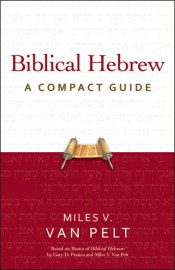
At long last, a compact reference guide to Biblical Hebrew!  Not long ago Zondervan released Biblical Greek: A Compact Guide, a helpful and portable distillation of Mounce’s oft-used grammar. Many such little books already exist for easily reviewing Koine Greek: Dale Russell Bowne’s Paradigms and Principal Parts for the Greek New Testament, Paul Fullmer and Robert H. Smith’s Greek at a Glance, and even the back of Kubo’s Reader’s Lexicon has a good summary of Greek grammar with paradigm charts.

There seem to be more resources available to students of Biblical Greek than to students of Biblical Hebrew.  For example, while there is just one (excellent!) “Reader’s” Hebrew Bible (uncommon vocabulary is glossed at the bottom of the page), I am aware of at least three Reader’s Bibles that exist for the Greek New Testament.  So Miles Van Pelt’s Compact Guide, based on his and Gary Pratico’s Basics of Biblical Hebrew, is a welcome addition as far as this eager Hebrew student is concerned.

The book is not terribly dissimilar from Pratico/Van Pelt’s Charts of Biblical Hebrew, but unlike that work, A Compact Guide is more than just a collection of charts and paradigms.  Each section includes a distillation of what is in the larger grammar textbook, followed by paradigms and charts for quick reference. Seeing Van Pelt’s world-famous color-coded verbal diagnostics is a highlight.

Oddly enough, at times there seems to be more precision and detail in this little book than in the larger grammar.  Or perhaps it’s just more nuance or smoother grouping of material that has come about with the passage of time since the publishing of the grammar’s second edition. For example, there is a section in the Compact Guide on “particles” that is a unique and clearer grouping than what is in the larger grammar. And whereas the grammar lists three kinds of Hebrew prepositions (independent, Maqqef, and inseparable), the Compact Guide adds a fourth: compound prepositions, where “two different prepositions, or a preposition and a noun” (28) combine to make a new preposition. (This fourth category appeared in the larger textbook later in its chapter as “Advanced Information”; having everything grouped together in the Compact Guide was easier.)

The primary focus of the guide is morphology (how words are formed, including paradigm charts) and syntax (how words are used in sentences, i.e., grammar).  Unlike Basics of Biblical Hebrew there is not much in the Compact Guide by way of vocabulary, save for a Hebrew-English mini-lexicon at the back of the book.  Unfortunately, there was no explanatory note as to what constituted inclusion on the lexicon.  (In Mounce’s Greek Compact Guide, the lexicon notes that it includes words that occur in the New Testament 10 times or more.)

From what I can tell, though, the Hebrew Compact Guide reproduces exactly the Hebrew-English lexicon in its larger textbook counterpart. In this case, the lexicon covers Hebrew words that occur 50 times or more in the biblical text. The Basics of Biblical Hebrew lexicon notes that it also adds “less frequently occurring words that appear in the grammar and workbook.”

In addition to a thorough listing of paradigms (the 11-page section on pronominal suffixes is particularly helpful), the book is filled with examples from the Hebrew Bible (with English translation).  The Hebrew font used, while not quite as easy to read as that of the grammar, is readable enough. (And that may just be a matter of personal preference anyway.)

The section on verbs is a particular strength of this work–in addition to examining all the forms and stems (both strong and weak), there are extensive listings of paradigms for easy review.

All in all, I give a hearty two thumbs up to this work–and express my gratitude that it is now on the scene for those who want to keep their Biblical Hebrew fresh!  For a beginner in Biblical Hebrew I would recommend the full-length grammar textbook, but for those with even a semester or two of Hebrew (and beyond), this small reference guide will be a valuable and inexpensive addition to their library. As Van Pelt notes in his preface, even “veterans” of Hebrew will be able to utlize the guide to “keep fit” in their language use.

Icing on the cake: the pocket-sized paperback comes encased in a sturdy, translucent plastic cover.

You can preview the book here.

Note: I received a review copy from Zondervan for the purposes of this review. I had initially reviewed a digital galley version of this book through Net Galley. The above reproduces my galley review, checked now against the hard copy for accuracy.

Basics of Biblical Aramaic

This textbook is a great one. I’m amazed at how much Aramaic it helped me pick up in just a long afternoon and evening. What follows is my review of Miles V. Van Pelt’s stellar text, Basics of Biblical Aramaic. It’s a winner!

Basics of Biblical Aramaic (BBA hereafter) is a “Complete Grammar, Lexicon, and Annotated Text.” I’ll review each of these components in turn.

Scope, Aim and Audience

BBA seeks to include “everything you need to learn biblical Aramaic” and is “designed for those who already have a working knowledge of biblical Hebrew.” This is a fair expectation, since most students of Aramaic only come to Aramaic having already had Hebrew (and often Greek, too). This allows Van Pelt to use Hebrew as a springboard for Aramaic throughout the book, which he does to great effect. He writes “for those students who desire to study, teach, and preach faithfully from those portions of the Bible that appear in Aramaic.”

I write as a member of Van Pelt’s target audience. I’ve had (more than) a year of Hebrew but no Aramaic to date.

Grammar

Van Pelt divides the grammar into the following sections:

  • Phonology, in which he introduces the Aramaic alphabet, vowels, and syllabification
  • The Nominal System, in which he covers nouns (absolute, determined, and construct states), conjunctions, prepositions, pronouns and pronominal suffixes, adjectives, numerals, adverbs, and particles
  • The Verbal system, in which he covers the simple Peal stem in all its conjugations (perfect, imperfect, imperative, etc.), followed by the derived stems in their multiple conjugations
  • Six pages of quick-reference Charts and Paradigms

Here is a sample pdf of the Table of Contents and first few chapters. In the book’s layout and in many other ways, BBA is like Van Pelt’s Basics of Biblical Hebrew (BBH), which he co-authored with Gary D. Pratico.

As with BBH the typical chapter layout of BBA is grammar followed by vocabulary. And in this case, since the workbook is essentially included in the text, chapters close with exercises. There is no answer key included, but the book lists the site from which it can be downloaded.

Van Pelt classifies verbs according to the “Peal” stem and its derived stems–also explaining alternate verbal terminology (G-stem, etc.). As he explains the various conjugations, he keeps aspect firmly in mind:

The incomplete (or imperfective) aspect of the Imperfect conjugation is well suited for describing present and future actions and so a present or future tense English translation is common with this verbal form. However, it is important to remember that that imperfective aspect of the imperfect conjugation may refer to actions in the past, present, or future….

One of Van Pelt’s aims in this textbook is “pedagogical sensitivity,” which he notes has not always appeared in Aramaic grammars. (He may have this one by Alger F. Johns in mind, which, good as it is, is not as user-friendly.) He succeeds immensely in this regard. That Van Pelt is a professor in an actual classroom is on display throughout the text; his tone is warm and even encouraging in many places. Each chapter concludes with a “Before You Move On” section, which helps the reader distinguish between things he or she needs to commit to memory and what he or she can leave for future reference.

Van Pelt’s grouping of vocabulary also exhibits “pedagogical sensitivity.” Initial lists have vocabulary that is similar or identical to Hebrew, so that an Aramaic student can get a quick jump on vocabulary acquisition. Van Pelt groups several lists according to semantic domain and also parts of speech. This is merciful to the students who will work their way through BBA (and good pedagogy). He includes all Aramaic words occurring four times or more in the OT, which constitute 91% of the text.

Lexicon

The lexicon is a comprehensive one that includes every Aramaic word occurring in the OT. Van Pelt bases the definitions/glosses on HALOT. There are definitions for different stems of each verb, too. There are no word frequency counts, either here or in the vocabulary lists. (Basics of Biblical Hebrew has frequencies in the vocab lists at the end of each chapter, one of its great features.) However, this may not be as essential as in Hebrew, since the Aramaic corpus in the OT is smaller. Van Pelt does include frequency statistics for many prepositions, conjunctions, adverbs, particles, and stems as he introduces them throughout the text.

Annotated Text

This is the best feature of an already great textbook. In the same way that Van Pelt and Pratico’s Graded Reader of Biblical Hebrew helps the student to really dig into the text, the Annotated Text in the back of BBA allows the student to put his or her new knowledge of Aramaic into practice. Every OT verse and passage in Aramaic is included: Genesis 31:47, Jeremiah 10:11, Daniel 2:4b-7:28, Ezra 4:8-6:18, and Ezra 7:12-26. The footnotes link back to specific chapters and sections of the text, and Van Pelt includes detailed morphological and lexical analysis of various words.

Further reflections

I have only two (minor) critiques of this textbook, which are as much as anything hopes for small adjustments that might be made in a future printing or edition of this book.

First, there is little about Aramaic in its Northwest Semitic context. This isn’t an oversight; Van Pelt says his grammar is not “written for Aramaic scholars or for students interested in comparative Semitic grammar.” Instead he wants to help produce a “working knowledge” for those who will “study, teach, and preach faithfully” from the Aramaic portions of the Bible. Fair enough. And he does allude to further discussions of Aramaic as a language in his footnotes. But as I imagine myself teaching and preaching Aramaic portions of the Bible, I think it would be helpful to know something of Aramaic’s context and development, to explain to my congregation. This could simply be a few paragraphs in a future edition.

Second, the verbal diagnostics Van Pelt highlights (using “the identification of distinctive verbal features unique to a group of related verbal forms”) are explained in the individual chapters, but not color-coded in the paradigm charts. They are given in red in the Hebrew textbook Van Pelt co-authored, and this was one of the most useful parts of that book–it really aided in learning the paradigms. Van Pelt does explain what diagnostics to look for, but I’d love if a future edition or printing could color-code the vowels/consonants that constitute the various verbal diagnostics. (UPDATE: I had thought that perhaps the lack of color in verbal diagnostics was a print cost issue. I’ve now been able to confirm that there will eventually be an electronic release of the grammar with color.)

Also, though this might be asking a lot of a single text, I found the English to Hebrew composition exercises in the BBH workbook to be a great way to improve my Hebrew. Perhaps supplemental composition exercises could find their way onto Van Pelt’s site in the future?

I initially thought a $45 retail price was steep for a paperback. But considering that this includes a grammar text, workbook exercises, a comprehensive Aramaic lexicon, and an annotated text of all the Aramaic in the Old Testament… it’s actually reasonable. In the Hebrew and Greek equivalents to this textbook, the text, workbook, and set of annotated readings are all separate volumes. This was a good move on the book’s part, I thought, and makes it easy to refer to it time and again as a one-stop shop for Aramaic acquisition and development.

What stands out most to me about Basics of Biblical Aramaic is the very-nice-to-have Annotated Text at the back with all the Aramaic OT passages. And another standout feature of this text is that Van Pelt truly does display “pedagogical sensitivity” throughout the text. Who would have thought an Aramaic textbook could have such a conversational tone without sacrificing thoroughness and good pedagogy?

Five stars. I imagine this textbook will become the standard in seminary and upper-level college courses where students learn biblical Aramaic.

My thanks to Zondervan for the review copy of this textbook. Find it here on Powell’s or here at Zondervan’s product page.

Review of Malachi (Baylor Handbook on the Hebrew Text), part 2

In this post I both explain the jarring Malachi 2:3-4 as well as offer part 2 of my review of Malachi: A Handbook on the Hebrew Text by Terry W. Eddigner (Baylor University Press, 2012). Part 1 of the review is here.

Eddinger begins each passage with his own English translation, then analyzes the Hebrew text verse by verse. Any reader will appreciate that Eddinger prints the full Hebrew text of a given verse, then reprints the various clauses and words when commenting on them. (This eliminates the need to constantly refer to another book when using Malachi.) The Hebrew font is large, clear, and easy to read. It’s fully pointed and includes the Masoretic markings that one would find in the BHS. Though at first I had wished to see the English translation verse-by-verse alongside the Hebrew, Eddinger’s decision to have English translations primarly at the beginning of a passage does force the reader more into the Hebrew itself. For the intended audience of “a second-year Biblical Hebrew student” whose focus is translation, grammar, and syntax, this is a good thing.

I was pleasantly surprised to see that Eddinger discusses textual variants throughout the handbook. He especially focuses on LXX/Septuagint variants that receive attention from the BHS editors. His conclusions regarding variants often end with something like, “X makes sense in context and so should be retained.” Thoroughgoing text critics may be left wanting more evaluation or interaction with variants than this (as I was at times)–but this is a short handbook. The fact that the author highlighted such variants at all was an added bonus, as far as I’m concerned.

Eddinger gives excellent attention to grammatical and syntactical detail–down to an assimilated dagesh lene (1:13)! He treats clauses as wholes–for example, highlighting word order and fronting for emphasis. And he treats individual words and parts of speech. He never loses the forest for the trees, and he gives the trees their due attention, too. In conjunction with the “key words” chart at the beginning of a section and the appendix of all Hebrew words in Malachi, Eddinger often notes rare Hebrew words as such, giving something of their context in the rest of the Hebrew Bible. He seems to have HALOT, TDOT, BDB, and other technical commentaries readily at hand as he comments on the text. On 1:14 he writes,

נוֹכֵל is a rare word in the Masoretic Text, occurring only four times (only here in Malachi) and means “one who acts cleverly” or “deceitfully” thus, “a cheat.”

That is the sort of insight I could come to expect on a regular basis by the end of the handbook. I loved it for that.

In terms of grammar, his discussion of individual words includes syntax and morphology, with every single word parsed / morphologically analyzed and often more detail than that. Eddinger uses the qatal and yiqtol verb classification system. This may not line up with what every Hebrew student has read regarding tense/aspect in their first-year Hebrew class, but it does (at least according to some) carry significant advantages over “perfect” and “imperfect.” (See a mini-primer on the Hebrew verbal system here.)

Regarding the verses from Malachi with which I led off part 1 of this review, Eddinger explains them well:

פֶרֶשׁ refers to the contents of the bowels of sacrificed animals, which the priests were to burn as refuse at a location away from the altar (Exod 29:14; Lev 4:11; 8:17). The phrase [feces upon your faces] is a double entendre in meaning as the act is an act of humiliation and contact with the ‘unclean’ matter makes the priests ‘unclean’ for their priestly duties.

(I allude more to Malachi 2:3 here.)

I’ve found Malachi to be an indispensable companion for reading through Malachi in Hebrew. I do have one minor critique and one larger one, though.

First, the English Bible versification at the end of Malachi gives the book four chapters; it is just three in the Hebrew text. Malachi nowhere notes this (although it does note regarding the last three verses that “some LXX texts have these verses reordered.” Again, this is a handbook on the Hebrew text, but a simple explanatory note here as to why English Bibles have four chapters in Malachi and Hebrew Bibles three would have been beneficial.

Second, I found myself often distracted (though I didn’t want to be) by the presence of typographical errors or comma splices or run-on sentences. I hope future printings can correct these, since they take away from an otherwise great book. There would be no benefit in listing typos here, but there were some 20 or more spots where either a word was misspelled, there was disagreement of number between verb and subject, punctuation was missing, and so on. Fortunately the vast majority of these are in English and so easy enough to spot. (I.e., the reader can trust the Hebrew here.) But the author’s English translation sections especially seemed to be in want of a closer edit. I do hope future printings or editions can make adjustments here; I imagine students of Malachi will want to make use of this book for years to come.

Eddinger in the end is a worthy guide through the Hebrew of Malachi. The prophets often (suddenly!) shifted pronouns or speakers or subjects in their writing. Who is talking now: God, the prophet, both, or the people? Eddinger coolly walks the reader through such grammatical challenges, and others besides.

While the obvious use of Malachi is as a reference work in which to look up a given passage, it reads well as a whole, too. I eagerly await future books in the Baylor Handbook on the Hebrew Bible series.

Thank you to Baylor University Press for providing me a free copy, in exchange for an unbiased review (which ends up being a two-part review in this case–by my choice). You can find the Baylor product page for Malachi: A Handbook on the Hebrew Text here. It’s on Amazon here.

Review of Malachi (Baylor Handbook on the Hebrew Text), part 1

“Because of you I will rebuke your descendants; I will smear on your faces the dung from your festival sacrifices, and you will be carried off with it. And you will know that I have sent you this warning so that my covenant with Levi may continue,” says the Lord Almighty.

–Malachi 2:3-4 (NIV)

Although Words on the Word has since taken fuller shape, two primary motivations in my beginning this blog were (a) to read and review good books and commentaries and (b) to interact with the original Biblical languages. This post offers a good opportunity to do both. Here I review Malachi: A Handbook on the Hebrew Text by Terry W. Eddigner (Baylor University Press, 2012).

The Hebrew prophet Malachi holds a significant place in the Hebrew Bible. Malachi is the last prophet of the Book of the Twelve (minor prophets) and the last book in the Hebrew Bible/Old Testament. The last two verses of Malachi are Yahweh’s promise to send the prophet Elijah–a promise fulfilled, Christians believe, by John the Baptist. It sets up the beginning of the Gospels well.

The Baylor Handbook on the Hebrew Bible series is a deliberately unique contribution to the field of commentaries on the Hebrew Bible. Okay, I suppose all commentary series intend to make unique contributions, but this one really does. It fills a void. Although the student of the Hebrew of the minor prophets is fortunate to perhaps be able to access Baker’s fine exegetical commentary (Malachi is in this volume), there is still a dearth in general of OT commentaries that comment extensively on the Hebrew text and grammar. In that sense I’ve been happy to see the careful attention this series gives to the Hebrew text. (Bonus: this book and some the others in the series that I’ve briefly glanced through give good treatment of discourse analysis.)

It’s important to note from the outset that Malachi (as a book in this series) is not a “full blown commentary.” It’s a “Handbook on the Hebrew Text,” which does “not attempt to replace the second step of consulting commentaries and secondary literature….” In keeping with this aim, Terry W. Eddinger gives the reader a short (five pages) introduction, yet it is plenty to be able to work well within the Hebrew text of Malachi. (And a bibliography with references throughout points readers in the direction of other Malachi-related literature.) Eddinger especially emphasizes the structure and “literary forms and devices” in Malachi. He views the structure of Malachi as consisting of a superscription, six oracles, and two appendices. Literarily, Eddinger says, Malachi is a prose and poetry hybrid, “perhaps the best example of such in the Hebrew Bible.”

There is a linguistic glossary at the back of the book, so when Eddinger says, “Hortatory style is the predominate literary form and is found in all but two verses,” the uninitiated reader can quickly determine that hortatory means “a word, clause, or sentence of direct dialogue.” This is perhaps an over-general or vague definition (the Jonah book in this series has, “Hortatory discourse is meant to exhort someone to act in a particular manner”), but I found that not to be the norm for the succinct and useful glossary.

One commendable feature is the “key words” chart at the beginning of each oracle. Malachi is the first book in this series to offer such a feature. Eddinger highlights important words that the reader will want to know as he or she makes his or her way through a pericope. Then–in what was my favorite part of this book–Eddinger has a chart at the back of the book that lists every Hebrew word in Malachi and verse references for all its occurrences. (Future printings or editions of this book could soup up this chart even more with English glosses of the Hebrew words, for the purposes of vocabulary acquisition.) Several times in making my way through Malachi and this handbook, I referred to the Hebrew word chart.  A second appendix lists all the times the “divine messenger formula” (e.g., אָמַר יְהוָה צְבָאוֹת) occurs in Malachi.

Eddinger begins each passage with his own English translation, then analyzes the Hebrew text verse by verse. In part 2 of this review (to post Monday), I’ll look at the guts of Eddinger’s handbook, that is, the verse-by-verse exposition, including his explanation of the verses that led off this post.

UPDATE: Part 2 of the review is here.

Thank you to Baylor University Press for providing me a free copy, in exchange for an unbiased review (which ends up being a two-part review in this case–by my choice). You can find the Baylor product page for Malachi: A Handbook on the Hebrew Text here. It’s on Amazon here.

What language did Jesus speak?

In my top 10 reasons why you need the Septuagint I conclude with the #1 reason being that the Gospel writers record Jesus’ words as occasionally matching the Old Greek of the Hebrew Bible against the Hebrew. This has become a new research interest of mine, and there is no lack of scholarly opinion on the issue! It’s hard to tell if there’s scholarly consensus. The conventional wisdom seems to be that Jesus spoke Aramaic and read from and recited Hebrew scrolls, but that’s certainly not a universal view, from what I can tell. For example, Stanley E. Porter suggests:

… Jesus not only had sufficient linguistic competence to converse with others in Greek but also even to teach in Greek during his ministry. 

I believe that, first, it can be firmly established that Jesus did speak Greek and that we do indeed have some of his actual words. 

Porter explores the question “Did Jesus Ever Teach in Greek?” here (pdf). Thanks to the LXX Yahoo! group for the link.

A Brief History of Old Testament Criticism: From Benedict Spinoza to Brevard Childs, Reviewed

The world of Old Testament interpretation can feel vast and complex, teeming with concepts and terms like “historical-critical,” Sitz im Leben, and documentary hypothesis. Admission into that field of ideas is potentially cost-prohibitive, not to mention time-consuming.

Mark Gignilliat, Associate Professor of Divinity at Beeson, has greatly simplified a student’s entrance into the realm of Old Testament interpretation. His new book, A Brief History of Old Testament Criticism: From Benedict Spinoza to Brevard Childs, explores major Old Testament interpreters and themes in the modern period. Gignilliat begins with Spinoza (b. 1632) and concludes with Childs (d. 2007) in his “picture gallery tour of sorts.” Gignilliat writes, “This is a book for students. …The intended audience of this book is anyone who is interested in the Bible, its history of interpretation, and the particular problems and approaches to Old Testament studies in the modern period.”

The “picture gallery tour” surveys OT criticism through the lens of seven major characters: Spinoza, de Wette, Wellhausen, Gunkel, von Rad, Albright, and Childs. The author makes “no comprehensive attempt at expounding the very complex history of Old Testament interpretation,” but he does go beyond even his seven major subjects in detailing the ideas of other important thinkers, too. Gignilliat gives each interpreter his own chapter, which includes a short biography and a survey of ideas and writings. Chapters end with a “For Further Reading” section that the interested reader can pursue.

Gignilliat in his introduction immediately shows himself to be humble, gracious, and warm in tone, which continues throughout the book. He is aware of the limitations of a “brief history” like this (perhaps overly aware), though his concerns are not warranted, since this book accomplishes what it sets out to do.

One thing the author does particularly well is analyzes major interpreters in their life context. Of Spinoza, for example (to whom he traces the beginning of the denial of Mosaic authorship of the Pentateuch), he writes:

But it is important to understand, even if somewhat minimally, the community values Spinoza was reacting against and the intellectual currents of the day that influenced his thought. Modernity’s most cherished claims–autonomous intellectual pursuits, dismissal of dogmatic tradition, naturalism, and affirmation of the Cartesian “I” (I think therefore I am)–were advanced by Spinoza’s philosophical and hermeneutical outlook.

He notes that Spinoza’s emphasis on rationalism and the knowing self may have been, in part, a reaction to the “religious dogmatism, military might, and political ambition” that “made for a toxic combination throughout the Thirty Years War.”

Gignilliat’s ability to understand thinkers in context helps the reader to better appreciate what led to their contributions. With the above in mind, I could better understand why Spinoza sought to turn “sola scriptura into nuda scriptura, that is, Scripture stripped of any theological or ecclesial context.” (I thought this was a brilliant line.) Gignilliat does not follow Spinoza this far, but he gives a fair shake to the ideas of Spinoza and others throughout the book.

The author treats the documentary hypothesis and its development, beginning with Wellhausen. Though many evangelicals bristle at J, E, D, and P, Gignilliat does a good job showing how Wellhausen and those after him developed the notion that the Pentateuch has a complex redaction history. One key implication of the hypothesis is that someone like von Rad can conclude (in Gignilliat’s words):

The Hexateuchal [Pentateuch+Joshua] traditions do not give us a historical account of Israel that will satisfy modern attempts at history making. What these traditions do give is insight into Israel’s ancient faith and how that faith was continually actualized in Israel’s history of salvation.

Childs is the climax of the book: He is both “confessional and critical.” That is, he integrates historical-critical insights that have preceded him, yet with a confessional understanding of the Bible as Scripture. The canon matters to Childs, and his belief in the Bible as God’s Word–not just an object of historical study–influences his approach.

Gignilliat finally stands with Childs. For Gignilliat, “[A] confession of faith shapes, if not determines, the way we go about reading the Old Testament as Holy Scripture.” Readers who are nervous about some of the tendencies of Old Testament criticism to minimize (or ridicule) this view of the Bible as Scripture can rest assured with Gignilliat as their tour guide. Readers who are nervous about a Zondervan author writing a history of a field that has not exactly been dominated by evangelicals can also be rest assured by Gignilliat’s fair treatment of ideas and interpreters.

One great strength of A Brief History of Old Testament Criticism is Gignilliat’s consistent use of primary source materials. He does what every good philosopher should do: examines thinkers’ own writings, not just others’ writings about their writings. In this way he is able to describe his subjects in their own terms.

As I read I found myself occasionally distracted by what came across as an overly conversational tone. Although this is not present in all parts of the book, some sections overused, I thought, phrases like “all to say,” or, “it will be remembered that,” or, “at the end of the day.” The writing would have been stronger without that kind of verbal filler–and the author certainly had no need of hedging anything he said in such ways, since his brief history is a cogent, readable, and enjoyable one.

An evangelical doing Old Testament criticism may often feel how de Wette did–“lost in the middle” and in “a theological no-man’s land,” as Gignilliat describes it. But evangelicals should also know that Gignilliat is in that same territory, honoring the insights of those who have gone before, yet holding a high view of the Bible as God’s words to humanity, for then and for now. He quotes Herman Bavinck: “[Holy Scripture] was not only ‘God-breathed’ at the time it was written; it is ‘God-breathing.'”

A Brief History of Old Testament Criticism has its Zondervan product page (including sample pdf) here. It’s on Amazon here.

I received a review copy of this book from Zondervan in exchange for an unbiased review.

Words on the Word Interview with Leslie C. Allen, Author of Liturgy of Grief

Not long ago I reviewed Leslie C. Allen’s Liturgy of Grief: A Pastoral Commentary on Lamentations. The book gently yet steadily coaches the reader in processing grief, expositing and drawing on the rich Biblical tradition of lament. I interviewed Dr. Allen this week.

You write, “Contemporary Western culture provides little space for grief.”  Why do you think this is?

A very good question. Perhaps, in reflection of a technologically advanced and relatively stable society, our culture expects comfort, convenience, and control, and won’t face up to anything contrary. Medication is assumed to be the answer to psychological as well as physical ills. So we feel embarrassed by grieving (and dying) people.

How can churches and worshiping communities better attend to the grieving processes of their community members? In addition to Lamentations and the rest of the rich Biblical tradition, are there other resources available to worship leaders and liturgists to better help them guide their communities through experiences of grief?

One example comes to mind. When I moved my home and started attending a new church some years ago, I found the associate minister’s morning prayer each Sunday was prayed on behalf of those present who were suffering in various ways. It was a different prayer each week, always wide reaching and beautifully crafted. I (and doubtless others) appreciatively felt she was praying for me, at a time when I needed prayer but found it difficult to pray.

You say, “‘Why?’ in the complaint psalms is never an intellectual request for information but a loaded rhetorical question that conveys emotional bewilderment and protest.”  Is there ever an appropriate time for the pastor/chaplain to address questions like “Why did this evil happen?” through a more deliberately theological-philosophical lens?  If so, how does the chaplain discern if and when it’s appropriate to go there?

C.S.Lewis’s The Problem of Pain evidently brought him no help as he penned A Grief Observed. Lamentations felt free to eventually tackle theological issues, using prophetic revelation as the guideline, whereas we and those we try to help are not living in the immediacy of such a situation when prophecy was being directly fulfilled. And Lamentations is able to give a variety of answers, perhaps in the hope that some at least would be found helpful. If a grieving person truly seeks an intellectual answer, one may tentatively broach some thoughts to be tried on for size. Otherwise, it is better considered when the emotional passion of grief does not intrude.

You mention the New Testament story (Mark 4:35-41) where Jesus’ disciples ask, “Teacher, don’t you care if we drown?”  Especially given Jesus’s reply (“Why are you so afraid? Do you still have no faith?”), how can we who worship God know when it’s appropriate to lament or complain in prayer and when it’s not?  This is the “how far is too far?” question with relation to lament and prayer!

If our prayers are to be real, we must pray from where we are, emotionally and in other ways. We miss a tone of voice in the written form of biblical revelation. I suspect Jesus’ reply was mainly meant as reassurance, rather than rebuke, like the examples of “Do not fear” in Isaiah 40:9; 41:13, 14; 43:1-2; 44:2, etc.

I happened to read Allen’s book just before the Colorado movie theater shootings. Reading it inspired me to find and pray two lament prayers in response (here and here). As a Professor of Old Testament and hospital chaplain, Allen in his book provides the reader with good space for grief and Biblically-inspired means to lament.  A Liturgy of Grief is available here.

BibleWorks in the pew? (Not quite, but the next best thing)

[GEEK ALERT] In an effort to integrate my learning of Biblical languages with church attendance and participation, I can be spotted at my church carrying this and this around. If I had an extra hand, I’d bring this, too. At first I feared it would look pretentious–it still may–but my motives are just to use my Greek and Hebrew in the context of corporate worship, while Scripture is being read aloud (in English, in my church’s case). So I follow along the Scripture readings, as best I can, in the original languages.

By Gerard Whyman (http://www.gerardwhyman.co.uk/)

To take it a step further, some time ago on the BibleWorks forums there was a user-initiated discussion about whether it is appropriate to have a laptop with BibleWorks open in the middle of a church service.

While I personally find the idea of a pew-sitter with a laptop tacky, I do understand the sentiment behind wanting to look at the Bible in the original languages while it’s being read and exposited in church. Hence my solution of having a print Bible with me. That’s not quite as out of place as a laptop would be.

So having my Greek and Hebrew Bibles with me is the next best thing to having BibleWorks open during church. However, there are two other next best things that do involve BibleWorks. First, there is a free user-created module that has the Revised Common Lectionary, linked to texts in BibleWorks. I rarely have time to use it on Sunday morning as we rush out the door, but I have at times been able to look ahead to the texts we’d be reading in church that week and use BibleWorks to work my way through them. The RCL module is really nifty. More about it here.

Today I found myself with the unexpected blessing of some time to play around with BibleWorks a bit. (I just received BibleWorks 9 in exchange for an unbiased review, which I will be offering in parts in coming weeks. Consider this a prologue of sorts.) Using the Report Generator, I was able to create a “Reader’s” version of Jeremiah 23:1-6, the Old Testament reading in church from the RCL this morning. Here’s the screen shot of how to get there, which also shows how I have my BibleWorks set up for Septuagint study. (Click on image for larger, or open it in a new tab.)

Once there, I set the Report Generator in the following way:

Then I clicked on “Build Report” and got a report with the text of Jeremiah 23:1-6 in Greek, followed by the listing of all words used in that passage, with frequency counts, followed by lexicon entries. After some manual organizing, I ended up with the below. Resources like this exist for the Hebrew Bible and the Greek New Testament (what I take to church with me), but there is not as of yet a “Reader’s” Septuagint.

Fellow language-lovers… what do you think? And do you take your languages with you to church? If so, how?

Jeremiah 23:1-6 (Rahlfs Septuagint)

–with footnoted vocabulary (glosses) for words that appear less than 200 times in entire Greek Bible (LXX+NT together). Glosses from here: print / BibleWorks module.

1 Ὦ[1] οἱ ποιμένες[2] οἱ διασκορπίζοντες[3] καὶ ἀπολλύοντες τὰ πρόβατα τῆς νομῆς[4] μου.
2 διὰ τοῦτο τάδε λέγει κύριος ἐπὶ τοὺς ποιμαίνοντας[5] τὸν λαόν μου Ὑμεῖς διεσκορπίσατε[6] τὰ πρόβατά μου καὶ ἐξώσατε[7] αὐτὰ καὶ οὐκ ἐπεσκέψασθε[8] αὐτά, ἰδοὺ ἐγὼ ἐκδικῶ[9] ἐφ’ ὑμᾶς κατὰ τὰ πονηρὰ ἐπιτηδεύματα[10] ὑμῶν·
3 καὶ ἐγὼ εἰσδέξομαι[11] τοὺς καταλοίπους[12] τοῦ λαοῦ μου ἀπὸ πάσης τῆς γῆς, οὗ ἐξῶσα[13] αὐτοὺς ἐκεῖ, καὶ καταστήσω αὐτοὺς εἰς τὴν νομὴν[14] αὐτῶν, καὶ αὐξηθήσονται[15] καὶ πληθυνθήσονται·
4 καὶ ἀναστήσω αὐτοῖς ποιμένας[16], οἳ ποιμανοῦσιν[17] αὐτούς, καὶ οὐ φοβηθήσονται ἔτι οὐδὲ πτοηθήσονται[18], λέγει κύριος.
5 Ἰδοὺ ἡμέραι ἔρχονται, λέγει κύριος, καὶ ἀναστήσω τῷ Δαυιδ ἀνατολὴν δικαίαν, καὶ βασιλεύσει βασιλεὺς καὶ συνήσει[19] καὶ ποιήσει κρίμα καὶ δικαιοσύνην ἐπὶ τῆς γῆς.
6 ἐν ταῖς ἡμέραις αὐτοῦ σωθήσεται Ιουδας, καὶ Ισραηλ κατασκηνώσει[20] πεποιθώς, καὶ τοῦτο τὸ ὄνομα αὐτοῦ, ὃ καλέσει αὐτὸν κύριος Ιωσεδεκ[21].


[1] ὦ (109) woe (to)
[2] ποιμήν (99) shepherd
[3] διασκορπίζω (64) scatter
[4] νομή (39) pasture
[5] ποιμαίνω (65) shepherd
[6] διασκορπίζω (64) scatter
[7] ἐξωθέω (31)  force out
[8] ἐπισκέπτομαι (181) visit
[9] ἐκδικέω (97) exact vengeance
[10] ἐπιτήδευμα (58) practice, way of living
[11] εἰσδέχομαι (20) gather
[12] κατάλοιπος (98) remnant
[13] ἐξωθέω (31)  force out
[14] νομή (39) pasture
[15] αὐξάνω (63) grow
[16] ποιμήν (99) shepherd
[17] ποιμαίνω (65) shepherd
[18] πτοέω (39) tremble
[19] συνίημι (144) have understanding
[20] κατασκηνόω (70) dwell, settle
[21] Ιωσεδεκ (18) proper noun (name)