For months I’ve been waiting for this book to come out. Today I received it in the mail. As it weds two of my loves in life–youth ministry and Bonhoeffer–it’s going straight to the top of my reading stack.
The youth ministry focus of Dietrich Bonhoeffer’s life is often forgotten or overlooked, even though he did much work with young people and wrote a number of papers, sermons, and addresses about or for the youth of the church. However, youth ministry expert Andrew Root explains that this focus is central to Bonhoeffer’s story and thought. Root presents Bonhoeffer as the forefather and model of the growing theological turn in youth ministry. By linking contemporary youth workers with this epic theologian, the author shows the depth of youth ministry work and underscores its importance in the church. He also shows how Bonhoeffer’s life and thought impact present-day youth ministry practice.
For $2.99, Fortress Press is selling Bonhoeffer’s Life Together, the purchase of which also gives you chance to win all 17 volumes of Dietrich Bonhoeffer Works (English Edition). This includes the new, forthcoming Volume 17: Index and Supplementary Materials.
Life Together is a powerful and heart-transforming book. I just finished reading it at the end of the summer, and reflected:
Bonhoeffer’s Life Together is substantial evidence that this servant of God saw himself as belonging to the church. The short, powerful book is both a gift and a challenge to any Christian who will take the time to study it.
The questions came from my wrestling through Matthew 5:38-48, which I find the be the most difficult passage in the Sermon on the Mount. I concluded, in part,
What seems a fairly straightforward statement, “Love your enemy,” is difficult. What does it mean to love enemies? In what spheres must that take place, and how should it happen, especially in the presence of an inordinately powerful evil? How categorical is Jesus in his forbidding of force? Was he speaking to disciples, or to disciples and states?
You can see how I landed (at least in a sense) at the end of this post.
Enter Scot McKnight
Scot McKnight’s Sermon on the Mount (The Story of God Bible Commentary, Zondervan, 2013) helped me wrestle through the difficult question of just what it means to “turn the other cheek.” While some interpreters (such as Luther) have sought to distinguish between private (interpersonal) and public (political) applications of this text, McKnight responds: “Utter nonsense.” Instead:
One of the main thrusts of the ethic of Jesus is the radicalization of an ethic so that we live consistently, from the so-called “private” to the “public” spheres. There is for Jesus no distinction between a secular life and spiritual life: we are always to follow him. His ethic is an Ethic from Beyond. But others, in words not so wrongheaded as Luther’s, have continued Luther’s personal vs. public or spiritual vs. secular distinction when it comes to ethics.
Jesus, McKnight persuasively argues, was not distinguishing between how the disciples should live in their private lives (whatever that would have meant) as opposed to in public. “The question every reader of the Sermon must ask,” McKnight goes on, is:
Does that world begin now, or does it begin now in private but not in public, or does it begin now for his followers in both private and to the degree possible in the public realm as well?
A New Commentary Series: SGBC
The Story of God Bible Commentary is a new series, with McKnight’s volume and Lynn Cohick’s Philippians volume being the first two published. As the name implies, the series is concerned to interpret and apply Scripture with an eye to how each passage relates to the larger biblical story:
We want to explain each passage of the Bible in light of the Bible’s grand Story. The Bible’s grand Story, of course, connects this series to the classic expression regula fidei, the “rule of faith,” which was the Bible’s story coming to fulfillment in Jesus as the Messiah, Lord, and Savior of all.
There are three primary sections in each passage:
1. Listen to the Story. With the assumption that “the most important posture of the Christian before the Bible is to listen,” the SGBC series begins with the full text of the passage under consideration (using the 2011 New International Version). The section also includes an introduction to the passage.
2. Explain the Story. From historical background to cultural context, from theological explanation to individual word studies, here is where SGBC unpacks “a sound and living reading of the text in light of the Story of God in the Bible.”
3. Live the Story. This is the “digging deeper” into “our world” section. The commentary series is not geared for an academic audience, which allows authors to spend more time imagining 21st century applications of a passage to life. This is especially helpful for preachers and anyone wanting to know how to live out a passage they are studying.
“Better People” or “Better Liars”?
McKnight wastes no time in convicting the reader, much as the Sermon on the Mount itself does. Just before the introduction he quotes Bonhoeffer, who says of the Sermon:
Its validity depends on its being obeyed.
And here’s Dean Smith, via McKnight:
The Sermon on the Mount has a strange way of making us better people or better liars.
(Ouch! But so true.)
McKnight agrees that the incongruence “between Jesus’ vision and our life bothers many of us.” Various interpretive attempts, he suggest, have made Jesus say what he did not really say. By contrast:
There is something vital—and this is a central theme in this commentary—in letting the demand of Jesus, expressed over and over in the Sermon as imperatives or commands, stand in its rhetorical ruggedness.
Jesus intended the Sermon on the Mount as “the claim of Jesus upon our whole being.”
So you can’t just read this commentary in a detached way or use it for dry or “objective” research (as if there were such a thing!). Throughout the commentary McKnight helps the reader hear Jesus’ demanding (yet life-giving) message in resounding terms.
McKnight on Jesus and Ethics
The commentary’s introduction has a substantive (and surprisingly helpful) section called, “The Sermon and Moral Theory,” where McKnight compares “Jesus’ moral vision” to other moral theories, whether Aristotle’s virtue ethics, Kant’s categorical imperative (deontology), or Bentham and Mill’s utilitarianism.
McKnight presents Jesus’ ethics through the conjoining lenses of:
“Ethics from Above”—Jesus speaks as God
“Ethics from Beyond”—”kingdom ethics” that seek to bring “God’s future to bear on the present”
“Ethics from Below”—based on human “inductive observation”
An ethical theory that is “messianic, ecclesial, pneumatic”—in Jesus’ “messianic vocation,” he believes that “an ethic can only be lived out in community (the kingdom manifestation in the church) and through the power of the Spirit now at work.”
The introduction offers no structural outline of the Sermon on the Mount. There is just a paragraph about its structure, saying that the matter is “incapable of any kind of firm resolution.” So the omission of an outline seems deliberate, but at least something preliminary would have helped–even a Table of Contents that shows the pericope divisions/commentary chapters at a glance, which this volume lacks.
The Commentary Proper
McKnight breaks the Sermon into 23 chapters in his commentary proper (chapter 1 treats both the very first and very last verses of the Sermon on the Mount together). Each chapter prints the full biblical text (it’s nice to have everything in one place), then proceeds with the sections noted above: Listen to the Story, Explain the Story, Live the Story. His experience in teaching and ministry is obvious throughout the book, which is a refreshing balance of deep exegesis, lucid prose, and convicting application.
To look briefly at just one passage, Matthew 7:12 says:
So in everything, do to others what you would have them do to you, for this sums up the Law and the Prophets.
McKnight writes:
Of the many ways to describe or articulate the Torah, two are pertinent in our text: one can either multiply laws so as to cover all possible situations, or one can reduce the law to its essence.
The verse, which he sets in biblical and rabbinical context, “summarizes the essence of the Sermon” (emphasis in original). And it has much to say to how we ought to live now:
But the Golden Rule is of direct value in relationships in churches. It takes but a moment’s thought to think it through: How do I want to treat others? How would I want to be treated?
*****
This is a fantastic commentary. It’s smart, well-researched, deep, engaging, challenging, and–perhaps best of all–like the Sermon it addresses, issues a clear call to righteous living according to God’s will.
Thanks to Zondervan Academic for the review copy, offered for the purposes of an unbiased review. Find it at Zondervan here or Amazon here.
Bonhoeffer’s Life Together is substantial evidence that this servant of God saw himself as belonging to the church. The short, powerful book is both a gift and a challenge to any Christian who will take the time to study it.
I have just finished reading it through all the way for the first time. Though it’s true that there is a focus on how one can be a faithful member of a Christian community, the application to the Christian-as-individual is rich, as well.
How Life Together is Structured
There are five main sections of Life Together:
Community
The Day Together
The Day Alone
Service
Confession and the Lord’s Supper
Bonhoeffer was, in fact, writing with his own seminary community in mind (see “Benefits of the DBWE Critical Edition,” below), but he also intended with Life Together something more universal:
We are not dealing with a concern of some private circles but with a mission entrusted to the church. Because of this, we are not searching for more or less haphazard individual solutions to a problem. This is, rather, a responsibility to be undertaken by the church as a whole.
Throughout each of the sections, the focus of the book is “life together under the Word” (my emphasis, but also an ongoing emphasis of Bonhoeffer). An editor’s footnote explains that “life together” can also be translated from German as “common life.”
Christians in community are a sort of sacrament to each other, a theme throughout Life Together:
The prisoner, the sick person, the Christian living in the diaspora recognizes in the nearness of a fellow Christian a physical sign of the gracious presence of the triune God. In their loneliness, both the visitor and the one visited recognize in each other the Christ who is present in the body.
Through prayer and worship together, intentional solitude, service to each other, hearing confession of sins and–ultimately–through participation in the Lord’s Supper, the purpose and aim of Christian communities is “to encounter one another as bringers of the message of salvation.”
Bonhoeffer’s Dialectic of Solitude and Community
Throughout the book Bonhoeffer explores the dialectic between living in community (“The Day Together”) and the individual’s time alone (“The Day Alone”). He suggests that the ones who will do best living in community are those who already do well alone. Those who cannot already live at peace with themselves will not do well in community:
Those who take refuge in community while fleeing from themselves are misusing it to indulge in empty talk and distraction, no matter how spiritual this idle talk and distraction may appear.
On the other hand, “the reverse is also true.” Discipleship is best when not received, experienced, and lived just as a solitary endeavor. Bonhoeffer says, “Whoever cannot stand being in community should beware of being alone” (emphasis in original).
Both solitude and the company of others, then, are needed:
We recognize, then, that only as we stand within the community can we be alone, and only those who are alone can live in the community. … It is not as if the one preceded the other; rather both begin at the same time, namely, with the call of Jesus Christ.
Bonhoeffer’s characteristic and refreshing forthrightness brings the point to a head:
Those who want community without solitude [Alleinsein] plunge into the void of words and feelings, and those who seek solitude without community perish in the bottomless pit of vanity, self-infatuation, and despair.
Whoever cannot be alone should beware of community. Whoever cannot stand being in community should beware of being alone.
Benefits of the DBWE Critical Edition
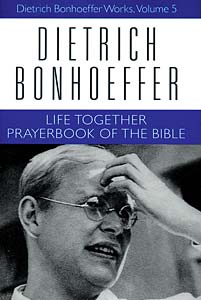
Life Together is Volume 5 of Fortress Press’s Dietrich Bonhoeffer Works (English Edition); it’s also the first one published (1995) in the series.
In addition to its being a new translation from Bonhoeffer’s German, there is an Editor’s Introduction to the English Edition, Editors’ Afterword to the German Edition [abridged], and an extensive (though not distractingly so) set of footnotes as part of an explanatory critical apparatus.
Though one could certainly read Life Together in its own right, editor Geffrey B. Kelly’s introduction is a great set-up. From the very beginning he highlights the fascinating history of the book:
It was because [the Gestapo] had shut down the preachers’ seminary at Finkenwalde that Dietrich Bonhoeffer was finally persuaded to compose his thoughts on the nature and sustaining structures of Christian community, based on the “life together” that he and his seminarians had sustained both at the seminary and in the Brothers’ House at Finkenwalde. … With the closing of the seminary at Finkenwalde and the dispersal of the seminarians, however, Bonhoeffer felt compelled not only to record for posterity the daily regimen and its rationale, but also to voice his conviction that the worldwide church itself needed to promote a sense of community like this if it was to have new life breathed into it.
Kelly brings to light more about the historical situation leading to Life Together (including the Finkenwalde seminary), as well as ties it in with some of Bonhoeffer’s earlier writing that undergirds the book. Kelly notes that Life Together is ultimately a highly Christocentric work. Indeed, Bonhoeffer writes:
Christian community means community through Jesus Christ and in Jesus Christ. There is no Christian community that is more than this, and none that is less than this. Whether it be a brief, single encounter or the daily community of many years, Christian community is solely this. We belong to one another only through and in Jesus Christ.
The critical footnotes are excellent and seem to be placed at just the right spots. They include biblical references, historical background, explanations of German-to-English translations, and descriptions, where needed, of the larger body of Bonhoeffer’s thought that informs a given passage.
For those wanting to read Life Together, there’s a nice bonus with the Fortress Press DBWE edition: it includes also Bonhoeffer’s Prayerbook of the Bible: An Introduction to the Psalms. Given his emphasis already in Life Together on the importance of the Psalms for the prayer life of the community (“The Psalter is the great school of prayer”), its inclusion in this volume is perfectly fitting. The text itself is just above 20 pages, with the addition of an English editor’s introduction and German editors’ afterword.
One More Bonhoeffer Quote,
and How to Get the Book
The last word of this review goes to Bonhoeffer. Here it is:
The fact that Jesus Christ died is more important than the fact that I will die. And the fact that Jesus Christ was raised from the dead is the sole ground of my hope that I, too, will be raised on the day of judgment. Our salvation is “from outside ourselves” (extra nos). I find salvation not in my life story, but only in the story of Jesus Christ. Only those who allow themselves to be found in Jesus Christ—in the incarnation, cross, and resurrection—are with God and God with them.
If you don’t already own Life Together, you should. If you do own it in an old paperback edition, you should get the Fortress Press Dietrich Bonhoeffer Works edition, if possible, whether through purchase or library check-out.
If you really want to go in depth, Geffrey B. Kelly (lead English editor of DBWE 5) wrote Reading Bonhoeffer, which includes a reading companion to Life Together.
Many thanks to Fortress Press for the review copy, given to me with no expectation as to the content of my review. You can find Life Together and Prayerbook of the Bible here on Amazon (affiliate link), or here at Fortress Press.
I’m reading Dietrich Bonhoeffer’s Life Together for the first time. As I near completion of the book, here is a convicting passage that jumped out at me:
But Christians who can no longer listen to one another will soon no longer be listening to God either; they will always be talking even in the presence of God. The death of the spiritual life starts here, and in the end there is nothing left but empty spiritual chatter and clerical condescension which chokes on pious words. Those who cannot listen long and patiently will always be talking past others, and finally no longer will even notice it. Those who think their time is too precious to spend listening will never really have time for God and others, but only for themselves and for their own words and plans.
You can find the book here (affiliate link) or here (they sent me a review copy). I’ll post again soon when I finish.
This October Fortress Press will publish a new–and the final–volume of the Dietrich Bonhoeffer Works (English edition). This is Volume 17: Index and Supplementary Materials.
Here is the description from Fortress Press:
The completion of the Dietrich Bonhoeffer Works, the definitive English translation of the Critical Edition, represents a milestone in theological scholarship. This wonderful series is a translation from the German editions of Dietrich Bonhoeffer Werke. The product of over twenty years of dedicated labor, the comprehensive and thoroughly-annotated sixteen-volume series will be the essential resource that generations of scholars will rely upon to understand the life and work of this seminal thinker in the wider frame of twentieth-century thought and history.
Now, the editorial team has offered an essential companion to the entire series in the form of an index volume.
Here are the book’s contents. It is more than just an index, per se:
General Editor’s Foreword to the Dietrich Bonhoeffer Works, English Edition—Victoria J. Barnett
The Translation of the Dietrich Bonhoeffer Works, English Edition: An Overview—Victoria J. Barnett
The Dietrich Bonhoeffer Works, English Edition: A Retrospective—Clifford J. Green
The Dietrich Bonhoeffer Werke: Afterword to the German Edition—Wolfgang Huber
Part I: Additional Letters and Documents
Part II: Comprehensive Chronology and Master List of Documents
1. Chronology 1906–1945
2. Master List of Documents for DBWE 8–17
Part III: Master Indexes
1. Master Index of Scriptural References
2. Master Index of Names
3. Master Index of Subjects
New to Bonhoeffer? I collected some reflections on his writings after spending much of Lent reading him. All my Bonhoeffer posts are gathered here. I’m currently reading Life Together and Prayerbook of the Bible (DBWE 5) and will post a review some time this summer.
As for DBWE 17, here is its product page at Fortress Press. It’s also here at Amazon.
My understanding is that the “Additional Letters and Documents” (Part I) have been published elsewhere, but not necessarily in English, and not in the German Dietrich Bonhoeffer Werke. So DBWE 17 will include material that is new to the Works series, some of it appearing in English for the first time anywhere.
The Dietrich Bonhoeffer Works series in English is described here, available for purchase (hardcover) through Fortress Press here. Fortress Press tells me that once DBWE 17 is published, there will be a discounted purchase rate available for the whole set for a short time this fall.
Some 12 years ago I wrote the following poem-prayer after reading Paulo Freire’s Pedagogy of the Oppressed and some of his other writing on the church. I found it again the other day so am posting it here:
Hasta que haya la paz, no descansaré. Hasta que las guerras cesen, no abandonaré la lucha. Hasta que la justicia reine, seguiré leyendo, predicando, y gritando. Hasta que haya una verdadera liberación humana, no dormiré. Que vengas, Jesucristo. Que venga tu voluntad y tu reino, como en el cielo, así también en la tierra.
These are good but difficult words from Mother Teresa. They were noted today on Plough, the Website where I mentioned finding the free Oscar Romero book. I’ve just subscribed to Plough Quarterly and am already enjoying the content of the site greatly.
Today I came across this arresting, powerful, and difficult quote from Mother Teresa:
God cannot fill what is full. He can fill only emptiness – deep poverty – and your “yes” [to Jesus] is the beginning of being or becoming empty. It is not how much we really “have” to give – but how empty we are – so that we can receive fully in our life and let him live his life in us. In you today, he wants to relive his complete submission to his father – allow him to do so. Take away your eyes from yourself and rejoice that you have nothing.
A sermon on Romans 6:1-11, on the day of ocean baptisms.
I’ve always been a little suspicious of Before and After photos. It’s as if Before photos are bad on purpose, and After photos do everything they can to try to enhance the actual improvements that have taken place, whether the subject is a human body or a newly improved, re-stained back deck.
I just found an article about a Before and After set of photos of an Australian fitness trainer. On first glance the After photo looks like about three months worth of exercise and nutritional improvement, compared to the Before.
But, in fact, one scrolls down past the Before and After to see a note: “Check out my transformation! It took me 15 minutes.” Meaning, the Before and After photos were 15 minutes apart.
Wanna know my secret? I…. smothered on some fake tan, clipped in my hair extensions, stood up a bit taller, sucked in my guts, popped my hip, threw in a skinny arm, stood a bit wider…pulled my shoulders back…Zoomed in on the before pic, zoomed out on the after and added a filter. Cause filters make everything awesome.
It seems that actual transformation–whether it’s of our bodies or of our inner selves–is elusive. We often try to short-change the process, or make things look better than they really are. And yet it’s a burning human desire to be different, to look better, to grow, to change.
Paul’s Before and After
The apostle Paul understands that. He speaks in Romans 6 of true transformation, a fundamental shift in the selfhood of the one who believes in Jesus. There is no doctoring of Before or After photos needed, because the picture of transformation that Paul paints is the most real kind of personal change there is.
For we know that our old self was crucified with him so that the body of sin might be done away with, that we should no longer be slaves to sin—because anyone who has died has been freed from sin.
When we give ourselves to Jesus, we understand that sin does not rule over us. We are free from having to sin. We are free from the inevitability of it.
In the same way, count yourselves dead to sin but alive to God in Christ Jesus.
Even as we are being sanctified, we’re far from sinless–and the next chapter in Romans will emphasize this frustrating reality. But we are to consider ourselves dead to sin, or, we might say, that sin is dead to us, because we are “alive to God in Christ Jesus.”
This is “Before and After” for the child of God:
Before: living in a body of sin, slaves to sin, an old, listless, aimless self.
After: dead to sin, alive to God, united with Jesus in his death, and so united also with him–and other Christians–in his resurrection glory, in new life.
This true transformation, the Christian’s inward change, Paul points out, is marked by baptism:
Or don’t you know that all of us who were baptized into Christ Jesus were baptized into his death? We were therefore buried with him through baptism into death in order that, just as Christ was raised from the dead through the glory of the Father, we too may live a new life.
The old self walks to the edge of the water, wades in, is dipped under–washed in the ocean of God’s love and forgiveness–and the new self comes up, freed to live a new life in Jesus.
I will sprinkle clean water on you, and you will be clean; I will cleanse you from all your impurities and from all your idols. I will give you a new heart and put a new spirit in you; I will remove from you your heart of stone and give you a heart of flesh.
What Baptism Is
Baptism is a physical, visible, experiential sign of this inward transformation that takes place when a person says, “Yes,” to the gift of God’s grace.
In just a few moments I will ask our candidates, “Do you renounce the powers of evil and desire the freedom of new life in Christ?” They will say, “I do.” Before: we were slaves to sin, afraid to even try to cast off the “powers of evil.” Or maybe we didn’t want to. After: we have renounced those powers. We celebrate our freedom. We have new life in Christ.
Also in just a few moments, all of us, as a congregation, will say: “Out of the waters of baptism, we rise with new life, forgiven of sin, and one in Christ, members of Christ’s body.” We affirm this “Before and After” that baptism represents, and we do it in a larger, communal context. We are “one in Christ, members of Christ’s body.”
Ancient Baptismal Pool (Source: Zondervan Illustrated Bible Backgrounds Commentary)
As we’ve gone through our high school confirmation class last month and this month, we’ve been talking about baptism and confirmation as a multi-faceted commitment. On the one hand, baptismal candidates and confirmands are themselves making a public commitment to God in the presence of us, the church. And on the other hand, we promise our commitment to them as they seek to carry out their baptismal vows. Ultimately, the waters of baptism signify God’s commitment to us to continue and one day complete his work in us.
So please do support these young people who are about to be baptized, as best you are able. When they go out of state for college and then come back on breaks to worship here, ask them how they’re doing–not just in school, but in their relationship to God. Seek them out during coffee hours in future Sundays. Commit to pray for them. You might even pick one or two of the folks you see being baptized today and decide that you will pray for them by name, for the next month, six months, two years.
Identity
We began our confirmation class with a short teaching video and discussion centered around the question, “Who Am I?” How do I understand my identity as a person? We watched and discussed a short video by a teacher from Grand Rapids, Michigan named Rob Bell.
Bell talked about our tendencies to compare ourselves with others, to measure ourselves against those around us. As he talked, the camera followed a cast of actors who had t-shirts with a single word printed on the back: baker, consultant, double degree, Southern, apathetic, ashamed, listener… single words that can define how we think about ourselves, especially in relation to others.
But Bell says:
We need to be saved from all the times we haven’t been our true selves. All the times we’ve tried to be someone else.
All of the lies we’ve believed about who God made when God made us. All the times we’ve asked the wrong questions:
‘What about him? What about her? What about them?’
And we’ve missed the voice of Jesus saying, ‘You, follow me.’
To those who are about to be baptized, I want to say, this is who you are: one who is loved dearly by God, one who is saying “yes” to Jesus’ invitation to follow him. You are choosing to not miss that voice. You are saying, “Yes, I will follow.”
Your decision to be baptized means that you are affirming your identity in Jesus–as one who is “forgiven of sin, and one in Christ with the members of Christ’s body, the church.” “The old has gone, the new has come,” as Scripture says. Baptism is a physical sign of the ultimate “Before and After” transformation.
Remember Your Baptism
This Baptism Sunday is also a chance us who have already been baptized to remember our baptism. We know that we at times wander away from God, but we can never be un-baptized. We always come back to our fundamental identity as ones forgiven by God’s grace, and given new life.
So, whether your baptism was years ago or is about to happen today: remember your baptism.
Whenever you look at the ocean, may God remind you of the cleansing, washing power of his forgiveness.
May the vast waters call to mind the immensity and intensity of Christ’s love for you.
Remember who you were before you said “yes” to following Jesus, but especially remember the new life to which you are now called.
Just as Jesus Christ died, was buried, and rose again, “In the same way, Paul says, “count yourselves dead to sin but alive to God in Christ Jesus.”
Scripture quotations above are from the 1984 NIV. See my other sermons gathered here.
“Beautiful is the moment,” Archbishop Oscar Romero said, “Beautiful is the moment in which we understand that we are no more than an instrument of God; we live only as long as God wants us to live; we can only do as much as God makes us able to do….”
The book above–La Violencia del Amor, or, The Violence of Love–is available as a free download from the publisher, here (Spanish) and here (English).




 Life Together





 Words on the Word