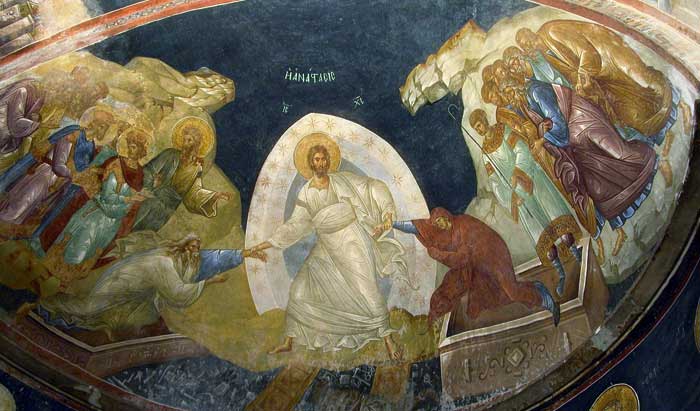
I’ve been admiring the above piece all week in anticipation of Easter. (Click to enlarge) It’s from Chora Church in Istanbul. The Greek is ἡ ἀνάστασις, in all capital letters=the resurrection. The letters just above Jesus are the Greek abbreviation for Jesus Christ.
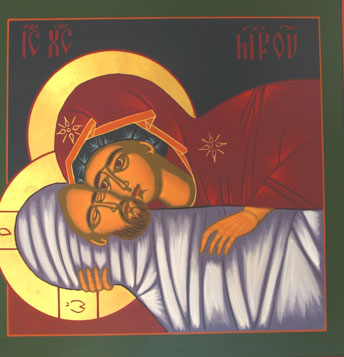
Two blogs I read posted a similar icon this morning. I love how Jesus (Life) is touching Adam and Eve (death), pulling them out of their graves, from death to resurrection.
All day I’ve been trying to meditate on what Jesus’ disciples must have been feeling on the day between Good Friday and Easter.
Wait–before you go further, if you don’t think it’s too cheesy, listen to this while you read the rest of the post:
Saturday.
Many Western Christians know how to observe Good Friday and Easter. On Good Friday we call to mind our sins, the last words of Jesus on the cross, the shock and despair his followers experienced… and we try to imagine his suffering, entering in to that as best as we are able.
And then Easter is the party of all parties, when we declare the defeat of death: “Jesus Christ is no longer dead!”
Alleluia! Christ is risen! The Lord is risen indeed! Alleluia!
But what about Saturday? The disciples didn’t have an “Easter” to look forward to. Jesus was done for, as far as they knew. He was really dead. When he did appear to the apostles, they were terrified and thought they were looking at a ghost. They weren’t even hopeful for resurrection–it hadn’t crossed their mind as an option.
So what some Orthodox call “Bright Saturday” was anything but bright for Jesus’ first followers. It was probably horrible. Awful Saturday. They felt as empty as the tomb was about to be. It was a Sabbath day, too, so they didn’t have any work to distract them. They were quiet. Or maybe they wailed loudly. Phillip Glass (the music you may have clicked on, above) makes a good soundtrack for trying to imagine the emptiness of that day.
In the loss of a loved one, the day of the beloved’s death is painful, and then there’s something about the second day that can be even more painful. The initial shock may begin to give way (but probably not really); reality sets in a little bit more. No, that wasn’t a bad dream–I’m still here, and my loved one really is… gone. Maybe the second day–Saturday–was even more difficult for the disciples than Friday.
At one point today I was thinking about the liminal nature of Saturday in Holy Week: it’s an often unnoticed, unmarked day that is situated between death (Good Friday) and life (Resurrection Sunday). How should I feel? Sad? Penitential? Happy? Pre-happy? Expectant? All or none of the above?
My church tradition has an Easter Vigil service on Saturday night, but just this simple offering for a Holy Saturday liturgy. We “await with him” and “rise with him” in that service’s Collect. This calls to mind Psalm 30:5, which says, “Weeping may stay for the night, but rejoicing comes in the morning.” Our Holy/Bright/Liminal Saturday is a short day, since we know of Resurrection Sunday’s shouts of acclamation and loud Alleluias.
But Saturday for the disciples was not liminal. It was not thought of as perched between death and life. That day and those men and women felt firmly ensconced in the grips of death. The closing anthem in the short Book of Common Prayer liturgy above begins, “In the midst of life we are in death….”
“We are in death.” Death Saturday. Awful Saturday.
Jesus’ followers had no clue what–or Who–was just around the corner….
Via Patheos, a beautiful Easter reflection from pastor and blogger Kara Root:
I need the Resurrection because my sister is sick and can’t afford insurance, because I’ve told a weeping Haitian mom, “No, I can’t take your son home with me.” because I’ve been rushed off a Jerusalem street so a robot could blow up a bag that could’ve blown up us. because I’ve exploded in rage and watched their tiny faces cloud with hurt. because evil is pervasive and I participate. I need the Resurrection because it promises that in the end all wrongs are made right. Death loses. Hope triumphs. And Life and Love Prevail.
Here is a prayer from The Valley of Vision, titled “Need of Jesus.” (More on this collection of Puritan prayers is here.)
Lord Jesus,
I am blind, be thou my light, ignorant, be thou my wisdom, self-willed, be thou my mind. Open my ear to grasp quickly thy Spirit’s voice, and delightfully run after his beckoning hand; Melt my conscience that no hardness remain, make it alive to evil’s slightest touch; When Satan approaches may I flee to thy wounds, and there cease to tremble at all alarms. Be my good shepherd to lead me into the green pastures of thy Word, and cause me to lie down beside the rivers of its comforts. Fill me with peace, that no disquieting worldly gales may ruffle the calm surface of my soul. Thy cross was upraised to be my refuge, Thy blood streamed forth to wash me clean, Thy death occurred to give me a surety, Thy name is my property to save me, By thee all heaven is poured into my heart, but it is too narrow to comprehend thy love. I was a stranger, an outcast, a slave, a rebel, but thy cross has brought me near, has softened my heart, has made me thy Father’s child, has admitted me to thy family, has made me joint-heir with thyself. O that I may love thee as thou lovest me, that I may walk worthy of thee, my Lord, that I may reflect the image of heaven’s first-born. May I always see thy beauty with the clear eye of faith, and feel the power of thy Spirit in my heart, for unless he move mightily in me no inward fire will be kindled.
Jesus makes a pun in Luke 4. I’m not the first one to notice this, but it stood out to me as I read my way through Luke 4:14-21 this past week. I’m preaching on the passage at my church tomorrow.
Jesus enters the synagogue at his hometown of Nazareth in Galilee and opens the Isaiah scroll to Isaiah 61. In the NIV, the Luke passage reads as follows:
The scroll of the prophet Isaiah was handed to him. Unrolling it, he found the place where it is written:
The Spirit of the Lord is on me,
because he has anointed me
to preach good news to the poor.
He has sent me to proclaim freedom for the prisoners
and recovery of sight for the blind,
to release the oppressed, to proclaim the year of the Lord’s favor.
But a few verses later (v. 24) Jesus tells the people, “No prophet is accepted in his hometown.” (They tried then to throw him off a cliff.)
The play on words Jesus uses is not readily evident in most translations, but Jesus uses the same word for favor (“year of the Lord’s favor“) as he does for accepted (“no prophet is accepted“). It’s a rare enough Greek word Luke uses, that I can only conclude it’s deliberate–this is the only passage in all the Gospels to use this word. (For Hellenophiles who read this blog, the word is δεκτός.)
The translations aren’t necessarily wrong to obscure the fact that it’s the same word in each verse. After all, context determines meaning, so even this same word carries different nuances the two times it’s used.
But the irony is that in this year of the Lord’s favor, which Jesus notes later in the passage begins “today,” even his hometown will not accept him. There is no acceptance (δεκτός) of this favor (δεκτός).
And before we rush to point backwards at the hard-heartedness of 1st century Nazareth, perhaps we easily enough realize those ways in which we fail to accept the favor that God would lavish on us. May Jesus give us sight where we do not see all that he comes to offer us.
We’re here; we blog about the Bible; get used to it.
Charles Spurgeon is reported to have said, “If you have to give a carnival to get people to come to church, then you will have to keep giving carnivals to keep them coming back.”
And so we who blog in the fields of academic biblical studies and theology keep giving carnivals.
So let Words on the Word be among the first to wish you and yours a Happy New Year! Let’s welcome the year ahead with a recap of what went on in the so-called biblioblogosphere in December 2012.
Newtown, Connecticut, December 14
On December 14 there was the horrible news of a shooter who killed 26 other people at an elementary school in Newtown, CT, 20 of them young children. Peter Enns shared some thoughts from an unsettled state. Jim West wrote about it quite a bit and excoriated the NRA.
With the generous lead support of the Leon Levy Foundation and additional generous support of the Arcadia Fund, the Israel Antiquities Authority and Google joined forces to develop the most advanced imaging and web technologies to bring to the web hundreds of Dead Sea Scrolls images as well as specially developed supporting resources in a user-friendly platform intended for the public, students and scholars alike.
A number of bloggers wrote about this, not a few of whom Jim McGrath links to.
That wasn’t all that went online in December. Evangelical Textual Criticism notes quiteafewothermanuscriptsthatare now online. (As proven by the fact that every word of that last phrase is its own hyperlink.) Charles Halton of awilum.com highlights the availability of A. Leo Oppenheim’s Ancient Mesopotamia as a free pdf. Readers of this carnival may also like to take some time with ASOR’s weekly archaeology roundups in December, here, here, and here.
Septuagint
December saw a plethora of posts about παρθένος/עלמה in Isaiah 7:14, and Matthew’s use of that verse. Here is T.M. Law, saying that Greek Isaiah’s use of παρθένος for עלמה is not without precedent in the LXX (“The Greek translator of Isaiah used a perfectly acceptable rendering for עלמה.”). Here’s the Jesus Creed on the virgin birth. Krista Dalton notes, “[T]he author of Matthew is not saying that Isaiah was envisioning the birth of Jesus.” Kevin Brown of Diglotting posts here about it. And, looking at hermeneutics more generally, Brian LePort suggested three paradigms to use in studying the virgin birth.
J.K. Gayle at The WOMBman’s Bible (“An Outsider’s Perspective on the Hebrew Males’ Hellene Book”) posted reflections from Greek Isaiah not 1, not 2, not 3, not 4, not 5, not 6, but 7 times in December. Set aside some time and read them all.
Codex Sinaiticus dropped in price to just under $200 at CBD this month–a facsimile edition, that is. Theophrastus of BLT notes it here. He will later lament (which I, too, lament) that Oxford University Press no longer prints their wonderful Comparative Psalter. And while we’re on those Ψαλμοὶ, did their Greek translator(s) have Aristotle and Greek rhetoric in mind?
Anthony Le Donne is taking on the Wikipedia entry on “Historical Jesus” (best biblioblog comment of the month: here). James Tabor asked how December 25 got to be the day we observe Jesus’ birthday (with more thoughts here). Mark Goodacre produced a Christmas NT Pod in which he “explores the differences between the Birth Narratives in Matt. 1-2 and Luke 1-2 and asks how this can be the case if Luke is familiar with Matthew.” The Sacred Page produced a podcast on “the first Christmas.” For a fresh translation of Luke 1:34-38 (with the Greek reproduced beneath the English), see “She spoke yet-Miriam did.” Daniel Street even gave us some Christmas songs in Greek!
Anglican minister Rach Marszalek calls for nuance in discussions on the Trinity, as well as an appreciation of “the perichoretic beauty” of the Same. Read her “Eternal functional subordination and ontological equality?” here. While we’re on Anglicans, Brian LePort asks whether he needs a Bishop?
Gaudete Theology offers a feminist reading of “the bride of Christ” language. (“The image of the Bride of Christ needn’t be viewed only through the patriarchal perception of woman’s nature as inherently passive, docile, compliant, and receptive.”) Alice C. Linsley at Just Genesis would, I think, agree that the image and office of priest should also not be viewed through a patriarchal lens. She says, “Luther Was Wrong About the Priesthood.”
And, finally, may I offer thanks to Amanda at Cheesewearing Theology for this excellent December 2012 theology roundup? She covers yet more territory in theology than I have already covered here. If you’re disappointed that this carnival is about over, spend time reading the posts she collects.
Ευχαριστω/תודה/Thank you
Thanks for coming, and keep coming back! I blog regularly, so feel free to follow/subscribe by going back up to the right sidebar of the blog.
I’m grateful for friends and family as Advent winds down and as we come to Christmas. I’m especially grateful for the amazing act of Incarnation through which Jesus came to us.
frameworks, quite simply, is a book about Bible navigation and context, material that’s designed to build your confidence in your ability to negotiate the text and understand it. Think of it as a guidebook, a Bible companion, written for anyone who would like to have a personal biblical tour guide. This book can be used for self-study, in small group discussions or in classrooms to set the context for Bible reading and to lead you through it.
The emphasis in the book is on presentation and memorability. Larson uses rich and beautiful imagery (and “lots of refreshing white space”) to create a book that has a good home on a coffee/display table. Yet he doesn’t neglect solid content around each biblical book, either.
The introduction is short and sweet and covers essential territory like who the writers were, literary divisions of the book, and an especially helpful 7-part “Navigating Jesus’ Ministry” section with simple maps and narrative highlights. After an introduction to the New Testament in general, each book of the New Testament has these 10 sections: introduction, theme, purpose, outline, verses to note in that book (the best part of frameworks, I thought), navigation (a page of things to look for when reading a book-well done), unique things about that book, recap, questions, and a verse to apply right now.
There is a sample pdf of the table of contents and introduction here.
Charts, tables, photographs and other graphics are a strong point of this book. Some are as simple as this historical timeline, which is visually appealing:
Or take this visual outline of the book of Luke, from p. 92 of the book (and posted on the author’s blog):
(The spelling error in ascension is corrected in the book.)
This book will answer many questions people had about the New Testament but were afraid to ask–one of its intended purposes. For example, in Larson’s introduction to the Gospels (“Biographies of Christ”), he writes about the “four living creatures” that many have understood to represent the Gospels. (Lion, Ox, Man, Eagle.)
I’ve always seen Mark associated with the lion, but Larson has the lion with Matthew, the ox with Mark, the man with Luke, and the eagle with John. He notes that this is the order of the four living creatures in Revelation 4:6-7. But the order as it appears in Ezekiel 1:1-14 is what I’ve seen more typically, where it’s human, lion, ox, and eagle. I understand that Christian tradition varies here a bit.
This is not a huge deal, but it is indicative of a larger trend in the book–nuance seems to be prioritized at times less highly then presentation. Larson’s laudable goal is to engage “anyone who would like to have a personal biblical tour guide.” It’s about “navigation and context,” but readers will still want to look elsewhere for greater detail and clarification on some matters.
As far as a New Testament framework goes, Larson’s 4-1-9-4-8-1 scheme did not immediately strike me as easily memorable. He divides the NT this way:
4 biographies of Christ
1 history book (Acts)
9 letters of Paul to the churches
4 letters of Paul to people
8 general letters
1 book of prophecy (Revelation)
This is less memorable than the 4-1-21-1! chant I’ve used with young people. (See the pdf of it here, from Center for Youth Studies.) Larson’s 4-1-9-4-8-1 does have the advantage of dividing up the 21 letters/epistles into their types/authors, but as much as I wanted to latch on to 4-1-9-4-8-1, I never quite did. This is not too say it’s a bad thing to use; it is to say a reader might not pick it up as easily as some other NT “frameworks.”
One other critique I offer is that, although I appreciate the approach of using visual imagery and stories and examples rooted in culture to try to connect the ancient text to today, sometimes the connections feel a bit stretched. For example, the photograph accompanying the “history” title page (for the book of Acts) is an unfinished attic with a sawhorse in it and a window with light coming through. It’s a beautiful image. But what’s it trying to evoke? The upper room? The light as the Holy Spirit? Okay, but why the sawhorse? Other such images left me curious as to why they were selected, or how they were meant to visually reinforce the author’s text.
Similarly, while the story about Anne Sullivan and Helen Keller to begin the book of James is itself inspirational, its application to James and his audience sure felt reach-y. That James’s “self-indulged spiritual children” were “behaving badly and desperately need a spanking” is an odd way, indeed, to describe things! James would have never “spanked” his listeners. I know the author doesn’t mean that literally, but that image was distracting. I often found myself reacting this way in the introductions to each of the books.
Everything after a book’s introduction is generally solid–and creative. In Mark, for example, Larson has a selection of verses from that Gospel that he has the reader “read…without stopping to take a breath.” He puts in bold words like “at once,” “quickly,” and “immediately” (a favorite of Mark’s). Then he concludes, “If you feel out of breath, congratulations. Mark has succeeded in brining you into his fast moving narrative.” I thought this was a great way to draw the reader into the fast-paced action movie that Mark often feels like.
I like the approach to this New Testament introduction; it’s creative and will reach a larger audience then some less visually-oriented books on the same subject. The short descriptions of each book are generally solid, but the occasional lack of nuance and informal tone distracted me at times as I worked my way through the book. (In other words, as with any book, this one should be read critically.)
Yet I do think Larson’s efforts will guide the reader into deeper engagement with the biblical text. His emphasis on what to look for in a book, pulling out and quoting specific verses, and his constant admonition to “Read It!” are refreshing. He even gives an estimate for how long it takes to read through a book at a casual pace, which is an enormous aid to anyone who will commit to sitting down and doing reading through God’s Word.
I received a free copy of frameworks for review purposes. Thank you to the author and publicist for the chance to review it.
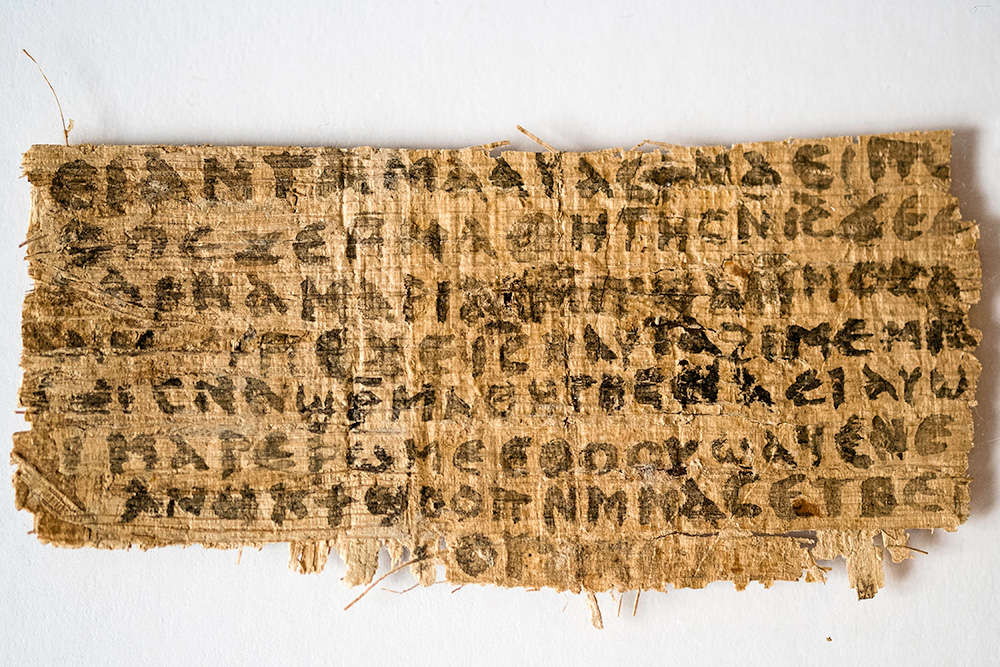
In the last two days I’ve seen about 50 Facebook status updates from friends and groups I follow, each with their own take on the “Gospel of Jesus’s Wife” papyrus that Harvard Professor Karen L. King recently announced. (Nerdy grammatical excursus: King has titled the papyrus with Jesus’s, but I follow Strunk and White and prefer Jesus’.)
The Harvard Divinity School press release is here. It begins,
Four words on a previously unknown papyrus fragment provide the first evidence that some early Christians believed Jesus had been married, Harvard Professor Karen King told the 10th International Congress of Coptic Studies today.
The papyrus has been dated to the 4th century and is written in Coptic, the alphabet of which has overlap with the Greek alphabet. King has postulated, in fact, that the Coptic in this little fragment may have translated a Greek original.
The key quote from the papyrus is translated, “Jesus said to them, ‘My wife….'” It then gets cut off. Go here for a full translation, as well as helpful Q&A with Professor King.
It seems to me there are two primary questions on folks’ minds right now. First, is this thing real or a fake? Second, did Jesus have a wife, or could he have?
In pursuit of these questions, I spoke with two Professors of Biblical Studies at Gordon College, a top Christian liberal arts school, located just north of Boston. Was Jesus married?
“Is there anything in the Gospels that would give us a hint he was married? I don’t think so,” noted Professor Marvin R. Wilson. “If he was married, how come he says to his beloved disciple at the cross, ‘Take my mother,’ not ‘Take my wife’?”
The significant woman in Jesus’ life, for whom he is looking out in his final hours, is his mother Mary, not a wife.
All the same, Wilson said, “It’s a good question. One who had no marriage would certainly have been the exception. We have an exception in Jeremiah, but that was a divinely commanded celibacy.”
Wilson noted, however, that the assertion that Jesus had a wife is still an argument from silence. “Certainly he had a wonderful ministry with women. We know the 4th century was a time of theological clarification (Council of Nicea) as well as turbulence. This Coptic text may have represented a small sect of aberrant Christians that had broken away from the larger–yet still emerging–traditional community.”
Is there much at stake in the question of whether or not Jesus had a wife?
“Certainly I don’t think any key issues of the Christian faith are at stake here. If Jesus had a self-imposed celibacy because of the work he was called to accomplish, that would make him unusual, but not unique.”
Professor Steven Hunt noted, “There’s so much we don’t know about it yet. It’s apparently a very small fragment.”
Regarding the authenticity of the papyrus, he added, “I’m perfectly willing to go with [Professor King] and say that it’s an authentic fragment of some document that’s now lost, but it’s probably speaking more to the nature of debates in the 3rd and 4th century about sex and marriage… it’s almost certainly not giving us accurate information about the historical Jesus.”
More interesting than the fragment itself, Hunt noted, is the question, “Would Christians be troubled to find out Jesus was married? The fact that many would, may really be quite suggestive, especially if their reaction was rooted in a negative attitude toward bodily existence in general and sexuality in particular.
“So, while there’s no good historical evidence that he was [married], from my perspective,” Hunt said, “it’s not really theologically problematic to suggest that he could have been. Since the Bible affirms the essential goodness of marriage and sexuality, what would be the problem with that?”
Recently for a seminary class I had to describe the difference between “the Maccabean hope in a Messiah and Jesus’ fulfillment of that hope.”
Maccabean hope on first glance would appear to be a hope in military power. This poem at the beginning of 1 Maccabees 3, for example, extols Judas for his might (NETS translation):
And he spread glory to his people and put on a breastplate like a giant and strapped on his war instruments.
And he conducted battles, protecting the camp by the sword.
And he resembled a lion in his works and was like a whelp roaring in the hunt.
And seeking out the lawless, he persecuted them and burned up those who disturbed his people.
And the lawless drew back for fear of him, and all the workers of lawlessness were disturbed, and salvation was successful by his hand.
1 Maccabees closes similarly, in 16:23-24:
The rest of the acts of John and his wars and the brave deeds that he did, and the building of the walls that he completed, and his achievements, are written in the annals of his high priesthood, from the time that he became high priest after his father.
It is difficult not to read Maccabees as, in some sense, a narrative of one war after another. There was a Maccabean respect for leaders/priests who would lead them in battle. Certainly, then, the expectation of a Messiah would have been affected by this. “Maccabean hope” would have called for a Messiah to be a Jewish freedom fighter—in the militaristic sense of the word.
However, I think there is another, perhaps fuller way of understanding “Maccabean hope in a Messiah” that honors the author of 1 Maccabees and that book on its own terms. While a Maccabean hope certainly expected military might from a Messiah, Mattathias and his sons above all valued upholding the law. Their military resistance flowed from and was a result of that desire to keep the law.
1 Macc. 2:27 has, “And Mattathias cried out in the city with a loud voice, saying, Let everyone who is zealous in the law and is upholding the covenant follow me’” (my emphasis, from the NETS again). Only having established zealousness in the law did Mattathias and his family wage their series of wars. (Although these few verses are preceded in 2:24 by Mattathias killing a Judean man who was making a sacrifice that was not in accordance with the law!)
So, to try to read 1 Maccabees on its own terms, Maccabean hope in a Messiah must have been hope in a Messiah who was “zealous in the law” and who was “upholding the covenant.” Christians believe that Jesus was the perfect fulfillment of the law. But the descendants of the faithful Hasidim mentioned in Maccabees did not see it that way.
As I recently read through 1 Maccabees, I was surprised by how much anti-Gentile language and imagery there is in the book. In the institution of Hannukah at the end of 1 Macc. 4, to take just one example, there is a sense of fortifying the temple against the Gentile enemies.
I can appreciate the need for protection and purity–especially given how the temple had been profaned previously. This was truly a matter of life and death for God’s chosen people, physically and spiritually. But I wanted to say to the Maccabees’ author and the Maccabean family: With all due respect, what about all those verses in the prophets and other parts of the Hebrew Scriptures that say things like “nations will stream to your light” and “all nations will be blessed through you“?
Law-abiding Jews who were influenced by 1 Maccabees seem to have been expecting a Messiah who would clear the temple of the nations/Gentiles, as Judas Maccabeus did. Instead, Jesus reminded the Jewish people of their own Scriptures that said the temple was to be a house of prayer “for all nations” (Isaiah 56:7).
What kind of Messiah was he, then?
Jesus fulfilled his role as Messiah by being a conqueror, but not in an earthly, militaristic way. He fulfilled the law, but did not uphold it in a manner many had hoped for. And he drew all nations to himself, but in a way that angered anti-Gentile, exclusivist Jews.
A zealous Jewish freedom fighter? Yes. But not like Maccabees.






 Scot McKnight lists the “Jesus Creed Books of the Year”
 Speaking of Greek Isaiah… more than 150 of us are reading through




 Words on the Word