“Leningrad Codex Carpet page e” by Shmuel ben Ya’akov. Public Domain via Wikimedia CommonsThe Leningrad Codex is the basis for the Biblia Hebraica Stuttgartensia (BHS), the critical edition of the Hebrew Bible. Leningrad is the earliest complete Masoretic manuscript still available to us, dating from the 11th century. BHS is what’s called a diplomatic edition–it uses Leningrad as the best available text with a critical apparatus at bottom.
Images of Codex Leningradensis, as it is also known, are available freely online. (See here, for example.) But users of Bible software still have hoped for something more integrated and easier to use than a .pdf.
BibleWorks 10 offers Leningrad images, fully integrated with the rest of the software’s texts. There are even verse markers so you know where you are in the manuscript. You can toggle verse markers off if you want to read through with no help.
Here’s what it looks like:
Click image or open in new tab to enlarge
You can see in the image above that I can view the Leningrad Codex (with verse markers) in tandem with BibleWorks’s Search Window (far left), Browse Window (second from left and showing multiple versions of my choosing), and Analysis Window (second from right, here featuring lexical data that automatically appears as I hover over words in the Browse window).
It’s possible to zoom in and out of the image at far right to get a closer look at the manuscript detail if you desire. Or you can open it in its own window, like so:
Click image or open in new tab to enlarge
Now you can navigate the Leningrad Codex using the sidebar at left.
One other really cool feature–by hovering over the verse reference in the codex, you bring up a pop-up window showing you multiple versions:
Click image or open in new tab to enlarge
Very impressive. Note, too, the nifty blue and yellow color scheme in the image above.
My only critique of this new, flagship feature (which is executed really well) is that there’s not a keyboard shortcut to zoom in and out of the codex images. You have to right-click, then navigate through the contextual menu for the zoom percentage you want, then select it. Somewhat making up for this, however, is the ability to simply click-hold and drag your way through the images.
Check out a short video of the codex in BW10 here:
BibleWorks 9 took a huge leap forward in offerings of Greek manuscripts:
Now BibleWorks 10 starts to bring the program’s Hebrew offerings to parity with the Greek. There is still much more by way of Greek MSS in BW10 (might we hope for the Aleppo Codex in BW11?). But BibleWorks is the first software to offer the images of Leningrad to its users. A big step forward to readers and students of Hebrew.
I received a free upgrade to BibleWorks 10 for the purposes of offering an unbiased review. See my other BibleWorks posts here. You can order the full program here or upgrade here. It’s on Amazon, too.
I’ve reviewed enough software to know over-hyped copy writing when I see it, so I was initially skeptical at the Things app’s claim to be “a delightful and easy to use task manager” (my italics).
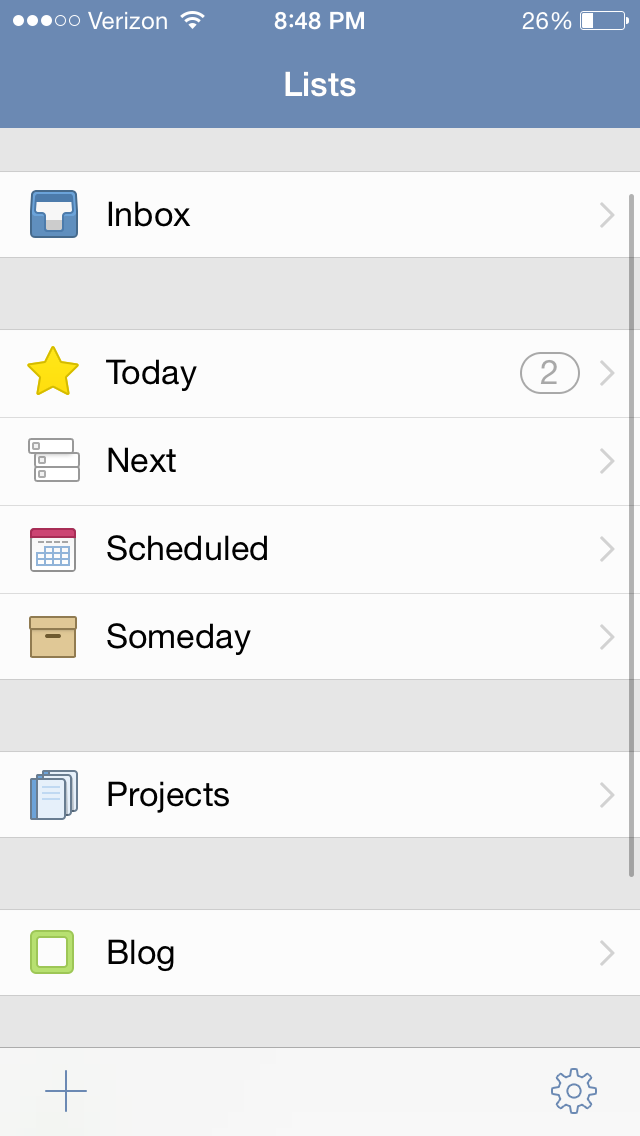
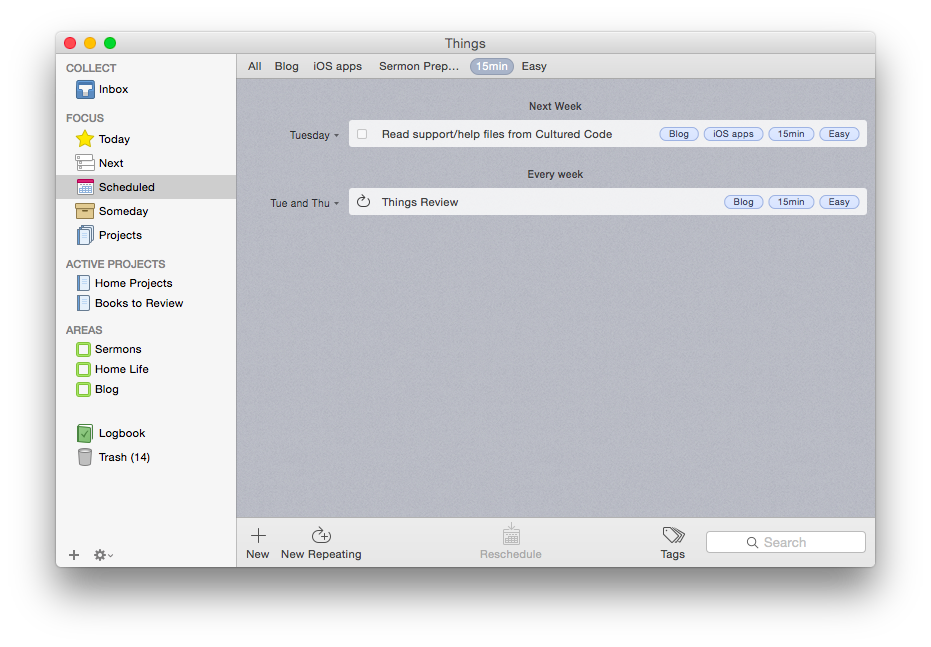
But its aesthetic and usability really are pleasing and enjoyable. The layout is very simple and clean. It has almost a cartoonish (in a comforting way) feel to it. It looks like this:
Mac OSX version (click image to enlarge)
iPhone version
Readers of this blog (especially patient ones) know that I’m a user of OmniFocus, but I’ve also been putting Things through its paces these last few months.
Today is the list for to-dos that you want to start before the day ends. They’re your priorities.
Next is home for all of the to-dos you could start at any time. It’s a good place to look when putting together your Today list, or when you’ve finished everything there and you need more to do.
Scheduled is for to-dos that you’d like to start on a later date, either because there’s nothing you can do to start them yet, or you’d just rather be reminded of them on a specific day.
Someday is the place for to-dos that you might like to get to, but you’re not sure when. Regularly review what you’ve added here to decide if it’s time to act.
It all starts with the Inbox, where you can put items until you’re ready to decide when to do them. Things also allows you to organize by multi-step Projects and Areas of Responsibility, as well as make extensive use of Tags.
Strengths
Things syncs instantaneously via its own cloud service across multiple devices. This makes using it on both a phone and a computer, for example, really easy—you never have to worry about an outdated notification showing up on your device. This is one of the few drawbacks of OmniFocus—if you don’t keep OF open and make sure it’s synced on all your devices, you’ll get a reminder on your iPhone to complete a task you already checked off on your computer. This is not an issue with Things, and it takes away an extra step in the task management process, so you can direct that energy to actually working through your task list.
Things is head and shoulders above other task management apps in this regard.
Things has a really nice tagging system. No GTD-style “contexts,” per se, though you could certainly use your tags as contexts if you wanted to. You can even assign sub-tags to your tags, a feature I really like. So I can tag a task under the category “Blog,” but also assign sub-tags such as “Future post” and “Learn apps.” I used this tagging system to track thank-you notes last Christmas—writing down presents (and who they were from) as we opened them, and then sorting by tag (giver) so that I knew what all I was thanking someone for when I came to their note! Handy, indeed.
The desktop app is feature-rich. As you might expect, in addition to seamless sync with the mobile apps, the desktop version of Things (pictured above) is fuller-bodied than the iOS apps. There is the Quick Entry feature, where a keyboard shortcut (no matter what app you’re using in the foreground, so long as Things is open somewhere) will let you enter a task before you forget. There is a really smooth way of accessing, displaying, and adjusting all your tags (where Things really shines). Editing a task is fast. And it looks good.
The iOS apps have a useful Today widget. Some Today widgets are better than others, and this one is good. You can view items due today, check them off (both without ever opening the app), and tap on New To-Do to be taken to the Things app to make a new entry.
Siri and Things work together (quite nicely). You can set up Things so that reminders you voice dictate to Siri go right into that app as tasks. So that you can use Things safely while driving. As OmniFocus is my task management app of choice, a comparison again is inevitable: to get Siri-generated reminders to show in OF, you have to actually open OF and let it sync. Not so in Things: the reminder goes to your Things Inbox for processing immediately.
Limitations
There are some things that Things can’t do, which I had hoped it could.
There is no way (whether in iOS or OSX) to attach photos or files to an item. I find this a noteworthy lack. In OmniFocus and Evernote you can take a photo of something and immediately set it up with a to-do reminder. Sometimes life’s “inputs” come as visuals, and taking a picture and setting a due date is easiest. That’s not doable in Things. (You can link to actual files on a desktop, but that’s not the same as attaching the file itself, and the file doesn’t show up on an iPad.) There is a “Notes” field that attaches to your to-do, which is essential, though that field just accepts text entry.
The cosmos (or just your co-workers and bosses) also like to give to-do items via email. There’s no way to automate moving from an email into a task in Things. In OmniFocus you can just forward an email to your special OmniFocus email address, and it automatically becomes a task in your inbox. Todoist, like Outlook, can let you turn an email into a task in just a click, without even having to forward it anywhere. Evernote even lets you send an email as a Note to a specific Notebook with Tags, if you phrase your subject line right. Things may add this email-in-to-Inbox feature in the future, but for now, you have to take the extra step of copy-pasting an email into a new task yourself. Not as automated as I’d have liked.
You can get to a new task via the + button on the bottom right screen on iOS—so entering a new task right away is easy—but there is not the “Save +” option that other apps offer… so you have to add an extra tap when doing a rapid-fire brain dump. (This is not as much an issue on the desktop version of the app.)
You can set up repeating tasks, but not easily. This process was not as immediately intuitive as the rest of the app is. Things’s support page (which is awesome) details how you can do it from iOS and OSX. But, wow, did I spend a lot of time figuring out the very specific way in which this must be done in Things—and a couple of methods that you’d think would get you there… don’t.
Conclusion
So many reviews of task management apps affirm that there’s a personal element to what app works best for you. One user’s “intuitive” is another user’s, “Huh?” I’ve bought into the OmniFocus methodology and layout (mostly), which is intuitive enough but not easy out of the box. Things, on the other hand, is easy to figure out how to use right away without using a manual. The “Today” part of the app functions as a sort of daily review, though I prefer OmniFocus’s Forecast and actual Review perspectives. But you might be totally different on that!
In terms of complexity and capability, I’d put Things somewhere between Reminders and OmniFocus. It’s far more robust than Reminders, but not quite the souped-up to-do app some users might need. (Although one could just use the robust tagging system to customize Things for higher levels of complexity.)
Things is well-designed, looks great, and the seamless sync is a huge plus. Try it for yourself here (download link) with a free trial.
Thanks to the fine folks at Cultured Code, the makers of Things, for giving me downloads for the Mac and iOS apps for this review. See my other AppTastic Tuesday reviews here.
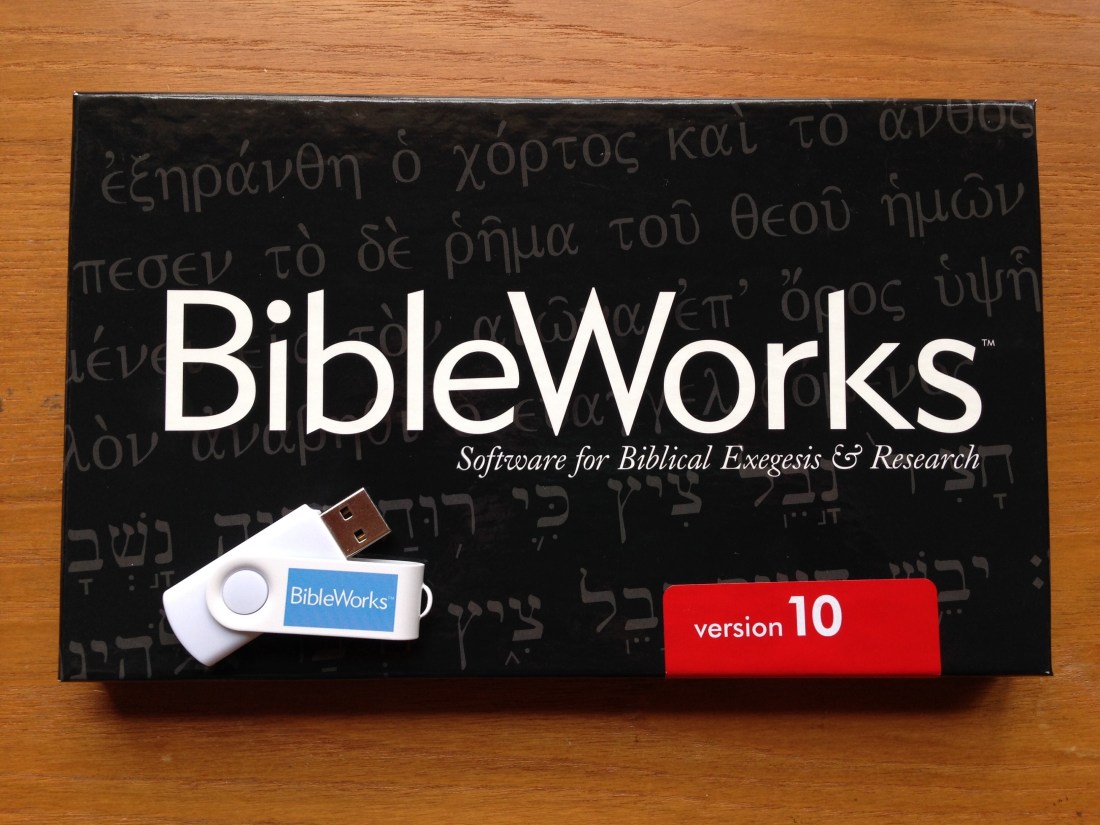
My inordinately strong appreciation of Bible software started with BibleWorks 7. BibleWorks 10 was just released, and it came yesterday to my mailbox on a thumb drive.
Go to www.bibleworks.com to see what’s new. After I’ve had a chance to install and use it, I’ll write a review here.
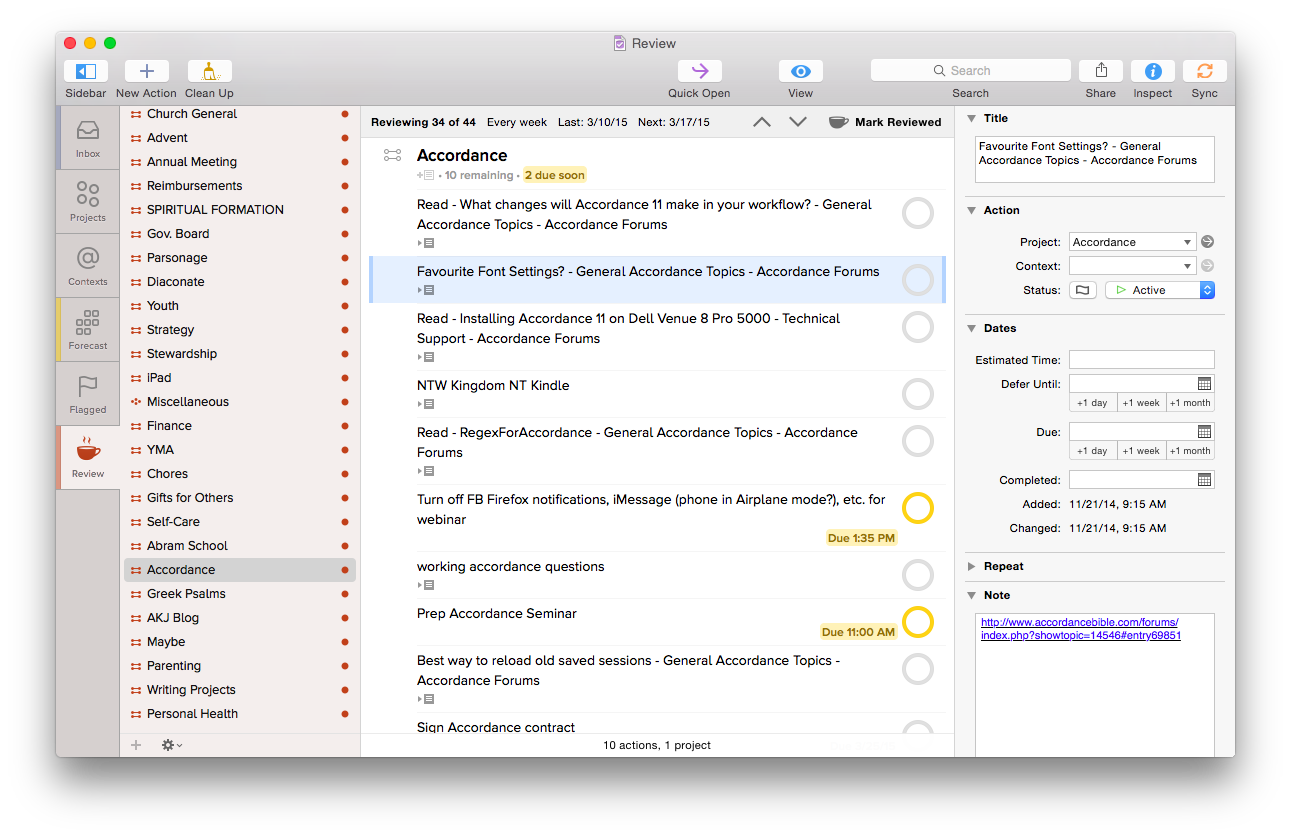
Accordance Bible Software has just posted the video recording of a recent webinar I taught, Sermon Preparation in Action with Accordance. Here‘s the one-page handout so you can see what I cover in the just-over one hour presentation. Live webinars are coming up, and include a Q and A time not shown in the video below. (The next one is May 21–sign up or learn more here.)
Here’s the video, with Accordance’s description below. (If you’re reading this blog post via email, you may need to go to the original post to watch the video.)
In this previously recorded webinar, pastor Abram Kielsmeier-Jones demonstrates how he uses Accordance for sermon preparation. Anyone who preaches or teaches the Bible regularly will benefit from watching Abram’s presentation. Originally recorded on April 27, 2015.
Accordance has quite a few other online trainings coming up. Check them all out.
I’ve been impressed by the Dell Venue 8 Pro in my use of it these past few months. I recorded my initial impressions here.
This post completes my two-part review of the device by way of a three-question Q and A session. (Leading up to this review I’ve benefited from conversations with R. Mansfield, who knows the Dell Venue 8 Pro–hereafter, DV8P–well.)
How Does the Dell Venue 8 Pro Compare to an iPad?
See… I knew you were going to ask that question! Here are five points of comparison.
First, the iPad still does not allow the user to view and use more than one app on the screen at a time. Why this continues to be the case is unclear to me, but the DV8P lets you have two apps open at once. So you can read an article from your Facebook feed without leaving Facebook. Or you can go to a Web link that pops up in a Kindle book you’re reading, while not having to leave and then navigate back to the Kindle app. Advantage: DV8P.
Second, the DV8P is more compact than a full-sized iPad, but close in dimensions to the iPad Mini. The DV8P is longer and skinnier, by a little bit. Its 8-inch screen size (measured diagonally) just edges out the iPad Mini’s 7.9 inches. To hold it feels about the same as the iPad Mini, though. Advantage: Both.
Third, the Dell Venue Pro is both tablet and personal computer. You can use it as both. You can run full-on Windows programs from the Desktop side, which Apple’s iOS on iPad does not permit.
I love being able to access full-bodied programs on this little tablet. Much as I appreciate Accordance’s iOS mobile app, for example, being able to use the full desktop version–but not having to be at a desktop or laptop–is awesome. Advantage: DV8P.
Fourth, the gesture-based interface of the iPad gives the user more options. Or is more intuitive. Or something. I know “intuitive” is a fuzzy word in software and hardware reviews. Of course, I’m way more used to an iPad than the Dell Venue Pro, but the former is easier to just pick up and tap and swipe your way around. Advantage: iPad Mini.
Finally, battery life on the 8 Pro leaves something to be desired, especially in comparison with the iPad Mini. Battery life when the device is in use is fine, but it does not hold charge very well when it idles/sleeps. If I put the tablet to sleep with full battery life, don’t use it at all for a couple days, then come back to it, it’s completely out of charge. I’ve never had this issue with the iPad mini. (And I’m not the only DV8P user to notice this, either.) Advantage: iPad Mini.
Does it Replace a Computer?
Because you have the computing capabilities of a desktop computer in your hands, one could think about the Dell Venue 8 Pro as a possible replacement for a computer.
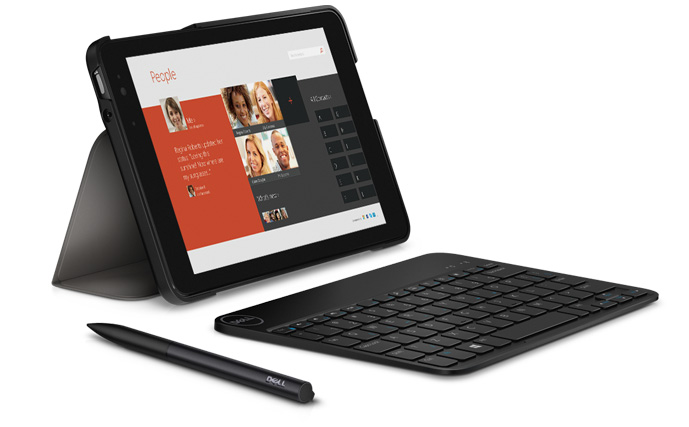
With the loaner review unit Dell sent me, they also included a stylus (with a responsive point) and a keyboard. Each of these are essential companions when using Windows and navigating full-bodied programs like Word or Accordance or whatever else. (Not the least reason for which is that the touch points on Windows apps are too small for even tiny fingers.)
Accordance on the DV8P (click or open in new tab/window to enlarge)
Being able to use–on a portable tablet–programs/apps that you could until now have to get to a desktop or laptop to use… is really sweet. If you don’t want to be limited by Android’s environment or iOS apps, the tablet-as-computer could make sense.
However, a limitation is in the memory size. The Dell Venue 8 Pro comes in 32GB or 64GB models, but even the latter is too small to make this your one-and-only computer (think: lots of images and movies stored). The Dell Venue 11 Pro model, however, has a hard drive up to 256 GB, which is definitely workable for making the DVP your only computing device.
Speaking of, here are the specs of the machine (compared to the 11) from Dell:
Does Abram K-J of Words on the Word
Recommend this Device?
I would be too tied to the Apple app ecosystem to be able to move all my work over to the DV8Pro, much as I like the device. I’d have no way to run OmniFocus, for example. Or Nisus Writer Pro. I could easily still access Evernote, and other such apps.
But if you’re already rocking in the Windows free world, with no Mac or iOS-only apps to consider, this small but powerful device is worth looking into. (I can’t say from experience how it compares to the Microsoft Surface.) It’s reasonably priced, too. And while I experienced more learning curve with the Dell Venue 8 Pro than I did when I first picked up an iPad, after a while it becomes intuitive, and convenient to have more computing power than one would expect in a tablet.
Thanks to the fine folks at Dell for loaning me a Venue 8 Pro 5000 Series Tablet to test for the review. Check out the Dell tablet page here.
Today OmniFocus is expected to release an update that makes their iOS apps universal. The iPhone app, for the first time, will carry with it the capability to view and create custom Perspectives.
There are several upgrade paths, depending on what you’ve already purchased from Omni in the past. (Before the universal update, the iPhone and iPad apps were paid, separate purchases, with only iPad carrying a Pro upgrade version.)
It’s not the easiest upgrade process to understand, but here are two charts from Ken Case (via the Twitter) that will help:
The upgrade paths (click to enlarge)
More Options on the iPhone Version (click to enlarge)
And check out this lovely screenshot from the updated help files. You can now re-arrange your Perspectives on the phone.
Reordering Perspectives in iOS Pro
You can see everything that’s new in iOS 2.1 here. My overly eager and long-winded review of OmniFocus is here.
You know that creeping suspicion that some of your strangest idiosyncrasies could not possibly be shared by anyone else ever?
You’re usually wrong.
Case in point: it turns out I’m far from the only one who has had about a dozen different to-do apps on his phone in the last couple months. But it’s a bad idea to use multiple apps to organize tasks. All the better if you can track everything through one clearinghouse.
OmniFocus is that place for me. In more than half a year of daily use (exception: techno-Sabbath), I’ve only found one real flaw in the program (sync is not seamless). Otherwise OmniFocus (a.k.a. OF) does everything I want a task management app to do, and many things I didn’t know I would want such an app to do.
First Things First: Learn OmniFocus Language
There’s a lot to OmniFocus. To get a quick overview, check out this video, or this one, which explains the fundamental OF concept of “perspectives,” ways of organizing and accessing your tasks.
Or skip the videos and read this one-paragraph simplification of what you need to know about OF terminology before using it:
Projectshelp you break a bigger endeavor down into its component actions. Projects can be Sequential (you have to do action 1 before you can do action 2) or Parallel (it doesn’t matter in which order you do the individual tasks). For that matter Projects can just have what Omni refers to as loosely-related but not interdependent “Single Actions,” like a grocery shopping list. Contexts allow you to organize actions according to the things/people/environment you need to do them: Office, iPad, Internet, Computer, Car (careful!), etc. The Forecast view shows your tasks chronologically in one place–I spend most of my time in this view. Or you can just make a quick entry in the Inbox, and then decide how to categorize it later.
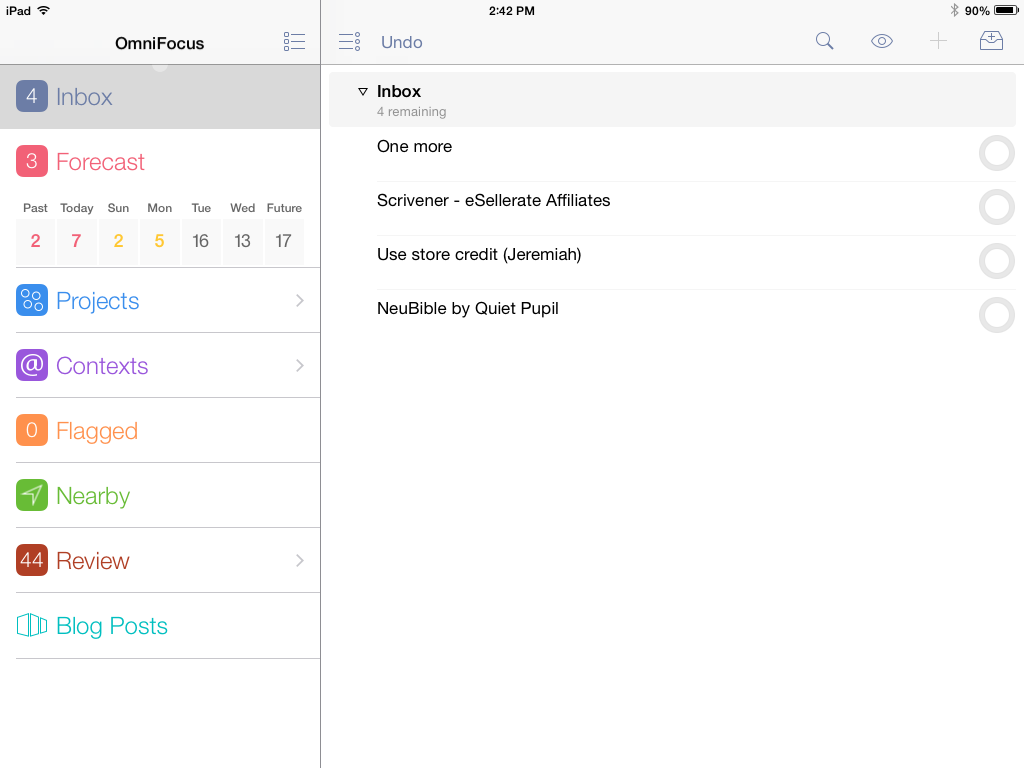
iPad, showing various perspectives and Inbox (“Blog Posts” is a “custom perspective” available with iPad Pro version)
The Inbox is the starting point–OmniFocus suggests that you take some time to just “brain dump” everything there and then assign Contexts and Projects, due dates and duration times later.
Using OF requires some patience and learning, but is worth the investment of time if you’re serious about project and task management.
Contexts perspective in iPad
OmniFocus is Ubiquitous Across Devices and Apps
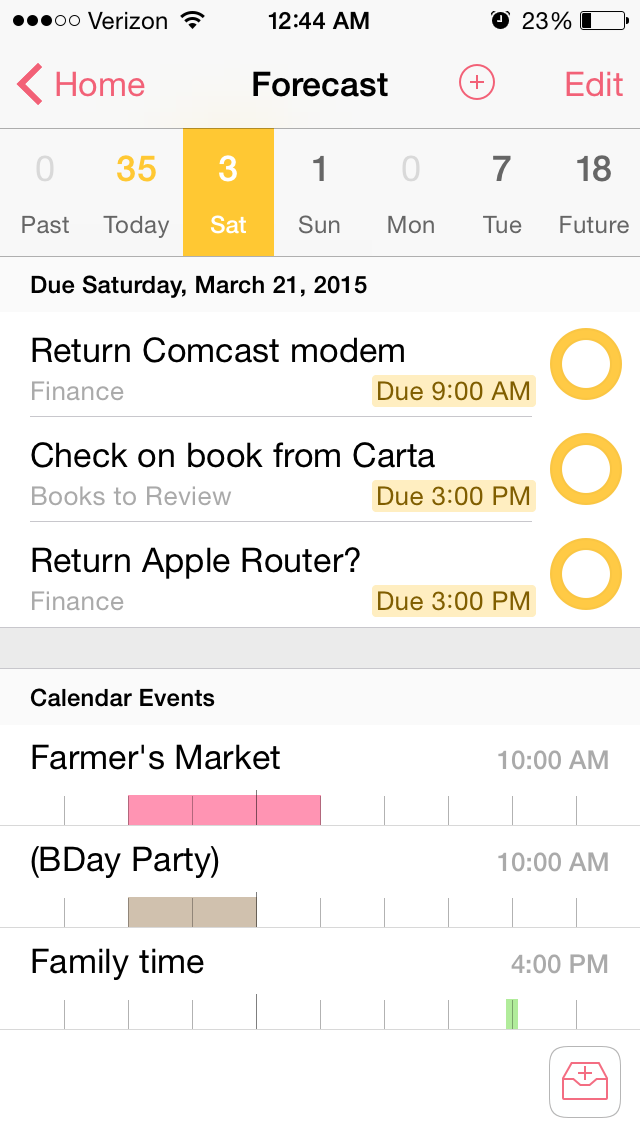
OF syncs automatically across Mac, iPad, and iPhone. When you are in the Forecast perspective, both the iOS apps and the OSX app allow you to see your Calendar Events right next to your actions for the day:
iPhone Forecast perspective
I even figured out, using their Clip-o-Tron 3001, how to turn Mac Mail messages into tasks with a keyboard shortcut. (Email inboxes are not a good place to keep tasks, you realize.)
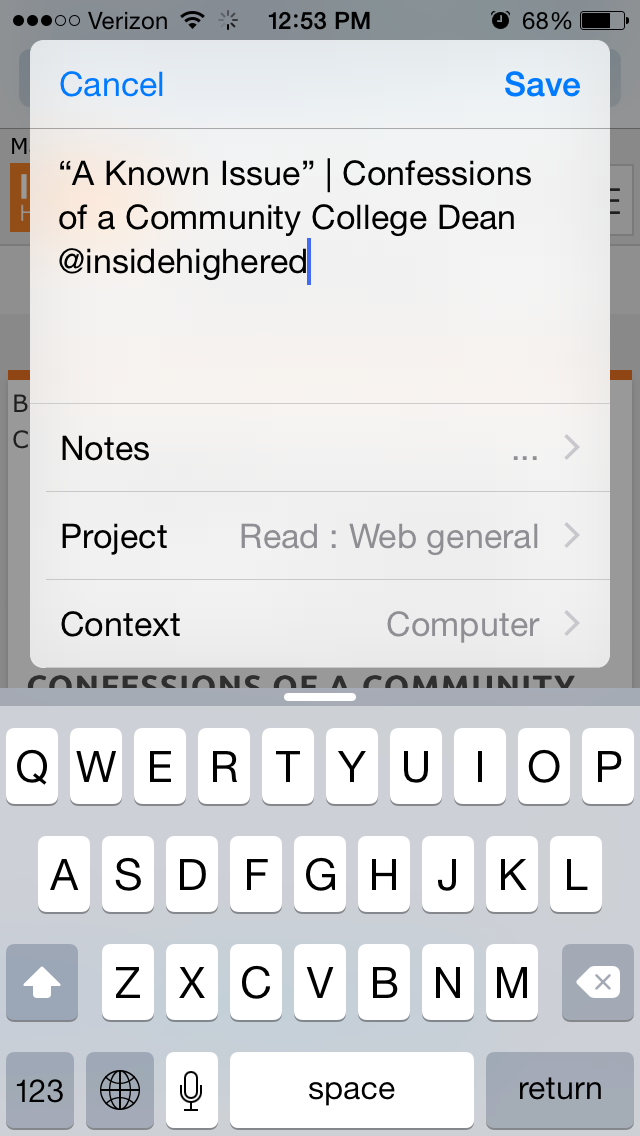
And I love the Share Extension in iOS8. From almost any app I can create an OmniFocus task. I do this regularly. I see something I like, so share to OF:
From Safari, for example, the Note is automatically populated with the article link, and I can set the Project and Context:
One lack in the Share Extension is the ability to assign a due date from the screen shown above–you have to manually open OmniFocus if you want to do that. However, the more I use OmniFocus, the more convinced I am to only set due dates if absolutely necessary–you can always look through undated tasks in your weekly review, which OF makes really easy with their excellent Review perspective:
OmniFocus for Mac Review perspective
What if you’re on a library computer or PC or purchased OF for Mac only and see something on your phone that needs to become a task?
OmniFocus gives you your own unique email address, to which you can email a task. This “Mail Drop” feature helps get the user close to Inbox Zero on email, too, since you can just forward a Gmail message to OmniFocus, where it will end up in your OF for future processing. In other words, you can input OmniFocus tasks from anywhere.
And TextExpander helps here. That app allows you to type your own abbreviations that then expand into text of your choosing. With TextExpander enabled, I write “.omni” and my OmniFocus task capture email address (which is neither short nor memorable) pops up right away.
Another way you can input tasks? Connect your OmniFocus in iOS to the Reminders app, then you can tell Siri to remind you something, and it goes into OmniFocus. Awesome!
Bonus: It Does Photos and Voice Memos
The iOS OF apps even allow attachments to tasks. If I’m processing paperwork and need to set a reminder to pay a bill, I can just take a picture of the bill from OF and save it to a task. Whenever I pull that task up on my computer or other device, the photo will be there.
You can also tap on the “Attachments” tab to record a voice memo, and save a task that way.
Limitations
There are some limitations to using OmniFocus, though not many, and far fewer than other task management apps. Its sync function, which uses Omni servers, operates with a delay. Though sync is supposed to be seamless, it doesn’t function with the same instantaneous speed as, say, Apple’s native Reminders app. On the ground level this means that if I work through a task list on my computer but don’t have the OF iPhone app open (even though background refresh is on), I will still get outdated task notifications on my phone until the sync properly takes place. This is a daily frustration, even if a minor drawback compared to all the other robust features.
The workaround for this is to manually sync the app each time I update it, to make sure it’s up-to-the-minute. OmniFocus has made improvements here since I started using it, but I hope it will soon match what other apps do by way of syncing speed.
OmniFocus is not cheap–they’re working on making their iOS app universal (very soon), but in the meantime, there is a separate Mac app, iPad app, and iPhone app available for purchase. It’s not on Windows or Droid.
However, if (a) you have a complex set of roles, priorities, and tasks to manage, (b) you don’t feel fully on top of them, and (c) you’re willing to take the time to learn OF, it’s well worth the purchase price. One could probably get by with OF on just one platform, too, though if funds permit, having it on a mobile device and a desktop is an advantage.
Made with Care: Some More Thoughtfully Designed Features
The longer I use OmniFocus, the more I appreciate some little features. Just the other day I noticed for the first time that in your perspectives sidebar on Mac, if there are items in that perspective to process, a little colored bar on the left highlights that perspective.
The image at left tells me I am due my Review, that there are items in the Forecast (i.e., scheduled actions), and that there are some entries in my OmniFocus Inbox needing attention.
There are lots of nice little touches like this–the color of your task circles, for example, varies depending on the status of the task (whether flagged, due soon, overdue, repeated, etc.).
And one of the best intangibles for me has been the ease of accessing the help manuals. Sure, you can get impressive help information from within the app, but OmniFocus has made their iPhone, iPad, and Mac help manuals available as free iBooks downloads so you can annotate them to your heart’s content.
Also, using Control-Option-Space on Mac, you can open a Quick Entry pop-up to enter an Inbox item. As long as OF is open, you can do this from anywhere on your computer.
Two more sweet little features I love about the iPhone version–there’s a little “+” icon for an new Inbox entry on just about any screen within the app, so adding tasks is easy, no matter where you are in the app. And once you add a task in iPhone or iPad, you can not only Save it, but can tap on “Save +” to go right to a new task entry. In other words, you can add a task and not be sent back to your Inbox, but keep adding task after task. I find this feature essential when I’m using OF to track action steps in meetings.
I could go on. Lots of people have! It seems that explaining OmniFocus is its own third-party cottage industry.
TL;DR version? (I know–I am supposed to put that at the top of the post.) OmniFocus is an amazing app, designed with care, and more than any other tool has helped me to greatly improve personal productivity. With a good system in place, I spend less time worrying about what I’m forgetting and more time doing what I know I’m supposed to do.
Thanks to the fine folks at Omni Group, the makers of OmniFocus, for giving me downloads for the Mac and iOS apps for this review. See my other AppTastic Tuesday reviews here.
Our daughter is in the Terrific/Terrible Twos stage.
The terrible: she does things like write on the new kitchen floor in permanent marker. She leaves tons of tiny fingerprints on the MacBook and almost pushes the TV off its stand because she thinks they are both touch screens. She changes her own diaper and *tries* to flush its contents down the toilet herself. (Okay–this last one isn’t all bad–potty training, here we come!)
The terrific: sometimes, when she presses random keys on the laptop keyboard, instead of making the computer freeze, she discovers new tips. (Far more terrific than that, of course, is the fact that she is an amazing and wonderful human being.)
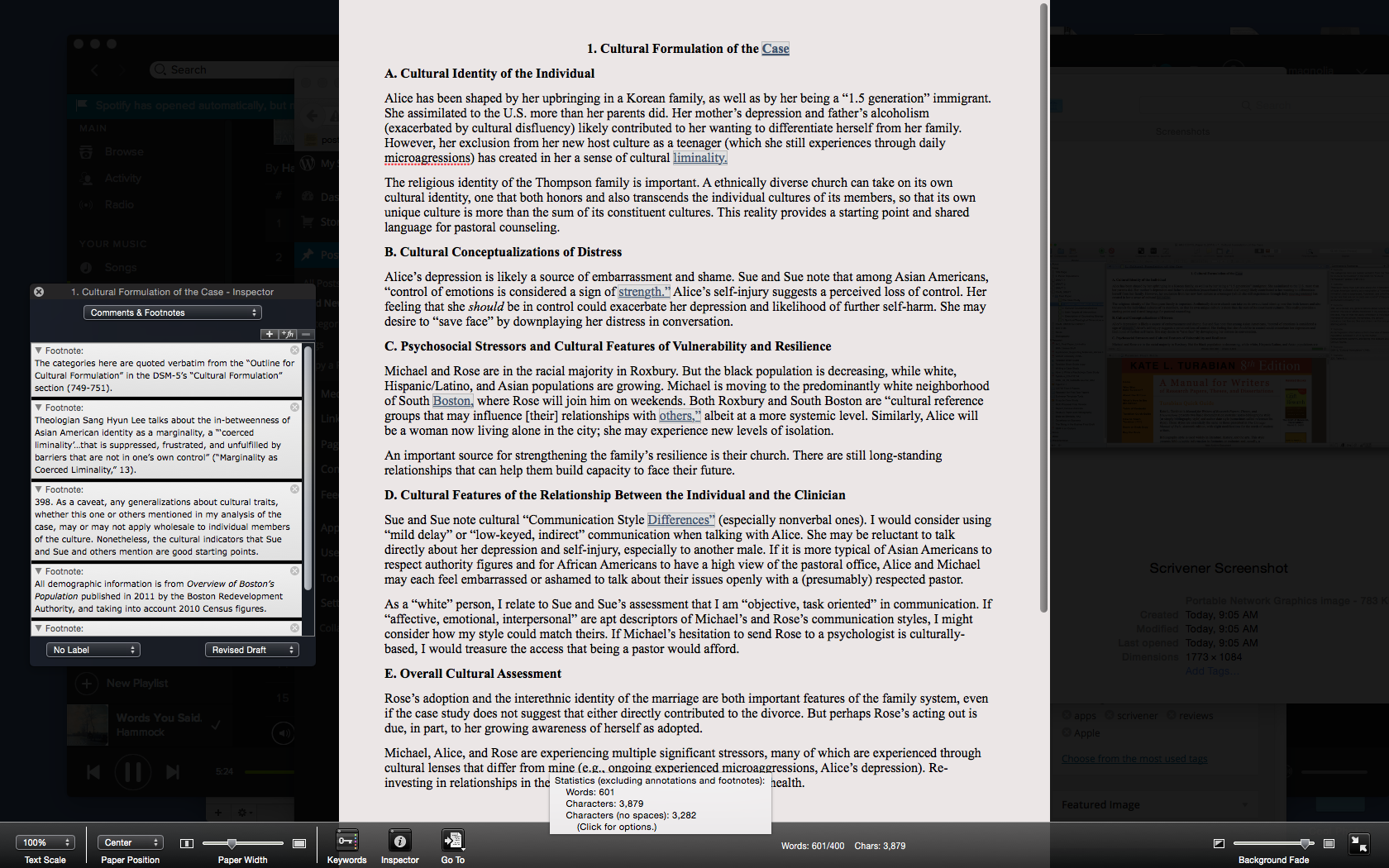
The other day she saw this little guy in the toolbar when I had Scrivener open for some work I was doing:
She tried to tap it (no Scrivener for iPad… but soon, I hear!). Then between the two of us, we clicked it and Scrivener went from this view:
Click or open in new tab to enlarge
to this one:
Click or open in new tab to enlarge
Yes, Scrivener can go into full screen, but this is something a little different–a composition mode where you can just write. You’ll see at the bottom (a toolbar which goes away if you want it to) that I can still pull up essentials like the footnote window on the left. Or I can move all that out and just focus on writing.
I’ve used Scrivener for more than a year now and don’t think I’ve ever clicked on “Compose.”
So… thank you, two-year-old daughter, for helping your dad learn more about a program he uses all week, and for simplifying my workflow!
Want to check Scrivener out? (I recommend it, and offer my thanks to the folks that make it for the review license.) Here you can download a free trial, for Mac or Windows. (It’s a generous trial period, too.) You can read more about Scrivener’s features here.
I’ll be presenting an online training webinar–Sermon Preparation in Action–twice for Accordance Bible Software in the coming weeks.
The webinar is free, and you can register here. The one-page outline of what I’ll cover is here.
The first session is this coming Monday, March 9, at 2:00 p.m. EST. Those registrations are almost full, so you can also register for the second session (the content is the same) on Monday, March 23 at the same link.
Accordance has quite a few other online trainings coming up. Check them all out.

!["Leningrad Codex Carpet page e" by Shmuel ben Ya'akov - [2]. Licensed under Public Domain via Wikimedia Commons](https://abramkj.com/wp-content/uploads/2015/06/leningrad-codex-cover.jpg)




















 Words on the Word