(Part 2) Review of IVP’s Dictionary of the Old Testament: Pentateuch

IVP OT Dictionary Pentateuch

Sarah, Melchizedek, and the language of the Pentateuch. Last week I reviewed the articles on each of those topics in InterVarsity Press’s Dictionary of the Old Testament: Pentateuch in Logos Bible Software.

Here’s what the IVP page says about the dictionary in its book description:

The Dictionary of the Old Testament: Pentateuch is the first in a four-volume series covering the text of the Old Testament. Following in the tradition of the four award-winning IVP dictionaries focused on the New Testament and its background, this encyclopedic work is characterized by close attention to the text of the Old Testament and the ongoing conversation of contemporary scholarship. In exploring the major themes and issues of the Pentateuch, editors T. Desmond Alexander and David W.Baker, with an international and expert group of scholars, inform and challenge through authoritative overviews, detailed examinations and new insights from the world of the ancient Near East.

My first review contains an initial evaluation of the dictionary specifically in Logos Bible Software; you can read that here. In this post I summarize and briefly interact with three more articles: “Terah,” “Lot,” and “Ur.”

Terah

Terah was Abram’s father and Lot’s grandfather. He also fathered Nahor and Haran. M.W. Chavalas notes that Terah was “the family head,” since “all of the material in Genesis 11:27-25:11 is prefaced by the statement, ‘This is the family history of Terah’” (829). Chavalas considers Terah in three parts: the etymology of his name, his time in the city of Ur, and “Terah and Later Traditions.”

Chavalas considers several options for the meaning and linguistic source of “Terah,” but concludes, “An understanding of the etymology of the name Terah has proved to be difficult” (829). It does seem to have “associations with a place name in northern Mesopotamia” (830) and perhaps some associations with lunar worship (though perhaps not). Similarly, Ur, from which Terah comes, has been difficult to pinpoint. Chavalas places it in southern Mesopotamia. Chavalas finally considers the challenge that Acts 7:4 and Philo pose regarding chronology and location.

Chavalas manages to cover most of the essential territory on Terah in a short space. There is not much biblical material on Terah, but this article contains an overview of it all. There is little content in the “Terah and Later Traditions” section, and the article’s bibliography does not point to more resources to explore Abram’s father, for example, in rabbinical tradition. Detailed research on Terah would have to be supplemented with other resources.

Lot

Lot was Terah’s grandson and Abram’s nephew. J.I. Lawlor notes that Lot traveled with his grandfather Terah from Ur to Haran because his own father has died (556).

Lawlor primarily takes a literary and narrative approach to understanding Lot’s place in the Abram/Abraham material. He notes “two ‘paired sets’” of Lot material that “have been integrated, one set in each half of the Abraham story” (556). The author/compiler of Genesis does this, Lawlor notes, to “suggest and hold open the possibility of Lot as Abraham’s heir” (556), later dismissing the possibility as Isaac becomes heir (557).

Genesis 14:17-24 marks Abram’s encounter with Melchizedek, occasioned because Abram had gone to battle due to the Mesopotamian kings’ kidnapping of Lot. Abram rescued Lot in Gen. 14, then rescued him again, in a way, by interceding on behalf of Sodom and Gomorrah in Gen. 18-19 (557-8).

Due to an incestuous drunken encounter with his daughters, Lot gave rise to two groups of people, the Moabites and Ammonites, which Lawlor briefly discusses.

Lawlor’s most helpful contribution is in his situating of Lot in the larger flow of Genesis 12-19, where Lot serves as a possible answer to the question, Who will be an heir to Abram and Sarai? His reading of the “two paired sets” of Lot material is illuminating.

Ur

Like Chavalas in the “Terah” article, Osborne locates Ur in southern Mesopotamia as one of its “oldest and most famous” cities (875). Today the two-millenia old city of Ur is “modern Tell al-Muqayyar, located on the Euphrates in southern Mesopotamia” (875). Osborne looks at the archaeology of Ur as well as its place in patriarchal times.

Based on an early 20th century exploration of the tell (hill/remains) where Ur once was, archaeologists think that Ur was “not…one of the most extensive cities of its time” (875), with a population of just under 25,000. Ur was a center of lunar worship in Mesopotamia, as was Haran, where Terah would go from Ur (875). Tomb excavations have shown a wealthy city, which “was most probably derived from its lucrative involvement in trade along the Gulf” (876). Osborne also explores the debate over the birthplace of Abraham, whether it was northern or southern Mesopotamia (he favors the latter). He notes that the Genesis text does not say why Terah and his family left Ur.

Archaeology is not my primary interest within biblical studies, but Osborne introduces the basic archaeological finds to the reader in a short space, and does a good job of it. The bibliography at the end of the article offers titles for further reading.

**********

My impression of the dictionary continues to be positive. At the same time it is becoming clear to me that it is not comprehensive in the subjects it treats. So researchers, exegetes, writers, and teachers will want to consider using it alongside other resources. However, its ability to summarize much detail in a succinct way is a strong point of the dictionary.

I’ll do at least one other installment in my review of Dictionary of the Old Testament: Pentateuch, and include some concluding thoughts there. See the first part of my review here.

The Dictionary is on Amazon here (in print) and at Logos here. My thanks to Logos for the review copy.

Review of IVP’s Dictionary of the Old Testament: Pentateuch (Logos edition)

IVP OT Dictionary Pentateuch

Over the next few weeks I’ll be reviewing IVP’s Dictionary of the Old Testament: Pentateuch in Logos Bible Software. I’ll look at a few dictionary articles in each post, commenting on the content of each, as well as on the dictionary’s presentation in Logos.

I’ve reviewed Logos 4 and 5, looking at several packages and additional resources. Find those reviews collected here.

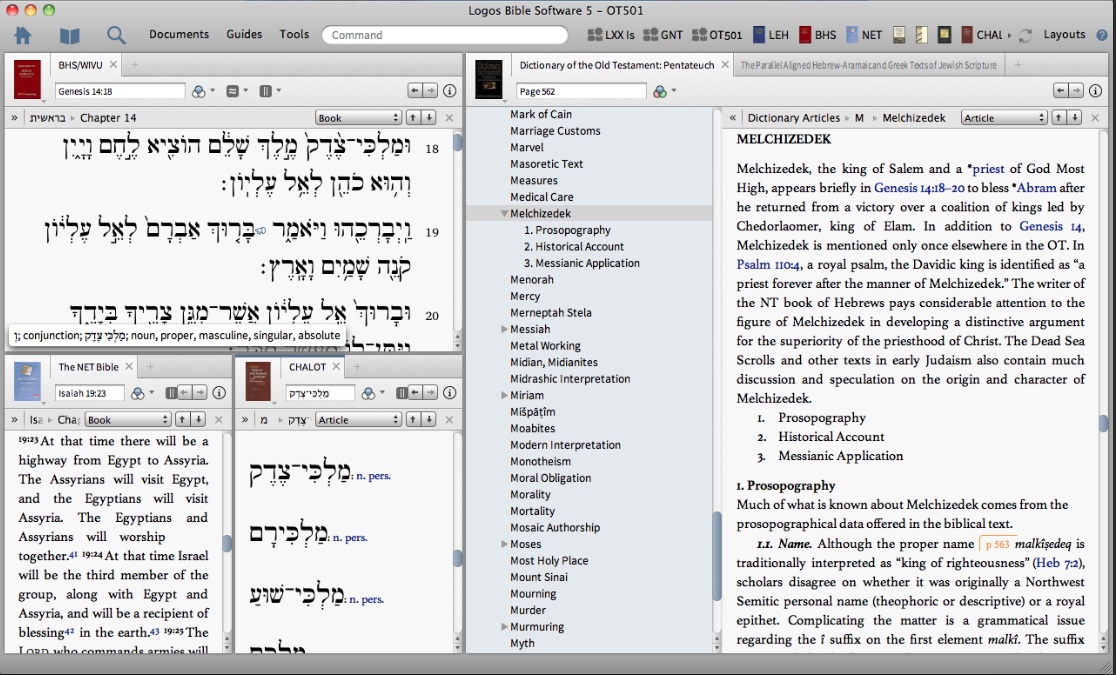
The dictionary is easy to lay out in Logos with other accompanying resources. Here I have it next to the Hebrew text with English translation and a Hebrew lexicon (click to enlarge):

IVP OT Dictionary Logos

As with all of Logos’s resources, you can hover over hyperlinked words (see “Heb 7:2” above) to see the Scripture without leaving that tab.

One solid feature so far (true of Logos resources in general): being able to use the shortcut command (Mac) or control (PC) + F to quickly find words in the entries.

One thing to critique so far: the items in the Table of Contents don’t expand to all the subpoints. In the shot above, for example, you can see that “1. Prosopography” under Melchizedek has “1.1. Name” in the entry, but not in the left sidebar Table of Contents. This makes navigating through multiple layers of detail a bit more cumbersome. (By contrast, the Accordance version of this module looks like it has the triangle that continues to expand, here.)

What about content of the dictionary itself? In this installment, I summarize and review three articles: “Sarah,” “Melchizedek,” and “Language of the Pentateuch.”

Sarah

R.G. Branch notes that Sarah and other “matriarchs of God’s people” are “equally significant” compared to the “widely recognized Israelite patriarchs” (733). Chief among these is Sarah. Even if there is not the amount of biblical material about Sarah that there is about Abraham, she remains a “pivotal character” in Genesis (733).

Branch divides the “Sarah” entry into two parts: “Sarah in the Ancestral Narratives” and “Sarah in the Later Tradition.”

In the first part Branch notes that Sarah, about 10 years younger than Abraham, is “the first matriarch of the biblical text” (733). Her childlessness in Genesis 11:30 is a key characteristic. Her first mention in that passage describes her barrenness, which “sets the tone for the stories about them that follow” (733). Sarai and Sarah (her name after God changed it in Genesis 17) both mean “princess” or “chieftainess.” Genesis records several threats to the possibility of Abraham and Sarah bearing offspring, not the least of which is two stories (in Genesis 12 and 20, which Branch understands as two separate incidents) of “marital deception,” where Abraham claims Sarah as his sister (734).

“In both cases,” Branch notes, “Abram feared for his life because of his wife’s great beauty” (734). It is this beauty that is the focus of the second part of the article, “Sarah in Later Tradition.” Branch cites various Jewish sources that extol Sarah for her immense beauty. She is also said to have been “surrounded” by miracles (735).

Branch gives a good, basic summary of biblical and Jewish rabbinic material about Sarah (as well as her importance for understanding Elizabeth in the New Testament), with citations that the reader can follow up for more.

Key statement from this article is: “Many of the issues in the stories about the couple can be understood as their struggle to come to terms with God’s promises of land, offspring, greatness and blessings” (734).

Melchizedek

Scripture contains very few references to the mysterious figure of Melchizedek. S.J. Andrews recounts Abram’s encounter with Melchizedek in Genesis 14:18-20, which Psalm 110 (noted as a “royal Psalm”) cites. Andrews also does well in noting the book of Hebrews’ understanding and interpretation of Melchizedek.

In “Prosopography” Andrews notes the complications that arise in trying to understand the name malkîṣedeq. Hebrews reads it as “king of righteousness,” but Andrews notes scholarly disagreement on “whether it was originally a Northwest Semitic personal name (theophoric or descriptive) or a royal epithet” (563). Therefore, “The name could mean either ‘(my) Malk/Melek is just’ or ‘Ṣedeq is my king’” (563). Either way, Genesis calls him “king of Salem,” which could be Jerusalem, or just mean, “king of peace,” as in Hebrews 7:2.

The “Historical Account” section of the article delves more into the story of Abram’s victory of kings and subsequent exchange with Melchizedek, where the latter gives the former bread and wine and a blessing, and the former appears to tithe to the latter.

In the final section, “Messianic Application,” Andrews explores various possibilities for the appearance of Melchizedek, what it meant, possible connection to a Messiah, and so on.

Andrews says, “The Qumran text 11QMelch portrays Melchizedek as an archangelic figure like Michael” (564), but he could have perhaps gone into more depth about the Qumran understanding of Melchizedek. However, his basic overview serves as a solid starting point for understanding the Melchizedek figure in biblical tradition.

Language of the Pentateuch

R.S. Hess’s “Language of the Pentateuch” article consist of three sections: “A discussion of the history of languages in and around Palestine during the third and second millennia b.c., a consideration of the grammar and style of the Pentateuch’s language in comparison with Classical Hebrew, and a study of those linguistic elements within the Pentateuch that might relate it to the period in which the narratives and events recorded in Genesis through Deuteronomy claim to have taken place” (491).

He offers a survey of Pentateuchal chronology, marking the date of the exodus as “sometime between the fifteenth century b.c and the end of the thirteenth century b.c.” (492), part of the Late Bronze Age. The Hebrew language is part of a family of West or Northwest Semitic dialects. There are not immense differences between the language of the Pentateuch and the language of (presumably) later Old Testament texts, but Hess does point out research around some “distinctive elements found in the Pentateuch that might set it apart from the grammar of the remainder of biblical Hebrew” (493), though these are few. Hess holds to an “early date” for at least the initial writing of the Pentateuch.

This particular article was a bit dry at times, but the level of detail is still to be appreciated.

So far my overall impression of the dictionary is positive. I will write more about it later. UPDATE: Part 2 is here.

The Dictionary is on Amazon here (in print) and at Logos here. My thanks to Logos for the review copy.

Psalms of Lament (for “Scalding Tears”)

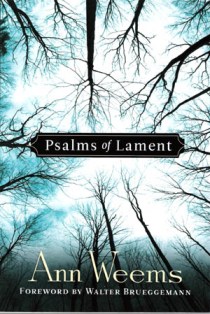
Psalms of Lament

Psalms of Lament is a heartbreakingly beautiful collection of poetry. Weems alarmingly yet assuringly gets right down to business in her Preface:

This book is not for everyone. It is for those who weep and for those who weep with those who weep. It is for those whose souls struggle with the dailiness of faithkeeping in the midst of life’s assaults and obscenities. This book is for those who are living with scalding tears running down their cheeks.

Her Psalms are for those whose experiences are “painful, too painful for any of us to try fitting our souls into ten correct steps of grieving.” They come from experience: Weems unexpectedly lost her son (“the stars fell from my sky”) just after his 21st birthday.

Drawing on the great biblical lament tradition, Weems writes lament psalms of her own. David’s familiar structure of

“How can you leave me like this, God?”–>”Yet I will trust you”

is on display throughout the collection. As personal as Weems’s psalms are, like David’s and Jeremiah’s laments, they are universal and could be prayed by anyone who is lamenting.

If you read with an open heart, Weems’s laments can evoke tears at nearly every line. And it’s a profound Godward lament in which she engages: “Anger and alleluias careen around within me, sometimes colliding.” There’s no bitterness here, but neither is there a naïve attempt to placate reality (as if we could!) with boring pseudo-truths like, “Everything happens for a reason,” or, “God took her away because he needed her for his heavenly choir.” Here is Lament Psalm Twelve, one of the starker and more personal psalms, in its entirety:

O God, what am I going to do?
He’s gone–and I’m left
with an empty pit in my life.
I can’t think.
I can’t work.
I can’t eat.
I can’t talk.
I can’t see anyone.
I can’t leave my house.
Nothing makes any sense.
Nothing seems worth doing.

How could you have allowed this to happen?
I thought you protected your own!
You are the power:
Why didn’t you use it?
You are the glory,
but there was no glory in his death.
You are justice and mercy,
yet there was no justice, no mercy for him.
In his death there is no justice for me.

O God, what am I going to do?
I’m begging you to help me.
At least you could be merciful.
O God, I don’t remember a time
when you were not my God.
Turn back to me;
you promised.
Be merciful to me;
you promised.
Heal me;
you promised.
My heart is broken.
My mind is broken.
My body is broken.
Nothing works anymore.
Unless you help me
nothing will ever work again.

O Holy One, I am confident
that you will save me.
You are the one
who heals the brokenhearted
and binds their wounds.
You are the power
and the glory;
you are the justice
and mercy.
You are my God forever.

The six “I can’t” statements (“I can’t think. I can’t work. I can’t eat. I can’t talk. I can’t see anyone. I can’t leave my house.) evoke the monotony and hopelessness that the grieving one feels. Yet three times: you promised… you promised… you promised. Given the way the poem begins, the last stanza seems almost out of place. But it’s a move David made (forced himself to make) in his Psalms.

I only wonder if those who grieve will be ready to pray along to the end of each psalm with Weems, as her laments so often end with an affirmation of God’s promises. For those whose grief is acute, fresh, and numbing, such prayers may at the moment be impossible.

Yet Weems gives us language for when we need it most, for when words of any kind are impossible. A person in the throes of grief not yet be able to say, “Alleluias spin in my heart!” But she or he may want to be able to make such affirmations, if not now, then eventually. Weems offers wording for the griever to attempt that journey. In so doing she provides a pattern for lament that is true to the biblical tradition, true to life.

Psalms of Lament 2Psalms of Lament is a gift to the Church and to those who grieve. Pastors, campus ministers, youth ministers, and worship leaders would all do well to have copies on hand. While Weems seems to have composed her laments with the individual in view, I’m intrigued by the possibility of reading and praying these psalms in corporate worship settings. A funeral or a Sunday after a tragedy would be particularly appropriate times. Yet if we consider, as Weems notes, the possibility of weeping with those who weep, those who pray would do well not to wait until a tragedy to employ these psalms.

Weems’s prayers floored me. I had turned to her before. As I read her again I never made it very far without choking back tears. (In my better moments, I gave up on trying to choke them back.) The tears Weems evokes, though, are not just tears of sadness, but tears of hope in the God who “will put the stars back in the sky.”

Thanks to Westminster John Knox Press for the review copy. I am confident I’ll want to pick up additional copies of Psalms of Lament for others. You can preview a good deal of the book at Google Books here.

Review of Zondervan’s Theologian Trading Cards

They’re a real thing, and they’re the best conversation starter I’ve brought into my office in a long time.

Creator Norman Jeune III came up with the idea of Theologian Trading Cards in seminary. It’s a good one. I remember, as a kid, memorizing and quoting statistics and quizzing friends with the back of baseball cards. I could tell you how many home runs and runs batted in Andrew Dawson of the Chicago Cubs had had for the last five years. It’s a good size for a learning tool.

The product description from Zondervan reads:

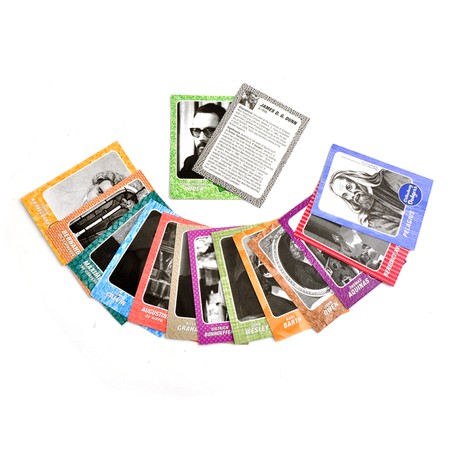
Patterned after the all-American baseball card, Theologian Trading Cards provide essential information about the major teachers, leaders, and trouble-makers throughout the history of the Church. At a glance you will have access to information regarding 288 important figures in church history, including when and where they lived, their contribution to the church, and enduring significance.

Jeune has organized the cards into 15 teams, each grouped by chronological or historical or theological commonality. The “Orthodoxy Dodgers” (great name) are the church’s heretics. Marcion (85-160), for example, “created his own canon [of Scripture], exlcuding the Old Testament and introducing numerous edits, compilations, and omissions to the New Testament.” The “St. James Padres” team consists of early church fathers: Ambrose, Augustine, Cyril, Justin, and so on.

The cards aren’t really “trading cards,” since there’s no trading to be done–you can only buy it as a complete set. But they’re just as fun as the baseball cards I collected as a kid… well, if you think theology is fun. (Which, of course, it is!) Jeune introduces a creative medium in a field that can be challenging for students. There are a lot of facts, figures, and beliefs to keep straight in a basic church history course.

Image from patheos.com

The front of the card consists of a photo (except where none is available; see below), the name of the figure, and his or her team. The back of each card has dates and two sections: biographical and significance. Of course it would be impossible to cover everything (even all the significant things) in each figure’s life on just the back of a card. But Jeune does a good job of hitting the main points.

And the cards are fun. I don’t think I’ve ever had anything on my office coffee table picked up as much as these cards. Folks want to leaf through and see who’s there, what is written about them, etc. I’d imagine that they aid exam preparation, too. The handy size makes them easy to stuff in backpack, or put a small stack in a purse for on-the-go quizzing.

Of course a set like this is prone to criticism–which figures Jeune includes, which ones he doesn’t, how much detail he includes, what detail he leaves out. There is somewhat decent representation of more than just white males–users of this set will find cards for Amy Carmichael, Elisabeth Schüssler Fiorenza, Rosemary Radford Ruether, Teresa of Avila… though still one wants for more. There is James Cone, but no MLK? Julian of Norwich, but no Perpetua? This must be impossible to get right in a set like this, but those omissions are noticeable. I’m holding out for a “booster pack” to add to the set.

Another quibble I have is that while each of the 15 teams has a checklist, there is no comprehensive checklist for the set. Even if spread out over a few cards, it would be useful to be able to quickly see all the persons that Jeune includes in the set. (Perhaps he will upload a list online in the future? If so, I’ll post here.)

Facebook silhouetteA distraction in the set is the number of cards that have a blank silhouette with a question mark on it. For these the publisher was not able to procure an image. There is a good reason for this, and it’s worth reading Jeune’s explanation here. All the same, an original sketch, however basic, would have been preferred. (Remember those Facebook friends who joined but didn’t add a profile pic for months? It looks like that, only with the super-imposed question mark.)

The idea of Theologian Trading Cards is a great one, though. The cards aim to be “a fun way to learn church history and theology.” They are that, but I hope future editions or additional sets/booster packs will be more thorough in covering all the areas and players in church history and theology. Until then, this is still a set worth having. Jeune’s layout makes it easy to fill in the gaps in one’s knowledge of church history and theologians.

Thanks to Zondervan for the opportunity to review the cards gratis. Find the cards here at Amazon or at their Zondervan product page. See here for a few sample cards.

Paul and the Old Testament

There are over 100 explicit quotations of Scripture in Paul’s letters and at least double that number of allusions. However, what is potentially more useful than just citing Paul’s answers to first-century questions is to study how Paul interpreted Scripture, and that is the theme of this book. (1)

This summer I reviewed the third volume of a de facto trilogy by Steve Moyise. In that same series is Paul and Scripture: Studying the New Testament Use of the Old Testament (click on book cover image to see at Amazon). In 160 packed pages Moyise surveys Paul’s use of the Hebrew Bible/Septuagint.

Moyise’s approach is a thematic one, rather than book-by-book. This helps the reader focus on how Paul treated the same topic across his various letters.

The author begins with an introduction to Paul, his “conversion” experience, his missionary activity, and a wonderful problematizing of the issue: because Paul was familiar with Greek, Hebrew, and Aramaic versions of Scripture, “[W]hen Paul introduces a phrase or sentence with an introductory formula (IF) such as ‘it is written’, we have to ask ourselves which version of the Scriptures he has in mind” (10). For Paul “would not have had our concept of ‘Bible’, a bound volume of 66 books (for Protestants) residing on his bookshelf” (10).

Moyise keeps his and the reader’s eye on this issue throughout Paul and Scripture. He explores how Paul used:

  • “The figure of Adam” and creation accounts (with Christ as a Second Adam)
  • The story of Abraham, including a brief but helpful look at “Abraham in Jewish tradition”
  • Moses–“an ambiguous figure for Paul. He speaks to God face to face, but his use of a veil is interpreted as a lack of openness” (59)
  • The law. This was perhaps the most interesting section of the book, as Moyise surveyed not only Paul’s use of Scripture, but how modern theologians have tried to make sense of what looks on first glance like conflicting statements about the law. This section is what led me to write:

I don’t even mind that at the moment I’m a bit perplexed by how Paul could both praise the law as being from God yet also refer to it as a “the ministry that brought death.”

  • The prophets–both to develop a theology of Israel and the Gentiles, and to provide instructions for how the Christian community should live
  • The Psalms, Proverbs, and Job

The final chapter is a more detailed survey dealing with “modern approaches to Paul’s use of Scripture,” which Moyise divides into “an intertextual approach,” “a narrative approach,” and “a rhetorical approach” (111 ff.).

Appendices include a focus on Paul’s quotations from Isaiah, an index of Paul’s quotations of Scripture, and pertinent excerpts from the Dead Sea Scrolls.

As with The Later New Testament Writings and Scripture, the book is accessible to a non-scholar or non-specialist in this field, though it will require some work. Due to the book’s brevity, and what I assume was Moyise’s desire to still cover all the proper territory, the book is dense. This means that even a short volume like this will be a great reference to me for some time, as I seek to better understand the ways in which Paul used the Old Testament, and the ways in which Christians have tried to make sense of that use for some 2,000 years, especially recently.

The gray shaded boxes throughout explain key concepts such as the Septuagint, Origen’s Hexapla, Greek grammar, the Dead Sea Scrolls, and so on. As with Moyise’s other book, one does not need to know Greek or Hebrew to read Paul and Scripture, but he does not hesitate to use transliterated Greek to aid his explanation.

I have begun to appreciate Moyise’s even-handedness in presenting various viewpoints and interpretations. Even when discussing potentially controversial aspects of Paul (which books Paul authored, the “New Perspective,” or the idea of some that Paul actually exhibited “contradictory” and inconsistent views of the law), Moyise is fair and presents the various views in a way that the reader is left to consider them for herself or himself. (And the reader knows where to go to find more.)

One thing that seems rare in a work like this is that Moyise generally writes out a Scripture he is citing, rather than just placing a slew of references in parentheses for the reader to slowly work through. This latter method is not all bad, but Moyise’s quotation or summation of the references he cites makes for a smooth read.

I found helpful Moyise’s employment of “an eclectic view, using whatever methods or approaches were helpful for understanding the particular quotation” (111). Moyise doesn’t conclusively answer all the questions that arise when studying Paul’s use of Scripture, nor does he seek to. He hopes “that this book has both laid a foundation and stimulated an interest to go on and read further” (125), a mission he very much has accomplished (at least in this reader) with Paul and Scripture.

Thank you to Baker Academic for providing me with a review copy of the book. See its product page at Baker here.

Free PDF sample of Sustainable Youth Ministry Study Guide

Youth Ministry Architects has posted a sample .pdf of Sustainable Youth Ministry: The Study Guide, which I wrote as a resource for using Mark Devries’s Sustainable Youth Ministry. I’ve posted in more detail about the study guide here. Click here (PDF) or on the image above for a sample of the study guide.

Guest post: Robbie Pruitt on A.W. Tozer

Magnificent Monograph Monday this week features a guest blogger, Robbie Pruitt. I have guest posted on his blog (My Two Mites) before, and today he posts here. It’s a review of Knowledge of the Holy by A.W. Tozer. Robbie is a gifted youth minister, teacher, poet, reader, writer, and friend.

Nothing is more important than a right understanding of God, or “thinking rightly about God.”  In Knowledge of the HolyA.W. Tozer states, “The Church has surrendered her once lofty concept of God and has substituted for it one so low, so ignoble, as to be utterly unworthy of thinking, worshipping men.”  Tozer is addressing idol worship that many fall into by thinking wrongly about God.

It is into this reality that Tozer speaks in Knowledge of the Holy, which is an excellent study of the attributes of God. (See pdf of book here.)  Tozer describes in detail the importance of thinking rightly about God, going so far as asserting, “What comes into our minds when we think about God is the most important thing about us.”  When it comes to our thinking about God, everything is at stake.  We must think deeply and accurately about God if we are to know Him and worship Him rightly and truthfully.

According to Tozer, when we think about God, we are using the language and the concepts that our finite minds can grapple with.  Our understanding of God is limited, as God is infinite and we are finite.  We are also unaware of the fullness of God as there are attributes we have not had revealed to us yet, and which we do not currently have the capacity to comprehend.  Tozer says, “We learn by using what we already know as a bridge, over which we pass to the unknown. It is not possible for the mind to crash suddenly past the familiar into the totally unfamiliar.”

While Tozer is acutely aware of the magnitude of his subject, God, he is not deterred from writing a most excellent reflection on the attributes of God that we can understand and contemplate.  An attribute, simply stated by Tozer, is “whatever may be correctly ascribed to God.”  While there is ample evidence to conclude that what we do not know about God is vast, there is so much about God’s character and nature that we can accurately know.  To begin with, we can know His attributes, and we can ascribe these attributes to Him with confidence.

In thinking about the enormity of God, Tozer is quick to warn against idolatry and thinking wrongly about God.  He says, “To think of creature and Creator as alike in essential being is to rob God of most of His attributes and reduce Him to the status of a creature.”  We must not think of God in “human” terms, though we are using human brains and creation and are reasoning, to contemplate the essence of God.  In thinking of God we must proceed cautiously, reverently and prayerfully, in faith and in love, as we rest in God’s divine revelation to us.

If we are not cautious, the dangers are clear.  We can think of something less than God and find ourselves in idolatry, worshipping something less than God.  Tozer says, “If we insist upon trying to imagine Him, we end with an idol, made not with hands but with thoughts; and an idol of the mind is as offensive to God as an idol of the hand.”  The other danger in thinking about God is attempting to manipulate, control, or manage God, which essentially places us above God as “god.”  Tozer describes this phenomenon this way: “Left to ourselves we tend immediately to reduce God to manageable terms.  We want to get Him where we can use Him, or at least know where He is when we need Him.”

We must look to God with great anticipation and appreciation of God’s revelation to us.  It is adequate.  God has revealed Himself to us and God is knowable.  God, in His great love and mercy, has revealed Himself to us in His son Jesus and we can know Him in faith and in love.  Tozer asserts, “In Christ and by Christ, God effects complete self-disclosure, although He shows Himself not to reason but to faith and love. Faith is an organ of knowledge, and love an organ of experience.”   We can know God and we can experience God.  This revelation of God is a great mercy to us and is a gift to us in Jesus Christ, through His Holy Spirit, which leads us into all truth.

As Tozer says so eloquently, “For while the name of God is secret and His essential nature incomprehensible, He in condescending love has by revelation declared certain things to be true of Himself.”  These truths of God are, indeed, His attributes, and we can know them and study them.  Knowledge of the Holy is a great tool for this study as we seek to come to know the eternal, magnificent, and indescribable God that we seek to worship rightly.

An attribute study is a great way to come to know God more deeply and is a great way to explore the richness of the Scriptures in a more non-linear approach.  Knowledge of the Holy covers some essential thoughts and attributes of God, as well as doctrines, that every Christian should think about.  As Tozer rightly points out, “The study of the attributes of God, far from being dull and heavy, may for the enlightened Christian be a sweet and absorbing spiritual exercise. To the soul that is athirst for God, nothing could be more delightful.”  As we seek God and seek to have our thirsts for Him quenched, this book, in addition to Scripture, prayer, and community, is a great place to start.

A thorough reading of Knowledge of the Holy highlights so many truths about God.  We are plunged into the depths of God’s character and nature and are left in a state of awe and worship in the presence of an awesome God.  While we will spend a lifetime and an eternity seeking to know God completely and to worship Him rightly, we can know God and worship Him now.  To quote Tozer one last time, “To our questions God has provided answers; not all the answers, certainly, but enough to satisfy our intellects and ravish our hearts. These answers He has provided in nature, in the Scriptures, and in the person of His Son.”  How marvelous it is to wonder at His greatness and to think rightly about our God!

One of my reviews to be published in Bible Study Magazine

I have written a book review that is slated to be published in an upcoming issue of Bible Study Magazine.

You can see what Bible Study Magazine looks like by flipping through this past issue.

The book I review is Lamentations and the Song of Songs, by Harvey Cox and Stephanie Paulsell. It’s the newest edition of Westminster John Knox Press’s Belief theological commentary series. (More about the book is here.)

Both authors suggest reading their respective biblical books in a “participatory mood.” Cox and Paulsell each highlight the timelessness of Lamentations and Song of Songs, surveying well their history of interpretation to help readers today apply them and enter in to the texts. A good commentary to have at hand, especially when preaching through either Lamentations or Song of Songs–something that probably doesn’t happen as often as it should.

Review: Accordance 10’s Commentary on the New Testament Use of the Old Testament, by Beale and Carson (part 2 of 2: the content)

Commentary on the New Testament Use of the Old Testament, edited by G.K. Beale and D.A. Carson, is available as an add-on module in Accordance 10. In the first part of my review of the module, I focused on Accordance’s presentation of the commentary. Here I review the content of the commentary itself, but still with a close eye on how I’ve experienced it in Accordance.

I mentioned in my last post that for reading this commentary straight through (e.g., if I want to spend some time absorbing the introduction to any given book), I can easily detach it from a given workspace where it has shown up as a “Reference Tool.” I also noted that navigating through the various headings and sub-headings of the commentary is very easy, as Accordance lays it out.

To quickly view hyperlinks you can do a “Popover” for Instant Details by holding a click on a hyperlink or by pressing option-click. Or, as I’ve begun doing since my last post, you can just have the Instant Details always open. This way I can quickly read the text of a verse that is merely referenced in the commentary, and not lose my place in the body of the commentary.

Highlighting is also mercifully easy, so that my commentary currently looks like this:

One thing to appreciate about the content of the commentary right off the bat is that it succeeds in its hope that

Readers will be helped to think through how a particular NT book or writer habitually uses the OT; they will be stimulated to see how certain OT passages and themes keep recurring in the various NT corpora.

Take D.A. Carson’s introduction to 1 Peter, for example:

The OT is cited or alluded to in 1 Peter in rich profusion. In a handful of instances quotations are introduced by formulae: dioti gegraptai, “wherefore it is written” (1:16, citing Lev. 19:2), dioti periechei en graphē, “wherefore it stands in Scripture” (2:6–8, citing Isa. 28:16; Ps. 118:22; Isa. 8:14), or, more simply, by dioti, “wherefore” (1:24–25a, citing Isa. 40:6–8) or by gar, “for” (3:10–12, citing Ps. 34:13–17). About twenty quotations are sufficiently lengthy and specific that there is little doubt regarding their specific OT provenance. For a book of only five short chapters, there is a remarkable record of quotation. Yet the quotations tell only a small part of the story, for 1 Peter is also laced with allusions to the OT.

Andreas J. Köstenberger’s introduction to John is remarkably thorough in this regard, containing (among other things!) a table of introductory formulas John used for OT quotations, a comparison between how John uses a given OT text and how other NT writers use it, how John’s quotations relate to potentially underlying Hebrew and Greek texts, and so on.

As noted above, there are several ways I can easily use Instant Details to look up each of the verses mentioned in the commentary, without losing my place in the main body. Note that the commentary uses transliteration for Greek and Hebrew throughout. For those who are not huge fans of transliteration (myself included), this is offset by the ease with which I can look up any of those verses in Accordance in the original texts, right alongside the commentary.

In the below screen shot I have the GNT-T text at bottom left tied to the Beale-Carson Commentary. This is simple to set up with a right click on the tab, then going to “Tab Ties.” This means that as I advance through 1 Peter, for example, the GNT-T text follows me. In the instance below, I have the parallel NET open, so that a Greek-English diglot follows me through the commentary. In the “Context” zone at the right I have the Hebrew Masoretic Text and the Old Greek (LXX) open with my favorite corresponding English translations (NET and NETS) below.

One thing I sort of stumbled on that is really neat. Besides clicking on a hyperlinked verse in the text (to show me that single verse in the Context zone), command-clikcing on a hyperlinked verse gives me all the verses in my commentary’s paragraph that are hyperlinked. Note the “Verse 1 of 12” below, and how Isaiah 8:14 is right below Leviticus 19:2 in my LXX. What a nice feature!

Okay. Back to the content of the commentary itself. The introductions to each NT book, then, do well to orient the reader to trends in how that particular writer interacts with the OT text. The list of contributors is impressive–see it here. The commentary seeks to analyze not only instances where the NT quotes the OT, but also “all probable allusions” as well.

Generally speaking, each citation or allusion in question is organized around these facets:

  • The New Testament context: “the topic of discussion, the flow of thought, and, where relevant, the literary structure, genre, and rhetoric of the passage”
  • The Old Testament context of the source of the quotation or allusion–already things get interesting here, because NT writers do seem to feel free to recontextualize or resituate OT passages…
  • How early Judaism literature understood the given OT text. Even when there is little evidence of citation in early Judaism, there is still explanation. Köstenberger, for example, on John 2:17 briefly discusses the Jewish valuing of zeal, drawing on Phinehas, the Maccabees, and the Qumran community.
  • Textual issues, e.g., changes in verb tense from the LXX to the NT, and explorations of what text (proto-MT, LXX, etc.) or texts might inform the NT author’s quotation, including good discussion of textual variants (in the MT, LXX, and GNT!)
  • “How the NT is using or appealing to the OT,” i.e., are they so steeped in the OT that its language comes out naturally and not as a deliberate quotation? Does the NT writer have fulfilled prophecy in view? Etc.
  • The “theological use” of the OT by the NT writer

This last category ties much of the other content together. For example, on the theological use of Mark 1:2-3, Rick E. Watts says, “As such, eschatologically, in Jesus Isaiah’s long-delayed new-exodus deliverance of Israel has begun in Malachi’s great and terrible day of the Lord (Mal. 4:5).” Watts is dense here, but delightfully so, in my opinion. He develops these themes further–especially that of the new exodus–throughout his analysis on Mark.

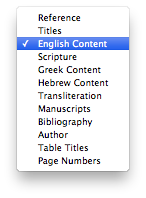
I mentioned in my last post that you can search this module in a dozen different ways. The search bar is similar to Google, in that you can search English content by a single word, but also by a phrase in quotation marks, so that that exact phrase comes up in your search. Unfortunately the “Greek Content” and “Hebrew Content” searches (which search using Greek and Hebrew letters) are not available in this module, but that’s no fault of Accordance’s, since the commentary uses transliteration.

Fortunately, “Transliteration” is a search option, so you can easily look up how the commentary treats a given Greek or Hebrew word. Searching hilastērion, I see that all seven of its uses in the commentary are at Romans 3:25.

There were a few times when I wanted to go deeper into a passage than the commentary allowed. For example, Paul’s citation of Malachi in Romans 9:13 has, “Jacob I loved, but Esau I hated.” It’s hard to imagine anyone using a commentary who doesn’t want at least a little explanation of “hated” here. The commentary, to be fair, does have, “This choice of Jacob meant the rejection of Esau,” but doesn’t connect this rejection with the verb “hate.”

This just means that Beale and Carson’s commentary won’t be the only place I turn for in-depth study of a passage, but all my seminary professors say don’t use just one commentary anyway! Not a major loss here. The book is already huge (though not on a computer, thankfully), and attempts to be only “reasonably comprehensive” (which it very much is), not exhaustively so.

Besides that, it took me about three seconds to find in Accordance the NET Bible note on Malachi 1:3:

The context indicates this is technical covenant vocabulary in which “love” and “hate” are synonymous with “choose” and “reject” respectively (see Deut 7:8; Jer 31:3; Hos 3:1; 9:15; 11:1).

This commentary is what we book reviewers like to call a monumental achievement. It sits in the carrel of many a student in my seminary’s library. For good reason. And Accordance has done a magnificent job if seamlessly integrating a rich and multi-facted commentary into its software. This is a five star commentary with five star integration into Accordance 10.

Beale and Carson say in their introduction:

If this volume helps some scholars and preachers to think more coherently about the Bible and teach “the whole counsel of God” with greater understanding, depth, reverence, and edification for fellow believers, contributors and editors alike will happily conclude that the thousands of hours invested in this book were a very small price to pay.

After consulting the original biblical texts, this commentary will always be the first place I turn when I am looking to better understand (and share with others) how the New Testament uses the Old. I am grateful for those “thousands of hours invested in this book.”

Thank you to Accordance for providing me with a copy of the Beale/Carson commentary module for review. Scroll through for all six parts of my Accordance 10 review here.

The Gospel According to Isaiah 53, reviewed

Isaiah 53 is one of the clearest prophecies of Jesus the Messiah in the Hebrew Scriptures. This chapter has changed the lives of thousands of people–both Jews and Gentiles–who have read the text and believed in the One who fulfilled these prophecies in glorious detail.

Thus begins Mitch Glaser’s Introduction in The Gospel According to Isaiah 53: Encountering the Suffering Servant in Jewish and Christian Theology (affiliate link). In three parts the book expounds how the prophecies of Isaiah 53 relate to and are ultimately fulfilled in the person of Jesus. (The full passage the book treats is Isaiah 52:13-Isaiah 53.)

The first section, a sort of exegetical prelude, discusses “Christian interpretations” and “Jewish interpretations” of Isaiah 53. The second section is a biblical theology of Isaiah 53 (with particular attention to its use throughout Scripture). The third and concluding section speaks to “Isaiah 53 and Practical Theology,” with an emphasis on how to preach the passage, both from the pulpit and in conversation.

The book is “designed to enable pastors and lay leaders to deepen their understanding of Isaiah 53 and to better equip the saints for ministry among the Jewish people.”

The first thing I noticed about the book is that it’s just as much an apologetic for Jesus-as-suffering-servant as it is an academic study of Isaiah 53. It’s not that it lacks academic substance, though. This is a meaty book, and pleasingly so.

Regarding the book’s explicitly evangelistic intent–there may be some who are uncomfortable with the description of Chosen People Ministries’ “Isaiah 53 Campaign” (including 75,000 postcards to Jewish homes and 40,000 voice blasts=robo-calls?). I’ll admit that I question the potential efficacy of pre-recorded phone messages for reaching anyone with the Gospel (though God can use anything!). But see blogger Joel Watts for his helpful (refreshing!) take on the blending of the academic and evangelistic enterprises, especially in the context of this book.

You can find a full list of contributors in the table of contents here (pdf). A few names to highlight are Walter C. Kaiser Jr., Darrell L. Bock (one of the co-editors), Craig A. Evans, and Donald R. Sunukjian. I particularly appreciated the book’s treatment of the New Testament use of Isaiah 53. The chapter by Michael J. Wilkins lists the quotations of Isaiah 53 in the NT and additional allusions to it in the Gospels. (He makes a key point, that Jesus himself understood “his mission and death in the light of Isaiah 53.”) Darrell Bock goes in depth with a comparison of the Greek and Hebrew texts of Isaiah 53:7-8, highlighting its use in Acts 8 where Philip explains the passage to the Ethiopian eunuch.

Something to critique in this book is that there were a few generalizations of Jews that I found to be unfair, particularly in the chapter “Using Isaiah 53 in Jewish Evangelism.” Mitch Glaser writes:

I think I can safely say that, in the United States, most Jewish people would recognize Isaiah as the first name of a professional athlete sooner than they would recognize the prophet of biblical literature.

Granted, he is operating from the assumption that “most Jewish people are not Lubavitch, Hasidic, or Orthodox,” but still…. What was more surprising to me: “Most Jewish people do not understand or believe in biblical prophecy” and, “Most Jewish people do not believe in sin.” Glaser does (only later) qualify these with, “We must note that all of the above does not apply to those who hold to traditional Jewish theological positions,” but he would have been better off saying something like “many secular or ethnic but non-religious Jews…” or at least supporting his statements with statistics from surveys rather than anecdotal evidence. Glaser himself is a converted Jew who has a compelling conversion story, but I still found those characterizations to be frustrating. I wonder how helpful such statements could be in advancing an evangelistic cause in conversation with another Jew.

This next thing to highlight may seem a small point to some, but as someone seeking to keep my Hebrew and Greek going, I appreciated the actual Hebrew and Greek fonts throughout the book (i.e., not just transliteration), which are clear and easy to read. I did think, however, about an intended audience of “pastors and lay leaders” who may have desired transliteration, too. (All Hebrew and Greek is translated into English.)

Darrell Bock’s conclusion summarizes all the essays of the book, with key quotations. Having this there was a big help in piecing everything together again. The Gospel According to Isaiah 53 will not be far from my reach in coming months and years. I expect I will often reference this compendium of biblical scholarship on a vital text. My hesitations about the characterizations of Jews above notwithstanding, there is a good deal here that can be useful for Christian-Jewish conversations about the Suffering Servant.

I received a free copy of The Gospel According to Isaiah 53 with the only expectations of providing an (unbiased and honest) review on this blog. Its publisher’s product page is here. It’s on Amazon here (affiliate link).