There is another big sale on Zondervan’s NIV Application Commentary series, with each of the ebooks selling at $4.99–on, among other places, Amazon. For the first time Zondervan is offering various discounted bundles, too. Check them out here.
As I’ve said before, I really liked Psalms vol. 1 in this series. There are a lot of really good volumes in NIVAC, like Genesis, Peter Enns’s Exodus, and the sleeper hit of the series: James (David P. Nystrom). (Seriously–I think it might be the best of the bunch.)
All the Table of Contents now are hyperlinked, so navigating via Kindle or iBooks should be relatively manageable. You won’t get the same sort of search power you’d get in Accordance or Logos, but the price is tough to beat.
I keep coming back to the NIV translation of the Bible. The (now discontinued) TNIV and the 2011 NIV (which supersedes the TNIV) are constant companions in my Bible reading and sermon preparation.
Bruce Waltke anticipates that the NIV will be “ever more precise and always in the language of the people” as it continues to evolve. 50 years ago the Committee on Bible Translation (CBT) convened.
CBT (image via Zondervan)
The first three speakers in the following video–Doug Moo, Karen Jobes, and Mark Strauss–are all ones whose works I’ve consulted (literally) in the last two days!
There is an utterly fascinating history of how the translation has changed over the years. I am particularly interested in the discussion about how gender works in translation. I’m with Bruce Waltke on this one:
If you use “man” and part of your constituency is hearing it as male, and it wasn’t intended to be male, that’s bad translation.
So get this:
For the coming [1990s] edition, the CBT decided that where the Greek or Hebrew clearly referred to all people—male and female—the translation would have to find accurate contemporary English language to make this clear.
But before the CBT could release the update, a Christian magazine learned what the CBT was planning and published an article condemning the shift in language, initiating a firestorm of controversy.
Some Christians were unhappy about what the CBT was planning. They accused the CBT of a “feminist” agenda when, in reality, the only agenda CBT had was to accurately reflect the meaning of Scripture in modern English. But the heat of the controversy made it hard for people to understand what was really going on.
The issue became so heated that the International Bible Society (now Biblica) decided that it was not in the best interest of the translation to continue and chose not to publish the revisions. In the United States, Zondervan would keep printing the 1984 edition of the NIV.
Finally, in 2005, the TNIV was born. But the publisher wanted to unify the now two separate editions, paving the way for the 2011 NIV.
Read the whole history here–it’s not a quick read, but it’s quite interesting. And it’s also sad how parts of the Christian community pushed against what would be not just a gender-inclusive, but a more gender-accurate translation.
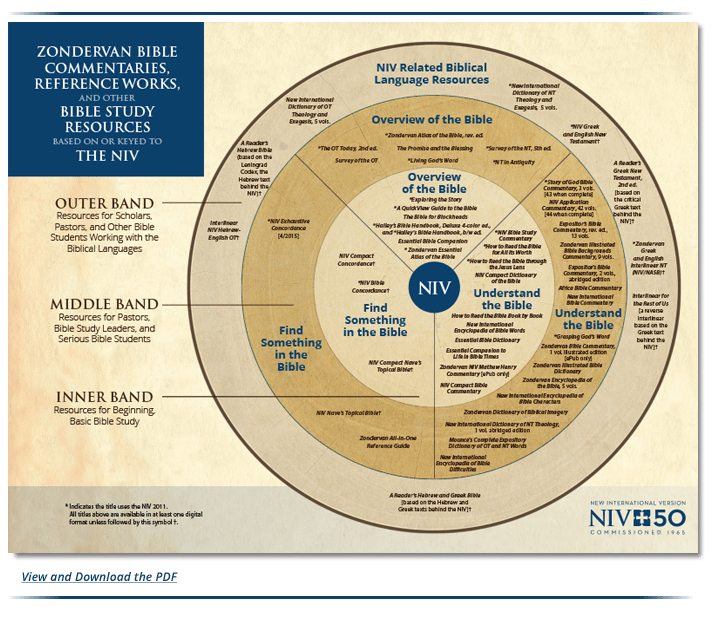
There are tons of NIV Bibles available, many of which are detailed here. I’ve had a chance to compare a number of the Bibles, so feel free to ask in the comments if you want to hear more… or share your own thoughts on the NIV translation.
It seems I’m blogging fairly regularly about Zondervan and its products. They have been gracious to provide copies of various products for my review purposes.
Two observations that didn’t fit into that review, with one that did:
Campbell’s writing is good. Compelling, clear, cogent, coherent, etc.
He has a further reading section after each chapter, and his footnotes point to even more related literature that I already want to check out.
I didn’t expect there to be as many practical, exegetical examples as there were, but this made me more engaged with the book, and helped me see more explicitly how its contents could better inform my sermon preparation.
I really appreciated Constantine R. Campbell’s Basics of Verbal Aspect in Biblical Greek. Yes, I read it cover to cover. And no, it was not even for a book review or class! Just for fun. I don’t know enough to wade intelligently into the minutiae of the verbal aspect debate, but I do know that Campbell presented his view succinctly and clearly in that work. I felt like I had a good, basic grasp on aspect after working through that book.
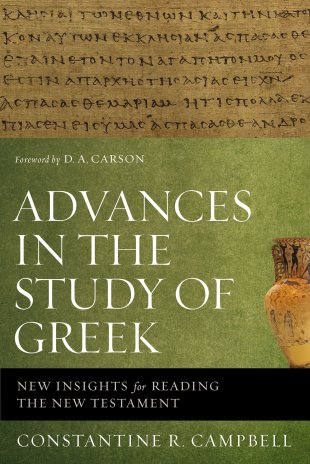
Now Advances in the Study of Greek releases this month. It surveys the thoughts, studies, and work of many Greek scholars. It’s got a chapter on aspect, but covers much more territory than just that.
Advances in the Study of Greek offers an introduction to issues of interest in the current world of Greek scholarship. Those within Greek scholarship will welcome this book as a tool that puts students, pastors, professors, and commentators firmly in touch with what is going on in Greek studies. Those outside Greek scholarship will warmly receive Advances in the Study of Greek as a resource to get themselves up to speed in Greek studies. Free of technical linguistic jargon, the scholarship contained within is highly accessible to outsiders.
Advances in the Study of Greek provides an accessible introduction for students, pastors, professors, and commentators to understand the current issues of interest in this period of paradigm shift.
I’m looking forward to reading it and writing the review, which will be published in an upcoming issue of Bible Study Magazine. Check out the book here.
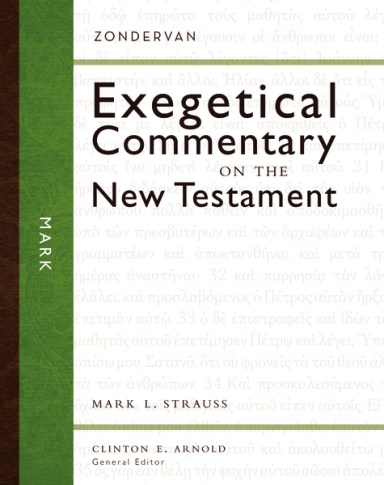
I really dig Zondervan’s Exegetical Commentary on the New Testament, as you can see by the multiple volumes I’ve reviewed here. The series continues production, with 10 volumes now available. Recent additions are Karen H. Jobes’s 1, 2, and 3 John and Mark L. Strauss’s Mark.
Here’s how the series is laid out:
The Greek text of the book of the Bible, verse by verse, or split up phrase by phrase
The author’s original English translation
First, showing up in the graphical layout preceding each passage
Second, verse by verse, together with the Greek
Author’s graphical layout of Mark 1:1-8
The book’s broader Literary Context for each passage
An outline of the passage in its immediate context
The Main Idea (perhaps they had preachers in mind?)
Structure and literary form
An Exegetical Outline of the passage under consideration
Explanation of the Text, which includes the Greek and English mentioned above–this is the bulk of the commentary
The concluding Theology in Application section (i.e., what does the passage mean for us, what are its themes, and so on)
As I’ve said before: This sounds like a lot, but the result is not a cluttered commentary. Rather, as one gets accustomed to the series format, it becomes easy to quickly find specific information about a passage. The section headings are in large, bold font.
Here’s Strauss on Jesus in Mark 3, who asks, “Who are my brothers and mother?”
At one point, [Jesus] refused to see his family, saying that his true mother and brothers were those who did God’s will (Mark 3:31–35, par.). Jesus is not repudiating his family but rather is affirming deeper spiritual bonds. It is not surprising that the early believers referred to each other as “brothers and sisters” (adelphoi). As Jewish followers of Jesus were increasingly expelled from the synagogues and Jewish families were divided, this emphasis on spiritual kinship became extremely important.
And:
In the context of the Beelzebub controversy, the point is clear: kinship in the kingdom of God is based not on ethnic identity or family background but on a relationship with God through Jesus.
I’m following the lectionary through parts of early Mark right now, and though there are already a host of great commentaries on book (not the least of which is this gem), Strauss’s volume has been a welcome addition to my sermon preparation process!
Find the book here at Zondervan’s product page or here on Amazon.
Far and away, The Sacred Bridge is the best Bible atlas–and one of the most impressive books–I’ve ever used. Now Carta is beginning to publish bite-sized adaptations from that massive and beautiful work. In the Master’s Steps: The Gospels in the Land is Volume 1 of The Carta New Testament Atlas, to be released in four total volumes. In the Master’s Steps is “partially excerpted” from The Sacred Bridge (TSB). (EDIT/UPDATE: Volume 2 will not be an excerpt from TSB–it’s a new work.)
The hope of the book, author R. Steven Notley writes, “is that a better understanding of the physical setting and events that framed the life of Jesus can assist us to hear more clearly the message he proclaimed.” Or, as St. Jerome puts it (quoted in this book):
Five gospels record the life of Jesus. Four you will find in books and the one you will find in the land they call Holy. Read the fifth gospel and the world of the four will open to you.
Those of us who have not yet had occasion to travel to Israel will have to settle for books such as Notley’s. However, as one makes her or his way through Notley’s careful writing, the vivid images, and the flawlessly rendered maps–one realizes there is no settling with this book. It’s the next best thing until such a day as one can make it to the Holy Land.
This book does not differ very much from its corresponding TSB sections, though this one is intended for a wider, more popular audience. Owners of TSB do not need to buy this volume, which does, however, carry with it the advantage of being portable, affordable, and concisely addressing the life of Jesus. If you don’t have TSB and are interested in geography and the New Testament, definitely pick up this work.
A few highlights in review:
Like all Carta books I’ve put my hands on, this one is of high quality. It’s paperback, but the thick, semi-glossy paper helps the full-color images really pop, and is perfect for making marginal notes in pencil.
As with The Sacred Bridge there is an index of place names, but not an index of Scripture references. Notley includes plenty of references, especially at the multiple points where he seeks to explain what could be, in fact, a harmony of apparently divergent gospel accounts when it comes to certain geographical details. Or if no harmonization is possible, Notley at least offers side-by-side comparisons.
The content of In the Master’s Steps is culled from chapter 22 of The Sacred Bridge, which, as it turns out, is the chapter I chose to profile most in-depth in my TSB review. Rather than repeat myself here, I simply refer you to my section 4 (“Case Study: The Sacred Bridge on The Holy Gospels”) here. Most, if not all, of what I say about the content there would apply to this book under review.
Here are the chapters of In the Master’s Steps:
The Birth of Jesus and the Flight into Egypt
The Ministry of John and the Baptism of Jesus
The Travels of Jesus
The Sea of Galilee: Development of an Early Christian Toponym
The First-century Environs of the Sea of Galilee
The Last Days of Jesus
Jesus and the Myth of an Essene Quarter in Jerusalem
The Arrest and Death of Jesus
From the Empty Tomb to the Road to Emmaus
Okay, I will quote this one helpful paragraph that leads off chapter 5 of In The Master’s Steps:
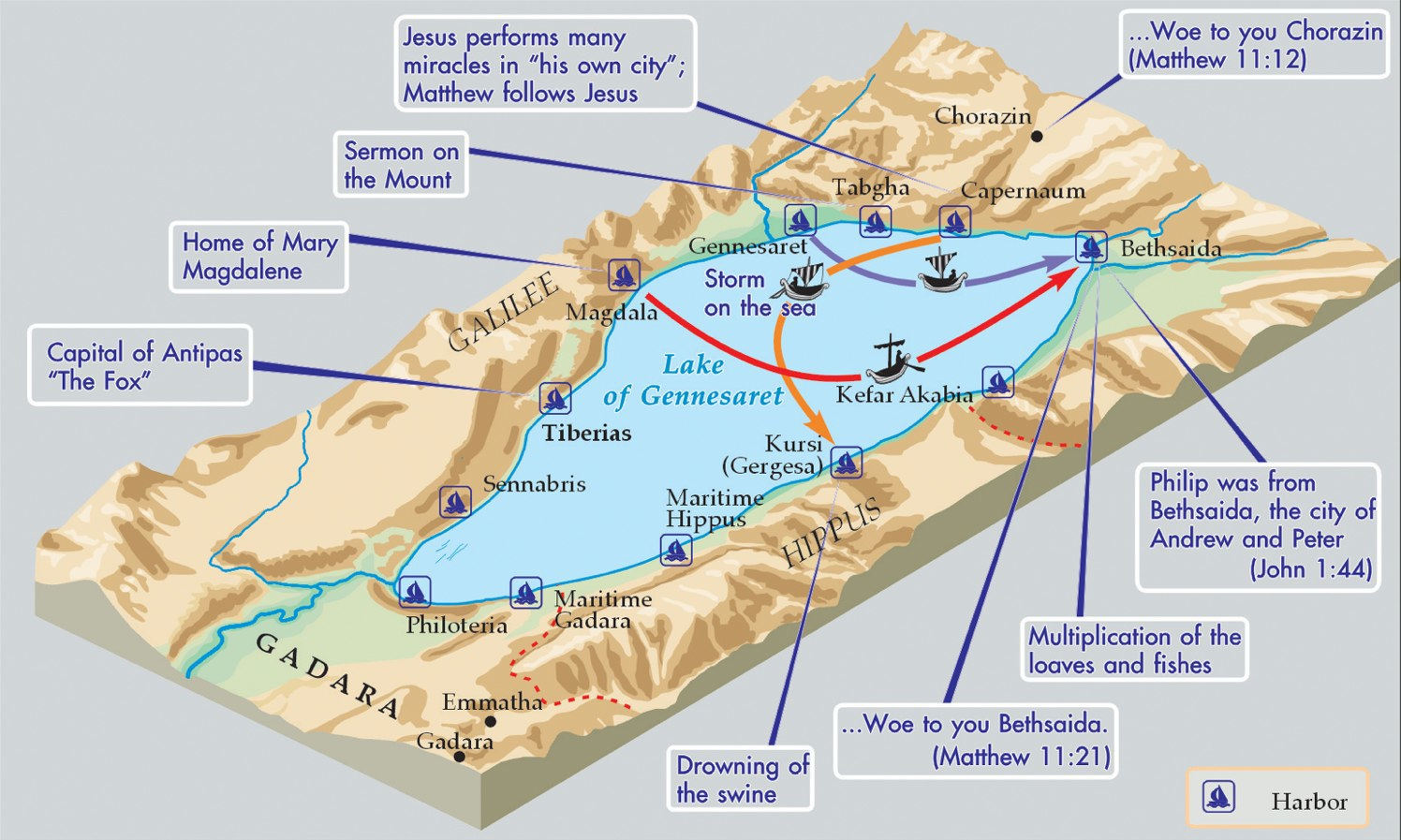
Events recorded in the ministry of Jesus outside of Jerusalem are primarily located in the region around the Sea of Galilee, specifically in the north and northwest area of the lake. The Gospels are an important historical witness for Jewish settlement in this region. Scholarship seldom notes that for many of these settlements, their first mention in the literary witnesses is in the New Testament. After a confrontation in the synagogue in Nazareth, his boyhood home, Jesus relocated to Capernaum on the Sea of Galilee (Mt 4:13; Mk 1:21; Lk 4:31). This village would become the center of his ministry in the region. We now turn our attention to settlements around the Sea of Galilee that find mention in the New Testament.
Here is a sample of the graphics and maps to be enjoyed (click on each image to enlarge):
Carta Caption: The arrest, interrogation and execution of Jesus
Around the Sea of Galilee (Carta’s caption)
To book’s hope, to revisit it again, “is that a better understanding of the physical setting and events that framed the life of Jesus can assist us to hear more clearly the message he proclaimed.” Reading through In the Master’s Steps will certainly offer such an understanding for the teacher, student, reader, or person of faith who picks up the book. The connections between geography and theological applications are not often made explicit here, but the reader will have more than enough historical background and imagery to begin to make those associations for herself or himself.
Many thanks to the good folks at Carta for sending the book. They didn’t ask for a review, so I write this of my own volition! I think they are one of the finest publishers in the business today. Check out their site here, and go here to see their works via Hendrickson, their U.S. distributor.
Whether it was for summer camp or Bible quizzing, I grew up memorizing the (1984) New International Version. And, yes, I’m still quite fond of the unfortunately discontinued TNIV. Now Zondervan no longer publishes the 1984 NIV, nor the TNIV–instead, the 2011 update to the NIV is the current version.
You might not realize that the NIV is 50 years old this year. Here’s a recent press release:
In 1965, the Committee on Bible Translation took on the most massive translation project of modern times: to prepare a contemporary English translation of the Bible from the best available original manuscripts. Since its release in 1978, the NIV has become the world’s most read and most trusted modern-English Bible translation with over 450 million copies distributed worldwide. Upon the 1978 release of the NIV, readers were ecstatic that they could finally understand the Word of God in contemporary language.
This anniversary got onto my radar screen when I came across the new NIV 50th anniversary app. What I didn’t know till the other day is that the NIV Study Bible is the best-selling study Bible in the last 30 years.
Here’s a video with some recognizable names discussing the work of the Committee on Bible Translation, who produced the NIV:
Disclosure of Material Connection: A Zondervan rep approached me with an invitation/encouragement to post about the NIV, and offered to send an NIV Study Bible. I plan to post about that in due course, too, once I receive it. While I do appreciate the 2011 NIV over the 1984 NIV in a number of ways, said “Material Connection” has not diminished the place in my heart that the TNIV will always have.
Much as I am grateful to be able to see the text of the Bible in multiple languages at one time on a computer, sometimes you just want to curl up with a good, printed edition of a 6-language polyglot.
Fredrick J. Long and T. Michael W. Halcomb have begun such a series, with the recent publishing of Matthew and Mark in Hebrew, Latin, Greek, English, German, and French. It’s obvious that an English-speaking Bible reader would want access to biblical texts in Greek and Hebrew and Latin. German and French, as major research languages for biblical and theological studies, complete the languages of this almost-500-page polyglot.
It’s a pretty sweet work, and an awesome way to practice multiple languages at once. Here’s what it looks like:
The layout of the polyglot is clean and easy to follow. It would not be all that difficult to read through all of Matthew and/or Mark in a single language, if one so desired. The fonts are quite legible, although the Hebrew font for Mark differs from the Hebrew font for Matthew. (Also, the vowels are not properly centered under the Hebrew consonants in Mark. This doesn’t make reading it impossible, but I found it distracting.)
There is no critical apparatus, but this is no problem–Long and Halcomb intend simply to provide multiple texts for reading. (Text-critical notes on six languages would make this volume unwieldy, indeed!) The versions used are largely ones in the public domain. The Greek text, for example, is the Robinson-Pierpont Byzantine edition. I have a Greek reader’s Bible I used to use with this same edition. At first I worried that I wasn’t using the academic version of the NA28, but after using that reader’s Bible for a few weeks, I realized it really didn’t matter, if the goal was just to get better at reading Greek. So, too, here: not having the NA28 text included is no loss.
The English translation in Matthew is an authors’ revision of the 1901 American Standard Version (ASV). In Mark the authors use their own translation. They aim to be “fairly literal” in translating the Greek, I’ve never really agreed with such translations’ taking the Greek’s historical present, for example, and keeping it in the present tense in English.
For example, Mark 10:35 begins, “And they come near to him…,” which follows a Greek present participle, but then the two verses later in English has “they said to them” (my emphasis). Though this translates a Greek aorist in the expected way, I would have smoothed out the tenses for the purposes of readability in English translation–even while seeking to be close to the Greek text. Even somewhat literal translations of Greek ought to put its historical present into English past tense, in my opinion. But this perhaps just amounts to a difference in translation philosophy. And a benefit of the authors’ translating Mark this way is you can easily tell, if your Greek parsing is rusty, which Greek verbs are present and which are aorist, since Greek historical present is rendered as present in English.
Those concerns aside, this modern-day “Hexapla” is hard to beat as a way of learning (and keeping active) multiple languages at once. A resource like this would be essential for someone preparing for a Ph.D. program in biblical studies or theology. Pastors, such as yours truly, who want to keep their Greek and Hebrew alive can do so with just this single book.
GlossaHouse offers a wide selection of creative resources for language learning and retention. Check out their site here to see the Hexapla and more.
Thanks to the good folks at GlossaHouse for the review copy! Find it here on Amazon.
Zondervan’s NIV Application Commentary series is on mega-sale, with each of the ebooks selling at $7.99 in Accordance, Logos, and Olive Tree.
I really liked Psalms vol. 1 in this series. The Genesis, Luke, and Galatians volumes were stand-by commentaries when I preached through those books, too.
Here is where you can find more details on the sale, which Zondervan rarely offers in any other e-format than Kindle:
Mark 13 is one of the most difficult chapters of the Bible to interpret and understand. From the “abomination of desolation” to the claim of Jesus that “this generation will not pass away until all these things have taken place,” the chapter is full of statements that could refer either to the near (historical) or far (apocalyptic) future.
Here is Stein’s outline of Mark 13, in his words (p. 49):
13:1-4: Jesus’ prediction of the destruction of the temple (and Jerusalem) (chapter 3 of this book)
13:5-23: The coming destruction of the temple (and Jerusalem) and the sign preceding it (ch. 4)
13:24-27: The coming of the Son of Man (ch. 5)
13:28-31: The parable of the fig tree and the coming destruction of the temple (and Jerusalem) (ch. 6)
13:32-37: The parable of the watchman and the exhortation to be alert for the coming of the Son of Man (ch. 7)
The majority of the book (chapters 3-7) is taken up with Stein’s exposition of each verse in Mark 13. Chapter 1 defines the goal of the book: “to understand what the author of the Gospel we call Mark meant and sought to convey by the present text of Mark 13” (39). Stein focuses especially on what Mark meant to “teach his readers by the Jesus traditions that he chose to include in this chapter, his arrangement of these traditions and his editorial work in the recording of this material” (45). Chapter 2 is “Key Issues Involved in Interpreting Mark 13.”
Chapter 8 is a really nice add-on, which consists of Stein’s “interpretive translation” of Mark 13. What a great idea! You can read the chapter in one sitting and see right away how Stein interprets it. This could be a really good starting point for the reader, as could the excellent and detailed “Outline” starting on p. 9 (basically an annotated table of contents).
Stein offers at the outset a nice tour of the so-called quests for the historical Jesus, and how that relates to reading Mark. But Stein doesn’t seem to think the authorship (Mark) or genre (historical narrative) of Mark matters much to the purpose of this short commentary. I find his views here less than compelling, but that didn’t keep me from being convinced by the rest of the book.
Two key points the book makes will give a sense of Stein’s approach:
Stein differentiates between three settings we need to keep in mind: “the first involving the teaching of the historical Jesus to his disciples, the second involving the situation of the early church between the death and resurrection of Jesus and the writing of the Gospels, and the third involving the situation in which and for which the Evangelist Mark wrote his Gospel” (47).
Because of the above point, Stein can tease out different settings and time-frames that different portions of Mark 13 refer to. He says, for example, “Mark does not see the coming of the Son of Man [AKJ: the apocalyptic imagery in 13:24-27] as part of Jesus’ answer (13:5-23) to the disciples’ twofold question (13:4) concerning the destruction of the temple” (72).
Throughout the book Stein keeps in view the distinction between the soon-to-come, 1st century future (destruction of the temple) and the distant, unknown day of the coming of the Son of Man. Stein acknowledges that it is “easy to intermix these two horizons [two settings in time] of the text, and the result is confusion and lack of clarity in understanding either setting in time” (100). Much of the chapter, Stein argues (but not all), anticipates the destruction of the Jerusalem temple in A.D. 70.
You don’t need to know Greek to make good use of this text, but Stein does keep (transliterated) Greek in front of him so he can analyze the text at the word and phrase level. He is really good, too, at using a broader biblical context to help explain specific parts of Mark 13.
I read the book cover-to-cover in a few sittings—it was that intriguing! As detailed and in-depth as Stein’s reasoning is, it reads really nicely: his tone is conversational, which makes it easy to try to sort through some tough hermeneutical issues. Stein’s is certainly not the only possible interpretation of Mark 13, but it’s a persuasive one.
Thanks to the fine folks at IVP Academic for the review copy. Find the book here at IVP’s site, or here on Amazon.













 Words on the Word