Mark (NIGTC) in Logos’s Biblia.com

France NIGTC MarkFor an exegesis course in seminary, I was assigned R.T. France’s Mark in the New International Greek Testament Commentary (NIGTC) series. The assignment was to read the entire commentary that semester, and I read every one of its 700+ pages. It was that good.

Like the rest of the NIGTC series, France’s volume focuses first on the Greek text, including textual variants where they arise. France is a careful interpreter and keeps the other synoptic gospels in view throughout the commentary. This is not, however, to the exclusion of a keen awareness of and sensitivity to the literary context of Mark as its own book. Even as he unpacks the lexical range of a Greek word, he keeps the larger contour of Mark in view.

As I mentioned in another France review, despite the technical nature of Mark, France moved me deeply with his interaction with the text. He helped me to know and love Jesus more deeply, using the Greek text of Mark as a means to that end. You can find France’s commentary on Amazon (affiliate link) here. It’s in Logos here, where it is well-produced and thoroughly hyperlinked.

For as much as I’ve reviewed Logos Bible Software, I’ve barely mentioned Biblia.com. It’s a Web-based way of accessing Logos resources you own. This is especially helpful for those times when I just need to pull up a commentary (like France’s) but don’t want to wait for Logos to open, load, or index. It looks like this (click on image to enlarge):

NIGTC Mark in Biblia

I haven’t found a way to make the ads at lower left disappear. Nor is Biblia intended to be as full-bodied as Logos (note that it’s in Beta). Since you can access it through any Web browser, it’s fairly universally accessible. Only real downside I’ve experienced: unlike Logos on iOS, Mac, and PC, you can’t highlight or take notes in any resources. But for reading texts–two at a time, as shown above–it’s pretty handy.

You can see above how I’m reading France’s Mark on the right, with a Bible open on the left. Regarding the way that Mark introduces John the Baptist at Mark 1:9, France writes:

(ἐν ἐκείναις ταῖς ἡμέραις has an equally formal, ‘biblical’ ring; Mark stands in the tradition of the great chroniclers of the acts of God in the OT.) It introduces a new phase in the story and, in this case, a new actor in the drama.

This is one of many examples of France’s using Greek to help the reader better understand what Mark is up to in his Gospel. His command of Greek and obvious love for God make this the first commentary to reach for when reading, teaching, or preaching on Mark.

Thanks to Logos for the review copy of the NIGTC series. See also my post about NIGTC Matthew in Logos here.

Free Book in Logos: Jesus and Scripture, by Steve Moyise

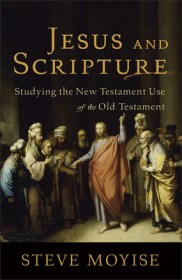
Jesus and Scripure by MoyiseIn early February I finished reading Steve Moyise’s Jesus and Scripture: Studying the New Testament Use of the Old Testament. You can read what I wrote about it here. Here is the concluding portion of that review:

Jesus and Scripture would be perfect for a seminary course on the Gospels, or on the NT use of the OT. An advanced undergrad course would also do well to adopt this book. I’d also recommend it to a serious Bible reader–no biblical languages are needed here, and I found that even with my own knowledge gaps in historical Jesus studies, Moyise explained everything I needed to know.

Though this survey is short (less than 150 pages), Moyise gives plenty of sample passages and insights that have challenged me. I know this is a book I will come back to and want to read again in the future.

This month Logos Bible Software is offering their edition of the book for free. It’s a fantastic book, and I look forward to being able to use it now electronically (with keyword searchability and hyperlinked Scripture references throughout). You can get the book here.

What are the Best New Testament Commentaries?

NT Commentary Survey

D.A. Carson’s 2013 update to his New Testament Commentary Survey puts the book into its seventh edition. Having come six years since the last edition, the new edition is substantially revised and updated to include just about every significant commentary on every book of the New Testament. The Survey rarely misses a volume.

Carson goes book-by-book through the New Testament and suggests what he thinks are the best-written commentaries and why. He also offers introductory notes and principles for selecting commentaries and series, as well as 14 pages on New Testament introductions and theologies to consider. The number of books that Carson surveys is impressive.

I found Carson’s survey to be much more detailed and up-to-date than its Old Testament counterpart. He makes mention, for example, of the brand new Teach the Text commentary series. And he seems to have already examined the relevant ZECNT volumes that had been released before this survey went to press. So anyone using this book can be assured that not much ground is left uncovered.

Of course, it’s impossible in 175 pages or so to get detailed analysis of each commentary. For the most part, Carson is able, in just a couple of sentences, to give the reader a really good idea of what each commentary does well, and whether or not to consider adding it to one’s library. One always knows what top two or three commentaries Carson would suggest on a given book of the New Testament (and why).

There are times where Carson’s evaluations are left unexplained, or when he fails to evaluate a commentary in accordance with its own purposes. For instance, he criticizes a New Testament introduction on “Intertextual Development of the NT Writings” for focusing “so narrowly on intertextual connections that other axes are unhelpfully ignored.” Or a socio-rhetorical commentary on Matthew is faulted for not including enough “penetrating comment on structure, grammar, and sometimes theology.” The discerning reader can overlook this and not be deterred by it.

Carson’s writing style is engaging, enjoyable, and downright funny at times. Of his own commentary on John, he writes, “Carson’s work is rather more difficult for me to assess.” He pulls no punches in his critiques. A reviewer could multiply examples, but here are just a few quotations:

  • “…despite the superfluity of cutesy remarks that are in constant danger of distorting the picture of who Jesus is…”
  • “…his grasp of Greek is mechanical, amateurish, and without respect for the fluidity of the Greek in the Hellenistic period.”
  • “…the result is a disappointing monument to misplaced energy.”
  • “…his reconstruction of the church situation is so quirky that it cannot be recommended except to readers who are devoted to quirkiness.”

I was surprised that a short guide like this would contain such strongly expressed opinions, but the more I read on, the more useful I found them to be–even as I realized that some of Carson’s assessments are subjective and need to be weighed. (He too blithely, in my opinion, dismisses reader-response criticism.) He is an excellent writer and somehow manages throughout the book to avoid many reviewers’ clichés, which is no small accomplishment when covering this many commentaries!

Carson is (refreshingly) not at all reluctant to call out unacknowledged borrowing, which occurs in commentaries more often than one would hope.

Carson’s goal is:

to provide theological students and ministers with a handy survey of the resources, especially commentaries, that are available in English to facilitate understanding of the NT.

In this Carson has succeeded, even in entertaining fashion. If the reader is willing to overlook the few critiques mentioned above (as I largely have been), she or he will find this a good desk-side companion to help wade through the world of myriad commentaries.

Thanks to Baker Academic for the review copy of NT Commentary Survey. You can find it here (Baker Academic) and here (Amazon/affiliate link).

Of Paul, James, Mattathias, and Phinehas: Works and Reckoned Righteousness

From Jesus to the Church Welcome to today’s stop of the book blog tour of Craig A. Evans’s From Jesus to the Church: The First Christian GenerationI’m covering chapter 4, “Phinehan Zeal and Works of the Law: What Paul and James Are Really Saying.” Brian at Near Emmaus introduces the book here, and quotes from the introduction, which is worth repeating:

The present study is not a history of the early church; it is not even a history of its first generation. It is, rather, a study narrowly focused on the clash between the family of high priest Annas and the family of Jesus of Nazareth, a class inaugurated by a Jeremiah-related prophecy of the temple’s doom, uttered by Jesus, and ended by another Jeremiah-related prophecy, uttered by another man named Jesus.

The title, then, is a bit misleading, or at least more general than the actual contents of the book.

Continue reading “Of Paul, James, Mattathias, and Phinehas: Works and Reckoned Righteousness”

Scot McKnight’s Sermon on the Mount Commentary

SGBC SMount

Scot McKnight just released a commentary on the Sermon on the Mount. I’ll post a review in due time, but as I prepare my sermon for our church’s last Sunday in the Sermon on the Mount, I wanted to give props here to what is a really good commentary! McKnight blends careful exegesis with relevant application, and isn’t afraid to really wrestle with some of the challenges Jesus issues in the S.Mount. Highly recommended.


The Gospel of Matthew: A Socio-Rhetorical Commentary

Craig S. Keener’s Gospel of Matthew: A Socio-Rhetorical Commentary utilizes two particular approaches to Matthew:

[A]nalysis of the social-historical contexts of Matthew and his traditions on one hand, and pericope-by-pericope suggestions concerning the nature of Matthew’s exhortations to his Christian audience on the other.

Keener is behind the ever-useful IVP Bible Background Commentary, now in a revised edition. And his exegetical commentary on the first two chapters of Acts is more than 1,000 pages, not counting the bibliography and indeces. Quantity does not always mean quality–it’s harder to write less than more, most of the time–but one can rightly expect Keener to be both thorough and insightful.

Let me jump right in with why I like (and trust) his Matthew commentary.

Layout Matters

The Gospel of Matthew is one of the best laid out commentaries I’ve used. The section on the Lord’s Prayer (“The Kingdom Prayer,” as Keener has it) is a good example. There’s a bold heading with an introduction to the prayer. Here Keener compares the prayer in Matthew to the version in Luke, while offering explanations as to why the two forms differ slightly. Then Keener goes through the passage phrase-by-phrase in eight parts, with the summary statement for each of the parts in bold.
Keener on Matthew

For example, he writes, “Second, the prayer seeks first God’s glory, not the petitioner’s own needs….” Then he uses italics for key questions or insights in each of the eight parts of the prayer. As here: “What did it mean in a first-century Jewish context for God’s name to be hallowed in the future?

The result is a commentary that is highly scannable and readable. Just the simple use of bold and italics, throughout the book, helps orient the reader to what Keener is doing–not to mention offers some really good ideas for how to preach or teach on the text. The layout also makes it easy to get a quick, cursory overview of how Keener understands a given passage.

Matthew, According to Keener

Keener’s humility is refreshing, as he writes that, “in contrast to [his] earlier opinion,” he is:

therefore presently inclined to accept the possibility of Matthean authorship on some level, although with admitted uncertainty. Perhaps the most probable scenario that incorporates the best of all the currently available evidence is the presence of at least a significant deposit of Matthean tradition in this Gospel, edited by the sort of Matthean school scholars have often suggested (though I believe the final product is the work of a single author, not a “committee”).

His judicious weighing of the consideration for and against actual Matthean authorship will allow the reader to have an informed opinion. Does it matter?

Yet what we do conclude about the author does affect our understanding of the Gospel. Matthew is clearly Jewish, in dialogue with contemporary Jewish thought, and skilled in traditional Jewish interpretation of the Old Testament…. Matthew also knows the context of his citations much better than many modern readers have supposed…, and he demonstrates familiarity with a variety of text-types….

On author and intended audience, Keener concludes:

Concurring with the perspectives of what is still probably the minority view, I find in the Gospel an author and audience intensely committed to their heritage in Judaism while struggling with those they believe to be its illegitimate spokespersons. On this reading, Matthew writes to Jewish Christians who, in addition to being part of their assemblies as believers in Jesus, are fighting to remain part of their local synagogue communities.

The introductory material covers the rest of the expected territory: dating, rhetoric, social settings, Gospel sources, the use of narratives in the early church, structure, and more. I found the introductory sections on Jesus (as teacher, as prophet-healer, as Messiah/King, as Son of God) especially illuminating for understanding Matthew as a whole. Keener also has a couple pages upfront about Matthew’s important “Kingdom of Heaven” theme, including this gem:

In short, the present significance of the future kingdom in early Christian teaching was thus that God’s people in the present age were citizens of the coming age, people whose identity was determined by what Jesus had done and what they would be, not by what they had been or by their status in the world.

Though the commentary is academic in nature, it also “will preach” pretty well, as Keener’s lines above make clear.

A Few More Highlights

As soon as picking up the commentary, one will want to read the Excursus on Pharisees (p. 538) and Excursus: Was Jesus Executed on Passover? (p. 622).

One should not expect to find lexical or grammatical comments on each keyword or phrase in Matthew. The comments on Matthew 6:25-34, for example, do not address the meaning of the oft-repeated “worry.” Keener points out that Jesus utilizes the Jewish qal wahomer (“How much more?”) argument to show God’s care for “people in his image and for his own beloved children.” That insight itself is in most commentaries already, but Keener goes further and covers yet more rhetorical territory:

Greek philosophers sometimes disdained such bodily needs altogether, complaining that their bodies were prisons because they were dependent on food and drink (Epict. Disc. 1.9.12) and advising that one turn one’s mind to higher pursuits (Marc. Aur. 7.16). …Jesus never condemns people for recognizing these basic needs…. Yet he calls them to depend on God for their daily sustenance, a provision that Jewish people considered one of God’s greatest miracles….

Keener consistently breaks passages down into main points, which helped me see both the flow of Matthew’s narrative and think about how I could apply each passage. For example, in Matthew 20:29-34 (“Persistent Prayer”) two blind men receive their sight when Jesus’ compassion leads him to heal them. Keener’s four sentences in bold (with a paragraph explanation after each) are:

First, these suppliants recognized the identity and authority of the one whose help they entreated (20:30).

Second, they refused to let others’ priorities deter them (20:31).

Third, Jesus’ compassion was the ultimate motivation for his acting (20:34).

Finally, recipients of Jesus’ gifts should follow him (20:34).

This 2009 edition is not essentially different from Keener’s 1999 Commentary on the Gospel of Matthew. (I.e., the Socio-Rhetorical Commentary is not a revised edition, per se.) There is, however, an addendum at the front of the commentary called, “Matthew and Greco-Roman Rhetoric.” Here Keener goes chapter-by-chapter through the book of Matthew and adds his recent insights into how Jesus and Matthew make use of known rhetorical practices in their teaching and writing, respectively. In the end, though, Keener finds that Jewish rhetoric offers “much closer analogies…than Greek or Roman rhetorical handbooks do.”

Finally, if you’ll permit me one more quotation of Prof. Keener, here is an example of the inspiring nature of his commentary:

But above all the teaching towers the figure of Jesus himself: King, Messiah, Son of Man, the rightful Lord of Israel whom their people would one day acknowledge (1:21; 23:39). The final judge, the true revelation of the Father (11:27), was the meek and lowly One who had walked among the first disciples and died for his people (11:29; 20:28; 21:5), the One who would also empower Matthew’s readers to fulfill the task he had given them (10:19-20; 11:28-30).

Bonus: The Bibliography

It may be strange to praise a book for its bibliography, but Keener offers 150 pages of bibliography on Matthew. Keener seems to not leave any stone unturned, whether it’s another commentary, monographs, or journal articles. He writes, “The purpose of this commentary does not allow me to summarize and interact in detail with all secondary sources on Matthean research.” And yet one would be hard-pressed to find a more thorough list of secondary sources for Matthew elsewhere. In this regard, Keener is successful in offering a commentary that “will contribute to further research.”

The reader should realize that, as noted above, though this commentary was published in 2009, it was not really a revision of the 1999 volume, so the bibliography has not been brought into the 21st century with any updates. (So Nolland and France, for example, are not listed.)

The commentary’s Index of Ancient Sources is 142 pages, taken “from a variety of narrative genres to illustrate Matthew’s narrative techniques, with special attention to ancient biography and historiography.” Copious references throughout the commentary give the researcher multiple good leads.

For all of Keener’s thoroughness, the use of bold and italics for main points keeps the commentary well-organized, so that the research does not become overwhelming. Keener’s heart seems to be pastoral, and his reverence toward the Jesus of Matthew is clear and an inspiration throughout the commentary.

You don’t need any Greek to use this commentary, but a good cup of coffee and a full night’s rest might help, as it can be dense and detailed (but not impenetrable) in places. The reader of Matthew who is willing to work at Keener’s commentary will be rewarded. This volume has already vaulted its way into my top four Matthew commentaries.

Thanks to Eerdmans for the review copy. You can find the book’s product page here. It is on Amazon here. Amazon links above are affiliate links, described further here.

Matthew (Zondervan ECNT), reviewed

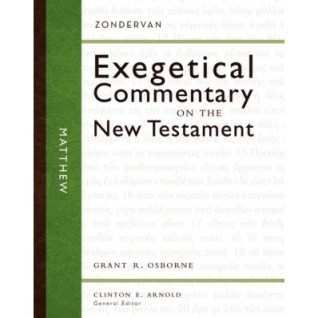
Matthew ZECNT

Now that I’ve been preaching through the early sections of Matthew for 10 weeks, I’ve had a chance to make regular use of a number of commentaries. I continue to value Zondervan’s Exegetical Commentary on the New Testament. Its Matthew volume is very much on par with the rest of the series (which I’ve reviewed here, here, and here). Author Grant R. Osborne primarily intends it for preachers, but I’ve seen it assigned as a seminary textbook, as well.

ZECNT Layout

Matthew, like the rest of the ZECNT series, includes:

  • The full Greek text of Matthew, verse by verse, or often split up phrase by phrase
  • The author’s English translation
    • First, appearing in the graphical layout for the entire passage
    • Second, verse by verse or phrase by phrase, next to the Greek
  • Matthew’s broader Literary Context for each passage
  • An outline of the passage in its immediately surrounding context
  • The Main Idea (probably the first place preachers would want to look)
  • Structure and Literary Form (with focus on source criticism)
  • A more detailed Exegetical Outline of the passage under consideration
  • Explanation of the Text, which includes the Greek and English mentioned above, as well as the commentary proper
  • A concluding Theology in Application section

This sounds like a lot, but the result is not a cluttered commentary. Rather, as one gets accustomed to the series format, it becomes easy to quickly find specific information about a passage. The section headings are in large, bold font.

The Greek font is aesthetically pleasing and readable. Here’s a picture:

ZECNT font

Osborne’s Introduction to Matthew

For a commentary of more than 1,000 pages, the introduction is surprisingly short (27 pages). Seven of those pages are a section called, “How to Study and Preach the Gospel of Matthew.” Osborne acknowledges,

[T]he details I chose to include in this commentary, both exegetical and theological, were chosen on the basis of one major question: What would I want to know as a pastor preparing a sermon on this passage?

So it’s fitting that he speaks directly to preachers at the very beginning of his introduction. He suggests understanding the Gospels as “history seen through theological eyes” and encourages the preacher to try to grasp the distinct “theological purposes of each [Gospel] author.”

Though the introduction is short, and someone doing extended work on Matthew will need to also look elsewhere for introductory concerns, Osborne is able to give an informative enough overview of dating, authorship, genre, purpose, audience (the thinnest subject in the introduction), sources, history, Matthew’s use of the Old Testament, and structure.

There are also more than 20 pages at the end of the commentary that cover the theology of Matthew. Although that section is tucked away, it’s not to be missed, especially Osborne’s coverage of Christology and of discipleship.

The Commentary Proper: Highlights and Observations

There is just enough Greek (grammar and word studies) to keep one’s Greek sharp. There’s not the level of detail found in the Baylor Handbook on the Greek Text series, which does not yet have a Matthew volume.

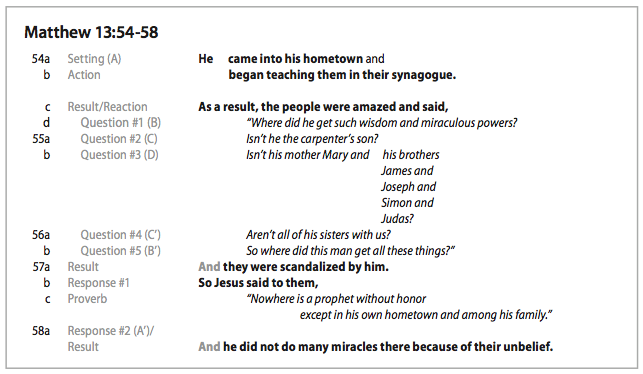
Matthew 13:54 begins, “He came into his hometown and began teaching (ἐδίδασκεν) them in their synagogue.” In the commentary you’ll find comments like this one:

The imperfect ἐδίδασκεν could refer to an ongoing practice but is probably ingressive, “began teaching” on this occasion (as in v. 8).

Osborne is sensitive to larger biblical context and theology–even in explaining individual words–so that one gets, for example, a fairly robust explanation of the “righteousness” Jesus talks about fulfilling in Matthew 3:15. And here is Osborne’s take on the “peacemakers” that Jesus calls blessed in 5:9:

The term “peacemaker” only appears elsewhere in verb form in Col 1:20, where Jesus made peace by his blood on the cross, but the concept is found often (Ps 34:14; Isa 52:7; Rom 12:18; 14:19; Jas 3:18; Heb 12:14; cf. 1 En. 52:11). This connotes both peace with God and peace between people—the latter flows out of the former. Jesus is the supreme peacemaker, who reconciles human beings with God through the cross (Col 1:20), so the supreme peacemaking is the proclamation of the gospel.

The graphical layout remains one of my favorite parts of the series. Look at Matthew 13:54-58 (from which the comment above is taken):

ZECNT passage flow

It’s readily apparent how Osborne sees the parts of a passage working together and relating to one another.

By way of critique, even with the commentary’s length there were times when I wanted more coverage. The “Explanation of the Text” section for Matthew 5:38-42, for example, barely covered two pages. The single paragraph on “turn the other cheek” addressed the main points that most other commentaries do, but given how many Christians have wrestled through this important passage (both on paper and in action), more could have been said.

Conclusion

Osborne succeeds in keeping the preacher in view throughout the commentary. I’ll give one last example, since this typifies Osborne’s blend of research and presentation in a way that will both assist and inspire preachers and teachers. In Matthew (and Luke) the Lord’s Prayer that Jesus gives his disciples to pray does not have the ending it does when prayed in liturgical settings (“for thine is the kingdom…”). Whether this should make it into a sermon or not is another question, but Osborne anticipates that readers and preachers will at least be wondering about it. He writes:

The traditional doxology (“for yours is the kingdom and the power and the glory forever. Amen”) appears in only a few late manuscripts (L W Θ 0233 et al.), and several of the best manuscripts end here (א B D Z et al.), with a variety of endings in others. This makes it almost certain that it is not original. It is possible that churches added their own doxology when praying this prayer, and this one emerged as the best summary of the contents of the prayer. However, it (and the other endings) is based on 1 Chr 29:11 – 13 and is meaningful, so it is not wrong to utter the ending as a personal prayer.

Where does the Matthew ZECNT volume rate among Matthew commentaries for preachers? Definitely toward the top. I still go to R.T. France’s NICNT volume first. And for Greek and history of interpretation, John Nolland (NIGTC) covers more territory. But Osborne’s constant eye on the larger literary context, the detailed structural outlines, the inclusion of Greek and English texts, the Theology in Application sections, and the graphical layout make his commentary a welcome guide for preaching and teaching through the First Gospel.

Thanks to Zondervan for the review copy. You can find the book’s product page here. It is on Amazon here. Amazon links above are affiliate links that help further the work of this blog, described here.

Zondervan Atlas of the Bible

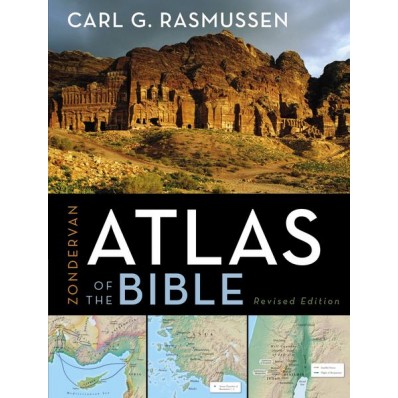
Zondervan Atlas

Carl G. Rasmussen has recently released a Revised Edition of Zondervan Atlas of the Bible. Below I offer a description of its contents with some evaluative remarks.

What’s in the Atlas

After the Preface and Introduction the atlas consists of a Geographical Section and a Historical Section, followed by Appendices.

The Geographical Section is first, because:

This atlas has been written in the belief that once one has a basic understanding of the geography of the Middle East, one has a much better chance of coming to grips with the flow of historical events that occurred there.

After “Introduction to the Middle East as a Whole” there are these sub-sections:

  1. The Geography of Israel and Jordan (the longest section, covering “the Five Zones,” weather, routes, and individual regions)
  2. The Geography of Egypt
  3. The Geography of Syria and Lebanon
  4. The Geography of Mesopotamia

The Historical Section covers the Bible’s history in canonical order, from the pre-patriarchal period to the churches in Revelation. It concludes with a special section on Jerusalem (“Of all the cities in the Bible, this is the most prominent one: it is mentioned 667 times in the Old Testament and 139 times in the New”) and an essay:  “The Disciplines of Historical Geography.” I appreciated being able to compare the layout of Jerusalem in the Old Testament, during the time of Nehemiah, and in the New Testament.

Rasmussen covers even the so-called intertestamental period, with sections on the Greeks (4th century B.C. onward), the Maccabees, and the Hasmonean dynasty.

The Appendices are also impressive. What really makes this atlas user-friendly is the 31-page Geographical Dictionary and Index. Any place name in the atlas (whether it has appeared on a map or in the descriptive text) is in the dictionary/index. There are also identifications with modern places, so one finds out, for example, that the biblical Bethany is the current-day El-Azariya. More specifically, here is the entry for Bethany at the back of the atlas:

Bethany (near Jerusalem)—Village on road to Jericho (Mark 11:1; Luke 19:29) less than 2 mi. from Jerusalem (John 11:18). Mary, Martha, and Lazarus lived there (John 11) and it seems that Jesus spent the evenings of the week before his crucifixion there. Mentioned 11 times in NT.–El-Azariya (174131), 1.5 mi. E of Jerusalem, on E side of Mount of Olives. 212, 214, 217, 251, 252

There’s quite a lot of text in the atlas, too. (It’s far more than just maps and photos.) In the section covering Jesus’ life, for example, Rasmussen offers an almost narrative overview of the locations of Jesus’ ministry, interspersed with graphics.

The Graphics

As with other Zondervan books along similar lines, there are striking full-color images and well-drawn maps throughout the book. Photographs like this will have to suffice until I can visit the lands described in this book:

Full-color photograph from the Atlas
Full-color photograph from the atlas

The atlas contains both two-dimensional and three-dimensional maps:

One of many maps from the Atlas

Between the maps, photographs, and timelines throughout the book, you can easily get your bearings in any era or biblical passage of study.

Evaluation

I’ve not been able to take full advantage of all that the atlas has to offer–there is a lot here–but it is my current go-to atlas. I look forward to making further use of it. Perhaps the proof is in the pudding: even though I was given a gratis copy for review by Zondervan, I purchased an electronic version of it in Accordance Bible software so I could have access to it there, too (I rarely purchase a book in two formats). Accordance’s production of the module, from what I’ve seen so far, enhances what is already an excellent book, with the added advantages of hyperlinks and advanced searching capabilities.

My two points of critique are fairly minor ones. First, the timelines throughout the book are easy enough to follow, but they are stylized in such a way that they feel a bit cluttered. You can see examples using the Search Inside feature on Amazon here (affiliate link). Second, the font is narrow and looks crammed on a page, especially pages that have a good amount of text. The flip-side to this is that in a book that is still fairly portable (just under 300 pages), you’re getting a lot of great information, but it’s not always easy to read for long stretches of time.

Any serious reader, no matter their level of prior knowledge of biblical geography and history, could make profitable use of the atlas. It’s not highly technical or scholarly, though students and professors should still consider it, especially in a classroom or Sunday school setting.

You can view a sample pdf of the atlas (including a detailed Table of Contents) here. Its product page at Zondervan is here. Accordance has it on sale for the rest of today (Monday) here.

Review of Luke (Baylor Handbook on the Greek Text)

Luke Baylor

Luke: A Handbook on the Greek Text is part of an expanding series by Baylor University Press that walks a reader through each word, phrase, and verse of the Greek New Testament. Of the series Baylor writes:

What distinguishes this series from other available resources is the detailed and comprehensive attention paid to the Greek text of the New Testament. Each handbook provides a convenient reference tool that explains the syntax of the biblical text, offers guidance for deciding between competing semantic analyses, deals with text-critical questions that have a significant bearing on how the text is understood, and addresses questions relating to the Greek text that are frequently overlooked or ignored by standard commentaries, all in a succinct and accessible manner.

The Luke volume is some 800 pages of lexical, grammatical, and syntactical detail. Language nerds will love it. The Baylor Handbook on the Greek New Testament series (BHGNT) “is designed to guide new readers and seasoned scholars alike through the intricacies of the Greek text.”

The Approach

Luke begins with a 15-page Introduction, with the following section headings:

  • Luke’s Style: “a mix of styles” and “higher on the literary scale than Matthew, Mark, or John”
  • Verbal Aspect: aorist tense verbs encode perfective aspect, generally used for mainline narrative events; imperfect tense verbs encode imperfective aspect, generally used for background events; present tense (imperfective aspect) is for quoted speech… but these are “tendencies only, not hard and fast linguistic rules”
  • The Use of Conjunctions at the Discourse Level: the authors focus here particularly on καί and δέ, which “serve distinct functions that assist readers in tracking the flow and status of information through large blocks of text”
  • Participles: primarily context (not just syntax) “drives the analysis” throughout the handbook
  • Word Order: the Greek verb defaults to a position at the start of a sentence; anything preceding it is “fronted” (which does not, the authors note, always imply emphasis)

Additionally, the Series Introduction addresses deponency, a label often given to middle/passive verbs with “active” meanings, but considered now by a number of scholars (and by the BHGNT series) to be an unhelpful concept “leading to imprecise readings of the text.” As a result,

users of the BHGNT will discover that verbs that are typically labeled “deponent,” including some with -θη- morphology, tend to be listed as “middle.”

The body of the handbook offers an English translation of each section of biblical text. Next there is the full Greek text of a given verse. Then follows a word-by-word (and/or phrase-by-phrase) analysis of the Greek text. One advantage to this structure is that, without having to have recourse to any other books, the user of this handbook has the full Greek and English texts of Luke in front of them.

There is also useful material at the back of the handbook: a glossary of nearly 50 grammatical terms and concepts, a bibliography, a grammar index (with grammatical concepts listed in English and words listed in Greek), and an author index. If I wanted to trace Luke’s use of the double accusative, for example, I’d see a list of verse references in the grammar index for further study.

An Example Passage: Zacchaeus in Luke 19:1-10

Luke 19:1-10 tells the well-known story of Zacchaeus’s encounter with Jesus. This handbook volume does comment on what a Greek phrase might “literally” mean, yet not (thankfully) to the point of making its English translation overly wooden, at least not on a regular basis. The translation is generally smooth, with additional comments on meaning throughout the notes.

Luke 19:1, for example, reads, “After entering Jericho, Jesus was passing through the city.” The handbook entry on that verse is as follows:

19:1 Καὶ εἰσελθὼν διήρχετο τὴν Ἰεριχώ.

Καὶ. The conjunction closely links this pericope with the preceding one, while the rest of the verse marks a shift in scene.
εἰσελθὼν. Aor act ptc masc nom sg εἰσέρχομαι (temporal).
διήρχετο. Impf mid ind 3rd sg διέρχομαι. The first three verses supply background information for the narrative that follows using imperfect verbs and equative clauses (διήρχετο; ἦν, v. 2; ἐζήτει, ἠδύνατο, v. 3).
τὴν Ἰεριχώ. Accusative complement of διήρχετο. Lit. “entering, he was passing through Jericho.”

Sometimes the entries are not much more than parsing, with a brief description of function (as in εἰσελθὼν, above). Other times there is more detail, as in διήρχετο. This reflects a concern throughout the handbook with discourse analysis: the authors are regularly asking (and answering) the question, “Why did Luke choose these words here? Why this verb tense? Why this position? What does it do for the narrative and the reader-hearer’s experience of it?”

Though Luke is not meant to be a full-on commentary, the authors nonetheless interact with other literature (commentaries and grammars, especially). For example, on 19:3’s “he was short in stature” (Greek: τῇ ἡλικίᾳ μικρὸς ἦν), they have this note:

The meaning of the phrase is debated. It could refer to Zacchaeus’ age (Green, 669–70) or his physical stature (Fitzmyer, 2:1223). The phrase probably not only refers to Zacchaeus’ height, but also serves to characterize him in a negative fashion (see Parsons 2001, 50–57; 2006, 97–108).

Whether or not one agrees with the conclusion (that Luke is talking about height), Culy, Parsons, and Stigall present the options, give bibliographical information, and–most important–say what the function of this phrase is in Luke’s story. Similarly, the authors consider textual variants where they would impact the meaning of the text.

What Luke: A Handbook on the Greek Text Is Not

This is a specialized work and does not aim to situate each passage in its literary or historical context. For example, when I was preaching on the Parable of the “Good Samaritan”, I turned to that passage. There is no introductory comment that sets it up, neither there nor at the beginning of chapter 10. There is a note that ἰδοὺ “is sometimes used to introduce a major character in a narrative, as here,” but that’s it.

Since the commentary does not set out to provide literary context or structural outlines, it would be unfair to criticize it for not doing that. The reader should be aware that this book is really true to its series title: it’s a handbook (that at times feels like a collection of notes) on the Greek text. Given that even technical, Greek-oriented commentaries pass over some words and concepts in the Greek text, there is definitely a place for a book like this. Those who want to go in-depth with the Greek (word-by-word and phrase-by-phrase) will find many riches to appreciate here, as I have.

Even so, I was pleasantly surprised by some places (i.e., the difficult Luke 18:7) where Culy, Parsons, and Stigall did offer insight into how to understand a passage as a whole.

The handbook will not replace a good lexicon. Some words simply have parsing information given, with little to no elaboration on the word’s meaning. To be truly comprehensive in this regard would double the size of the book, so it’s an understandable decision. Just keep BDAG close by as you read. That said, in this handbook you will get detail even down to the level of Greek accents!

Concluding Evaluation

The series preface says:

Readers of traditional commentaries are sometimes dismayed by the fact that even those that are labeled “exegetical” or “critical” frequently have little to say about the mechanics of the Greek text, and all too often completely ignore the more perplexing grammatical issues.

I have definitely felt this way as a commentary reader and user (and wanna-be Greek nerd). To have a handbook (albeit one that requires large hands to hold!) devoted to the Greek and its grammar is a great aid to anyone wanting to maintain or deepen their use of biblical languages. The lexical analysis (with sensitivity to larger New Testament context), grammatical insights, and linguistic nuances make for a smart and challenging companion to the Greek text. I’m excited to see more coming from this series.

N.B.: I have also reviewed Malachi in the similar Baylor Handbook on the Hebrew Text series, in two parts: here and here.

Thanks to Baylor University Press for the review copy. You can find the book’s product page here. It is on Amazon (affiliate link) here, where you can also “look inside” the book.

Matthew (NIGTC) in Logos Bible Software

The below is adapted from my full-length review of the print edition of NIGTC Matthew. Here I reproduce some of the content of that post, but with an eye toward the commentary’s presentation and use in Logos Bible Software.

NIGTC MatthewReaders of this blog (and those with whom I worship on Sunday!) will know I’ve been preaching through Matthew this year. I have made profitable use of John Nolland’s commentary almost every week in my preparation.

This is what Nolland says about his commentary:

My central concern in this commentary is with the story Matthew has to tell and how he tells it. Though the reader will recognise that I have been influenced by some scholarly methods more than by others, my work is committedly eclectic.

Nolland comments on Matthew using redaction criticism, grammatical analysis, rhetorical criticism, and more. Though the NIGTC series does not seek to be devotional, per se, and though Nolland’s Matthew is not an application commentary, the author is consistently sensitive to the broader context of Matthew and his aims. (Nolland says he cares about “a close reading of the inner logic of the unfolding text.”)

Nolland’s Introduction to Matthew

The introduction includes the following sections (the bullet points below are all the author’s words):

  • authorship of the Gospel
  • the sources for the Gospel
  • the prehistory of the sources
  • the date and provenance of the Gospel
  • the kind of document the Gospel intends to be
  • the state of the Greek text of the Gospel
  • aspects of the author’s narrative technique
  • the Gospel’s use of the OT and of other Jewish tradition
  • and the theology of the Gospel of Matthew.

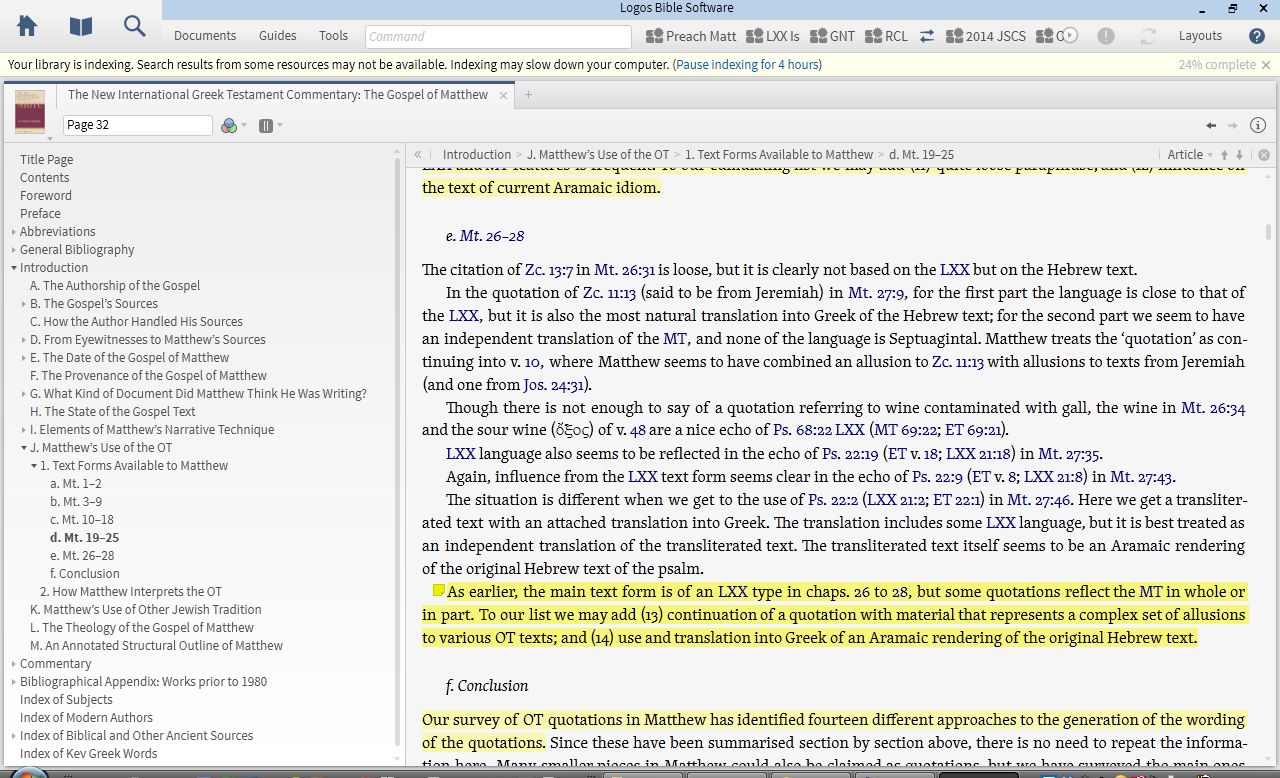
Here’s what it looks like in Logos on a PC. You can hide or show the table of contents at the left, and many of its sections have expand/collapse triangles (click or open in a new tab to enlarge the image below):

Introduction to Matthew

Any highlights or notes I add (which you can see above) automatically sync with any other devices that run the Logos app.

Like R.T. France, Nolland would rather elaborate on certain points in the body of the commentary itself, which makes the introduction accordingly shorter. I experienced this as a relief, because (a) I could get into the commentary proper more quickly and (b) when primarily coming to the commentary with a specific passage in mind, I found quite a bit of substance in the commentary proper, without having to go back to the introduction. Getting to a given passage via Logos is almost instantaneous.

Nolland on Matthew’s Use of the OT

There is more of note in the introduction, but “Matthew’s Use of the OT” is probably the most exceptional section (pictured above). It details both (a) what text forms Matthew might have had and (b) how he used them. Nolland lists 14 (!) “different approaches to the generation of the wording of the quotations.” And yet, amid the detail, he can conclude:

Though some of Matthew’s text forms come to him straight from the Gospel tradition, the overall impression is of a man who freshly scrutinises, at least on many occasions, the OT texts to which he appeals, and is able to do so in Greek, Hebrew (not always the Hebrew of the preserved MT), and occasionally in Aramaic. When it suits him to do so, he produces translations that reflect influence along more than one track of tradition.

Nolland then identifies eight different ways in which Matthew uses the OT. This section of the commentary alone is worth half the price of the commentary. A nearly 20-page “Annotated Structural Outline of Matthew” at the end of the introduction is quite impressive (and maybe even worth the other half of the price of the commentary).

The Author’s Translation of Matthew

Nolland admits that his translation of Matthew (located at the beginning of each section) “may at times be wooden,” and this woodenness is noticeable in a number passages. For example, the genealogy reads: “Abraham produced Isaac; Isaac produced Jacob….” Nolland acknowledges the “unfortunately impersonal and nonbiological” implications of that translation. Indeed, a better word is needed.

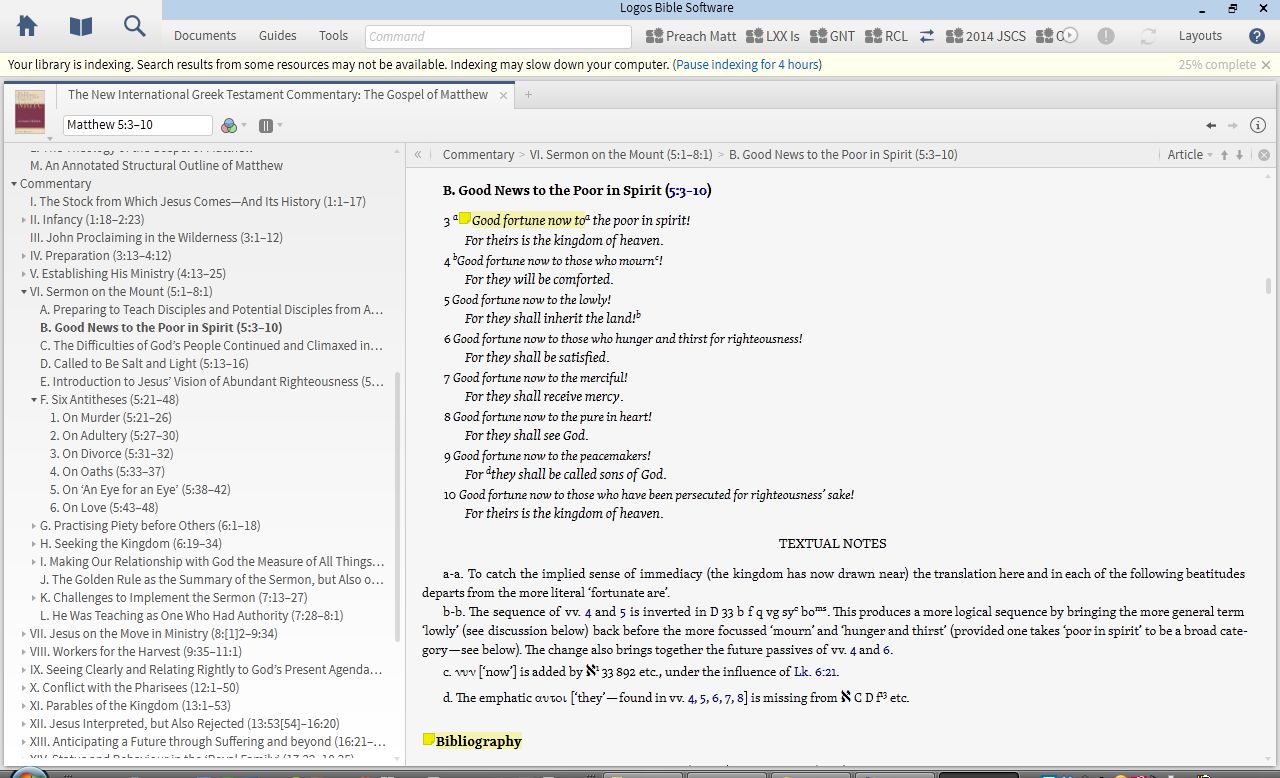
And for the Beatitudes (where the Greek μακάριος is admittedly difficult to translate), he has, “Good fortune now to….” I liked  the “now” part of this (it carries an “implied sense of immediacy”), but the more traditional “blessed” still seems to leave room in English for the divine blesser, who should be kept in view here. “Good fortune now” seems to miss that.

The commentary proper (with original translation)
The commentary (with original translation)

A more readable translation would not have compromised Nolland’s aims in producing a fairly literal rendering of the Greek. It wasn’t an enormous distraction from a well-written commentary, but it stood out, nonetheless.

The Commentary Proper

It would be impossible for Nolland to be comprehensive at every turn. There were some Greek words or passages of Matthew where I had hoped for more detail, but on the whole, Nolland is thorough.

For instance, in the narrative of the devil’s temptation of Jesus in Matthew 4, Nolland writes of verse 1:

The opening ‘then’, the role of the Spirit, and the Son of God language to come in vv. 2 and 6 create a strong link between 4:1–11 and 3:13–17.

and:

Because of the agency of the devil (and the specific temptations to come) πειρασθῆναι has been translated ‘to be tempted’, but there is in fact a play on the two senses of the πειραζ- root: ‘test’ or ‘tempt’.

This commentary matches literary sensitivity and Greek analysis with conclusions that can easily lead the reader to application. In the same passage: “[T]he devil suggests that sonship is a privilege to be exploited, that Jesus should use his opportunities to see to his own needs.”

Nolland often presents multiple scholarly interpretations of a given passage before offering his own–and even then, he does it humbly (though not unconvincingly). In the Beatitudes, for instance, he notes 11 different understandings of “poor” and four different understandings of “in spirit” for Matthew 5:3. One gets the sense that the author is just as interested in historical interpretation of given passages as he is with his own. This is a good thing.

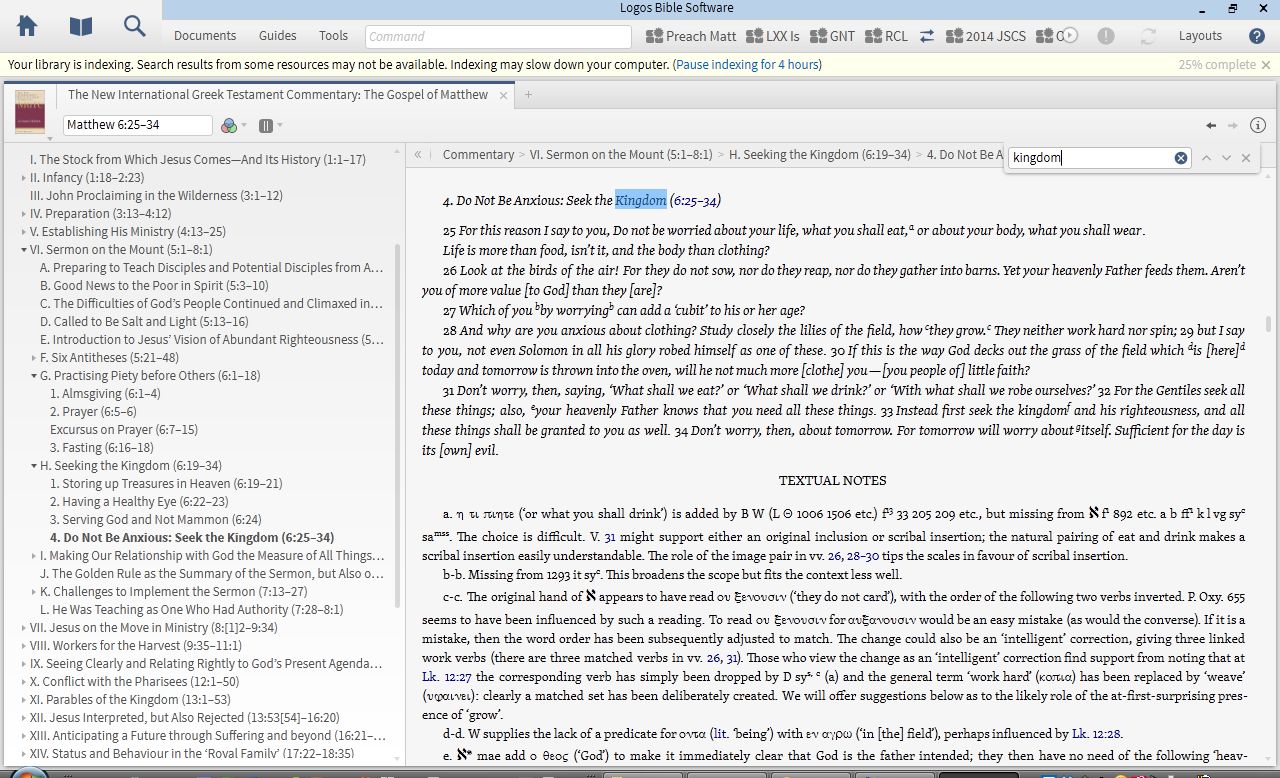
In Logos, one can search the commentary using control+F (PC) or command+F (Mac):

Keyword searching NIGTC
Keyword searching NIGTC for “kingdom”

One cool thing about this is that if you are already in Matthew 6:25 of the commentary (as above), the search results start right where you are (instead of going back to the beginning of the commentary). This way one can research a given word or theme as it unfolds in Nolland’s writing.

Concluding Evaluation

Despite the technical nature of the commentary (which I appreciated), the writing style is engaging and accessible, even inspiring in places. I loved this:

Jesus proclaims the imminent arrival of the kingdom of heaven. God now intends to establish afresh his rule among his people. If people are to be ready for this development, then repentance is urgent. Only a fundamental change of life direction will match the needs of the moment.

The bibliographies are a gold mine. One wonders if there’s any journal article or monograph on Matthew that Nolland hasn’t examined. Even so, he says in his preface that he had to trim his listing to accommodate the requirements of the editors!

My critique of the author’s translation notwithstanding, Nolland’s Matthew is a magnificent work, probably even one of the very first places one should go when doing in-depth study of Matthew’s text. Nolland does not disappoint in his technical analysis of words and passages, and yet he somehow is able to keep the Gospel as a whole before him and the reader as he expounds on its component parts. The reader cannot help but be impressed throughout the commentary, both with Nolland, and with Matthew’s Gospel which he describes.

Thanks to Logos for the review copy of the NIGTC series. I will post more in the future about the series and its use in Logos.