Leslie C. Allen’s Liturgy of Grief is under $5 this month in ebook form. It’s here on Amazon ($4.99) and here on CBD ($3.99). It’s a good deal for a great “pastoral commentary” on Lamentations.
Issue 131.3 of The Journal of Biblical Literature is out. You have to be a Society of Biblical Literature member to access the full contents, but you can see what’s in the new fall 2012 issue here.
From SBL, here is what’s inside the issue.
Judah Comes to Shiloh: Genesis 49:10ba, One More Time
Serge Frolov, 417–422
The Four Moses Death Accounts
Philip Y. Yoo, 423–441
Not Just Any King: Abimelech, the Northern Monarchy, and the Final Form of Judges
Brian P. Irwin, 443–454
The Heart of Yhwh’s Chosen One in 1 Samuel
Benjamin J. M. Johnson, 455–466
Secrets and Lies: Secrecy Notices (Esther 2:10, 20) and Diasporic Identity in the Book of Esther
Martien A. Halvorson-Taylor, 467–485
Psalms Dwelling Together in Unity: The Placement of Psalms 133 and 134 in Two Different Psalms Collections
Ryan M. Armstrong, 487–506
Archer Imagery in Zechariah 9:11–17 in Light of Achaemenid Iconography
Ryan P. Bonfiglio, 507–527
Eyewitnesses as Guarantors of the Accuracy of the Gospel Traditions in the Light of Psychological Research
Robert K. McIver, 529–546
Voluntary Debt Remission and the Parable of the Unjust Steward (Luke 16:1–13)
John K. Goodrich 547–566
Paul’s Areopagus Speech of Acts 17:16–34 as Both Critique and Propaganda
Joshua W. Jipp, 567–588
“Be Ye Approved Money Changers!” Reexamining the Social Contexts of the Saying and Its Interpretation
Curtis Hutt, 589–609
Logos 4 offers an “Exegetical Guide” and a “Passage Guide” for any verse(s) a user is studying. These features’ utility lies primarily in how Logos compiles and presents the various resources in the program. A couple times in the last year or two when I was trying out Logos on a seminary library computer, I had trouble seeing the use in the Exegetical Guide and the Passage Guide. Can’t I just find that stuff all myself, I thought?
Now I’ve had a chance to use both at greater length. Here’s what I think about them.
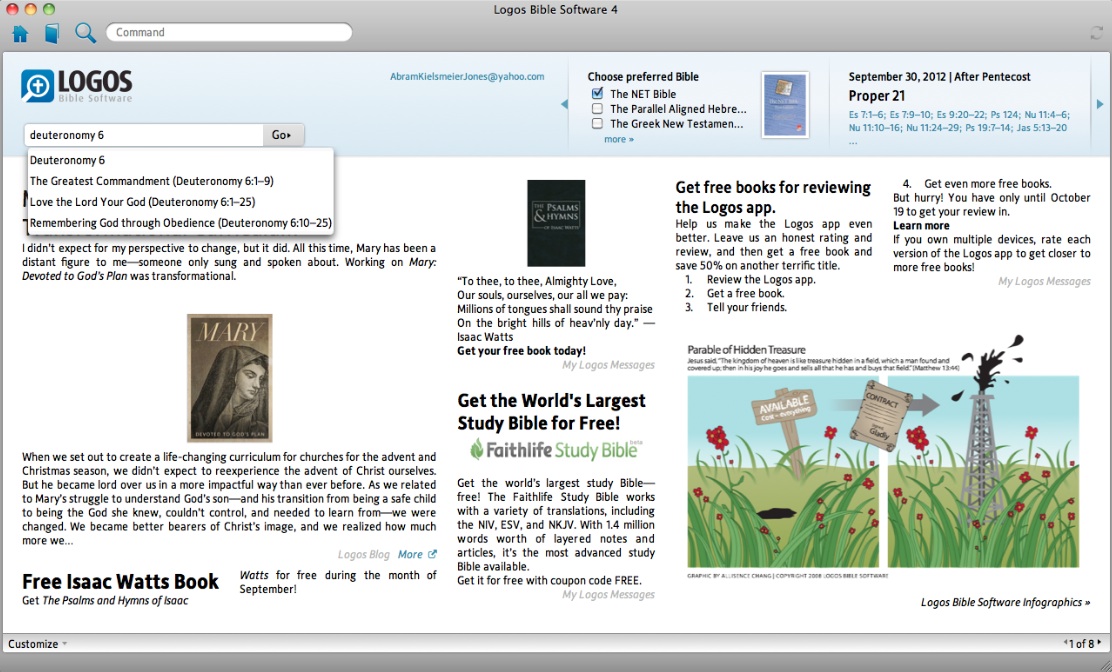
From the home page I begin to type in Deuteronomy 6, and a nice drop-down auto-complete feature comes up (a smart search engine!). Everything you see below in the home page can be changed and customized, as I noted here.
Selecting “The Greatest Commandment (Deuteronomy 6:1-9),” this screen then comes up (along with other tabs I already had open, not shown here). Click for larger if need be.
There are multiple collapsable and expandable sections from which I can choose. Most helpful are the “cross references” that pop up. Below that are “parallel passages,” which highlighted for me a resource I didn’t even realize Logos 4 had: Old Testament Quotations and Allusions in the New Testament (you know I love that!).
There’s more, too–a quick gathering of and hyperlinks to pertinent people, places, and “biblical things”; “media resources,” such as this one shown at right; a compare versions tool… and more. There are some things I won’t necessarily use, like the Graceway Media graphics (which take you to an external site, where it looks like you have to pay to download). But that’s no biggie–there’s an “x” I can click on so that won’t show in future Passage Guides. It’s all highly customizable, a consistent strength of Logos.
The Passage Guide saves me time and highlights resources and references throughout Logos 4 that users may not even be aware exist. I’m a fan and can easily envision using this in preparing messages and Bible studies.
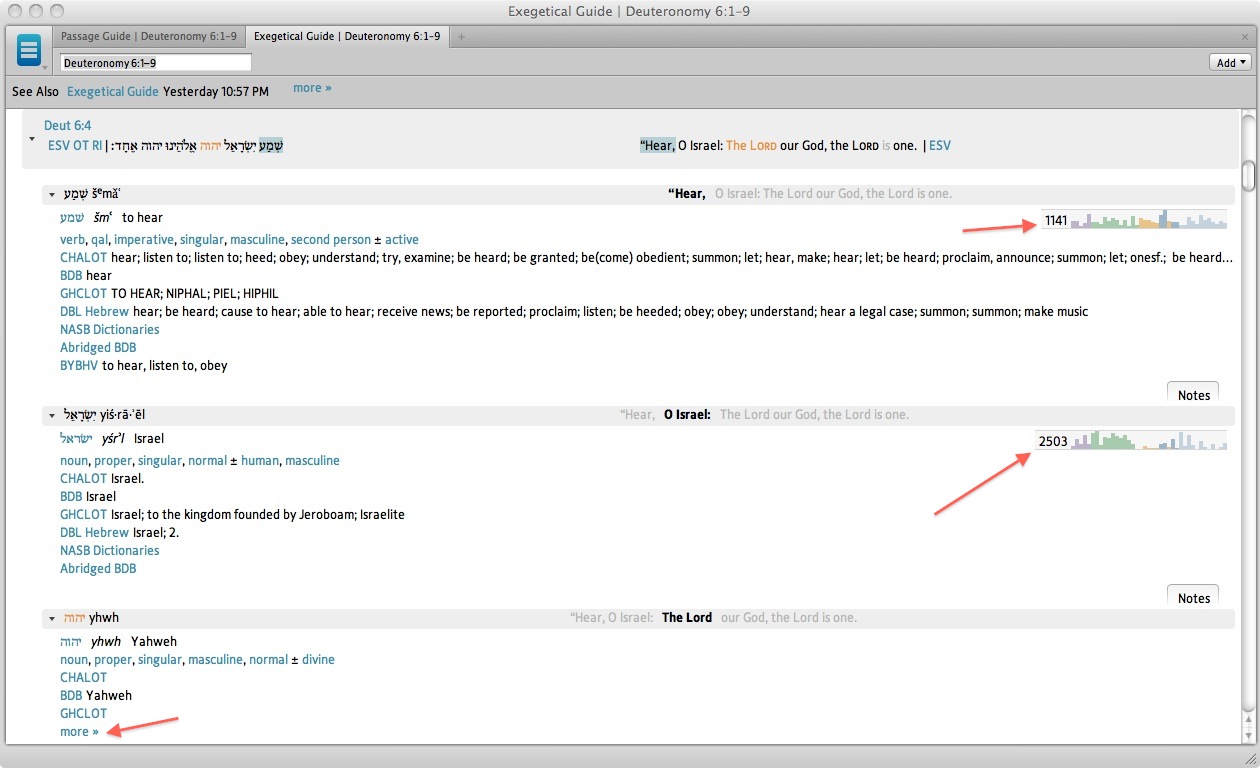
The Exegetical Guide has a really similar layout. The categories here, however, tend to be more focused at the word, clause, sentence, and verse level, such as: textual apparatuses (if you have any in your Logos), grammars, visualizations, and word-by-word analysis. This latter feature is cool–it shows you parsing for every word, as well as its definitions in multiple dictionaries/lexica at the same time. See here:
In the image below (another part of the Exegetical Guide), the top two arrows show you the colorful word distribution results throughout the various biblical books; the bottom arrow shows you how you can click on “more” for a given word (click for larger):
The Exegetical Guide and the Passage Guide are winners. They pull a lot together in one easy-to-get-to place, and they do it quickly. Nicely done.
Thanks to Logos for the review copy of Logos 4 with the Original Languages Library included. For the review copy I am giving my honest impressions of the program in a multi-part review. This has been part 4. See part 1 here, part 2 here, and part 3 here.
When preparing a lexicon of the LXX, one is faced with several basic questions related to the fact that most of the books of the LXX are translations. This lexicon is supposed to give the meaning, i.e. the English translation equivalents, of the words used in the LXX. However, which meaning should be given, the one intended by the translator or the one understood by the readers for whom it was intended? Is reference to be made to the underlying Hebrew or Aramaic, or is the search for meaning to be confined to the Greek? These questions are interrelated and connected with the special character of “Septuagint Greek.”
This made me think of something I just read in Roy E. Ciampa’s chapter, “Approaching Paul’s Use of Scripture in Light of Translation Studies,” in Paul and Scripture: Extending the Conversation, edited by Christopher D. Stanley.
The point is that translations need to be analyzed not only in terms of their relationship with the source text but also in terms of (a) how the target text’s place within its adoptive literary system (as well as the social, religious, and other systems of which it is a part) relates to the source text’s place within its adoptive literary and other systems, and (b) how the place of the author of the source text within his culture and context relates to his place within the target text’s culture and context, and so forth.
Readers and how they understand texts are an issue, too.
Ciampa says in another place:
Paul’s interpretative method is closer to the idea of an indirect translation—one that that only partially resembles the original text and its meaning, retaining only those parts that are relevant to those to whom his interpretation is being transmitted. He may be aspiring not to complete interpretive resemblance with the original but only to partial resemblance, making alterations in order to adapt the text and its message in ways that optimize its relevance for his congregations.
The questions raised by each of the three above quotations are all reasons I am interested in studying the Septuagint, and now the use of the Old Testament in the New Testament. I’m learning that it’s so much more than just, what text did the NT writers have at hand, but also: how did NT writers use a text (whether Greek or Hebrew) to fit the needs of their writing and their audience? It’s a lot to unpack, and some of it is near impossible to know. But exploring questions like these strikes me as time well spent, even if I’ve unearthed more questions than answers for the time being.
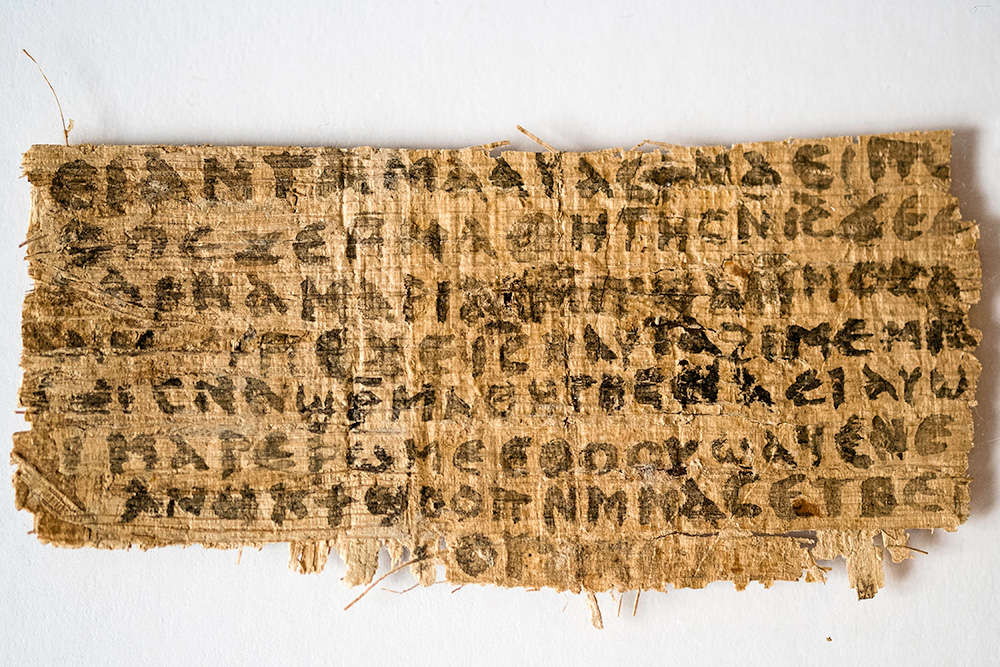
In the last two days I’ve seen about 50 Facebook status updates from friends and groups I follow, each with their own take on the “Gospel of Jesus’s Wife” papyrus that Harvard Professor Karen L. King recently announced. (Nerdy grammatical excursus: King has titled the papyrus with Jesus’s, but I follow Strunk and White and prefer Jesus’.)
The Harvard Divinity School press release is here. It begins,
Four words on a previously unknown papyrus fragment provide the first evidence that some early Christians believed Jesus had been married, Harvard Professor Karen King told the 10th International Congress of Coptic Studies today.
The papyrus has been dated to the 4th century and is written in Coptic, the alphabet of which has overlap with the Greek alphabet. King has postulated, in fact, that the Coptic in this little fragment may have translated a Greek original.
The key quote from the papyrus is translated, “Jesus said to them, ‘My wife….'” It then gets cut off. Go here for a full translation, as well as helpful Q&A with Professor King.
It seems to me there are two primary questions on folks’ minds right now. First, is this thing real or a fake? Second, did Jesus have a wife, or could he have?
In pursuit of these questions, I spoke with two Professors of Biblical Studies at Gordon College, a top Christian liberal arts school, located just north of Boston. Was Jesus married?
“Is there anything in the Gospels that would give us a hint he was married? I don’t think so,” noted Professor Marvin R. Wilson. “If he was married, how come he says to his beloved disciple at the cross, ‘Take my mother,’ not ‘Take my wife’?”
The significant woman in Jesus’ life, for whom he is looking out in his final hours, is his mother Mary, not a wife.
All the same, Wilson said, “It’s a good question. One who had no marriage would certainly have been the exception. We have an exception in Jeremiah, but that was a divinely commanded celibacy.”
Wilson noted, however, that the assertion that Jesus had a wife is still an argument from silence. “Certainly he had a wonderful ministry with women. We know the 4th century was a time of theological clarification (Council of Nicea) as well as turbulence. This Coptic text may have represented a small sect of aberrant Christians that had broken away from the larger–yet still emerging–traditional community.”
Is there much at stake in the question of whether or not Jesus had a wife?
“Certainly I don’t think any key issues of the Christian faith are at stake here. If Jesus had a self-imposed celibacy because of the work he was called to accomplish, that would make him unusual, but not unique.”
Professor Steven Hunt noted, “There’s so much we don’t know about it yet. It’s apparently a very small fragment.”
Regarding the authenticity of the papyrus, he added, “I’m perfectly willing to go with [Professor King] and say that it’s an authentic fragment of some document that’s now lost, but it’s probably speaking more to the nature of debates in the 3rd and 4th century about sex and marriage… it’s almost certainly not giving us accurate information about the historical Jesus.”
More interesting than the fragment itself, Hunt noted, is the question, “Would Christians be troubled to find out Jesus was married? The fact that many would, may really be quite suggestive, especially if their reaction was rooted in a negative attitude toward bodily existence in general and sexuality in particular.
“So, while there’s no good historical evidence that he was [married], from my perspective,” Hunt said, “it’s not really theologically problematic to suggest that he could have been. Since the Bible affirms the essential goodness of marriage and sexuality, what would be the problem with that?”
Typically when I think about Bible software and original languages, three important areas come to mind:
The Hebrew Old Testament
The Greek New Testament
The Greek Old Testament, or, the Septuagint
I’ve already written about the Septuagint in Logos here. What about the Hebrew OT and Greek NT?
For Hebrew study there is the BHS Hebrew Bible with (WIVU) morphological analysis. I mentioned in my last post that the Information tab can be brought up to give lexical and morphological analysis of any word. Also, the bottom gray border area of Logos updates with morphological analysis as you move over a word. So you can instantly parse and analyze the Hebrew as you go.
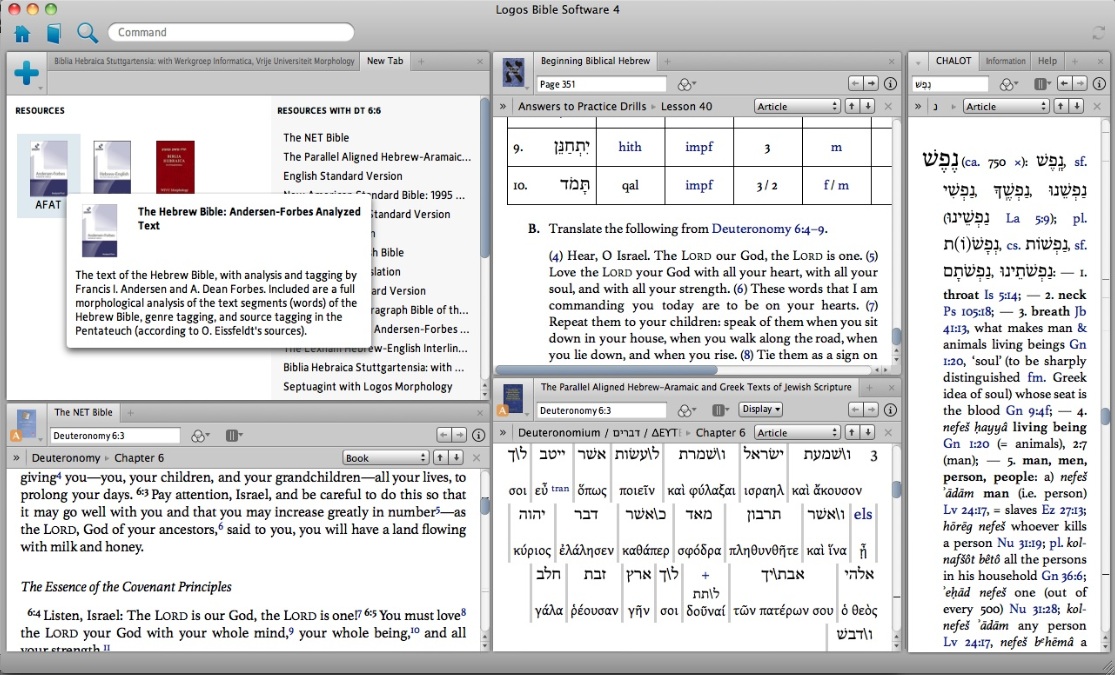
My go-to Hebrew lexicon is part of this base package: Concise Hebrew and Aramaic Lexicon of the Old Testament by Holladay (based on HALOT). And Landes’s ever-helpful Building Your Biblical Hebrew Vocabulary is included. There are some grammars like Futato and Gesenius. You can open all of these as stand-alone windows, or integrate them into what you’re doing in a given text. Here’s a Hebrew Bible layout I’m using at the moment (click for larger):
You can see in the top left area that I’ve got BHS open in the leftmost tab–what you’re seeing in the shot above is what happens when you seek to open a new tab. I like that it suggests resources that address the verse that’s already open. You can also mouse over a resource for a handy pop-up window with description. The above pop-up window is for the Andersen-Forbes Analyzed Text, which gives even more insight into the Hebrew text than just the BHS with WIVU morphological analysis.
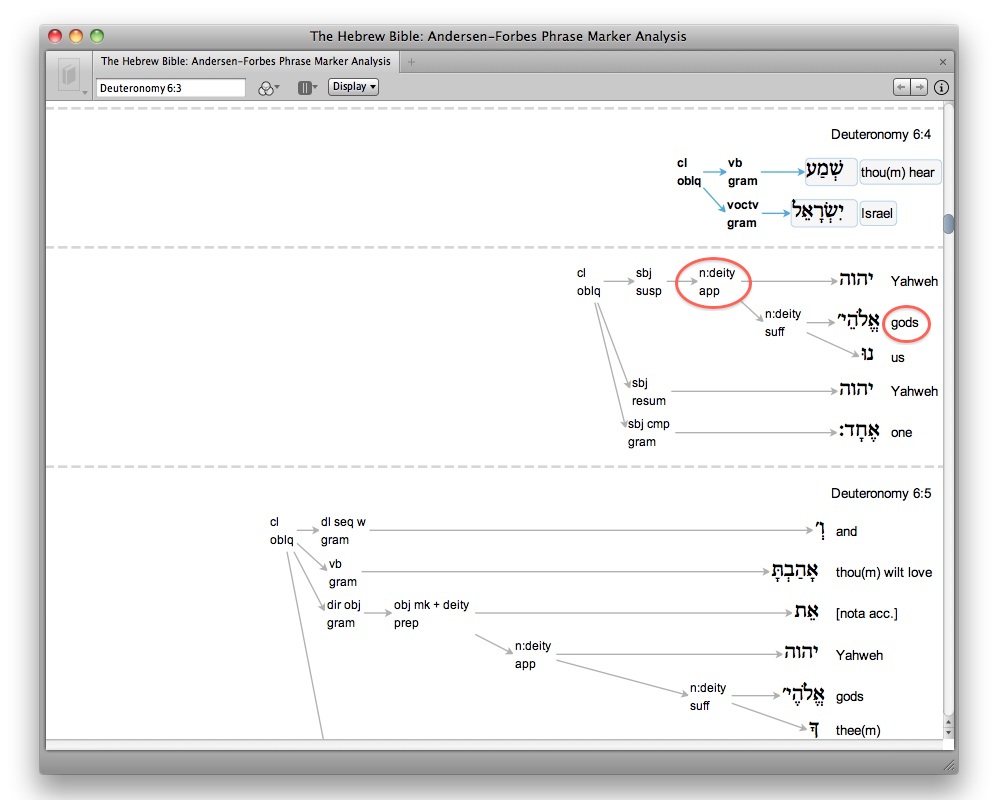
One highlight of the Hebrew resources available in this package is the Andersen-Forbes Phrase Marker Analysis. See here for a good description of the “seven layers of syntax information” included. (That’s better than a seven-layer burrito!) Here’s a screenshot:
The Analyzed Text contains morphological and lexical analysis, similar to that found in the above editions of the Hebrew Bible, but also analyzes features such as genre and semantic domains. The Phrase Marker Analysis, however, goes beyond the word level and shows how phrases and clauses function together, in essence diagramming the entire Hebrew Bible with Syntax information. There is a database that allows the user to search the Hebrew bible based on these Syntax structures, and a glossary resource that defines all the terms used in the Analyzed Text and the Phrase Marker Analysis. This package represents a new trend in computerized biblical studies – the ability to work with syntax, not just morphology, when studying the Bible.
I was a little unclear as to why the English translation (on the far right in the shot above) was so wooden in this resource–and “thou wilt” struck me as out of place. Also odd (in this verse) is the English translation “gods” (circled above) when it is in apposition to Yahweh, and the idea is clearly of one God.
But that barely takes away from the impressiveness of the Phrase Marker Analysis. It’s unique to Logos, and packs quite a punch. Grammar nerds rejoice! (As I have.)
When it comes to the Greek New Testament, all the basic stuff is there–the NA27 and UBS4 with morphology (apparatus sold separately), Westcott and Hort, the Byzantine textform of the GNT, the Louw-Nida lexicon, a concise Greek-English dictionary, both a harmony and synopsis for the Gospels (not Aland’s in this package, and nothing in Greek, but decent nonetheless), a great vocabulary guide, and so on. UPDATE: You can, in fact, view the Gospel synopsis in Greek, just by opening the synopsis tool and changing the versions, as below (click image for larger):
But get this. The Original Languages Library comes with the digitized 10-volume Theological Dictionary of the New Testament. I couldn’t believe this at first and thought surely it was the abridged version. Nope. It’s the full thing–“Big Kittel.” It’s fun to use as a digital resource, too. One saves time not having to look things up, and all the abbreviations are hyperlinked, so that if you just move your cursor over them, you see quickly what they stand for. Same thing with verse references:
This resource in print is $400 (retail is something like $700). Once I realized its inclusion, the $415.95 sticker price for the Original Languages Library made more sense. Comparable packages in other Bible software are cheaper, but none of them include TDNT. I’m amazed Logos can include it in this base package, but glad that they do.
As for English translations, the Original Languages Library includes these, among others:
English Standard Version (ESV)
King James Version (KJV)
Lexham English Bible (NT)
The NET Bible (my personal favorite at the moment)
New American Standard Bible (NASB)
New Revised Standard Version (NRSV)
There is also a variety of (reverse) interlinear Bibles. I personally don’t use these much, but they could be helpful to others. The Tov/Polak Hebrew-Greek Parallel Aligned Bible, however–presented in interlinear format–is great. (More about that here.)
The Original Languages Library packs in quite a bit. With the exception of perhaps an English translation of the Septuagint, all you need for original language study is here. The Andersen-Forbes resources for the Hebrew OT, the TDNT for the Greek NT, and the Tov/Polak aligned Hebrew-Greek OT are all wonderful inclusions and fantastic resources.
How is Logos 4 for study of biblical languages? It’s great.
Thanks to Logos for the review copy of Logos 4 with the Original Languages Library included. For the review copy I am giving my honest impressions of the program in a multi-part review. This has been part 3. See part 1 here and part 2 here.
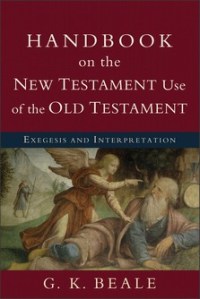
I’m reading the book shown at right for a seminary class I’m taking. The class is called “The Old Testament in the New.” Its syllabus is here (pdf).
I’ll offer a review of Beale’s Handbook on the New Testament Use of the Old Testament later, but for now, this:
The aim of this chapter [3], and indeed of this entire handbook, is to obtain a better understanding of the way the NT is related to the OT at just those points where the New refers to the Old. The ultimate purpose in this exercise is more clearly to hear and apprehend the living word of the living God (cf. Acts 7:38), so that we may encounter God increasingly and know him more deeply, and so think and do those things that honor God.
He notes that he realizes “that this purpose is not shared by all in the academic guild,” but I believe that if the biblical authors meant for their writings to be read in a “participatory mood,” we actually do some injustice to the text when we don’t read them that way.
I have written a book review that is slated to be published in an upcoming issue of Bible Study Magazine.
You can see what Bible Study Magazine looks like by flipping through this past issue.
The book I review is Lamentations and the Song of Songs, by Harvey Cox and Stephanie Paulsell. It’s the newest edition of Westminster John Knox Press’s Belief theological commentary series. (More about the book is here.)
Both authors suggest reading their respective biblical books in a “participatory mood.” Cox and Paulsell each highlight the timelessness of Lamentations and Song of Songs, surveying well their history of interpretation to help readers today apply them and enter in to the texts. A good commentary to have at hand, especially when preaching through either Lamentations or Song of Songs–something that probably doesn’t happen as often as it should.
Recently for a seminary class I had to describe the difference between “the Maccabean hope in a Messiah and Jesus’ fulfillment of that hope.”
Maccabean hope on first glance would appear to be a hope in military power. This poem at the beginning of 1 Maccabees 3, for example, extols Judas for his might (NETS translation):
And he spread glory to his people and put on a breastplate like a giant and strapped on his war instruments.
And he conducted battles, protecting the camp by the sword.
And he resembled a lion in his works and was like a whelp roaring in the hunt.
And seeking out the lawless, he persecuted them and burned up those who disturbed his people.
And the lawless drew back for fear of him, and all the workers of lawlessness were disturbed, and salvation was successful by his hand.
1 Maccabees closes similarly, in 16:23-24:
The rest of the acts of John and his wars and the brave deeds that he did, and the building of the walls that he completed, and his achievements, are written in the annals of his high priesthood, from the time that he became high priest after his father.
It is difficult not to read Maccabees as, in some sense, a narrative of one war after another. There was a Maccabean respect for leaders/priests who would lead them in battle. Certainly, then, the expectation of a Messiah would have been affected by this. “Maccabean hope” would have called for a Messiah to be a Jewish freedom fighter—in the militaristic sense of the word.
However, I think there is another, perhaps fuller way of understanding “Maccabean hope in a Messiah” that honors the author of 1 Maccabees and that book on its own terms. While a Maccabean hope certainly expected military might from a Messiah, Mattathias and his sons above all valued upholding the law. Their military resistance flowed from and was a result of that desire to keep the law.
1 Macc. 2:27 has, “And Mattathias cried out in the city with a loud voice, saying, Let everyone who is zealous in the law and is upholding the covenant follow me’” (my emphasis, from the NETS again). Only having established zealousness in the law did Mattathias and his family wage their series of wars. (Although these few verses are preceded in 2:24 by Mattathias killing a Judean man who was making a sacrifice that was not in accordance with the law!)
So, to try to read 1 Maccabees on its own terms, Maccabean hope in a Messiah must have been hope in a Messiah who was “zealous in the law” and who was “upholding the covenant.” Christians believe that Jesus was the perfect fulfillment of the law. But the descendants of the faithful Hasidim mentioned in Maccabees did not see it that way.
As I recently read through 1 Maccabees, I was surprised by how much anti-Gentile language and imagery there is in the book. In the institution of Hannukah at the end of 1 Macc. 4, to take just one example, there is a sense of fortifying the temple against the Gentile enemies.
I can appreciate the need for protection and purity–especially given how the temple had been profaned previously. This was truly a matter of life and death for God’s chosen people, physically and spiritually. But I wanted to say to the Maccabees’ author and the Maccabean family: With all due respect, what about all those verses in the prophets and other parts of the Hebrew Scriptures that say things like “nations will stream to your light” and “all nations will be blessed through you“?
Law-abiding Jews who were influenced by 1 Maccabees seem to have been expecting a Messiah who would clear the temple of the nations/Gentiles, as Judas Maccabeus did. Instead, Jesus reminded the Jewish people of their own Scriptures that said the temple was to be a house of prayer “for all nations” (Isaiah 56:7).
What kind of Messiah was he, then?
Jesus fulfilled his role as Messiah by being a conqueror, but not in an earthly, militaristic way. He fulfilled the law, but did not uphold it in a manner many had hoped for. And he drew all nations to himself, but in a way that angered anti-Gentile, exclusivist Jews.
A zealous Jewish freedom fighter? Yes. But not like Maccabees.
I enjoy reading the Septuagint in Greek (as best I can), and I enjoy using Bible software programs to do it. In this post I offer part 2 of my Logos 4 review (part 1 is here), focusing on the Septuagint in Logos.
An Intermediate Greek-English Lexicon (Liddell/Scott)
The Parallel Aligned Hebrew–Aramaic and Greek Texts of Jewish Scripture (Logos product page here)
The BHS Hebrew Bible with WIVU morphological analysis (as well as other Hebrew-related resources)
As far as texts go, the standard base is there (Rahlfs). And there’s instant morphological analysis so you can hover over a word to see its parsing right away. The LEX Septuagint lexicon is my personal go-to, and adding the Liddell-Scott abridgement is an especially nice touch. Students can do decent lexical analysis of words in their Septuagint-specific context.
The best part is the inclusion of the Parallel Aligned Hebrew-Aramaic and Greek Texts of Jewish Scripture. Here’s what Logos says:
Prof. Tov’s Parallel shows how the Hebrew and Aramaic line up against the Greek text on a word-by-word basis, but it does far more. In places where the Greek text doesn’t follow the Masoretic reading, Dr. Tov has provided a reconstruction of what the Hebrew or Aramaic text that the Greek translators were looking at might have been. In addition to these theoretical reconstructions, this database includes copious notes on the translation techniques used by the Septuagint translators, making this work a rather specialized commentary on the text. Did the Greek translators change the word order for grammatical or stylistic reasons? Did they change the voice of a verb from passive to active? Did they use a genitive absolute to translate an infinitive absolute? These types of observations are exhaustively noted in the alignment.
Dig this:
It’s a really nice feature, and presented especially well in Logos.
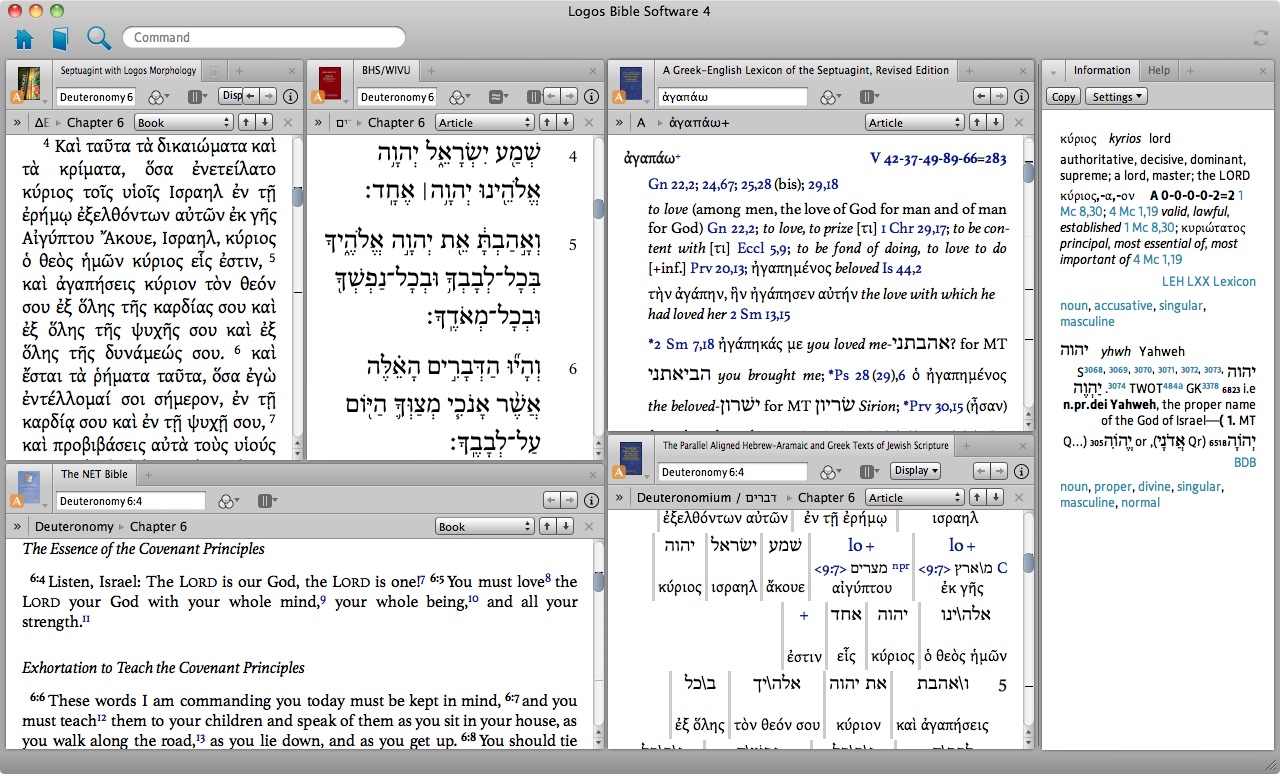
With all of the above in use, here’s what my Septuagint layout looks like in Logos 4 (click to enlarge):
That’s six resources open at once, each of which is plenty visible! And moving around which tabs go where, re-sizing, opening “in a floating window,” and saving the layout is easy.
The little orange A next to each resource icon/image is a “Link Set.” By clicking on the icon/image of the resource, I can assign it a letter in a Link Set, which then means each of the tabs and resources updates as any one of them moves ahead. So if I move ahead through the Greek LXX, the Hebrew MT follows, as does the NET Bible, as does the MT/LXX Parallel. Nice.
It was easy enough to figure out how to make LEH my default lexicon (“prioritize” it, in Logos parlance). Now double clicking on any Greek word opens up the corresponding entry in that lexicon.
The Information tab at the right in the screen shot above gives lexical and morphological analysis of any word. And something that’s not present in the image above: the bottom gray portion of Logos (just under the bottom left tab) also updates with morphological analysis as you move over a word. That part of the screen updates faster than the Information tab, which has just a slight delay in displaying new information.
One thing that stands out as a possible oversight is that there is no English translation of the Septuagint bundled with the Original Languages Library. In other major Bible software programs for a comparable price and package level, there is at least one English translation of the Septuagint, so Logos is unique here. (Logos does have Brenton’s English translation available, though you have to purchase it in addition to this package to use it.)
The MT-LXX Parallel, the two solid LXX-related lexica, and the customizability of the layout are standouts when it comes to using the Septuagint in Logos 4. One other thing worth mentioning is the availability of the Göttingen Septuagint and apparatus in Logos. It’s an add-on module that’s not cheap, but its price for how much it offers is hard to beat anywhere, digitally or in print. There are other Septuagint resources that Logos has digitized, too, that would be good additions to a digital library.
Thanks to Logos for the review copy of Logos 4 with the Original Languages Library included. For the review copy I will be giving my honest impressions of the program in a multi-part review. The couple Amazon links in this post are Amazon Affiliate links.
















 Words on the Word