(Life Update) I Am Pastoring Now

ChurchExciting news: I’ve accepted a call to be pastor at a great church in a seaside community in the Greater Boston area. My first Sunday was June 2.


My “About” page has been updated accordingly:

In my current capacity as pastor, I seek to support, encourage, and equip the congregation, connect with people in local and global communities, preach and help lead services weekly, and minister with the congregation in a variety of other ways.

I am grateful to God for the privilege of serving the congregation, and look forward to our weeks, months, and years of ministry together.

Weekly Greekly Lectionary Confectionery

If your church uses a fixed Sunday lectionary, I found a great blog for you this week. Looking at the Greek (and English translation) of the Gospel reading each week, Left Behind and Loving It is a help to preachers (and parishioners) who want to explore the text in depth.

The Greek is there, but knowledge of it certainly isn’t required to make use of the site. Posts come early in the week, too–no “Saturday specials” here!

Advent Wreath! Advent Wreath! Advent Wreath!

advent wreath

“Advent Wreath! Advent Wreath! Advent Wreath!”

This is the mantra my 2-year-old son repeats as soon as bedtime routines begin–and sometimes before that.

Each night since the beginning of Advent, our family has observed Advent together by praying, reading a Bible passage, lighting a candle, and singing a verse and the chorus of “O Come, O Come, Emmanuel.” There is perhaps nothing more heart-warming than hearing our two young boys sincerely belt out, “REJOICE! REJOICE!” each night around the Advent wreath. This will be a family tradition for years to come.

We made the wreath together as a family at our church before Advent. We use it to mark the time as we eagerly anticipate the celebration on Christmas of Christ’s first coming to earth, even as we await and long for his second coming. The waiting and yearning themes of Advent have been particularly appropriate given that we have yet again recently seen the evil we humans are capable of.

For those of you who plan worship services, or like to think deeply about them, the Calvin Institute of Christian Worship has a helpful Advent and Christmas Resource Guide. A reflection from that site says:

In Advent we hear the prophecies of the Messiah’s coming as addressed to us—people who wait for the second coming. In Advent we heighten our anticipation for the ultimate fulfillment of all Old Testament promises, when the wolf will lie down with the lamb, death will be swallowed up, and every tear will be wiped away.

There is something for me to learn from my two-year-old’s persistence as we gather each night. The anticipation with which he comes to our time of prayer (often clapping his hands) is what I want to offer God in this time of waiting.

More on the Connecticut school shooting: the haughtiness of humanity will collapse, says Isaiah

I wondered tonight whether this week’s Greek Isaiah readings might have something to say to the recent school shooting in Connecticut. Indeed, here is Isaiah 2:17-19 (my translation from the Greek):

Then every person will be brought low,
and the haughtiness of humanity will collapse,
and the Lord alone will be exalted in that day.

And they will hide everything that is made by hand,

as they bring them into caves
and into the clefts of rocks
and into the holes of the earth,
from before the fear of the Lord
and from the glory of his strength,
when he rises up to strike the earth.

The word for that which is made by hand (τὰ χειροποίητα) refers to idols. But as I read this I couldn’t help but think of the promise from Psalm 46:

He makes wars cease
to the ends of the earth.
He breaks the bow and shatters the spear;
he burns the shields with fire.

…bows, spears, and shields, of course, all being made by hand. I suggested here that a 21st century way of reading that verse could be something like, “He crushes guns and diffuses bombs, he destroys human weapons of destruction.”

One day either we or God himself will bring all our weapons of destruction–indeed, all our evil inclinations–into “caves” and “into the clefts of rocks and into the holes of the earth,” as we recoil at the glory of God’s strength. He will make wars cease; he will end all senseless violence; he will crush evil and wipe it away from the face of the earth.

Lord, as we mourn in the meantime, please hasten that day.

He crushes guns and diffuses bombs; he destroys weapons of destruction (Psalm 46 speaks into the mass school shooting)

gun

Psalm 46, a Psalm for tragedies and disasters, reads:

God is our refuge and strength,
an ever-present help in trouble.
Therefore we will not fear, though the earth give way
and the mountains fall into the heart of the sea,
though its waters roar and foam
and the mountains quake with their surging.

There is a river whose streams make glad the city of God,
the holy place where the Most High dwells.
God is within her, she will not fall;
God will help her at break of day.
Nations are in uproar, kingdoms fall;
he lifts his voice, the earth melts.

The Lord Almighty is with us;
the God of Jacob is our fortress.

Come and see what the Lord has done,
the desolations he has brought on the earth.
He makes wars cease
to the ends of the earth.
He breaks the bow and shatters the spear;
he burns the shields with fire.
He says, “Be still, and know that I am God;
I will be exalted among the nations,
I will be exalted in the earth.”

The Lord Almighty is with us;
the God of Jacob is our fortress.

The third part of this Psalm begins, “Come and see the works of the LORD, the desolations he has brought on the earth. He makes wars cease to the ends of the earth.” God is stronger than war—he can demolish even the strongest weapons of warfare. So in some kind of cosmic sense we don’t have to be afraid when there is violence.

“He breaks the bow and shatters the spear, he burns the shields with fire.” We might read this today as, “He crushes guns and diffuses bombs, he destroys human weapons of destruction.”

And then there is the main point of the Psalm, verse 10, followed by the refrain in verse 11 that appeared earlier in the Psalm: “Be still, and know that I am God; I will be exalted among the nations, I will be exalted in the earth. The LORD Almighty is with us; the God of Jacob is our fortress.”

Nature can appear to be in chaos, human actions can leave us scratching our heads, but neither the chaos of nature nor the chaos of human sinfulness can ultimately stand up to the power of God. He is exalted over the earth and over all people. He is a warrior God who declares war on war and causes all violence to end.

“The LORD Almighty,” a title for God from verse 11 and earlier in verse 7, is also sometimes translated “LORD of hosts,” or God of the angel armies. Based on these verses Martin Luther wrote, “LORD Sabaoth his name, from age to age the same, and he must win the battle.”

This Almighty warrior God is with us, present in chaos and suffering. He is the God of heavenly hosts of armies, yet he is the God of Jacob, too, a title that speaks of God’s personal relationship with his people.

He is a personal God that people can know. He invites us into an intimate relationship with him, especially when we are hurting, especially when things are going wrong.

The above is adapted from part of a sermon I preached a couple of summers ago on Psalm 46. I post in now in light of today’s awful news.

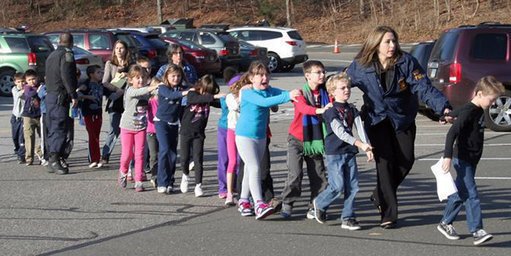
Jesus weeps, we weep

Shannon Hicks/Newtown Bee, via Associated Press

Jesus wept, and he weeps again today, with the horrible news of another school shooting in Newton, CT. From the New York Times:

A gunman killed 26 people, 20 of them children between the ages of 5 and 10, in a shooting on Friday morning at an elementary school in Newtown, Conn., about 65 miles northeast of New York City, the authorities said.

The gunman, who was believed to be in his 20s, walked into a classroom at Sandy Hook Elementary School where his mother was a teacher. He shot and killed her and then shot 20 students, most in the same classroom. He also shot five other adults, and then killed himself inside the school.

This evil deed is so heinous that even naming and describing it feels bad. May God have mercy on the souls of those poor children, and the grieving families they leave behind.

Christians have a rich Biblical tradition of lament that we can employ in times like this. This summer after the Colorado shooting, I posted this prayer, which was an aid to me in processing the grief, anger, and bewilderment I felt after hearing such awful news.

Prayer of Lament

O God, you are our help and strength,
our refuge in the time of trouble.
In you our ancestors trusted;
They trusted and you delivered them.
When we do not know how to pray as we ought,
your very Spirit intercedes for us
with sighs too deep for words.
We plead for the intercession now, Gracious One.

For desolation and destruction are in our streets,
and terror dances before us.
Our hearts faint; our knees tremble;
our bodies quake; all faces grow pale.
Our eyes are spent from weeping
and our stomachs churn.

How long, O Lord, how long
must we endure this devastation?
How long will destruction lay waste at noonday?
Why does violence flourish
while peace is taken prisoner?
Rouse yourself! Do not cast us off in times of trouble.
Come to our help;
redeem us for the sake of your steadfast love.

For you are a gracious God
abounding in steadfast love and faithfulness.

By the power of the cross,
through which you redeemed the world,
bring to an end hostility
and establish justice in the gate.
For you will gather together your people into that place
where mourning and crying and pain
will be no more,
and tears will be wiped from every eye.
Hasten the day, O God for our salvation.
Accomplish it quickly! Amen.

**From Let the Whole Church Say Amen! A Guide for Those Who Pray in Public, by Laurence Hull Stookey, pp 94-95 (Copyright 2001 by Abingdon Press). Reproduced by permission. Formatted print-friendly pdf of prayer here.

The Scriptures that the above prayer draws on are: Psalm 124:8, Psalm 37:39, Psalm 22:4, Romans 8:26, Isaiah 59:7, Job 41:22, Nahum 2:10, Lamentations 2:11, Isaiah 6:11, Psalm 91:6, Psalm 44:23, Psalm 44:26, Exodus 34:6, 1 Corinthians 1:17, Ephesians 2:14, Amos 5:15, Revelation 21:4, Isaiah 60:22.

Leslie C. Allen’s Liturgy of Grief for under $5 (ebook)

Leslie C. Allen’s Liturgy of Grief is under $5 this month in ebook form. It’s here on Amazon ($4.99) and here on CBD ($3.99). It’s a good deal for a great “pastoral commentary” on Lamentations.

I reviewed the book this summer, as well as interviewed the author.

One of my reviews to be published in Bible Study Magazine

I have written a book review that is slated to be published in an upcoming issue of Bible Study Magazine.

You can see what Bible Study Magazine looks like by flipping through this past issue.

The book I review is Lamentations and the Song of Songs, by Harvey Cox and Stephanie Paulsell. It’s the newest edition of Westminster John Knox Press’s Belief theological commentary series. (More about the book is here.)

Both authors suggest reading their respective biblical books in a “participatory mood.” Cox and Paulsell each highlight the timelessness of Lamentations and Song of Songs, surveying well their history of interpretation to help readers today apply them and enter in to the texts. A good commentary to have at hand, especially when preaching through either Lamentations or Song of Songs–something that probably doesn’t happen as often as it should.

The Gospel According to Isaiah 53, reviewed

Isaiah 53 is one of the clearest prophecies of Jesus the Messiah in the Hebrew Scriptures. This chapter has changed the lives of thousands of people–both Jews and Gentiles–who have read the text and believed in the One who fulfilled these prophecies in glorious detail.

Thus begins Mitch Glaser’s Introduction in The Gospel According to Isaiah 53: Encountering the Suffering Servant in Jewish and Christian Theology (affiliate link). In three parts the book expounds how the prophecies of Isaiah 53 relate to and are ultimately fulfilled in the person of Jesus. (The full passage the book treats is Isaiah 52:13-Isaiah 53.)

The first section, a sort of exegetical prelude, discusses “Christian interpretations” and “Jewish interpretations” of Isaiah 53. The second section is a biblical theology of Isaiah 53 (with particular attention to its use throughout Scripture). The third and concluding section speaks to “Isaiah 53 and Practical Theology,” with an emphasis on how to preach the passage, both from the pulpit and in conversation.

The book is “designed to enable pastors and lay leaders to deepen their understanding of Isaiah 53 and to better equip the saints for ministry among the Jewish people.”

The first thing I noticed about the book is that it’s just as much an apologetic for Jesus-as-suffering-servant as it is an academic study of Isaiah 53. It’s not that it lacks academic substance, though. This is a meaty book, and pleasingly so.

Regarding the book’s explicitly evangelistic intent–there may be some who are uncomfortable with the description of Chosen People Ministries’ “Isaiah 53 Campaign” (including 75,000 postcards to Jewish homes and 40,000 voice blasts=robo-calls?). I’ll admit that I question the potential efficacy of pre-recorded phone messages for reaching anyone with the Gospel (though God can use anything!). But see blogger Joel Watts for his helpful (refreshing!) take on the blending of the academic and evangelistic enterprises, especially in the context of this book.

You can find a full list of contributors in the table of contents here (pdf). A few names to highlight are Walter C. Kaiser Jr., Darrell L. Bock (one of the co-editors), Craig A. Evans, and Donald R. Sunukjian. I particularly appreciated the book’s treatment of the New Testament use of Isaiah 53. The chapter by Michael J. Wilkins lists the quotations of Isaiah 53 in the NT and additional allusions to it in the Gospels. (He makes a key point, that Jesus himself understood “his mission and death in the light of Isaiah 53.”) Darrell Bock goes in depth with a comparison of the Greek and Hebrew texts of Isaiah 53:7-8, highlighting its use in Acts 8 where Philip explains the passage to the Ethiopian eunuch.

Something to critique in this book is that there were a few generalizations of Jews that I found to be unfair, particularly in the chapter “Using Isaiah 53 in Jewish Evangelism.” Mitch Glaser writes:

I think I can safely say that, in the United States, most Jewish people would recognize Isaiah as the first name of a professional athlete sooner than they would recognize the prophet of biblical literature.

Granted, he is operating from the assumption that “most Jewish people are not Lubavitch, Hasidic, or Orthodox,” but still…. What was more surprising to me: “Most Jewish people do not understand or believe in biblical prophecy” and, “Most Jewish people do not believe in sin.” Glaser does (only later) qualify these with, “We must note that all of the above does not apply to those who hold to traditional Jewish theological positions,” but he would have been better off saying something like “many secular or ethnic but non-religious Jews…” or at least supporting his statements with statistics from surveys rather than anecdotal evidence. Glaser himself is a converted Jew who has a compelling conversion story, but I still found those characterizations to be frustrating. I wonder how helpful such statements could be in advancing an evangelistic cause in conversation with another Jew.

This next thing to highlight may seem a small point to some, but as someone seeking to keep my Hebrew and Greek going, I appreciated the actual Hebrew and Greek fonts throughout the book (i.e., not just transliteration), which are clear and easy to read. I did think, however, about an intended audience of “pastors and lay leaders” who may have desired transliteration, too. (All Hebrew and Greek is translated into English.)

Darrell Bock’s conclusion summarizes all the essays of the book, with key quotations. Having this there was a big help in piecing everything together again. The Gospel According to Isaiah 53 will not be far from my reach in coming months and years. I expect I will often reference this compendium of biblical scholarship on a vital text. My hesitations about the characterizations of Jews above notwithstanding, there is a good deal here that can be useful for Christian-Jewish conversations about the Suffering Servant.

I received a free copy of The Gospel According to Isaiah 53 with the only expectations of providing an (unbiased and honest) review on this blog. Its publisher’s product page is here. It’s on Amazon here (affiliate link).