Va-yikra’: A JPS Companion for Reading Leviticus

I think I am actually on pace to finish my Bible-in-a-Year reading plan in two years–but, as I’ve said before, as much as I value getting a good overview of all of Scripture in a short time, it’s so deep and rich (and sometimes surprising and/or befuddling) that I keep wanting to go slow. This is not, of course, a bad thing. The reading plan can wait.

JPS Torah LeviticusThe JPS Torah Commentary has been my go-to companion for reading through the first five books of the Bible. I’m three volumes in, and each one has been excellent. See what I say about the Genesis volume here, and the Exodus volume here and here. Now I’ve found myself similarly aided by Baruch A. Levine’s JPS Torah Commentary: Leviticus as I’ve made my way through that dense book of the Bible.

Levine’s commentary is more difficult to sit down and read through than Nahum Sarna’s Genesis or Exodus volumes, but this is less because of Levine and more because Leviticus does not have the same narrative flow of Genesis and Exodus. Its descriptions of laws and rituals are difficult for the uninitiated (um… and for the initiated) to wade through. It’s dense.

But Levine matches the density of the text with detail of his own, drawing also on rabbinical traditions to help the reader understand the world of the text. Levine addresses historical background and theology, as well as exegetical detail at the word level. But even his detailed exegesis highlights the larger literary context, so you can see the interrelations of Scripture as you read this commentary.

Allow me to share a specific example.

Here is the Hebrew text (nicely included in this commentary) of the admittedly harsh-sounding Leviticus 26:21:


Hebrew text of Leviticus


Here’s the verse in the Jewish Publication Society’s New JPS translation–also included in this edition:

And if you remain hostile toward Me and refuse to obey Me, I will go on smiting you sevenfold for your sins.

Levine’s comment for the verse focuses on the phrase, “And if you remain hostile toward Me.” Note how he balances lexical analysis with both extrabiblical and biblical references (the Hebrew in the commentary is transliterated throughout):


Here, again, is a transition, where the conditions for God’s forgiveness are stated.

Hebrew keri, “hostility,” and the idiom halakh ʿim. . . be-keri, “to walk with. . . in hostility,” are unique to this chapter. Targum Onkelos translates be-kashyu, “with hardness, obstinacy,” deriving keri from the root k-r-r, “to be cold.” Compare the noun form karah, “cold wave,” in Nahum 3:17, and mekerah, “cool chamber,” in Judges 3:24. The reverse of “walking in hostility” is “agreeing to obey” (ʾavah li-shmoʿa) suggesting that keri is synonymous with meri, “rebelliousness.” Note the contrast in Isaiah 1:19–20: “If, then, you agree and give heed, / You will eat the good things of the earth; / But if you refuse and disobey (u-meritem), / You will be devoured by the sword.” The notion of meri as “rebelliousness” is a major theme in the prophecies of Ezekiel, but the term keri occurs nowhere else in the Bible; hence its meaning remains uncertain.


There is one other portion I need to quote at length, since it comes in Levine’s opening explanation of the sacrificial system in Leviticus 1. Maybe I’m obtuse or just not familiar enough with Leviticus, but I had somehow missed until now that one could not sacrifice to expiate for intentional sins:

It should be emphasized here, as the workings of the sacrificial system are introduced to the reader, that the laws of the Torah did not permit Israelites to expiate intentional or premeditated offenses by means of sacrifice. There was no vicarious, ritual remedy—substitution of one’s property or wealth—for such violations, whether they were perpetrated against other individuals or against God Himself. In those cases, the law dealt directly with the offender, imposing real punishments and acting to prevent recurrences. The entire expiatory system ordained in the Torah must be understood in this light. Ritual expiation was restricted to situations where a reasonable doubt existed as to the willfulness of the offense. Even then, restitution was always required where loss or injury to another person had occurred. The mistaken notion that ritual worship could atone for criminality or intentional religious desecration was persistently attacked by the prophets of Israel, who considered it a major threat to the entire covenantal relationship between Israel and God.

Is this why David in Psalm 51 says,” For you have no delight in sacrifice; if I were to give a burnt offering, you would not be pleased”?

Levine comes back to this theme as Leviticus introduces the various offering types. He also explains the difference between sin and impurity, in a way that is really helpful for more fully engaging Leviticus.

The Introduction is some 30 pages, addressing both “The Leviticus Text” (which summarizes the book, highlights its structure, discusses its formation, and compares early versions) and “The Context” (Levine spells out how this commentary supports “the realism of Leviticus”). The 11 Excursuses (spanning some 40 pages) are utterly fascinating, covering topics like dietary laws, the scapegoat ritual, the festivals, and more.

All that is already more than enough to help the reader or teacher in her/his quest to better enter the world of Leviticus. But then the icing on the cake is the section called, “Leviticus in the Ongoing Jewish Tradition.” Here Levine hopes that “the reader of the Commentary may catch a glimpse of continuity and change and focus attention on the lasting relevance of Leviticus.”

And here’s some icing to go on that other icing: the binding is sewn and the book is beautifully bound. I’m quite sure I’ll be returning to this commentary again, but first–I’ve got more of the Torah to read through.


Tolle, lege.


Many thanks to the folks at University of Nebraska Press/Jewish Publication Society for sending me a copy of the commentary for review. The book’s JPS product page is here; you can order it through Nebraska Press here. Find it on Amazon here.

Prefer an electronic edition? Accordance has the JPS Torah Commentary here.

Hearing the Message of Scripture: A Fantastic (the Best?) Commentary on Jonah

HMS Jonah


When I preached through Jonah last Advent, I knew the JPS Commentary on Jonah would be helpful. What I wasn’t expecting was how often I would eagerly turn to Kevin J. Youngblood’s new Jonah volume in the recently begun Hearing the Message of Scripture commentary series. It might be the best commentary (in this reviewer’s humble opinion) written on Jonah.


Format of the Commentary


Each passage of Jonah includes the following sections:

  1. Main Idea of the Passage–a short, couple-sentence overview, where Youngblood helps you get oriented to the text.
  2. Literary Context–The author shows how the passage under consideration ties in with the rest of the book.
  3. Translation and Outline–the author’s original translation and visual layout of the biblical text.
  4. Structure and Literary Form–this looks at literary features and the rhetorical aims of Jonah. This section is especially strong.
  5. Explanation of the Text–the primary section of each passage, comprising the verse-by-verse commentary proper.
  6. Canonical and Practical Significance–though Youngblood is plenty practical throughout, this section is especially helpful for preachers, teachers, or any Bible reader wanting to know how to apply the message of the text.

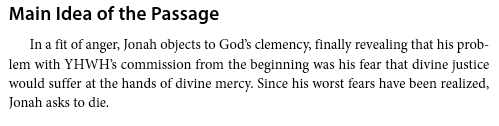
For example, here is Youngblood on the main idea of Jonah 4:1-4:


HMS Jonah 4 Main Idea


He then situates the passage in its larger context:


HMS Jonah 4


From there he relates Jonah 4:1-4 to the patterns of the rest of the book (“Every encounter with Gentiles brings Jonah to a crisis point”), surmises why Jonah wants to die (“Jonah cannot see how YHWH could simultaneously maintain his covenant faithfulness to Israel and grant clemency to Nineveh”), explains the text in detail, and then relates it to Moses and the other prophets and their interactions with “the nations.”


Youngblood’s Insights Make the Text Come Even More Alive


Youngblood makes the literary features of the text come alive. Regarding Jonah’s short stint in the belly of a fish, Youngblood writes:

The fish, however, functions as a means of deliverance and transportation from the murky depths back to the orderly realm of dry land. In this respect, the fish is the antithesis of the ship, which carried Jonah from the orderly realm of dry land out to the chaotic deadly sea.

Correspondingly, Jonah’s disposition and activity in the fish is the antithesis of his disposition and activity on the ship. Whereas Jonah pays out of his own pocket for passage on the ship, the journey in the fish back to land and life is free, courtesy of YHWH.

He continues to unpack the “important contrast” between ship and fish to help the readers with “the peak episode of the book’s first main section.”

This sort of analysis and clear explanation is emblematic of what the reader will find in every section of the book.


Final Evaluation: Easily a Top 3 Jonah Commentary


And what’s not to love about the first paragraph of the Introduction mentioning a Bruce Springsteen song? Here it is, by the way:


To write a nearly 200-page commentary with a 20-page introduction on a 4-chapter book of the Bible is no small feat; and none of what’s here is fluff. Youngblood notes in his introduction: “An understanding of three overlapping contexts–canonical, historical, and literary–is critical to the book’s interpretation.” He helps the reader attain ample understanding of those contexts and more.

Youngblood says only that this volume “strives to advance the discussion regarding Jonah’s message.” I think it does far more. This is easily a top 3 Jonah commentary–maybe even the best one I’ve used.

You can read a .pdf sample of the commentary here. See also my review of Obadiah in the same series.


I am grateful to Zondervan for the gratis review copy of this commentary, which was offered for an unbiased review. You can find the book on Amazon here. The Zondervan product page is here.

Galileans at Pentecost

"Pentecost," by Jan Joest van Kalkar (1505 – 1508)
“Pentecost,” by Jan Joest van Kalkar (1505 – 1508)


Pentecosts reminds us that God pours out the Holy Spirit on any and all persons who would receive… and he uses unexpected persons as his conduits!

The use of “Galileans” to help usher in the era of the Spirit is also a sort of breaking of barriers. It shows that when God chooses to do something marvelous, he does not necessarily wait till a person high in earthly esteem comes along. He does use such people, of course, as we see with God’s using Paul. But he is not limited to them.

The key to usefulness is the fullness of the Spirit, and the Spirit can bring life to anyone he chooses, provided that he or she is open to this enlivening.

(Ajith Fernando, Acts: The NIV Application Commentary)

Image above via Global Christian Worship.

After Luke and Acts: Part 3 of Luke’s Trilogy

As I’ve been working on the Book of Acts for my last few sermons, Acts has been working right back on me. I’m still thinking about my encounter with the Ethiopian eunuch. This last week, as the lectionary moved from Acts 8 and Acts 10 back to Acts 1 (for the Sunday after Ascension Day), I found myself thinking in terms of Acts 1:8 as a prequel for what had been happening so far.

Just before he ascends, Jesus tells the disciples to wait for the promised gift of the Holy Spirit.

He says:

But you will receive power when the Holy Spirit comes on you; and you will be my witnesses in Jerusalem, and in all Judea and Samaria, and to the ends of the earth.

They had wanted to know when the kingdom would be restored, but Jesus points them to a different when: the when of the Holy Spirit.

One implication of Jesus’ response, I think, is that we don’t have to know when or have life’s tensions resolved to be a witness right now to what we have seen in Jesus.

We don’t have to understand all the ins and outs of the kingdom of God–we may even think of its consummation as being a loooong ways away–to be able to make a contribution to it today, through the power of the Holy Spirit.

There’s an African proverb that says, “That which is good is never finished.”

The Book of Acts is like this. It’s not finished. If Acts 1 serves as a prequel for the whole narrative, Acts’s sequel is being written by men, women, boys, and girls who make up the church today.

The Story Luke TellsJusto Gonzalez comes at this another way in his excellent new book,The Story Luke Tells: Luke’s Unique Witness to the Gospel (Eerdmans, 2015).

He points out that Luke’s story in Luke-Acts doesn’t really end: “Paul has suffered countless vicissitudes. He has been shipwrecked. He has finally made it to Rome. He is awaiting trial before Caesar. And then—nothing!”

(This helps explain why after a recent read-through of Acts, I was at a loss to remember what happened to Paul at the end!)

Gonzalez goes on:

In telling his story and leaving it unfinished, Luke is inviting his readers to be part of it, to join the throng. ….But since the story is unfinished, it is more appropriate to conclude it with “RSVP,” like an invitation that awaits a response. This is what Luke demand from us: not satisfied curiosity about the past, but a response here and now. RSVP!

Pretty amazing, isn’t it?

We are the sequel to the two-part combo of Luke and Acts–the threequel, if you like. The story of the church in the world now becomes the third part in Luke’s trilogy. Luke-Acts-Us.

My Encounter with the Ethiopian Eunuch

Preaching so specifically about the Ethiopian eunuch the other week felt risky for at least two reasons:

  1. The eunuch in Acts 8:26-40 reads as a category-defying character, with a sort of in-between sex/gender identity and a home that was the unknown “ends of the earth” described in Acts 1:8.
  2. What even was a eunuch?

DeFranza EerdmansI found a great deal of help in understanding the eunuch and his identity from a just-published book from Eerdmans: Megan DeFranza’s Sex Difference in Christian Theology: Male, Female, and Intersex in the Image of God.

As the book treats sex difference widely, it examines the oft-misunderstood (or unknown!) category of intersex, with eunuchs providing a sort of historical case study in chapter 2. Did you know that Jesus spoke approvingly of eunuchs, and described three kinds?

The chapter was an immense boost to my appreciation of all the uncertainties that could have been at play as Philip encountered the eunuch, part of a group of people that DeFranza cites a 4th century poet as calling “exiles from the society of the human race, belonging to neither one sex nor the other.” They’re male, but not fully, at least not in the expected sense. And there were prohibitions in the Torah like this one in Deuteronomy 23:

 No one who has been emasculated by crushing or cutting may enter the assembly of the LORD.

Yet, as DeFranza and others have suggested, already in the broad sweep of Scripture, there seemed to be hope for eunuchs. Moving from the books of the Law to the prophets, Isaiah, just a few chapters after what the eunuch was reading in his chariot, there is:

To the eunuchs who keep my Sabbaths, who choose what pleases me and hold fast to my covenant—to them I will give within my temple and its walls a memorial and a name better than sons and daughters; I will give them an everlasting name that will not be cut off…. (Isa. 56:3ff)

But if he may not “enter the assembly of the LORD,” maybe he couldn’t be baptized, either?

Josephus, a first century historian, was no exchanger of pleasantries with eunuchs. He wrote:

Let those that have made themselves eunuchs be had in detestation; and do you avoid any conversation with them who have deprived themselves of their manhood, and of that fruit of generation which God has given to men for the increase of their kind….  (Antiquities 4:290)

It seems that the eunuch—a man probably used to giving orders and approval to decisions on the home front—in this poignant moment is asking Philip for his approval. Having heard the good news of Jesus as Philip explains the Scriptures to him, the eunuch wants to know, “Am I allowed in?” Am I excluded or included? Can I be baptized into Jesus?”

Philip had no problem baptizing him into the fellowship of Jesus. Philip surely knew of God’s promise through Isaiah to give the eunuch “a name better than sons and daughters” (which they could not have!). Philip surely had surmised that this man who had traveled from Ethiopia to Jerusalem–a great cost and sacrifice of time… and could he even get in at the temple?–was committed to worshiping God with his whole life. Philip had experienced the Holy Spirit’s presence in Jerusalem and all Judea and (just verses before) in Samaria… and now he must have thought, “Here are the very ends of the earth–the blurring and transcending of many categories–coming right here to this odd deserted road I’ve just been called to!”

Yes, the eunuch had to be baptized.


The chapter on eunuchs is as far as I’ve gotten in Megan’s book. (And if I’ve gone astray anywhere in the above, it’s my doing, not hers.) But I’ve found myself transformed by this vicarious encounter with the Ethiopian eunuch in Acts 8. As I told my congregation, I come back to this passage again, now asking these questions:

Where have I drawn my own borders? How open to re-examination am I in how I think about others and their place in the kingdom of heaven? How can I learn from the eunuch and allow that would-be outcast to change my heart? What do the people Jesus calls brother and sister really look like? Will I allow “the uncategorized” or marginalized or ignored ones to instruct me and lead me into deeper appreciation for the wideness of God’s mercy?

I don’t expect Megan to answer all these questions for me, but hers is a very important book, timed perfectly for this moment in the life of the church and society at large. I’m excited to read the rest of it, as my own encounter with God’s grace shown to the eunuch continues to work on my heart and mind.


Find Dr. DeFranza’s book here at Amazon. The publisher’s book page is here. Megan writes compellingly about the book’s coming into being here.

This is Why I’m Behind on my 2015 Bible-in-a-Year Reading Plan

JPS Torah ExodusThe reason I’m so far behind on my Bible in a Year reading plan is that I’ve been reading Genesis, Exodus, and Leviticus via the JPS Torah Commentary volumes. No, I’m not reading the Hebrew alongside the English–it’s just that the introductions, essays, and verse-by-verse notes are so gripping and elucidating, that I am moving more slowly through the Torah than my plan dictates. (I’m still on track for Bible in Two Years–maybe.)

With the exception of a few chapters, my recent reading of Exodus was all from Nahum Sarna’s volume, which, like other JPS Torah volumes, has all of the following:

  • the full Hebrew text of Exodus, with vowel points and cantillation marks,
  • an English translation (the Jewish Publication Society’s New JPS translation)
  • commentary that addresses the text and its background at the section-by-section, phrase-by-phrase, and word-by-word level
  • an introduction and excursuses
  • sewn binding and beautiful construction

Sarna begins with just a 5-page (!) introduction. Leviticus in the same series, by contrast, has a 30-page introduction. Sarna discusses the book’s title, the division of Torah readings, the book’s setting and events, and it’s “contents and character.” Broadly speaking, Sarna divides Exodus like this:

  1. Exodus 1:1-15:21–oppression and liberation
  2. Exodus 15:22-18:27–toward Sinai
  3. Exodus 19-40–at Sinai

He notes that Exodus’s “influence is due to the special orientation and perspective of Exodus. It is a document of faith, not a dispassionate, secular report of the freeing of an oppressed people.” (Again–I love this guy’s writing style.)

Sarna blends what I experienced as a faith-filled and a critical approach to understanding Scripture. He understands God in the book as “the sole actor, the only initiator of events.” In addition to verse-by-verse and phrase-by-phrase commentary (sometimes down to the word level), Sarna sets up each chapter with a short introduction, which is always good and always useful.

The glossary, which takes up almost as many pages as the introduction, gives a really helpful orientation to readers like me, who keep needing reminders on the distinctions between Talmud and Targum, Mishnah and Mekhilta, Rambam and Ramban.

Sarna’s Exodus commentary does not initially seem to be as thorough as his Genesis volume. (Here there are six as opposed to 30 excursuses at the back of the commentary.) On the other hand that short introduction allows the reader to get into the text right away with Sarna, who makes up for the initial brevity of his work along the way. In the end I found that the comments really did seem to be just the right amount of detail for the kind of reading I was doing of the text–Sarna had addressed nearly all my questions by the time I made it through Exodus 40.

And Sarna’s comments are delivered beautifully. On Israel’s response of faith to the LORD’s “wondrous power” in Exodus 14:31, Sarna writes:

“Faith” in the Hebrew Bible is not belief in a doctrine or subscription to a creed. Rather, it refers to trust and loyalty that finds expression in obedience and commitment.

The commentary on the following chapter of Exodus 15–the one with the “Song at the Sea”–is one of the most moving, incisive, and compelling commentary sections I’ve ever read… and why I’m so far behind on that reading plan!

By way of critique, I only offer two things: (1) a few places could have benefited from more exegetical or grammatical-historical detail and (2) having Sarna’s detailed outline of Exodus all in one place–beyond what’s in the Table of Contents and section headings throughout the book–would have enhanced the introduction. His passage divisions are clear enough throughout the book, but I found myself wanting a summary sketch of Exodus all in one place for quick reference.

When I preach or teach on Exodus (or when I just want to remember what I sensed God speaking to me when reading through Exodus this spring), I will reach first for this exceptional volume.

If you want to look more in-depth with me at the body of the commentary, I interacted a bit with Sarna’s take on the 10 plagues here.


Many thanks to the folks at University of Nebraska Press/Jewish Publication Society for sending me the copy of the Exodus commentary for review. The book’s JPS product page is here; you can order it through Nebraska Press here. Find it on Amazon here.

Prefer an electronic edition? Accordance has the JPS Torah Commentary here.

How to Use Accordance to Write Sermons

Accordance Live Online Training


Accordance Bible Software has just posted the video recording of a recent webinar I taught, Sermon Preparation in Action with Accordance. Here‘s the one-page handout so you can see what I cover in the just-over one hour presentation. Live webinars are coming up, and include a Q and A time not shown in the video below. (The next one is May 21–sign up or learn more here.)

Here’s the video, with Accordance’s description below. (If you’re reading this blog post via email, you may need to go to the original post to watch the video.)


In this previously recorded webinar, pastor Abram Kielsmeier-Jones demonstrates how he uses Accordance for sermon preparation. Anyone who preaches or teaches the Bible regularly will benefit from watching Abram’s presentation. Originally recorded on April 27, 2015.


Accordance has quite a few other online trainings coming up. Check them all out.

Big-Time Deals on NIV Application Commentaries (NIVAC) in Accordance, Logos, and Olive Tree

NIVAC Accordance sale


Zondervan’s NIV Application Commentary series is on mega-sale, with each of the ebooks selling at $7.99 in Accordance, Logos, and Olive Tree.

I really liked Psalms vol. 1 in this series. The Genesis, Luke, and Galatians volumes were stand-by commentaries when I preached through those books, too.

Here is where you can find more details on the sale, which Zondervan rarely offers in any other e-format than Kindle:

Accordance // Logos // Olive Tree

Kierkegaard: “Christ Enters Through Closed Doors”


Søren Kierkegaard, in an 1837 journal, wrote this about the so-called “doubting Thomas” post-resurrection Gospel account:

If Christ is to come in order to dwell in me, that has to transpire in accordance with the heading of the gospel for the day in the calendar: “Christ enters through closed doors.”

With Him in Death, With Him in Life

S 1


When I saw the Whoopie Pie truck in the drop-off lane of a local workout facility, I was reminded that life is full of oxymorons. Or at least things that go together that seem to be contradictory. (Chocolate and cream-filled power up for the elliptical? Yes, please!)

Jesus once said:

Whoever wants to be my disciple must deny themselves and take up their cross and follow me. For whoever wants to save their life will lose it, but whoever loses their life for me and for the gospel will save it.”

There’s another oxymoron for you—or at least it sure sounds like one. The disciples thought it was. “Lose your life to save it? If you lose your life, you’re dead.”

Jesus applied that idea to himself. Before he could rise again from the dead, he had to… well… die first. That you would have to die before you could come back from death is logical enough. But that Jesus even could come back once he was in the irreversible state of death sounded as oxymoronic to the disciples as a dessert delivery driver stopping by the morning Zoomba class.

Peter “knew better.” After his teacher’s death-to-life crazy-talk, Peter pulled Jesus aside and started to “rebuke him.” Jesus rebuked him right back, “Get behind me, Satan! You do not have in mind the concerns of God, but merely human concerns.”

Shortly after that episode with Peter, Jesus said again to his disciples, “‘The Son of Man is going to be betrayed into human hands, and they will kill him, and three days after being killed, he will rise again.’”

Once again, the Gospel of Mark tells us, “They did not understand what he was saying,” but this time they “were afraid to ask him.”


I-Thou: Why Jesus’ Death Was So Devastating


Peter and the others thought that death could only be the career-ending move that it has been, is, and will be for every other human being. It’s not something you come back from.

The idea of resurrection supersedes rationality and, generally, so-called empirical evidence.

And underneath Peter’s blockheaded attempt to tell Jesus who he really was and what he should do, there was a real love. Peter would confess Jesus as “the Messiah, the Son of the living God.”

The disciples didn’t understand Jesus’ teaching of, “I must die and you must die so that we together may truly live.” And even if they could grasp it intellectually, Jesus’ disciples were a group of men and women who had left home, jobs, ways of life to follow someone they believed was going to save them, guide them, and just be with them.

Someone you love that much is the last person you want to even think about dying, let alone hear that person repeatedly referring to their death and saying it has to happen. So there was, I’m sure, an emotional resistance on the disciples’ part to hearing Jesus talk about his own death.

The Jewish theologian Martin Buber offers some insight into why the death of a loved one is so difficult. In his I and Thou, Buber writes that the identity of the individual is constituted not just in isolation, but in relationship to others:

If Thou is said, the I of the combination I-Thou is said along with it.
The primary word I-Thou can only be spoken with the whole being.
There is no I taken in itself, but only the I of the primary word I-Thou.

The disciples’ sense of self was fully interdependent with their sense of who Jesus was. They knew, at least at some level, that they lived and died with him. When they heard Jesus talk about his own death, whether they kept living or not, they knew that a part of themselves would die with him.

It was that knowledge—that gut sense of their intertwined identity—that would lead Peter to say just before the crucifixion, “Even if I have to die with you, I will never disown you.”

Jesus’ death was devastating to his followers. Their sense of self and of the world would never be the same. How could they ever hope again? How could they ever trust? How could they dig out of the hole they now found themselves in?

In the Gospel John’s resurrection account, the stone is gone, but the disciples still don’t understand about Jesus’ dying-then-living. Even with the tombstone rolled away, it was all Mary Magdalene could do to stand “outside the tomb crying… [weeping].”


But There’s More Beneath the Surface


It seems like every time I walk back to our house from the church, I find something new in the driveway or yard. As the snow continues its slow, steady melt, we keep discovering things we forgot we lost. A whiffle ball bat. The pink plastic shovel that caused so much discord back when the kids were fighting over who would use it. Or that hand towel I was reaching for to wipe snotty noses in between shoveling piles of snow off the van several times a week.

I asked our Deacons if they, too, were able to testify to the signs of life emerging from underneath the snow, shooting up from the ground. And they were—let me show you.


B 1


B 3


S 2


S 3


There’s always more beneath the surface. Life is so rich and the universe so mysterious and wonderful that what you see on first glance isn’t all that’s there.

The workings of God exceed what we can comprehend. We may think or live as if he’s limited by natural laws. Yet the One who wrote those laws, who put them into place, can re-order the universe as he sees fit.

The one who breathed and still breathes life into creation does not find death to be an obstacle to his purposes.

What seems to be the end is not the end. What the disciples thought was the Last Supper they would ever have with Jesus was, in fact, the first communion meal, an observance that would be repeated countless times by Christians everywhere. That bread—in its brokenness‚ representing death—would be the very source of life to followers of Jesus throughout the ages. One early church father called the communion bread, “medicine of immortality” and “an antidote to prevent us from dying.”


I-Thou, Redux: With Him in Death, With Him in Life


Jesus’ death was heart-wrenching to his disciples. This is because, for them, participation in Jesus’ suffering and death was not a spiritual discipline, or a spiritual state to try to attain—it was their natural reaction to an immense loss. They died with him, as the fire in their hearts went out.

But if they died with Jesus that awful Friday we dare to call “Good,” they came right back life with him, at his resurrection.

“I have seen the Lord!” Mary Magdalene proclaimed. When Jesus came—in person—to the fear-struck, mourning disciples, John says they “were overjoyed when they saw the Lord.”

The disciples were buried with Christ, and they rose again with him to new life. Jesus breathed on them, gave them the Holy Spirit, and the book of Acts happened. The church spread at an amazing rate. Christ’s followers could not contain the joy of new life.

We who call ourselves disciples today also have participated in the death of Jesus. We take part with Jesus in his suffering any time we are compassionately attuned to the unjust treatment and oppression of others. We associate ourselves with Christ’s crucifixion again today when we receive the elements of communion. We join with the first disciples when we observe Holy Week, or practice austerity during Lent, and when we affirm that we, too, were there when they crucified our Lord.

One well-known disciple, Paul, would say, “Is not the cup of thanksgiving for which we give thanks a participation in the blood of Christ? And is not the bread that we break a participation in the body of Christ?”

We participate in Jesus’ death when we accept that it was a sacrifice made on our behalf, offered to bring us into communion with God. From the cross came life–our life, springing forth from the cold, dead ground.

Elsewhere Paul would write, “We were therefore buried with him through baptism into death in order that, just as Christ was raised from the dead through the glory of the Father, we too may live a new life. For if we have been united with him in a death like his, we will certainly also be united with him in a resurrection like his.”

If we have died with Christ, then we live with Christ. We have participated in his death, so we participate in his resurrection.


Conclusion: The Stone Has Been Rolled Away


The stone has been rolled away. Jesus did not stay in the land of the dead, but rose to the land of the living. When death gets the last word in the lives of the ones we love, we know that life actually has a rejoinder. Dead isn’t dead forever.

This is why the Psalmist, perhaps in anticipation of the coming Messiah, could say, “I will not die but live, and will proclaim what the Lord has done.”

So, like those beautiful buds and flowers that improbably spring forth from under an impossible mound of snow, come on out of the hole you’ve dug into the ground. The stone has been rolled away–Jesus himself has done this! There’s no more need to hibernate or hide out.

Jesus, thought to have breathed his last, springs forth from the grave, finds the disciples he so loves, and breathes his own new life on them, so that they can share with him in the resurrected life. The darkness of the tomb is now illuminated by the light of Christ. The somber purple of Lent has give way to the bright white of Easter.

Jesus is risen from the dead! Death is so last season. Resurrection is the new black.

Apparent endings can become starting points, seedbeds, for unexpected beginnings. We now have access to new life in Christ.

The world is lit up with the light of the resurrection of Jesus. Jesus died and lived through it. He took us with him from cross to grave to glory.

We who have died with Christ, who “were there” when they crucified our Lord, now share in the abundant, new life he gives us, through his resurrection from the dead. Thanks be to God!