The Forerunners of Christ with Saints and Martyrs, by Fra Angelico (15th century)
November 1 is All Saints Day. It’s a holiday in the church calendar of multiple Christian traditions: Catholic, Anglican, Lutheran, Methodist, and others. Halloween gets its name from All Saints Day. All Saints Day used to be known as All Hallows Day, and Halloween was a contraction of All-Hallows-Even, or All Hallows Eve.
All Saints Day is meant to remember the saints, or fellow believers, who have gone on before us, walking in the way of Jesus. The author of Hebrews writes, “We are surrounded by such a great cloud of witnesses.” We have the example of men and women who have walked with God, who have struggled with God, and who have triumphed in life with God. As we look ahead to All Saints Day we can pause today to remember their example, and ask God to strengthen our faith, too. We are part of that number.
Psalm 85:8 in the NIV says, “I will listen to what God the LORD will say; he promises peace to his people, his saints.” Some 30 times Paul addresses congregations of believers as “saints.” We who follow Jesus are rightfully called “saints.” We are part of a narrative that is much bigger than ourselves, much bigger than any one community, and much bigger than this period in history. We are a part of a timeless, worldwide communion of saints—the body of Christ.
Wisdom of Solomon (yes, it’s from the Septuagint!) puts it beautifully:
But the souls of the righteous are in the hand of God,
and no torment will ever touch them.
In the eyes of the foolish they seemed to have died,
and their departure was considered to be suffering,
and their going from us to be destruction,
but they are at peace.
For even if in the sight of human beings they were punished,
their hope is full of immortality,
and having been disciplined a little, they will be greatly benefited,
because God tested them and found them worthy of himself;
as gold in the furnace, he tested them,
and as a sacrificial whole burnt offering, he accepted them.
And in the time of their visitation they will shine out,
and as sparks through the stubble, they will run about.
They will judge nations and rule over peoples,
and the Lord will be king over them for ever.
Those who trust in him will understand truth,
and the faithful will remain with him in love,
because grace and mercy are upon his holy ones,
and he watches over his chosen ones.
Some excellent scholarly treatments of the BHQ have already appeared. Anyone serious about learning how to use this resource discerningly (as all text critics must be discerning) will do well to avail themselves to these, probably in this order:
Emanuel Tov: “The Biblia Hebraica Quinta–An Important Step Forward” (PDF). Tov says the BHQ is “much richer in data, more mature, judicious and cautious than its predecessors. It heralds a very important step forward in the BH series.” Yet at the same time, “This advancement implies more complex notations which almost necessarily render this edition less user-friendly for the non-expert.” That said, anyone who reads Tov’s 11-page introduction will be well-equipped to begin making use of BHQ.
Richard D. Weis: “Biblia Hebraica Quinta and the Making of Critical Editions of the Hebrew Bible.” Weis has served as a member of BHQ’s editorial committee, so he is able to offer some good detail on “philosophical and pragmatic choices” made in publishing the editions. His article includes full sample pages of the print edition, too.
Blogger John F. Hobbins: “Taking Stock of Biblia Hebraica Quinta” (PDF). As I will note below, the oft-appearing, seldom-explained “prp=propositum=it has been proposed” of the BHS is replaced in BHQ with more conservatism in suggesting emendations. But Hobbins calls this “the chief drawback of BHQ” and writes “in defense of conjectural emendation” as it would appear in the apparatus. Not all text critics will agree–and many will appreciate BHQ’s approach–but his argument is compelling all the same.
Taking the BHQ for a spin alongside the BHS is perhaps the most helpful way to see how the two compare. It’s easy to have both side-by-side in Accordance. Here’s my workspace for reading the Hebrew Bible with BHS, BHQ, the apparatus for each, and the BHQ commentary. You can click or open in a new tab to enlarge.
You can see that the text of Deuteronomy 6:4-5 above is unchanged in the BHQ. Consonants, vowels, and cantillation marks are all the same. As the BHQ is based on the Leningrad Codex, just as the BHS is, the text itself is largely unchanged. (The BHQ, however, corrects the BHS to the Leningrad Codex based on new color photographs.)
Note that abbreviations in the BHQ apparatus are now abbreviations of English, not Latin. Those who have learned how to make use of the abbreviated Latin in the BHS apparatus may be somewhat disappointed to not be able to put that knowledge to use (and to have to learn a new system), but in the end this makes for a more widely accessible apparatus, in my view.
A comparison between the BHS apparatus and the BHQ apparatus at the same point is instructive. For Deuteronomy 6:4 BHS has a superscript “a” in the text after שְׁמַ֖ע, directing to footnote a, which reads: “𝔊 pr nonn vb.” I write here about the use of Accordance to quickly decipher the abbreviated Latin in the BHS critical apparatus. “𝔊 pr nonn vb” means something like, “The Old Greek/Septuagint puts before [שְׁמַ֖ע] several words.”
It’s easy enough, especially in the workspace how I have it set up above, to find out what these Greek words in question are: Καὶ ταῦτα τὰ δικαιώματα καὶ τὰ κρίματα, ὅσα ἐνετείλατο κύριος τοῖς υἱοῖς Ισραηλ ἐν τῇ ἐρήμῳ ἐξελθόντων αὐτῶν ἐκ γῆς Αἰγύπτου. But the BHS alone does not give the reader much more guidance than that.
The BHQ apparatus, however, reads: “שְׁמַ֖ע Smr V S T | prec 4:45 Nash G ✝ •” Note that instead of a superscript letter in the text with the same letter as a footnote in the apparatus, the text of the BHQ is unmarked, and the apparatus note simply preceded by the word (שְׁמַ֖ע) under consideration. Some will find this gives the text an uncluttered feel; others may find it takes extra time to match text to apparatus. Hovering over the (all in English!) abbreviations in the BHQ in Accordance shows that the note says something like, “The Samaritan Pentateuch, Vulgate, Syriac, and Targumim all begin with just שְׁמַ֖ע. In the Nash Papyrus and Old Greek שְׁמַ֖ע is preceded by the text from Deut. 4:45.” Then the ✝ notes that the BHQ commentary gives the matter more discussion. For text criticism, I have been thrilled about the addition of an included-in-the-book commentary on the text and apparatus.
The BHQ commentary at this verse reads:
The Shemaʿ in both the Nash Papyrus and G is prefaced by an introduction taken from 4:45 with the following differences: both attest a cj. before אלה; both omit העדות and the cj. attached to the following word; both read צוה for דבר, but with “the Lord” as subject in G, whereas the Nash Pappyrus and some G Mss follow M in reading “Moses”; finally, both insert במדבר after “Israel.” For further background to the combination of certain biblical passages for liturgical reading, with particular reference to this addition in G and the Nash Papyrus, see Elbogen, Jewish Liturgy, 193. The six extant phylacteries follow M.
Thumbs up here for the additional detail provided in the BHQ apparatus and commentary and for Accordance’s presentation of it. In the print edition the commentary is in a section of the fascicle that is separate from the apparatus. In Accordance you can easily lay it all out together and see it at once.
Just as BHS was, BHQ is being published in fascicles, so a bit at a time. The following six already exist in print:
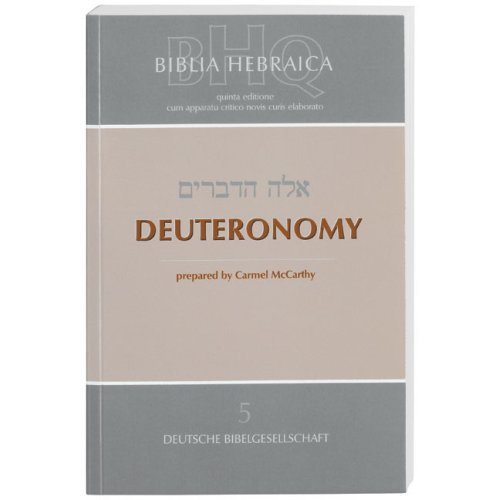
Fascicle 5: Deuteronomy
Fascicle 7: Judges
Fascicle 13: The Twelve Minor Prophets
Fascicle 17: Proverbs
Fascicle 18: General Introduction and Megilloth (i.e., Ruth, Canticles, Qoheleth, Lamentations, Esther)
Fascicle 20: Ezra and Nehemiah
The BHQ module in Accordance has fascicles 5 (Deuteronomy), 18 (General Introduction and Megilloth), and 20 (Ezra and Nehemiah) so far. 13 (The Twelve Minor Prophets) and 17 (Proverbs) will be added free of charge to those who have the BHQ package. They exist in print but have not yet come from the German Bible Society to Accordance for digitization. When Judges comes to Accordance, it and future fascicles will be available as paid upgrades.
Accordance has produced a short video that shows a couple ways to use the BHQ, including a comparison with the print edition. It’s worth watching, since it explores not only the text, apparatus, and commentary that I cite above, but also the Masorah Magna (below the text in the print edition) and the Masorah Parva (at the margins of the print edition). Note especially (early in the video) how Accordance merges the Notes on the Masorah to eliminate the user’s need to go back and forth between references:
The place for the BHQ user to start is probably with the three articles at the beginning of this post. Then, the General Introduction contained in Fascicle 18 should be consulted. As with its other commentaries and books, Accordance has it presented beautifully. The English introduction tells what BHQ is, gives advice on how to use it (including full explanations of sigla and abbreviations), and tells a bit of background on the editorial processes leading to the BHQ as it is now. Click on the below for a larger image of the general introduction:
BHQ in Accordance is not morphologically tagged; Accordance does not currently have plans to tag it. But this is because the text is so similar to that of BHS already. Because I am so used to BHS and BHQ is still so new on the scene, I always have both open anyway, so I can easily get morphological tagging information from BHS. A tagged BHQ would be ideal, but it’s not a huge loss.
BHQ has less conjectural emendation than BHS. Case in point, “prp” (=”propositum”=”it has been proposed”) occurs 2,146 times in the BHS apparatus (a search that is exceedingly easy to do in Accordance). In BHQ what goes into “prp” is teased out a bit more. From the introduction to BHQ:
In cases where the editor proposes that a reading other than that of the base text is to be preferred, this is presented in the concluding portion of the entry following a double vertical stroke and the abbreviation “pref” (for “preferred reading”). The evidence supporting the preferred reading is recapitulated. If the preferred reading is not directly attested by any of the extant witnesses, but is only implied by their evidence, it is marked by the signal “(origin)”, i.e., that it is the indirectly attested origin of the extant readings. If the grammatical form of the preferred reading is not found otherwise in Hebrew of the biblical period, it is marked either as “unattest” (= “unattested”) or as “conjec-phil” (= “philological conjecture”), depending on the kind of external support for the reading. Where the proposed reading is a conjecture, it is not introduced by the abbreviation “pref” (= “preferred reading”), but by the abbreviation “conjec” (= “conjecture”). In line with the focus of the apparatus on the evidence of the text’s transmission, proposals for preferred readings will not seek to reconstruct the literary history of a text. Readings that are judged to derive from another literary tradition for a book will be characterized as “lit” (see the definitions of characterizations below).
Also,
Since the apparatus is devoted to the presentation and evaluation of the concrete evidence for the text’s transmission, a hypothetical reading (i.e., a conjecture) will have place in the apparatus of BHQ only when it is the only explanation of the extant readings in a case.
“Pref” occurs 201 times in the apparatus in the three fascicles so far published in Accordance. A primary difference in BHQ, though, is the level of textual or manuscript-based explanation given for why a certain reading is to be preferred. As someone who tries to be a cautious textual critic, I appreciate this.
Here are some additional resources for using BHQ:
A review of Fascicle 18 in Review of Biblical Literature (PDF)
A sample set of pages (print edition) of BHQ (PDF)… and note here that a .pdf of BHQ is not part of Accordance’s module
At least three things make it worth seriously considering adding BHQ in Accordance to your library. First, BHQ is a significant advance over BHS. Second, Accordance’s presentation of BHQ makes using it easier than it is in print. Third, the print editions would cost you just as much as or more than buying BHQ in Accordance. And, of course, an Accordance module is word-searchable, lighter to carry around, and so on.
All in all, BHQ in Accordance is well-produced, easy to use, and a great aid in textual criticism of the Hebrew Bible.
Thank you to Accordance for providing me with a copy of the BHS and BHQ modules for review. At the time of this writing, the sale price for that package was $149.99, an excellent deal. See all the parts of my Accordance 10 review (including the Beale/Carson commentary module) here. I reviewed BHQ’s predecessor, BHS, here.
You can read more about the book here. I’ve made some progress in reading the book myself this week, and will be offering a review in the near future.
To choose a winner, I assigned a number to every entry (both a comment on this blog and a share of any kind qualified), then used a random number generator to select the winner.
The winner is…William Varner!
Congratulations, William, and enjoy the new book.
Thanks very much to all who entered and spread the word. I write about the Septuagint at Words on the Word at least once a week. You can bookmark this tag for my Septuagint posts; it updates as I add new posts. If you like what you see here, you can subscribe/follow this blog using the button on the right sidebar.
While you’re here, here are some highlights of what I’ve written about the Septuagint:
Great stuff from N.T. Wright on how he starts his days (reading Greek and Hebrew), how he responded when an adviser told him to choose between the Church and the Academy (he chose both), and more:
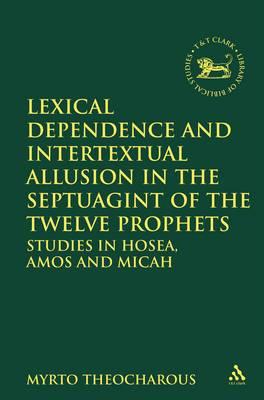
This is a reminder that Sunday night I’ll be announcing the winner of a study by Myrto Theocharous called Lexical Dependence and Intertextual Allusion in the Septuagint of the Twelve Prophets: Studies in Hosea, Amos and Micah.
If you haven’t already entered the giveaway, there’s still time. Go here to read more and enter.
There are over 100 explicit quotations of Scripture in Paul’s letters and at least double that number of allusions. However, what is potentially more useful than just citing Paul’s answers to first-century questions is to study how Paul interpreted Scripture, and that is the theme of this book. (1)
This summer I reviewed the third volume of a de facto trilogy by Steve Moyise. In that same series is Paul and Scripture: Studying the New Testament Use of the Old Testament (click on book cover image to see at Amazon). In 160 packed pages Moyise surveys Paul’s use of the Hebrew Bible/Septuagint.
Moyise’s approach is a thematic one, rather than book-by-book. This helps the reader focus on how Paul treated the same topic across his various letters.
The author begins with an introduction to Paul, his “conversion” experience, his missionary activity, and a wonderful problematizing of the issue: because Paul was familiar with Greek, Hebrew, and Aramaic versions of Scripture, “[W]hen Paul introduces a phrase or sentence with an introductory formula (IF) such as ‘it is written’, we have to ask ourselves which version of the Scriptures he has in mind” (10). For Paul “would not have had our concept of ‘Bible’, a bound volume of 66 books (for Protestants) residing on his bookshelf” (10).
Moyise keeps his and the reader’s eye on this issue throughout Paul and Scripture. He explores how Paul used:
“The figure of Adam” and creation accounts (with Christ as a Second Adam)
The story of Abraham, including a brief but helpful look at “Abraham in Jewish tradition”
Moses–“an ambiguous figure for Paul. He speaks to God face to face, but his use of a veil is interpreted as a lack of openness” (59)
The law. This was perhaps the most interesting section of the book, as Moyise surveyed not only Paul’s use of Scripture, but how modern theologians have tried to make sense of what looks on first glance like conflicting statements about the law. This section is what led me to write:
The prophets–both to develop a theology of Israel and the Gentiles, and to provide instructions for how the Christian community should live
The Psalms, Proverbs, and Job
The final chapter is a more detailed survey dealing with “modern approaches to Paul’s use of Scripture,” which Moyise divides into “an intertextual approach,” “a narrative approach,” and “a rhetorical approach” (111 ff.).
Appendices include a focus on Paul’s quotations from Isaiah, an index of Paul’s quotations of Scripture, and pertinent excerpts from the Dead Sea Scrolls.
As with The Later New Testament Writings and Scripture, the book is accessible to a non-scholar or non-specialist in this field, though it will require some work. Due to the book’s brevity, and what I assume was Moyise’s desire to still cover all the proper territory, the book is dense. This means that even a short volume like this will be a great reference to me for some time, as I seek to better understand the ways in which Paul used the Old Testament, and the ways in which Christians have tried to make sense of that use for some 2,000 years, especially recently.
The gray shaded boxes throughout explain key concepts such as the Septuagint, Origen’s Hexapla, Greek grammar, the Dead Sea Scrolls, and so on. As with Moyise’s other book, one does not need to know Greek or Hebrew to read Paul and Scripture, but he does not hesitate to use transliterated Greek to aid his explanation.
I have begun to appreciate Moyise’s even-handedness in presenting various viewpoints and interpretations. Even when discussing potentially controversial aspects of Paul (which books Paul authored, the “New Perspective,” or the idea of some that Paul actually exhibited “contradictory” and inconsistent views of the law), Moyise is fair and presents the various views in a way that the reader is left to consider them for herself or himself. (And the reader knows where to go to find more.)
One thing that seems rare in a work like this is that Moyise generally writes out a Scripture he is citing, rather than just placing a slew of references in parentheses for the reader to slowly work through. This latter method is not all bad, but Moyise’s quotation or summation of the references he cites makes for a smooth read.
I found helpful Moyise’s employment of “an eclectic view, using whatever methods or approaches were helpful for understanding the particular quotation” (111). Moyise doesn’t conclusively answer all the questions that arise when studying Paul’s use of Scripture, nor does he seek to. He hopes “that this book has both laid a foundation and stimulated an interest to go on and read further” (125), a mission he very much has accomplished (at least in this reader) with Paul and Scripture.
Thank you to Baker Academic for providing me with a review copy of the book. See its product page at Baker here.
I am giving away a book at Words on the Word this week. It’s a study by Myrto Theocharous called Lexical Dependence and Intertextual Allusion in the Septuagint of the Twelve Prophets: Studies in Hosea, Amos and Micah. This author had me at the title. (Seriously.) It’s part of the Library of Hebrew Bible/Old Testament Studies series from Continuum/T&T Clark. (Thanks to the publisher for making the giveaway possible.) It’s got nice library binding, good quality paper, clear and easy-to-read Greek and Hebrew fonts.
I’ve been enjoying working my way through it, and in coming weeks will offer a review of the book. You can browse inside by clicking here (Amazon affiliate link). Here’s an excerpt from the publisher’s description of the book:
This book explores various aspects of intertextuality in the LXX Twelve Prophets, with a special emphasis on Hosea, Amos and Micah.
Divided into five parts, the first introduces the topic of intertextuality, discusses issues relating to the Twelve Prophets and their translator and concludes with various methodological considerations. Chapter two deals initially with the lexical sourcing of the prophets in their Hellenistic milieu and tests proposed theories of influence from the Pentateuch.
The rest of the book examines specific cases from the books of Hosea, Amos and Micah.
Theocharous summarizes her book in this short pdf. From what I’ve read so far, I can already recommend it.
I will choose a winner at random this time next week. To enter the drawing, simply comment on this blog post with your greetings, thoughts about the Septuagint or prophets, World Series predictions, etc.
Then if you link to this post on your Facebook, Twitter, blog, etc., come back here to tell me in the comments section that you did, and you’ll receive a second entry. I will announce the winner on the blog before midnight Sunday, October 21.
And you can now like Words on the Wordon Facebook.
Oddly enough, the biggest challenge for me in my Hebrew exegesis classes was not to do with the Hebrew language itself. Instead, learning how to decipher the abbreviations and sigla in the “critical apparatus” of a scholarly Hebrew Bible stretched me most.
I recently wrote a brief introduction to the available scholarly editions of the Hebrew Jewish Scriptures (“Old Testament”), the Greek Jewish Scriptures (“Septuagint”), and the Greek New Testament, with most of the emphasis on that post falling on the Hebrew Bible:
Most students of the Hebrew Bible who read Hebrew know of the premier scholarly edition, the Biblia Hebraica Stuttgartensia (BHS, here on Amazon). The BHS is now being updated by the BHQ (Q=Quinta), about which you can read more here. Both the BHS and BHQ are “diplomatic” editions of the text, which means that they reproduce a single “best” manuscript, the Leningrad Codex, in their cases. The footer in each page contains a critical apparatus, which lists variant readings from other manuscripts and versions that the editors have deemed to be of importance for getting even closer to the “original” (now often being called the “earliest attainable text”). In some cases, the editors may wish to show where another manuscript or version differs from the Leningrad Codex; the critical apparatus is where they do it.
However, the BHS editors show manuscript and version differences in their critical apparatus through the use of abbreviated Latin. Even those who know Latin will have to learn the abbreviations, and those who don’t know Latin will have an even harder time trying to decipher the apparatus.
Having figured out my way around the print edition of the BHS, and having reviewed Accordance 10, I have been eager to use the BHS module in Accordance. Here I review it.
The Original Languages base package in Accordance comes with HMT-W4, which gives the user access to the Groves-Wheeler Westminster Hebrew Morphology 4.16. This text reflects additional and ongoing corrections to the Leningrad Codex. Accordance says HMT-W4 is “almost identical” to the BHS text.
But for the user who wants not just the text but the apparatus, an add-on module is needed. If you already have HMT-W4 or BHS-W4 for your Hebrew Bible in Accordance, you can save money and buy the apparatus by itself. It’s just $50, which is a good deal. (Note: there are no Masora–Masoretic marginalia–included in the module; it’s just the apparatus at the bottom of the page.) If you have Accordance and don’t already have a Hebrew text, you could buy this package, where BHS-T is the “complete text of the Hebrew Bible, following the Biblia Hebraica Stuttgartensia, with the Groves-Wheeler Westminster Hebrew Morphology 4.14. This module includes vowel pointing, cantillation marks, and lemma and grammatical tagging information for each word in the text.”
In any of these Hebrew texts in Accordance, there is instant parsing easily available as you go through the text.
BHS with apparatus in Accordance significantly streamlines study and use of the critical apparatus. Accordance makes it easy to do textual criticism without carrying the heavy BHS around. I really appreciate being able to access the BHS critical apparatus on my laptop, and in a way that is integrated well into the Accordance program. The layout is good, the feel is intuitive, and the windows are easy to set up. Here’s how I have Accordance set up to use the critical apparatus with the Hebrew text and Old Greek in view (click to enlarge):
There’s the BHS critical apparatus, right under the text. Anything in blue in that window is hyperlinked and will display something in the Instant Details window. If I want to know what “pc Mss” means in the apparatus, I see it unabbreviated in the Instant Details just by mousing over the blue text. (If you don’t need the abbreviations expanded, you can also hover over the superscript letters in the BHS-T text, and the corresponding content from the apparatus pops up.)
Using the layout above you can quickly see what an abbreviation in the apparatus stands for in Latin, but this is not translated into English. In the above example, it’s obvious that “manuscripti” for “Mss” means manuscripts–no Latin knowledge is needed to understand that Latin word. But what is “pauci”? Those with good vocabulary may be able to recall that a paucity of something is a small number, a lack, so “pauci” here means few.
But not all Latin in the apparatus is that easy. I would like to have seen this module provide a translation from Latin into English. This is probably my only complaint about this module. I believe this is not unique to Accordance and has more to do with how the German Bible Society may have offered the licensing for the apparatus. All the same, getting from abbreviated Latin to unabbreviated Latin, while nice, may not be enough for the beginning text critic.
Some good news, though. There are two workarounds to be able to translate the apparatus contents from Latin to English. First, there is Google Translate, which I understand has improved its accuracy over the last few years. Here is the link for Google Translate from Latin to English. Simply copy Latin from Accordance into the query box in Google translate, and you’ll have your English. “prb l c” in the apparatus becomes, “probabiliter lege(ndum) cum” in Instant Details, which Google gives me as, “probably read with.”
A yet easier way to get to English is possible within Accordance itself, and it’s quite smooth, thanks to the good programming and easy layout of the software. Dr. Hans Peter Rüger’s well-known “English Key to the Latin Words, Abbreviations, and the Symbols of BIBLIA HEBRAICA STUTTGARTENSIA” is available in Accordance.
Note that in the bottom right zone, my far right tab (behind the open one) is this “BHS Latin Key.” I can easy look up an abbreviation in that tab’s search bar. It’s also simple to just right click the abbreviated word in the apparatus and “Look up” in “Dictionary” to quickly access the English/Latin key.
As far as the BHS apparatus itself, BHS remains the scholarly standard. BHQ is beginning to update/replace it, and there are other scholarly projects underway. The BHS apparatus is not exhaustive, nor could it be. But it does offer a good representation of variant readings from different versions (e.g., the Latin Vulgate, the Greek LXX, the Syriac Peshitta, Aramaic Targums, etc.) and different manuscripts (whether a specific Old Greek manuscript or just the general “Mss” for “manuscripts”).
There are different editors for different portions of the BHS, and some are less cautious than others in suggesting textual emendations. In the Minor Prophets, for example, editor Karl Elliger seems to have no trouble writing “prp”=”propositum”=”it has been proposed” when he wants to suggest an alternate reading. Sometimes this means that someone elsehas proposed what Elliger is footnoting; other times it’s just his suggestion, and not always with textual/manuscript evidence accompanying the suggestion. So the user of BHS should not use the critical apparatus, well… uncritically.
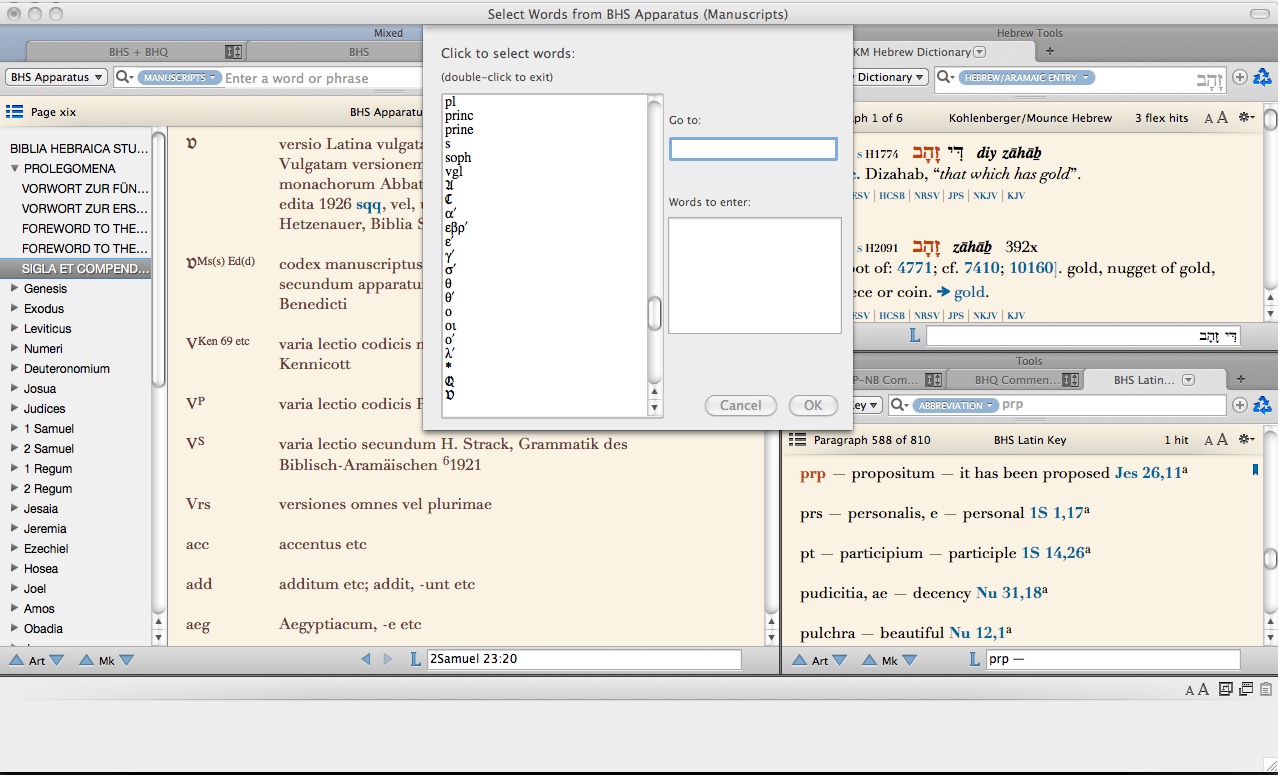
An especially neat feature that wowed me is that I can open up the apparatus and search by content to study all 2,146 times the Latin abbreviation “prp” occurs in the BHS apparatus. You can even search the apparatus for its Hebrew and Greek contents. Curious how often ποῦ finds its way into the apparatus? A simple search shows its four occurrences.
And you can search the apparatus by manuscripts mentioned. Change the search bar to “manuscripts,” then right click in the bar and select “Enter Word…” and you get this:
It’s a great way to be able to interact with the apparatus, much of which simply isn’t possible in print.
Bonus: Accordance offers an excellent, succinct explanation of critical editionshere, with emphasis on the critical editions available in Accordance. If you’re interested in BHS in Accordance, you’ll want to read it.
If you do text criticism in the Hebrew Bible and have the money to spare, Accordance’s BHS apparatus is well worth getting, though most users will want to make sure they also have the “BHS Latin Key,” too. All in all, it’s a well-executed and seamlessly-integrated module.
Thank you to Accordance for providing me with a copy of the BHS and BHQ modules for review. See all the parts of my Accordance 10 review (including the Beale/Carson commentary module) here. I will review the BHQ separately in the future.
I met N.T. Wright briefly in January at a worship symposium and asked him how to improve my Greek. He said, “Read the text, read the text, read the text.”
He told me to really get the feel of the language. Don’t think of Greek just as a code for English; get into the Greek itself. I asked him about reading with a diglot, but he encouraged me to check the English translation only after reading an entire Greek paragraph, and then, only as necessary.
The same holds true with Hebrew. Read the text, read the text, read the text. Reading it out loud is even better, and better still is trying to speak it to others.
Zondervan has published what is to my knowledge the only “reader’s” edition of the Hebrew Bible. It’s a masterpiece. The font is clear, sized perfectly, and easy to read (see at right, and click to enlarge). It uses the Leningrad Codex. It has no textual apparatus (which could be a distraction in a “reader’s edition”), but instead footnotes rarely occurring vocabulary. Not counting proper nouns, editors Philip Brown and Bryan Smith footnote all words that occur less than 100 times in the Hebrew Bible. Here they give “glosses,” which give the reader the basic meaning of the word. Aramaic words that occur less than 25 times are listed in the footnotes in the page on which they occur.
For readers who blank on a word that occurs, say, 150 times in the Hebrew Bible, a glossary at the back will allow them to look up even additional words.
Brown used HALOT and BDB to write the glosses. The bottom of the page looks like this (click for larger):
Note in #s 2, 7, and 8 that there is also listed what the verb stem is for a given use. What makes this feature especially easy to use is the bolding of the words before their glosses.
The only thing to critique in the Hebrew reader’s edition is that proper nouns, which are to appear in grey font since they’re not footnoted, occasionally go missed. Brown has posted an errata list here, many of which have been fixed in recent printings.
For a preview of the Hebrew reader’s edition, see here (PDF) and here (PDF).
Zondervan’s Greek reader’s New Testament has not met with such universal acclaim. It’s a good resource to have on hand, to be sure, but in my view it’s not as well executed as the Hebrew reader’s Bible.
Rather than being based on the scholarly editions of the NA27 or UBS4, the text is “the eclectic text that underpins the Today’s New International Version.” The scholars who produced the TNIV, in other words, made different textual decisions in some instances than did the editors of the “Standard Text” of the NA27/UBS4. Where this is the case, a limited textual apparatus notes it. While this could be problematic for textual criticism, the text is not vastly different from the standard one, and is certainly fine for reading.
As with the Hebrew reader’s edition, the Greek reader’s Bible footnotes and explains words that occur less than 30 times in the Greek New Testament. One unfortunate decision is that, unlike the Hebrew, the Greek footnotes do not have the glossed word in bold. This makes navigating the footnotes more cumbersome:
Font is perhaps a personal preference. While Philip Brown did a magnificent job of typesetting the Hebrew, the Greek font leaves something to be desired. It’s not the easiest Greek font I’ve read. It’s not unreadable as fonts go, but it’s thin. I got used to it after a while, so it’s not unmanageable, but the font in the UBS Greek Reader’s New Testament is easier to read. The latter also puts the footnoted glosses into two columns, which makes referencing them quicker.
Not long ago Zondervan combined the Hebrew and the Greek into one mammoth, leather-bound Reader’s Hebrew and Greek Bible. The volume is large (but how could it not be?) and impressive. It’s constructed well. The binding is sewn (rejoice!), so it will last for a while.
This combination carries with it the great advantage that its user has both the Hebrew and the Greek Bibles under one cover. Now I just have to carry one geeky Bible to church rather than two! Huge benefit.
Another nice thing about this edition is that with Hebrew going from right to left and Greek from left to right, the Greek New Testament starts at the “front” and the Hebrew Bible starts at the “back,” just as both would be in their separate volumes.
The introduction to each half explains well how the text is laid out, the footnoting of the vocabulary, and so on. All the glory of Brown’s Hebrew edition is there, and the less-than-ideal Greek font is there in the Greek portion. One thing to add in appreciation of the Greek part, however, is that Old Testament quotations appear in bold, with their references listed at the bottom of the page. The eight pages of color maps between the two sections are a nice bonus, too.
The construction of the two Bibles combined is executed quite well. I’m happy to only have to take one original language Bible with me to church now.
Thanks to Zondervan for the review copy of A Reader’s Hebrew and Greek Bible. They provided me with one in the hopes of my reviewing it on my blog, but with no expectation as to the content of the review. Find Zondervan’s product page here.














 Words on the Word