In which I finally try out Accordance Bible Software for Mac (new version 10!)

I have been an avid and happy BibleWorks user since version 7 (they are now in version 9). But my first computing love is a Mac. (Too bad for expensive taste in that regard!) I have a cheap PC laptop at home on which I run BibleWorks, but have been interested in exploring Accordance for some time. Now, thanks to the kind folks at Accordance who have given me a copy for review, I can take Accordance for a spin.

I apparently got into Accordance at just the right time. This week they launched an upgrade from Accordance 9 to Accordance 10. And it looks like users are pretty happy with the switch.

In a series of posts, I will offer my review of Accordance 10, Original Languages Collection. In this post I report on my installation process and initial impressions as to the program’s layout and interface.

Download and installation was mercifully fast, even over a wireless Internet connection. In 30 minutes or so I was able to download the Accordance application to my computer and the Original Languages Collection with its various modules.

I appreciated the flexibility offered me even in the initial setup. For example, I could make choices at the following spots:

(Although, I confess, I don’t know what “Helvetica Neue Light” looks like off the top of my head! No matter–this can always be changed later.) This next option for text formatting immediately endeared me to Accordance:

These are perhaps little things, but Accordance’s customizability seems obvious from the beginning.

The only snag I hit in installation was being able to install one of the included modules, even after multiple attempts (the BHS Latin Key). Although, taking a look at the forums, I’m not alone. I expect the Accordance team is mighty busy with the new release. Accordance 10 is already in 10.0.1. I don’t think this is a sign of a buggy version released too soon, but rather an indication that the folks behind the software are quick, responsive, and eager to improve upon the program.

Once finishing installation, I played around a bit with my resources, and within just a few minutes and no prior knowledge of Accordance, was able to set things up this way (click image for larger or open in new tab):

On the left you can see my “library” which in this view shows some of the texts that come with the Original Languages Collection. Thing of beauty: it has the New English Translation of the Septuagint. With how often I am in (and blogging about) the Septuagint, this makes me happy to see. The NETS is far from a perfect translation, but it’s the best English translation on the market right now.

In the middle you can see I have the Greek of Genesis 1 open, with the NETS right next to it and the IVP New Bible Commentary on the right of the middle section.

Then in the top right corner I opened the LEH Greek-English Lexicon of the Septuagint, available in previous Accordance versions only as a paid, add-on module (from what I understand). The bottom right corner shows the Hebrew text of Genesis 1.

Each of these boxes/windows are changeable and rearrangeable. I look forward to spending more time exploring the various configurations available to me through Accordance.

In sum: A quick, easy install with just that one hiccup of a missing module–soon to be resolved with a released fix, I’m sure. (UPDATE 8/23/12: It’s fixed!) And the layout and its flexibility has really impressed me on first use.

And, oh. The interface? Absolutely stellar. I love seeing a high-powered Biblical languages-oriented program native to a Mac. The interface in Accordance is as smooth as any program I’ve ever seen from Apple.

So far, so good.

UPDATE: Parts 2 and 3 of my review are here and here.
UPDATE 2: Here is part 4, a review of the Original Languages Collection.
UPDATE 3: Here is part 5, “Bells and Whistles.” UPDATE 4: part 6, “More Bells and Whistles.”

Review of Malachi (Baylor Handbook on the Hebrew Text), part 2

In this post I both explain the jarring Malachi 2:3-4 as well as offer part 2 of my review of Malachi: A Handbook on the Hebrew Text by Terry W. Eddigner (Baylor University Press, 2012). Part 1 of the review is here.

Eddinger begins each passage with his own English translation, then analyzes the Hebrew text verse by verse. Any reader will appreciate that Eddinger prints the full Hebrew text of a given verse, then reprints the various clauses and words when commenting on them. (This eliminates the need to constantly refer to another book when using Malachi.) The Hebrew font is large, clear, and easy to read. It’s fully pointed and includes the Masoretic markings that one would find in the BHS. Though at first I had wished to see the English translation verse-by-verse alongside the Hebrew, Eddinger’s decision to have English translations primarly at the beginning of a passage does force the reader more into the Hebrew itself. For the intended audience of “a second-year Biblical Hebrew student” whose focus is translation, grammar, and syntax, this is a good thing.

I was pleasantly surprised to see that Eddinger discusses textual variants throughout the handbook. He especially focuses on LXX/Septuagint variants that receive attention from the BHS editors. His conclusions regarding variants often end with something like, “X makes sense in context and so should be retained.” Thoroughgoing text critics may be left wanting more evaluation or interaction with variants than this (as I was at times)–but this is a short handbook. The fact that the author highlighted such variants at all was an added bonus, as far as I’m concerned.

Eddinger gives excellent attention to grammatical and syntactical detail–down to an assimilated dagesh lene (1:13)! He treats clauses as wholes–for example, highlighting word order and fronting for emphasis. And he treats individual words and parts of speech. He never loses the forest for the trees, and he gives the trees their due attention, too. In conjunction with the “key words” chart at the beginning of a section and the appendix of all Hebrew words in Malachi, Eddinger often notes rare Hebrew words as such, giving something of their context in the rest of the Hebrew Bible. He seems to have HALOT, TDOT, BDB, and other technical commentaries readily at hand as he comments on the text. On 1:14 he writes,

נוֹכֵל is a rare word in the Masoretic Text, occurring only four times (only here in Malachi) and means “one who acts cleverly” or “deceitfully” thus, “a cheat.”

That is the sort of insight I could come to expect on a regular basis by the end of the handbook. I loved it for that.

In terms of grammar, his discussion of individual words includes syntax and morphology, with every single word parsed / morphologically analyzed and often more detail than that. Eddinger uses the qatal and yiqtol verb classification system. This may not line up with what every Hebrew student has read regarding tense/aspect in their first-year Hebrew class, but it does (at least according to some) carry significant advantages over “perfect” and “imperfect.” (See a mini-primer on the Hebrew verbal system here.)

Regarding the verses from Malachi with which I led off part 1 of this review, Eddinger explains them well:

פֶרֶשׁ refers to the contents of the bowels of sacrificed animals, which the priests were to burn as refuse at a location away from the altar (Exod 29:14; Lev 4:11; 8:17). The phrase [feces upon your faces] is a double entendre in meaning as the act is an act of humiliation and contact with the ‘unclean’ matter makes the priests ‘unclean’ for their priestly duties.

(I allude more to Malachi 2:3 here.)

I’ve found Malachi to be an indispensable companion for reading through Malachi in Hebrew. I do have one minor critique and one larger one, though.

First, the English Bible versification at the end of Malachi gives the book four chapters; it is just three in the Hebrew text. Malachi nowhere notes this (although it does note regarding the last three verses that “some LXX texts have these verses reordered.” Again, this is a handbook on the Hebrew text, but a simple explanatory note here as to why English Bibles have four chapters in Malachi and Hebrew Bibles three would have been beneficial.

Second, I found myself often distracted (though I didn’t want to be) by the presence of typographical errors or comma splices or run-on sentences. I hope future printings can correct these, since they take away from an otherwise great book. There would be no benefit in listing typos here, but there were some 20 or more spots where either a word was misspelled, there was disagreement of number between verb and subject, punctuation was missing, and so on. Fortunately the vast majority of these are in English and so easy enough to spot. (I.e., the reader can trust the Hebrew here.) But the author’s English translation sections especially seemed to be in want of a closer edit. I do hope future printings or editions can make adjustments here; I imagine students of Malachi will want to make use of this book for years to come.

Eddinger in the end is a worthy guide through the Hebrew of Malachi. The prophets often (suddenly!) shifted pronouns or speakers or subjects in their writing. Who is talking now: God, the prophet, both, or the people? Eddinger coolly walks the reader through such grammatical challenges, and others besides.

While the obvious use of Malachi is as a reference work in which to look up a given passage, it reads well as a whole, too. I eagerly await future books in the Baylor Handbook on the Hebrew Bible series.

Thank you to Baylor University Press for providing me a free copy, in exchange for an unbiased review (which ends up being a two-part review in this case–by my choice). You can find the Baylor product page for Malachi: A Handbook on the Hebrew Text here. It’s on Amazon here.

Review of Malachi (Baylor Handbook on the Hebrew Text), part 1

“Because of you I will rebuke your descendants; I will smear on your faces the dung from your festival sacrifices, and you will be carried off with it. And you will know that I have sent you this warning so that my covenant with Levi may continue,” says the Lord Almighty.

–Malachi 2:3-4 (NIV)

Although Words on the Word has since taken fuller shape, two primary motivations in my beginning this blog were (a) to read and review good books and commentaries and (b) to interact with the original Biblical languages. This post offers a good opportunity to do both. Here I review Malachi: A Handbook on the Hebrew Text by Terry W. Eddigner (Baylor University Press, 2012).

The Hebrew prophet Malachi holds a significant place in the Hebrew Bible. Malachi is the last prophet of the Book of the Twelve (minor prophets) and the last book in the Hebrew Bible/Old Testament. The last two verses of Malachi are Yahweh’s promise to send the prophet Elijah–a promise fulfilled, Christians believe, by John the Baptist. It sets up the beginning of the Gospels well.

The Baylor Handbook on the Hebrew Bible series is a deliberately unique contribution to the field of commentaries on the Hebrew Bible. Okay, I suppose all commentary series intend to make unique contributions, but this one really does. It fills a void. Although the student of the Hebrew of the minor prophets is fortunate to perhaps be able to access Baker’s fine exegetical commentary (Malachi is in this volume), there is still a dearth in general of OT commentaries that comment extensively on the Hebrew text and grammar. In that sense I’ve been happy to see the careful attention this series gives to the Hebrew text. (Bonus: this book and some the others in the series that I’ve briefly glanced through give good treatment of discourse analysis.)

It’s important to note from the outset that Malachi (as a book in this series) is not a “full blown commentary.” It’s a “Handbook on the Hebrew Text,” which does “not attempt to replace the second step of consulting commentaries and secondary literature….” In keeping with this aim, Terry W. Eddinger gives the reader a short (five pages) introduction, yet it is plenty to be able to work well within the Hebrew text of Malachi. (And a bibliography with references throughout points readers in the direction of other Malachi-related literature.) Eddinger especially emphasizes the structure and “literary forms and devices” in Malachi. He views the structure of Malachi as consisting of a superscription, six oracles, and two appendices. Literarily, Eddinger says, Malachi is a prose and poetry hybrid, “perhaps the best example of such in the Hebrew Bible.”

There is a linguistic glossary at the back of the book, so when Eddinger says, “Hortatory style is the predominate literary form and is found in all but two verses,” the uninitiated reader can quickly determine that hortatory means “a word, clause, or sentence of direct dialogue.” This is perhaps an over-general or vague definition (the Jonah book in this series has, “Hortatory discourse is meant to exhort someone to act in a particular manner”), but I found that not to be the norm for the succinct and useful glossary.

One commendable feature is the “key words” chart at the beginning of each oracle. Malachi is the first book in this series to offer such a feature. Eddinger highlights important words that the reader will want to know as he or she makes his or her way through a pericope. Then–in what was my favorite part of this book–Eddinger has a chart at the back of the book that lists every Hebrew word in Malachi and verse references for all its occurrences. (Future printings or editions of this book could soup up this chart even more with English glosses of the Hebrew words, for the purposes of vocabulary acquisition.) Several times in making my way through Malachi and this handbook, I referred to the Hebrew word chart.  A second appendix lists all the times the “divine messenger formula” (e.g., אָמַר יְהוָה צְבָאוֹת) occurs in Malachi.

Eddinger begins each passage with his own English translation, then analyzes the Hebrew text verse by verse. In part 2 of this review (to post Monday), I’ll look at the guts of Eddinger’s handbook, that is, the verse-by-verse exposition, including his explanation of the verses that led off this post.

UPDATE: Part 2 of the review is here.

Thank you to Baylor University Press for providing me a free copy, in exchange for an unbiased review (which ends up being a two-part review in this case–by my choice). You can find the Baylor product page for Malachi: A Handbook on the Hebrew Text here. It’s on Amazon here.

What language did Jesus speak?

In my top 10 reasons why you need the Septuagint I conclude with the #1 reason being that the Gospel writers record Jesus’ words as occasionally matching the Old Greek of the Hebrew Bible against the Hebrew. This has become a new research interest of mine, and there is no lack of scholarly opinion on the issue! It’s hard to tell if there’s scholarly consensus. The conventional wisdom seems to be that Jesus spoke Aramaic and read from and recited Hebrew scrolls, but that’s certainly not a universal view, from what I can tell. For example, Stanley E. Porter suggests:

… Jesus not only had sufficient linguistic competence to converse with others in Greek but also even to teach in Greek during his ministry. 

I believe that, first, it can be firmly established that Jesus did speak Greek and that we do indeed have some of his actual words. 

Porter explores the question “Did Jesus Ever Teach in Greek?” here (pdf). Thanks to the LXX Yahoo! group for the link.

Septuagint Sunday: I Heart Maccabees


I’d give away half a bookshelf worth of books to see Mark Wahlberg or Matt Damon star in a film adaptation of 1 Maccabees. Judas Maccabeus (“Hammer” will be his nom de film) and his Hasmonean family drive out imperial powers and call the Jewish people back to faithful observance of the Torah. They do it with great violence, against all odds. (This would be an action movie, and not for small children.)

Here’s how Jonathan A. Goldstein, in his 1 Maccabees Anchor Bible commentary, begins his introduction. Try to call to mind that deep male voice that does movie trailer voice-overs:

The faithful Israelite living in Judaea under the rule of the Ptolemies and the Seleucids in the third and second centuries B.C.E. learned from childhood that the LORD’s chosen people had nothing to fear if they kept the LORD’s commandments. Subjection to the great empires of Persia and the Hellenistic kings had brought stability and security over long periods, which in part compensated for galling exploitation and servitude and for episodes of devastating warfare. Then, under the Seleucid Antiochus IV from 167 to 164 B.C.E., obedience to the LORD’s commandments became a crime punished with extreme severity. No harsher trial ever tested the monotheistic faith of the Jews.

[Cue music swell.] Goldstein/our movie trailer goes on:

The outcome was entirely unexpected: the desperate resistance of the Jews prevailed, and for a time the “yoke of foreign empires” was lifted from the Jews as they became independent under the Hasmonaean dynasty. After the centuries of heartbreaking delay, were the glorious predictions of the prophets of a mighty restored Israel being fulfilled?

That’s got to be good watching, folks. It’s certainly making for great reading! (I’m focusing on the first four chapters for a directed study for one of my seminary classes.) Here is a “Quick and Dirty Summary” of 1 Maccabees from Gordon College professor Ted Hildebrandt.

As I wrote in an earlier post about the Septuagint:

Books like 1 Maccabees, especially, fill out the intertestamental gap between Malachi and Matthew. I’ve been working my way through 1 Maccabees lately, and it’s really helping me better understand Jewish expectation of a conquering Messiah who would expel oppressive Roman rule.

Good book. Would make an awesome movie. The Maccabean Identity? Or, perhaps, simply: I Heart Maccabees.

BibleWorks out of the box: Review of BibleWorks 9, part 1 (setup and layout)

The perennial question: Should I upgrade my BibleWorks program? I was perfectly happy with BibleWorks 7 until I upgraded to 8. (Then I was really happy with 8.) I thought 8 was such a vast improvement that when 9 came out, I saw no need… at least until I got to know version 9 a little better. Versions 7 or 8 are certainly still powerful in their own right, but my upgrade to 9 has been a great experience so far. In this and future posts, I’ll highlight why. Today: BibleWorks 9, out of the box.

The installation is easy and quick. I consider myself somewhat proficient when it comes to computer know-how, but certainly don’t have programming expertise. No matter. BibleWorks is easy to install and keep updated. And the BibleWorks staff is constant in making updates available if and as they find bugs in the program. Better than any other computer software I’ve used, in this sense.

BibleWorks 9 comes with a “Quick-Start Guide,” which has the Installation Instructions (they are mercifully short–three pages and easy to follow) and a 12-page Orientation to BibleWorks guide. The guide focuses on the Search Window, the Browse Window, and the Analysis Window, and gives instructions and specific examples as to how to best utilize each in studying the Biblical text. My only quibble with the helpful guide is that the images contained therein seem to be from BibleWorks 8, not 9. But that doesn’t really keep it from doing what it needs to, namely, quickly and effectively orienting the new or only somewhat experienced user to using the program well. (The instructions do detail the contents of the new tabs in version 9.)

BibleWorks 9 adds a delicious fourth column (essentially, a second analysis window). It looks like this (click on the png below for a larger view, if you wish):

Already this opens more options. There are also more available tabs in the Analysis Window. For example, the new “Use” tab, in my third column above, instantaneously shows you all the uses of a word with how many occurrences it has in that book and version (here, the WTT=Hebrew Bible). You had to search on a word in previous versions to do this (using the first column above). I find this particularly useful for vocabulary acquisition. As I come across a word I don’t know in the text, I can easily see–does this occur 121 times and I should know it? Or is it just in the text two or three times, so I was okay in not knowing right away what it means?

The “Verse” tab and the “Mss” tabs are new, too–those are worthy of their own post. (Anyone familiar with BibleWorks, whether they have 9 or not, may already know that this new version allows you to look at and work with images of original manuscripts.)

And, what I find best of all, you can drag and drop the tabs between the third and fourth columns so that you can customize your setup. I had already figured out a setup so that I had my own equivalent of a “fourth column” in BibleWorks 8. Now I can do even more! Check this out (from a previous post):

It’s a thing of beauty.

BibleWorks has unbeatable customer service. The user forums are active and always helpful. (Good things to know when you’re considering getting set up with them.) And they’ve provided quite a few videos to show users their way around the program. If you don’t want to wait for the rest of my review, you can see all that’s new in BibleWorks 9 here. You can order the full program here or upgrade here. It’s even on Amazon!

I received a free upgrade to BibleWorks 9 in exchange for an unbiased review. See my prolegomenon to a review here.

July 2012 Biblical Studies Carnival

Head over to Reading Acts for the July “Biblical Studies Carnival.” It’s a compilation of many, many posts on all things Biblical studies on the blogosphere in July. There is some really good stuff there, and Phil has done a great job gathering some informative links. I’m thankful to have received mention in the carnival (of my July posts here, here, and here).

“Septuagint” is the wrong word to use


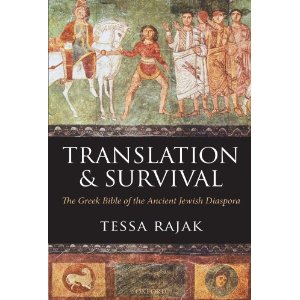
“Septuagint” is perhaps the wrong word to use to describe the Greek translation of the Hebrew Scriptures. Just about every author I’ve read so far on the Septuagint is quick to point this out. In the mail the other day I was happy to receive my review copy of Tessa Rajak’s Translation & Survival: The Greek Bible of the Ancient Jewish Diaspora (Oxford University Press, 2009). She puts it this way:

The term “Septuagint” does not appear in the title of this book, and that is no accident. It is in fact an inappropriate description for the Jewish Bible in Greek. The problem is that “Septuagint” is a term which evolved in the usage of the early Church and refers to the corpus created there as we find it in the great biblical codices of the fourth century CE. It is precisely these layers of reception that we shall need to strip away, at any rate until the last chapter of this book. But even were we to resolve to stick with the name, as one of convenience, we would soon find that the ambiguities and complications of its usage outweighed that convenience. (14-15)

Larry Hurtado recommends the book here. Keep checking back here–I’ll have a full review up some time next month.

Review of The Greek of the Septuagint: Supplemental Lexicon

This, then, is the single dominant characteristic of the LXX vocabulary: it is normal, idiomatic Greek. I base my construal of it on this hypothesis whenever I can.

–Gary Alan Chamberlain in The Greek of the Septuagint: A Supplemental Lexicon

Not long ago I noted that “the challenging nature of Septuagint vocabulary is … one reason why even students of New Testament Greek stay away from the Septuagint. How can one make her or his way through the Septuagint in Greek in a way that is not entirely frustrating?” To begin, you could read about why you need the Septuagint here, and some helpful resources here to get started. Also, I recently reviewed Bernard A. Taylor’s Analytical Lexicon to the Septuagint: Expanded Edition, a one-stop reference work to guide readers through the LXX.

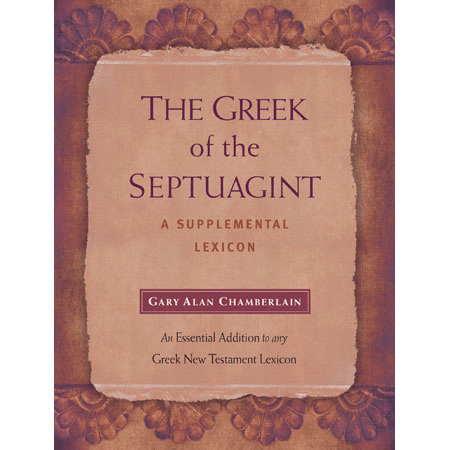
I have now had the occasion (and privilege) to spend some time with The Greek of the Septuagint: A Supplemental Lexicon, by Gary Alan Chamberlain. (Thanks to Hendrickson for the review copy, provided in exchange for an unbiased review.)

Chamberlain intends his lexicon to be a supplemental one, an addition to any Greek New Testament lexicon. (He has BDAG specifically in view.) The vocabulary of the Septuagint is more expansive and potentially different enough from New Testament vocabulary that a lexicon like this is warranted. Many Greek students, especially Biblical studies ones, come to the LXX after first studying the New Testament. So if they already own BDAG or some other New Testament lexicon, the potential need for something like this to “fill in the gaps” could make sense.

The Greek of the Septuagint contains lexicon entries for 5,000 LXX words not in the NT, as well as 1,000 words with LXX-specific uses that a NT lexicon would not carry. For the latter, Chamberlain simply adds to the BDAG numbering system, so that the entry for καθίστημί, for example, begins, “3.b. seek to establish, declare.” Words that the lexicon does fully treat have morphological information (e.g., principal parts for verbs) and citations of word usage in the LXX and beyond.

There is “no treatment of the most common words” in the LXX, so not just a cursory knowledge but a solid grasp of Greek vocabulary would be needed to use this lexicon on its own. I.e., a first- or second-year Greek student really would have to use this as the “supplemental” lexicon it intends to be. “Throughout this work,” Chamberlain notes, “I have assumed that the user has sufficient command of ancient Greek to cope with articular infinitives, genitive absolutes, and the varied means of expressing volition and command. The thousand or so most common LXX words should convey relatively few difficulties.” This work won’t serve the Greek initiate, in other words, but Chamberlain does not intend for his work to be “elementary.”

One might ask, Why not just purchase a full-on Septuagint lexicon? Here is where Chamberlain makes the “distinctive contribution…to LXX studies” that he aims to make.

The dense 19-page introduction explains several classifications of LXX words, and is complemented by an exceedingly useful set of word lists in the appendices. (Hendrickson has the intro in pdf here.) Chamberlain includes word lists and discussion of:

  1. Precise parallels between the LXX and extrabiblical texts. This is where he asserts that LXX vocab is “normal, idiomatic Greek.” He accounts for what others have claimed are examples to the contrary (e.g., “Semitisms”) with the following categories.
  2. Transliterations of the Hebrew into Greek.
  3. Hapax Legomena–Greek words that occur once in the LXX and nowhere else in ancient Greek literature, as well as words that occur multiple times in the LXX but nowhere else (he notes all this and all these categories throughout the lexicon in the appropriate entries, a sample pdf of which is here).
  4. Greek words that occur first in the LXX.
  5. Words with no parallel in other ancient Greek sources.
  6. Stereotypical translations (“calques,” where “translators faced severe challenges in rendering a few common Hebrew terms for which no equivalent was possible within the framework of Greek language”).
  7. Mistranslations (where “LXX translators misconstrued the meaning of their sources’ words, through a confusion of roots or a misunderstanding of meaning of the source”).
  8. Textual variants (more than 200 instances, including his suggested emendations, helpfully organized in canonical order).
  9. More complicated words “involving multiple factors” (“We are simply trying to explain how a Greek word was placed in a context that does not make good sense if we read it as a Greek sentence”).

Having read the descriptions of each of these categories and looked through the corresponding word lists, this reader is convinced that The Greek of the Septuagint offers something that neither BDAG nor any other LXX lexicon on the market (of which I’m aware) currently does. Even without the actual lexicon entries, the word lists and explanations are an invaluable contribution to LXX studies. (The lexical entries themselves are appropriately concise yet substantive.)

His Appendix II is the place to start when looking up a word. It shows (through the use of bold, italics, and regular font) if a word is in this lexicon but not BDAG; if it is in BDAG and supplemented here; or if the word is sufficiently covered in BDAG and therefore not in Chamberlain’s lexicon. Appendix III has a neat listing of LXX book titles in English and Greek, as well as a table that shows the differing versification between the two.

The Greek and English fonts are clear and easy to read (the Hebrew font is a bit small).

I found The Greek of the Septuagint to be a lexicon one has to work at. In other words, it’s not like Taylor’s lexicon, which one could easily pick up and use right away off the shelf. Carefully reading the 4-page preface and 19-page introduction is pretty much required to be able to make use of Chamberlain’s work. But that’s true of BDAG, too, and sort of the point of a preface and introduction in the first place. So that’s not at all a strike against this lexicon. In fact, the user who is willing to put in the work will find great reward in a deepened understanding of the LXX and its vocabulary.

Chamberlain concludes his introduction in this inspiring way:

For many years I have been reflecting upon and experimenting with the question of what the faithful reading of Scripture is in relation to life lived very much “in the world.” Both the method and the goal of preparing this lexicon have been the reading of the LXX text itself (alongside the Hebrew Bible, the Greek NT, and not infrequently the Vulgate) with the prayerful attention the Benedictines call lectio divina. I have made constant and grateful use of the astonishing resources of biblical and classical scholarship, with an embarrassed and hopeless inability to be in any sense in command of those resources. I want simply to apprehend the text, and beyond that to engage the living reality of which the text intends to speak.

Chamberlain’s lexicon is available here.