Review of Sony SRS-BTS50 Bluetooth Wireless Speaker

Sony has just released its SRS-BTS50 bluetooth wireless speaker. Here’s what it looks like in the box (with other colors available):

in the box

Here’s what’s in the box:

box components

Setup, Appearance, and Portability (Two Thumbs Up)

Setup was easy, both with my iPad mini and a Mac laptop. Once you link a bluetooth-enabled device to the speaker, the speaker remembers it. You can link multiple devices to it without Continue reading “Review of Sony SRS-BTS50 Bluetooth Wireless Speaker”

Video Review of Flash Greek iOS App

And now a video review of a solid and versatile iOS app for learning Greek vocabulary. You can adjust the video setting in the bottom right part of the video below to watch in HD and full screen, if you like.


Thanks to Danny Zacharias for the app, given to me for the purposes of a review. Find out more about FlαshGrεεk here.

UPDATE: I made the video above using the handy Reflector app. Reflector mirrors your iOS device to a computer, from which you can record. (I added the audio later.)

Review of Bear Motion iPad Mini Case

Product image via Bear Motion

“Bites on Bytes” is too trite, but Words on the Word does have a growing tech focus. I’ve reviewed software before, and have moved into iOS and its apps, and now gear. Here I’ll review a classy case for the iPad mini, with another case review to follow, some iOS app reviews on the way, and a forthcoming review of a Sony bluetooth wireless speaker. Stay tuned.

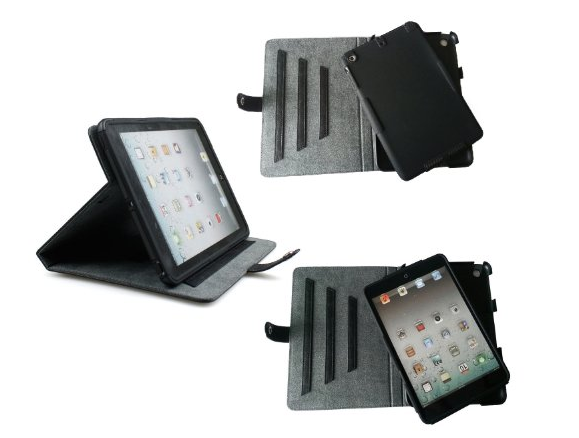
Here is the lengthily-titled 100% Genuine Brazilian Buffalo Hide Leather Dual Protection Folio Stand/Cover/Case for iPad Mini with Built-in Stand and Detachable Inner Silicon Cover (Black), by Bear Motion:

iPad mini in case, the full setup

This is really two cases in one. On the right in the photo below there is the silicon stand-alone backing, which I’d recommend just for home (but not travel) use. On the left is the folio with a hard back plastic shell that is attached to the leather case that wraps around and closes over the iPad mini. It’s got a sleep/wake feature that functions perfectly.

Case both parts

There is actually a third casing option, since the Bear Motion Dual Protection case comes also with a protective velvet sleeve. So your iPad would be well-protected here.

Let me break it down into pros and cons:

Pros

  • The construction quality is high
    • The stitching is careful and tight
    • The holes (to access camera, earbuds, etc.) are cut out just right; you can still access everything
    • The leather smells amazing (I am a notorious smeller of books… and of this case)
  • I can hold the iPad, while in this case, in one hand (results may vary according to hand size)
  • The price is currently $19.99, which is a good deal
  • I haven’t test-dropped the iPad while in this case, but my money is on a safe landing, were some sort of accident to happen
  • There are three notches for standing it up (in landscape mode only) for viewing; these are sturdier than the typical origami-style construction in other cases… as here:
One of three settings

Cons

  • It’s not the slimmest option
    • It is heavier than some mini cases
    • It is bulkier than some
    • This cuts two ways:
      • On the one hand, it is sturdy and classy, a case you’d definitely take to your business meeting
      • On the other hand, the “package weight” Bear Motion lists is 0.7 pounds, which is just a touch more than the iPad mini itself. So you double your weight if you use this case
  • It is difficult to maneuver the case in order to take photo or video (it doesn’t just fold back)
  • There is no place to hold a stylus, which would be a nice feature in a case like this

All told, the pros significantly outweigh the cons. I’ve looked at a number of cases for the iPad mini (and have used four now, with another review to follow), and this is among the best you can get–if the weight is not a problem for you.

Thanks to Bear Motion for the review sample. They make plenty of other cases for various devices, too. The case reviewed above can be found at Amazon here.

BHS module in Accordance 10, reviewed

Oddly enough, the biggest challenge for me in my Hebrew exegesis classes was not to do with the Hebrew language itself. Instead, learning how to decipher the abbreviations and sigla in the “critical apparatus” of a scholarly Hebrew Bible stretched me most.

I recently wrote a brief introduction to the available scholarly editions of the Hebrew Jewish Scriptures (“Old Testament”), the Greek Jewish Scriptures (“Septuagint”), and the Greek New Testament, with most of the emphasis on that post falling on the Hebrew Bible:

Most students of the Hebrew Bible who read Hebrew know of the premier scholarly edition, the Biblia Hebraica Stuttgartensia (BHS, here on Amazon).  The BHS is now being updated by the BHQ (Q=Quinta), about which you can read more here. Both the BHS and BHQ are “diplomatic” editions of the text, which means that they reproduce a single “best” manuscript, the Leningrad Codex, in their cases. The footer in each page contains a critical apparatus, which lists variant readings from other manuscripts and versions that the editors have deemed to be of importance for getting even closer to the “original” (now often being called the “earliest attainable text”). In some cases, the editors may wish to show where another manuscript or version differs from the Leningrad Codex; the critical apparatus is where they do it.

However, the BHS editors show manuscript and version differences in their critical apparatus through the use of abbreviated Latin. Even those who know Latin will have to learn the abbreviations, and those who don’t know Latin will have an even harder time trying to decipher the apparatus.

Having figured out my way around the print edition of the BHS, and having reviewed Accordance 10, I have been eager to use the BHS module in Accordance. Here I review it.

The Original Languages base package in Accordance comes with HMT-W4, which gives the user access to the Groves-Wheeler Westminster Hebrew Morphology 4.16. This text reflects additional and ongoing corrections to the Leningrad Codex. Accordance says HMT-W4 is “almost identical” to the BHS text.

But for the user who wants not just the text but the apparatus, an add-on module is needed. If you already have HMT-W4 or BHS-W4 for your Hebrew Bible in Accordance, you can save money and buy the apparatus by itself. It’s just $50, which is a good deal. (Note: there are no Masora–Masoretic marginalia–included in the module; it’s just the apparatus at the bottom of the page.)  If you have Accordance and don’t already have a Hebrew text, you could buy this package, where BHS-T is the “complete text of the Hebrew Bible, following the Biblia Hebraica Stuttgartensia, with the Groves-Wheeler Westminster Hebrew Morphology 4.14. This module includes vowel pointing, cantillation marks, and lemma and grammatical tagging information for each word in the text.”

In any of these Hebrew texts in Accordance, there is instant parsing easily available as you go through the text.

BHS with apparatus in Accordance significantly streamlines study and use of the critical apparatus. Accordance makes it easy to do textual criticism without carrying the heavy BHS around. I really appreciate being able to access the BHS critical apparatus on my laptop, and in a way that is integrated well into the Accordance program. The layout is good, the feel is intuitive, and the windows are easy to set up. Here’s how I have Accordance set up to use the critical apparatus with the Hebrew text and Old Greek in view (click to enlarge):

There’s the BHS critical apparatus, right under the text. Anything in blue in that window is hyperlinked and will display something in the Instant Details window. If I want to know what “pc Mss” means in the apparatus, I see it unabbreviated in the Instant Details just by mousing over the blue text. (If you don’t need the abbreviations expanded, you can also hover over the superscript letters in the BHS-T text, and the corresponding content from the apparatus pops up.)

Using the layout above you can quickly see what an abbreviation in the apparatus stands for in Latin, but this is not translated into English. In the above example, it’s obvious that “manuscripti” for “Mss” means manuscripts–no Latin knowledge is needed to understand that Latin word. But what is “pauci”? Those with good vocabulary may be able to recall that a paucity of something is a small number, a lack, so “pauci” here means few.

But not all Latin in the apparatus is that easy. I would like to have seen this module provide a translation from Latin into English.  This is probably my only complaint about this module. I believe this is not unique to Accordance and has more to do with how the German Bible Society may have offered the licensing for the apparatus. All the same, getting from abbreviated Latin to unabbreviated Latin, while nice, may not be enough for the beginning text critic.

Some good news, though. There are two workarounds to be able to translate the apparatus contents from Latin to English. First, there is Google Translate, which I understand has improved its accuracy over the last few years. Here is the link for Google Translate from Latin to English. Simply copy Latin from Accordance into the query box in Google translate, and you’ll have your English. “prb l c” in the apparatus becomes, “probabiliter lege(ndum) cum” in Instant Details, which Google gives me as, “probably read with.”

A yet easier way to get to English is possible within Accordance itself, and it’s quite smooth, thanks to the good programming and easy layout of the software. Dr. Hans Peter Rüger’s well-known “English Key to the Latin Words, Abbreviations, and the Symbols of BIBLIA HEBRAICA STUTTGARTENSIA” is available in Accordance.

Note that in the bottom right zone, my far right tab (behind the open one) is this “BHS Latin Key.” I can easy look up an abbreviation in that tab’s search bar. It’s also simple to just right click the abbreviated word in the apparatus and “Look up” in “Dictionary” to quickly access the English/Latin key.

As far as the BHS apparatus itself, BHS remains the scholarly standard. BHQ is beginning to update/replace it, and there are other scholarly projects underway. The BHS apparatus is not exhaustive, nor could it be. But it does offer a good representation of variant readings from different versions (e.g., the Latin Vulgate, the Greek LXX, the Syriac Peshitta, Aramaic Targums, etc.) and different manuscripts (whether a specific Old Greek manuscript or just the general “Mss” for “manuscripts”).

There are different editors for different portions of the BHS, and some are less cautious than others in suggesting textual emendations. In the Minor Prophets, for example, editor Karl Elliger seems to have no trouble writing “prp”=”propositum”=”it has been proposed” when he wants to suggest an alternate reading. Sometimes this means that someone else has proposed what Elliger is footnoting; other times it’s just his suggestion, and not always with textual/manuscript evidence accompanying the suggestion. So the user of BHS should not use the critical apparatus, well… uncritically.

An especially neat feature that wowed me is that I can open up the apparatus and search by content to study all 2,146 times the Latin abbreviation “prp” occurs in the BHS apparatus. You can even search the apparatus for its Hebrew and Greek contents. Curious how often ποῦ finds its way into the apparatus? A simple search shows its four occurrences.

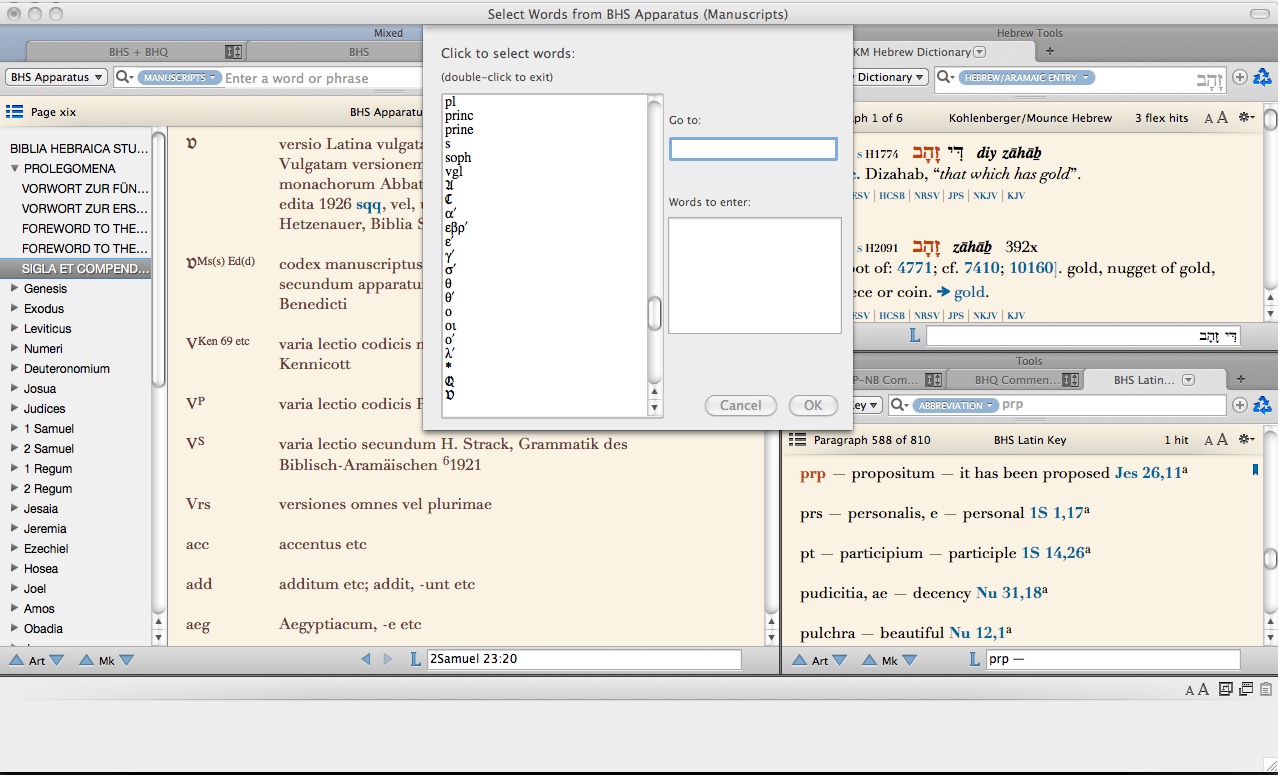
And you can search the apparatus by manuscripts mentioned. Change the search bar to “manuscripts,” then right click in the bar and select “Enter Word…” and you get this:

It’s a great way to be able to interact with the apparatus, much of which simply isn’t possible in print.

Bonus: Accordance offers an excellent, succinct explanation of critical editions here, with emphasis on the critical editions available in Accordance. If you’re interested in BHS in Accordance, you’ll want to read it.

If you do text criticism in the Hebrew Bible and have the money to spare, Accordance’s BHS apparatus is well worth getting, though most users will want to make sure they also have the “BHS Latin Key,” too. All in all, it’s a well-executed and seamlessly-integrated module.

Thank you to Accordance for providing me with a copy of the BHS and BHQ modules for review. See all the parts of my Accordance 10 review (including the Beale/Carson commentary module) here. I will review the BHQ separately in the future.

My Accordance 10 review: all six parts (plus Beale/Carson module review)

Here, collected in one place, are all six parts of my review of the Bible software program Accordance 10, as well as my two-part review of the Accordance module for Commentary on the New Testament Use of the Old Testament, edited by G.K. Beale and D.A. Carson.

Part 1In which I finally try out Accordance Bible Software for Mac (new version 10!)

Part 24 Cool Features in Accordance 10

Part 33 Powerful Ways to Search in Accordance 10

Part 4The Original Languages Collection in Accordance 10 meets Septuagint Sunday

Part 5Accordance 10: Bells and Whistles

Part 6: More Bells and Whistles in Accordance 10

Review of Commentary on the New Testament Use of the Old Testament, edited by G.K. Beale and D.A. Carson:
part 1 / part 2.

UPDATE: Go here to see my comparative review of BibleWorks, Accordance, and Logos.

UPDATE 12/29/12: Here I review the User Notes feature.

Thanks again to Accordance for the review copies of the Original Languages Collection and the Beale/Carson module. Five stars for all of the above.

Review: Accordance 10’s Commentary on the New Testament Use of the Old Testament, by Beale and Carson (part 2 of 2: the content)

Commentary on the New Testament Use of the Old Testament, edited by G.K. Beale and D.A. Carson, is available as an add-on module in Accordance 10. In the first part of my review of the module, I focused on Accordance’s presentation of the commentary. Here I review the content of the commentary itself, but still with a close eye on how I’ve experienced it in Accordance.

I mentioned in my last post that for reading this commentary straight through (e.g., if I want to spend some time absorbing the introduction to any given book), I can easily detach it from a given workspace where it has shown up as a “Reference Tool.” I also noted that navigating through the various headings and sub-headings of the commentary is very easy, as Accordance lays it out.

To quickly view hyperlinks you can do a “Popover” for Instant Details by holding a click on a hyperlink or by pressing option-click. Or, as I’ve begun doing since my last post, you can just have the Instant Details always open. This way I can quickly read the text of a verse that is merely referenced in the commentary, and not lose my place in the body of the commentary.

Highlighting is also mercifully easy, so that my commentary currently looks like this:

One thing to appreciate about the content of the commentary right off the bat is that it succeeds in its hope that

Readers will be helped to think through how a particular NT book or writer habitually uses the OT; they will be stimulated to see how certain OT passages and themes keep recurring in the various NT corpora.

Take D.A. Carson’s introduction to 1 Peter, for example:

The OT is cited or alluded to in 1 Peter in rich profusion. In a handful of instances quotations are introduced by formulae: dioti gegraptai, “wherefore it is written” (1:16, citing Lev. 19:2), dioti periechei en graphē, “wherefore it stands in Scripture” (2:6–8, citing Isa. 28:16; Ps. 118:22; Isa. 8:14), or, more simply, by dioti, “wherefore” (1:24–25a, citing Isa. 40:6–8) or by gar, “for” (3:10–12, citing Ps. 34:13–17). About twenty quotations are sufficiently lengthy and specific that there is little doubt regarding their specific OT provenance. For a book of only five short chapters, there is a remarkable record of quotation. Yet the quotations tell only a small part of the story, for 1 Peter is also laced with allusions to the OT.

Andreas J. Köstenberger’s introduction to John is remarkably thorough in this regard, containing (among other things!) a table of introductory formulas John used for OT quotations, a comparison between how John uses a given OT text and how other NT writers use it, how John’s quotations relate to potentially underlying Hebrew and Greek texts, and so on.

As noted above, there are several ways I can easily use Instant Details to look up each of the verses mentioned in the commentary, without losing my place in the main body. Note that the commentary uses transliteration for Greek and Hebrew throughout. For those who are not huge fans of transliteration (myself included), this is offset by the ease with which I can look up any of those verses in Accordance in the original texts, right alongside the commentary.

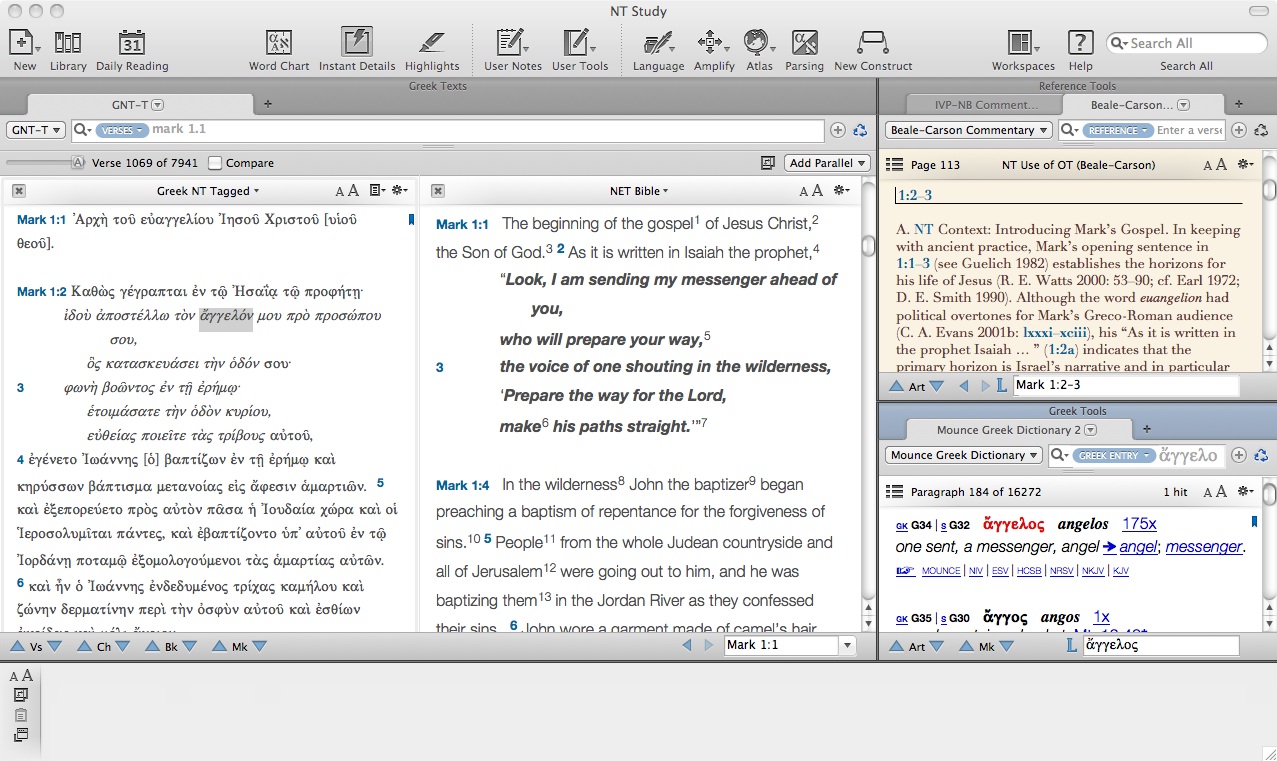
In the below screen shot I have the GNT-T text at bottom left tied to the Beale-Carson Commentary. This is simple to set up with a right click on the tab, then going to “Tab Ties.” This means that as I advance through 1 Peter, for example, the GNT-T text follows me. In the instance below, I have the parallel NET open, so that a Greek-English diglot follows me through the commentary. In the “Context” zone at the right I have the Hebrew Masoretic Text and the Old Greek (LXX) open with my favorite corresponding English translations (NET and NETS) below.

One thing I sort of stumbled on that is really neat. Besides clicking on a hyperlinked verse in the text (to show me that single verse in the Context zone), command-clikcing on a hyperlinked verse gives me all the verses in my commentary’s paragraph that are hyperlinked. Note the “Verse 1 of 12” below, and how Isaiah 8:14 is right below Leviticus 19:2 in my LXX. What a nice feature!

Okay. Back to the content of the commentary itself. The introductions to each NT book, then, do well to orient the reader to trends in how that particular writer interacts with the OT text. The list of contributors is impressive–see it here. The commentary seeks to analyze not only instances where the NT quotes the OT, but also “all probable allusions” as well.

Generally speaking, each citation or allusion in question is organized around these facets:

  • The New Testament context: “the topic of discussion, the flow of thought, and, where relevant, the literary structure, genre, and rhetoric of the passage”
  • The Old Testament context of the source of the quotation or allusion–already things get interesting here, because NT writers do seem to feel free to recontextualize or resituate OT passages…
  • How early Judaism literature understood the given OT text. Even when there is little evidence of citation in early Judaism, there is still explanation. Köstenberger, for example, on John 2:17 briefly discusses the Jewish valuing of zeal, drawing on Phinehas, the Maccabees, and the Qumran community.
  • Textual issues, e.g., changes in verb tense from the LXX to the NT, and explorations of what text (proto-MT, LXX, etc.) or texts might inform the NT author’s quotation, including good discussion of textual variants (in the MT, LXX, and GNT!)
  • “How the NT is using or appealing to the OT,” i.e., are they so steeped in the OT that its language comes out naturally and not as a deliberate quotation? Does the NT writer have fulfilled prophecy in view? Etc.
  • The “theological use” of the OT by the NT writer

This last category ties much of the other content together. For example, on the theological use of Mark 1:2-3, Rick E. Watts says, “As such, eschatologically, in Jesus Isaiah’s long-delayed new-exodus deliverance of Israel has begun in Malachi’s great and terrible day of the Lord (Mal. 4:5).” Watts is dense here, but delightfully so, in my opinion. He develops these themes further–especially that of the new exodus–throughout his analysis on Mark.

I mentioned in my last post that you can search this module in a dozen different ways. The search bar is similar to Google, in that you can search English content by a single word, but also by a phrase in quotation marks, so that that exact phrase comes up in your search. Unfortunately the “Greek Content” and “Hebrew Content” searches (which search using Greek and Hebrew letters) are not available in this module, but that’s no fault of Accordance’s, since the commentary uses transliteration.

Fortunately, “Transliteration” is a search option, so you can easily look up how the commentary treats a given Greek or Hebrew word. Searching hilastērion, I see that all seven of its uses in the commentary are at Romans 3:25.

There were a few times when I wanted to go deeper into a passage than the commentary allowed. For example, Paul’s citation of Malachi in Romans 9:13 has, “Jacob I loved, but Esau I hated.” It’s hard to imagine anyone using a commentary who doesn’t want at least a little explanation of “hated” here. The commentary, to be fair, does have, “This choice of Jacob meant the rejection of Esau,” but doesn’t connect this rejection with the verb “hate.”

This just means that Beale and Carson’s commentary won’t be the only place I turn for in-depth study of a passage, but all my seminary professors say don’t use just one commentary anyway! Not a major loss here. The book is already huge (though not on a computer, thankfully), and attempts to be only “reasonably comprehensive” (which it very much is), not exhaustively so.

Besides that, it took me about three seconds to find in Accordance the NET Bible note on Malachi 1:3:

The context indicates this is technical covenant vocabulary in which “love” and “hate” are synonymous with “choose” and “reject” respectively (see Deut 7:8; Jer 31:3; Hos 3:1; 9:15; 11:1).

This commentary is what we book reviewers like to call a monumental achievement. It sits in the carrel of many a student in my seminary’s library. For good reason. And Accordance has done a magnificent job if seamlessly integrating a rich and multi-facted commentary into its software. This is a five star commentary with five star integration into Accordance 10.

Beale and Carson say in their introduction:

If this volume helps some scholars and preachers to think more coherently about the Bible and teach “the whole counsel of God” with greater understanding, depth, reverence, and edification for fellow believers, contributors and editors alike will happily conclude that the thousands of hours invested in this book were a very small price to pay.

After consulting the original biblical texts, this commentary will always be the first place I turn when I am looking to better understand (and share with others) how the New Testament uses the Old. I am grateful for those “thousands of hours invested in this book.”

Thank you to Accordance for providing me with a copy of the Beale/Carson commentary module for review. Scroll through for all six parts of my Accordance 10 review here.

Review: Accordance 10’s Commentary on the New Testament Use of the Old Testament, by Beale and Carson (part 1 of 2: the module)

Baker Academic has made its way to Accordance 10 Bible Software. The first offering is Commentary on the New Testament Use of the Old Testament, edited by G.K. Beale and D.A. Carson. Here I review it, with this first part of the review covering Accordance’s version of it.

One nice thing about Accordance’s setup is that I can use Commentary on the NT Use of the OT just as any other Accordance tool (for the below and all images in this post, click or open in new tab for larger):

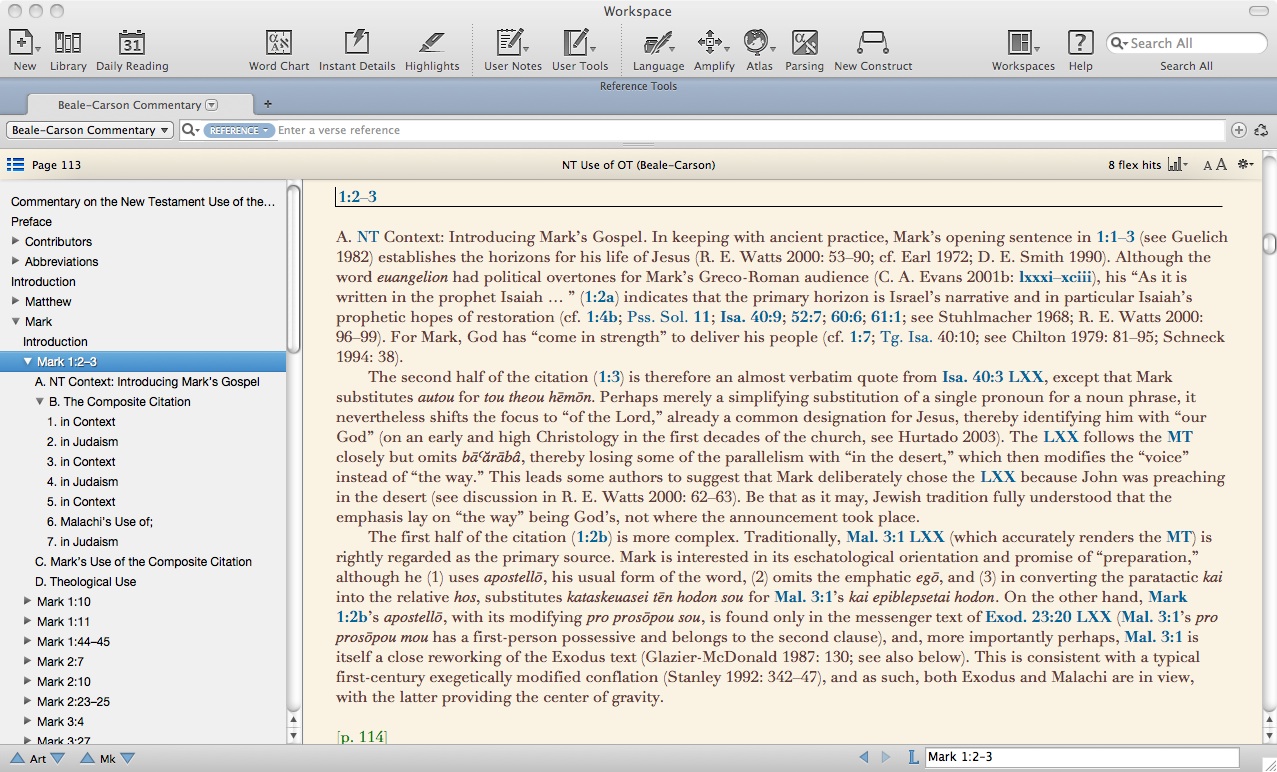
Or I can right-click on the tab to “detach it,” so that it’s its own workspace. For reading through a good deal of text at once, this is ideal. One other great feature, as you’ll see in the left sidebar below, is how easy it is to navigate through all the sections and sub-sections of the book:

But what about how I’d actually need to use this resource? To really make sense of it, I’d need the Hebrew MT, Greek LXX, possibly English translations of each, and the Greek NT all open and easy to view. Combining that kind of layout with the hyperlinking in Accordance’s version of this commentary would be sweet. Wonderfully… it’s possible. Check this out:

For a resource that can be had in print for under $40, it seems like paying nearly $60 for the Accordance module could only be justified if the electronic version could do things the print version can’t. The electronic version can, indeed, do some unique things. (See the image above.) Especially for a commentary like this with lots of cross-references and constant movement between Greek, Hebrew, and other versions, being able to see multiple versions at once–together with the commentary–is a huge benefit. It saves time and allows me to better grasp how NT writers used OT texts by seeing a quotation alongside its original context.

The Instant Details (which I happen to have closed above to maximize screen space for different versions) show whatever hyperlink you hover over–this gives you yet another window for text display, and is particularly useful for, say, quickly seeing a longer passage in English. Things did get a little buggy when I opened the Instant Details the first time, but I assume that was because of how many windows I had open (not the module itself, necessarily):

I was able to get rid of the jumbling on the top right by closing and re-opening the Instant Details. See now below:

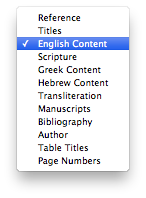
One really nice feature about Accordance’s Beale and Carson commentary module is how many ways you can search it. Accordance then tells you how many hits come up for your search, and using the “move down one mark” arrow keys, you can easily move through the results. You can even see the “real” (i.e., print) page numbers! Look again at that image at right–that’s 12 different ways you can search Beale/Carson. Pretty handy.

Most folks interested in Commentary on the New Testament Use of the Old Testament likely know of its solid reputation and are perhaps now merely trying to decide between a print and electronic version. (In a second post I’ll review the content of the commentary.) If you use Bible software regularly already, I think it is well worth the extra cost to own Accordance’s module. It’s facile to get around, hyperlinked nicely, easy to line up with original language texts, highly searchable, and quite readable as a detachable resource. I, for one, am really glad to have this module on my computer.

Thank you to Accordance for providing me with a copy of the Beale/Carson commentary module for review. Scroll through for all six parts of my Accordance 10 review here.

UPDATE: Read the rest of my review of Beale/Carson here.