And Now… Bonhoeffer *Reader’s Editions*

Bonhoeffer Reader's Editions
Super-sweet image via Fortress Press (click to enlarge)


Big news for Bonhoeffer aficionados/as: Fortress Press, publishers of the 17-volume Dietrich Bonhoeffer Works (English edition), has just announced the Fall 2015 publication of Reader’s Edition volumes of DiscipleshipLife TogetherEthics, and Letters and Papers from Prison.

I haven’t seen a ton of information yet, but here’s the publisher’s description:

Featuring the acclaimed DBWE translation and adapted for a more accessible format, the new Reader’s Edition volumes include supplemental material from DBWE general editor, Victoria J. Barnett, as well as insightful introductions by Bonhoeffer scholars which clarify the theological meaning and importance of his work.

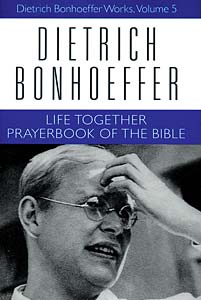
New to Bonhoeffer? I collected some reflections on his writings after spending much of one Lent reading him. All my Bonhoeffer posts are gathered here. I reviewed the amazing Life Together and Prayerbook of the Bible (DBWE 5) here.

It’s hard to imagine how the editors of the DBWE set could offer anything to improve upon those exceptional volumes, but I do like the idea of a more accessible, annotated Bonhoeffer. Check it all out here.

My Encounter with the Ethiopian Eunuch

Preaching so specifically about the Ethiopian eunuch the other week felt risky for at least two reasons:

  1. The eunuch in Acts 8:26-40 reads as a category-defying character, with a sort of in-between sex/gender identity and a home that was the unknown “ends of the earth” described in Acts 1:8.
  2. What even was a eunuch?

DeFranza EerdmansI found a great deal of help in understanding the eunuch and his identity from a just-published book from Eerdmans: Megan DeFranza’s Sex Difference in Christian Theology: Male, Female, and Intersex in the Image of God.

As the book treats sex difference widely, it examines the oft-misunderstood (or unknown!) category of intersex, with eunuchs providing a sort of historical case study in chapter 2. Did you know that Jesus spoke approvingly of eunuchs, and described three kinds?

The chapter was an immense boost to my appreciation of all the uncertainties that could have been at play as Philip encountered the eunuch, part of a group of people that DeFranza cites a 4th century poet as calling “exiles from the society of the human race, belonging to neither one sex nor the other.” They’re male, but not fully, at least not in the expected sense. And there were prohibitions in the Torah like this one in Deuteronomy 23:

 No one who has been emasculated by crushing or cutting may enter the assembly of the LORD.

Yet, as DeFranza and others have suggested, already in the broad sweep of Scripture, there seemed to be hope for eunuchs. Moving from the books of the Law to the prophets, Isaiah, just a few chapters after what the eunuch was reading in his chariot, there is:

To the eunuchs who keep my Sabbaths, who choose what pleases me and hold fast to my covenant—to them I will give within my temple and its walls a memorial and a name better than sons and daughters; I will give them an everlasting name that will not be cut off…. (Isa. 56:3ff)

But if he may not “enter the assembly of the LORD,” maybe he couldn’t be baptized, either?

Josephus, a first century historian, was no exchanger of pleasantries with eunuchs. He wrote:

Let those that have made themselves eunuchs be had in detestation; and do you avoid any conversation with them who have deprived themselves of their manhood, and of that fruit of generation which God has given to men for the increase of their kind….  (Antiquities 4:290)

It seems that the eunuch—a man probably used to giving orders and approval to decisions on the home front—in this poignant moment is asking Philip for his approval. Having heard the good news of Jesus as Philip explains the Scriptures to him, the eunuch wants to know, “Am I allowed in?” Am I excluded or included? Can I be baptized into Jesus?”

Philip had no problem baptizing him into the fellowship of Jesus. Philip surely knew of God’s promise through Isaiah to give the eunuch “a name better than sons and daughters” (which they could not have!). Philip surely had surmised that this man who had traveled from Ethiopia to Jerusalem–a great cost and sacrifice of time… and could he even get in at the temple?–was committed to worshiping God with his whole life. Philip had experienced the Holy Spirit’s presence in Jerusalem and all Judea and (just verses before) in Samaria… and now he must have thought, “Here are the very ends of the earth–the blurring and transcending of many categories–coming right here to this odd deserted road I’ve just been called to!”

Yes, the eunuch had to be baptized.


The chapter on eunuchs is as far as I’ve gotten in Megan’s book. (And if I’ve gone astray anywhere in the above, it’s my doing, not hers.) But I’ve found myself transformed by this vicarious encounter with the Ethiopian eunuch in Acts 8. As I told my congregation, I come back to this passage again, now asking these questions:

Where have I drawn my own borders? How open to re-examination am I in how I think about others and their place in the kingdom of heaven? How can I learn from the eunuch and allow that would-be outcast to change my heart? What do the people Jesus calls brother and sister really look like? Will I allow “the uncategorized” or marginalized or ignored ones to instruct me and lead me into deeper appreciation for the wideness of God’s mercy?

I don’t expect Megan to answer all these questions for me, but hers is a very important book, timed perfectly for this moment in the life of the church and society at large. I’m excited to read the rest of it, as my own encounter with God’s grace shown to the eunuch continues to work on my heart and mind.


Find Dr. DeFranza’s book here at Amazon. The publisher’s book page is here. Megan writes compellingly about the book’s coming into being here.

Book Review: Jesus, the Temple and the Coming Son of Man

Mark 13 is one of the most difficult chapters of the Bible to interpret and understand. From the “abomination of desolation” to the claim of Jesus that “this generation will not pass away until all these things have taken place,” the chapter is full of statements that could refer either to the near (historical) or far (apocalyptic) future.

Robert H. Stein’s goal in writing Jesus, the Temple and the Coming Son of Man: A Commentary on Mark 13 is to finish the sentence, “I, Mark (the author), have written Mark 13:1-37, because…”. Stein, author of the Baker Exegetical Commentary on the New Testament volume on Mark, is one of the best commentators one could hope to read on such a challenging and important chapter.

Here is Stein’s outline of Mark 13, in his words (p. 49):


  • 13:1-4: Jesus’ prediction of the destruction of the temple (and Jerusalem) (chapter 3 of this book)
  • 13:5-23: The coming destruction of the temple (and Jerusalem) and the sign preceding it (ch. 4)
  • 13:24-27: The coming of the Son of Man (ch. 5)
  • 13:28-31: The parable of the fig tree and the coming destruction of the temple (and Jerusalem) (ch. 6)
  • 13:32-37: The parable of the watchman and the exhortation to be alert for the coming of the Son of Man (ch. 7)


The majority of the book (chapters 3-7) is taken up with Stein’s exposition of each verse in Mark 13. Chapter 1 defines the goal of the book: “to understand what the author of the Gospel we call Mark meant and sought to convey by the present text of Mark 13” (39). Stein focuses especially on what Mark meant to “teach his readers by the Jesus traditions that he chose to include in this chapter, his arrangement of these traditions and his editorial work in the recording of this material” (45). Chapter 2 is “Key Issues Involved in Interpreting Mark 13.”

Chapter 8 is a really nice add-on, which consists of Stein’s “interpretive translation” of Mark 13. What a great idea! You can read the chapter in one sitting and see right away how Stein interprets it. This could be a really good starting point for the reader, as could the excellent and detailed “Outline” starting on p. 9 (basically an annotated table of contents).

Stein offers at the outset a nice tour of the so-called quests for the historical Jesus, and how that relates to reading Mark. But Stein doesn’t seem to think the authorship (Mark) or genre (historical narrative) of Mark matters much to the purpose of this short commentary. I find his views here less than compelling, but that didn’t keep me from being convinced by the rest of the book.

Two key points the book makes will give a sense of Stein’s approach:

  1. Stein differentiates between three settings we need to keep in mind: “the first involving the teaching of the historical Jesus to his disciples, the second involving the situation of the early church between the death and resurrection of Jesus and the writing of the Gospels, and the third involving the situation in which and for which the Evangelist Mark wrote his Gospel” (47).
  2. Because of the above point, Stein can tease out different settings and time-frames that different portions of Mark 13 refer to. He says, for example, “Mark does not see the coming of the Son of Man [AKJ: the apocalyptic imagery in 13:24-27] as part of Jesus’ answer (13:5-23) to the disciples’ twofold question (13:4) concerning the destruction of the temple” (72).

Throughout the book Stein keeps in view the distinction between the soon-to-come, 1st century future (destruction of the temple) and the distant, unknown day of the coming of the Son of Man. Stein acknowledges that it is “easy to intermix these two horizons [two settings in time] of the text, and the result is confusion and lack of clarity in understanding either setting in time” (100). Much of the chapter, Stein argues (but not all), anticipates the destruction of the Jerusalem temple in A.D. 70.

You don’t need to know Greek to make good use of this text, but Stein does keep (transliterated) Greek in front of him so he can analyze the text at the word and phrase level. He is really good, too, at using a broader biblical context to help explain specific parts of Mark 13.

I read the book cover-to-cover in a few sittings—it was that intriguing! As detailed and in-depth as Stein’s reasoning is, it reads really nicely: his tone is conversational, which makes it easy to try to sort through some tough hermeneutical issues. Stein’s is certainly not the only possible interpretation of Mark 13, but it’s a persuasive one.


Thanks to the fine folks at IVP Academic for the review copy. Find the book here at IVP’s site, or here on Amazon.

Bonhoeffer’s Last Words, Before He Was Hanged (70 Years Ago Today)

Source: German Federal Archive

Dietrich Bonhoeffer was hanged in the Nazi concentration camp of Flossenbürg on April 9, 1945, just two weeks before the U.S. military came to liberate it.

John W. de Gruchy describes the lead-up to that day in his Editor’s Introduction to Letters and Papers from Prison (Dietrich Bonhoeffer Works, volume 8):

On October 8 [of 1944], Bonhoeffer was taken to the cellar of the Gestapo prison on Prinz-Albrecht-Straße, where he stayed until February 7, 1945. From then on, all correspondence came to an end, and contact between Bonhoeffer and the family and [Eberhard] Bethge was broken. From there Bonhoeffer was taken first to Buchenwald and then, via the village of Schönberg in Bavaria, to the Flossenbürg concentration camp, where he arrived on April 8. That evening he was tried by a hastily rigged court and condemned to death. Early the next morning Bonhoeffer was executed along with several other coconspirators.

He was hanged April 9. His family would not learn about it for several months.

The July before he had written to his trusted friend (and later biographer) Eberhard Bethge, one day after the failed assassination attempt on Hitler’s life. He wrote:

How should one become arrogant over successes or shaken by one’s failures when one shares in God’s suffering in the life of this world? You understand what I mean even when I put it so briefly. I am grateful that I have been allowed this insight, and I know that it is only on the path that I have finally taken that I was able to learn this. So I am thinking gratefully and with peace of mind about past as well as present things. …

May God lead us kindly through these times, but above all, may God lead us to himself.

His final recorded words before his hanging are especially appropriate in these days that follow Easter Sunday:

This is the end–for me the beginning of life.


This post is adapted from a post I wrote around this time last year, as part of the “Tuesdays in Lent with Bonhoeffer” I was doing. See other gathered posts here.

When Bible Software Marketing Crosses a Theological Line

Logos 6 is Here


Logos, I appreciate you. I use your products. I was impressed with Logos 6. I even recently signed on as an affiliate to receive commissions for Logos purchases generated through a unique Words on the Word-based url. You’ve been kind to offer me a lot of great stuff to review.

You invest a lot of time and effort (and, I assume, money) in marketing.

I ignore most of it.

But you recently emailed me a link to an awkwardly titled blog post: 6 Reasons That Shouldn’t Stop You from Getting Logos 6.

This post has gone too far in trying to convince people to override their objections to spend more:

2. I already have enough books.

Even if you think you’ll never read through everything in your library, adding more books will make it more powerful and increase the value of the books you already own.

In other words, “If you buy more books to search, you’ll have more books to search.”

Dear friends at Logos, do we not already succumb enough to an insufficiency mentality in the world? I don’t have enough. I need to have more. My Bible study and teaching prep is good, but if I just had that one more commentary series, life would be awesome!

I’m as guilty of this mentality as anyone (probably more so)–and I want to fight it. Bible software marketing copy that taps into the culturally-rooted materialism that Christians are supposed to stand against? Not okay.

One other “reason” gave me pause:

4. I can’t afford a new base package.

If a base package isn’t in your budget right now, you have a couple of options.

You can take advantage of interest-free payment plans and spread out the cost over up to 24 months. That means you only pay a fraction up front, pay for the rest over time, and start using your new software right away.

Let me help with the rewrite:

If a base package isn’t in your budget right now, you have one option: don’t buy one right now.

“Our mission is to serve the church,” you say. How does enabling and even encouraging churchgoers and pastors to take on new debt serve the church?

I think it’s time for some serious evaluation of the sort of marketing mantras that (however unintentionally) undermine Kingdom values of sufficiency and wise financial stewardship and promote instead the harmful values of incessant accumulation and overspending.

Saying, “What I have is enough,” and curbing credit-card-style overspending are actually two excellent reasons not to upgrade to Logos 6.


UPDATE: The “6 Reasons” email I received from Logos had no author’s name on it. I didn’t see an author’s name on the blog version of the post, either, until just before this post was about to go live. I direct my critique, though, to Logos as a whole, since the individual post is emblematic of Logos’s marketing approach in general.

Bonhoeffer’s Black Jesus

I. Can’t. Wait. To. Read. This. Book.

So I’m simply going to post a picture, leave a few links, publish this post, and close the computer so I can get to reading. Here it is–it just came in the mail today:


Bonhoeffer's Black Jesus


Thank you to Baylor University Press and thank you already to Prof. Reggie L. Williams for writing what looks to be an awesome book. Its full title is–get ready–Bonhoeffer’s Black Jesus: Harlem Renaissance Theology and an Ethic of Resistance.

The first sentence is the best one-sentence summary I’ve read about why people like Bonhoeffer so much:

Dietrich Bonhoeffer championed a radical interpretation of Jesus and ethics that was validated by his resistance to the Nazis and his execution by them.

I’ll post a review of it (and of the also exciting Bonhoeffer as Youth Worker) before Christmas. Find Bonhoeffer’s Black Jesus here (Amazon) or here (Baylor).


You Have 10 Days to Get Yourself a Bonhoeffer Hoodie or T-Shirt

This is easily the most awesome piece of clothing I have ever seen:


Bonhoeffer Hoodie


And the Teespring “campaign” that offers it has enough pre-orders that it will go into production again! So you can order one now before the window closes.

Read details about Teespring and how it works here. You can go get the shirt ($20) or hoodie ($30) here.

A First Look Inside Bonhoeffer Works, Volume 17 (VIDEO)

DBWE17

After nearly 20 years the Dietrich Bonhoeffer Works (English edition) is complete.

Yesterday I received the concluding Volume 17, Index and Supplementary Materials. Take a look inside–this is a fittingly well-done volume to complete the set. (Make sure you click the gear icon to watch in HD.)


I describe the volume more in detail here.

To learn more about Fortress Press’s giveaway of the entire 17-volume Bonhoeffer Works, go here.

This Just Went to the Top of My Reading Stack

Bonhoeffer as Youth Worker


For months I’ve been waiting for this book to come out. Today I received it in the mail. As it weds two of my loves in life–youth ministry and Bonhoeffer–it’s going straight to the top of my reading stack.

About Bonhoeffer as Youth Worker:

The youth ministry focus of Dietrich Bonhoeffer’s life is often forgotten or overlooked, even though he did much work with young people and wrote a number of papers, sermons, and addresses about or for the youth of the church. However, youth ministry expert Andrew Root explains that this focus is central to Bonhoeffer’s story and thought. Root presents Bonhoeffer as the forefather and model of the growing theological turn in youth ministry. By linking contemporary youth workers with this epic theologian, the author shows the depth of youth ministry work and underscores its importance in the church. He also shows how Bonhoeffer’s life and thought impact present-day youth ministry practice.

With appreciation to Baker Academic. I’ll post a review here this fall. Check out the Table of Contents and first chapter here. You can also pre-order the print book on Amazon or the Kindle edition.


Bonhoeffer’s Life Together for $2.99, Chance to Win 17 Bonhoeffer Works

DBWE Life Together


For $2.99, Fortress Press is selling Bonhoeffer’s Life Together, the purchase of which also gives you chance to win all 17 volumes of Dietrich Bonhoeffer Works (English Edition). This includes the new, forthcoming Volume 17: Index and Supplementary Materials.

Life Together is a powerful and heart-transforming book. I just finished reading it at the end of the summer, and reflected:

Bonhoeffer’s Life Together is substantial evidence that this servant of God saw himself as belonging to the church. The short, powerful book is both a gift and a challenge to any Christian who will take the time to study it.

My full review of the book is here.

Go here to check out Life Together for $2.99, as well as to have a chance to win the whole DBWE hardcover set.