Hearing the Message of Scripture: A Fantastic (the Best?) Commentary on Jonah

HMS Jonah


When I preached through Jonah last Advent, I knew the JPS Commentary on Jonah would be helpful. What I wasn’t expecting was how often I would eagerly turn to Kevin J. Youngblood’s new Jonah volume in the recently begun Hearing the Message of Scripture commentary series. It might be the best commentary (in this reviewer’s humble opinion) written on Jonah.


Format of the Commentary


Each passage of Jonah includes the following sections:

  1. Main Idea of the Passage–a short, couple-sentence overview, where Youngblood helps you get oriented to the text.
  2. Literary Context–The author shows how the passage under consideration ties in with the rest of the book.
  3. Translation and Outline–the author’s original translation and visual layout of the biblical text.
  4. Structure and Literary Form–this looks at literary features and the rhetorical aims of Jonah. This section is especially strong.
  5. Explanation of the Text–the primary section of each passage, comprising the verse-by-verse commentary proper.
  6. Canonical and Practical Significance–though Youngblood is plenty practical throughout, this section is especially helpful for preachers, teachers, or any Bible reader wanting to know how to apply the message of the text.

For example, here is Youngblood on the main idea of Jonah 4:1-4:
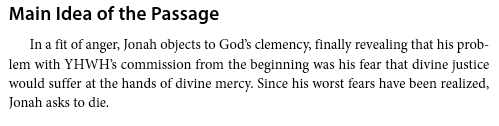
 

HMS Jonah 4 Main Idea


He then situates the passage in its larger context:


HMS Jonah 4


From there he relates Jonah 4:1-4 to the patterns of the rest of the book (“Every encounter with Gentiles brings Jonah to a crisis point”), surmises why Jonah wants to die (“Jonah cannot see how YHWH could simultaneously maintain his covenant faithfulness to Israel and grant clemency to Nineveh”), explains the text in detail, and then relates it to Moses and the other prophets and their interactions with “the nations.”


Youngblood’s Insights Make the Text Come Even More Alive


Youngblood makes the literary features of the text come alive. Regarding Jonah’s short stint in the belly of a fish, Youngblood writes:

The fish, however, functions as a means of deliverance and transportation from the murky depths back to the orderly realm of dry land. In this respect, the fish is the antithesis of the ship, which carried Jonah from the orderly realm of dry land out to the chaotic deadly sea.

Correspondingly, Jonah’s disposition and activity in the fish is the antithesis of his disposition and activity on the ship. Whereas Jonah pays out of his own pocket for passage on the ship, the journey in the fish back to land and life is free, courtesy of YHWH.

He continues to unpack the “important contrast” between ship and fish to help the readers with “the peak episode of the book’s first main section.”

This sort of analysis and clear explanation is emblematic of what the reader will find in every section of the book.


Final Evaluation: Easily a Top 3 Jonah Commentary


And what’s not to love about the first paragraph of the Introduction mentioning a Bruce Springsteen song? Here it is, by the way:


To write a nearly 200-page commentary with a 20-page introduction on a 4-chapter book of the Bible is no small feat; and none of what’s here is fluff. Youngblood notes in his introduction: “An understanding of three overlapping contexts–canonical, historical, and literary–is critical to the book’s interpretation.” He helps the reader attain ample understanding of those contexts and more.

Youngblood says only that this volume “strives to advance the discussion regarding Jonah’s message.” I think it does far more. This is easily a top 3 Jonah commentary–maybe even the best one I’ve used.

You can read a .pdf sample of the commentary here. See also my review of Obadiah in the same series.


I am grateful to Zondervan for the gratis review copy of this commentary, which was offered for an unbiased review. You can find the book on Amazon here. The Zondervan product page is here.

The NIV’s 50th Anniversary

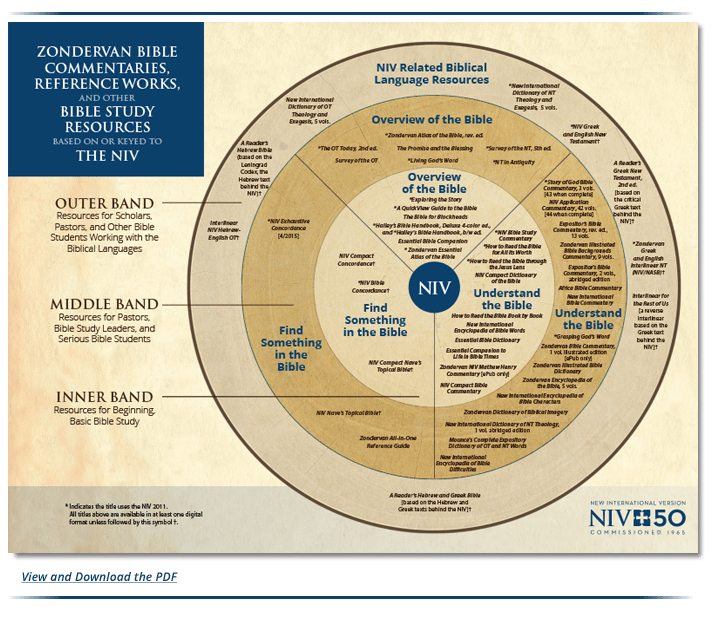
NIV Wheel Graphic


Whether it was for summer camp or Bible quizzing, I grew up memorizing the (1984) New International Version. And, yes, I’m still quite fond of the unfortunately discontinued TNIV. Now Zondervan no longer publishes the 1984 NIV, nor the TNIV–instead, the 2011 update to the NIV is the current version.

You might not realize that the NIV is 50 years old this year. Here’s a recent press release:

In 1965, the Committee on Bible Translation took on the most massive translation project of modern times: to prepare a contemporary English translation of the Bible from the best available original manuscripts. Since its release in 1978, the NIV has become the world’s most read and most trusted modern-English Bible translation with over 450 million copies distributed worldwide. Upon the 1978 release of the NIV, readers were ecstatic that they could finally understand the Word of God in contemporary language.

This anniversary got onto my radar screen when I came across the new NIV 50th anniversary app. What I didn’t know till the other day is that the NIV Study Bible is the best-selling study Bible in the last 30 years.

Here’s a video with some recognizable names discussing the work of the Committee on Bible Translation, who produced the NIV:


You can read more about the NIV here.


Disclosure of Material Connection: A Zondervan rep approached me with an invitation/encouragement to post about the NIV, and offered to send an NIV Study Bible. I plan to post about that in due course, too, once I receive it. While I do appreciate the 2011 NIV over the 1984 NIV in a number of ways, said “Material Connection” has not diminished the place in my heart that the TNIV will always have.

Big-Time Deals on NIV Application Commentaries (NIVAC) in Accordance, Logos, and Olive Tree

NIVAC Accordance sale


Zondervan’s NIV Application Commentary series is on mega-sale, with each of the ebooks selling at $7.99 in Accordance, Logos, and Olive Tree.

I really liked Psalms vol. 1 in this series. The Genesis, Luke, and Galatians volumes were stand-by commentaries when I preached through those books, too.

Here is where you can find more details on the sale, which Zondervan rarely offers in any other e-format than Kindle:

Accordance // Logos // Olive Tree

NIV Application Commentaries, As Low as $4.27 Each

NIVAC sale


Zondervan’s NIV Application Commentary series is on sale, with each of the ebooks selling at $4.99–or less on Amazon.

I really liked Psalms vol. 1 in this series. There are a lot of really good volumes in NIVAC; I just picked up Genesis (now that I’m almost done preaching through it this fall-ha!), Peter Enns’s Exodus, and a few others.

All the Table of Contents now are hyperlinked, so navigating via Kindle or iBooks should be relatively manageable. You won’t get the same sort of search power you’d get in Accordance or Logos, but the price is tough to beat.

See everything here on Amazon or here at Zondervan’s page.

Free 45-Page Primer on Revised NIDNTTE

Get the New International Dictionary of New Testament Theology and Exegesis


Zondervan has just released a Revised Edition of its New International Dictionary of New Testament Theology and Exegesis (NIDNTTE).

From Zondervan:

This new revision includes:

  • Vital insights on over 3,000 Greek words — every word that ought to be in a New Testament theological dictionary
  • Scholarship on the latest debates over many word meanings
  • A wealth of background on ancient Greek and Jewish literature, shedding light on the NT’s context
  • Streamlined organization makes words easier to find and cross-reference

This thorough new revision of NIDNTTE was completed over eight years. With nearly 800 concepts (covering 3,000 Greek words) you’ll benefit from it far longer.

You can order NIDNTTE here. The free 45-page primer is available here.

Through the Psalms? 2 Books to Help

Before the mid-50 degree winds blow Psalms of Summer too far back into my homiletical consciousness, I want to highlight two Psalms commentaries I used every week this summer.

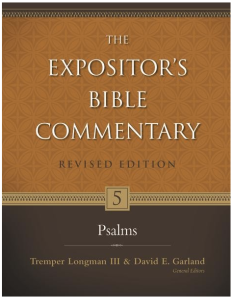
They are Willem A. VanGemeren’s Psalms (Expositor’s Bible Commentary, Revised edition) and Gerald H. Wilson’s Psalms Volume 1 (NIV Application Commentary), both from Zondervan.


1. Revised EBC


Psalms Revised EBC

In the EBC set’s previous edition, Psalms was only available in a larger volume that also contained Proverbs, Ecclesiastes, and Song of Solomon. Now, with some expansions and revisions, it is its own 1,000-page volume.

VanGemeren’s introduction is detailed, offering the kind of thorough but not verbose overview anyone reading or preaching on the Psalms would want. Among other issues, he writes about Psalm types, the formation of the Psalter, theology in the Psalms, and literary/poetic devices–in addition to parallelism, he lists and describes 16 devices.

The typical pattern is for each Psalm to begin with an Overview (covering its themes, structure, authorship, and so on). Then follow “Commentary” and “Notes” for each passage. The Commentary section is verse-by-verse exposition; the Notes include more detailed technical insights, especially delving into the Hebrew text. 22 “Reflections” throughout the commentary offer additional explanation of important themes.

To take just one look inside the commentary, Psalm 13:5-6 in the NIV (1984) reads:

But I trust in your unfailing love;
my heart rejoices in your salvation.

I will sing to the LORD,
for he has been good to me.

Of these verses VanGemeren says:

Though he has experienced deep despair, the psalmist does not give up. His feet did not slip. He held on to the promise of God’s covenant love: “your unfailing love” (hesed). He is not overwhelmed by his troubles, but in his depression he says, “But I trust.” The emphatic “But I” (v.5) is a surprising response from the heart of a depressed person. Because life may be so bitter for some, it is only by God’s grace that the heart of faith may groan, “but I.”


2. NIVAC


Psalms Vol 1 NIVACAs with the Revised EBC volume, the introduction to Psalms Volume 1 in the NIV Application Commentary series (NIVAC) covers good ground: authorship, historical use of Psalms (in temple worship, as well as the move “from public performance to private piety”), poetic conventions, Hebrew poetry specifically (parallelism, use of refrains, acrostics), Psalm headings, and types of Psalms.

Wilson–after an informative historical survey of attempts to categorize Psalms–highlights three “main” Psalm types: Praise, Lament, and Thanksgiving. He also notes other types, like royal Psalms and wisdom Psalms. The introduction spans more than 60 pages and (thankfully) exceeds what one might expect to find in an “application commentary.”

The NIVAC series has as its primary goal “to help you with the difficult but vital task of bringing an ancient message into a modern context.” It employs three sections for each Psalm to (quite successfully) accomplish the aim:

  1. Original Meaning: “the meaning of the biblical text in its original context.”
  2. Bridging Contexts: “to help you discern what is timeless in the timely pages of the Bible–and what is not,” i.e., what applies only particularly to a context and not universally.
  3. Contemporary Significance: the application section, including suggestions for the preacher or teacher or reader of the passage.

The text of each Psalm is printed in full before its commentary, which I appreciated. This first volume covers Psalms 1-72 (Books I and II of the Psalter). The author is as adept in the text’s Original Meaning as he is in Bridging Contexts or discussing its Contemporary Significance. Wilson won’t write your sermon for you, but he gives the preacher or teacher plenty to chew on, both for herself and for her congregation. Especially illuminating in the application section is Wilson’s Christological read of many Psalms.

Here are just two examples of the kind of edifying insights that fill Wilson’s NIVAC volume:

1. He notes the walk…stand…sit progression of Psalm 1, and does so with a nice turn of phrase:

The order of these verbs may indicate a gradual descent into evil, in which one first walks alongside, then stops, and ultimately takes up permanent residence in the company of the wicked.

2. When Sons of Korah in Psalm 46 call the congregation to a counterintuitive praise session, they do so in the midst not just of some tragic events befalling God’s people—it’s the complete disintegration of all of life that is the dominant metaphor in these verses. Wilson says that when the Psalm speaks of mountains falling into the sea, this “amounts to a moment of uncreation.”


Praying with Many, Many Others


Wilson puts it well:

Thus, whenever you read the psalms, when you sing them or pray them, you are praying, singing, and reading alongside a huge crowd of faithful witnesses throughout the ages. The words you speak have been spoken thousands–even millions–of times before: in Hebrew, Greek, Latin, English, and a myriad of other languages. As you read or sing or pray, off to your right stand Moses and Miriam, in front of you David and Solomon kneel down, to your left are Jesus, Peter and Paul, Priscilla and Aquila, while from behind come the voices of Jerome, St. Augustine, Theresa of Avila, Luther, Calvin, and more–so many more!


Thanks to Zondervan for review copies of each of the above, given to me with no expectation as to the content or trajectory of my review. Find the Revised EBC volume here (Amazon) or here (Zondervan). The NIVAC Psalms volume is here (Amazon) or here (Zondervan). 

What I’m Reading to Keep My Greek and Hebrew Fresh

To keep my Greek and Hebrew active, right now I’m alternating between two books (and enjoying them both):


Prepositions and Theology


Murray J. Harris’s Prepositions and Theology in the Greek New Testament (Zondervan, 2012).

Without accepting a so-called “theology of prepositions,” Harris’s guide is readable and illuminating. I found his exegetical guide to Colossians and Philemon quite helpful. Here is a sample of Prepositions and Theology.


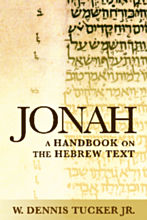
Jonah Handbook on Hebrew Text


W. Dennis Tucker Jr.’s Jonah: A Handbook on the Hebrew Text (Baylor University Press, 2006).

I like this series already. I’m halfway through Jonah and finding Tucker’s handbook a welcome companion.

I’ll post a review of each when I finish.

Scot McKnight’s Sermon on the Mount Commentary, Reviewed

SGBC SMount


My mild obsession with the writings of Dietrich Bonhoeffer can be traced back to a question I asked myself and the congregation with whom I worship in early March: How can Ukraine love its Russian occupiers? And what would Bonhoeffer suggest?

The questions came from my wrestling through Matthew 5:38-48, which I find the be the most difficult passage in the Sermon on the Mount. I concluded, in part,

What seems a fairly straightforward statement, “Love your enemy,” is difficult. What does it mean to love enemies? In what spheres must that take place, and how should it happen, especially in the presence of an inordinately powerful evil? How categorical is Jesus in his forbidding of force? Was he speaking to disciples, or to disciples and states?

You can see how I landed (at least in a sense) at the end of this post.


Enter Scot McKnight


Scot McKnight’s Sermon on the Mount (The Story of God Bible Commentary, Zondervan, 2013) helped me wrestle through the difficult question of just what it means to “turn the other cheek.” While some interpreters (such as Luther) have sought to distinguish between private (interpersonal) and public (political) applications of this text, McKnight responds: “Utter nonsense.” Instead:

One of the main thrusts of the ethic of Jesus is the radicalization of an ethic so that we live consistently, from the so-called “private” to the “public” spheres. There is for Jesus no distinction between a secular life and spiritual life: we are always to follow him. His ethic is an Ethic from Beyond. But others, in words not so wrongheaded as Luther’s, have continued Luther’s personal vs. public or spiritual vs. secular distinction when it comes to ethics.

Jesus, McKnight persuasively argues, was not distinguishing between how the disciples should live in their private lives (whatever that would have meant) as opposed to in public. “The question every reader of the Sermon must ask,” McKnight goes on, is:

Does that world begin now, or does it begin now in private but not in public, or does it begin now for his followers in both private and to the degree possible in the public realm as well?


A New Commentary Series: SGBC


The Story of God Bible Commentary is a new series, with McKnight’s volume and Lynn Cohick’s Philippians volume being the first two published. As the name implies, the series is concerned to interpret and apply Scripture with an eye to how each passage relates to the larger biblical story:

We want to explain each passage of the Bible in light of the Bible’s grand Story. The Bible’s grand Story, of course, connects this series to the classic expression regula fidei, the “rule of faith,” which was the Bible’s story coming to fulfillment in Jesus as the Messiah, Lord, and Savior of all.

There are three primary sections in each passage:

1. Listen to the Story. With the assumption that “the most important posture of the Christian before the Bible is to listen,” the SGBC series begins with the full text of the passage under consideration (using the 2011 New International Version). The section also includes an introduction to the passage.

2. Explain the Story. From historical background to cultural context, from theological explanation to individual word studies, here is where SGBC unpacks “a sound and living reading of the text in light of the Story of God in the Bible.”

3. Live the Story. This is the “digging deeper” into “our world” section. The commentary series is not geared for an academic audience, which allows authors to spend more time imagining 21st century applications of a passage to life. This is especially helpful for preachers and anyone wanting to know how to live out a passage they are studying.


“Better People” or “Better Liars”?


McKnight wastes no time in convicting the reader, much as the Sermon on the Mount itself does. Just before the introduction he quotes Bonhoeffer, who says of the Sermon:

Its validity depends on its being obeyed.

And here’s Dean Smith, via McKnight:

The Sermon on the Mount has a strange way of making us better people or better liars.

(Ouch! But so true.)

McKnight agrees that the incongruence “between Jesus’ vision and our life bothers many of us.” Various interpretive attempts, he suggest, have made Jesus say what he did not really say. By contrast:

There is something vital—and this is a central theme in this commentary—in letting the demand of Jesus, expressed over and over in the Sermon as imperatives or commands, stand in its rhetorical ruggedness.

Jesus intended the Sermon on the Mount as “the claim of Jesus upon our whole being.”

So you can’t just read this commentary in a detached way or use it for dry or “objective” research (as if there were such a thing!). Throughout the commentary McKnight helps the reader hear Jesus’ demanding (yet life-giving) message in resounding terms.


McKnight on Jesus and Ethics


The commentary’s introduction has a substantive (and surprisingly helpful) section called, “The Sermon and Moral Theory,” where McKnight compares “Jesus’ moral vision” to other moral theories, whether Aristotle’s virtue ethics, Kant’s categorical imperative (deontology), or Bentham and Mill’s utilitarianism.

McKnight presents Jesus’ ethics through the conjoining lenses of:

  • “Ethics from Above”—Jesus speaks as God
  • “Ethics from Beyond”—”kingdom ethics” that seek to bring “God’s future to bear on the present”
  • “Ethics from Below”—based on human “inductive observation”
  • An ethical theory that is “messianic, ecclesial, pneumatic”—in Jesus’ “messianic vocation,” he believes that “an ethic can only be lived out in community (the kingdom manifestation in the church) and through the power of the Spirit now at work.”

The introduction offers no structural outline of the Sermon on the Mount. There is just a paragraph about its structure, saying that the matter is “incapable of any kind of firm resolution.” So the omission of an outline seems deliberate, but at least something preliminary would have helped–even a Table of Contents that shows the pericope divisions/commentary chapters at a glance, which this volume lacks.


The Commentary Proper


McKnight breaks the Sermon into 23 chapters in his commentary proper (chapter 1 treats both the very first and very last verses of the Sermon on the Mount together). Each chapter prints the full biblical text (it’s nice to have everything in one place), then proceeds with the sections noted above: Listen to the Story, Explain the Story, Live the Story. His experience in teaching and ministry is obvious throughout the book, which is a refreshing balance of deep exegesis, lucid prose, and convicting application.

To look briefly at just one passage, Matthew 7:12 says:

So in everything, do to others what you would have them do to you, for this sums up the Law and the Prophets.

McKnight writes:

Of the many ways to describe or articulate the Torah, two are pertinent in our text: one can either multiply laws so as to cover all possible situations, or one can reduce the law to its essence.

The verse, which he sets in biblical and rabbinical context, “summarizes the essence of the Sermon” (emphasis in original). And it has much to say to how we ought to live now:

But the Golden Rule is of direct value in relationships in churches. It takes but a moment’s thought to think it through: How do I want to treat others? How would I want to be treated?

*****

This is a fantastic commentary. It’s smart, well-researched, deep, engaging, challenging, and–perhaps best of all–like the Sermon it addresses, issues a clear call to righteous living according to God’s will.


Thanks to Zondervan Academic for the review copy, offered for the purposes of an unbiased review. Find it at Zondervan here or Amazon here.

Zondervan Theology Collection (Logos Software) Giveaway

Logos Zondervan TheologyWant to enter for a chance to get some free theology books? These ones won’t even take up shelf space. I’m joining with a few other bloggers and Logos Bible Software for a giveaway of Logos’s Zondervan Theology Collection.

What’s Up for Grabs

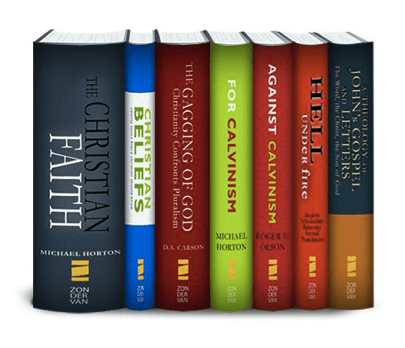
The collection can be found here. It includes these books:

How to Enter the Giveaway

Logos will choose the winner at random on August 1, with the collection sent to that person’s Logos account. If you don’t have a Logos account, you can register for free here. An iOS app for Logos (and other mobile apps can be found here, also free.

To enter, log in below using either your email address or Facebook account, and the Punchtab widget walks you through the rest. You can choose which methods of entry to use. Each prompted action is its own entry.

Logos has this disclaimer: By entering this giveaway you consent to being signed up to Logos’ “Product Reviews” email list.  (This just means you’d get emails with Logos-related content written by bloggers such as yours truly.)

UPDATE: WordPress doesn’t want to show the Punchtab widget for some reason. For now you can enter here.

Hearing the Message of Scripture: Obadiah, Reviewed

HMS Obadiah by Block

At less than 400 Hebrew words, Obadiah is shorter than many Words on the Word blog posts, including this one. But its literary and rhetorical sophistication is by no means lessened by its length. Obadiah is the prophetical incarnation of the axiom, “Brevity is the soul of wit.” Or, in Obadiah’s case, “Brevity is the soul of calling out Edom and declaring God’s restoration of Jacob.”

Earlier this year Zondervan published the first two volumes of a new Old Testament commentary series, Hearing the Message of Scripture (HMS). If you want a brief overview of the series, I’ve posted about it here. Daniel I. Block is author of Obadiah: The Kingship Belongs to YHWH, as well as the general editor of HMS. I’ve had a chance to carefully work my way through the inaugural Obadiah volume, and review it in this post.

Block’s Introduction to Obadiah

The Introduction consists of three primary parts:

  1. Historical Background to Obadiah’s Prophecies–outlining some options for dating the book’s composition, as well as describing the historical setting of Obadiah’s oracles.
  2. Obadiah’s Rhetorical Aims and Strategy–the largest section in the introduction, with an excellent definition of “prophet,” as well as the idea that “Obadiah’s rhetorical aim was to rebuild his audience’s hope in the eternal promises of God.”
  3. The Structure of Obadiahhere Block outlines the book, the “climax” of which is highlighted by the “marked structure” of verse 17a (“But on Mount Zion there shall be an escape…”).

Block later summarizes Obadiah’s style as “terse elevated prose, the style being chosen for maximum rhetorical effect.” After “the climax” of verse 17, the final verse 21 “brings his proclamation to a triumphant conclusion.”

Particularly useful in the introduction was this diagram of the arc of the book, to which I frequently found myself referring:

Block's Plot Summary of Obadiah
Block’s Plot Summary of Obadiah

The Commentary Proper

Hearing the Message of Scripture intends to help its readers “to hear the message of Scripture as biblical authors intended them to be heard.” Obadiah is typeset and laid out quite a lot like Zondervan’s Exegetical Commentary on the New Testament series (which I’ve reviewed–several volumes–here). Each passage of Obadiah includes this treatment:

  1. Main Idea of the Passage–a short paragraph overview, good for getting bearings on what the prophet is trying to do.
  2. Literary Context–Block explains the overall flow of Obadiah here and how the passage under consideration fits within the book. This might be the best section in the commentary.
  3. Translation and Outline–the author’s original translation and spacing of the text.
  4. Structure and Literary Form–this looks especially at the rhetorical aims of Obadiah in a given passage.
  5. Explanation of the Text–the longest section of each passage, and the bulk of the commentary.

Block divides the commentary into five “chapters” (8-14 pages each) that follow the five sections of his structural outline.

A good example of the kind of rhetorical analysis Block does appears in his comment on the first verse of Obadiah:

Obadiah’s preference for the name Esau reflects his rhetorical concern. As noted, he is not interested in the political history of Edom or Edom’s economic standing among the nations. To him Edom is a person, the brother of Jacob (vv. 10b, 12a), who shares a common ancestry in the first two patriarchs, Abraham and Isaac, but whose history of violence against his twin brother will finally be answered.

And again, on verse 5:

Obadiah’s penchant for cutting of a thought by inserting an erratic mid-sentence is also evident in v. 5c, “How you have been destroyed!”

One thing I really appreciated about the commentary is Block’s sense of the larger literary context of Scripture. He keeps the parallel Jeremiah 49 in view throughout the commentary, as well as other prophetical literature like Ezekiel and Daniel. Block helps the reader see how Obadiah fits into the larger sweep of the Hebrew Bible. Especially noteworthy is his elaboration of what other prophets in the Hebrew Bible had to say about Edom. As I read the commentary, in other words, I was able to reflect on and learn about much more than just Obadiah.

At the end of the commentary, there is a section called “Canonical and Practical Significance,” in which Block, having worked carefully through Obadiah, draws out some theological implications of the book.

Evaluation of Block’s Obadiah

A few observations, by way of evaluation:

The footnotes serve as an excellent source of references for a given word’s use elsewhere in the Old Testament. Footnotes also keep other versions such as the Vulgate and Septuagint in view.

I found the transliterated Hebrew throughout the book to be distracting. The ZECNT, which in many ways is the NT counterpart to this HMS series, does not transliterate its Greek. It also includes the full Greek text of the New Testament book under consideration, verse-by-verse, so it would have been nice to have had the full Hebrew text of Obadiah reproduced here, as well.The Series Introduction does note that “electronic versions of this commentary series will also include the Hebrew font.”

One intangible I appreciated–the margins are nice and roomy for notes. (I made quite a few to help me process Obadiah as I read.)

In an excellent commentary that is hard to fault for much else, it has an unusually large amount of typos. Many of these occur when the same verses from Obadiah are not consistently translated when they occur in multiple spots in the commentary. I heartily recommend this volume, but would suggest that those interested perhaps wait until the second printing, when corrections can be made.

Though this series aims to focus more on the rhetorical features of Obadiah, there is a good focus throughout Obadiah on the Hebrew syntax. My grammatical knowledge of Hebrew increased just by reading this commentary.

I didn’t fully agree with Block’s interpretation at every turn, but even in such instances I generally found his arguments to be reasonable and well-argued.

Bottom line: this is a really good commentary, and I like this series a lot so far. Even with its lexical, grammatical, and rhetorical details, Hearing the Message of Scripture: Obadiah is an engaging and page-turning read. Block explains the challenging book of Obadiah well at every turn. There are other good commentaries on Obadiah already in print, but pastors especially should start here, and academicians, too, will want to make sure to pick this book up.

You can look at the volume yourself–a sample PDF of Obadiah is here.

I am grateful to Zondervan for the gratis review copy of this commentary, which was offered for an unbiased review. You can find the book on Amazon here. The Zondervan product page is here.