Would Mark’s Jesus have us handle snakes and drink poison? (part 1 of 2) (BibleWorks 9 review, continued)

First century snake handler?

Many believe that Mark’s Gospel ends rather abruptly at 16:8 (“for they were afraid”), but others have found it difficult to think of a Gospel ending with Jesus’ followers’ being afraid to say anything to anyone about the resurrection.

So there is the so-called shorter (add-on) ending of Mark, which adds to the above, “…the sacred and imperishable proclamation of eternal salvation” (RSV). This has 10 words that otherwise appear nowhere else in the book.  In my view the vocabulary and style of the shorter ending do not seem to fit well with the rest of the Gospel, and have the feel of an effort to give the book closure well after the fact of the writing.

Then there is the so-called longer ending of Mark, which is also not satisfied in ending with his followers’ fear. This records Jesus’ appearance to some of his followers, as well as the commissioning of his disciples, including the hard-to-understand reference to picking up snakes and drinking poison.

Mark could well have ended with “For they were afraid”–Mark is not unknown for being abrupt—nor would he have a problem upbraiding (or reporting Jesus’ upbraiding) people for their lack of faith or for their fear.  But would someone who started so positively with a proclamation of Jesus as “Son of God” in 1:1 have truly ended on such a dour note?  One possibility is that Mark’s original ending was lost.  R.T. France says, “It is one thing to emphasise and exploit paradoxical elements within the story of Jesus’ ministry and passion, as we have seen Mark doing again and again, but quite another to conclude his gospel with a note which appears to undermine not only his own message but also the received tradition of the church within which he was writing” (683).

Of course, lacking evidence of such a “lost” ending means that to postulate one is speculative, and it is perhaps a wiser hermeneutic to accept the text as we have it to be the intended one.

Can BibleWorks help here? One of the major new features in BibleWorks 9 is the BibleWorks Manuscript Project. From the BibleWorks site:

This massive project has been years in the making. BibleWorks 9 includes the first installment of this ongoing work. The BibleWorks Manuscript Project’s initial release covers the following:

  • Sinaiticus
  • Vaticanus
  • Alexandrinus
  • Bezae
  • Washingtonianus
  • Boernerianus
  • GA1141

For these manuscripts, the BibleWorks Manuscript Project includes the following:

  • New full NT transcriptions
  • Complete NT digital image sets (over 7.5 GB!!)
  • Verse location tagging in images
  • Extensive transcription notes
  • MSS comparison tool
  • Morphological tagging (not complete for all manuscripts but updates will be provided free of charge to BibleWorks 9 users as they become available)

Manuscripts are fully searchable and integrated with the full array of BibleWorks analysis tools. As you change verses in BibleWorks, the MS image display tracks with the current verse. Compare, inspect, and analyze the text and images of key original manuscripts. Tweak and enhance the manuscript images using the sophisticated image processing panel now included in BibleWorks.

Before I could even get into the manuscripts, there were two ways BibleWorks immediately helped me to explore this issue. First, with my NET Bible notes open in the Verse Tab (which I review here), I see a nice, lengthy note that explains the options–with manuscript evidence–for Mark’s possible ending. (You can see the NET note itself by clicking on footnote 9 here.) That much I’ve come to expect from BibleWorks.

What pleasantly caught me by surprise was that the NET note mentions a section in Wallace’s Greek Grammar that discusses the grammar of the contested snake-handling verses. I quickly and easily navigated over to the “Resources” tab in my analysis window and looked it up (click for larger image, or open in a new tab):
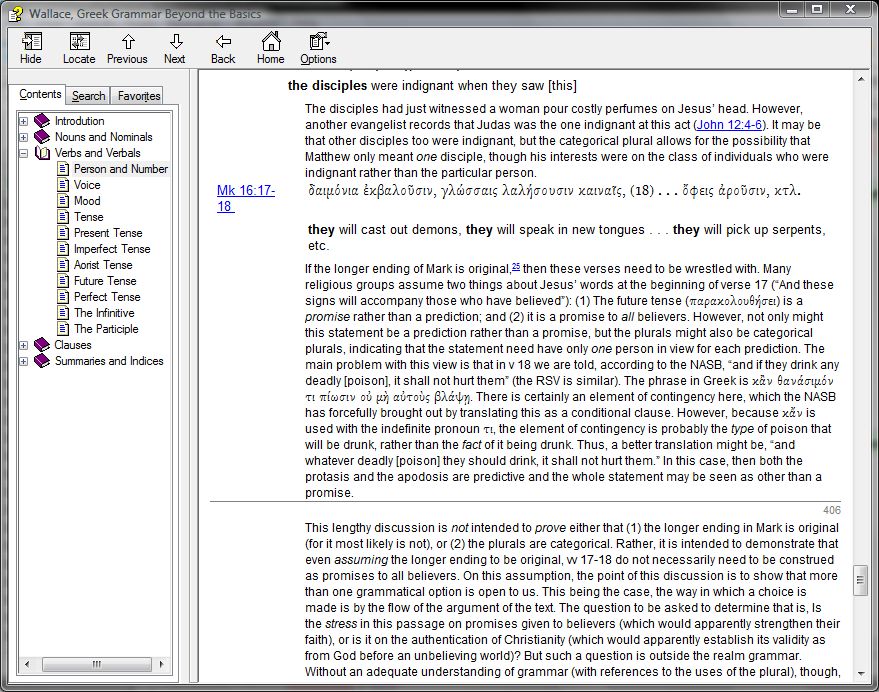
Wallace’s grammar is free with BibleWorks, a nice bonus. And it’s set up so that as you’re working your way through a text, Wallace tracks with you, so you can easily look up what he has to say about a given verse or grammatical topic.

Already some great help from BibleWorks in exploring a difficult textual issue. In my next post, I’ll use BibleWorks to get into the Mark manuscripts themselves, exploring the possible endings of the Gospel of Mark.

See all that’s new in BibleWorks 9 here.

I received a free upgrade to BibleWorks 9 in exchange for an unbiased review. See my prolegomenon to a review here, part 1 (setup and layout) here, and part 2 (the Verse tab) here. You can order the full program here or upgrade here. It’s on Amazon, too.

My 4-year-old son reviews Zoom, Rocket, Zoom!

5, 4, 3… liftoff! It says, “Whoo-oom!”

The astronauts are flying in the rocket ship. They’re in orange shirts. And they have space helmets on, and one is dark-skinned, and one is light-skinned. And there’s two seats, even cords, even channels to see how fast they go.

Lunar landers–they shoot flying out on the side to get it landing. And one big one on the bottom, one big spike, two big spike, three big spike, four big spike, five big spike, six big spike, seven big spike. And three on one of the shooters.

The earth’s right by kind of a circle of stars, and the lunar lander is right by this astronaut that’s going “Byoo!” He’s not really saying something; that’s just how he’s flying. “Byoo!” means he’s going, like jumping. This astronaut is digging, even working in space. Even there’s 1, 2, 3, 4, 5, 6, 7, 8, 9, 10 bumps here and 1, 2, 3, 4, 5, 6, 7, 8, 9, 10, 11, 12, 13, 16… 16 lumps over here!

“Moon buggies are good at roll, roll, rolling,” as they travel in space. Space rockets are good at–bam!–flying.

Rocket ships are good for playing, eating, and typing, and sleeping and good for “weightless somersaulting.” [laughs] That’s so funny!

Astronauts are “good at space walking… almost dancing.” Space satellites fly around in circles, around planets.

There’s wheels, some lumps… and the stars. And the machine driving around on the Mars.

The moon buggy’s rolling around, and it’s right by the lunar lander.

The end.

This book is good because it has astronauts in it, and every age should read it… even grown ups. Every, every, every person. Even you!

Find more about Zoom, Rocket, Zoom on Amazon. Read the rest of my 4-year-old son’s reviews here.

In which I finally try out Accordance Bible Software for Mac (new version 10!)

I have been an avid and happy BibleWorks user since version 7 (they are now in version 9). But my first computing love is a Mac. (Too bad for expensive taste in that regard!) I have a cheap PC laptop at home on which I run BibleWorks, but have been interested in exploring Accordance for some time. Now, thanks to the kind folks at Accordance who have given me a copy for review, I can take Accordance for a spin.

I apparently got into Accordance at just the right time. This week they launched an upgrade from Accordance 9 to Accordance 10. And it looks like users are pretty happy with the switch.

In a series of posts, I will offer my review of Accordance 10, Original Languages Collection. In this post I report on my installation process and initial impressions as to the program’s layout and interface.

Download and installation was mercifully fast, even over a wireless Internet connection. In 30 minutes or so I was able to download the Accordance application to my computer and the Original Languages Collection with its various modules.

I appreciated the flexibility offered me even in the initial setup. For example, I could make choices at the following spots:

(Although, I confess, I don’t know what “Helvetica Neue Light” looks like off the top of my head! No matter–this can always be changed later.) This next option for text formatting immediately endeared me to Accordance:

These are perhaps little things, but Accordance’s customizability seems obvious from the beginning.

The only snag I hit in installation was being able to install one of the included modules, even after multiple attempts (the BHS Latin Key). Although, taking a look at the forums, I’m not alone. I expect the Accordance team is mighty busy with the new release. Accordance 10 is already in 10.0.1. I don’t think this is a sign of a buggy version released too soon, but rather an indication that the folks behind the software are quick, responsive, and eager to improve upon the program.

Once finishing installation, I played around a bit with my resources, and within just a few minutes and no prior knowledge of Accordance, was able to set things up this way (click image for larger or open in new tab):

On the left you can see my “library” which in this view shows some of the texts that come with the Original Languages Collection. Thing of beauty: it has the New English Translation of the Septuagint. With how often I am in (and blogging about) the Septuagint, this makes me happy to see. The NETS is far from a perfect translation, but it’s the best English translation on the market right now.

In the middle you can see I have the Greek of Genesis 1 open, with the NETS right next to it and the IVP New Bible Commentary on the right of the middle section.

Then in the top right corner I opened the LEH Greek-English Lexicon of the Septuagint, available in previous Accordance versions only as a paid, add-on module (from what I understand). The bottom right corner shows the Hebrew text of Genesis 1.

Each of these boxes/windows are changeable and rearrangeable. I look forward to spending more time exploring the various configurations available to me through Accordance.

In sum: A quick, easy install with just that one hiccup of a missing module–soon to be resolved with a released fix, I’m sure. (UPDATE 8/23/12: It’s fixed!) And the layout and its flexibility has really impressed me on first use.

And, oh. The interface? Absolutely stellar. I love seeing a high-powered Biblical languages-oriented program native to a Mac. The interface in Accordance is as smooth as any program I’ve ever seen from Apple.

So far, so good.

UPDATE: Parts 2 and 3 of my review are here and here.
UPDATE 2: Here is part 4, a review of the Original Languages Collection.
UPDATE 3: Here is part 5, “Bells and Whistles.” UPDATE 4: part 6, “More Bells and Whistles.”

A New Reader’s Lexicon of the Greek New Testament, Reviewed

Unfamiliar vocabulary proves to be an enduring challenge for students of New Testament Greek. Even students who understand the rules of the language get bogged down having to look up uncommon words while translating. Nevertheless the correct interpretation of many passages of Scripture hinges on the meaning of its rare words.

–Michael H. Burer and Jeffrey E. Miller, Preface

Vocabulary acquisition is key to being able to read any language, but so is just reading a text straight through. A “reader’s lexicon” or “reader’s Bible” seeks to bridge the gap so students can both improve their vocabulary and engage in a continuous reading of the text. To that end, Kregel Academic and Professional has published A New Reader’s Lexicon of the Greek New Testament by Michael H. Burer and Jeffrey E. Miller.

But why a new reader’s lexicon when the old one (by Kubo) has been useful to students of the Greek New Testament for so long? That’s been the primary question before me as I’ve reviewed the New Reader’s Lexicon (NRL). Daniel B. Wallace in the preface gives the reasons for this new lexicon:

But as helpful as Kubo was, there were weaknesses. First, it was not updated to the glosses found in the third edition of the Bauer Lexicon (BDAG). Second, there were numerous errors (involving word frequency numbers, omissions of words, inappropriate glosses, etc.) that went uncorrected. Third, the special vocabulary section at the beginning of each book, involving all the words that occurred more than five times in that book but less than fifty times in the New Testament, created its own problems: designed for efficiency of space, it did not prove helpful for efficiency in learning.

While I think Wallace has it right on the first two points, I (sort of) disagree with the third–that list that Kubo offers at the beginning has actually been helpful to me for learning a given book’s vocabulary, since it groups some of that book’s common words together. However, it does mean that words in that beginning list don’t then appear in Kubo’s lexicon throughout the rest of the book. To overcome this, I would make a copy of the list and use it as a bookmark, referring to it often so I didn’t have to keep flipping pages.

Herein lies one area of strength for the New Reader’s Lexicon. There is no common vocabulary list at the beginning of each book (users now can generate those easily enough through Bible software), but it means that every word that occurs less than 50 times in the New Testament is in this lexicon… in the verse in which it appears. So as I’m beginning my way through Mark 6, I can look in the NRL to quickly see that ἐκεῖθεν in verse 1 means “from there.”

To Wallace’s first two points, that the NRL uses the updated BDAG is a great relief–readers now don’t have to guess whether recent advances in lexicography or discoveries of new papyri mean that the word in front of them actually has a slightly different nuance. The NRL updates Kubo here well.

In addition to “concisely defin[ing] in context” each word, the NRL gives statistics for how many times that word appears. (Names and proper nouns are included.) There are up to three numbers listed:

  • How many times the word appears in that given book of the New Testament
  • How many times that word appears “in all canonical works by the traditional author of the book at hand”
  • How many times the word appears in the whole NT

Kubo had the first and third numbers. This second statistic now allows me to see not only how many times ἀνάθεμα appears in 1 Corinthians (twice) and in the NT (six times), but it tells me that five of the six uses of this word in the NT are with Paul.

And here’s where the lexicon is unique and really stands out–in the instance of such a rarely occurring word, it lists cross references, so I can quickly see that the other use of ἀνάθεμα in I Corinthians is at 16:22and that Paul also uses the word in Romans 9:3, Galatians 1:8,9, and that the only non-Pauline NT occurrence of the word is at Acts 23:14.

The NRL truly does improve upon Kubo’s lexicon. It accomplishes its mission quite well.

But don’t take my word for it. I’ve found that what original language resources to own and invest in is often a matter of personal preference and what works best for an individual. If you’re still on the fence about this resource, download a free sample of the lexicon for Colossians here (pdf). Read through Colossians with it in hand and see how it goes. Personally I’ve found this to be an indispensable resource for making my way through the Greek New Testament.

One huge bonus: the book is designed well. The pages are smooth and thick and bright. The font is clear and easy to read. And the binding is sewn! This means it will stand the test of time well, which you’d hope a reference work like this would.

My thanks to Kregel Academic for providing me with a review copy of this book. Find out more about the book at Kregel’s site or look inside on Amazon.

Creation… Fall… Redemption… Consummation. (Another one hour worship service from scratch)

On Sunday I led a group of student ministry leaders in worship for an hour. As in the time I described in this post, it was a one hour worship service from scratch. In other words, I was invited to plan and lead the hour of worship from start to finish. In my previous post I mentioned one way to give shape to what otherwise could be unstructured worship, using the A.C.T.S. acronym.

Here’s how I opted to structure the hour together with this same group this year. This is a version of the run sheet the worship musicians and I had before us.

Intro: Creation, Fall, Redemption, Consummation

  • What it is: way of understanding the whole sweep of the Bible (explain each part briefly)
  • Why it’s important: tells us God’s story—and our place in it.  Situate selves at start of new year.
  • We’ll weave between Scripture and Song and Prayer, standing and sitting, together and alone

Creation

Fall

Redemption

Consummation

  • Scripture: Revelation 21:1-5
  • And so our prayer, “Make all things new” is finally answered.
  • Moment of silence to reflect on “I am making all things new.”
  • Song (standing): Grace Like Rain

Conclusion: Close in prayer

Reviews of various Hebrew, Aramaic, and Greek books, commentaries, and software

I’ve now reviewed enough Biblical languages textbooks, lexicons, commentaries, and other resources, that I thought it was time to put them together all in one place. Grouped by language and title, with hyperlinks to each review, here are the language resources reviewed-to-date at Words on the Word. I plan to keep this page updated for future reviews, so feel free to bookmark it.

Hebrew

Aramaic

New Testament Greek

Septuagint Greek

Other Biblical Commentaries

Bible Software

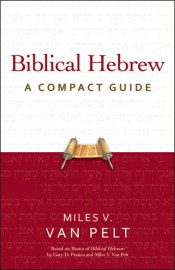
Review of Biblical Hebrew: A Compact Guide

At long last, a compact reference guide to Biblical Hebrew!  Not long ago Zondervan released Biblical Greek: A Compact Guide, a helpful and portable distillation of Mounce’s oft-used grammar. Many such little books already exist for easily reviewing Koine Greek: Dale Russell Bowne’s Paradigms and Principal Parts for the Greek New Testament, Paul Fullmer and Robert H. Smith’s Greek at a Glance, and even the back of Kubo’s Reader’s Lexicon has a good summary of Greek grammar with paradigm charts.

There seem to be more resources available to students of Biblical Greek than to students of Biblical Hebrew.  For example, while there is just one (excellent!) “Reader’s” Hebrew Bible (uncommon vocabulary is glossed at the bottom of the page), I am aware of at least three Reader’s Bibles that exist for the Greek New Testament.  So Miles Van Pelt’s Compact Guide, based on his and Gary Pratico’s Basics of Biblical Hebrew, is a welcome addition as far as this eager Hebrew student is concerned.

The book is not terribly dissimilar from Pratico/Van Pelt’s Charts of Biblical Hebrew, but unlike that work, A Compact Guide is more than just a collection of charts and paradigms.  Each section includes a distillation of what is in the larger grammar textbook, followed by paradigms and charts for quick reference. Seeing Van Pelt’s world-famous color-coded verbal diagnostics is a highlight.

Oddly enough, at times there seems to be more precision and detail in this little book than in the larger grammar.  Or perhaps it’s just more nuance or smoother grouping of material that has come about with the passage of time since the publishing of the grammar’s second edition. For example, there is a section in the Compact Guide on “particles” that is a unique and clearer grouping than what is in the larger grammar. And whereas the grammar lists three kinds of Hebrew prepositions (independent, Maqqef, and inseparable), the Compact Guide adds a fourth: compound prepositions, where “two different prepositions, or a preposition and a noun” (28) combine to make a new preposition. (This fourth category appeared in the larger textbook later in its chapter as “Advanced Information”; having everything grouped together in the Compact Guide was easier.)

The primary focus of the guide is morphology (how words are formed, including paradigm charts) and syntax (how words are used in sentences, i.e., grammar).  Unlike Basics of Biblical Hebrew there is not much in the Compact Guide by way of vocabulary, save for a Hebrew-English mini-lexicon at the back of the book.  Unfortunately, there was no explanatory note as to what constituted inclusion on the lexicon.  (In Mounce’s Greek Compact Guide, the lexicon notes that it includes words that occur in the New Testament 10 times or more.)

From what I can tell, though, the Hebrew Compact Guide reproduces exactly the Hebrew-English lexicon in its larger textbook counterpart. In this case, the lexicon covers Hebrew words that occur 50 times or more in the biblical text. The Basics of Biblical Hebrew lexicon notes that it also adds “less frequently occurring words that appear in the grammar and workbook.”

In addition to a thorough listing of paradigms (the 11-page section on pronominal suffixes is particularly helpful), the book is filled with examples from the Hebrew Bible (with English translation).  The Hebrew font used, while not quite as easy to read as that of the grammar, is readable enough. (And that may just be a matter of personal preference anyway.)

The section on verbs is a particular strength of this work–in addition to examining all the forms and stems (both strong and weak), there are extensive listings of paradigms for easy review.

All in all, I give a hearty two thumbs up to this work–and express my gratitude that it is now on the scene for those who want to keep their Biblical Hebrew fresh!  For a beginner in Biblical Hebrew I would recommend the full-length grammar textbook, but for those with even a semester or two of Hebrew (and beyond), this small reference guide will be a valuable and inexpensive addition to their library. As Van Pelt notes in his preface, even “veterans” of Hebrew will be able to utlize the guide to “keep fit” in their language use.

Icing on the cake: the pocket-sized paperback comes encased in a sturdy, translucent plastic cover.

You can preview the book here.

Note: I received a review copy from Zondervan for the purposes of this review. I had initially reviewed a digital galley version of this book through Net Galley. The above reproduces my galley review, checked now against the hard copy for accuracy.

Words on the Word Weekend Recap

Here’s a Words on the Word weekend recap. Friday the 17th through Sunday the 19th at WotW had the following:

Kids’ takes on things: My 4-year-old son reviews Duck Soup / Little kids review Radiohead’s “Paranoid Android” (VIDEO) / Calvin’s macabre snowmen

Abram’s take on two five-star books: James (Zondervan ECNT), reviewedBasics of Biblical Aramaic

Cool stuff: Oldest known Septuagint fragments (interactive picture)